


You hand your portfolio to Betterment so you never have to think about rebalancing again, and you pay 0.25% a year for it. Or $5 a month. Either number sounds small enough to ignore, and that’s the whole problem. You never write a check for a percentage fee. It’s deducted automatically, calculated on the whole balance, so the dollar amount doubles every time your balance does while the work behind it stays the same.
Put $100,000 in and the advisory fee, plus the expense ratios of the funds it buys for you, comes to roughly $280 to $420 a year. Leave it there for twenty years at an assumed 6% return and that automation has cost you about $18,100 in forgone compounding, against holding the same funds yourself.
Stay under $24,000 without recurring monthly deposits totaling $200 or more, and you’re billed the flat $5 a month instead. On a $5,000 balance that works out to 1.20% a year, nearly five times the percentage rate. Plenty of account holders can’t say which of the two modes they’re in, and the cheaper one is often a single setting away.
So I went looking for what this account really costs, and what it gives you back. This Betterment review takes a side, and it ends on a decision rather than a shrug.
1. What Betterment is, and what the automation actually does
So who’s actually on the other side of a Betterment account? I went looking before I checked a single fee, and it isn’t one company. It’s a stack of them, each doing one job.
1.1 Who advises you, who holds your securities, and what you can open here
The paperwork answers it. The adviser is Betterment LLC, registered with the Securities and Exchange Commission (SEC) under number 801-70171. Betterment Securities holds the brokerage account and belongs to both the Financial Industry Regulatory Authority (FINRA) and the Securities Investor Protection Corporation (SIPC), while Apex Clearing Corporation clears the trades. Your cash goes out to 26 program banks, Checking is issued by nbkc bank, and individual retirement accounts (IRAs) are custodied by Inspira Financial Trust. Betterment’s own summary: no Betterment entity is a bank.
Its Form ADV filed July 31, 2026 reports $69,524,492,986 under management across 1,344,483 advisory accounts, and 992,194 individual clients hold $46,630,077,847 of that. That’s about $47,000 an account, which tells you who the pricing was built around.
Here’s what you can open.
Table: The account lineup, and what is missing from it
| Account type (tax wrapper) | Offered by Betterment? | Condition |
|---|---|---|
| Individual taxable investing | Yes | The core managed product |
| Joint taxable with rights of survivorship | Yes | Both parties on the platform |
| Roth IRA / Traditional IRA | Yes | Standard IRS contribution limits apply |
| SEP IRA | Yes | Single participant only |
| Inherited IRA | Yes | |
| Solo 401(k) | Yes | Additional $100 annual platform fee |
| Health Savings Account (HSA) | Yes | 0.50% all-in annual fee, via Optum Bank |
| 529 education savings | Restricted | Only through select employers |
| Trust accounts | Yes | |
| Self-Directed Investing | Yes | No advisory fee, no commissions; fund expenses still apply |
| Cash Reserve | Yes | Cash account, not an investment account |
| Checking | Yes | Through nbkc bank |
| Custodial / minor accounts (UTMA/UGMA) | No | Explicitly not supported |
Data current as of August 2026. Solo 401(k) and HSA fees per Form ADV Part 2A, July 31, 2026.
Two rows change decisions. There are no custodial accounts, and the 529 runs only through an employer already using Betterment’s workplace product, so a parent saving for a child can’t do it here. The retirement accounts are all there, including a Roth IRA and a traditional one.
You need a permanent US address, a Social Security number or Individual Taxpayer Identification Number (ITIN), and a US bank checking account. It costs nothing to open and $10 to fund, with 4 to 5 business days to approval and 1 to 3 more for a first transfer. Budget a week, not an afternoon.
1.2 What the fee actually buys: 101 allocations, a 3% drift band and a glide path
The wrappers are ordinary. What the software does inside them is what you’re paying for.
Core gives you 101 possible stock-to-bond allocations. At the default 90% stock setting it holds 48.1% US large cap, 25.5% international developed markets, 8.1% emerging markets and 6.8% US high quality bonds, plus small mid cap, small cap and international bond sleeves. These are ordinary index ETFs anyone can buy, two exchange-traded funds (ETFs) per sleeve, not proprietary products.
Three automations run on top. Rebalancing triggers at 3% drift from target, dividends are reinvested for you, and the glide path moves the stock allocation from 90% down to 30% as your target date approaches.
Betterment also targets about 0.5% of portfolio value in operational cash, roughly $14 a year of forgone return on $100,000. That’s real, but an order of magnitude below the advisory fee.
Then the wrinkle few people mention: Betterment publishes a $50 portfolio minimum before it rebalances at all, so under $50 the account buys funds but the rebalancing you’re paying for never runs.
That’s what the automation does. Knowing that isn’t the same as knowing what it charges.
2. What Betterment really costs, in dollars
Betterment doesn’t have one price, it has two, and which one you’re on depends on a threshold and a habit.
2.1 Two ways Betterment bills you, and the $24,000 hinge between them
The Betterment management fee comes in two forms.
Table: The two billing modes and the $24,000 hinge
| Plan / balance band | Annual fee | Condition |
|---|---|---|
| Digital, $0 to $24,000 balance | $5 per month ($60 a year) | Default billing mode |
| Digital, $24,000 to $1M balance or $200+ monthly recurring deposit | 0.25% a year | Either trigger flips billing |
| Portion of balance $1M to $2M | 0.15% (15 bps) | Automatic |
| Portion of balance above $2M | 0.10% (10 bps) | Automatic |
| Premium (first $1M) | 0.65% | $100,000 minimum eligible balance |
| Premium above $1M | 0.15% / 0.10% tiers apply | The 0.40% Premium increment stops above $1M |
| Self-directed investing | $0 advisory fee, $0 commissions | Fund expenses still apply |
| Cash held at Betterment | No advisory fee | Betterment is paid by the program banks instead |
Data current as of August 2026. Rates per betterment.com/pricing and the Fee Disclosure of May 5, 2026.
Now for the arithmetic on that flat $5. Sixty dollars a year is 6.00% of $1,000, 1.20% of $5,000 and 0.50% of $12,000, and at $24,000 the two modes cost the same. Setting up $200 a month in recurring deposits cuts a $5,000 account’s fee from $60 to $12.50, and that’s a habit that was going to build the balance anyway.
The fee accrues daily on your daily balance and comes out at the end of each month. If there isn’t enough cash, Betterment sells securities, and in a taxable account that sale is itself a taxable event.
One detail people get backwards: Cash Reserve counts toward the $24,000 trigger. But HSA, 401(k), Cash Reserve, Checking and self-directed balances are excluded from the balance that decides the $1 million and $2 million discounts.
2.2 The second layer: the fund expense ratios sit on top, not inside
The advisory fee isn’t the total, and Betterment says so: its pricing states that fund expense ratios are “in addition to our management fees.”
Core’s weighted expense ratio ranges from about 0.03% to 0.17% as of May 31, 2026; the socially responsible variants cost 0.13% to 0.19%. The one number I couldn’t find anywhere is a single weighted figure for a specific allocation, so you place yourself inside a range 14 basis points wide, which is $140 a year apart on $100,000.
Stacked, Digital comes to 0.28% to 0.42% all in and Premium to 0.68% to 0.82%. Here’s the Betterment annual fee in dollars.
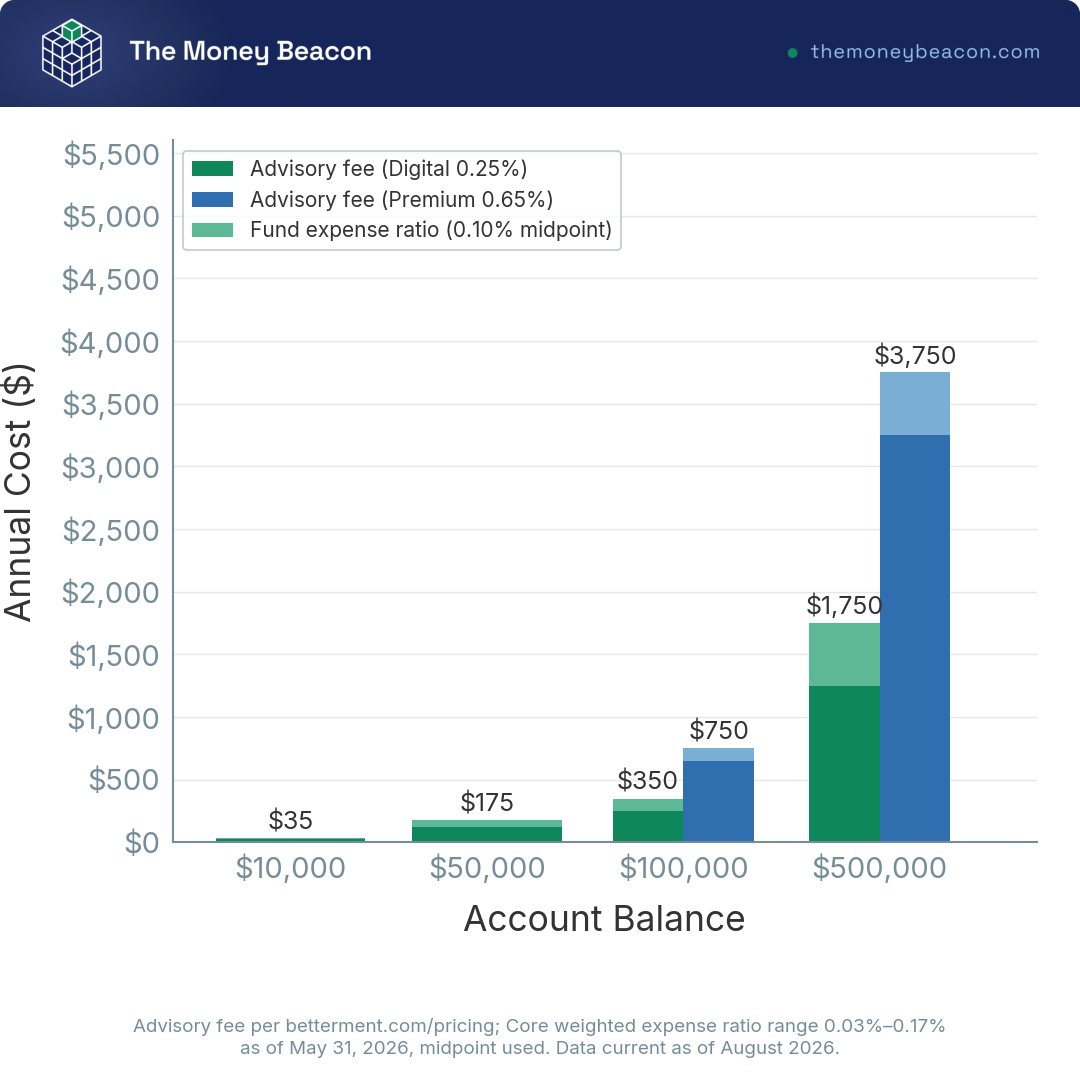
At $100,000 on Digital that’s $250 of advisory plus $30 to $170 of fund expenses, so $280 to $420 a year. At $500,000 it’s $1,400 to $2,100. The fund layer is a rounding error at $10,000 and a real cost by half a million.
Premium’s 0.40% increment adds $400 a year at its $100,000 entry point, and that only means something next to what six real fee-only advisor paths charge for the same access. That increment stops above $1 million, so the Premium surcharge is heaviest exactly where the account is smallest.
2.3 Could you just buy this yourself? The ten and twenty year arithmetic
Which brings us to the fairest test: Betterment vs doing it yourself.
The same global index exposure costs roughly 0.03% to 0.05% in fund expenses in a low-cost brokerage account instead, against 0.35% all in on Digital. Let’s run a single $100,000 lump sum at an assumed 6% gross return, no contributions and no tax.
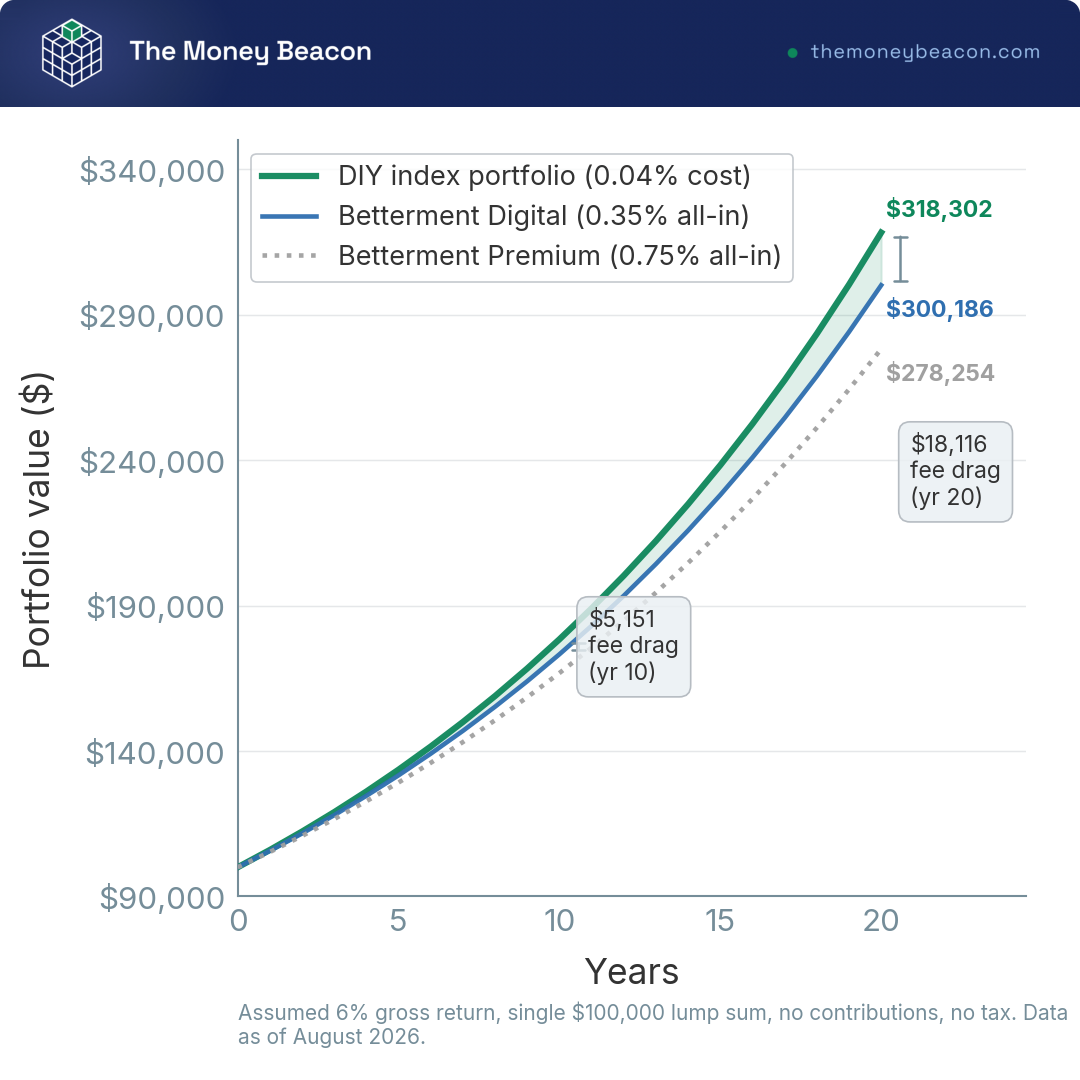
At ten years Digital reaches $173,259 against $178,410 held directly, so $5,151 apart. At twenty years it’s $300,186 against $318,302, a difference of $18,116, and Premium ends the same stretch at $278,254. That 6% is an assumption, not a promise, and past performance doesn’t guarantee future results.
That $18,116 buys something, though: the 3% drift-band rebalancing and the glide path, running whether or not you’re paying attention. It’s only waste for someone who would genuinely have rebalanced their own portfolio, year after year, through a bad market.
Hank’s take

the behavioral-finance research is blunt about this. The portfolio that gets rebalanced on paper and the portfolio that gets rebalanced in real life are two different populations, and the second one is a lot smaller than the spreadsheet assumes.
So the fund picks aren’t what you’re paying for. What’s left on the invoice is enforced discipline and the tax features, and only one of those has a number attached to it.
3. Do the tax features earn the fee back?
$18,116 over twenty years is the figure the tax side has to beat, and Betterment’s answer is automated tax-loss harvesting. Does it recover more than the fee, and for whom does it recover nothing?
3.1 How the harvesting works here, and what a harvested loss is really worth
Here’s how the harvesting works, from Betterment’s disclosures. It shifts allocations among three ETFs in each sub-asset class of the Core portfolio, charges nothing extra, sets no minimum, and stays opt-in and switchable from the Settings page. The election covers your whole taxable legal account and never applies to self-directed accounts.
Tax law decides what a harvested loss can do for you. It offsets unlimited capital gains plus up to $3,000 of ordinary income a year ($1,500 married filing separately), with the excess carried forward indefinitely.
Table: Running the fee against the tax benefit: worked scenarios
| Scenario | Loss harvested | Tax effect in year 1 | Cost when the deferred gain is realized | Net |
|---|---|---|---|---|
| Offset $3,000 of ordinary income, 24% federal bracket | $3,000 | $720 saved | $3,000 lower basis, later taxed at 15% long-term = $450 | +$270 permanent, plus deferral |
| Offset $10,000 of short-term gains at 24%, deferred gain later long-term at 15% | $10,000 | $2,400 saved | $1,500 | +$900 permanent, plus deferral |
| Offset $10,000 of long-term gains at 15%, deferred gain later long-term at 15% | $10,000 | $1,500 saved | $1,500 | $0 permanent; benefit is the time value only |
| Investor in the 0% long-term capital gains bracket | $10,000 | $0 saved | Full gain later at a possibly higher rate | Negative |
Author’s calculation using federal long-term capital gains rates of 0%, 15% and 20% and ordinary brackets of 10% to 37%. State tax excluded. Data current as of August 2026.
The top row is the one that clears the fee, and only just: $270 of permanent gain plus the deferral, against a $250 Digital fee on $100,000. Betterment tax loss harvesting is mostly deferral, and the permanent piece comes from arbitraging a higher rate now against a lower one later. Your bracket decides it, the same way it decides which tax accounts to fund first.
Betterment claims “nearly 70% of customers using tax-loss harvesting covered their taxable advisory fees through estimated tax savings.” To its credit it publishes the method: an internal calculation over 2022 and 2023 only, assuming the standard deduction, excluding state capital gains taxes, and measured against fees on the taxable account alone. 2022 was an unusually good year for harvesting. That’s a backward-looking average, not a forecast for you.
3.2 The accounts and the households where it is worth exactly zero
Betterment says most of this itself, which counts in its favor. It states that harvesting “cannot be used with tax-advantaged accounts such as IRAs and 401(k)s,” and that clients with no taxable account “will not benefit from the operation of TLH,” its own shorthand for tax-loss harvesting. Tax coordination and asset location can’t run either, because both need taxable and tax-advantaged accounts held there at once. In an IRA, a Roth, a Solo 401(k) or an HSA, what moves the outcome instead is the 401(k) match and withdrawal rules.
The wash-sale rule causes trouble in three situations. A substantially identical security bought 30 days before or after the sale disallows the loss. Betterment can’t police accounts held elsewhere. And a replacement bought inside an IRA makes the loss permanently disallowed rather than merely deferred.
Betterment also publishes four profiles it calls unsuitable: investors in low brackets who expect higher rates later, anyone withdrawing a large part of their taxable assets within twelve months, anyone whose spouse trades the same ETFs elsewhere, and anyone who can realize capital gains at a 0% rate. It advises switching harvesting off twelve months before a large withdrawal, and notes that it raises the trade count.
3.3 The $9 million SEC order about this exact feature
On April 18, 2023 the SEC charged Betterment LLC with material misstatements and omissions about its automated tax-loss harvesting service. The findings cover 2016 to 2019: an undisclosed change in how often the harvesting scan ran, an undisclosed programming constraint, two coding errors that stopped harvesting for some clients, plus a failure to give advance notice of advisory contract changes and to keep accurate books and records. More than 25,000 accounts were affected and roughly $4 million of potential tax benefits lost.
The outcome was a cease-and-desist, a censure and a $9 million civil penalty distributed to affected clients, settled without admitting or denying.
Now the denominator, because that’s what you need to judge a lawsuit headline. The Consumer Financial Protection Bureau (CFPB) database holds 95 complaints naming Betterment in total, against 1,344,483 advisory accounts. That’s roughly 7 per 100,000 over seven years, all answered on time, clustered on deposits, withdrawals and closing an account rather than portfolio management. The order is a reason to read the tax claims skeptically, not evidence of a platform falling apart.
The tax case only works in a taxable account, which leaves the cash side to be priced on its own terms.
4. The cash accounts, and whether 0.25% is a fair market price
Two questions are left before the ruling: what the cash side pays you, and what the rivals really charge once their headlines are priced.
4.1 Cash Reserve and Checking against a standalone savings account
The Betterment savings account interest rate took some pinning down, because the page gives you two of them. The binding disclosure says 3.25% base annual percentage yield (APY), variable, and the live rate feed still served 3.25 in August 2026. A marketing table higher up prints a better number than the disclosure does. When a page disagrees with itself, I take the disclosure.
New clients do get a real 0.75% boost to 4.00% on balances up to $1 million, if you deposit $1,000 within 14 days, and it ends January 15, 2027. There’s no minimum balance and no advisory fee on cash, because the program banks pay Betterment the spread.
Your insurance comes from those 26 program banks: $250,000 per depositor per bank from the Federal Deposit Insurance Corporation (FDIC), up to $4 million individual and $8 million joint. Cash in transit is SIPC covered but not FDIC insured, and cash already at the banks is the reverse. Neither one protects your portfolio from a falling market.
Checking, issued by nbkc bank, is the opposite product: no APY by its own disclosure, no overdraft fees, ATM and Visa 1% foreign transaction fees reimbursed worldwide. It’s a good travel card, and an emergency fund left in Checking earns nothing. Here’s a year on $25,000.
Table: The annual dollars on a $25,000 emergency fund
| Where the $25,000 sits | APY | Annual interest |
|---|---|---|
| Cash Reserve, base | 3.25% | $812.50 |
| Cash Reserve, new-customer boost | 4.00% | $1,000.00 |
| Betterment Checking | 0.00% | $0.00 |
| Wealthfront Cash Account, base | 3.30% | $825.00 |
| Schwab Intelligent Portfolios sweep | 3.28% | $820.00 |
| FDIC national average savings | 0.38% | $95.00 |
Data current as of August 2026. All rates variable.
The bottom row is what matters. $812.50 against $95.00 is $717.50 a year just for moving your cash off a branch-bank savings account, and that’s the difference our comparison of what seven other banks pay walks through. Betterment trails the rival cash accounts by 3 to 10 basis points, which is noise. The bigger question is how much belongs in cash at all, and our guide to sizing an emergency fund settles it.
4.2 What the alternatives really charge once you price the free one
The advisory fee is where the money is, and three platforms set the price Betterment has to justify.
Betterment vs. Wealthfront is close to a tie: the same 0.25%, tax-loss harvesting included. Wealthfront asks $500 to open an Automated Investing Account where Betterment asks nothing, as our review of Wealthfront lays out. Schwab Intelligent Portfolios is the harder case. It charges no advisory fee at all, but requires $5,000 to start, gates tax-loss harvesting at $50,000 invested, and holds 6.9% to 15.0% of the portfolio in cash swept at 3.28%. Price that allocation and the free platform stops being free.
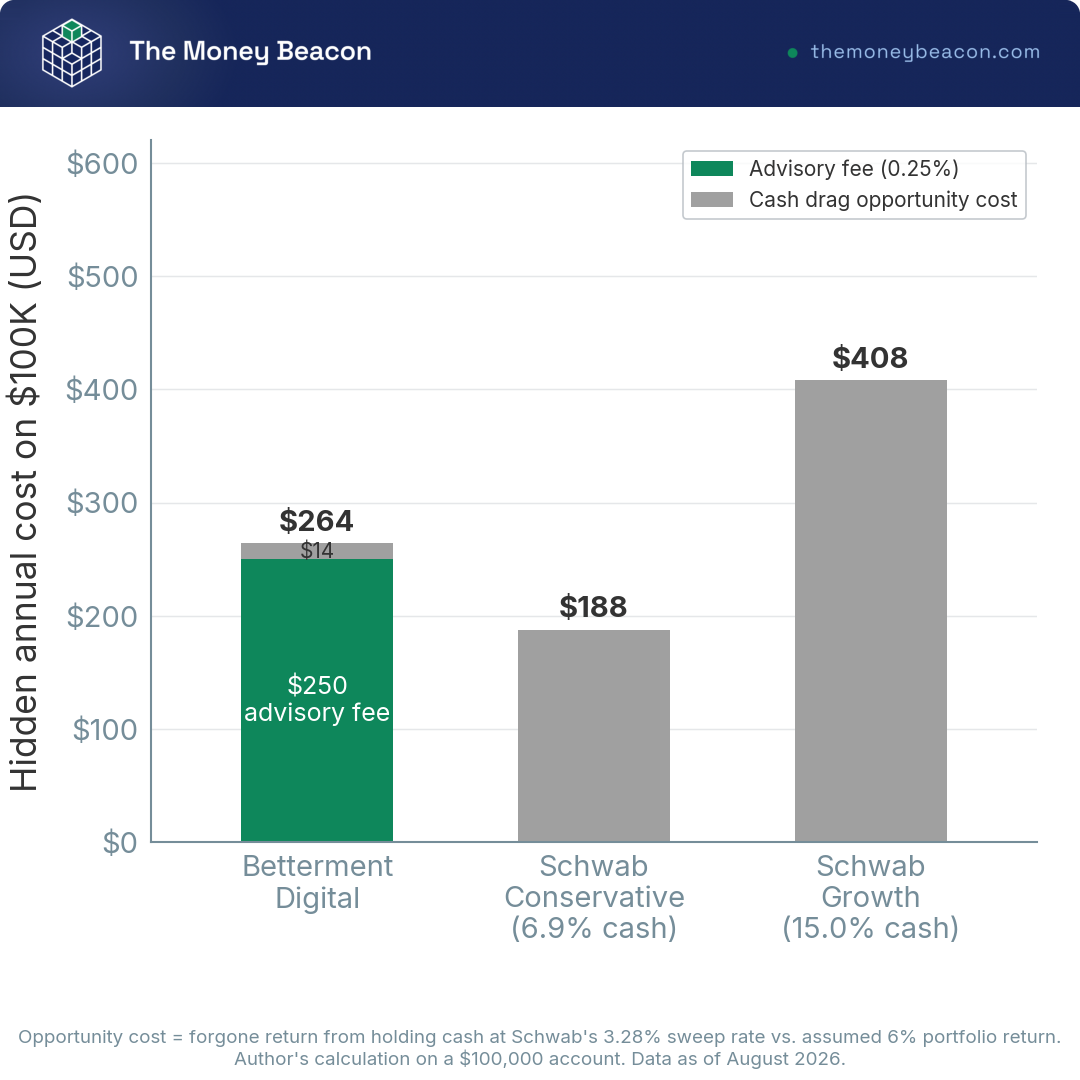
On $100,000 at an assumed 6% return, that cash gives up roughly $188 to $408 a year against Betterment’s $250 fee. And Schwab Bank earns the spread on it, a mechanism our review of Charles Schwab takes apart. Vanguard Digital Advisor undercuts both at roughly 0.15% net on a $100 minimum, then charges $100 to leave against Betterment’s $75, and our review of Vanguard shows how narrow the edge is at that price.
So Betterment isn’t the cheapest, not the highest cash yield, not the lowest minimum. It’s the only one of the four with no meaningful minimum that still gives every taxable client tax-loss harvesting at any balance. Its 69% fee-coverage claim and Wealthfront’s 97% are unaudited internal numbers, not forecasts.
5. The verdict: who Betterment is worth it for, and who should skip it
Every number the decision needs is on the table. So is Betterment worth it? For some readers clearly yes, for others clearly no, and the line is sharper than the marketing on either side admits.
5.1 Worth it, and worth it on one condition
Five profiles get a yes, and one of them only on a condition.
First and strongest is the taxable-account accumulator in the 22% to 35% brackets, realizing gains most years and holding none of the same index ETFs elsewhere. The tax machinery only works for that reader, and it can clear the fee: $270 of permanent benefit plus deferral on one $3,000 ordinary-income offset at 24%, against $250 of Digital fee on $100,000. Second is the household keeping taxable and tax-advantaged accounts here, so the tax coordination has something to coordinate.
Third, and conditionally, comes the first-time investor below the $24,000 hinge. Set up the $200 monthly recurring deposit on day one or this answer flips, because the flat fee is 1.20% a year on $5,000 and 6.00% on $1,000.
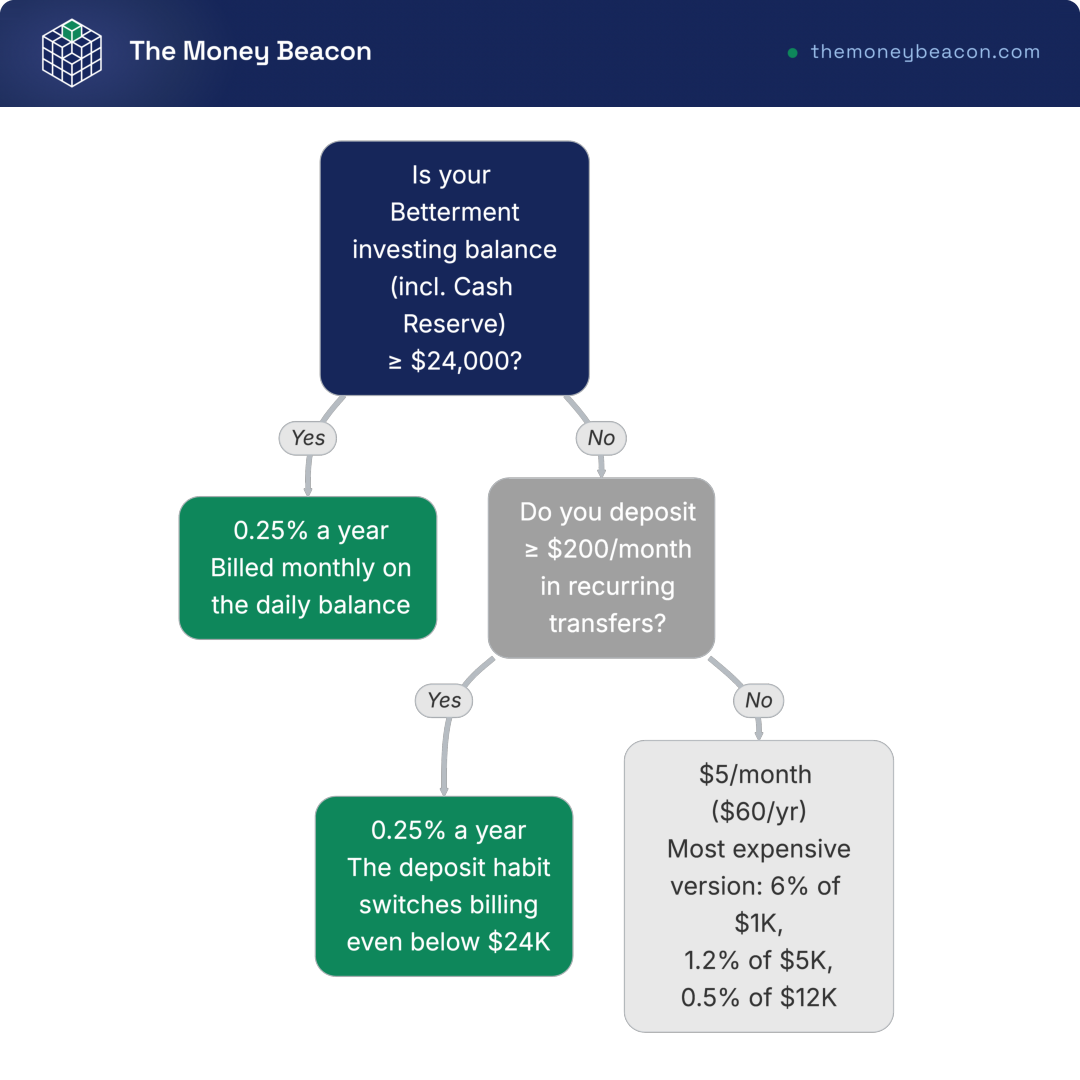
Clear $24,000 and you’re on 0.25% whatever you do.
Fourth is the investor who has genuinely failed to rebalance year after year, for whom 0.25% buys a 3% drift band that runs unattended. Fifth is the conservative investor, whose 0.5% cash target beats a forced 6.9% to 15.0% allocation at the nominally free rival.
For the taxable accumulator, my answer is yes. Below $24,000, it’s yes only once the billing mode is fixed.
5.2 Not worth it, and what it costs to change your mind
The other side is longer, and it’s the half a Betterment investing review usually leaves out.
Skip it if you hold only tax-advantaged accounts. Harvesting can’t run inside an IRA or a 401(k), by Betterment’s own statement, so the fee buys rebalancing and the glide path and nothing more. And the Solo 401(k) adds $100 a year while the HSA costs 0.50% all in. Skip it if you can realize long-term capital gains at the 0% rate, which is Betterment’s own unsuitability list talking. Skip it, for now, if you or your spouse hold the same index ETFs outside, because a replacement bought in an IRA disallows the loss permanently.
Skip it if you’ll genuinely rebalance twice a year yourself: that’s worth about $18,116 on $100,000 over twenty years at 6%. And skip it if the balance stays small with no regular deposits, because $60 a year is 6.00% of $1,000.
Then price the exit, the number people find out about too late. Leaving costs $75 per outbound transfer, takes 5 to 7 business days, and liquidates fractional shares to cash even on a move meant to go in kind. Closing and withdrawing cash are free. In a taxable account the real cost of leaving is the embedded gain, not the transfer fee: a $50,000 gain realized at 15% costs $7,500, a hundred times the $75.
Conclusion
Betterment sells automation, and the only way to price it is in dollars, not percentages. On $100,000 the all-in cost is $280 to $420 a year, and over twenty years at an assumed 6% that drag comes to roughly $18,100 against holding the same index ETFs yourself. Only the tax side is built to win that money back, and it only works inside a taxable account. Harvesting is mostly deferral.
The fee is the only certain number in the whole calculation. That 6% return is an assumption, and the 69% fee-coverage claim is an unaudited look back at two unusually good years. The fee is deducted every month regardless, so the real question isn’t whether Betterment is good, it’s whether the discipline it enforces is discipline you were never going to supply. Plenty of people answer that honestly only after years of paying.
So do the free thing first. Check which of the two billing modes your account is on, because $5 a month is 1.20% a year on $5,000 and 6.00% on $1,000, and a $200 monthly recurring deposit moves you onto 0.25%.
If you want the wider field on the same criteria, our comparison of six robo-advisors scores them side by side. The tax half deserves its own read, and our guide to how investments are taxed lays out the brackets that decide whether harvesting pays anything. And if your answer is to run it yourself, our review of Fidelity prices what near zero fees actually look like.
FAQ
What does Betterment cost per year, all in?
I treat this as two separate bills, because Betterment does. The advisory fee is $5 a month ($60 a year) until your combined investing balance, Cash Reserve included, hits $24,000, or until you set up $200 or more in monthly recurring deposits; either trigger flips you to 0.25% a year. Cross $1 million and the rate drops to 0.15%, then 0.10% above $2 million. Premium is 0.65% and needs a $100,000 minimum. None of that counts the ETFs themselves: Core’s expense ratios add roughly 0.03% to 0.17% on top. All in, a $100,000 Digital account runs about $280 to $420 a year.
Is there a minimum balance to open a Betterment account?
No, and that surprised me the first time I read the fine print. Betterment sets no minimum account size for a Digital account, just a $10 minimum to fund it by ACH. The number that actually matters is smaller and less advertised: automated rebalancing won’t run at all until a portfolio holds at least $50, so a brand-new account with a few dollars in it just sits unmanaged. Premium is different, requiring $100,000 in eligible investing balances that exclude Cash Reserve, Checking and self-directed money. Deciding whether to start this small? Our guide to starting to trade covers the earliest steps.
How do I avoid or reduce Betterment’s fees?
Four levers actually move the needle, in this order. If your balance is under $24,000, set up $200 or more in recurring monthly deposits and you flip from the flat $5 a month to 0.25%, cutting the bill by 80% or more on a small account. Second, keep spare cash in Cash Reserve rather than the managed portfolio, since Betterment charges no advisory fee there. Third, use self-directed investing for any position you’d rather manage yourself; the wrap fee doesn’t apply. Fourth, unhappy Digital clients can request the Satisfaction Guarantee, a 90-day fee waiver not available on the $5 monthly plan.
Does tax-loss harvesting do anything inside an IRA?
No, and this is the mix-up I see most often. Betterment says plainly that tax-loss harvesting generally can’t run inside tax-advantaged accounts like IRAs and 401(k)s, and a client with no taxable account gets none of its benefit. It can work against you too: buy a substantially identical replacement inside your IRA within 30 days of a harvested sale, and the loss is gone for good, not simply pushed to a later year. That’s a real risk if your IRA and an outside 401(k) hold the same index funds every payday.
Is money in Betterment Cash Reserve insured, and is the yield competitive?
Eligible cash sweeps out to 26 program banks, each covering you separately: $250,000 per depositor per bank under FDIC insurance, adding up to $4 million individual and $8 million joint. Betterment itself isn’t a bank. Worth being precise here: SIPC protects your brokerage account if the broker-dealer fails, it doesn’t cover cash once that cash has moved to the program banks, so don’t confuse the two. On yield, the base rate is 3.25% APY, variable, with a 0.75% boost to 4.00% for new customers through January 15, 2027 on balances up to $1 million, well ahead of a branch savings account.
What are the downsides of Betterment, and are there complaints or lawsuits against it?
A few real limits show up once you’ve used the account for a while. There’s no custodial account for a child, no retail 529, and tax-loss harvesting goes idle once your money sits entirely inside IRAs or 401(k)s; support staff aren’t licensed to give investment advice either. On the legal record, the SEC charged Betterment LLC in April 2023 over misstatements about how its tax-loss harvesting ran from 2016 to 2019, affecting more than 25,000 accounts and roughly $4 million in lost tax benefits; the firm settled for a $9 million penalty without admitting or denying wrongdoing. Against that, the CFPB complaint database shows only 95 complaints against Betterment ever, about 7 per 100,000 accounts, all answered on time.
What does it cost to transfer my Betterment account to another broker?
Moving a Betterment Securities account elsewhere costs a flat $75 per outbound transfer, and a typical ACATS transfer takes 5 to 7 business days. Closing the account and withdrawing cash to a linked bank are both free. Two things catch people off guard: fractional shares get liquidated to cash rather than moved in kind, and the real cost of leaving a taxable account usually isn’t that $75 fee. A position that’s grown from $50,000 to $100,000 realizes a $50,000 gain on sale, which is $7,500 at a 15% long-term rate, a hundred times the transfer charge. Our M1 Finance review covers a similarly automated alternative.




Comments
Questions and corrections welcome. We read everything.