


Someone told you to open a Vanguard account, and at the time they were right. Vanguard built its name on being the cheapest place to hold an index fund, and that reputation still gets passed around forums and family dinners without a single current number attached to it.
The numbers have moved. Vanguard’s Total Stock Market Index Fund Admiral Shares (VTSAX) charges an expense ratio of 0.04%, as of April 28, 2026. Fidelity’s total market index fund costs 0.015%, and its zero expense ratio version is 0.00%.
A new Vanguard Brokerage Services fee schedule took effect on July 10, 2026, and it carries a $25 annual account service fee with six published ways to get it waived. Fidelity’s account service fee is $0.
Not everything moved against Vanguard. Cash waiting in Vanguard’s settlement fund earned a 3.61% seven-day yield on August 18, 2026, while Schwab’s default sweep paid 0.01%.
So I stopped taking the reputation on trust and read Vanguard’s own fee schedule and fund pages line by line. What follows is what a Vanguard brokerage account really costs you in a year, how that compares with what Fidelity and Schwab publish, and who should open one.
1. What a Vanguard brokerage account actually is
Vanguard’s fee schedule holds a surprise before you reach a single number. Those pages don’t describe one company, they describe several, and which one holds your shares decides both what protects them and what you can be charged for.
1.1 Three companies wear the Vanguard name, and only one is holding your shares
Vanguard Brokerage Services (VBS) is a trade name, a division of Vanguard Marketing Corporation. That second company is the broker-dealer you actually trade through. It’s a member of the Financial Industry Regulatory Authority (FINRA) and of the Securities Investor Protection Corporation (SIPC), and it carries CRD #7452. The Vanguard Group, Inc. is the fund manager, and it holds directly held fund accounts. Vanguard Advisers, Inc. is the third, running Digital Advisor and Personal Advisor.
I went looking for what that split actually does to you, and Vanguard’s own trust and security page answers it. Brokerage assets are covered by SIPC. In Vanguard’s words, “Vanguard funds not held in a brokerage account are held by The Vanguard Group, Inc., and are not protected by SIPC.”
You can own identical securities outside SIPC coverage through legacy directly held fund accounts, and nothing about the fund looks any different. It’s the entity named on your statement, not the Vanguard name on the envelope, that decides whether SIPC reaches the position.
Check which entity your statement names before you assume SIPC covers a holding.
1.2 What you can hold, what it costs to trade, and where the minimums really sit
An exchange-traded fund (ETF) trades like a stock through the day, a certificate of deposit (CD) is a fixed-term deposit, and you can hold both in this one account.
| Asset class | Minimum | Online cost, Qualifying Assets under $1 million |
|---|---|---|
| Vanguard ETFs, US stocks and non-Vanguard ETFs | $1 for Vanguard ETFs, share price otherwise | $0; $25 broker-assisted |
| Vanguard mutual funds | $1,000 to $50,000 by fund | $0; $25 broker-assisted |
| Non-Vanguard mutual funds | Set by the fund | $0 for no-transaction-fee funds; $20 for transaction-fee funds |
| Options | Approval required | $0 base plus $1 per contract |
| New-issue CDs, agency and corporate bonds, US Treasuries | $1,000 | $0 |
| Municipal bonds | $5,000 plus dealer minimums | Not available at new issue; $1 per $1,000 of face value in the secondary market, $250 maximum |
Effective July 10, 2026. Data current as of August 2026.
Two lines get misread a lot. The first is the minimum. Vanguard publishes no minimum initial deposit for the brokerage account, so it opens at $0 and every minimum in the table attaches to a product. The $3,000 on the core Admiral funds is a product gate, not an account gate.
So $1,500 doesn’t shut you out. The same total US market exposure is available in a Vanguard ETF at a $1 minimum, and it’s worth seeing how brokers out there price the same minimums.
The second is crypto. Vanguard Brokerage permits select third-party cryptocurrency ETFs and mutual funds, and Vanguard states that it offers none of its own.
2. What the account really costs, layer by layer
You’ve got the shape of the account. Now the bill. Vanguard charges in layers, and the two that matter most pull in opposite directions: the fund layer is cheap and boring, while the account layer is where a small balance gets hit.
2.1 Layer one: Vanguard’s ETF is cheaper than Vanguard’s own Admiral fund
Before comparing Vanguard with anyone else, compare Vanguard with itself. Same index, same manager, two share classes, two prices.
| Exposure | Admiral fund | ER | Minimum | ETF | ER | Minimum |
|---|---|---|---|---|---|---|
| Total US stock market | VTSAX | 0.04% (04/28/2026) | $3,000 | VTI | 0.03% (04/28/2026) | $1.00 |
| S&P 500 | VFIAX | 0.04% (04/28/2026) | $3,000 | VOO | 0.03% (04/28/2026) | $1.00 |
| Total international stock | VTIAX | 0.09% (02/27/2026) | $3,000 | VXUS | 0.05% (02/27/2026) | $1.00 |
| Total US bond market | VBTLX | 0.04% (04/28/2026) | $3,000 | BND | 0.03% (04/28/2026) | $1.00 |
| Target Retirement 2055 | VFFVX | 0.08% (01/28/2026) | $1,000 | n/a | n/a | n/a |
| Settlement money market fund | VMFXX | 0.11% (12/19/2025) | $3,000 | n/a | n/a | n/a |
Each expense ratio (ER) carries its own as-of date, shown beside it. Data current as of August 2026.
On every core exposure the ETF is cheaper than the Admiral fund, and it starts at $1 instead of $3,000. Put $250,000 into total international stock and VTIAX charges $225 a year while VXUS charges $125. That’s $100 for the same index, decided by which share class you buy.
The old argument for accepting the pricier class was automation, and it has largely gone. Vanguard has supported recurring automatic investments into Vanguard ETF positions since January 2025, and dividend reinvestment buys fractional shares to three decimal places at no fee and no commission.
Already holding the conventional class in a taxable account with a gain on it? Vanguard permits a tax-free conversion of eligible conventional shares into the ETF class of the same fund, one way only, because ETF shares can’t be converted back. It’s a share-class change inside one fund rather than a sale, so it doesn’t realize the embedded gain.
2.2 Layer two: the $25 account service fee and the six published ways out
Vanguard Brokerage Services “may charge a $25 annual account service fee,” and publishes six ways out of it.
| Waiver | Wording | Effort |
|---|---|---|
| Cash Plus Account | Waived for all Cash Plus Accounts | None, if held |
| EIN organization or trust | Client is an organization or trust registered under an employer identification number (EIN) | Structural |
| E-delivery election | Client elected e-delivery of statements and the annual privacy notice; confirmations; reports, prospectuses and proxy materials; and notices, amendments and other account updates | Minutes, once |
| Advisory enrollment | Brokerage account enrolled in a Vanguard-affiliated advisory service | Pay an advisory fee |
| Qualifying Assets of at least $1 million | Client has Qualifying Assets of at least $1 million | Asset threshold |
| Wealth Management | Client is in Wealth Management | Relationship threshold |
Effective July 10, 2026. Data current as of August 2026.
Five of those six are all-or-nothing. The sixth is a checkbox that takes minutes.
Read its wording carefully, though. It asks for e-delivery of that whole list, not statements alone. A partial election keeps the fee running, which is a quiet way to pay $25 a year by accident.
The charge also applies per brokerage account, with no household cap published in the schedule. A taxable account plus a traditional individual retirement account (IRA) plus a Roth IRA gets charged the $25 three separate times unless you make the election on each one.
2.3 What an unwaived fee does to a small balance
A flat fee never sounds like much until you write it as a percentage of what you hold.
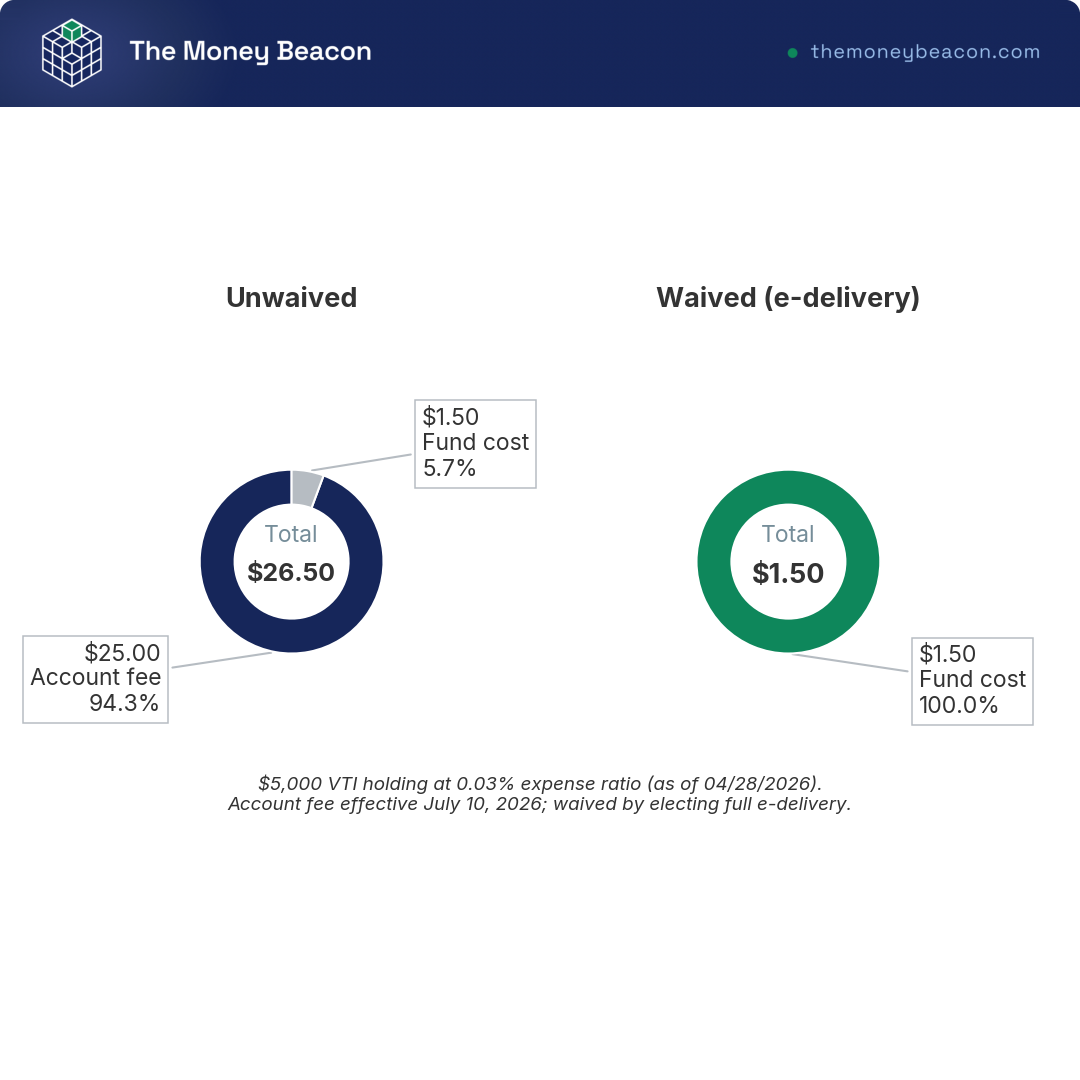
Let’s take the $5,000 case. A $5,000 holding of VTI costs $1.50 a year in fund expenses at 0.03%. Add an unwaived $25 and the year-one bill is $26.50, which is 0.53% of the balance rather than 0.03%.
It gets worse as the balance shrinks. On $2,000 the fee alone is 1.25% a year, 31 times the $0.80 VTSAX would charge on the same money. Below roughly $50,000 an unwaived account fee costs more than everything the funds charge put together, which is the first thing to check if you’re starting out with a small balance in the market.
What separates this charge from every other cost in the account is that it’s entirely avoidable, which makes it the most expensive mistake on the list. Run the e-delivery election on every registration before your first purchase, not after the first statement lands.
Hank’s take

the behavioral research on default settings is unambiguous, and this is a textbook case: a charge you can switch off in one session is the kind people leave running for years, because nothing on a fund fact sheet ever reminds them it’s there.
3. How that price looks beside Fidelity and Charles Schwab
Vanguard’s numbers only become evidence once you put the same lines beside what the two other big self-directed brokers publish.
3.1 On fund price, the reputation no longer matches the published numbers
Start with the claim most readers arrive with: Vanguard has the cheapest index funds going. Here’s $50,000 in a total US market index product at each provider.
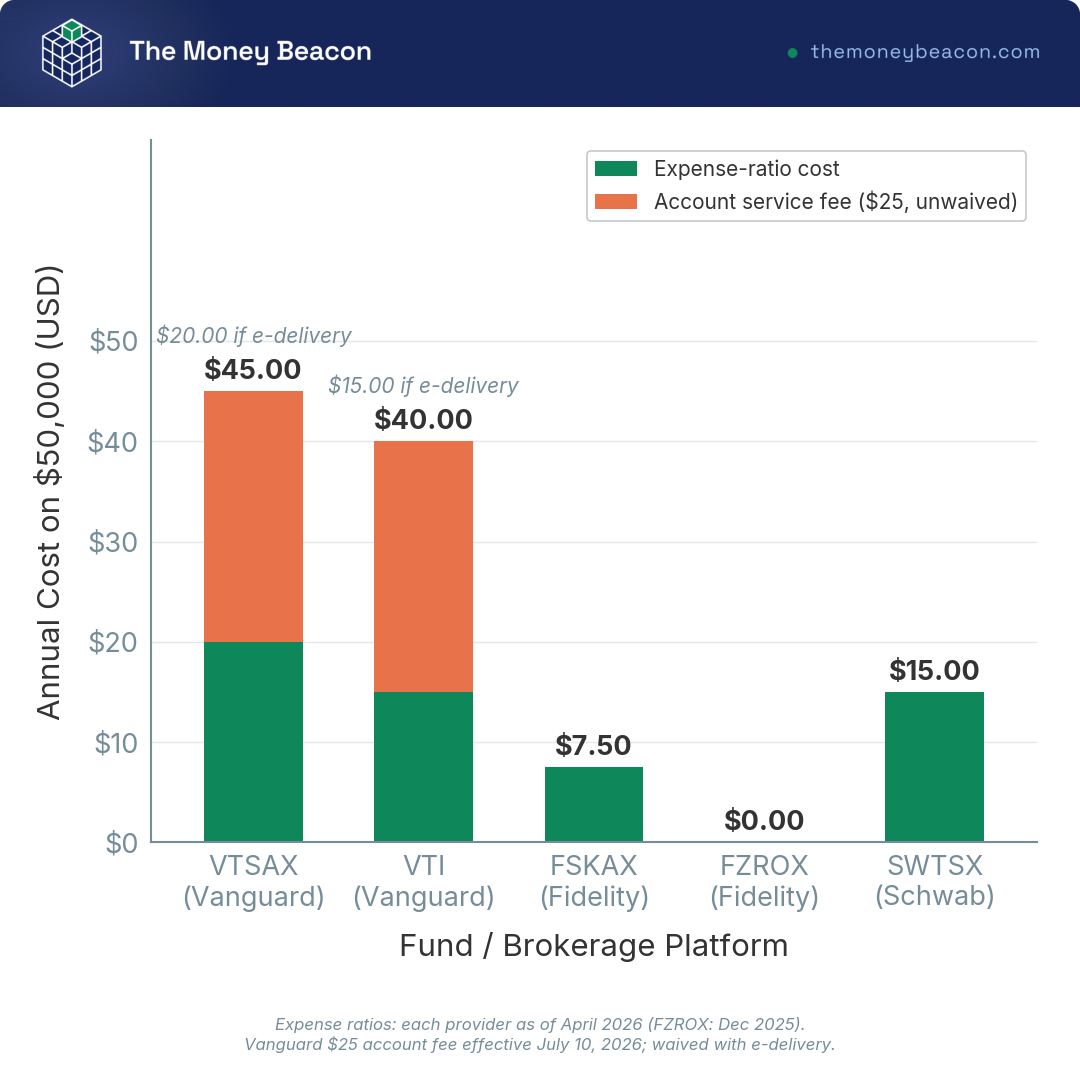
VTSAX at 0.04% (April 28, 2026) costs $20.00 a year on that balance, VTI at 0.03% costs $15.00, and Schwab’s SWTSX at 0.030% costs $15.00 too.
Fidelity is cheaper than all three. FSKAX at 0.015% (April 29, 2026) costs $7.50, and FZROX at 0.00% (December 30, 2025) costs nothing at all.
The ordering holds elsewhere too. On the S&P 500 it’s VFIAX at 0.04% and VOO at 0.03% against FXAIX at 0.015% and SWPPX at 0.020%. On international it’s VTIAX at 0.09% and VXUS at 0.05% (February 27, 2026) against FZILX at 0.00%.
Keep the dollars in view, though, because the fund difference is narrow. Between VTI and FSKAX it’s 0.015 percentage points, or about $15 a year per $100,000, a good deal smaller than one unwaived account fee.
Vanguard’s own comparison measures it against the industry average, not against Fidelity and Schwab.
3.2 At the account level, Vanguard is behind on three published lines
The account layer is a different set of lines, so here they are side by side.
| Item | Vanguard | Fidelity | Charles Schwab |
|---|---|---|---|
| Online stock and ETF commission | $0 | $0 | $0 |
| Options per contract | $1.00 | $0.65 | $0.65 |
| Broker-assisted surcharge | $25 | Charged, amount unconfirmed | $25 |
| Annual account service fee | $25, waivable | $0 | $0 |
| Account transfer out | $100 | $0 | $50 full, $0 partial |
| Non-proprietary transaction-fee mutual funds | $20 online | Charged, amount unconfirmed | OneSource $0 |
| Outgoing bank wire | $10, waivable | $0 | $25, or $15 online |
| Minimum initial investment | $0 to open the account; minimums at fund level only | $0 | None on the funds cited |
Data current as of August 2026.
Three rows explain the difference. The annual account service fee is $25 at Vanguard against $0 at both rivals. Options cost $1 per contract against $0.65. And leaving costs $100 at Vanguard, $50 for a full transfer at Schwab and $0 at Fidelity.
Human help costs $25 a trade below $1 million in Qualifying Assets and $0 above it, the same charge Schwab publishes. Vanguard publishes phone service Monday through Friday, 8 a.m. to 8 p.m. Eastern time.
A non-Vanguard transaction-fee fund costs $20 per online trade, and selling one within 60 calendar days of your most recent purchase adds a $50 early redemption fee, which catches rebalancers rather than traders.
3.3 Cash is the one line Vanguard wins outright
Now the line where Vanguard is plainly in front, and the one most people skip.
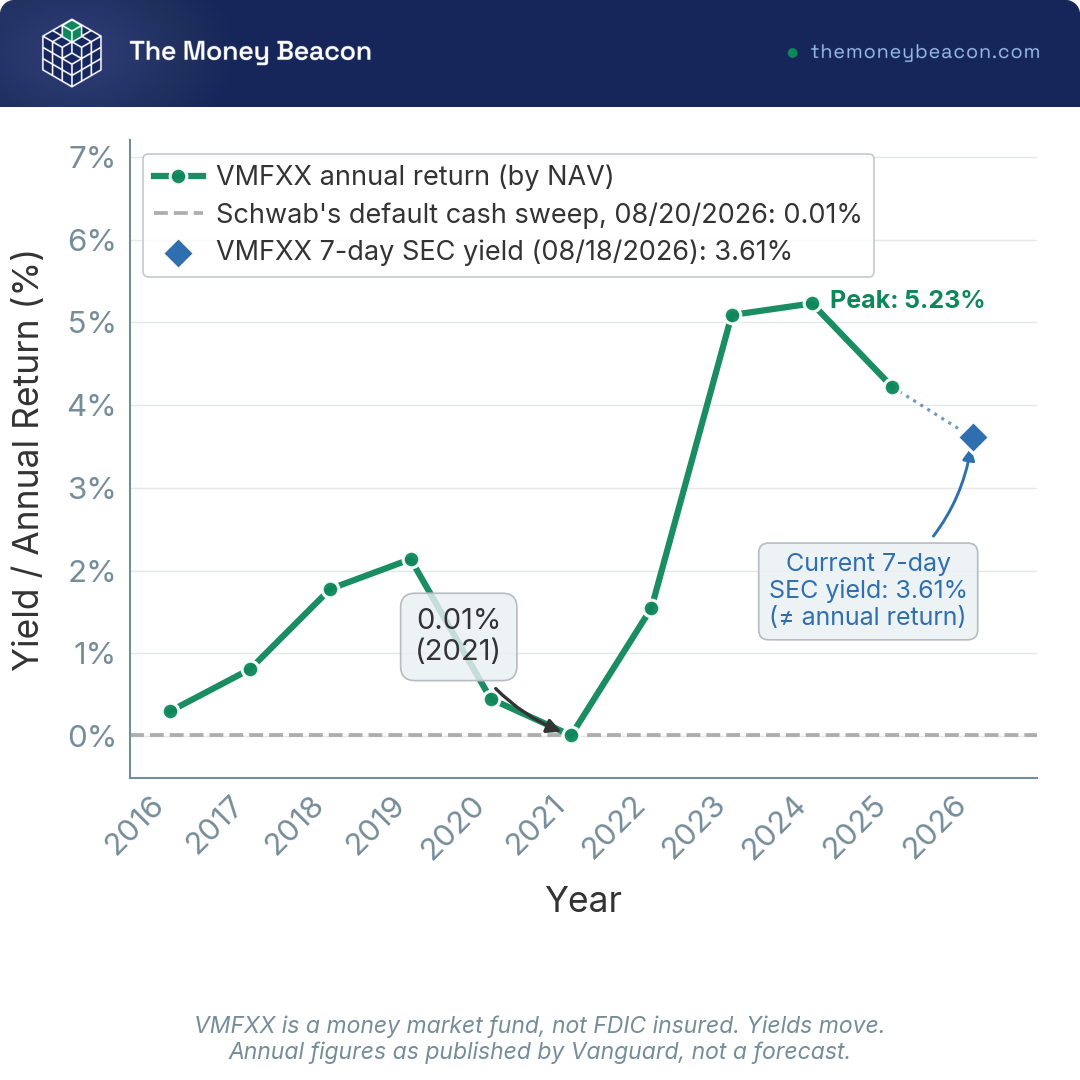
Vanguard’s default settlement fund, VMFXX, published a 3.61% seven-day yield on August 18, 2026, on a 0.11% expense ratio (December 19, 2025). That yield uses the Securities and Exchange Commission (SEC) standardized formula, so it compares like with like. Fidelity’s SPAXX published 3.31% on August 14, 2026, and Schwab’s default uninvested brokerage cash sweep published a 0.01% annual percentage yield (APY) on August 20, 2026.
Put $25,000 of idle cash in each. At Vanguard that’s roughly $903 a year, and at the 0.01% sweep it’s roughly $3. One year of parked cash covers more than three decades of the $25 account service fee.
This is by design, not a rate quirk. Vanguard’s settlement fund is a money market fund, so it pays roughly what short-term government paper pays. A bank-sweep default pays whatever the broker decides.
That has a downside, because a money market yield moves, and moves fast. VMFXX returned 0.01% in 2021 and 1.55% in 2022, then 5.23% in 2024 and 4.22% in 2025. If you want a rate you can plan around, comparing no-fee savings accounts on published APY is the cross-check to run.
And it isn’t a deposit. VMFXX seeks a stable $1.00 share price and holds at least 99.5% of its assets in cash, US government securities and government-collateralized repurchase agreements, but Federal Deposit Insurance Corporation (FDIC) insurance doesn’t apply.
4. What client ownership and the record on file actually deliver
The structure is the one argument price can’t settle, and it’s the reason people give for staying put.
4.1 Ownership shows up in expense ratios and almost nowhere else
Vanguard states the claim in one line. “Vanguard is owned by its member funds, which in turn are owned by fund shareholders.” The structure is real, and the firm puts numbers on it: more than 2,000 fund fee reductions since 1975, and an asset-weighted average US combined mutual fund and ETF expense of 0.07% as of December 31, 2025, or $175 a year on $250,000.
Then, on that same page, Vanguard adds this: “Vanguard does not operate at cost.”
That’s the honest reading, and it’s Vanguard’s, not a critic’s. Mutual ownership removes an outside shareholder’s claim on fund fees. It doesn’t make the firm a charity.
Where does mutual ownership show up on your bill? In fund expense ratios, and that comparison is settled. Against a 0.50% industry average the structure looks decisive. Against the two brokers you’d otherwise use, it isn’t in front.
On the account layer it buys you nothing. And 20% is deducted from any class action settlement recovered on your behalf. That line sits in an account agreement that also carries a predispute arbitration clause, a class action waiver, and FINRA as the forum. Read the ownership claim as a statement about fund expense ratios, because the fee schedule shows it nowhere else.
Tom’s take
I’ve shopped most of the big private banks, and the lesson carries over: the ownership story is on the marketing page, the terms you live with are in the fee schedule and the account agreement.
4.2 What protects the account, and the one enforcement item on the record
Ownership answered, the other half is what stands behind your money.
SIPC covers a custody failure of the broker-dealer, up to $500,000 per customer including a $250,000 cash sub-limit. It never covers market losses, of any size. It reaches assets held at Vanguard Brokerage Services. FDIC insurance covers deposits at an insured bank up to $250,000 per depositor, per insured bank, per ownership category. It doesn’t reach your brokerage account or a money market fund inside it.
Vanguard adds a promise of its own, unusually direct: “Where you have taken the qualifying steps to protect your account, Vanguard will reimburse every dollar that leaves your account through an unauthorized distribution.”
The conditions are where that promise narrows. The qualifying steps are guarding your login information, keeping devices current, monitoring the account and cooperating with an investigation. Granting someone transaction authority or sharing credentials disqualifies the promise, and both are ordinary things people do.
The record on file isn’t blank either. On January 17, 2025 the SEC instituted and settled an order against The Vanguard Group, Inc. over misleading statements about capital gains distributions and the tax consequences for retail investors in the Investor Target Retirement Funds. Relief funded for distribution to harmed investors totaled $106.41 million.
The lesson goes wider than one fund family. A mutual fund in a taxable account can hand you a capital gains bill created by other shareholders’ redemptions, and sitting still doesn’t prevent it.
5. The verdict: who should open this account, and who should not
You’ve seen both sides of the ledger. Time to rule.
5.1 Who it fits, and who should open elsewhere
One profile per row, and one published number decides it.
| Profile | Ruling | The datum that decides it |
|---|---|---|
| Long-horizon ETF holder who elects e-delivery | Strong fit | VTI at 0.03%, $1 minimum, $0 online commissions, $25 fee waived |
| Beginner with less than $3,000 | Redirected, not rejected | The $3,000 minimum sits on VTSAX; VTI starts at $1 |
| Investor parking cash between deployments | Strong fit | VMFXX at 3.61% (08/18/2026) against a 0.01% default sweep |
| Large balance consolidating accounts | Good fit | At $1 million in Qualifying Assets the $25 fee, the broker-assisted charge and the $10 wire all fall away |
| Cost-minimizer who wants a mutual fund | Poor fit | FSKAX at 0.015% and FZROX at 0.00%, both at a $0 minimum |
| Active options trader | Poor fit | $1.00 per contract against $0.65 at both rivals |
| Multi-fund-family investor | Poor fit | $20 per online transaction-fee fund trade, plus $50 to sell one inside 60 calendar days |
| Small or short-tenure account | Worst fit | $25 unwaived is 0.50% a year on $5,000, and leaving costs $100 against Fidelity’s $0 |
Fee schedule effective July 10, 2026. Each expense ratio and the 3.61% yield carries its own as-of date. Data current as of August 2026.
The large-balance row is the one I’d pull out, because it flips this review’s sharpest criticism. Once your Qualifying Assets reach $1 million, the annual fee, the broker-assisted commission and the wire fee all fall away. So if you’re consolidating retirement and taxable accounts, you’re not reading the fee schedule a $5,000 account reads.
Two of those misfits are pricing decisions, not platform failures. Nobody is telling the options trader or the multi-fund-family investor to stop investing; this account just charges $0.35 more per contract and $20 per outside transaction-fee fund trade for doing it here.
5.2 The ruling, and the two settings that decide it
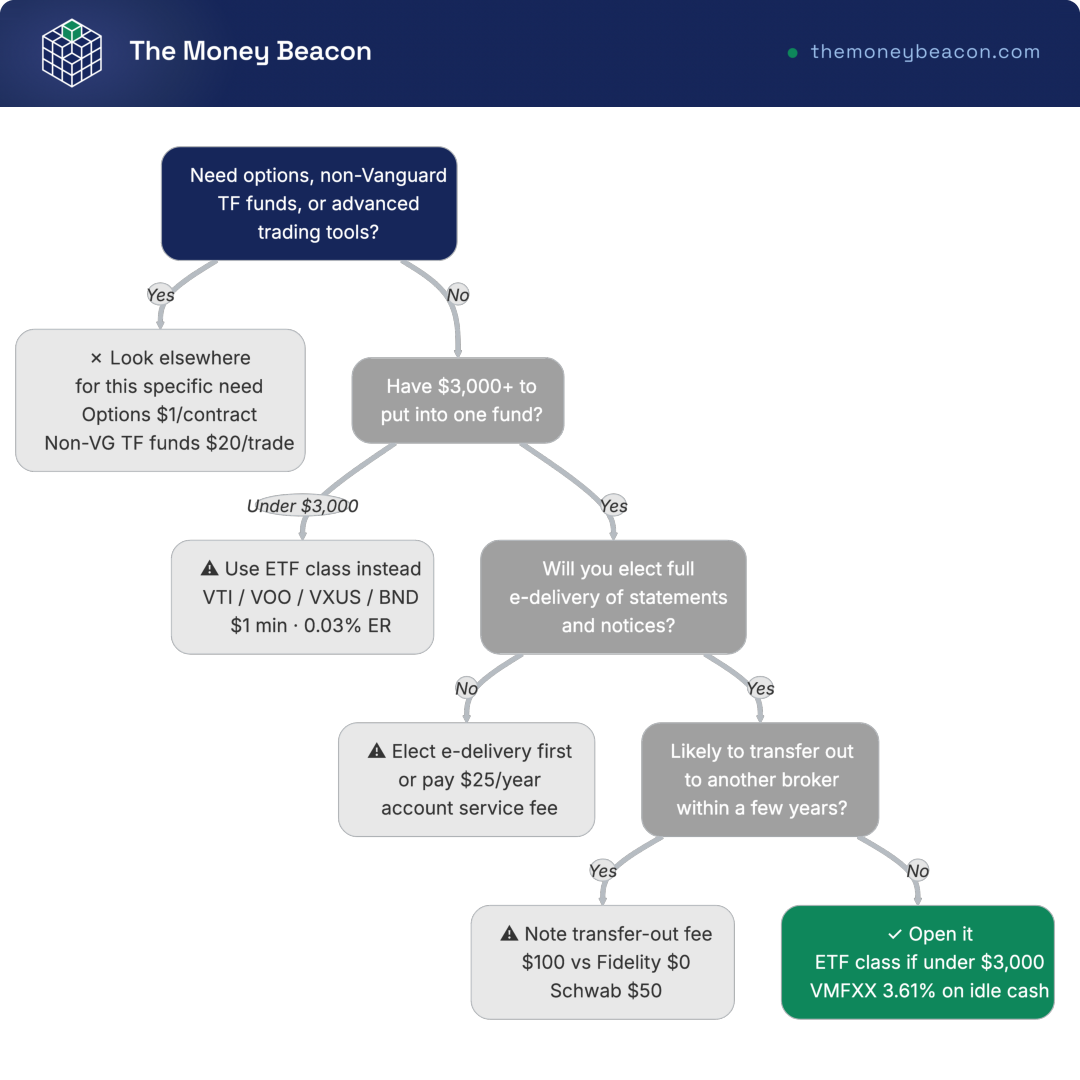
So is it worth opening? For one investor, yes, and I’ll be specific about which one. A Vanguard brokerage account is worth opening for a buy-and-hold ETF investor who elects e-delivery before funding and holds the ETF class instead of clearing the $3,000 Admiral minimum. On that setup you pay 0.03% on VTI, $0 in online commissions and $0 in account service fees, and uninvested cash earns 3.61% instead of 0.01%.
It is not worth opening for options trading or for outside transaction-fee fund families. And it’s the wrong home for money that will probably move brokers within a few years. Hold $5,000 here for three years unwaived and then transfer out, and the account has cost you $175 in fees alone, against $0 at Fidelity for the same three years and the same move.
The thresholds that would change any of that are published, so you can measure yourself against them. E-delivery is an action, not an amount. The VTSAX-to-FSKAX difference is about $25 a year per $100,000, and the $100 exit is 2% once on $5,000 but 0.02% once on $500,000. That extra $0.35 per contract starts to matter from roughly 70 contracts a year, and idle cash at 3.61% against a 0.01% sweep is worth about $36 a year per $1,000.
Two settings do most of that work, and both are made in the account’s first hour: the e-delivery election and the share class you buy. Elect e-delivery on every registration before you fund it, set the recurring purchase on the ETF class, and leave uninvested cash in the settlement fund.
Conclusion
Vanguard came out of this review better than its critics claim and worse than its reputation promises. The settlement fund paid a 3.61% seven-day yield on August 18, 2026 against a 0.01% sweep, and VTI at 0.03% is still among the cheapest ways to own the whole US stock market. But the fund lineup no longer wins on price alone, and the account around those funds charges fees the old recommendation never mentioned.
Here’s the part I’d underline, the one people work out too late. Fund costs are quoted as percentages, so you compare them by reflex. An account service fee is quoted in dollars, so you don’t. That $25 stays an abstraction until you divide it by your own balance. On $5,000 that’s 0.50% a year, more than twelve times what the fund inside charges you.
So settle the fee question before you fund anything: elect e-delivery on every registration, then buy the ETF share class rather than clearing the $3,000 Admiral minimum. E-delivery removes the $25, and VTI charges 0.03% from a $1 minimum against 0.04% on VTSAX. Neither move depends on your balance, which makes this one of the few investing costs you can zero out yourself. None of it cancels the $100 exit charge, so money you might move within a few years belongs elsewhere. For money staying put, that’s the cheapest version of this account.
A taxable brokerage account can hand you a tax bill you didn’t create, so our guide to how investments are taxed in 2026 is the natural next read. If choosing share classes yourself sounds like work, weigh the alternative in our comparison of the leading robo-advisors. And if you’re still deciding which money belongs in a brokerage, start with how to diversify your savings by goal.
FAQ
Is there a minimum to open a Vanguard brokerage account?
No. Vanguard publishes no minimum for the account itself, it opens at $0, and every dollar figure that actually matters is at the product level instead. A Vanguard ETF such as VTI needs $1, the core Admiral index funds ask for $3,000, and other mutual funds range from $1,000 to $50,000 depending on the fund. I went looking for an account-level gate and there isn’t one. So a $3,000 minimum on VTSAX doesn’t lock a smaller account out, it just points you toward VTI instead, which tracks the same index at a lower expense ratio and a $1 minimum. If you’re weighing where a first small deposit belongs, I lay out that beginner path in how to start trading.
What is Vanguard’s annual account service fee, and how do I avoid it?
Vanguard Brokerage Services charges $25 a year per brokerage account under the fee schedule effective July 10, 2026, and publishes six ways around it. Five are structural: a Cash Plus Account, an EIN-registered organization or trust, enrolling in a Vanguard advisory service (worth comparing against a robo-advisor if you’d rather pay for hands-off management), $1 million in Qualifying Assets, or Wealth Management status. The sixth matters most for everyone else: elect e-delivery of every listed document category, not statements alone, and the fee disappears for free. Skip it and the cost scales badly on a small account: $25 is 1.25% a year on a $2,000 balance, 31 times what VTSAX charges on the same money. I’d make that election the day I funded the account, before the first statement even arrives.
Are Vanguard index funds still the cheapest option in 2026?
Not on the two exposures most investors actually hold. VTSAX is 0.04% (April 28, 2026) against Fidelity’s FSKAX at 0.015% (April 29, 2026) and FZROX at 0.00% (December 30, 2025), both with no minimum, plus Schwab’s SWTSX at 0.030% with no minimum. Vanguard’s own ETF class closes most of that difference: VTI is 0.03% at a $1 minimum, $15 a year behind FSKAX on a $100,000 balance rather than $25 behind VTSAX. The honest answer is that Vanguard’s lineup is still cheap, just not the cheapest out there anymore, and the case for choosing it has shifted from lowest price to fit within the account you actually want.
What does Vanguard charge to transfer my account to another broker?
$100 to close the account and transfer everything out to another firm, though that fee doesn’t apply if you move the money by ACH or an electronic bank transfer, or if you hold at least $5 million in Qualifying Assets, are a Wealth Management client, or have an advisory-enrolled account. Fidelity publishes $0 for the same move, and Schwab charges $50 for a full transfer. The size of your account decides how much this matters: $100 is a one-time 2% hit on a $5,000 balance, but only 0.02% on $500,000. If you do leave, ask for an in-kind ACATS transfer rather than liquidating first, since selling can trigger a capital gain a straight transfer would have avoided.
Does Vanguard pay interest on uninvested cash?
Yes, and it’s the one place Vanguard is clearly ahead of its rivals. Uninvested cash defaults into the Vanguard Federal Money Market Fund (VMFXX), which posted a 3.61% seven-day yield on August 18, 2026 at a 0.11% expense ratio, against a 0.01% APY on Schwab’s default cash sweep (August 20, 2026). Put $25,000 of idle cash in each and you’re looking at roughly $903 a year at Vanguard against about $3 at the 0.01% sweep, enough on its own to cover decades of the $25 account fee. Two caveats: a money market fund isn’t an FDIC-insured deposit, and the yield moves with short-term rates, VMFXX paid just 0.01% in 2021 and 5.23% in 2024.
Is my money safe at Vanguard, and what does SIPC actually cover?
Your brokerage assets are protected by SIPC up to $500,000 per customer, including a $250,000 cash sub-limit, because they’re held at Vanguard Brokerage Services, a division of Vanguard Marketing Corporation, a member of FINRA and SIPC carrying CRD #7452. SIPC only steps in if the broker-dealer itself fails; it does nothing for a fund that simply drops in value. Two details catch people off guard: Vanguard funds held directly with The Vanguard Group rather than in a brokerage account aren’t SIPC protected at all, and FDIC insurance never reaches the brokerage account or the money market fund inside it; only the separate Cash Plus bank sweep qualifies for that. The practical takeaway: this account is well protected against Vanguard itself failing, a different question entirely from protection against the market moving against you.




Comments
Questions and corrections welcome. We read everything.