

Charles Schwab is the default answer when someone asks where to open a brokerage account, and defaults rarely get audited. Every large broker now advertises $0 commissions on online stock trades, so that number settles nothing. Neither does size, and Schwab has plenty of it: $13.04 trillion in client assets and 39.9 million brokerage accounts as of July 31, 2026. The costs that shape a decade of returns are quieter, and the quietest one is the rate Schwab pays on the cash you haven’t invested yet. That rate appears on no fee page at all.
It’s 0.01%. Leave $25,000 of uninvested cash in a Schwab brokerage account for a year and you earn $2.50. That’s two dollars and fifty cents, for the whole year. Schwab’s own prime money market fund showed a 3.50% seven-day yield in August 2026. The same $25,000 in that fund earns about $875 a year, so the default costs you roughly $872 inside one account. Schwab explains the mechanism itself in the Cash Features Program Disclosure Statement it republished in January 2026. Sweep rates, it says, “may be set as low as possible, consistent with prevailing market and business conditions,” and Schwab isn’t responsible for contacting you if a higher-yielding cash option becomes available to you.
So I set the reputation aside and priced this account instead: a year of Charles Schwab brokerage account fees for three different investors, what Schwab gives back in thinkorswim and the linked checking account, what the TD Ameritrade migration left behind, and who should open a Schwab brokerage account and who should not.
1. What You Actually Open When You Open a Schwab Brokerage Account
Before any fee figure means anything, settle two things: who legally holds your money, and whether the account you’d open in 2026 is still shifting under you.
1.1 One relationship, several legal entities, and what protects what
You open a Schwab One account, the taxable brokerage wrapper, and it costs $0. Behind it are three legal entities, and which one holds a balance determines what protects it.
Charles Schwab & Co., Inc. is the broker-dealer, registered with the Securities and Exchange Commission (SEC) and the Financial Industry Regulatory Authority (FINRA). Securities and cash there carry Securities Investor Protection Corporation (SIPC) coverage of $500,000 per customer, including a $250,000 cash sub-limit. There’s also a private excess-of-SIPC policy capped at $600 million in aggregate across every client, not per client.
Charles Schwab Bank, SSB is a separate business, a Federal Deposit Insurance Corporation (FDIC) insured state savings bank, certificate 57450. It holds Investor Checking, Investor Savings and the Bank Sweep deposits where your uninvested cash goes, insured to $250,000 per depositor per ownership category. That coverage aggregates, so a sweep balance and a checking balance at the same bank share one $250,000 limit.
The third entity, Charles Schwab Futures and Forex LLC, answers to the Commodity Futures Trading Commission (CFTC) and the National Futures Association (NFA). Futures positions and futures-account cash carry no SIPC protection.
The client assets and brokerage accounts I quoted at the top belong to the broker-dealer. The bank has 2.4 million banking accounts of its own as of July 31, 2026, and Schwab has more than 400 branches. When I went to confirm that bank on FDIC BankFind, the brand name returned nothing; you have to search the legal entity.
1.2 What the TD Ameritrade migration left you with
The migration is finished, so the useful question now is which paperwork binds you.
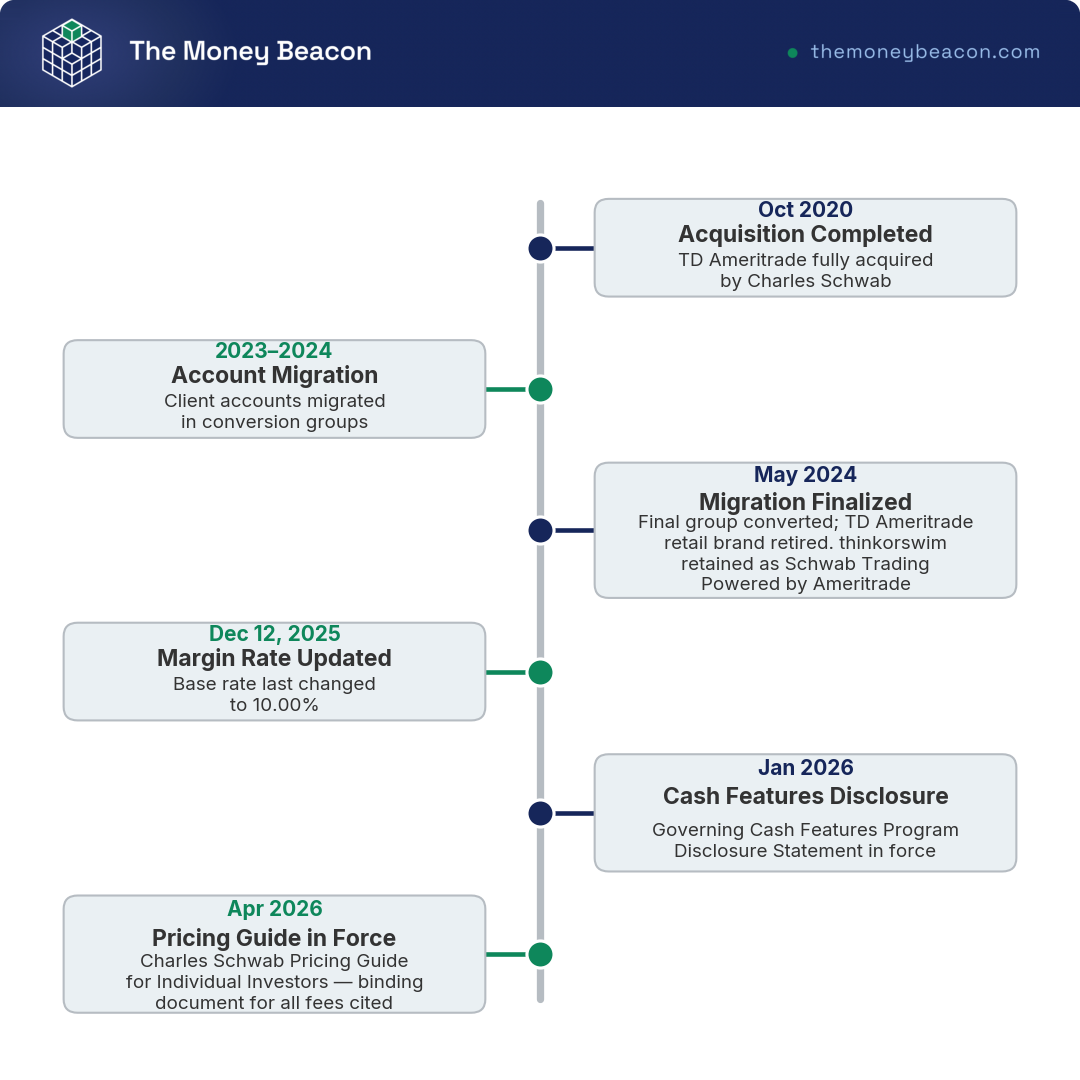
Schwab closed the TD Ameritrade acquisition in October 2020, moved client accounts across in conversion groups through 2023 and into 2024, and finished the last group in May 2024. The retail brand was retired after that. But thinkorswim came through intact in its desktop, web and mobile versions, and Schwab markets it as the flagship of Schwab Trading Powered by Ameritrade.
Converted clients kept up to 10 years of tax documents and trade confirmations, up to four years of transaction history, and realized gain and loss data for at least two years. What changed was the login, the account number, the mobile app conventions and the fee schedule.
So the Schwab TD Ameritrade migration isn’t a live risk in 2026; what it changed is which document governs. The Charles Schwab Pricing Guide for Individual Investors is dated April 2026, the Cash Features Program Disclosure Statement was republished in January 2026, and the margin base rate last changed on 12/12/2025.
Check the version date on any Schwab fee page against the April 2026 Pricing Guide, because the Pricing Guide binds and includes rows the web page leaves out. For a converted client the open question was never whether thinkorswim after the Schwab migration would survive. It’s which cash feature the account ended up on, and section 3 answers that.
2. What the Account Really Costs Once You Get Past the $0 Headline
You know who holds the money and which documents govern it. Now for the question every broker comparison starts with.
2.1 Where the $0 commission actually stops
So how much does Charles Schwab charge per trade? Nothing on an online order in a US exchange-listed security, what the rules call a national market system (NMS) security.
| Security type | Online | Automated phone | Broker-assisted |
|---|---|---|---|
| US exchange-listed (NMS) stocks and ETFs | $0 | $5 | $25 |
| US over-the-counter (non-NMS) equities | $6.95 | $6.95 plus $5 | $6.95 plus $25 |
| Canadian stocks traded on the US OTC market | $6.95 | $6.95 plus $5 | $6.95 plus $25 |
| Foreign ordinary shares traded on the US OTC market | $50 foreign transaction fee | $55 total | $75 total |
| Foreign ordinary shares placed directly on a foreign exchange | Not available | Not available | Greater of $100 or 0.75% of principal, no maximum |
Data current as of April 2026, from the Charles Schwab Pricing Guide for Individual Investors.
The top row is the one Schwab advertises. The other four are where a quiet year of small charges comes from.
One definition in that guide works in your favor. “Online” covers Schwab.com, thinkorswim desktop, web and mobile, Schwab Mobile, Schwab software and the Schwab application programming interfaces (APIs). So the professional platform costs you no more per trade than the browser does.
The trap is the second row. A ticker that looks like an ordinary stock can still be an over-the-counter (OTC) security at $6.95 a trade, and that catches plenty of American depositary receipts (ADRs), small banks, and some mining and cannabis stocks. Check the ticker before you order, and don’t call the desk for a routine trade, because that’s $25 every time.
The rest is short. Options are $0 base plus $0.65 per contract, waived on a buy-to-close at $0.05 or less, and futures are $2.25 per contract per side. New issues including brokered certificates of deposit (CDs) are $0, Treasurys are $0 online, and secondary bonds and CDs are $1 per bond, $10 minimum and $250 maximum.
Read like that, the big brokers’ schedules look identical, and it’s only in the exceptions that seven brokers score very differently.
2.2 One year, three investors, and the line that is not on the fee schedule
A price list isn’t a cost. To get a cost you have to pick an investor and run a full year.
| Cost line | A. Index investor (6 ETF trades/yr, $25,000 idle cash) | B. Options trader (100 contracts/month, $50,000 margin debit) | C. Fund investor (12 transaction-fee buys/yr) |
|---|---|---|---|
| Commissions | $0 | $0 base | $0 on equities |
| Per-contract options fees | $0 | $780 | $0 |
| Mutual fund transaction fees | $0 | $0 | Up to $599.40, or $120 via automatic investment plan |
| Margin interest | $0 | About $5,188 at 10.375% | $0 |
| Account service fee | $0 | $0 | $0 |
| Cash sweep opportunity cost | About $872 | About $872 if the same cash sits idle | About $872 |
| Visible annual total | $0 | About $5,968 | Up to $599 |
| True annual total including the sweep | About $872 | About $6,840 | Up to $1,471 |
Data current as of August 2026.
For column A, the investor Schwab attracts most, every visible charge is $0 and the year still costs about $872.
Column B is the one with real published prices in it. Schwab margin rates are tiered, from 11.825% on a debit under $25,000 down to 10.075% at $250,000, so a $50,000 debit is priced at 10.375% and costs roughly $5,188 a year on its own. Add $780 of per-contract fees and the visible bill is about $5,968.
Column C is where a fund investor gets caught. Twelve transaction-fee purchases cost up to $599.40, or $120 through the automatic investment plan at up to $10 a buy. Schwab is straight about why the top tier exists, charging up to $74.95 on funds “from certain fund families that do not pay Schwab for recordkeeping, shareholder, and other administrative services.” Two ways around it: buy direct from the fund company, or use that plan, though increased-fee funds aren’t eligible. And hold OneSource no-transaction-fee (NTF) funds more than 90 days, because selling inside the window costs $49.95.
3. The Cash Sweep: the Biggest Cost in the Account, and It Is on No Fee Page
You already have the headline: 0.01% on idle cash. Stretched over a decade it gets worse, and for most accounts you can’t fix it with a setting.
3.1 What 0.01% on idle cash actually costs you
The $872.50 gap I quoted is one year on one balance. Both of those move.
Take the balance to $100,000 and the same default costs about $3,490 a year. Stretch the clock instead. At constant rates, $25,000 in the sweep earns about $25 over ten years. The same money in SWVXX, the Schwab Prime Advantage Money Fund, earns about $10,265. That’s roughly $10,240 given up for never changing one setting, and the order of magnitude is the point, not the decimal.
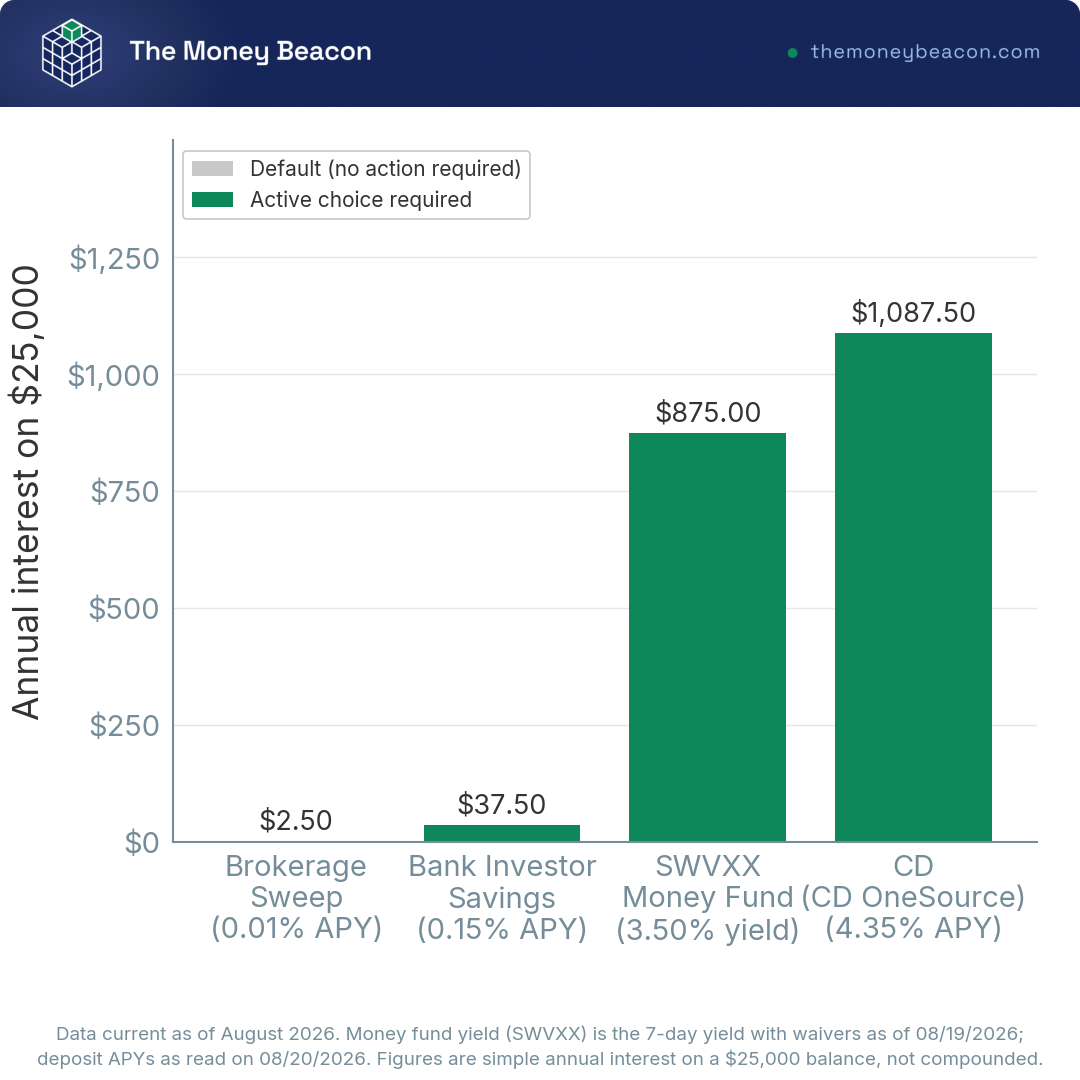
Investor Savings pays 0.15% annual percentage yield (APY), $37.50 on $25,000, and Schwab’s brokered CDs range from 3.85% to 4.35% APY. Money funds quote a 7-day yield while deposits quote an APY, so the two aren’t quite the same measure.
Then there’s the part nobody prices. Schwab uninvested cash interest is taxed as ordinary income at 10% to 37%, so a 0.01% sweep in a 24% bracket returns 0.0076% after federal tax. Sweep interest is both the lowest-yielding and the worst-taxed income the account produces, while a Treasury money fund’s income is generally exempt from state tax.
Hank’s take

after years of picking apart this kind of data, what strikes me is how much gets decided by settings nobody chose. A default is still a decision, and this one charges you for it.
So buy the money fund the same day you fund the account. The retail Schwab funds have a $0 minimum initial investment, so there’s no balance excuse. And if the cash isn’t earmarked for a trade at all, a high-yield savings account paying a competitive rate outside the brokerage is another place for it.
3.2 Why most accounts cannot simply switch the setting
The obvious answer is to change the setting. For most retail accounts there’s no setting to change.
Schwab offers three cash features, and eligibility rather than preference determines which one an account gets.
| Feature | Who is eligible | Where the money legally sits | Insurance | Yield mechanics |
|---|---|---|---|---|
| Bank Sweep | Most retail brokerage accounts | Deposit accounts at one or more affiliated program banks (Schwab Bank, Schwab Premier Bank) and, contractually, TD Bank and TD Bank USA | FDIC, $250,000 per depositor per program bank; balances can be spread across banks to extend coverage | Rates “may be set as low as possible, consistent with prevailing market and business conditions” |
| Schwab One Interest | Accounts approved for option trading, linked to Investor Checking, linked to a Schwab Crypto account, pledged against a Schwab bank line of credit, enrolled in portfolio margin, or designated pattern day traders | A direct obligation of Schwab, the broker-dealer | SIPC, within the $250,000 cash sub-limit; plus excess-of-SIPC | Tiered by balance ($0 to $24,999.99; $25,000 to $99,999.99; $100,000 to $249,999.99; $250,000 to $499,999.99; $1,000,000 and above). Schwab “has the option to pay as low a rate as possible” |
| Money Fund Sweep | Generally only managed accounts, some benefit plan accounts and other retirement accounts | Shares of a Schwab sweep money fund | SIPC as a security; not FDIC insured, can lose value | Fund yield, less fees and expenses |
All rows from the Cash Features Program Disclosure Statement, January 2026.
The third row settles it. Money Fund Sweep is the only feature that pays a fund yield automatically, and a standard self-directed taxable account can’t elect it. So the higher yield has to be a purchase you make and a sale you make, never a preference you set. The Schwab Bank Sweep rate isn’t negotiable either, and the disclosure publishes the Schwab One Interest balance tiers without the rates.
Watch the second row for a different reason. Getting approved for options, or linking an Investor Checking account, moves your cash to Schwab One Interest on at least 30 days’ written notice. That swaps FDIC insurance for SIPC’s cash sub-limit, as a side effect of a decision about something else.
The economics are disclosed too. Schwab writes that the affiliated program banks expect to earn more from lending and investing sweep deposits than Schwab earns from managing and distributing its own sweep money funds. It adds that it “may adjust eligibility for a particular sweep vehicle in part based on optimizing the financial benefits to Schwab.” So after any approval or account link, ask which cash feature you’re on and get the answer in writing.
3.3 How that default looks next to Fidelity, Vanguard and E*TRADE
A number needs a scale, so here’s Schwab on the same labels as the three brokers you’re most likely weighing it against.
| Label | Charles Schwab | Fidelity | Vanguard | E*TRADE |
|---|---|---|---|---|
| Positioning and audience | Full-service scale broker with branches, a bank and an active-trader platform | Full-service scale broker, zero-expense-ratio index funds | Client-owned, index-first, buy-and-hold | Self-directed broker inside Morgan Stanley |
| Online stock, ETF and option commission | $0 | $0 | $0 (broker-assisted $25) | $0 |
| Options per contract | $0.65 | $0.65 | $1.00 | $0.65, or 50 cents at 30+ trades a quarter |
| Transaction-fee mutual funds | Up to $49.95 or $74.95 per buy | $49.95 NTF short-term redemption (under 60 days) | $20 online, $20 plus $25 broker-assisted | Not asserted here |
| Account service fee | $0 | $0 | $25 | Not asserted here |
| Full transfer out | $50 | $0 | $100 | $75 for full transfers |
| Default for uninvested cash | Bank sweep at 0.01% APY | Not asserted here | Vanguard Federal Money Market Fund (VMFXX), 7-day SEC yield 3.61% as of 08/18/2026, expense ratio 0.11% | Not asserted here |
| Margin | 10.075% to 11.825% by tier | “As low as” 7.50% (lowest published tier) | Not asserted here | Not asserted here |
| SIPC | $500,000 including $250,000 cash | $500,000 including $250,000 cash | Settlement fund SIPC-covered up to $500,000 | $500,000 including $250,000 cash |
| Excess of SIPC | $600 million aggregate | $1 billion aggregate | Not asserted here | $1 billion aggregate for securities, $1.9 million per client for uninvested cash |
| Cash / deposit products | CDs 3.85% to 4.35% APY; Investor Savings 0.15% | Not asserted here | Not asserted here | Premium Savings 4.00% APY; Max-Rate Checking up to 2.00% APY; CDs up to 4.35% APY |
Data current as of August 2026. Each column is taken only from that firm’s own site.
Run down the rows and Schwab is average on almost every published line, then an outlier on one.
Start with the fee to leave. $50 is worse than Fidelity’s $0 transfer-out policy and better than Vanguard’s $100 or E*TRADE’s $75, which puts Schwab in the middle. Margin tells the same story, Schwab’s 10.075% to 11.825% against Fidelity’s published “as low as” 7.50%.
Schwab vs Fidelity on the cash sweep is the comparison readers ask for most, but Fidelity publishes no default cash rate. Vanguard does: its default settlement fund yields 3.61% against Schwab’s bank sweep at 0.01%. On $25,000 that’s roughly $900 a year of difference, and the Vanguard customer does nothing to get it. Vanguard does charge a $25 account service fee where Schwab charges none, and whether that $25 fee still pays for itself is its own question.
That’s the case against the account, quantified. So what does Schwab hand back?
4. What Schwab Gives Back: the Platform, the Bank Tie-In and the Record Behind Them
Three things go on the other side: the platform, the bank tie-in, and the public record.
4.1 thinkorswim is free, and here is what it asks of you
Every thinkorswim review opens with the feature list, so let’s take that fast.
Desktop, web and mobile all come free, each with paperMoney, where you place simulated orders with nothing at risk. Add hundreds of indicators and studies, 24/5 trading on more than 1,300 stocks and exchange-traded funds (ETFs), and a 30-day Guest Pass if you want to try before opening. There’s no minimum funding. Bundled research (Morningstar, Argus Research, S&P Capital IQ, Schwab’s own Equity Ratings) is free with any account, so a $500 account sees what a $5 million account sees. A trade desk at 888-245-6864 is advertised 24/7.
What the platform asks of you is approvals, not money. Options run through four approval levels. Margin needs approval plus at least $2,000 in cash or marginable securities. Day trading requires $25,000 of equity at all times. Futures and forex need a separate agreement with the futures affiliate. Market data is included for standard retail use, though a professional classification costs $31.50 to $241.50 a month. Schwab’s FAQ describes a review running several business days, so file early, the way a careful beginner’s path into trading front-loads the paperwork.
4.2 The checking and debit tie-in, priced out to one number
Schwab Bank Investor Checking only exists linked to a Schwab One brokerage account. No monthly service fee, no overdraft fee, no minimum, no foreign transaction fee, and unlimited ATM rebates on cash withdrawals worldwide.
On realistic assumptions of my own: two out-of-network domestic withdrawals a month at $3.00 come to $72 a year, six abroad at $5.00 add $30, a dodged 3% foreign transaction fee on $5,000 of foreign spending saves $150, and a skipped $12 monthly fee elsewhere is another $144. Call it $396 gross.
Investor Checking pays the same 0.01% the sweep pays, so a $10,000 buffer gives up about $349 a year against a 3.50% money fund. Net benefit, roughly $47. At a $2,500 float the $396 easily beats the $87 forgone; at $25,000 the free account costs you about $476 a year.
Two details narrow that. The rebate covers only ATM cash withdrawals in local currency on the Schwab Bank debit card, and Schwab can end it at any time. Linking checking also moves the brokerage sweep to Schwab One Interest, so consolidating for safety can shrink the insurance perimeter rather than widen it.
Tom’s take
running a company taught me one rule about operating cash: fund what the month needs, then make every dollar past that earn.
So keep the float at a few thousand dollars and the rest in a money fund. I used the same lens on how six no-fee checking accounts stack up.
4.3 What the complaint and enforcement record actually shows
Charles Schwab reviews and complaints fill forum threads. The official file is better evidence.
The Consumer Financial Protection Bureau (CFPB) publishes every complaint filed against a company. As of August 20, 2026, Schwab’s file holds 360 complaints over 12 months against 193 the year before. Of those, 304 concerned checking or savings and 44 money transfers, and managing an account tops the issue list at 202.
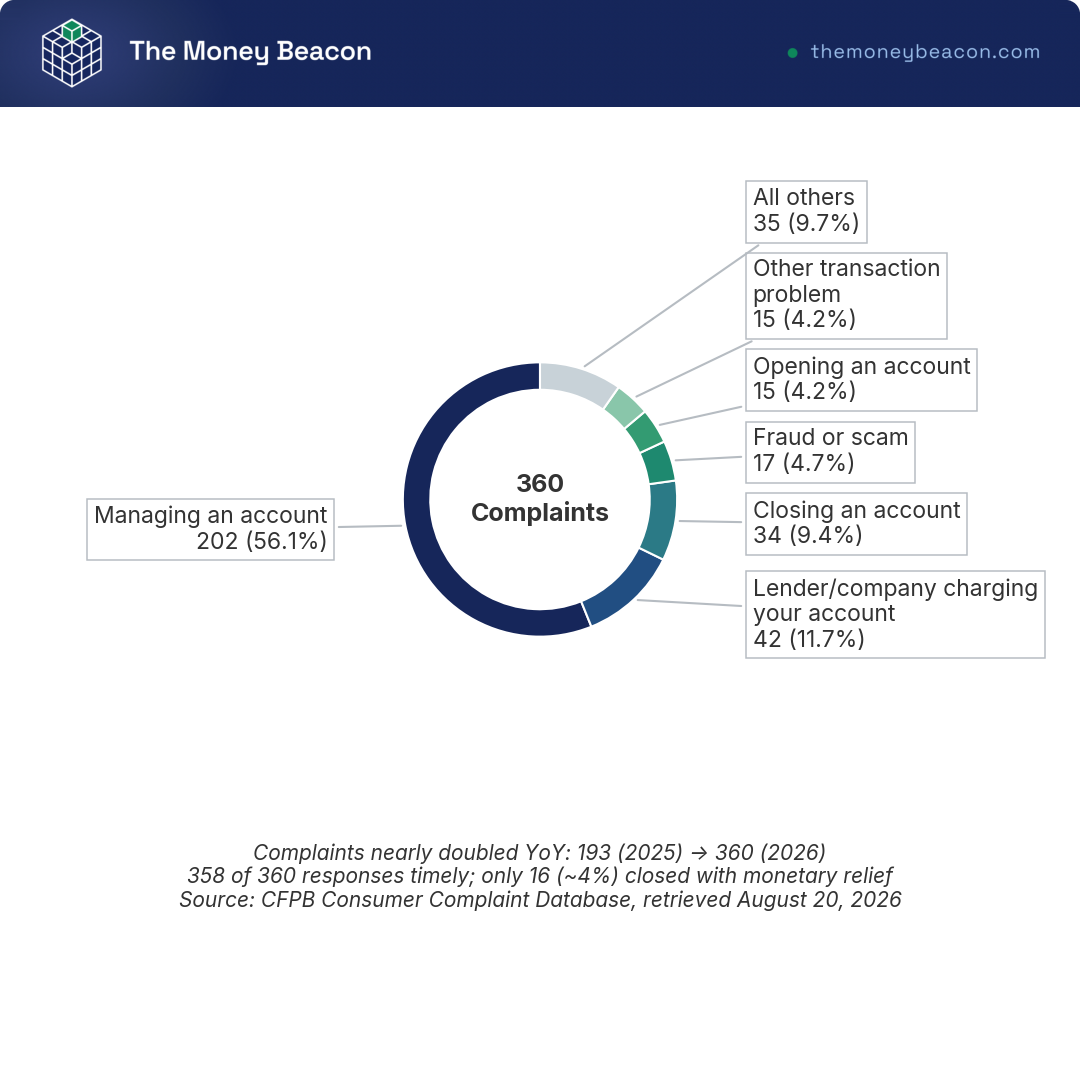
The process looks strong; the remedy looks limited. 358 were answered on time and 337 closed with an explanation, while just 16, about 4%, closed with monetary relief.
One enforcement entry matters here. On June 13, 2022 the SEC charged three Charles Schwab investment adviser subsidiaries over undisclosed cash drag in the Schwab Intelligent Portfolios robo-adviser: cash was swept to the affiliated bank and lent out. They paid $187 million ($52 million in disgorgement and interest plus a $135 million penalty) without admitting or denying the findings. FINRA BrokerCheck lists 319 disclosure events on the firm record, Central Registration Depository (CRD) number 5393, as of July 31, 2026.
Two qualifications matter. The CFPB database covers consumer banking, while brokerage disputes go to FINRA and the SEC, so it distorts any read on brokerage service. And the 2022 order covered 2015 to 2018 conduct in another product, though the same cash-drag economics behind how robo-advisors compare on cash drag and fees still set the 0.01% today. The disclosure got fixed. The incentive didn’t.
5. The Verdict: Should You Open a Charles Schwab Brokerage Account?
Every line is priced now, the give-backs included. So who should open one, and who should walk.
5.1 Who this account fits, and who should open one somewhere else
Is Charles Schwab good? The Schwab pros and cons come out differently person to person, and one variable does most of the sorting: how much idle cash you carry, and whether you’ll manage it.
It fits the active options, futures or day trader most cleanly. thinkorswim costs nothing, options are $0.65 a contract and futures $2.25 per contract per side. Execution is measured, not asserted: $966 million of price improvement, meaning fills better than the displayed quote, on 97% of orders in the second quarter of 2026.
It fits the buy-and-hold index investor whose idle cash stays small. You get $0 commissions and fractional shares from $1. SWPPX charges a 0.020% expense ratio against SWTSX at 0.030%, neither with a minimum, and both hold up against seven more index funds on expense ratio. It fits the former TD Ameritrade client whose platform survived the May 2024 conversion, with one job left: confirm which cash feature the account ended up on. And it fits the consolidator at a small checking float, worth roughly $47 a year.
It doesn’t fit three people. The cash-heavy saver who won’t manage the balance forgoes about $350 a year per $10,000 left idle. The set-and-forget investor who wants the default itself to be right belongs at Vanguard, whose settlement fund yields 3.61% where Schwab’s pays 0.01%. And the margin shopper pays 11.825% below a $25,000 debit balance against Fidelity’s published “as low as” 7.50%.
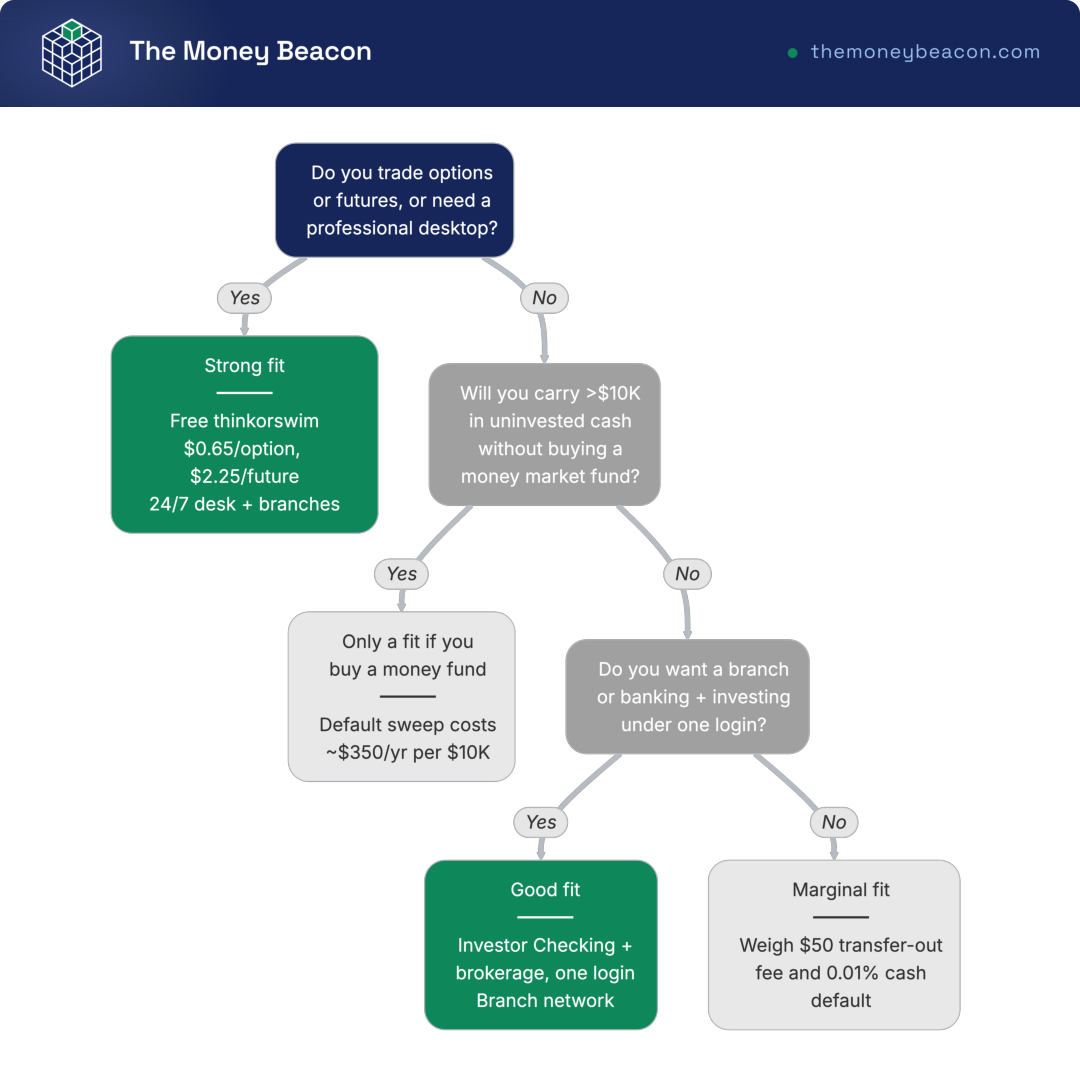
Whichever profile you’re in, settle your cash answer before you open, not after.
5.2 The verdict on the four questions that settle it
Is Schwab worth it? Four questions opened this review, and here’s where each one lands.
Trading comes out genuinely cheap and fully disclosed, with channel traps and fund traps you can avoid once you know they’re there. The cash sweep is the decisive flaw, fixable in one purchase but only by a customer who knows to make it. The platforms still earn their reputation and are the strongest part of the offer. The banking tie-in is worth about $47 net on a $10,000 balance, clearly positive at a $2,500 float, a loss at $25,000.
So here’s the ruling, no hedging. Open the account, then change the cash setting the same day, and don’t open it if you won’t. Schwab all but writes that instruction itself: its own disclosure says the cash features “are not intended for long-term investments” and that yields may be lower elsewhere. Then re-check the sweep rate against the money fund yield once a quarter, because rates move and the default doesn’t, the same discipline behind matching each account to its goal’s horizon.
| Decision point | The published fact | What it costs or saves in dollars | Verdict |
|---|---|---|---|
| 1. What trading really costs | $0 online listed equities and ETFs; $0.65 per option contract; $2.25 per futures contract; $6.95 OTC; up to $74.95 per transaction-fee fund buy; $25 broker-assisted; $50 full transfer out; no account fee; $0 minimum | An index investor pays $0 a year; an options trader at 100 contracts a month pays $780; a monthly transaction-fee fund buyer pays up to $599 | Genuinely cheap, and fully disclosed. The traps are channel traps and fund traps, all avoidable |
| 2. What the cash sweep takes | Uninvested cash 0.01% APY; SWVXX 3.50%; Investor Savings 0.15%; CDs 3.85% to 4.35%; most retail accounts cannot elect a money fund sweep; rates “may be set as low as possible” | About $872 a year forgone on $25,000; about $3,490 on $100,000; roughly $10,240 over ten years on $25,000 | The decisive flaw. Fixable in one purchase, but only by a customer who knows to make it |
| 3. Whether the platforms still earn it | thinkorswim desktop, web and mobile free; paperMoney; 24/5 on 1,300+ stocks and ETFs; $25,000 equity to day trade; app ratings 4.8 (Schwab Mobile) and 4.7 (thinkorswim) | $0 for a platform tier that competitors charge for or do not have | Yes. The migration is finished and the platform is the strongest part of the offer |
| 4. What the banking tie-in is worth | No monthly fee, no overdraft fee, no foreign transaction fee, unlimited ATM rebates on cash withdrawals; 0.01% APY; linking checking moves the brokerage sweep to Schwab One Interest | About $396 of gross benefits, minus about $349 forgone on a $10,000 balance, net about $47 | Worth it at a $2,500 float, a net loss at $25,000 |
| Overall | A cheap, well-equipped, well-regulated brokerage account with an expensive default setting | The account’s true annual cost for a typical user is not on the fee schedule | Open it, then change the cash setting the same day. Do not open it if you will not |
Data current as of August 2026.
Conclusion
Charles Schwab is a cheap, well-equipped brokerage account with one expensive setting switched on by default, and nothing I found changed that ruling. But the sweep pays 0.01% and quietly costs you about $872 a year on $25,000 of uninvested cash. That’s the review in one line: the account is good, the default is not, and Schwab tells you plainly that it won’t call you when a better cash option exists.
So my answer stays conditional, and I mean the condition. Open the account, then the same day, before your first trade, put the cash you aren’t investing yet into the money market fund. One purchase and a few minutes of your time turn $2.50 a year on $25,000 into roughly $875. If you already know you won’t do that, or won’t re-check the yield each quarter, this isn’t your broker, and the verdict above pointed you somewhere better.
The number that determines your next decade rarely shows up on a fee schedule; it’s buried in a setting you accepted without reading it. Most people find that out years later, from a statement.
To dig deeper, how investment income is taxed in 2026 explains why a money fund yield is taxed as ordinary income. If it’s cash you won’t need for a year, the best CD rates of 2026 covers the other option. And once the cash question is settled, investing in the stock market from as little as $1 is where to go next.
FAQ
Is there a minimum deposit to open a Charles Schwab brokerage account?
No. The April 2026 Pricing Guide sets a $0 minimum deposit for the Schwab One account, Schwab individual retirement accounts (IRAs), education savings and custodial accounts, and the small-business retirement plans, and Schwab says no minimum funding is required to open an account and use thinkorswim. Activity gates you, not the account itself: you need $2,000 in cash or marginable securities to borrow on margin, and $25,000 of equity maintained at all times to day trade. If you’re funding a Roth IRA here, the same $0 rule applies.
What does Schwab pay on uninvested cash, and can I change the default sweep?
Not much. The default sweep pays just 0.01% APY, and moving off it isn’t simple. Per the Cash Features Program Disclosure Statement from January 2026, most accounts qualify only for Bank Sweep or Schwab One Interest; the higher-paying Money Fund Sweep Feature is generally reserved for managed accounts and certain retirement plans. My workaround: skip the sweep and buy a money market fund as a regular trade instead. SWVXX showed a 3.50% seven-day yield with waivers as of August 19, 2026, with no minimum to buy in. A sweep change usually takes effect the next business day, costing you a day or two of interest.
Does Schwab charge a fee to transfer my account to another broker?
Yes, if you’re leaving entirely. The April 2026 Pricing Guide lists $50 for a full transfer out of a Schwab account, and $0 for a partial transfer. I checked that figure against the rivals in this review, and Schwab lands in the middle: Fidelity charges $0 to leave, E*TRADE charges $75, and Vanguard charges $100 for a full closure and transfer. The Pricing Guide doesn’t spell out what happens if you transfer part of the account and then close what’s left, so call Schwab directly and confirm that sequence first.
Is thinkorswim free at Schwab, and do I need it?
It’s free, and it survived the TD Ameritrade migration that Schwab finished in May 2024 by keeping thinkorswim rather than retiring it. Desktop, web and mobile all come at no charge, paperMoney paper trading is included, and no minimum funding is required. A 30-day Guest Pass lets a non-client try it first. Because Schwab defines an “online” trade to include thinkorswim, what you pay per trade there is the same $0 as on Schwab.com. You need it for options, futures and multi-leg spreads; Schwab.com and the mobile app handle plain buy-and-hold investing just fine.
Is my money safe at Schwab, and what do SIPC and FDIC actually cover?
They protect different things, and neither covers a market downturn. Securities and cash in the brokerage account at Charles Schwab & Co., Inc. carry SIPC (Securities Investor Protection Corporation) coverage of $500,000 per customer, including a $250,000 sub-limit for cash, plus Schwab’s own excess-of-SIPC policy capped at $600 million across every client, not per account. Cash swept into Bank Sweep, plus Investor Checking and Investor Savings balances, sits instead at Charles Schwab Bank, SSB, where FDIC (Federal Deposit Insurance Corporation) insurance covers $250,000 per depositor per ownership category, combined across those accounts at that one bank. Futures positions and cash in a futures account get neither.
What is the downside to Charles Schwab?
The cash default costs real money. Uninvested cash sits at 0.01% APY while Schwab’s own SWVXX money market fund showed a 3.50% seven-day yield as of August 19, 2026, a gap worth roughly $872 a year on a $25,000 cash balance in the same account. Most standard accounts can’t elect the higher-paying sweep either, so fixing it means buying the fund yourself. Schwab’s own disclosures say Bank Sweep rates “may be set as low as possible” and that it isn’t responsible for telling you when something better becomes available. Smaller downsides follow: $50 to transfer out in full, up to $74.95 to buy a non-OneSource fund, and margin as high as 11.825% under a $25,000 debit balance.
How does Schwab make money if trades are free?
Three ways I could verify in Schwab’s own filings. The biggest is the spread on cash: banks holding swept deposits lend and invest that money and keep the difference, and Schwab discloses those banks expect to earn more from it than Schwab earns running its own sweep money funds. Second is order flow: Schwab states it “maintains arrangements with various exchanges and liquidity providers and receives compensation based upon the order flow executed at each destination,” and that most orders result in rebates, while reporting $966 million in price improvement on 97% of orders in the second quarter of 2026. Third is the visible fee schedule: margin interest, transaction-fee fund charges, and service charges on top of the free trade.




Comments
Questions and corrections welcome. We read everything.