


A 0.25% advisory fee sounds like a rounding error until you turn it into dollars. Put $100,000 into a Wealthfront Automated Investing Account and you’re paying about $250 a year, on top of the expense ratios the funds inside the portfolio charge you. That bill comes back every year, and it grows as your balance grows. A recurring dollar amount is harder to skim past on a statement, and that’s what this review is really about.
The first thing I went looking for was that dollar total, and Wealthfront’s own pricing page doesn’t give it. What it shows you is $3.18 a month, plus a claim that tax-loss harvesting covers the fee 6x. You have to dig into the help center before anyone shows you the arithmetic on a real account size.
And the cheaper ways to automate aren’t obscure. Schwab Intelligent Portfolios charges no advisory fee at all. Wealthfront’s rate is flat at every balance, with no discount as your account grows, so that fee has to buy you something the cheaper options don’t.
This review prices Wealthfront the way you’d price any other recurring expense: what the fees cost at your own balance, whether the tax features give back more than they take, and whether the Cash Account beats a plain high-yield savings account. Then the question that’s left: is it worth it, and for whom?
1. What Wealthfront is, and what you can actually open
Before any fee math means anything, you need to know what you’d be buying and who would be holding it. Wealthfront isn’t one product. It’s a stack of them, priced at four different advisory rates, and the account you open decides which rate you pay.
1.1 Who is actually holding your money
Start with the paperwork, because what looks like one app is really three companies.
Wealthfront Advisers LLC is the investment adviser registered with the Securities and Exchange Commission (SEC), and it manages your portfolio on a discretionary basis. Wealthfront Brokerage LLC is the affiliated broker-dealer that carries the client brokerage accounts. Forge Trust Co. is the custodian of clients’ individual retirement accounts (IRAs), so your retirement money is held somewhere your taxable money isn’t.
Wealthfront’s Form ADV Part 2A puts it in one sentence. “Neither Wealthfront Brokerage nor its affiliates are a bank.” That isn’t a warning. It tells you which insurance covers which money. Your invested money is brokerage money, and the cash side is a deposit product insured through outside banks.
Wealthfront Advisers reported about $46 billion of discretionary client assets as of March 31, 2026, across 1.44 million funded clients. Divide it out and the average funded balance is near $32,000, well below the $100,000 line where the platform’s headline tax feature switches on.
The split isn’t unique to Wealthfront, and we compare six platforms built the same way elsewhere.
1.2 Ten products, four fee rates, and the minimums that gate them
So what can you actually open, and at what price?
Wealthfront product lineup, minimums and advisory fee
| Product | What it is for | Minimum to open | Annual advisory fee | As-of |
|---|---|---|---|---|
| Automated Investing Account | Discretionary ETF portfolio, rebalanced and harvested | $500 | 0.25% | July 23, 2026 |
| Automated Bond Portfolio | Discretionary bond-ETF portfolio for medium-term money | $500 | 0.25% | July 23, 2026 |
| Automated Bond Ladder | Ladder of US Treasuries held to maturity | $500 | 0.15%, waived for 3 months on a client’s first ladder | July 23, 2026 |
| S&P 500 Direct | Direct-indexed S&P 500, stock-level harvesting | $5,000 | 0.09% | July 23, 2026 |
| Nasdaq-100 Direct | Direct-indexed Nasdaq-100 | $5,000 | 0.12% | July 23, 2026 |
| US Direct Indexing (inside Automated Investing) | Stock-level harvesting on the US-equity sleeve | $100,000 balance | Included in the 0.25% | August 23, 2026 |
| Stock Investing Account | Self-directed stock and ETF picking | $1 | No out-of-pocket advisory fee | July 23, 2026 |
| Cash Account | Cash management with debit card, bill pay, direct deposit | $1 | $0 account fees | January 30, 2026 |
| IRAs (traditional, Roth, SEP) and 401(k) rollovers | Tax-advantaged retirement wrappers | The $500 automated-account minimum applies to the managed portfolio inside | 0.25% on the automated portfolio | July 23, 2026 |
| 529 College Savings Account | Education savings wrapper, open to new clients | $500 initial contribution | 0.25%, waived on the first $25,000 for Nevada residents | August 23, 2026 |
Data current as of August 2026.
The flagship is the Automated Investing Account, a discretionary portfolio of exchange-traded funds (ETFs) at 0.25%, and it’s the only product on that list that offers tax-loss harvesting.
The advisory fee is charged per product rather than per household, so an Automated Investing Account and an Automated Bond Ladder are billed 0.25% and 0.15% on their own balances. And there’s a $500 floor on the way out, since a withdrawal can’t take an automated account, a bond product or a direct-indexing account below it.
On a $100,000 Automated Investing Account, the advisory fee is deducted no later than the tenth business day of the following month, $20.55 at a time, so your first month looks free and isn’t.
By contrast, a self-directed account has no advisory rate at all, and it’s worth knowing what a plain self-directed account costs elsewhere.
2. What it costs you in dollars, not basis points
But a rate isn’t a cost, and a quarter of a percent is designed to feel like nothing. So what does the automation actually take out of your account in a year, once every layer is counted?
2.1 Two fee layers, and only one of them gets advertised
The first is the advisory fee, 0.25% a year on the Automated Investing Account, stated in Form ADV Part 2A dated July 23, 2026. The second is the expense ratio charged inside each ETF the portfolio holds.
I went through Wealthfront’s own investment catalog to price that second layer. VTI, VEA, VTEB, SCHP and BND all charge 0.030%. VIG charges 0.040%, VWO 0.060%, and VNQ 0.130%, all retrieved August 23, 2026.
Here’s the limit on that number. Wealthfront publishes the catalog as the funds it offers, explicitly not as the Classic portfolio’s weights, so there’s no weighted average to quote. The all-in cost is a band rather than a single figure, 0.280% to 0.380% a year, advisory fee plus fund layer.
In dollars that’s $28 to $38 a year on $10,000, $280 to $380 on $100,000, and $1,400 to $1,900 on $500,000. Set beside the same asset classes held directly, it looks like this.
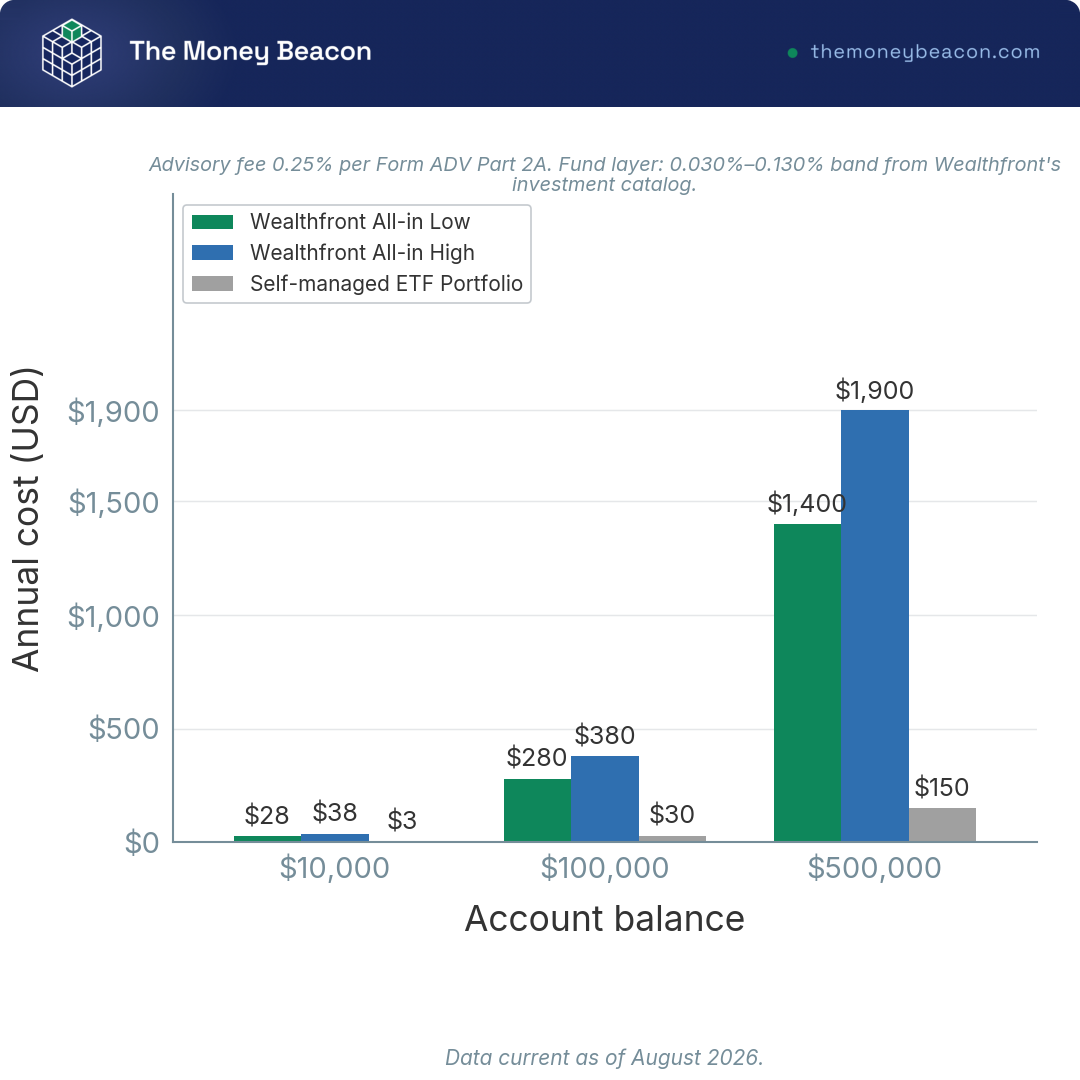
The fund layer is the part most people forget. It isn’t paid to Wealthfront. It’s deducted inside the ETFs, which is why it never appears on the pricing page. It scales too, from about $3 a year at $10,000 to $650 at $500,000.
Hold those asset classes directly and the whole bill is about $30 a year per $100,000, and you can check how those expense ratios compare fund by fund. The automation layer is the difference.
2.2 The charges that survive the “no fees” claim
After the two fee layers, what else do you actually pay?
Not much. Form CRS, dated July 23, 2026, records no account-opening, withdrawal, closing, trading or transfer fees. That last one is the standard broker-to-broker move, known as an ACATS transfer.
What Wealthfront charges, and what it says it doesn’t
| Item | Wealthfront charge |
|---|---|
| Account opening, withdrawal, account closing | $0 |
| Trading and commissions | $0 |
| ACATS account transfer out | $0 |
| Cash Account monthly or maintenance fee | $0 |
| Wire transfer, domestic or international | No Wealthfront fee; the receiving institution may charge one |
| Bond Ladder early withdrawal | No fee, but selling before maturity can reduce yield |
| In-network ATM withdrawal (about 19,000 fee-free ATMs nationwide) | $0 |
| Out-of-network ATM | $2.50 plus the ATM owner’s fee, set by Green Dot Bank |
| Debit card foreign transaction | 2.75% |
Data current as of August 2026.
Exactly two out-of-pocket charges apply to a normal customer, and both are on the debit card. Part of the out-of-network ATM fee comes back: Wealthfront reimburses up to $7.50 on each of your first two domestic withdrawals a month. The foreign transaction fee is 2.75% and isn’t reimbursed at all, so $5,000 of spending abroad costs you $137.50.
The $0 to leave is genuinely unusual. And if you’d use the card day to day, compare the same out-of-network ATM math on a checking account.
2.3 By year 30, a quarter of a percent is $51,231
Per year, that cost is small. The framing that changes the answer is the ending balance.
Take $100,000, leave it alone for thirty years, and grow it at 7% gross a year with costs deducted annually, no contributions and no taxes. The 7% is an illustration, not a forecast. At a 0.030% annual cost the money reaches $754,864, against $703,633 at 0.280% and $684,070 at 0.380%.
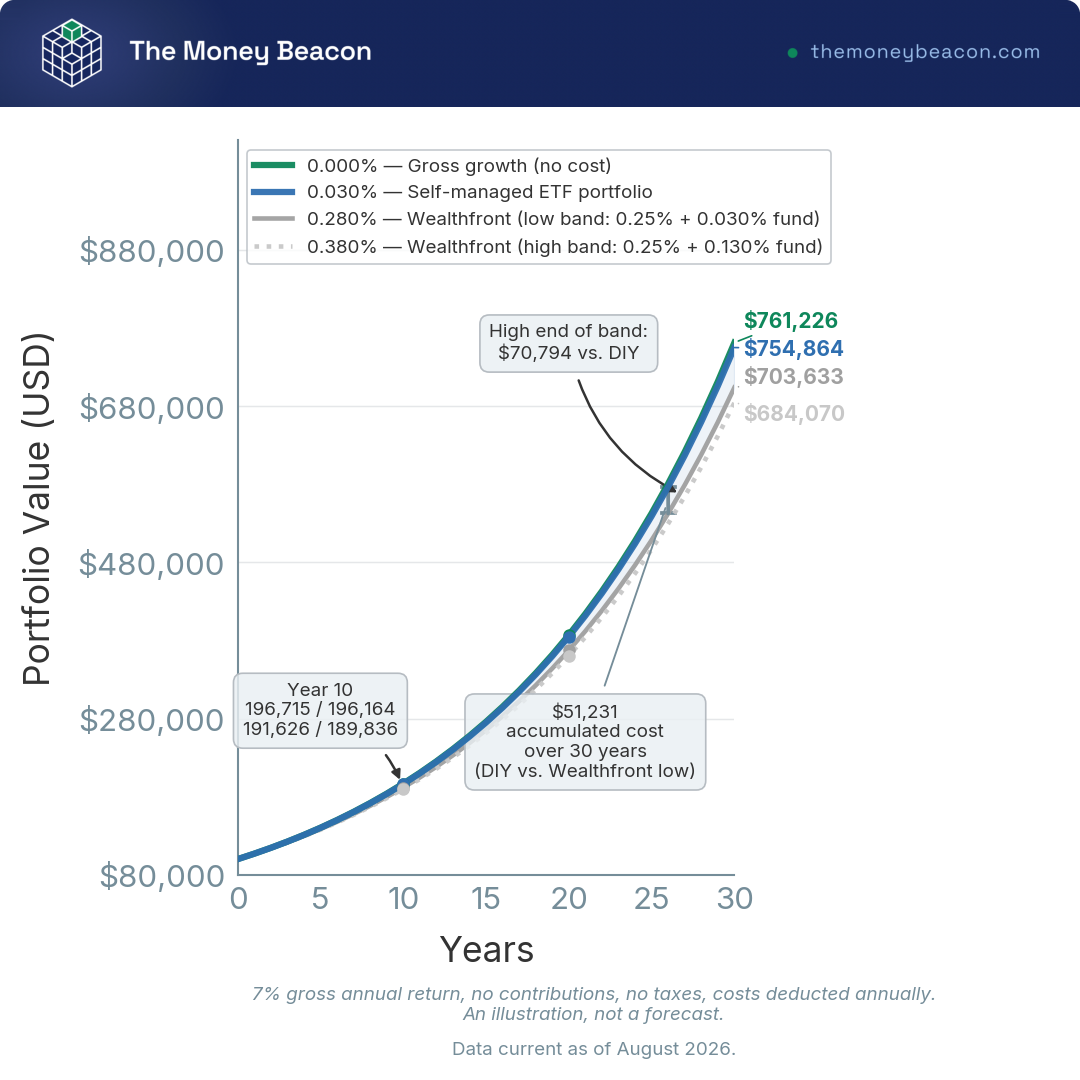
The shaded band is the cost gap against holding the same asset classes directly: $51,231 at the low end of the all-in band, $70,794 at the high end.
Both framings are true at once. $51,231 over thirty years is most of a year of retirement spending. The same cost at the start is under $12 a week.
Hank’s take

after years spent picking apart long-run return data, the cost line is the one input you can actually control. Markets do what they do, but a fee you pay every year compounds against you with exactly the same reliability that returns compound for you.
For the other end of the cost spectrum, see our review of a near-zero fee surface and nothing else. And read the chart at the balance you expect in fifteen years, not the one you’re opening with, because the drag is a share of the ending number.
3. Do the tax features earn the fee back?
That’s the case against the fee. Wealthfront’s answer to it is tax, and the claim is specific: harvest losses year after year and the tax you avoid covers the 0.25% several times over.
3.1 The $100,000 line, and what changes when you cross it
One threshold decides which product you’d actually be buying.
US Direct Indexing, the stock-level harvesting feature, carries a $100,000 account minimum and is, in Wealthfront’s own words, “included in our 0.25% advisory fee.” Below that balance the US-equity sleeve of an Automated Investing Account “will hold VTI (or ITOT),” a single total-market fund.
So the same 0.25% buys a materially different product on either side of $100,000. Below the line, harvesting happens at the fund level only. Above it, that sleeve becomes a basket of individual stocks and losses can be booked one company at a time.
The 0.25% account isn’t the cheapest route into stock-level harvesting, either. S&P 500 Direct starts at $5,000 and charges 0.09%, and Nasdaq-100 Direct charges 0.12% on the same minimum. Both are standalone products, and neither is inside the Automated Investing Account.
One thing the threshold doesn’t change: harvesting produces losses, not returns. Crossing $100,000 changes what the fee buys only if you have realized gains for those losses to offset.
3.2 The loss you need every year just to break even
The break-even is a single division. To cover a 0.25% advisory fee, your harvested losses have to equal 0.25% divided by the rate the loss is deducted at. Run that across the rate schedule on a $100,000 account.
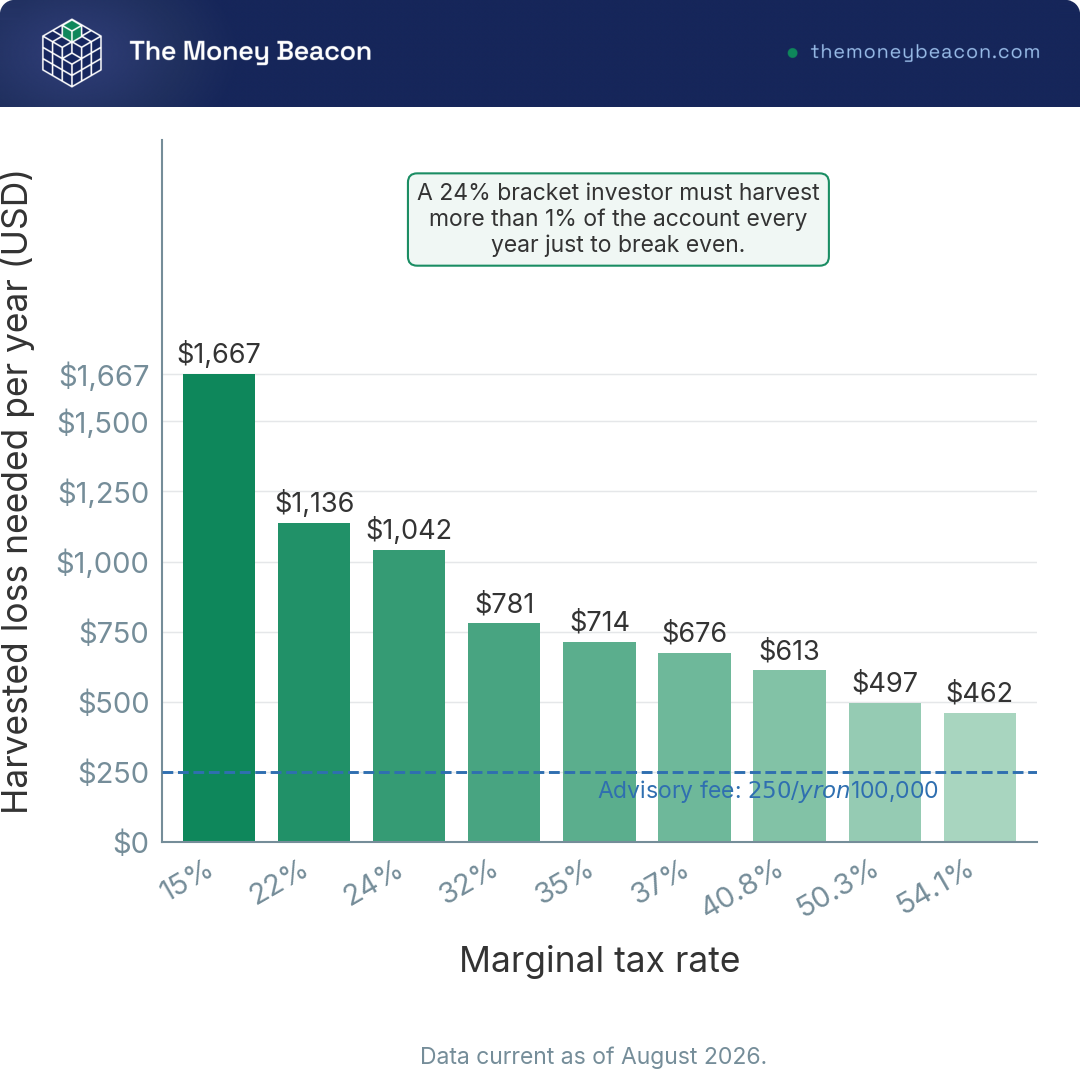
At a 15% long-term capital-gains rate you need to harvest 1.67% of the balance every year, $1,667 on $100,000. At the 24% federal bracket it’s $1,042, and at 37%, the top federal bracket, $676.
Keep two labels apart here, because the math falls apart if you blur them. A federal bracket is 22%, 24%, 32%, 35% or 37%. A combined marginal rate adds the 3.8% net investment income tax (NIIT) and your state on top, and it’s your state’s rate that brings the requirement below half a percent, to 0.50% at a combined 50.3%.
At a combined 40.8%, the top bracket plus the NIIT, it’s $613. Add California’s 13.3% top rate for a combined 54.1% and it’s 0.46%, or $462 a year against a $250 advisory fee. Read the chart at your own combined rate, not your bracket alone. And if you’re unsure which income the 3.8% charge reaches, we cover why the 3.8% NIIT stacks on top of your bracket.
Wealthfront checks for harvesting opportunities every trading day, so it’s real rather than a once-a-December gesture. And harvesting defers tax rather than erasing it, because every booked loss lowers your cost basis and enlarges the gain you eventually realize.
3.3 Where it is worth nothing, and what the SEC had to say
All of that assumes a taxable account, and Wealthfront draws the boundary itself in two sentences. “Tax-Loss Harvesting is only relevant to taxable accounts,” and “We only offer Tax-Loss Harvesting for the Automated Investing Account.” So in a traditional IRA, a Roth IRA, a SEP IRA, a 401(k) rollover or the Stock Investing Account, the 0.25% buys allocation and rebalancing and nothing tax-related at all.
Even in a taxable account, two limits apply. Losses offset realized capital gains first, then ordinary income, and that second offset is capped at $3,000 of ordinary income a year. The wash-sale rule then disallows the loss outright if a substantially identical security is bought within 30 days either side of the sale. That holds in any account you control, including a spouse’s or an employer plan Wealthfront can’t see.
Then there’s the marketing. The pricing page shows a $3.18 monthly advisory fee beside $78.11 of potential tax savings, calls harvesting 6x the fee, and says 97% of Classic portfolio clients had their fees covered. It publishes no balance, no rate and no period behind any of it. And $3.18 a month is roughly $38 a year, which makes $78.11 about 2x the fee, not 6x.
Wealthfront’s own Form ADV Part 2A, Item 9 discloses a $250,000 SEC penalty settled December 21, 2018 over how tax-loss harvesting was described.
So the tax case is real, it runs daily, and it clears the fee comfortably at high combined marginal rates when there are gains to offset. Either way, it only touches invested money. One Wealthfront product carries no advisory fee at all, and that’s the one you might want even with no interest in robo-investing.
4. Is the Cash Account better than the savings account you already have?
4.1 The 4.20% headline, and the 3.30% you actually get
That product is the Cash Account, with no account fees, so the rate is the only thing you’re judging. Wealthfront leads with an annual percentage yield (APY) of 4.20%. The program banks pay 3.30%, unconditionally.
The Cash Account APY stack
| Component | Rate | Condition | Duration | Balance cap | As-of |
|---|---|---|---|---|---|
| Base APY paid by the program banks | 3.30% | None | Ongoing, variable | None stated | January 30, 2026 |
| New-client boost | plus 0.65%, producing 3.95% | New client | 3 months | Up to $150,000 | January 30, 2026 |
| Direct-deposit boost | plus 0.25% | Direct deposit of $1,000 a month, plus opening and funding any investing account | No expiration date | No balance limit | January 30, 2026 |
| Headline maximum, both boosts stacked | 4.20% | Both conditions met | 3 months | Effectively $150,000 for the stacked rate | January 30, 2026 |
Data current as of January 2026.
Two boosts explain the difference: 0.65% for three months capped at $150,000, and 0.25% with no expiry in exchange for $1,000 a month of direct deposit plus a funded investing account. So 4.20% means three months, on $150,000, for someone who has done both. The honest number to set against a standalone high-yield savings account is 3.30%, or 3.55% if your paycheck really lands there. It still pays: $25,000 earns $825 a year against about $2.50 at the 0.01% that uninvested cash earns in a Schwab brokerage account. Compare it with what a standalone savings account pays with no conditions and with the 0.01% a brokerage sweep pays instead.
4.2 Where the $8 million of FDIC coverage actually comes from
Outside banks pay that rate, so your deposit insurance runs through them. Wealthfront’s published list has 52 entries as of July 28, 2026, headed by Goldman Sachs Bank USA. Provident Bank is flagged as a planned addition, so 51 are live. The Cash Sweep Program disclosure of February 10, 2026 sets Federal Deposit Insurance Corporation (FDIC) pass-through at “up to $250,000 (or $500,000 for joint accounts) per bank, per ownership category.”
Let’s multiply it out. 51 banks at $250,000 is $12,750,000 individual and $25,500,000 joint, far above the advertised $8 million and $16 million. That $8 million is a cap Wealthfront sets, not the maximum the network could carry, so never assume a dollar above it is swept and insured.
The pass-through breaks a second way if your own bank is on that list, because those deposits count against the same $250,000 there. Wealthfront publishes no way to exclude a bank, so the monthly Cash Account statement is where you learn who holds your money.
5. So is it worth 0.25% a year, and who for?
5.1 How it compares to Betterment, Schwab and Vanguard
A quarter of a percent is only expensive or cheap next to what the same money buys you elsewhere.
Positioning grid, first-party figures only
| Criterion | Wealthfront | Betterment | Charles Schwab | Vanguard |
|---|---|---|---|---|
| Headline automated advisory rate | 0.25% | 0.25%, or $5 per month below $24,000 without a recurring deposit | Intelligent Portfolios: $0, with a required 4% to 30% cash allocation | Digital Advisor: 0.20% gross, about 0.15% net |
| High-balance discount | None published | 0.15% from $1M, 0.10% above $2M | Not applicable at a $0 fee | Not established from a first-party source in this report |
| Premium human-advice tier | None advertised at any tier | 0.65%, minimum $100,000 | Not established from a first-party source in this report | Not established from a first-party source in this report |
| Minimum to open the automated portfolio | $500 | $10 | $5,000 | $100 |
| Cash product APY | 3.30% base, 4.20% headline (January 30, 2026) | Cash Reserve 3.25% (December 12, 2025); Checking does not earn APY | Investor Savings 0.15%; uninvested brokerage cash 0.01% | Vanguard Cash Deposit 1.75% (August 21, 2026) |
| Deposit insurance headroom on cash | $8M individual / $16M joint across 51 program banks | $4M individual / $8M joint | Not established from a first-party source in this report | $1.25M individual / $2.5M joint |
| Annual account service fee | $0 | $0 on Checking | Not established from a first-party source in this report | $25 per brokerage account, waivable |
| Transfer-out or closure fee | $0 | $75 | $50 full, $0 partial | $100 |
| Tax-loss harvesting included in the advisory fee | Yes, taxable Automated Investing Account only | Not established from a first-party source in this report | Yes in Intelligent Portfolios, from a $50,000 balance | Yes, scoped to Vanguard Digital Advisor |
| Foreign transaction fee on the card | 2.75% | 1%, reimbursed | Not established from a first-party source in this report | Not applicable |
Data current as of August 2026.
Is Wealthfront the cheapest way to automate? No. Schwab Intelligent Portfolios charges $0, and its required 4% to 30% cash allocation is what pays for it. Vanguard Digital Advisor lists 0.20% gross, or 0.15% net once the fund credits are applied. Betterment starts at $5 a month until the balance clears $24,000, then discounts to 0.15% and 0.10%. Wealthfront’s 0.25% is flat at every balance. It wins two rows outright, the cash rate and the $0 cost of leaving.
5.2 Who should say yes, and who should walk away
Say yes if you hold $100,000 or more in a taxable account, in a high-tax state, with realized gains most years: US Direct Indexing is included in the 0.25%, and at a 50.3% to 54.1% combined marginal rate the break-even loss drops to 0.46% to 0.50% of the balance. Say yes if you sell vested stock grants on a schedule, since $462 to $613 a year per $100,000 is a low bar when the gains already exist. Say yes if you park operating cash above $250,000. The $8 million and $16 million pass-through, the $250,000 daily automated clearing house (ACH) limit and the 9pm ET cutoff for instant withdrawals have no equivalent elsewhere in this review.
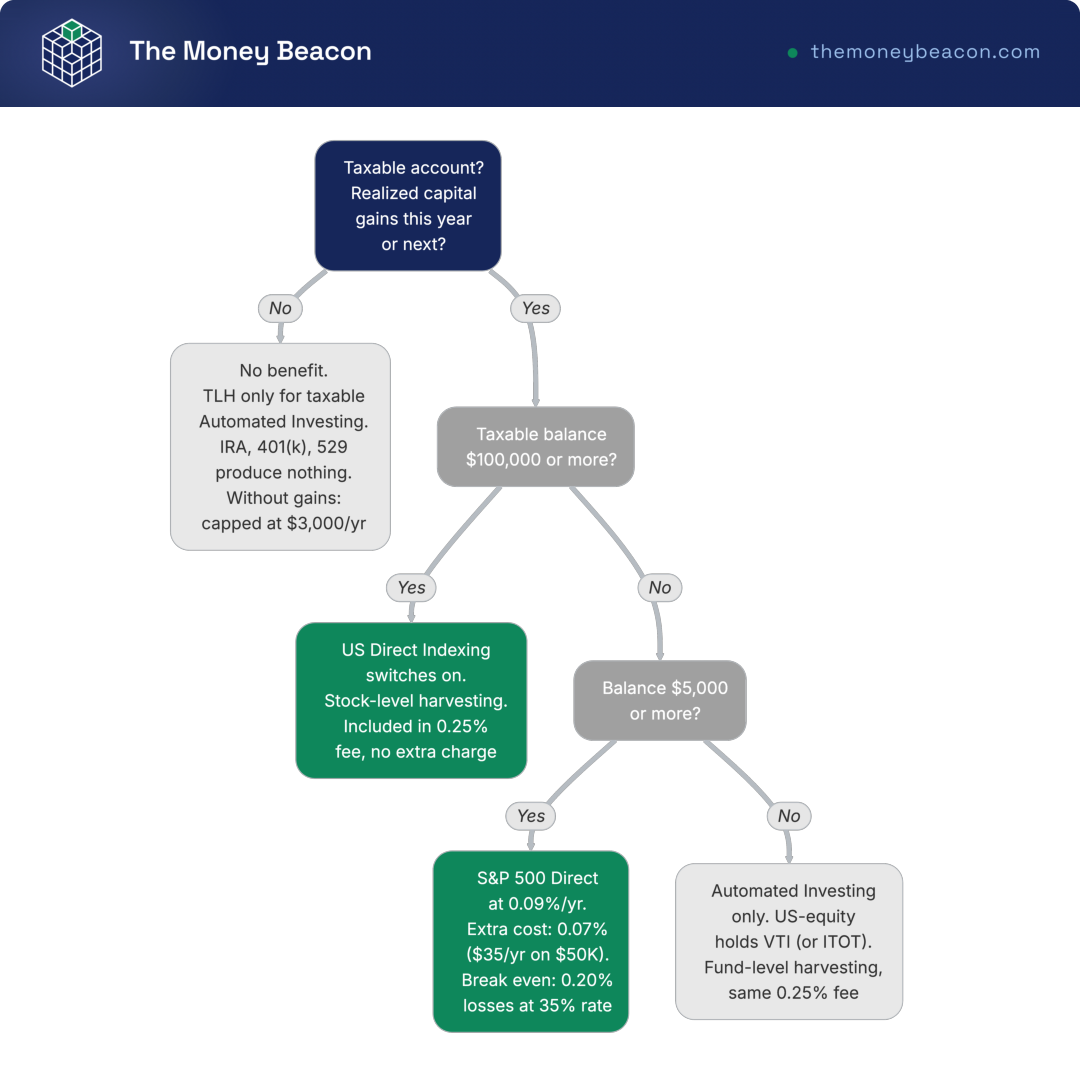
Say no if your taxable balance is under $100,000, because the fee is identical and the US-equity sleeve is just VTI or ITOT. Say no if the money sits entirely in IRAs and 401(k)s, because “Tax-Loss Harvesting is only relevant to taxable accounts.” Say no above $1 million if you shop on price, against 0.15% and 0.10% at Betterment and about 0.15% net at Vanguard. Say no if you travel a lot, at 2.75% unreimbursed against Betterment’s 1%. Say no if you already rebalance a three-fund portfolio yearly, at about $30 per $100,000 against $280 to $380 all-in.
And say no outright if you want a named human planner: no human financial planner or certified financial planner (CFP) access is advertised at any Wealthfront tier. The planning is software.
The ruling is neutral for a reason, not out of caution. It turns on your account type, your balance and your combined marginal rate, three numbers the app can’t move. Run yours against the break-even loss.
Conclusion
The fee never arrives as a bill. It comes out of the balance itself, no later than the tenth business day of the following month, $20.55 on a $100,000 Automated Investing Account. Nothing about that deduction depends on whether it’s still buying you something. The same 0.25% funds daily stock-level harvesting in a taxable account at a 54.1% combined marginal rate, and the same 0.25% applies to a Roth IRA where harvesting is irrelevant by Wealthfront’s own definition. Identical rate, completely different thing being bought.
So the useful question here was never whether a quarter of a percent is expensive. It’s whether your money is parked where that quarter of a percent does any work. The fee earns its keep when your account type, your balance and your combined marginal rate all point the same direction, and it’s dead weight the moment one of them doesn’t.
Here’s tonight’s job, and it takes ten minutes. Open last year’s tax return, find your realized capital gains and work out your combined marginal rate. Then multiply the balance you’d actually move by 0.0025 and see which figure is bigger.
If that math comes back no, there are cheaper options. Our walkthrough of how a low-cost index portfolio gets built from scratch covers the do-it-yourself version, and our review of a rules-based automated alternative covers the middle ground. If the money is all inside retirement wrappers, the match and the fill order matter far more than the advisory rate.
FAQ: Wealthfront fees, minimums and insurance
How much does Wealthfront cost per year?
Two layers apply, and the pricing page shows one. The advisory fee is 0.25% a year, flat at every balance, so $100,000 costs you $250 with no discount at any level. On top of that you pay the expense ratios of the funds the portfolio holds, and Wealthfront’s own published catalog ranges from 0.030% to 0.130%, which adds $30 to $130 on the same balance. That’s roughly $280 to $380 all in.
I went looking for where the charge shows up, because the first month feels free and isn’t. The advisory fee accrues daily and is billed monthly in arrears, deducted no later than the tenth business day of the following month. On a $100,000 Automated Investing Account, Wealthfront’s own help center puts that deduction at $20.55 for a 30-day month.
What is the minimum to open a Wealthfront account?
It depends which product you want. $1 opens the Cash Account or the Stock Investing Account. $500 opens an Automated Investing Account, an Automated Bond Portfolio, an Automated Bond Ladder or the 529. $5,000 opens S&P 500 Direct at 0.09% or Nasdaq-100 Direct at 0.12%.
The number that changes what the fee actually buys is $100,000. That’s where stock-level US Direct Indexing switches on inside the Automated Investing Account, included in the same 0.25%. Below it, the US-equity sleeve holds VTI (or ITOT) at the identical rate, which is my whole verdict in one line: under $100,000 in a taxable account you pay the same fee for a plainer product. And none of it does anything inside a Roth IRA, where the growth is already tax-free, because Wealthfront limits harvesting to taxable accounts.
Is Wealthfront FDIC insured?
Yes, though the insurance comes from partner banks rather than from Wealthfront, which isn’t a bank. Cash in the Cash Account is swept out to them, and the Federal Deposit Insurance Corporation (FDIC) pass-through limit is $250,000 per bank, per ownership category, or $500,000 for joint accounts. Wealthfront’s published list carried 52 entries as of July 28, 2026, one of them a planned addition, so 51 are live, and it advertises up to $8 million of coverage individually and $16 million jointly.
One trap I’d check before moving a large balance. If you already bank with an institution on that list, both balances count against the same $250,000 limit there, and Wealthfront publishes no way to exclude a bank from the sweep. The monthly Cash Account statement is where you learn who holds your money, which is a decent reason to spread cash deliberately across accounts.
Does Wealthfront give me a human financial adviser?
No, at any balance and any tier. No human financial planner or certified financial planner (CFP) access is advertised, so the 0.25% buys discretionary portfolio management by software plus a planning tool that’s free for active clients. Support does exist by email and phone, weekdays from 7 AM to 5 PM Pacific with a stated first response inside 24 business hours, but that’s service rather than advice.
If you want a person to call before you sell a position or change your allocation, the fee isn’t buying one here, and that alone is enough to rule Wealthfront out.
What does Wealthfront charge to leave, and what does the card cost abroad?
Nothing to leave. Form CRS, dated July 23, 2026, states no account-opening fee, no withdrawal or account-closing fee, no trading commissions and no account transfer fee, including the standard broker-to-broker ACATS move. That’s genuinely unusual, since Betterment charges $75 to transfer out and Vanguard $100.
The debit card is where the only real out-of-pocket charges are. An out-of-network ATM costs $2.50 plus whatever the machine’s owner adds, though Wealthfront reimburses up to $7.50 on each of your first two domestic withdrawals a month, and roughly 19,000 in-network ATMs are free. Foreign transactions cost 2.75% with no reimbursement at all, so $5,000 of spending abroad costs you $137.50.
What is the Wealthfront controversy?
The one item on the public record concerns the tax feature itself. Wealthfront’s own Form ADV Part 2A, Item 9 discloses a $250,000 penalty from the Securities and Exchange Commission (SEC), settled December 21, 2018, over how tax-loss harvesting was described to clients. That was a disclosure failure rather than a loss of client money, and it’s now eight years old.
I’d still read it beside the current marketing. The pricing page shows a $3.18 monthly fee against $78.11 of potential tax savings and calls harvesting 6x the fee, without publishing the balance, the rate or the period behind any of it. $3.18 a month is about $38 a year, which makes $78.11 closer to 2x. Check that arithmetic yourself before you take a tax claim at face value.




Comments
Questions and corrections welcome. We read everything.