


Take a look at the savings account your paycheck lands in. If it’s with a traditional bank, there’s a good chance it pays 0.01% APY. On a $10,000 emergency fund, that works out to about $1 of interest a year. Not $1 a month. One dollar for the whole year. That same $10,000 in a high-yield savings account paying 3.65% earns about $365 a year, and you take on no extra risk to get it: the cash is still cash, still insured, still yours to pull out whenever you want. That’s the quiet cost of inertia, and most savers never run the numbers.
The Fed has held its target rate at 3.50% to 3.75% since December 2025, and the seven accounts in this comparison now cluster between roughly 3.00% and 3.65%. The big win isn’t squeezing out the last half point. It’s leaving 0.01% behind.
The harder question is which account fits how you actually use a bank. Some savers chase the top rate; some want one app for everything; some want a name they recognize or cash they can pull from an ATM. So I’ve compared seven FDIC insured high-yield savings accounts side by side on rate, fees, and access, then named the winner for each kind of saver, so you can move your money this week with a clear answer in mind about which account fits you best.
1. How we compared these seven high-yield savings accounts
Before any single account’s characteristics mean anything, we need a common measuring stick. We evaluated all seven on one identical set of criteria, then computed why the move off 0.01% beats every other decision you can make here.
1.1 Our criteria and the seven accounts at a glance
We evaluated all seven banks based on the following criteria: the current APY (annual percentage yield) and how it is earned, the minimum to open and to earn that rate, the monthly fee, ATM and branch access, FDIC (Federal Deposit Insurance Corporation) coverage, the surrounding ecosystem, situational wire and excess-transaction fees, any sign-up bonus, and the quality of support. The good news up front: all seven charge $0 a month and require $0 to open, so the comparison focuses on the things that actually differ: rate, access, and what each bank bundles around the cash. The chart below plots them on rate against cash access, with bubble size showing the size of each bank’s ecosystem.
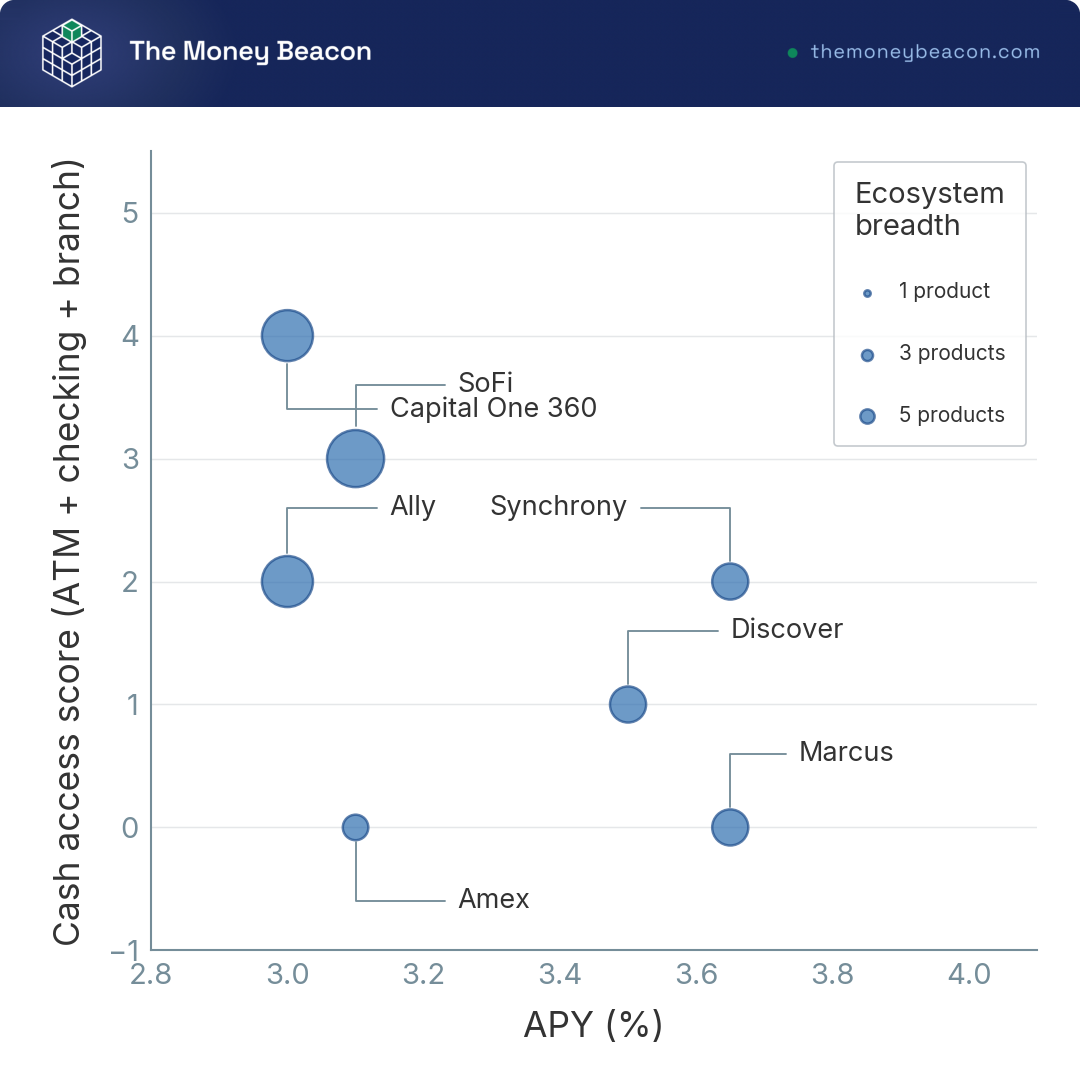
Here is the same data as a table.
Opening summary of the seven high-yield savings accounts
| Account | APY (variable) | Min. to open / earn APY | Monthly fee | ATM/branch access |
|---|---|---|---|---|
| Ally Online Savings | 3.00% | $0 / $0 | $0 | No ATM card on savings; no branches |
| Marcus Online Savings | 3.65% | $0 / $0 | $0 | No ATM card; no branches |
| SoFi Savings | 4.50% on first $20k (SoFi Plus); 3.10% standing w/ direct deposit; up to 3.80% new-member boost; ~0.80% without direct deposit | $0 / $0 | $0 | ATM via Allpoint network; no branches |
| Capital One 360 Performance Savings | 3.00% | $0 / $0 | $0 | ATM card via linked checking; Cafes in some states |
| Amex High Yield Savings | 3.10% | $0 / $0 | $0 | No ATM card; no branches |
| Discover Online Savings | 3.50% | $0 / $0 | $0 | No ATM card on savings; no branches |
| Synchrony High Yield Savings | 3.65% | $0 / $0 | $0 | ATM card with reimbursements; no branches |
Data current as of June 2026. All APYs are variable; “Not disclosed” means the figure is not published by the actor.
The interest rate for the accounts ranges from 3.00% to 3.65%, which is the highest you can reach in a savings account without market risk.
1.2 Why escaping 0.01% beats chasing the last half point
Run the numbers, and the priority becomes obvious. Park $10,000 in a legacy account paying 0.01% and you earn about $1 a year. Move that same cash to a 3.00% account and you earn about $300. Now push for the top of the group at 3.65%, and you add only about $65 more on top of that $300. So the leap out of the legacy account is worth roughly 5 times what the leap from the bottom to the top of this group is worth. The rate spread among the seven accounts presented here only starts to move real money once your balance climbs, while leaving 0.01% behind pays off at any balance. The line chart below tracks a $10,000 emergency fund over five years at four rates.
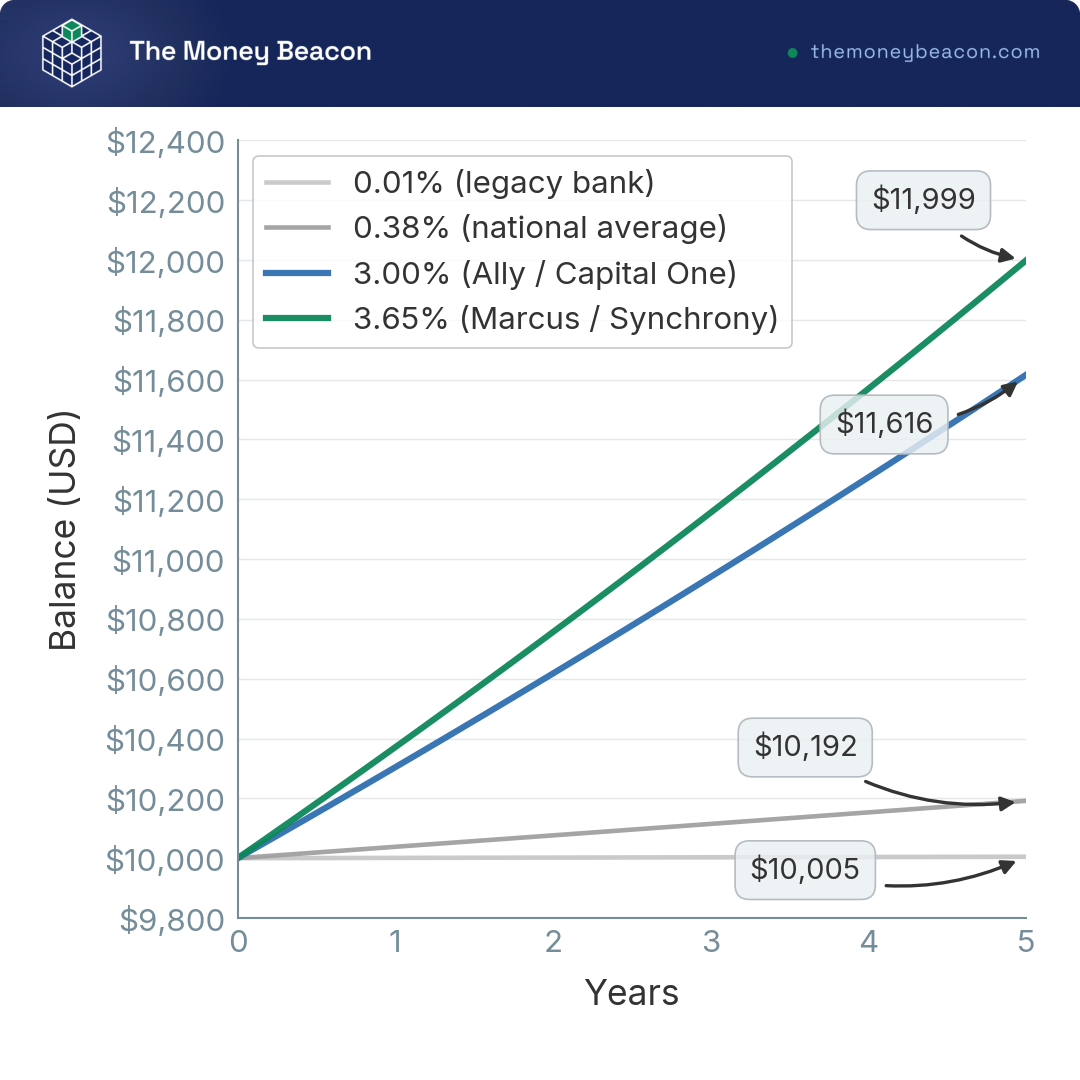
If you want to verify the gain on your own balance, any high-yield savings account calculator will show you the same results. The point is to match every dollar to its time horizon. In our guide to building savings in layers, we sort cash, cushion, and long-term money accordingly.
1.3 How far above your old account these accounts pay
Even the lowest account in this comparison pays about eight times the 0.38% national average and hundreds of times what a 0.01% account pays. The important gap is between your old account and any of these seven; the gap among the seven is insignificant. The bar chart below shows all seven accounts compared to the national average of 0.38% and the legacy rate of 0.01%.
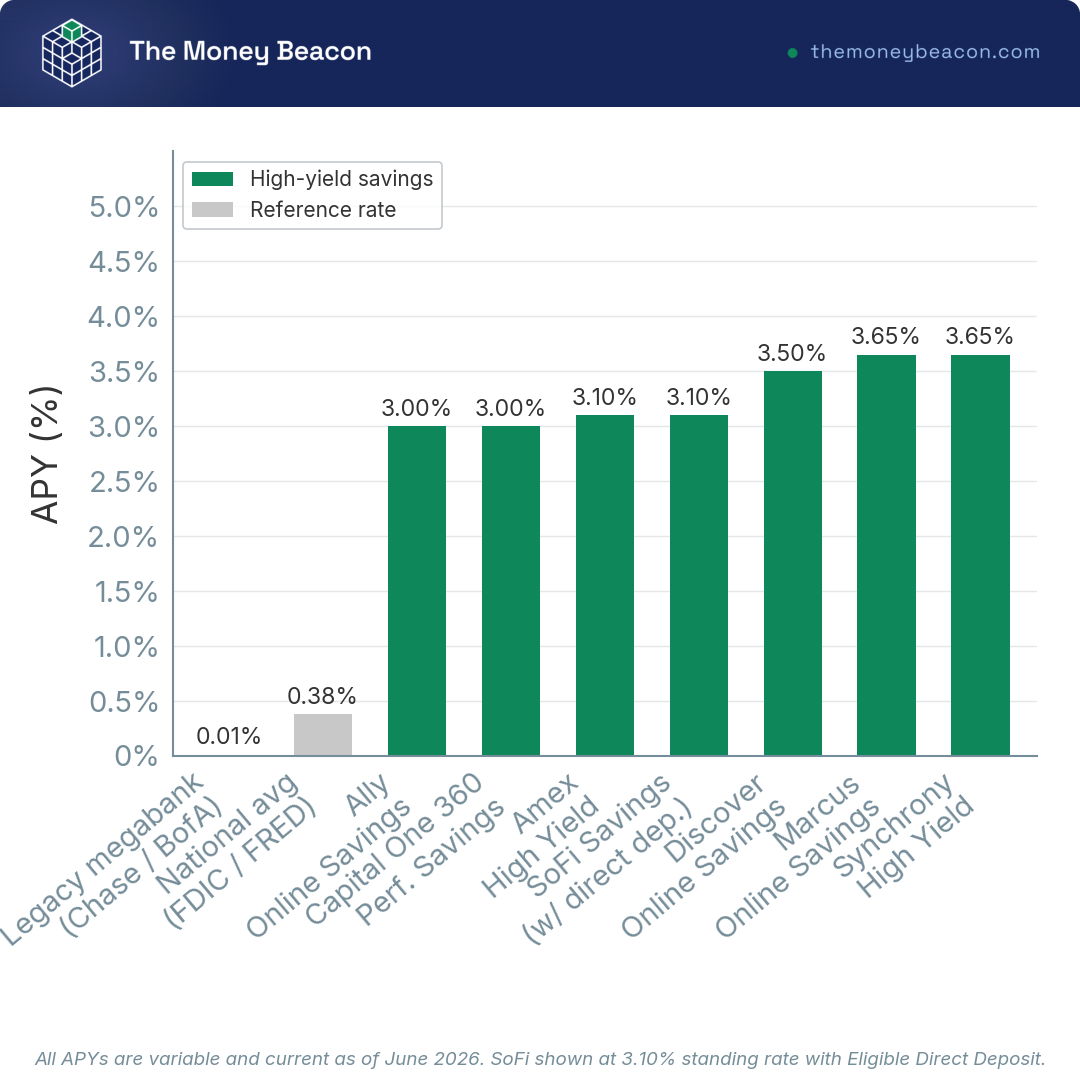
One note before the reviews: SoFi is included here at its 3.10% standing rate, but that rate is conditional and tiered. We fully explain it in its own review. Now that we have our measuring stick, let’s start with the first account.
2. Ally Bank: the well-rounded digital bank for one-stop simplicity
2.1 Ally overview
Ally Bank is a long-standing online-only bank and an FDIC-insured institution. Rather than offering the highest rates, Ally Bank positions itself as a no-fee, full-service digital bank. Its Ally Online Savings account offers a flat 3.00% APY, which is variable and has no balance tiers or direct deposit requirements. The appeal lies in the comprehensive package: savings, checking, certificates of deposit, and investing, all accessible with one login. This high-yield online savings account is built for the saver who wants one trustworthy bank and a strong app, not someone hunting for the last half point of yield.
2.2 Ally strengths
Ally stands out through its user-experience. The same 3.00% APY comes with savings “buckets,” which split your balance into labeled goals, as well as surprise round-ups that automatically sweep small amounts into savings. You also get access to a full ecosystem of services, including checking, CDs, and investing, all under one login. Ally has a long-standing reputation for providing strong customer support 24/7, which is hard to find at this price. There are no excess-transaction fees, and Ally offers a $100 savings referral bonus when a new account is funded through a referral and meets the qualifying transfer requirements. For a full walk-through of the account, see our complete Ally Bank review.
2.3 Ally weaknesses
The trade-offs are about rate and reach. Ally’s 3.00% APY is at the lower end of this group. The savings account does not have an ATM card or branches. Cash can be withdrawn via an ACH (automated clearing house) transfer, which takes one to three business days, or a $20 wire transfer, if needed more quickly. There is no standard sign-up bonus for the base account, and like every account here, the APY is variable and can drop when the Fed cuts rates. None of that is a deal-breaker for a saver who values simplicity, but it is the cost of a clean, one-bank setup.
2.4 Ally pricing and fees
Here is what Ally actually costs.
Ally Online Savings fees
| Item | Value |
|---|---|
| Monthly maintenance fee | $0 |
| Minimum to open | $0 |
| Minimum balance to earn APY | $0 |
| Excess-transaction fee | $0 (Ally does not charge an excess-transaction fee) |
| Outgoing domestic wire | $20 |
| Out-of-network ATM (savings has no card) | N/A on savings |
Data current as of June 2026.
2.5 Who Ally is for
Ally is ideal for savers who value a clean, one-bank experience, in-app savings tools, and 24/7 support more than a slightly higher APY. For a $10,000 starter emergency fund, the difference in rates compared to the top of this group is minimal, which is a fair price to pay for keeping everything under one roof. However, it is not the best choice for a high-balance saver who is looking for the highest possible rate, where that same spread starts to matter in real dollars.
3. Marcus by Goldman Sachs: top flat rate in a clean savings silo
3.1 Marcus overview
Marcus is the consumer banking brand of Goldman Sachs Bank USA. It offers clean, high-rate savings and CD products backed by a blue-chip institution and insured by the FDIC. Marcus Online Savings offers a flat 3.65% APY, which is variable and has no tiers or direct deposit requirements. The appeal is narrow on purpose: a top rate from a trusted name, without any ecosystem clutter. It’s ideal for savers who want a high interest rate but don’t need a checking account.
3.2 Marcus strengths
The main strength is the rate. Marcus frequently ranks at or near the top of this group with an APY of about 3.65%, no minimum balance requirement, and no direct deposit requirement. There are no fees or minimums. Notably, Marcus does not charge an outgoing wire fee, though the receiving bank still might. No excess-transaction fee is disclosed either. Marcus also has a strong CD lineup, which is useful if you want to invest cash that you won’t need for a set period. You can see how those terms compare in our current CD rate comparison. For a saver who simply wants the best savings APY from a major institution, it’s an appealing package.
3.3 Marcus weaknesses
What you give up is everything surrounding the rate. Marcus is purely a savings and CD account: there is no checking account, debit card, or ATM access. Cash can only be withdrawn via ACH or wire transfer. The app is functional but lacks tools like buckets and round-ups. There is no standard cash sign-up bonus for the savings account, only occasional referral bonuses or limited-time rate boosts, and the APY is variable.
3.4 Marcus pricing and fees
Here is what Marcus charges.
Marcus Online Savings fees
| Item | Value |
|---|---|
| Monthly maintenance fee | $0 |
| Minimum to open | $0 |
| Minimum balance to earn APY | $0 |
| Excess-transaction fee | $0 (no excess-withdrawal fee disclosed) |
| Outgoing domestic wire | $0 (Marcus does not charge a wire fee; the receiving bank may) |
| ATM access | None on savings |
Data current as of June 2026.
3.5 Who Marcus is for
Marcus is the best choice for rate-conscious savers who want a top flat APY and a trusted name and are content to transfer funds via ACH when needed. However, it is not the right account for someone who needs a debit card, ATM access, or a single login for savings, checking, and investing.
4. SoFi: best for combining checking, savings, and investing in one app
4.1 SoFi overview
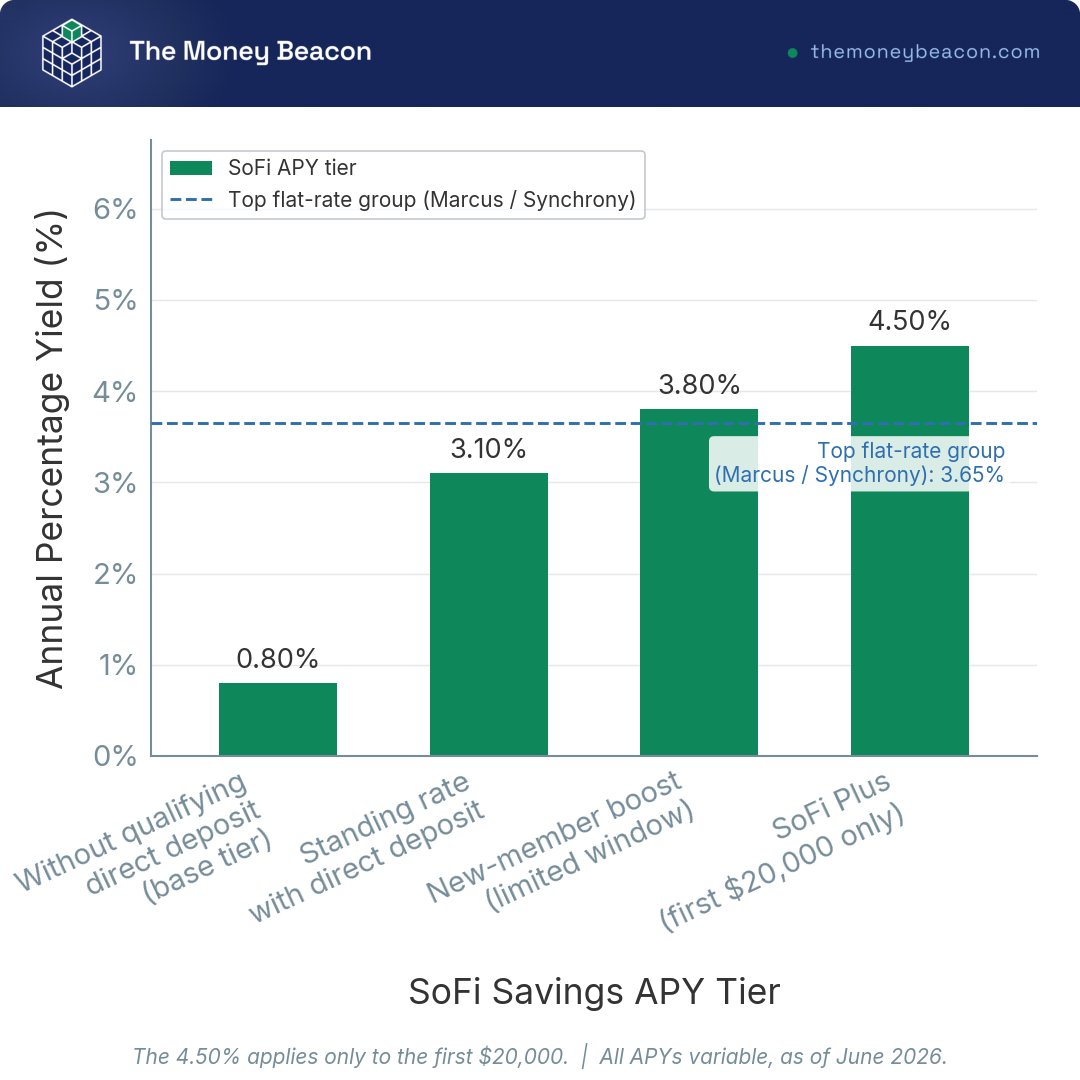
SoFi (deposits held at SoFi Bank, N.A.) is an all-in-one fintech bank that runs checking, savings, investing, and lending inside a single app. The savings rate is tied to setting up direct deposit. The rate is conditional and tiered, so the advertised rate is not automatic. With Eligible Direct Deposit the standing rate is 3.10% APY; new members can earn up to 3.80% APY for a limited window thanks to a temporary boost; SoFi Plus members earn 4.50% APY on the first $20,000 and 3.10% above that; and without qualifying direct deposit, the rate drops to roughly a 0.80% base tier. The chart below shows those tiers side by side.
4.2 SoFi strengths
SoFi is hard to beat when the conditions line up. It’s a true all-in-one app with checking, savings, investing, and lending all accessible with one login. It boasts a leading rate of 4.50% APY on the first $20,000 for SoFi Plus members, plus an additional 3.80% new-member boost. There’s also a cash incentive: a direct deposit bonus of $50 for deposits of $1,000 to $4,999.99, and $400 for deposits of $5,000 or more. You also get ATM access through the Allpoint network with the debit card and a deposit-sweep program that extends FDIC coverage up to $3,000,000 across partner banks. With no fees or minimums, SoFi is a genuine contender for a high-APY savings account if you have a paycheck coming in.
4.3 SoFi weaknesses
The catch is in the conditions. Without Eligible Direct Deposit, the rate drops to about 0.80%, which is well below every flat-rate account here. Therefore, a saver who cannot redirect a paycheck loses the account’s main benefit. The 4.50% rate applies only to the first $20,000; the rate is 3.10% for balances above that amount, so it is not a top rate for large balances. SoFi also heavily promotes its other products, and the outgoing wire fee is not disclosed on the public fee sheet.
4.4 SoFi pricing and fees
Here is the fee picture.
SoFi Savings fees
| Item | Value |
|---|---|
| Monthly maintenance fee | $0 |
| Minimum to open | $0 |
| Minimum balance to earn APY | $0 (but top APY needs direct deposit) |
| Out-of-network ATM | In-network Allpoint ATMs (55,000+) fee-free; out-of-network third-party fees not reimbursed |
| Outgoing domestic wire | Transaction fee applies (amount Not disclosed) |
Data current as of June 2026.
4.5 Who SoFi is for
SoFi is ideal for the all-in-one user who will redirect a paycheck and wants savings, checking, and investing under a single login, and who can stack the conditional top rate with the cash bonus. However, it is not the right account for a saver who cannot qualify for direct deposit because the rate drops to the 0.80% base tier, and a flat-rate account likely pays more.
5. Capital One 360: brand familiarity with Cafes in select states
5.1 Capital One 360 overview
The Capital One 360 Performance Savings account is an online savings product offered by Capital One, N.A. Its distinctive feature is that it blends online banking with Capital One Cafés in select states. The account earns a variable 3.00% APY with no tiers or direct deposit requirements and is FDIC insured. One corporate note worth knowing: Capital One completed its acquisition of Discover on May 18, 2025, but as of June 2026, the two savings products remain separately branded and operated.
5.2 Capital One 360 strengths
The pull here is brand and reach. Capital One is a well-known national brand, and its Cafés in select states offer in-person assistance that most online banks can’t offer. With the linked 360 Checking card, you also get access to over 70,000 fee-free ATMs, plus a full ecosystem of checking, cards, and auto products with easy same-bank transfers. There are no monthly fees, no minimums, and no excess-transaction fee, and Capital One periodically runs cash bonuses on its checking and savings products. If you’re considering the linked checking account, our comparison of the best checking accounts explains how 360 Checking compares.
5.3 Capital One 360 weaknesses
The limits are the rate and reach. The 3.00% APY is at the low end of this group, and the Cafés that make Capital One distinctive exist only in select states, so the in-person perks aren’t accessible to most of the country. ATM access comes through the linked checking card, not the savings account itself, so you need both products to access cash directly. The outgoing wire transfer fee is $30, the highest disclosed fee in this group, which matters if you ever need to move a large sum quickly. There is no standard, always-on savings sign-up bonus; only periodic promotions exist.
Tom’s take

I’ve shopped most of the big banks for cash, and the lesson is simple: make them compete and read the situational fees, not just the marketed APY. A wire fee like this one is exactly the kind of line that quietly costs you when you move money in a hurry.
5.4 Capital One 360 pricing and fees
Here is the cost structure.
Capital One 360 Performance Savings fees
| Item | Value |
|---|---|
| Monthly maintenance fee | $0 |
| Minimum to open | $0 |
| Minimum balance to earn APY | $0 |
| Excess-transaction fee | $0 (no excess-transaction fee) |
| Outgoing domestic wire | $30 |
| Branch/Cafe access | Cafes in select states (no traditional branches); 70,000+ fee-free ATMs |
Data current as of June 2026.
5.5 Who Capital One 360 is for
The Capital One 360 account is ideal for savers who value brand familiarity and branch access, especially those in a Café state who prefer the option of walking in for help and want access to a large fee-free ATM network. However, it is not the best account for those who are purely optimizing for the top rate or for anyone outside the Café footprint, where the semi-physical perk simply isn’t available.
6. American Express High Yield Savings: a simple, reputable, rate-only account
Amex overview
American Express National Bank offers a savings account that does one thing, and it makes no apologies for that. The Amex High Yield Savings account pays a flat 3.10% APY, which is variable and has no tiers or conditions. It is also an FDIC-insured institution. Think of it as the comfort pick: you want a recognizable name and a fair rate, not a bunch of features you’ll never use.
Amex strengths
You get a household-name brand with a strong service reputation, a mid-pack flat APY of 3.10%, and a straightforward single-product experience with nothing to qualify for and no hoops to jump through. Opening and earning both cost $0, with no monthly fee and no minimum balance. If you just want a reputable bank that offers a competitive high yield savings account interest rate, the simplicity is the whole point. Phone support is solid when you need to speak with a real person.
Amex weaknesses
What you give up is access and extras. There is no ATM card or branches, so cash can only be withdrawn via ACH and takes 1-3 business days to settle. There is no checking account in the ecosystem, nor is there a sign-up bonus for the savings account. The 3.10% APY is lower than those of other banks in this comparison, and the app offers fewer tools than those of more established banks, with no buckets or round-ups. The Deposit Account Agreement notes fees for outgoing wires and references excess activity, but Amex does not publish exact amounts, so both are listed as “Not disclosed.”
Amex pricing and fees
Here are the costs of running an Amex savings account.
Amex High Yield Savings fees
| Item | Value |
|---|---|
| Monthly maintenance fee | $0 |
| Minimum to open | $0 |
| Minimum balance to earn APY | $0 |
| Excess-transaction fee | Not disclosed as a charged fee |
| Outgoing domestic wire | Fee may apply (amount not stated) |
| ATM access | None on savings |
Data current as of June 2026.
Who Amex is for
Amex is ideal for those who are brand-familiar and want one simple, reputable account with no maintenance required. For a $10,000 balance, the difference in monthly fees between Amex and the top account in this group is only a few dollars. However, it is not the right choice if you want ATM access, a checking account, a cash bonus, or the highest APY.
7. Discover Online Savings: a no-fee account with a cashback checking ecosystem
Discover overview
Discover Online Savings from Discover Bank pairs a no-fee savings account with a spending account. The savings account itself is cardless and pays a flat 3.50% APY, which is variable with no tiers or conditions. It sits comfortably above the low end of this group. Alongside it is a well-regarded Cashback Debit checking account for everyday spending. Note that Capital One completed its acquisition of Discover on May 18, 2025, but the two companies continue to operate under their own brands. As of June 2026, there has been no documented effect on Discover’s savings rate or terms.
Discover strengths
With an APY of 3.50%, Discover pays significantly more than the low-end accounts in this group. Its no-fee, no-minimum policy is as clean as it gets, with no excess-transaction fees on the savings account. The Cashback Debit checking account is a good option if you want a spending hub from the same brand. US-based customer service is also a noted strength. If you’re looking for a good APY on a savings account without giving up a familiar name, Discover is a good option.
Discover weaknesses
The catch is liquidity and a couple of unanswered questions. The savings account does not come with its own ATM card; the debit card is linked to the Discover checking account, so cash from the savings account is still withdrawn via ACH unless you also open the checking account. Currently, there is no active savings sign-up bonus, as prior tiered deposit bonuses worth up to $200 have expired. The outgoing wire fee is not disclosed, and the longer-term integration under Capital One is worth monitoring if you plan to keep money here long term.
Discover pricing and fees
Here is the cost picture.
Discover Online Savings fees
| Item | Value |
|---|---|
| Monthly maintenance fee | $0 |
| Minimum to open | $0 |
| Minimum balance to earn APY | $0 |
| Excess-transaction fee | $0 (Discover advertises no fees) |
| Outgoing domestic wire | Not disclosed as a charged fee |
| ATM access | None on savings (debit belongs to Discover checking) |
Data current as of June 2026.
Who Discover is for
Discover is ideal for the saver who is familiar with the brand and wants a competitive rate, as well as a cash-back checking account for spending, all under a zero-fee umbrella. However, it is not the right choice if you need an ATM card for the savings account itself, want a sign-up bonus, or are looking for the highest APY.
8. Synchrony Bank: top rate paired with a rare savings ATM card
Synchrony overview
Synchrony Bank’s High Yield Savings account defies the typical trade-off between a high interest rate and easy access to cash. It pays a flat and variable rate of about 3.65% APY, frequently ranking at or near the top of its category. It also offers the rare option of an ATM card for the savings account itself. Synchrony Bank is an FDIC-insured institution that offers CDs and money market accounts alongside. If you want the highest APY savings and the ability to withdraw cash directly, this is an unusual combination.
Synchrony strengths
The main feature is the top-of-group flat APY of about 3.65%, with no minimum balance and no direct deposit requirement. The standout feature, though, is the optional ATM card for savings accounts, which reimburses out-of-network ATM fees up to $5 per statement cycle. Almost no other savings account in this group offers this feature. There are no monthly fees, minimums, or excess-transaction fees. If you want to ladder cash, CDs and money market accounts are also available, and you can see how those money-market options stack up in our roundup of the top money market accounts.
Synchrony weaknesses
The gaps are about breadth, not rate. Since there is no checking account, Synchrony is not an all-in-one hub like some other accounts are. An outgoing domestic wire transfer costs $25, and there is no standalone savings account sign-up bonus. Like every rate in this comparison, the APY is variable. While Synchrony does not charge a per-transaction excess fee, the bank reserves the right to close an account for habitual excess activity.
Synchrony pricing and fees
Here is what Synchrony charges.
Synchrony High Yield Savings fees
| Item | Value |
|---|---|
| Monthly maintenance fee | $0 |
| Minimum to open | $0 |
| Minimum balance to earn APY | $0 |
| Out-of-network ATM | Optional ATM card; reimbursements up to $5 per statement cycle |
| Outgoing domestic wire | $25 |
| Excess-transaction fee | $0 (bank may close an account for habitual excess activity) |
Data current as of June 2026.
Who Synchrony is for
Synchrony is ideal for high-balance savers who prioritize high rates and direct ATM access without opening a separate checking account, which most banks require. However, it is not the right choice if you want to bundle savings, checking, and investing under one login, since Synchrony deliberately keeps its product narrow.
9. The full comparison and which account fits your profile
The seven accounts side by side
Each account is reviewed on its own terms. Here is the entire field on one set of lines: the table to which every comparative claim in this article can be traced back.
Full seven-account comparison (the single source of truth for comparative claims, as of June 2026)
| Criterion | Ally | Marcus | SoFi | Capital One 360 | Amex | Discover | Synchrony |
|---|---|---|---|---|---|---|---|
| APY (variable) | 3.00% | 3.65% | 4.50% first $20k (SoFi Plus); 3.10% standing w/ DD | 3.00% | 3.10% | 3.50% | 3.65% |
| How earned | Flat | Flat | Conditional (direct deposit) | Flat | Flat | Flat | Flat |
| Min. to open | $0 | $0 | $0 | $0 | $0 | $0 | $0 |
| Min. balance for APY | $0 | $0 | $0 | $0 | $0 | $0 | $0 |
| Monthly fee | $0 | $0 | $0 | $0 | $0 | $0 | $0 |
| FDIC insured | Yes, $250k | Yes, $250k | Yes, $250k (sweep up to $3M) | Yes, $250k | Yes, $250k | Yes, $250k | Yes, $250k |
| ATM card on savings | No | No | Via checking (Allpoint) | Via checking | No | No | Yes + reimburse up to $5/cycle |
| Branch/Cafe access | No | No | No | Cafes in select states | No | No | No |
| Checking in ecosystem | Yes | No | Yes | Yes | No | Yes (cashback) | No |
| Outgoing wire fee | $20 | $0 | Fee applies (amount not disclosed) | $30 | Fee may apply (not disclosed) | Not disclosed | $25 |
| Sign-up bonus | $100 referral | Referral/occasional | DD bonus $50/$400 | Periodic, terms vary | None | None currently | None standard |
| Withdrawal limit | Bank-set; no excess fee | Bank-set; no excess fee | Bank-set | Bank-set; no excess fee | Bank-set | Bank-set; no excess fee | Bank-set; no excess fee |
Data current as of June 2026. No federal limit on savings withdrawals since April 2020; any limit shown is bank-discretionary.
As you read down any column, the best APY savings account for your situation will become clear because the $0 fee and $0 minimum baseline holds true for all seven. The real differences lie in the rate, access, and ecosystem.
Is chasing the top rate worth it at your balance?
The table illustrates the spread. Whether closing it is worth your time depends almost entirely on your balance. As the chart below illustrates across four balance levels, the spread among the seven only turns into real dollars as the balance climbs.
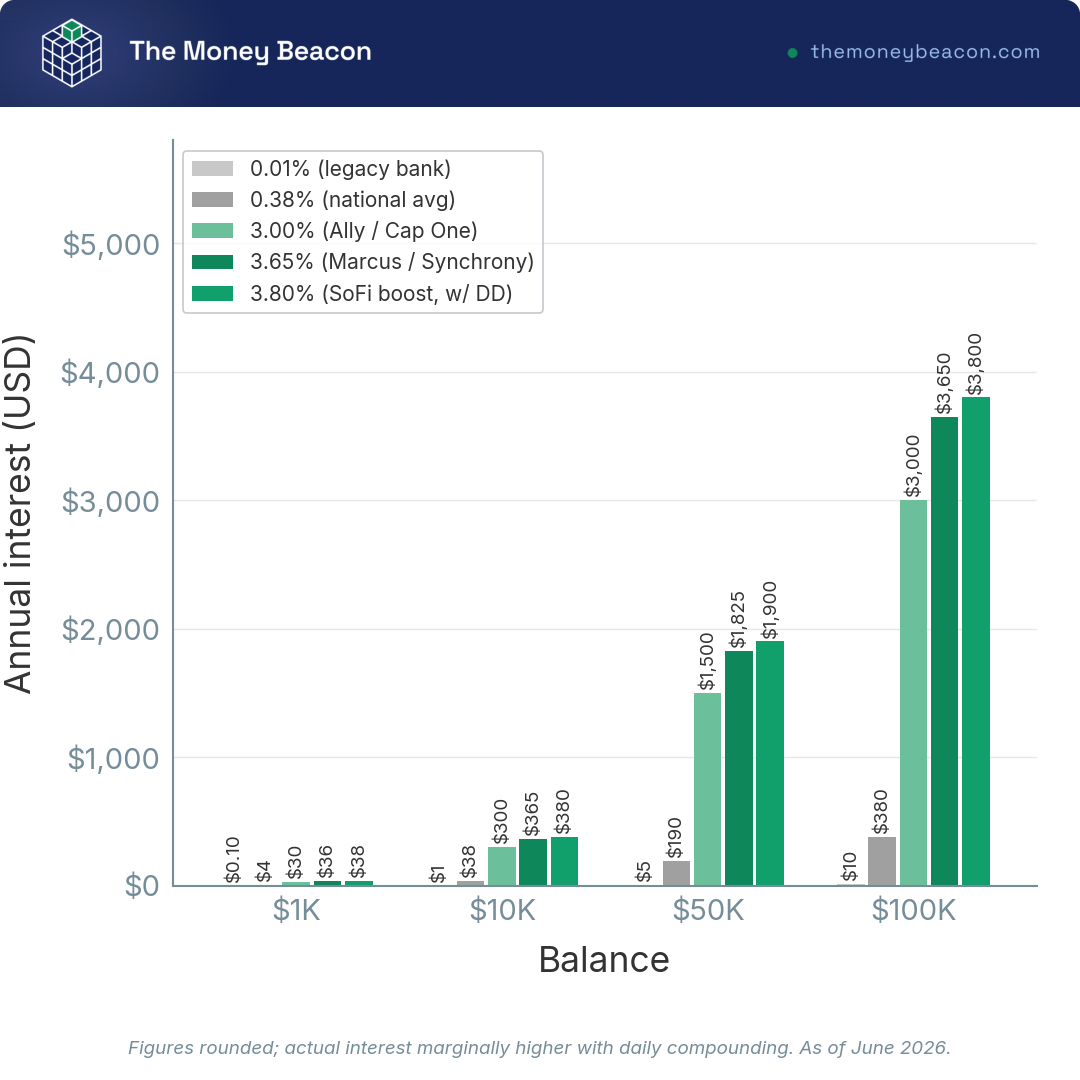
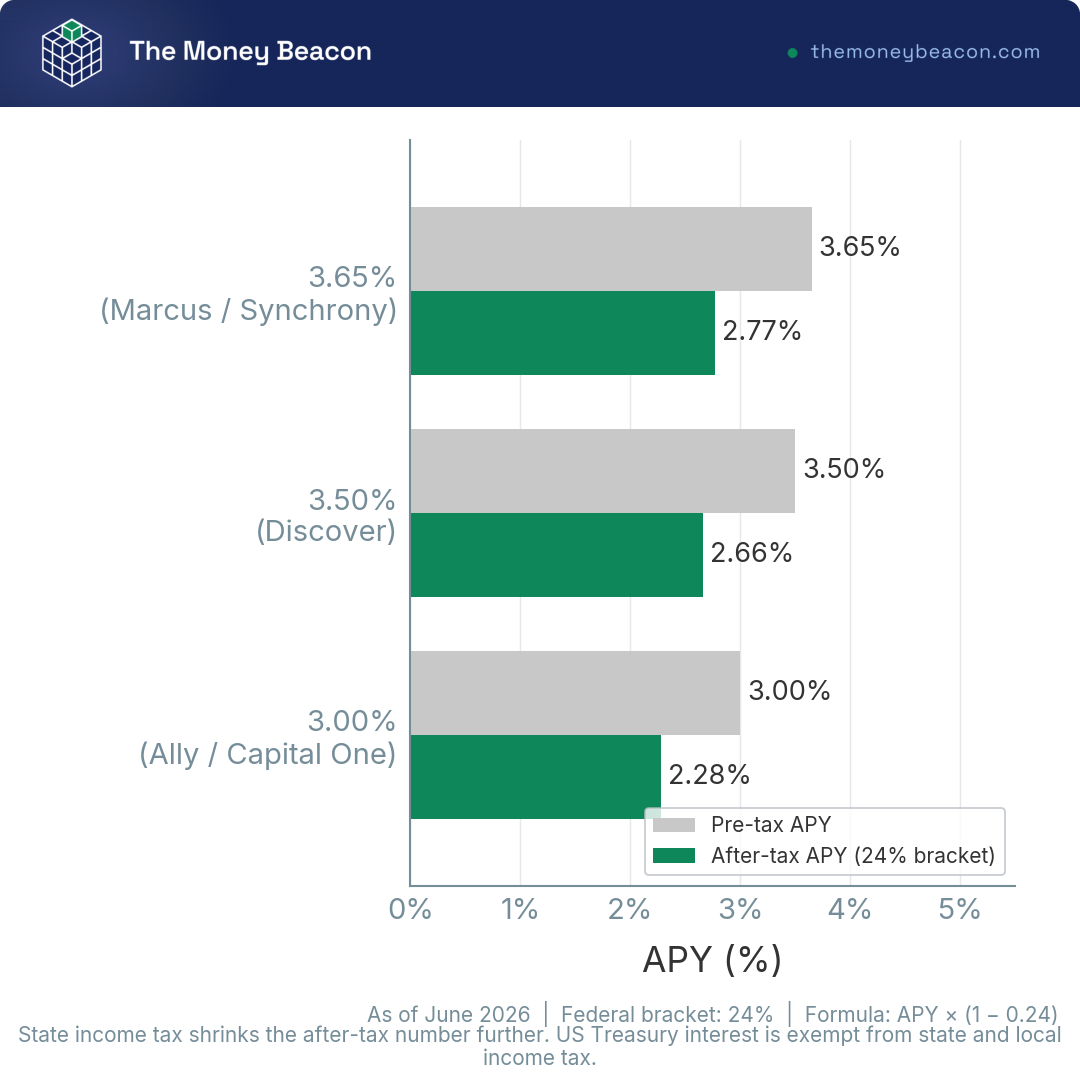
One more layer is hidden by the headline rate: taxes. Savings interest is considered ordinary income. At a 24% federal tax bracket, a 3.65% APY yields approximately 2.77% after taxes, while a 3.00% APY yields approximately 2.28%. This calculation does not account for state taxes. If you have a large balance in a state with high taxes, this is exactly why some savers compare a high-yield savings account (HYSA) to state-tax-exempt Treasury bills. a tradeoff that hinges on how your investment income is taxed.
Features and fees that break a near-tie
Once two accounts have similar after-tax rates, the rate becomes irrelevant and other features take over, such as the ATM card, checking account, branch or Café access, sign-up bonus, and extended FDIC sweep. The chart below shows how many of these features each account offers.
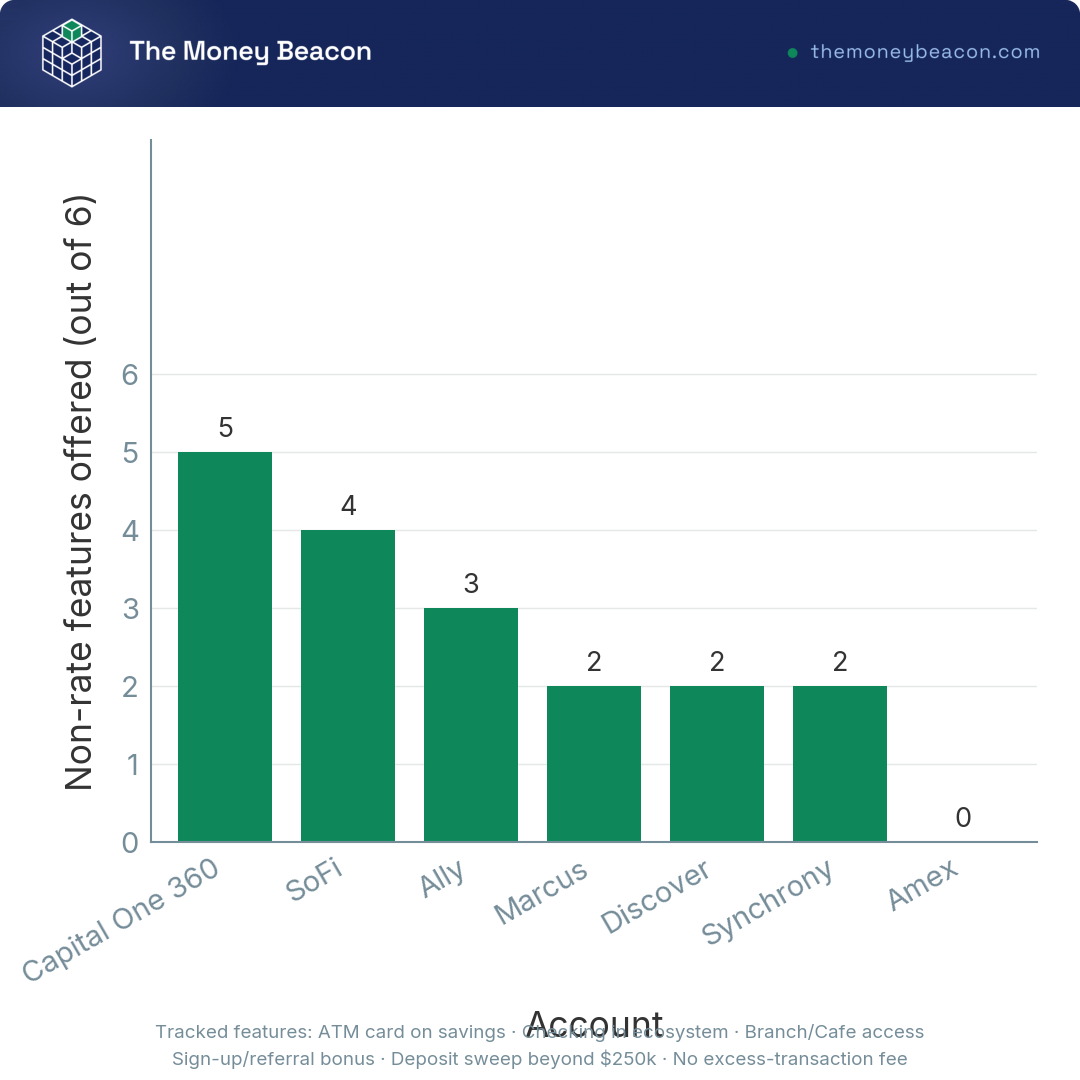
Brand-and-ecosystem accounts offer the most for your money, while pure-rate accounts offer almost nothing but the APY.
A one-question chooser
Instead of considering all eleven criteria at once, ask yourself one question: What matters most to you? Is it simplicity, the top rate, an all-in-one app with direct deposit, or brand and branch access? Each answer points to a winner, and the chart below shows the options at a glance.
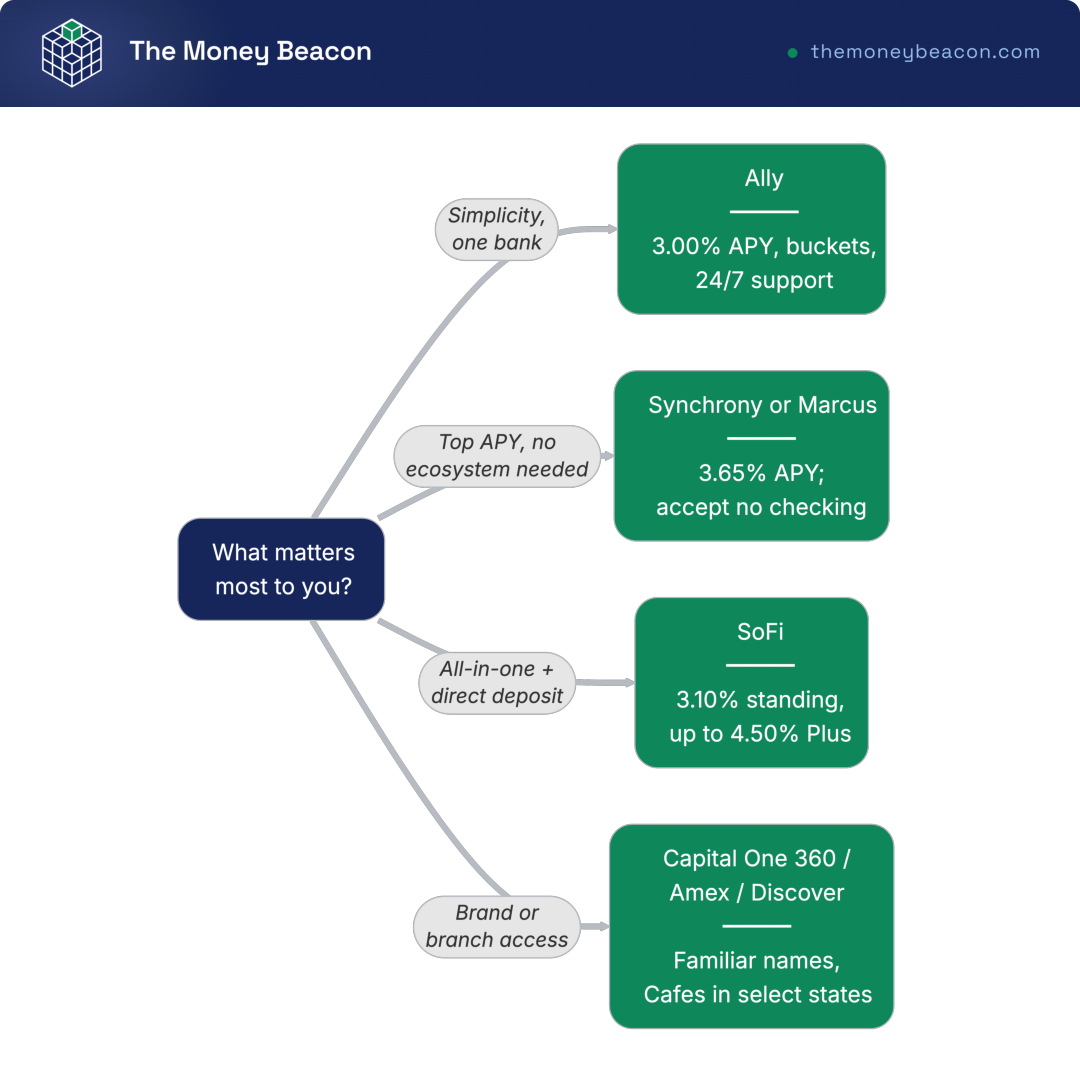
Verdict: the emergency-fund simplicity saver
If you’re looking for a clean, fee-free, one-bank experience with strong support and a half-point yield, Ally is the best choice. You get the full ecosystem, savings buckets, and 24/7 support, and the low-end 3.00% APY ($65 spread a year to the 3.65% APY accounts on a $10,000 starter emergency fund), a small price for money you mainly want safe and reachable.
Verdict: the high-balance APY chaser
If you are optimizing purely for the highest reliable flat APY, the math finally rewards you, because that same 0.65% gap is worth about $650 a year on $100,000. The pick is Synchrony, which leads on rate and uniquely adds an optional ATM card with reimbursements, or Marcus, which matches the rate with a blue-chip name. This profile is the one most exposed to tax, so the after-tax read below is the number to weigh.
If your goal is to earn the highest reliable flat APY (the 0.65% difference is worth approximately $650 per year on $100,000), Synchrony is the best choice because it has the highest rate and offers an optional ATM card with reimbursements. Alternatively, you could choose Marcus because it has the same rate and is a well-known brand. This profile is most exposed to taxes, so consider the after-tax return below.
Hank’s take
follow Fed policy closely and you stop treating a variable savings APY as if it were locked. The Fed has held its target range at 3.50% to 3.75% since December 2025, and the day that changes, every rate in this comparison will move. On a big balance, that drift matters more than the gap between the top two accounts today.
If you want to lock in today’s rate for cash you won’t touch, take a look at the longer-term CD rates.
Verdict: the all-in-one banking user
If you want a single login for savings, checking, and investing, and if you can set up direct deposit, SoFi is the best choice. Its top rate is conditional and it offers a cash bonus of up to $400 for redirecting your paycheck. On a one-year, all-in basis, that bonus can tip the scales well past any flat-rate account. Ally is the runner-up and a better choice if you prefer an all-in-one account but don’t have a redirectable direct deposit.
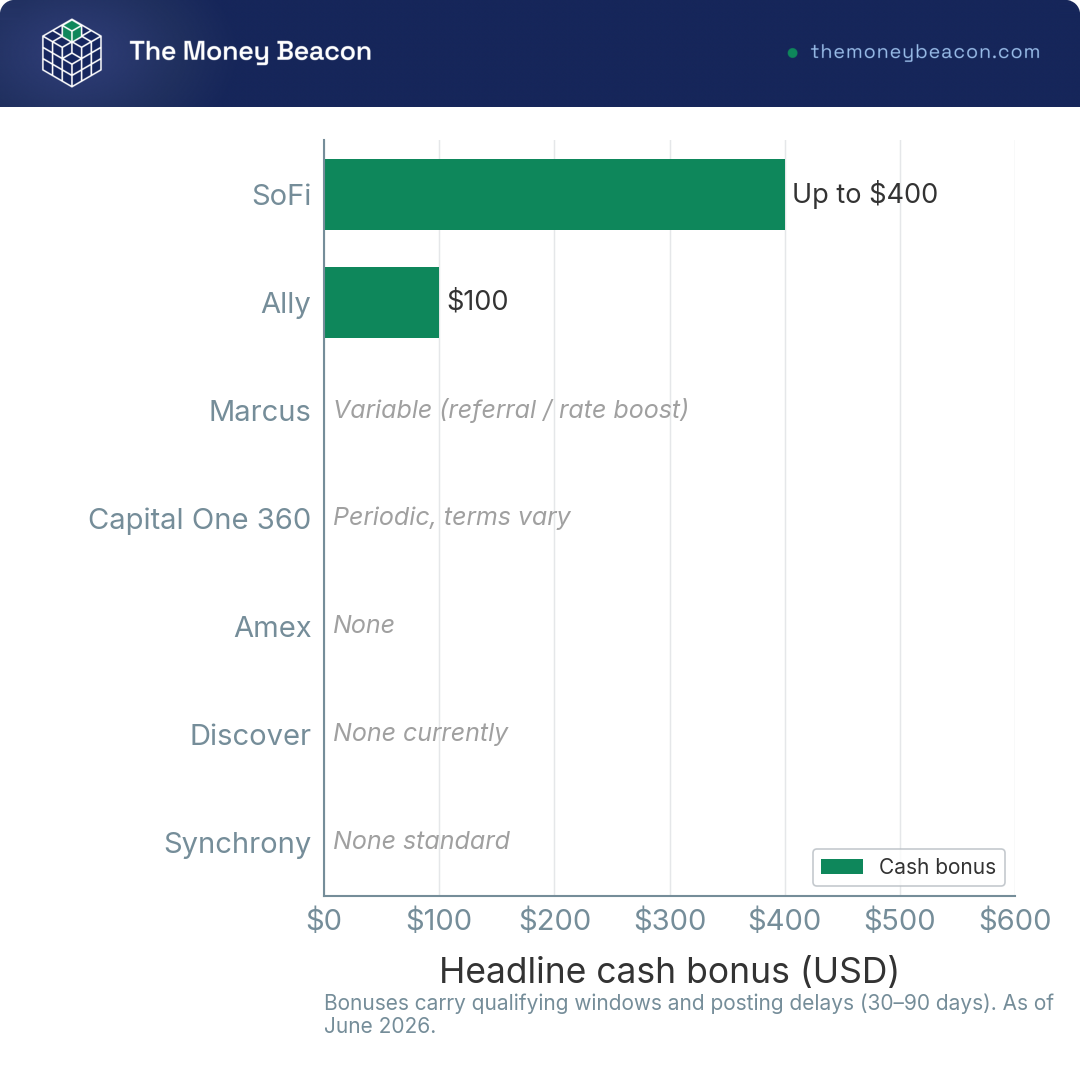
If you want the full platform walked through, see our SoFi platform review.
Verdict: the brand-familiarity and branch-access saver
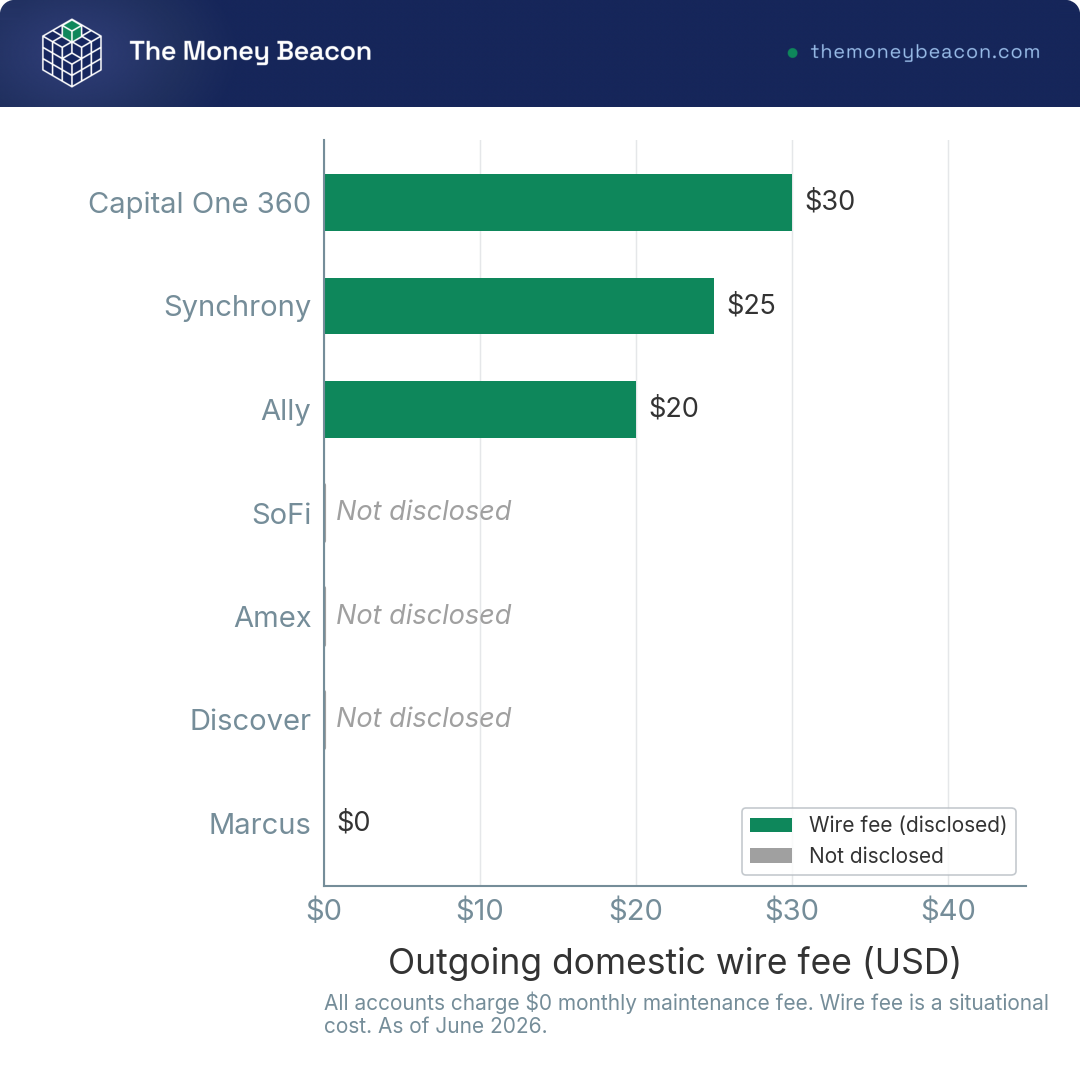
If you prefer a well-known name and want the option of walking in for help, Capital One 360 in a Cafe state is the best choice. If you live outside a Café state Amex or Discover are good options too. One potential pitfall to be aware of before committing is the situational wire fee, which only becomes an issue when you move a large sum in a hurry. The chart below outlines those fees.
Reading each account’s profile across five dimensions
Each profile leader leans a particular way across five dimensions: As the grouped bars below show, these dimensions are APY, cash access, ecosystem breadth, low fees, and support reputation.
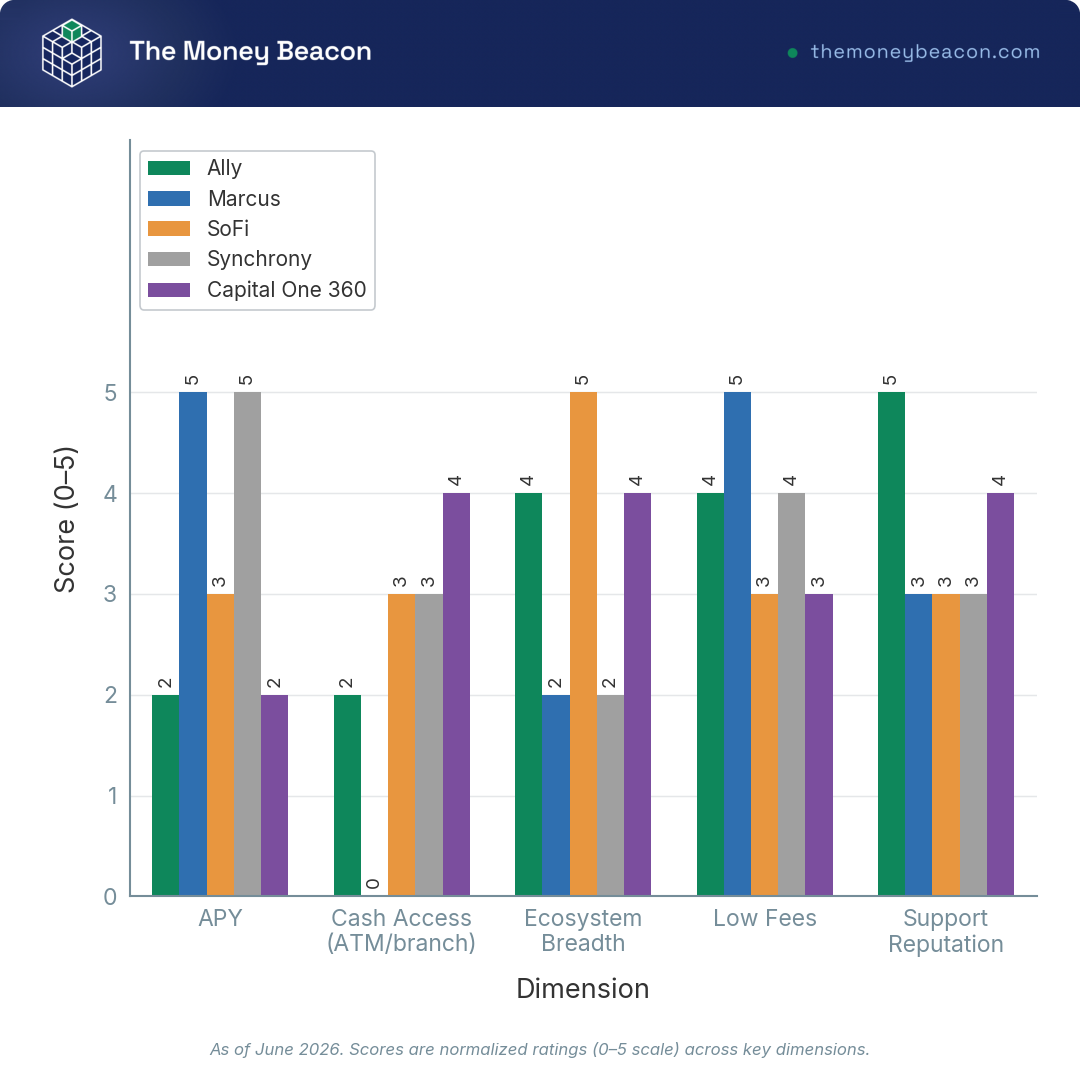
Match the shape of the account to the most important dimension, and the right answer will be one you can live with for years.
Conclusion
So, which of these seven accounts should your emergency fund live in? Honestly, there’s no single winner because the right account matches how you bank, not the one with the biggest number on the homepage. All seven accounts are FDIC-insured up to $250,000, have no monthly fees, and require no minimum deposit to open. They all meet the basic requirements; from there, it comes down to which one fits you best.
You’ve already left 0.01% behind by reading this far, and that’s where the real money is. For a $10,000 starting fund, the entire spread up to the top of the group is worth approximately $65 per year; less than skipping one streaming service. Chasing the last half point only starts to pay off once your balance reaches the tens of thousands.
The verdicts above name a winner for each kind of saver, from the one-app simplicity pick to the rate-first chaser. Pick the one that fits your saver profile, fund it this week, and let the rate do its quiet work.
For money you won’t need for at least a year, our comparison of the best CD rates shows where it pays to lock it up, and our comparison of money market accounts covers the checking account alternative to a high-yield savings account (HYSA). Our guide to diversifying your savings ties it all together, mapping each dollar to the right home by time horizon.
Frequently asked questions
What is a high-yield savings account, and how is it different from a regular savings account?
A high-yield savings account (HYSA) is an ordinary, FDIC-insured savings account that pays far more interest than a legacy big-bank account. The mechanics are identical, you deposit cash, it stays liquid, and you can pull it back out; the only real difference is the rate. The seven accounts in this comparison pay roughly 3.00% to 3.65% APY, while Chase Savings pays 0.01% and the FDIC national average sits near 0.38%. On $10,000 that gap is about $300 a year versus roughly $1, so the move that matters is leaving 0.01% behind, not chasing the single highest rate.
Are high-yield savings accounts safe, and how does FDIC insurance protect my money?
Yes. All seven banks here are FDIC members, so your deposits are insured up to $250,000 per depositor, per insured bank, per ownership category. If the bank fails, the FDIC covers your insured balance, and the cash itself carries no market risk, unlike a money market fund or a bond. To stay fully covered above the limit, keep no more than $250,000 per bank per category, or spread money across multiple banks, add ownership titles such as a joint account, or use a deposit-sweep network. SoFi’s Insured Deposit Program, for example, can extend coverage up to $3,000,000 by spreading balances across partner banks.
Is the APY on a high-yield savings account fixed, or can it change?
It is variable. A HYSA rate tracks the federal funds rate, which held a target range of 3.50% to 3.75% as of June 2026, so the bank can raise or lower your APY at any time, even the day after you open. That is the trade-off for staying liquid. If you want a rate locked in place, a certificate of deposit fixes its rate for the full term instead. Recheck your savings APY every few months, since the headline number you opened with is not a promise.
Do I owe taxes on the interest, and are there any fees?
Yes, the interest is ordinary income, taxed at your federal marginal bracket plus any state income tax, not at the lower long-term capital-gains rate. Once you earn $10 or more in a year, the bank sends a Form 1099-INT to report it. At a 24% federal bracket, a 3.50% APY keeps roughly 2.66% after federal tax, so the after-tax number is what you actually pocket. On fees, all seven accounts charge $0 monthly maintenance and require $0 minimum; watch only for situational charges like outgoing wires (around $20 to $30) or out-of-network ATM use. For the full picture, see our investment taxes guide.
How many withdrawals can I make each month?
There is no federal limit anymore. The Federal Reserve removed the old six-per-month Regulation D rule in April 2020, and no new federal cap has replaced it. Individual banks may still set their own limits and charge an excess-transaction fee, so check the specific account before you treat it like a checking account. Among the seven here, Discover, Ally, Marcus, Capital One, and Synchrony notably do not charge an excess-transaction fee.
How much should I keep in a HYSA versus a CD or investments?
A common rule of thumb is an emergency fund of three to six months of living expenses kept in a HYSA, where it stays liquid and you can reach it fast (the CFPB suggests sizing the fund to your own situation rather than a fixed range). Cash you will not need until a known date can earn a fixed rate in a CD, and money for long-term goals five or more years out generally belongs in invested assets, not cash. The point is to match each dollar to its time horizon, which our guide to how to diversify your savings walks through in detail.
How long does it take to move money in and out, and does opening an account hurt my credit?
External transfers run on the ACH network and usually settle in 1 to 3 business days, though same-day ACH exists in some windows, so plan for a short lag rather than instant access. Opening a savings account is generally a soft inquiry or no credit pull at all, so it does not ding your credit score, and you can open more than one HYSA without penalty.




Comments
Questions and corrections welcome. We read everything.