


Most households treat their tax bill as a fixed number that shows up every April, something to pay rather than something to shape. So they only think about taxes once the year is already closed, after the moves that actually cut the bill have expired. By then the pre-tax contributions, the credits, and the loss-harvesting window have all slipped past their December 31 deadline, and a 22% earner who skipped a $10,000 pre-tax deferral handed the IRS roughly $2,200 it was never owed. Multiply that across a few years and you have given up tens of thousands of dollars for nothing more than bad timing.
The good news is that almost none of this requires anything clever or risky. Every lever in this guide is a feature Congress wrote into the code on purpose. The hard part has never been the legality, it is knowing which lever fits your situation and acting before the deadline.
This guide covers every legal way to lower your taxable income, from the accounts and credits that do the heaviest lifting down to the timing moves and the question of when a CPA earns its fee. Each one comes with real dollar figures, and the difference between a credit and a deduction becomes clear before you get past the first section.
1. How Tax Reduction Actually Works (and Where the Legal Line Is)
Two questions decide everything before you touch a single account or claim a single credit: is the move you are about to make actually legal, and what arithmetic tells you whether it is worth the trouble? We start at the legal boundary, then build the one number that prices every lever in this guide, and finish by mapping where in your tax return each move actually bites.
1.1 Avoidance vs. Evasion: The Line You Must Not Cross
The fear that keeps people from cutting their tax bill is usually a fear of doing something wrong, so it is worth settling that first. Tax avoidance is arranging your affairs to pay the least tax the law allows, and the Supreme Court blessed it back in 1935: you are entitled to structure your finances to minimize what you owe. Contributing to a 401(k), claiming the Child Tax Credit, harvesting a real investment loss, these are not loopholes. They are levers Congress built into the code on purpose to nudge you toward saving and investing.
Tax evasion is the opposite, and it is a felony. Hiding income, inventing deductions, or claiming dependents who do not exist falls under Section 7201 of the tax code, with fines up to $100,000 for an individual and up to five years in prison. The dividing line is simple: every legal move is in the open, reported on a form, with nothing concealed from the IRS. The table below sorts common behaviors onto each side.
| Behavior | Category | Legal? | Example |
|---|---|---|---|
| Contributing pre-tax to a 401(k) | Avoidance | Yes | Lowers taxable wages on Form W-2 |
| Claiming the Child Tax Credit | Avoidance | Yes | Statutory credit on Form 1040 |
| Harvesting a real investment loss | Avoidance | Yes | Reported on Form 8949 / Schedule D |
| Not reporting cash income | Evasion | No (felony) | IRC Section 7201 |
| Claiming dependents who do not exist | Evasion | No (felony) | Fraud penalty of 75% of underpayment |
The pattern on the legal side is that nothing is hidden; the saving comes from using a rule as written. With every lever ahead confirmed as fully legal, the next thing to settle is how much each one is actually worth to you, and that depends entirely on a single number.
1.2 Marginal Rate vs. Effective Rate: Why It Changes Every Decision
That number is your marginal rate, the rate the IRS charges on your next dollar of income or saves you on the last dollar you remove. It is not the same as your effective rate, which is your total tax divided by your total income, a blended average that always comes out lower. The distinction matters because every deduction saves you tax at your marginal rate, never the effective rate. Get this one number right and you can price any move in this guide in real dollars.
Here is why it changes the math. A $1,000 pre-tax 401(k) contribution saves a worker in the 22% bracket $220 in federal tax, while the same $1,000 saves only $120 for someone in the 12% bracket and $370 for someone in the 37% bracket. The deduction is identical; the value is not, because it is priced at the rate on your top slice of income. This is why pre-tax contributions are worth more to higher earners, and why your marginal bracket is the first thing to pin down before anything else. The 2026 brackets for a single filer below show where each rate kicks in as your taxable income, which is your gross income after the adjustments and deductions we cover next, climbs.
| 2026 rate | Single taxable income |
|---|---|
| 10% | Up to $12,400 |
| 12% | $12,400 to $50,400 |
| 22% | $50,400 to $105,700 |
| 24% | $105,700 to $201,775 |
| 32% | $201,775 to $256,225 |
| 35% | $256,225 to $640,600 |
| 37% | Over $640,600 |
Data current as of June 2026.
The brackets are progressive, so moving into the 24% band does not retax your whole income at 24%; only the dollars above $105,700 pay that rate. For you, that means the rate on your next dollar, the one that prices your deductions, is the bracket you are sitting in right now. Hold onto that figure, because the rest of the guide turns it into dollars.
1.3 The Three Ways to Cut a Tax Bill
Once you know your marginal rate, every legal tax move sorts into one of three buckets, ranked roughly by how much each saves per dollar of effort. You can lower your taxable income through pre-tax contributions and deductions, which save at your marginal rate. You can change the rate that applies to a gain by holding an investment more than a year, turning a gain taxed at up to 37% into one taxed at 0%, 15%, or 20%. Or you can cut the tax itself with credits, which come straight off what you owe. The whole article is built on those three moves, in that order of leverage.
One distinction is worth keeping in mind before we go further, because confusing it derails a lot of decisions. An account is a tax wrapper, not an investment. A 401(k), an individual retirement account (IRA), an HSA, an FSA, and a taxable brokerage are accounts; stocks, bonds, ETFs, and index funds are what you hold inside them. The same total-market fund can sit in any of those wrappers, and the wrapper, not the fund, decides how it is taxed.
To see why the first lever rewards higher earners so unevenly, the chart below prices a single $1,000 pre-tax contribution at each 2026 bracket.
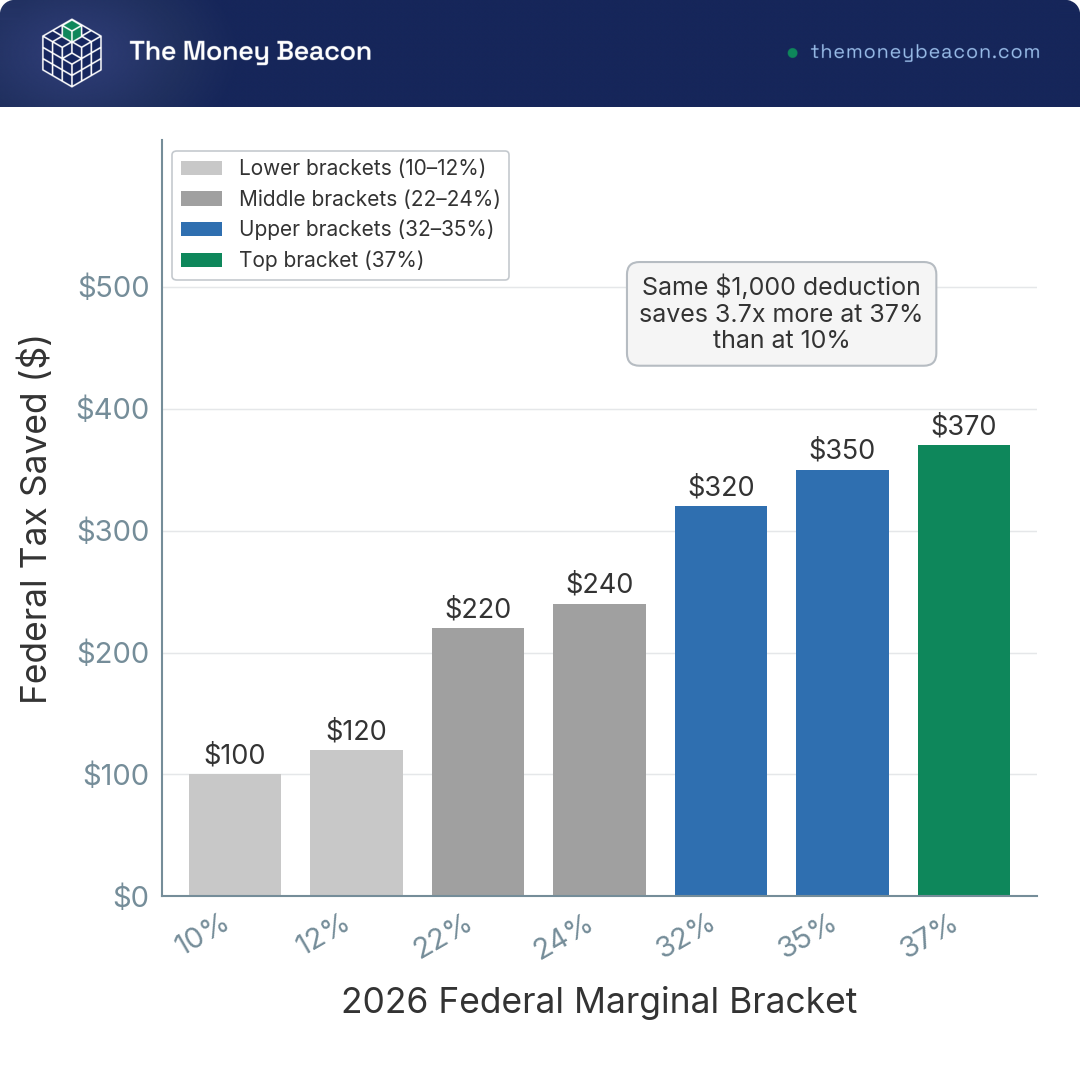
The same deduction is worth $100 at the bottom and $370 at the top, which is the marginal-rate point made visual. Knowing the three moves is the map; the next step is knowing exactly where on your return each one takes effect.
1.4 Above-the-Line vs. Below-the-Line: Standard vs. Itemized
Your tax return runs as a pipeline, and each lever bites at a specific stage. You start with gross income, subtract above-the-line adjustments to reach your adjusted gross income (AGI), subtract the larger of the standard or itemized deduction to reach taxable income, apply the brackets to get tax owed, then subtract any credits. Above-the-line adjustments, which include the deductible traditional IRA contribution, the HSA deduction, and the self-employment-tax deduction, reduce your AGI whether or not you itemize. That is what makes them so useful, because AGI is the figure that governs most of the income phase-outs you will meet later in this guide.
Below-the-line is the choice between the standard deduction and itemizing, and you take whichever is larger. For 2026 the standard deduction is $16,100 for single filers, $32,200 for married filing jointly, and $24,150 for head of household. Those amounts are high enough that most households never itemize, which is exactly why the above-the-line levers, the pre-tax accounts, matter more to most readers than the itemized list.
One itemized deduction changed enough for 2026 to warrant a fresh look. The deduction for state and local taxes (SALT) was stuck at a $10,000 cap from 2018 through 2025. The One Big Beautiful Bill Act raised the SALT cap to $40,400 for 2026 ($20,200 for married filing separately), with a phase-down for high earners that starts at $505,000 of MAGI. If you live in a high-tax state and stopped itemizing under the old $10,000 cap, re-run the math now, because that single change can flip the standard-versus-itemized decision back in your favor.
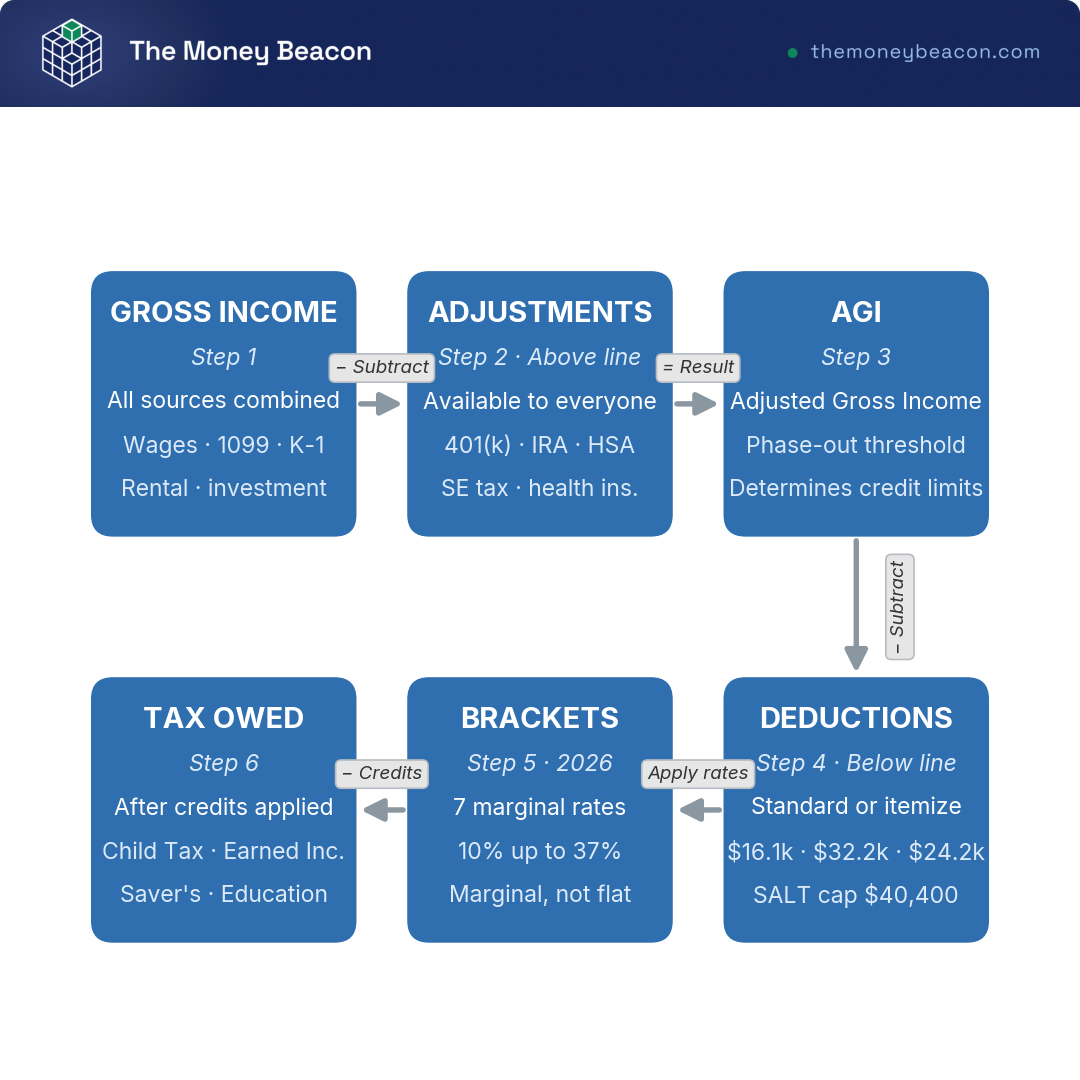
The flow shows the order plainly: adjustments and deductions shrink the income the brackets apply to, while credits come off the tax itself at the very end. That last stage, where a credit lands dollar for dollar, is where the biggest single confusion in tax planning lives, so it earns a section of its own.
2. Tax Credits vs. Tax Deductions: The Distinction That Saves the Most
You have the pipeline in your head: deductions shrink the income that gets taxed, credits come off the tax itself. Those two breaks sound interchangeable, and people treat them that way, but a dollar of one can be worth four or five times a dollar of the other. We settle that gap first, then look at why some credits can actually pay you, and finish on the breaks most households leave on the table.
2.1 A Credit Cuts Your Tax Bill; A Deduction Cuts Your Income
The cleanest way to feel the difference is to run the same $1,000 through both. A $1,000 deduction reduces your taxable income, so it is worth your marginal rate: $220 at 22%, $370 at 37%. A $1,000 credit reduces the tax you owe dollar for dollar, so it is worth a flat $1,000 to everyone, regardless of bracket. Between a credit and a deduction of the same size, the credit wins every time, and it is not close at the lower brackets.
| Item | What it reduces | Value of a $1,000 item at 22% | Value at 37% |
|---|---|---|---|
| Deduction | Taxable income | $220 | $370 |
| Nonrefundable credit | Tax owed | $1,000 (if tax owed ≥ $1,000) | $1,000 |
| Refundable credit | Tax owed, then refunded | $1,000 (even if tax owed = $0) | $1,000 |
A deduction’s value rides on your bracket while a credit’s value is fixed, which is why the credit pulls so far ahead for anyone below the top rates. There is one wrinkle hiding in that table, though, in the difference between the two kinds of credit.
2.2 Refundable vs. Nonrefundable Credits
Not every credit behaves the same once it has wiped out your bill. A nonrefundable credit can take your tax down to zero but no further; any leftover is lost, though some types carry forward. A refundable credit keeps going past zero and pays you the excess as a refund. The Earned Income Tax Credit is fully refundable, so a low-income worker who owes nothing can still collect it as cash. The Child Tax Credit, raised to $2,200 per child for 2026 under the One Big Beautiful Bill Act, is partly refundable up to $1,700 and begins phasing out above $200,000 of MAGI for single filers and $400,000 for married filing jointly.
That distinction is exactly why refundable credits should be the first thing you confirm you are claiming, before you ever fuss over deductions. The decision tree below maps that planning order, from checking for unclaimed credits down to the itemize-or-not call.
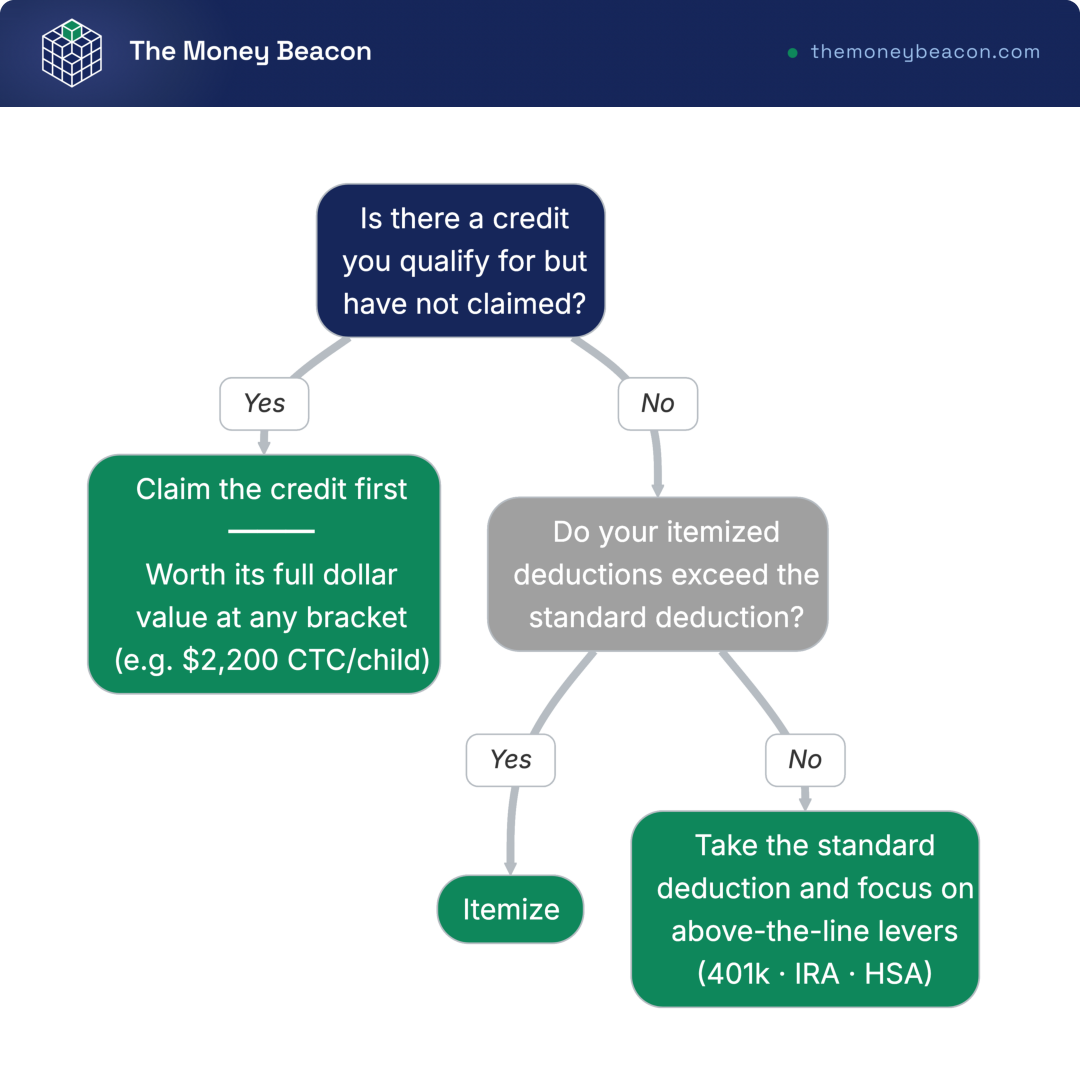
The tree routes you to credits first because they pay full value, then to the standard-versus-itemized choice and the above-the-line levers underneath it. With that order in hand, the question becomes which specific credits and deductions are slipping past most households.
2.3 The Credits and Above-the-Line Deductions Most Households Miss
A surprising amount of money goes unclaimed every year simply because people do not know a break exists. The table below collects the ones families most often miss, with their 2026 amounts.
| Credit | 2026 amount | Refundable? | Who qualifies |
|---|---|---|---|
| Child Tax Credit | Up to $2,200 per child under 17 | Partly (up to $1,700) | Income below phase-out ($200k single / $400k MFJ) |
| Earned Income Tax Credit | Up to roughly $8,200 with 3+ kids | Yes | Low-to-moderate earned income |
| Saver’s Credit | 10%/20%/50% of up to $2,000 contributed | No | Low/moderate AGI retirement savers |
| American Opportunity Credit | Up to $2,500 per student | 40% refundable | Undergrad, first 4 years |
| Lifetime Learning Credit | Up to $2,000 per return | No | Any post-secondary education |
| Child & Dependent Care Credit | 20%-35% of up to $3,000/$6,000 | No | Working parents paying for care |
Data current as of June 2026.
The most overlooked of the bunch is the Saver’s Credit, and it stacks. It pays a low- or moderate-income saver back up to 50% of the first $2,000 they put into a 401(k) or IRA, on top of whatever deduction that contribution already earns. A worker in the 50% tier turns a $2,000 retirement contribution into a $1,000 credit plus the deduction, a combination almost nobody who qualifies remembers to claim, and the credit attaches to the same 401(k) deferral you may already be making.
That covers the credits. Now the deductions that survive even when you take the standard deduction: the deductible traditional IRA contribution, the HSA deduction, student-loan interest up to $2,500 (phasing out from $85,000 of MAGI for single filers), and, for the self-employed, the half-of-SE-tax deduction and the 20% qualified business income deduction that the One Big Beautiful Bill Act made permanent. Because most households take the standard deduction, these above-the-line moves are where the real savings live, which is precisely why the next section turns to the retirement accounts that drive them.
3. Pre-Tax vs. Roth: The 401(k) and IRA Decision
The above-the-line levers point straight at your retirement accounts, where the largest reliable savings sit. The decisions here come in a clear order: grab the employer match first, understand how a pre-tax deferral cuts this year’s wages, weigh the Roth trade-off, learn the IRA limits and phase-outs, and then apply a simple rule. We close on the accounts built for the self-employed, who can shelter far more than a salaried worker.
3.1 The Employer Match and How a Pre-Tax 401(k) Lowers This Year’s Bill
If you do only one thing this year, defer enough of your salary to capture the full employer match. A common formula is 50% of the first 6% of pay, so an $80,000 earner who defers 6% ($4,800) collects a $2,400 employer contribution on top. That match is an immediate, guaranteed 50% return, and walking past it is the most expensive mistake in this whole guide. You set it in your plan portal (Fidelity, Vanguard, Schwab, or Empower) or through HR, and the change takes effect the next pay period.
The mechanic underneath is what makes a pre-tax 401(k) work. The money is withheld before federal income tax is calculated, so your taxable wages in box 1 of your W-2 drop by exactly what you defer. The money and its growth then get taxed later, when you withdraw in retirement, ideally at a lower rate. For 2026 the employee deferral limit is $24,500, with an $8,000 catch-up at age 50 and a larger $11,250 super catch-up for ages 60 to 63.
Here is the subtlety many people get wrong. A pre-tax deferral cuts your federal and most state income tax, but it does not cut Social Security and Medicare (FICA) tax, which is withheld on your full salary including the amount you defer. A Roth 401(k) has no FICA effect either, so neither route helps your payroll tax. If you want to confirm the current caps or the rules for rolling an old plan into a new one, we keep a running breakdown in our 401(k) limits and rollover guide.
3.2 Roth: Pay Tax Now, Withdraw Tax-Free Later
The pre-tax route deducts now and taxes later; the Roth route does the reverse. A Roth contribution is funded with after-tax dollars, so you get no deduction today, but qualified withdrawals, meaning after age 59 and a half and a five-year holding period, come out completely tax-free, growth included. A Roth IRA also carries no lifetime required minimum distributions for the owner, so you are never forced to draw it down. If your bracket is low and you are early in your career, the Roth usually wins, because you pay a little tax now and never pay tax on decades of compounding.
One rule changed for 2026 under SECURE 2.0. Workers whose prior-year FICA wages with their plan sponsor topped $150,000 must now make their catch-up contributions as Roth rather than pre-tax. The $24,500 elective limit is shared between the pre-tax and Roth 401(k), not doubled, so you are splitting one bucket between the two. The decision tree below walks the catch-up rule and the current-versus-future-bracket choice in one path.
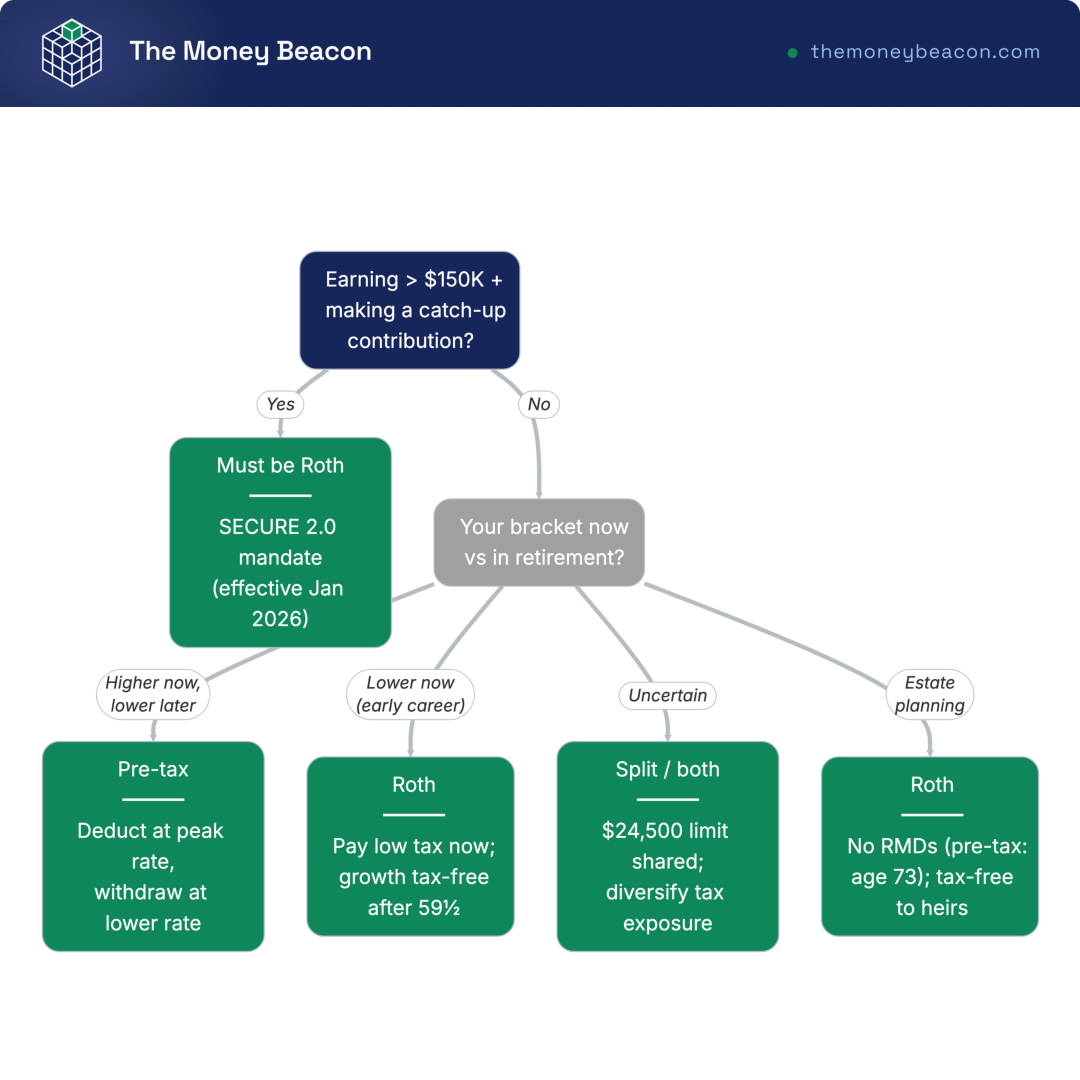
The tree settles the 401(k) version of the question; the IRA version adds income limits that the workplace plan does not have.
3.3 Traditional vs. Roth IRA: Contribution Limits and Income Phase-Outs
Outside your workplace plan, the IRA gives you a second pre-tax-or-Roth choice, with a smaller limit and an income test. For 2026 you can put $7,500 across all your IRAs combined, plus a $1,100 catch-up at 50 or older, so $8,600 in total. A traditional IRA contribution is deductible unless you or your spouse are covered by a workplace plan and your income climbs into a phase-out; a Roth IRA gives no deduction but grows tax-free, subject to its own income phase-out. The table sets the two side by side.
| Account | 2026 limit | Tax on contribution | Tax on qualified withdrawal | Income phase-out (MAGI) |
|---|---|---|---|---|
| Traditional IRA | $7,500 (+$1,100 at 50+) | Deductible (if eligible) | Ordinary income | Deduction phases out if covered by a workplace plan: $81,000-$91,000 single; $129,000-$149,000 MFJ (contributor covered) |
| Roth IRA | $7,500 (+$1,100 at 50+) | After-tax (no deduction) | Tax-free | $153,000-$168,000 single / $242,000-$252,000 MFJ |
Data current as of June 2026.
The detail people misread is that the Roth income limit is a phase-out range, not a cliff. Above the top of the range, a direct Roth contribution is barred entirely, but the door is not shut. The backdoor Roth, where you contribute to a nondeductible traditional IRA and then convert it, is the standard workaround, and it gets complicated by the pro-rata rule if you already hold other pre-tax IRA balances. We unpack how that conversion is taxed in our walkthrough of the backdoor Roth and the pro-rata rule. With the limits clear, the only thing left is a rule for choosing pre-tax or Roth in the first place.
3.4 Decision Framework: When Pre-Tax Wins, When Roth Wins
The whole choice turns on one comparison: your marginal rate today versus the rate you expect when you withdraw. If you are in a high bracket now and expect a lower one in retirement, lean pre-tax, because you deduct at a high rate and withdraw at a low one. If you are in a low bracket now, lean Roth. The table makes each if-then explicit.
| If… | Then lean… | Why |
|---|---|---|
| In a high bracket now, expect lower in retirement | Pre-tax | Deduct at high rate, withdraw at low rate |
| In a low bracket now (early career, young adult) | Roth | Pay low tax now, never tax the growth |
| Uncertain about future rates | Split / both | Diversify tax exposure |
| Prior-year FICA wages > $150,000 (catch-up) | Roth required for catch-up | SECURE 2.0 mandate |
| Want to leave tax-free money to heirs | Roth | No RMDs on Roth IRA; tax-free to heirs |
Data current as of June 2026.
For you, the practical read is this: when you genuinely cannot guess your future bracket, splitting between pre-tax and Roth buys you tax diversification, so some of your retirement income is taxable and some is not. Traditional pre-tax accounts force required minimum distributions starting at age 73, while a Roth IRA never does for the original owner, which is why leaving tax-free money to heirs tilts the call toward Roth.
Hank’s take

when you follow Fed policy and the long arc of tax legislation closely, betting that your bracket in retirement is knowable thirty years out is the part most savers overstate. Splitting pre-tax and Roth is less a forecast than an admission that rates move, and the data on past rate regimes is humbling on that point.
Fitting these choices into a plan you can actually stick to is its own discipline, and we cover the sequencing in our guide to building a retirement plan you can follow. The salaried path is now clear, which leaves the readers who answer to no employer.
3.5 Self-Employed and 1099 Filers: SEP IRA and Solo 401(k)
If your income runs through a 1099 or a Schedule C, you can shelter far more than a W-2 employee, but you choose among three accounts. A SEP IRA lets you contribute up to 25% of your net self-employment income, to a $72,000 cap for 2026, and it suits a high earner with few or no employees who wants something simple. A Solo 401(k) pairs a $24,500 employee deferral with a profit-sharing contribution up to that same $72,000 total, often reaching a bigger number at moderate income, and it offers a Roth option. A SIMPLE IRA, with a $17,000 deferral for 2026, fits a small employer under 100 staff who wants a low-cost plan.
Two extra rules shape the self-employed picture. You owe self-employment tax of 15.3% on net earnings up to the $184,500 Social Security wage base for 2026, then 2.9% Medicare above it, and you may deduct half of that above the line. On top of that sits the 20% qualified business income deduction under Section 199A, made permanent by the One Big Beautiful Bill Act, which begins phasing in income-based limits above roughly $201,750 of taxable income for single filers and $403,500 for joint filers. The selector below routes you to the right account based on employees, income, and whether you want a Roth.
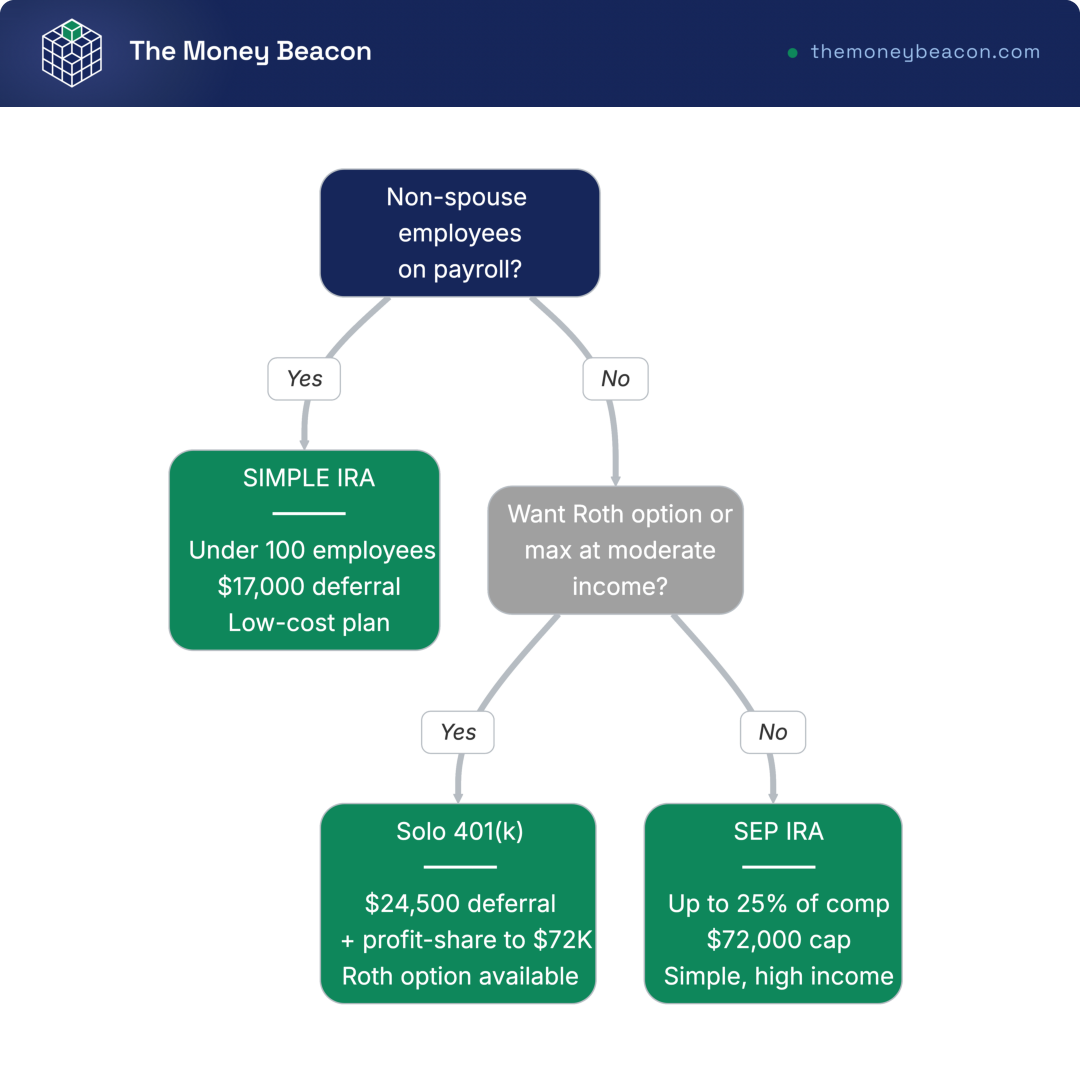
There is one account, though, that beats every retirement account here on tax treatment, and that is where we head next.
4. The HSA: The Most Tax-Advantaged Account in the Code
The retirement accounts get taxed favorably at one end or the other, never both. The Health Savings Account is the exception: the only account in the code taxed favorably going in, growing, and coming out. That triple tax advantage makes it the single most powerful tax shelter most households have access to, yet almost nobody uses it to the full. The catch is that you have to qualify, and the real payoff only shows up if you treat it the right way, so let’s start with who gets in the door.
4.1 Who Qualifies and the Triple Tax Advantage Explained
Eligibility comes first, because the HSA is not an account you simply choose to open. You have to be enrolled in a qualifying high-deductible health plan (HDHP), and you cannot hold disqualifying coverage like a general-purpose health FSA or Medicare. For 2026 the plan counts as an HDHP only if its deductible is at least $1,700 for self-only coverage or $3,400 for family coverage, with an out-of-pocket maximum capped at $8,500 self-only and $17,000 family. This ties your health-plan choice straight to your tax strategy, because the insurance decision you make in open enrollment is what unlocks the account. Once you qualify, you can open one at a provider like Fidelity, Lively, or HealthEquity.
Now the part that earns the HSA its reputation. Most accounts give you one tax break; the HSA stacks three. Your contributions are deductible (and if you fund it through payroll, they also escape Social Security and Medicare tax, an edge a deductible IRA does not share), the money grows tax-free year after year, and withdrawals for qualified medical costs come out tax-free as well. No other account in the code combines all three breaks at once. For 2026 you can contribute $4,400 for self-only coverage or $8,750 for family coverage, plus a $1,000 catch-up once you turn 55.
One caveat worth knowing before you count on the full benefit: a handful of states, notably California and New Jersey, do not conform to the federal treatment and will tax your HSA contributions or earnings at the state level. The federal triple advantage holds everywhere, but if you live in one of those states, your state return takes a bite the others do not. With eligibility confirmed and the three breaks clear, the question becomes how to actually use the account, because the way most people use it throws away most of its value.
4.2 Using an HSA as a Backdoor Retirement Account
Here is a mistake I see constantly: people open an HSA, run their copays and prescriptions through the debit card, and let the balance hover near zero. That treats a retirement-grade account like a checking account. The far more powerful move is to pay your current medical bills out of pocket, invest the HSA in a low-cost index fund, and let it compound for decades, saving every medical receipt. Because there is no deadline to reimburse yourself, you can pull that money out tax-free years later against those receipts.
What turns the HSA into a stealth retirement account is what happens at 65. After that age, you can withdraw for any reason at all, not just medical, and a non-medical withdrawal is simply taxed as ordinary income with no penalty, exactly like a traditional IRA. Before 65, that same non-qualified withdrawal costs you income tax plus a 20% penalty, so the strategy rewards patience and punishes raiding it early. Used this way, a fully funded HSA becomes a supplemental retirement account that still keeps its tax-free medical escape hatch for life.
The chart below tracks a maxed family HSA invested at a 7% assumed return against the same contributions left sitting as cash, over 30 years.
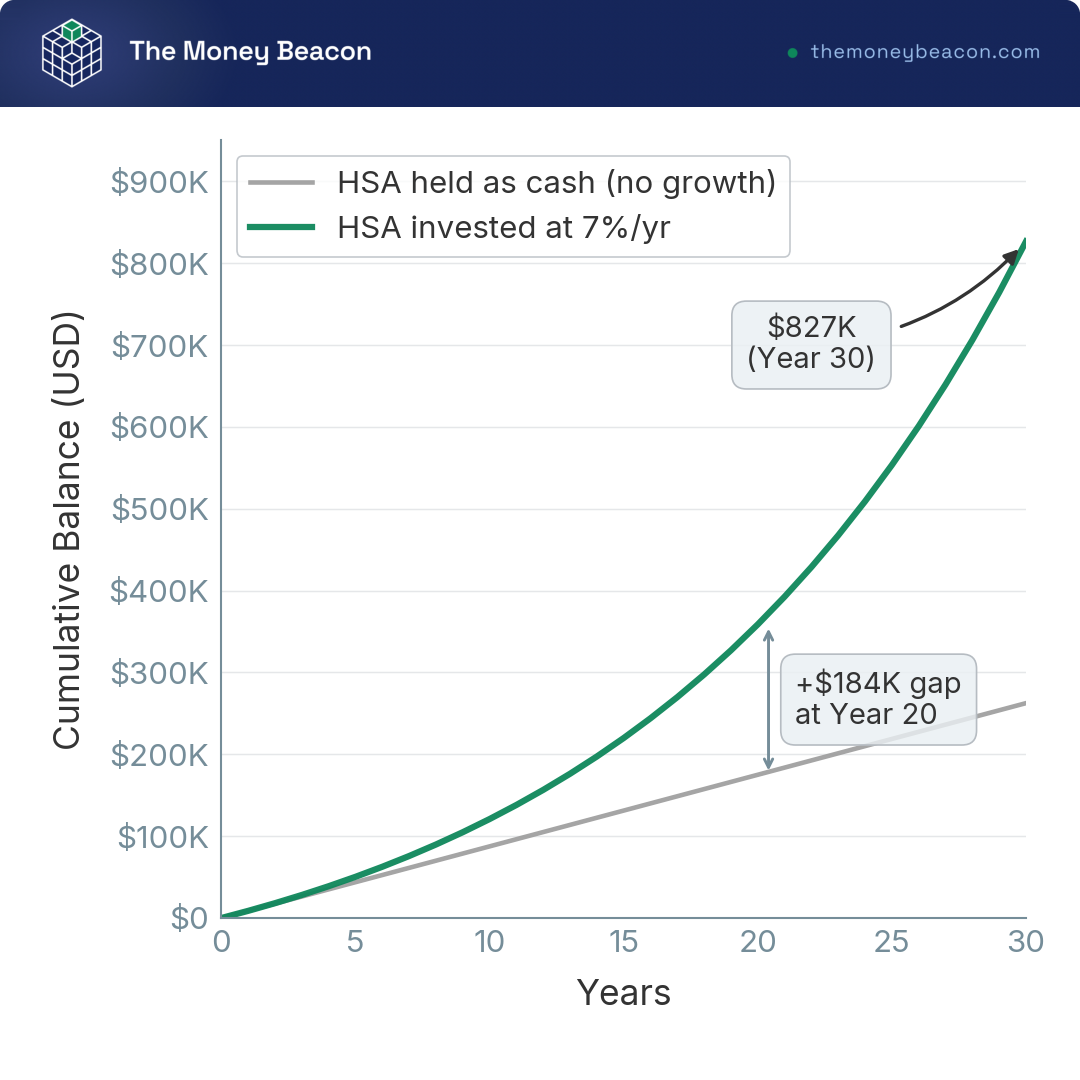
The two lines start together and then split wider every year, because tax-free compounding does its heaviest lifting in the final decade. Past returns never guarantee future ones, and 7% is an assumption, not a promise, but the shape of the gap is the point: the biggest payoff comes from investing the HSA and not spending it. All of this assumes you have an HSA in the first place, which raises the account it gets confused with most often: the FSA.
4.3 HSA vs. FSA: Don’t Confuse Them
The HSA and the health FSA sound like the same account, and people treat them as interchangeable, but they behave very differently once the year ends. The cleanest way to separate them is on four features: who owns the account, whether the money rolls over, whether it follows you when you change jobs, and whether you can invest the balance. The table sets them side by side.
| Feature | HSA | Health FSA |
|---|---|---|
| Requires HDHP? | Yes | No |
| Funds roll over? | Yes, indefinitely | No (use-it-or-lose-it, limited carryover) |
| Portable if you leave job? | Yes, you own it | No, generally forfeited |
| Can invest the balance? | Yes | No |
| Triple tax advantage? | Yes | Pre-tax in, tax-free out (no investing) |
| 2026 limit | $4,400 / $8,750 | $3,400 |
Data current as of June 2026.
The defining split is ownership. An HSA belongs to you, rolls over forever, and travels with you from job to job, which is what lets the invest-and-hold strategy work in the first place. A health FSA is tied to your employer and is largely use-it-or-lose-it, so it can never be a long-term account no matter how disciplined you are. There is also a rule that trips people up: you generally cannot contribute to an HSA and a general-purpose health FSA in the same year, with the one exception being a limited-purpose FSA restricted to dental and vision, which can ride alongside an HSA. For readers without an HDHP, the HSA is off the table entirely, and that is exactly where the FSA earns its place.
5. FSAs and Other Pre-Tax Payroll Levers
Not everyone has access to an HDHP, and not everyone who does wants one. If the HSA is closed to you, there is still a pre-tax health account that lowers your bill. The FSA family does similar work through your paycheck, with its own rules and its own trap. We start with how a health FSA cuts your taxable pay, then turn to the forfeiture risk and the dependent care version that families lean on most.
5.1 How a Health FSA Lowers Your Taxable Pay
A health Flexible Spending Account works through your employer under a Section 125 cafeteria plan, which is a fancy label for one simple mechanic: you elect an amount, and it comes out of your salary before taxes are calculated. That pre-tax routing is what makes it useful, because it cuts both your income tax and your FICA, the same payroll tax that a pre-tax 401(k) deferral leaves untouched. For 2026 you can set aside up to $3,400. A worker in the 22% bracket who funds the full amount saves roughly $748 in federal income tax plus about $260 in FICA, before any state tax savings on top.
The trade-off is what the FSA gives up. Unlike the HSA, you cannot invest a health FSA balance, so it will never compound into a retirement asset; it is a spending account, not a savings account. That makes it the natural fit for two readers: those without an HDHP who still want a pre-tax health account, and those running a limited-purpose FSA for dental and vision alongside an HSA. The Venn diagram below locks in what the two accounts share against what belongs to each one alone.
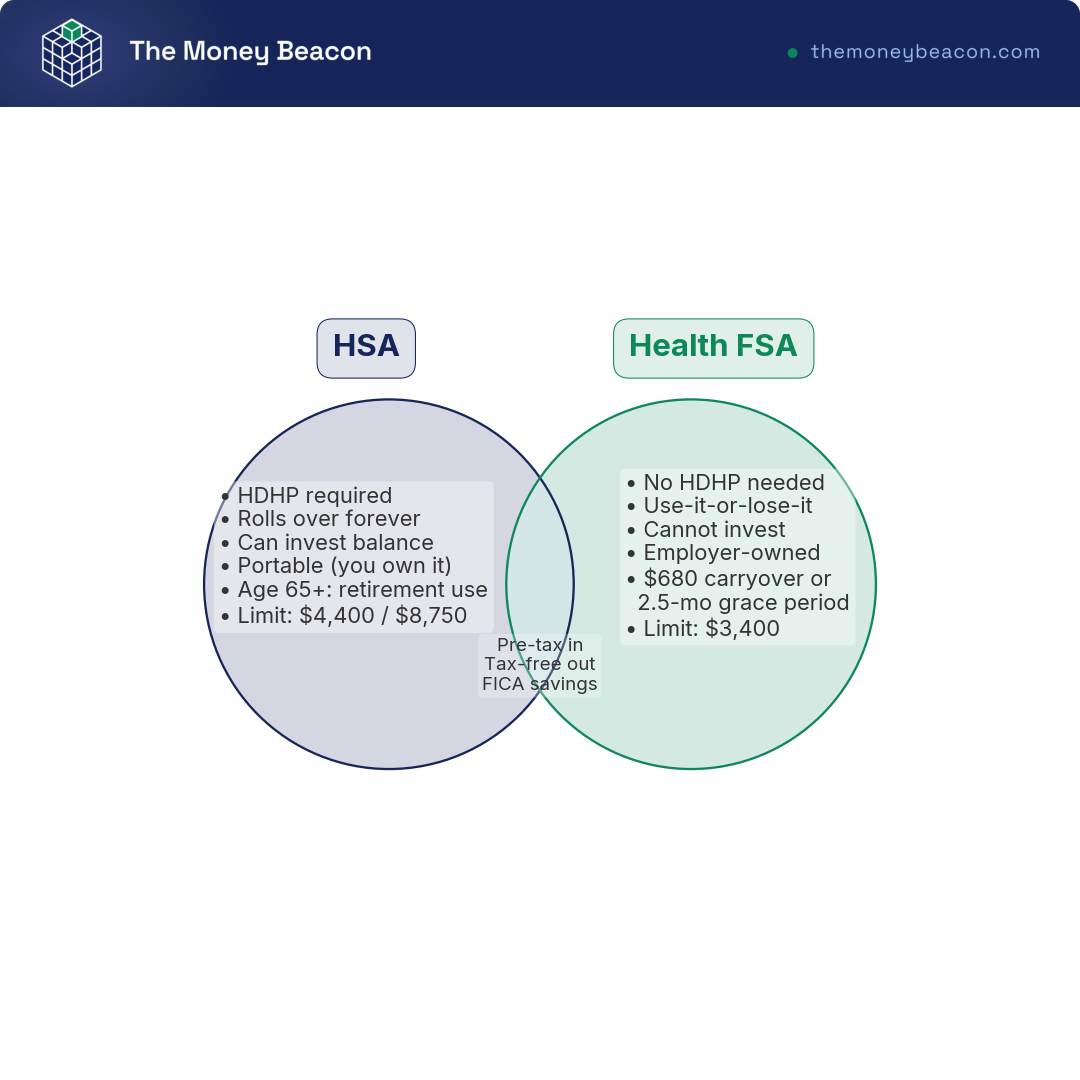
The overlap in the middle is real: both accounts go in pre-tax, both come out tax-free for qualified medical costs, and both save you FICA. Everything that makes the HSA a long-term wealth tool, the HDHP requirement, the rollover, the investing, the portability, sits outside that overlap and belongs to the HSA alone. That single exclusive feature, the rollover, is exactly what the FSA lacks, and it sets up the rule that costs FSA users the most money.
5.2 Use-It-or-Lose-It, Plus the Dependent Care FSA for Families
The reason you size an FSA carefully is that unspent money does not come back to you. Health FSA funds are forfeited if you do not spend them by the plan-year end, with only two narrow escape valves an employer can offer: a carryover of up to $680 into the next year for 2026, or a grace period of up to two and a half months after year-end to keep spending. An employer can offer one of those, never both, and many offer neither. The practical rule is to estimate your predictable expenses conservatively and elect close to that floor, anchoring on the bills you know are coming, like prescriptions, dental work, and glasses, rather than the ones you hope you will not need. The timeline below lays out the deadlines that decide whether the money survives.
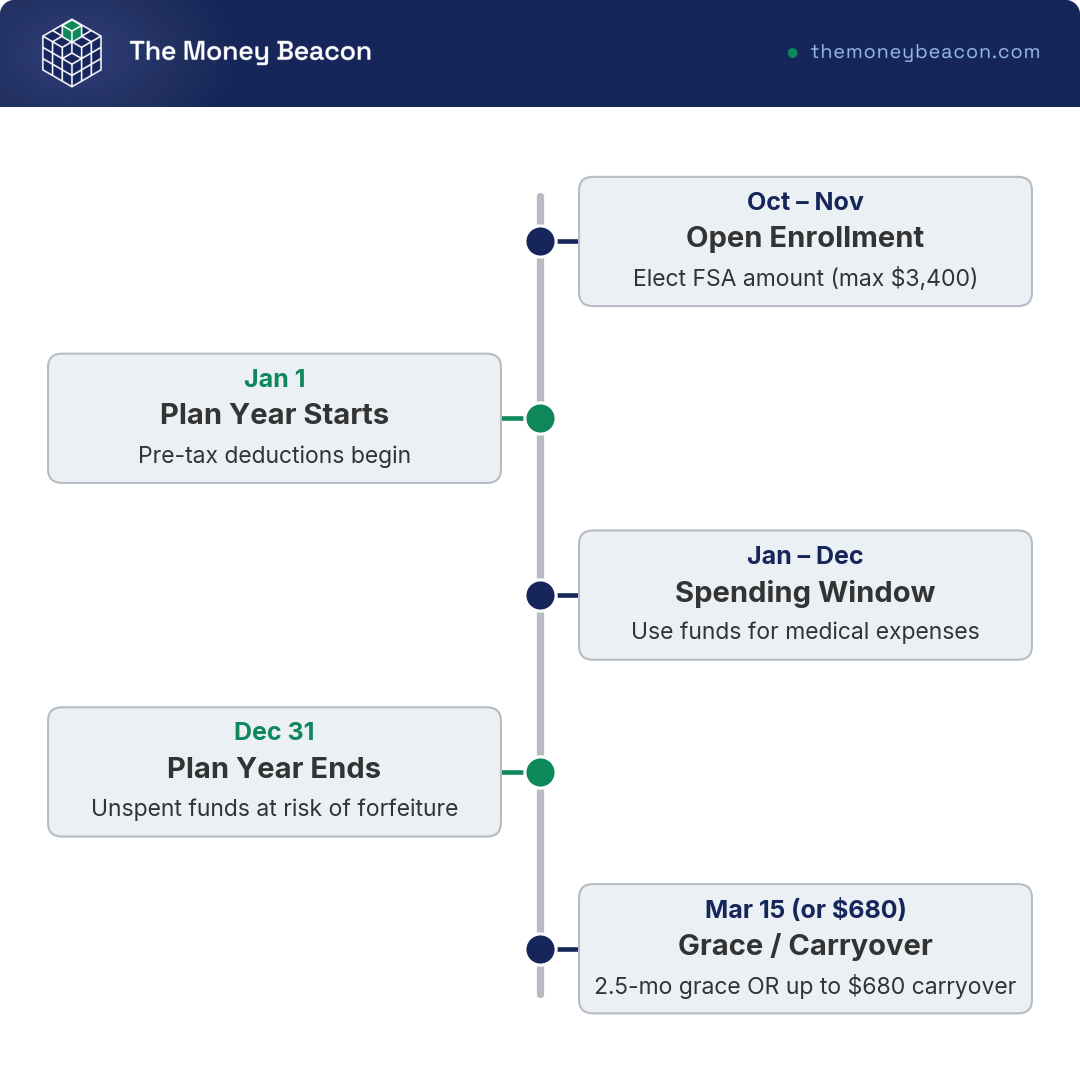
The timeline makes the danger plain: once the plan year closes and any grace period or carryover runs out, whatever is left is gone for good. So the discipline is to under-elect rather than over-elect, because money you forfeit is worse than money you never sheltered at all.
There is a second FSA built for a different expense, and for families it is often the larger lever. A Dependent Care FSA (DCFSA) shelters up to $5,000 per household ($2,500 if married filing separately) of pre-tax pay for childcare or eldercare that lets you go to work, and like the health FSA it dodges both income tax and FICA. The complication is that it does not stand alone. Families have to coordinate it with the Child and Dependent Care Credit we covered earlier, because every dollar you run through the DCFSA shrinks the expense base that qualifies for the credit, and double-counting the same dollars is a common, costly error.
Tom’s take
every account I hold gets weighed across four dimensions at once, financial, tax, legal, and estate, and the dependent care choice is a small version of that same habit. You do not pick the FSA or the credit in isolation; you run both numbers and keep the one that nets more after FICA, because the right answer flips with your income.
For most middle- and higher-income families the math favors the DCFSA, since dodging FICA on top of income tax usually beats the credit’s percentage. Lower-income families often do better with the credit, because its rate climbs as income falls and can outrun the pre-tax saving. Either way, you choose one path for a given dollar, not both. That exhausts the pre-tax wrappers your paycheck and your health plan can offer, which leaves the money you have already paid tax on and invested in a regular brokerage account, where a different set of rules decides what you owe.
6. Tax-Loss Harvesting in a Taxable Brokerage Account
Everything covered so far lowered your bill before the money ever got invested, inside accounts where the IRS leaves your gains alone until you withdraw. A taxable brokerage account works differently. You have already paid tax on the money going in, and the account hands you a tax bill every time you sell at a profit or collect a dividend. But it also opens a lever none of the sheltered accounts offer: you can deliberately realize your losers to shrink what you owe on your winners. Here is how that actually trims the bill, and the single rule that can erase the whole benefit.
6.1 How Harvesting a Loss Cuts Your Tax Bill
A taxable brokerage account is an ordinary investment account, the one you open at Fidelity, Schwab, or Vanguard outside any retirement wrapper. It matters here because harvesting works only in a taxable account; inside an IRA, a 401(k), or an HSA, your gains and losses have no current tax effect at all, so there is nothing to harvest. The move itself is simple. You sell a position that is worth less than you paid for it, which “realizes” a capital loss, and that loss goes to work cutting your taxes.
The loss follows a strict order. It first offsets your capital gains, dollar for dollar, and only after your gains are wiped out can it offset up to $3,000 of ordinary income per year ($1,500 if you are married filing separately). Anything left over does not vanish; it carries forward to future years, which we will get to shortly. All of it gets reported on Form 8949 and Schedule D when you file.
The dollar math makes it concrete. Say you are sitting on $5,000 of realized long-term gains and you harvest a $5,000 loss from another holding. The two cancel out, and the 15% tax you would have owed on those gains, $750, simply disappears. You stay invested at roughly the same risk level, and you have converted a paper loss into a real tax saving. That is the whole appeal of harvesting, and the mechanics of how those gains and dividends get taxed in the first place are laid out in our guide to capital gains and dividends. There is one rule, though, that can quietly void the entire deduction.
6.2 The Wash-Sale Rule: The Mistake That Voids the Benefit
The trap is called the wash-sale rule, and it is the reason a harvest you thought you booked can get thrown out at filing time. Under IRC Section 1091, the IRS disallows the loss if you buy the same or a substantially identical security within 30 days before or after the sale. Count both sides and that is a 61-day window with your sale date in the middle. The rule is wider than most people expect, because it also reaches a purchase in your spouse’s account or in your IRA, so you cannot dodge it by simply rebuying in a different account under the same roof.
The good news is that a disallowed loss is deferred, not destroyed. The amount you lose gets added to the cost basis of the replacement shares, so you recover it whenever you eventually sell those. The cleaner fix is to not trigger the rule at all, and there are two ways to do that. You can wait 31 days before buying back the identical position, or you can stay invested the whole time by buying a similar but not substantially identical fund, for example selling one broad S&P 500 index fund and buying a total-market index fund from a different provider. The timeline below shows the full danger zone on both sides of the sale.
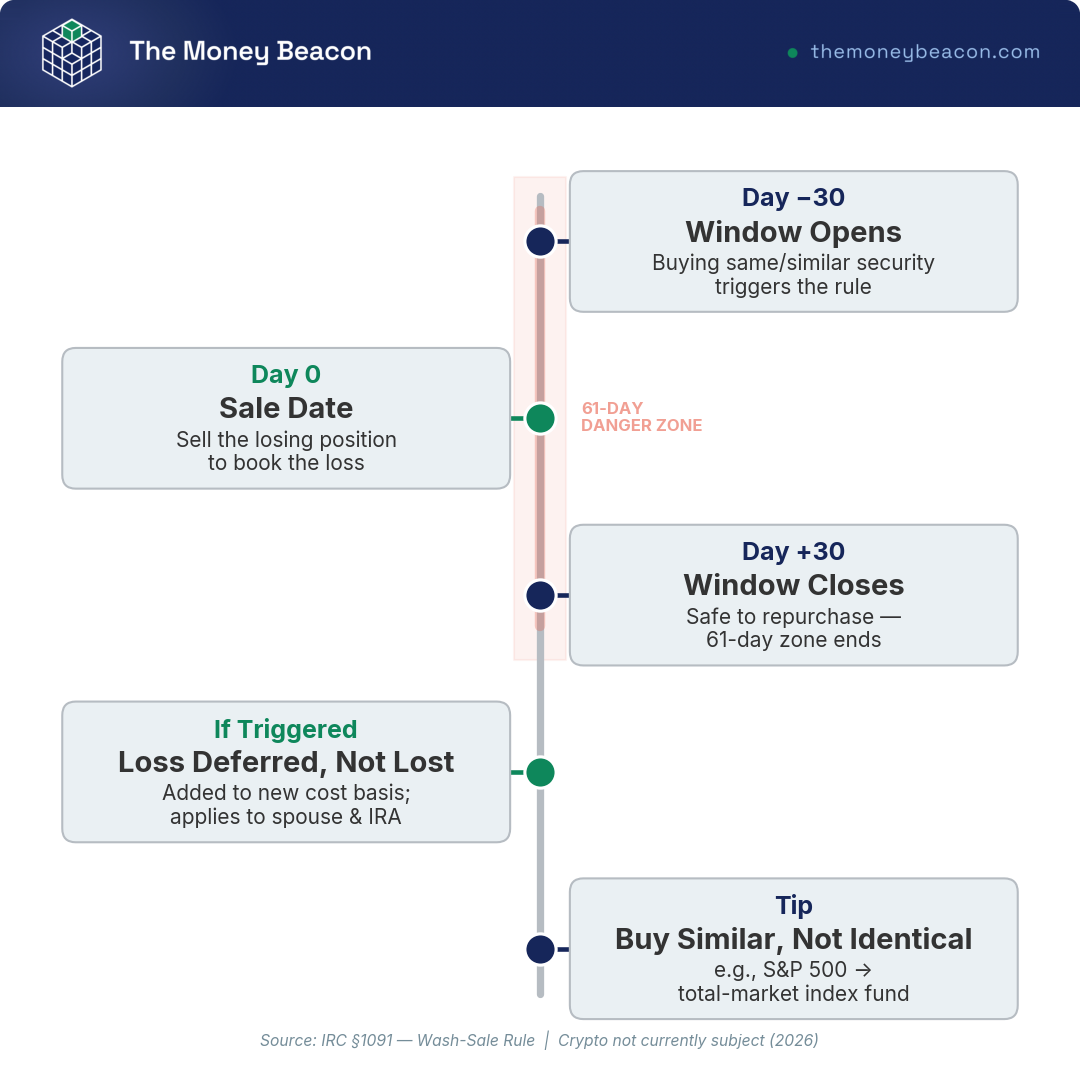
Seeing both sides of the window matters, because plenty of people count only the 30 days after a sale and forget the 30 days before, then get caught by a purchase they had already made. One more wrinkle worth knowing: under current IRS guidance the wash-sale rule does not apply to crypto, which is treated as property rather than a security, so you can sell a coin at a loss and rebuy it immediately. That gap is a quirk of current law, not a permanent feature, and Congress could close it, so do not build a long-term plan around it. With the trap mapped, the real question is which gains are worth offsetting in the first place, and that comes down to how long you held the position.
6.3 Short-Term vs. Long-Term: Why Holding Period Matters
Not every gain is taxed the same, and that changes which losses are most valuable to harvest. Gains and losses net within their own category first: short-term losses offset short-term gains, long-term losses offset long-term gains. The dividing line is one year and a day, because holding a position longer than a year converts a short-term gain into a long-term one. That single day can move the gain into a far lower tax bracket.
Why does this matter for harvesting? The rate gap is large. The table below lays out how the two holding periods are taxed for 2026.
| Short-term (held one year or less) | Long-term (held more than one year) | |
|---|---|---|
| Tax rate on gains | Ordinary, 10% to 37% | 0% / 15% / 20% |
| NIIT (above MAGI threshold) | +3.8% | +3.8% |
| Top federal rate | 40.8% | 23.8% |
| Qualified dividends | n/a | Taxed at 0/15/20% |
Data current as of June 2026.
Short-term gains are taxed as ordinary income at your regular bracket, which runs as high as 37%, while long-term gains top out at 20%. On top of either, the 3.8% net investment income tax (NIIT) applies once your modified adjusted gross income clears $200,000 single or $250,000 married filing jointly, which pushes the worst case to 40.8% on a short-term gain versus 23.8% on a long-term one. Because short-term gains are taxed so much harder, a harvested loss aimed at a short-term gain saves you the most per dollar. Qualified dividends, helpfully, get the gentler long-term rates rather than ordinary ones. The fuller picture of how all these gain and dividend rates interact lives in our breakdown of short and long-term gains. So what happens when your losses outrun your gains, and should you even be doing this by hand?
6.4 Carrying Losses Forward and Automating It
A good harvesting year can leave you with more losses than you have gains to absorb, and the tax code is generous about it. Unused losses carry forward indefinitely, with no expiration, and they keep their short- or long-term character the whole way. Work through an example: suppose your losses exceed your gains by $8,000 in a year. The first $3,000 offsets your ordinary income now, saving $660 at the 22% bracket, and the remaining $5,000 rolls into next year to offset future gains or income. Nothing is wasted; it is just spread across tax years.
The follow-up question is whether to bother doing this manually at all. Robo-advisors like Betterment and Wealthfront automate daily loss harvesting for an advisory fee of about 0.25% of assets per year on their standard tiers, though Betterment charges 0.65% on its Premium advisory tier. The catch is that the automation only pays off if the harvested losses beat the fee’s drag, which is most likely on larger balances that swing around enough to throw off losses. The chart below weighs that benefit against the fee over a decade.
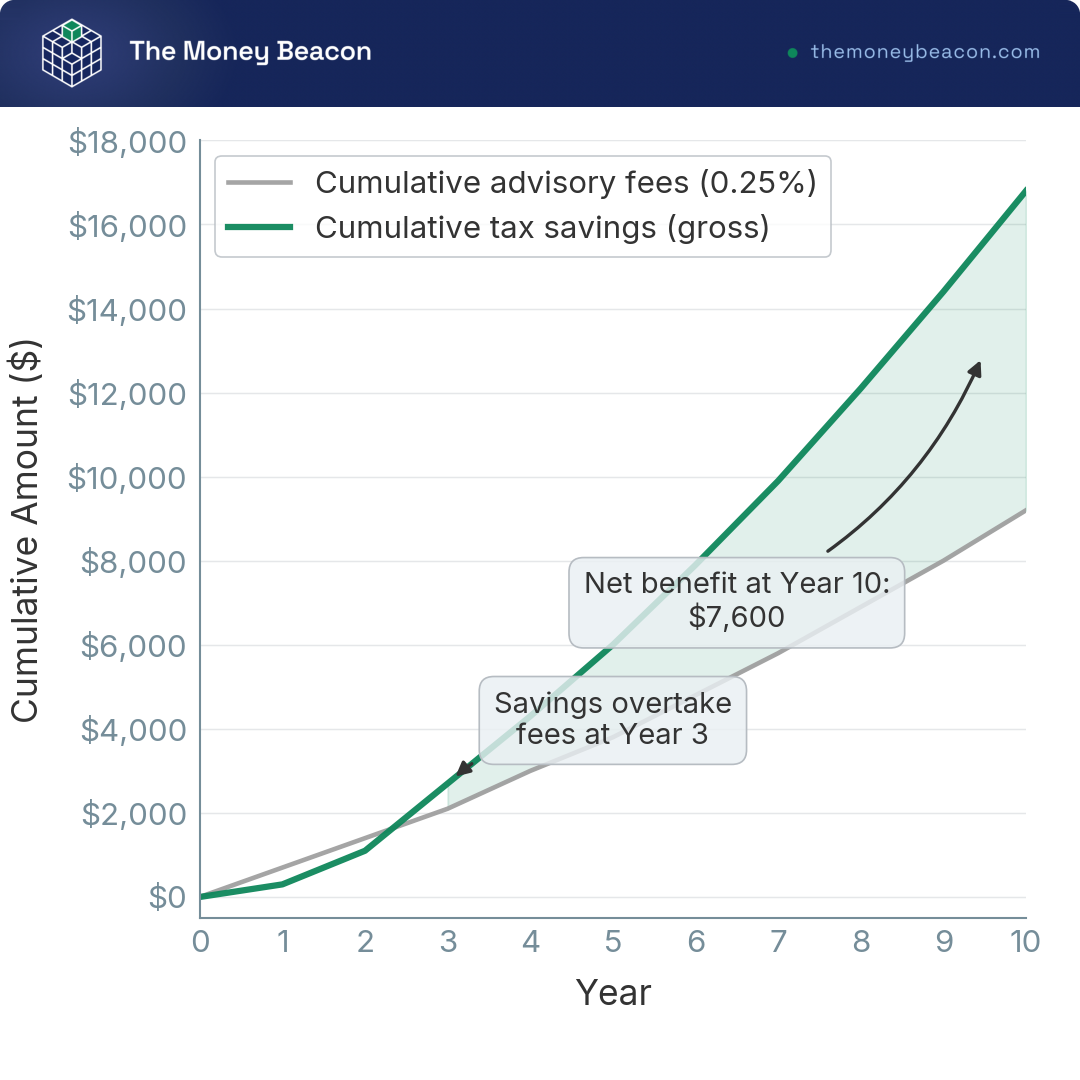
On a $250,000 portfolio with moderate volatility, the harvesting line eventually pulls clear of the fee, but on a small, quiet balance the 0.25% can cost you more than the harvesting saves. If you would rather not watch the wash-sale calendar yourself, automation is a reasonable trade, and we compare the platforms in our review of the hands-off automated services.
Hank’s take
the behavioral-finance research is blunt about this: the investors who chase a harvest often end up trading more, drifting from their target allocation, and paying for it in ways that dwarf the tax they saved. Harvest when a real loss is sitting there, but do not let a tax tail wag the investing dog.
That rounds out the last distinct lever, harvesting, the final move available inside a taxable account. You now have every tool the code offers, from the employer match to the loss carryforward. The real question is the order you reach for them in, and whether you need help pulling it off.
7. Putting It Together and Knowing When to Hire a CPA
You have met every lever in this guide one at a time, which is the only way to understand them, but it is not how you actually use them. In real life your next saved dollar has to go somewhere specific, your deadlines are not all on the same date, and at some point the return gets complicated enough that doing it alone costs more than paying someone.
7.1 The Priority Order: What to Fund First
When you have a limited number of dollars to save and several accounts competing for them, the order is not a matter of taste; it follows the size of the payoff. A widely used funding waterfall, adaptable to your own situation, sequences the levers from the highest guaranteed return down to the most flexible. Here is the order most households should follow:
- First, fund your 401(k) up to the full employer match, because a common 50%-of-the-first-6% match turns a $4,800 deferral into a free $2,400, and no investment beats an instant 50% return.
- Second, max your HSA to the $4,400 self-only or $8,750 family limit if you are HDHP-eligible, since it is the only account with the triple tax advantage.
- Third, pay down high-interest debt, because eliminating a 20%-plus annual percentage rate (APR) is a guaranteed, tax-free return equal to that rate.
- Fourth, fund a Roth or traditional IRA to the $7,500 limit, then max the rest of your 401(k) up to $24,500, and only after all that does a taxable brokerage with harvesting come into play.
The flowchart below walks the same waterfall stage by stage, with each step’s 2026 limit attached.
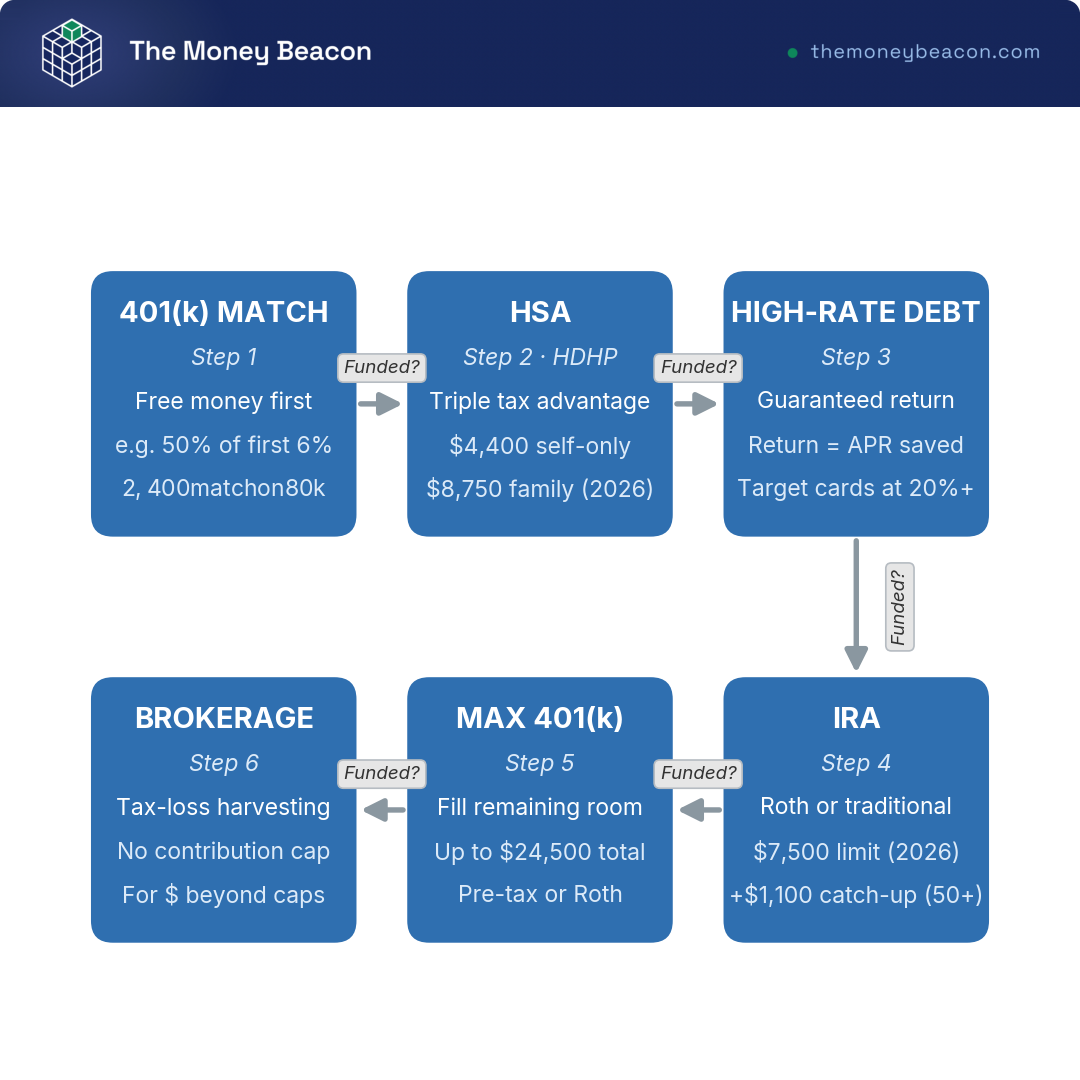
Each dollar does the most work where you place it first, so you fill the high-return buckets before the merely good ones. The exact mix shifts with your goals and your time horizon, which we work through in our guide to matching accounts to the right time horizon. Knowing the order is half the job; the other half is doing it before the clock runs out.
7.2 Your Year-End Tax-Reduction Checklist
The most expensive mistake at this stage is not picking the wrong account; it is missing a deadline, and the deadlines are not all the same day. Some moves must be done by December 31 with no extension, while others run all the way to the filing deadline the following April. The checklist below pairs each action with the mistake that most often costs people the saving.
| To do (by Dec 31 unless noted) | To avoid (common mistake) |
|---|---|
| Increase 401(k) deferral to hit the limit | Missing the Dec 31 401(k) deadline (no extension) |
| Spend down or plan FSA balance | Forfeiting FSA funds to use-it-or-lose-it |
| Harvest investment losses | Triggering a wash sale within 30 days |
| Make HSA / IRA contributions (deadline April 15, 2027) | Assuming HSA/IRA close Dec 31 (they run to filing deadline) |
| Confirm full employer match captured | Leaving match money on the table |
| Bunch deductible expenses if near itemizing threshold | Itemizing when the standard deduction is larger |
| Check Saver’s Credit / CTC / EITC eligibility | Overlooking refundable credits |
Data current as of June 2026.
The split that trips people up sits in the middle of that list. Your 401(k) deferrals, FSA spending, and loss harvesting all have to happen by December 31, and there is no extension on any of them. But your prior-year IRA and HSA contributions can be made right up to the tax-filing deadline, April 15, 2027 for tax year 2026. Confusing the two is a genuinely costly error, because someone who assumes their IRA closed in December stops funding it and forfeits months of room. Once the deadlines are clear, the last call is whether you handle the filing yourself or bring in help.
7.3 When to Hire a Pro: CPA vs. Enrolled Agent vs. DIY Software
For a clean W-2 return with the standard deduction, tax software handles the job and a professional is an expense you do not need. The calculus flips as complexity climbs. A pro starts earning the fee the moment your return involves self-employment or a small business, rental property, equity compensation like RSUs or ISOs, a backdoor Roth, multi-state income, large capital gains, an inheritance, or an IRS notice in the mail. The rule of thumb is clean: if professional help surfaces or correctly handles a deduction, credit, or strategy worth more than the fee, it pays for itself. A single missed strategy on a self-employed return can easily clear a four-figure cost.
Knowing you need help is one thing; knowing which kind is another, because the options differ in price and in what they are licensed to do. The table below lays out the four routes side by side.
| Option | Best for | Typical cost | Represents you before IRS? |
|---|---|---|---|
| DIY software (TurboTax, H&R Block, FreeTaxUSA) | Simple W-2, standard deduction | Roughly $0 to $130 | No |
| Enrolled agent (EA) | Tax-focused, IRS matters, moderate complexity | $150 to $400+ | Yes (federally licensed) |
| CPA | Business, multi-state, planning + filing | $300 to $2,500+ | Yes |
| Robo-advisor (harvesting only) | Automated taxable-account harvesting | About 0.25%/yr of assets | No |
Data current as of June 2026.
The one most people overlook is the enrolled agent (EA), a tax specialist federally licensed by the IRS who can represent you in an audit and usually costs less than a CPA. A CPA carries broader accounting credentials and is state-licensed, which is what you want for a business, multi-state income, or year-round planning rather than just filing. On price, a simple individual return runs around $220, an itemized return with a state filing about $450, and a self-employed or complex return $800 to $2,500 or more, with a Schedule C commonly $400 to $800 and a rental-property return $600 to $1,000. If your situation has grown past software but you also want ongoing money guidance, our comparison can help you find a fee-only fiduciary you can trust. With the help question settled, here is every lever on a single page.
7.4 Every Lever at a Glance: The 2026 Recap Table
This is the whole guide compressed into one reference. Every row is a lever already worked through, now lined up with its 2026 key number, what part of your bill it cuts, the hard deadline you cannot miss, and the single mistake that most often spoils it.
| Lever | Account / mechanism | 2026 key number | What it cuts | Hard deadline | Top mistake to avoid |
|---|---|---|---|---|---|
| Employer match | 401(k) | Often 50% of first 6% | Free contribution | Dec 31 (deferrals) | Not deferring enough to get full match |
| Pre-tax deferral | Traditional 401(k) | $24,500 (+$8,000 / $11,250 catch-up) | Taxable income at marginal rate | Dec 31 | Expecting it to cut FICA |
| Roth | Roth 401(k) / Roth IRA | $24,500 / $7,500 | Tax on future growth | Dec 31 / Apr 15 | Assuming phase-out is a cliff |
| IRA | Traditional / Roth IRA | $7,500 (+$1,100 at 50+) | Income (trad.) / future tax (Roth) | Apr 15, 2027 (prior year) | Missing deductibility phase-out |
| HSA | HSA (HDHP required) | $4,400 / $8,750 (+$1,000 at 55+) | Income + FICA + growth + withdrawal | Apr 15, 2027 (prior year) | Spending instead of investing it |
| Health FSA | Section 125 cafeteria | $3,400 | Income + FICA | Dec 31 (spend) | Use-it-or-lose-it forfeiture |
| Dependent Care FSA | Section 129 | $5,000 household | Income + FICA | Dec 31 (spend) | Double-counting vs. care credit |
| Tax-loss harvesting | Taxable brokerage | $3,000/yr vs. ordinary income | Capital gains, then income | Dec 31 (sale) | 30-day wash sale |
| Credits | CTC, EITC, Saver’s, education | Dollar-for-dollar | Tax owed directly | Filing | Overlooking refundable credits |
| Pro help | CPA / EA | $220 to $2,500+ | Surfaces missed savings | Filing | Paying when DIY would do |
Data current as of June 2026.
Read down that table and the through-line is right there: capture the free match, fill the triple-advantage HSA, work down the waterfall, and mind which deadlines fall in December versus April. So pick the single highest-priority account you have not yet funded to its limit, and move money into it before its deadline.
Conclusion
The biggest lesson from all of this is that lowering your tax bill is mostly a matter of using the accounts Congress built on purpose and acting before the calendar runs out. Fund your 401(k) to the full employer match first, because turning down a 50%-of-the-first-6% match is leaving a guaranteed return on the table, then fill the HSA if you have a qualifying high-deductible plan, since it is the only account where the contribution, the growth, and the withdrawal all escape tax. Credits beat deductions dollar for dollar, so chase the ones you qualify for before you fine-tune anything else.
Two details trip people up every year. The first is the wash-sale trap, where rebuying the same fund within 30 days on either side of a harvested loss quietly voids the whole deduction; the fix is to wait 31 days or buy a similar but not identical fund. The second is that the deadlines split: 401(k) deferrals, FSA spending, and loss harvesting close December 31, while a prior-year IRA or HSA contribution runs to April 15, 2027. Concretely, your next move is to open your plan portal this week and raise your deferral to at least the full match before year-end.
If you want to go deeper on the accounts doing the heaviest lifting here, our guide to how a 401(k) works and our Roth IRA guide walk through the limits and the pre-tax-versus-Roth call in detail, and our guide to investment taxes takes the harvesting and capital-gains math further for anyone with a taxable brokerage account.
FAQ: Cutting Your Tax Bill in 2026
Is a tax credit or a tax deduction better?
A credit is almost always the stronger lever, and the reason comes down to how each one touches your bill. A credit reduces the tax you owe dollar for dollar, so a $200 credit saves you a full $200 no matter which bracket you sit in. A deduction only reduces your taxable income, so it saves you $200 times your marginal rate, which works out to just $24 at the 12% bracket or $74 at the 37% bracket. So when you can choose between a $200 credit and a $200 deduction, take the credit every time. Some credits, like the Earned Income Tax Credit, are even refundable, which means they can pay you back more than you actually owed.
Should I choose a pre-tax 401(k) or a Roth 401(k)?
The decision turns on one comparison: your tax bracket today against the bracket you expect in retirement. If you are a high earner now and reasonably expect lower income later, pre-tax usually wins, because you deduct the contribution at a high rate now and withdraw it at a lower one. If you are early in your career and sitting in a low bracket, especially as a young adult, Roth tends to win, since you pay little tax now and never pay tax on decades of growth. When you genuinely cannot tell, splitting your contribution between the two diversifies your tax exposure. One 2026 rule to watch: workers whose prior-year FICA wages topped $150,000 must now make their catch-up contributions as Roth. Our guide to how a 401(k) works walks through the choice in more detail.
How much can I put into an IRA and an HSA this year?
For 2026, the IRA limit is $7,500 across all of your IRAs combined, plus a $1,100 catch-up if you are 50 or older, which brings the ceiling to $8,600. The HSA limit is $4,400 for self-only coverage and $8,750 for family coverage, plus a $1,000 catch-up at age 55 or older, and you must be enrolled in a qualifying high-deductible health plan (HDHP) to contribute at all. One timing detail saves a lot of grief: you have until the tax-filing deadline, April 15, 2027 for tax year 2026, to make prior-year IRA and HSA contributions. That is unlike 401(k) deferrals, which must run through payroll by December 31. If you want the full picture on the tax-free Roth side, our Roth IRA guide covers the income limits and the backdoor route.
What is tax-loss harvesting and how does the wash-sale rule work?
Tax-loss harvesting means selling a losing investment in a taxable brokerage account to realize the loss, which then offsets your capital gains and, after that, up to $3,000 of ordinary income per year, with anything left over carried forward. The catch is the wash-sale rule, which voids the loss if you buy the same or a substantially identical security within 30 days before or after the sale, a 61-day window in total. The fix is simple enough: buy a similar but not identical fund so you stay invested while still booking the loss. One useful wrinkle is that the rule does not currently apply to crypto, since the IRS treats crypto as property rather than a security. Our guide to investment taxes goes deeper on the holding-period rules behind all of this.
When is it worth paying for a CPA instead of using tax software?
It comes down to whether a professional surfaces or correctly handles savings worth more than the fee. Tax software handles a simple W-2 return well and costs roughly $0 to $130, so for a straightforward filing it is hard to beat. A CPA or enrolled agent starts earning the fee once your return involves self-employment income, rental property, equity compensation, a backdoor Roth, multi-state income, large capital gains, or an IRS notice. Individual returns commonly run around $220 for simple work, rising to $800 to $2,500 or more for complex or self-employed filings. If a CPA feels like overkill, an enrolled agent is a lower-cost, tax-focused alternative who can still represent you before the IRS.




Comments
Questions and corrections welcome. We read everything.