


Here’s how most people end up with a financial advisor: your bank offers you a “wealth consultation,” or someone cold-calls you after you roll over an old 401(k), and you say yes because you don’t know where else to look. A few months later you find out the friendly person across the table earns a commission on the products they sold you, and was never legally required to put your interests ahead of their own paycheck. Nobody told you a free directory of fee-only fiduciaries existed, or that a flat-fee planner would have charged you a fraction of what that “advice” actually cost.
That’s the real problem when you set out to find a financial advisor: not a shortage of options, but not knowing which one is someone paid only by you, and which one is a salesperson. The word “advisor” isn’t even legally protected. Two people can print it on a business card while one owes you a fiduciary duty and the other owes you almost nothing.
Getting this right matters more in 2026 than it used to, and in a good way. Flat-fee and no-minimum planning have kept expanding, so you no longer need a six-figure portfolio to hire real ongoing help, and the pool of certified planners keeps growing (up 4.3% in 2025 alone).
So I rated the six leading ways to find an advisor in the US, from free fee-only directories like NAPFA to flat-fee services like Facet. Before I rank them, here’s exactly how I compared each path, and the four free official checks that let you vet any advisor yourself before you sign a thing.
1. How we compared the six ways to find a financial advisor
Every path in this comparison gets scored on the same axes: what it costs you, whether it screens for fee-only fiduciaries, the asset minimum you need to qualify, how it’s delivered, and whether it fits a one-time checkup or ongoing planning. I keep two costs separate throughout: the cost to use the search tool, and the cost to hire the advisor it surfaces. Those are not the same number, and confusing them is how people talk themselves into the wrong path.
The three families: free directory, planner network, direct service
Before any fee talk, you need to know what a “path” physically is, because the six sort into three families. A free directory (NAPFA, CFP Board Let’s Make a Plan) is a search database: you look for free, but you still contact, interview, and hire an independent firm yourself. A network of planners (XY Planning Network, Garrett Planning Network) is a curated group of firms held to a shared fee standard; you search for free, then engage a member firm. A direct service (Vanguard Personal Advisor, Facet) is different in kind: the fee is the service, one company plans or manages for you under one contract, and there’s no separate firm to go hire.
The three structural families (this is the spine of the comparison)
| Family | Members | What it is | Cost to use the tool | You still hire/enroll separately? |
|---|---|---|---|---|
| Free directory | NAPFA, CFP Board Let’s Make a Plan | Search database of vetted advisors | Free | Yes, you contact and hire an independent advisor |
| Network of planners | XY Planning Network, Garrett Planning Network | Curated network with a shared fee standard | Free to search | Yes, you engage an independent member firm |
| Direct service | Vanguard Personal Advisor, Facet | One company plans/manages under one contract | The fee is the service | No, the service is the advisor |
Structural classification, current as of July 2026.
Fee-only vs fee-based vs commission, and what fiduciary really means
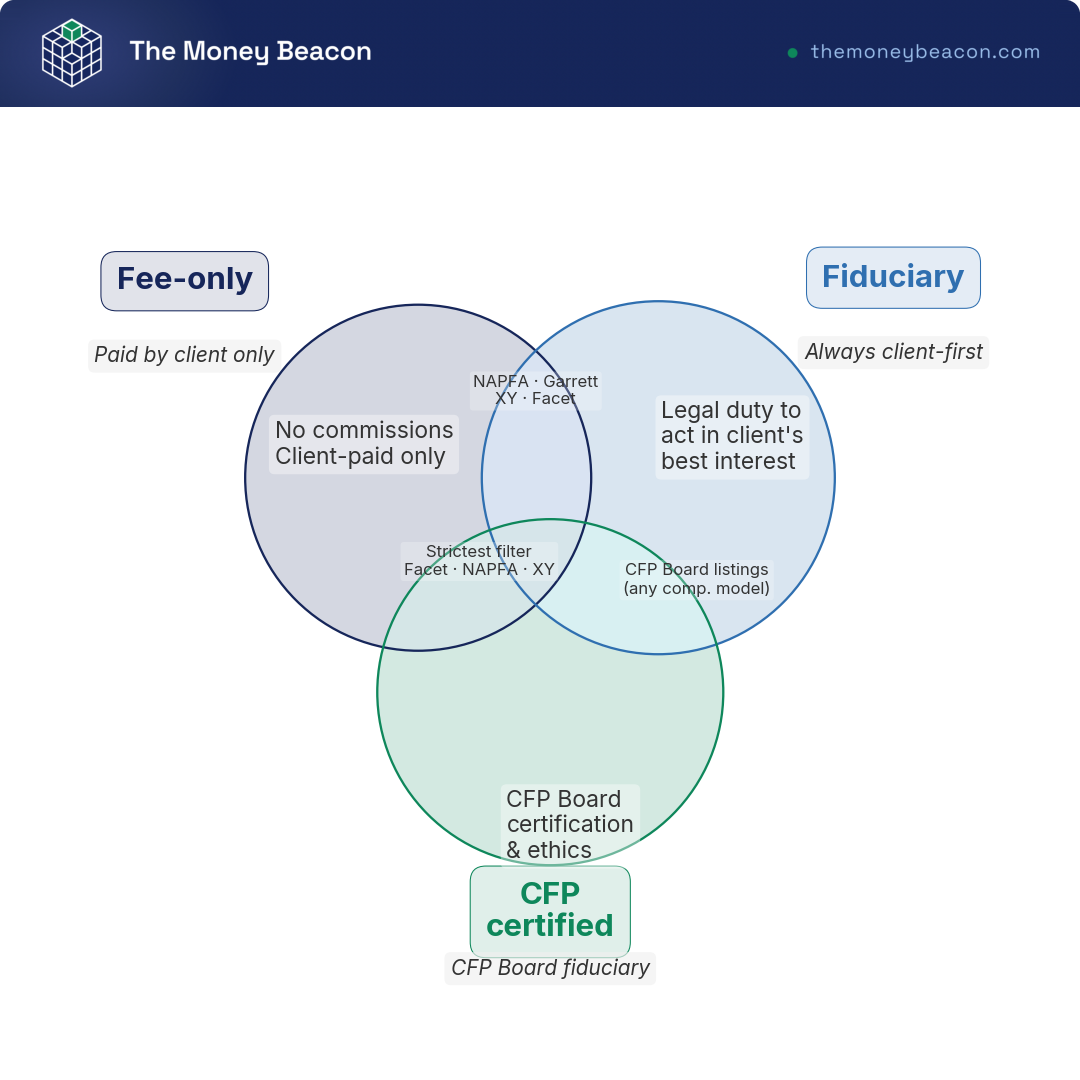
Here’s the distinction most people get wrong, because the words look almost identical. A fee-only advisor is paid only by you: a flat fee, an hourly rate, a subscription, or a percentage of assets, and never a commission. A fee-based advisor charges you client fees plus commissions from selling products, which is a mixed set of incentives, not a fee-only one. A commission advisor is paid by the product sponsor when you buy. When you’re weighing a robo-advisors option or a human one, that pay structure is the first thing to pin down, not the last.
Compensation models
| Model | How the advisor is paid | Conflict of interest | Typical example in this report |
|---|---|---|---|
| Fee-only | Only by the client (flat, hourly, subscription, or % of assets). No commissions. | Lowest | NAPFA, XY, Garrett, Facet members; Vanguard |
| Fee-based | Client fees plus commissions from selling products | Mixed | Some CFP professionals in the CFP directory |
| Commission | Paid by product sponsors when you buy | Highest | Many brokers/insurance agents (not in this comparison) |
Now the word “fiduciary.” A registered investment adviser and its representatives owe you a fiduciary duty under the Investment Advisers Act of 1940: a duty of care and loyalty across the whole relationship, including disclosing conflicts. A broker is held to Regulation Best Interest, a lower, transaction-level standard. A CFP professional must act as a fiduciary at all times when giving financial advice. So when someone in the fee-only vs fee-based advisor conversation calls themselves an “advisor,” remember it isn’t a protected term at all. Fee-only is not automatically the same as fiduciary, and a fee-based advisor is not fee-only. An AUM percentage, by the way, is just a fee model, not a verdict: a percentage-of-assets advisor can still be a fee-only fiduciary.
Verify any advisor yourself: BrokerCheck, IAPD, Form ADV, Form CRS
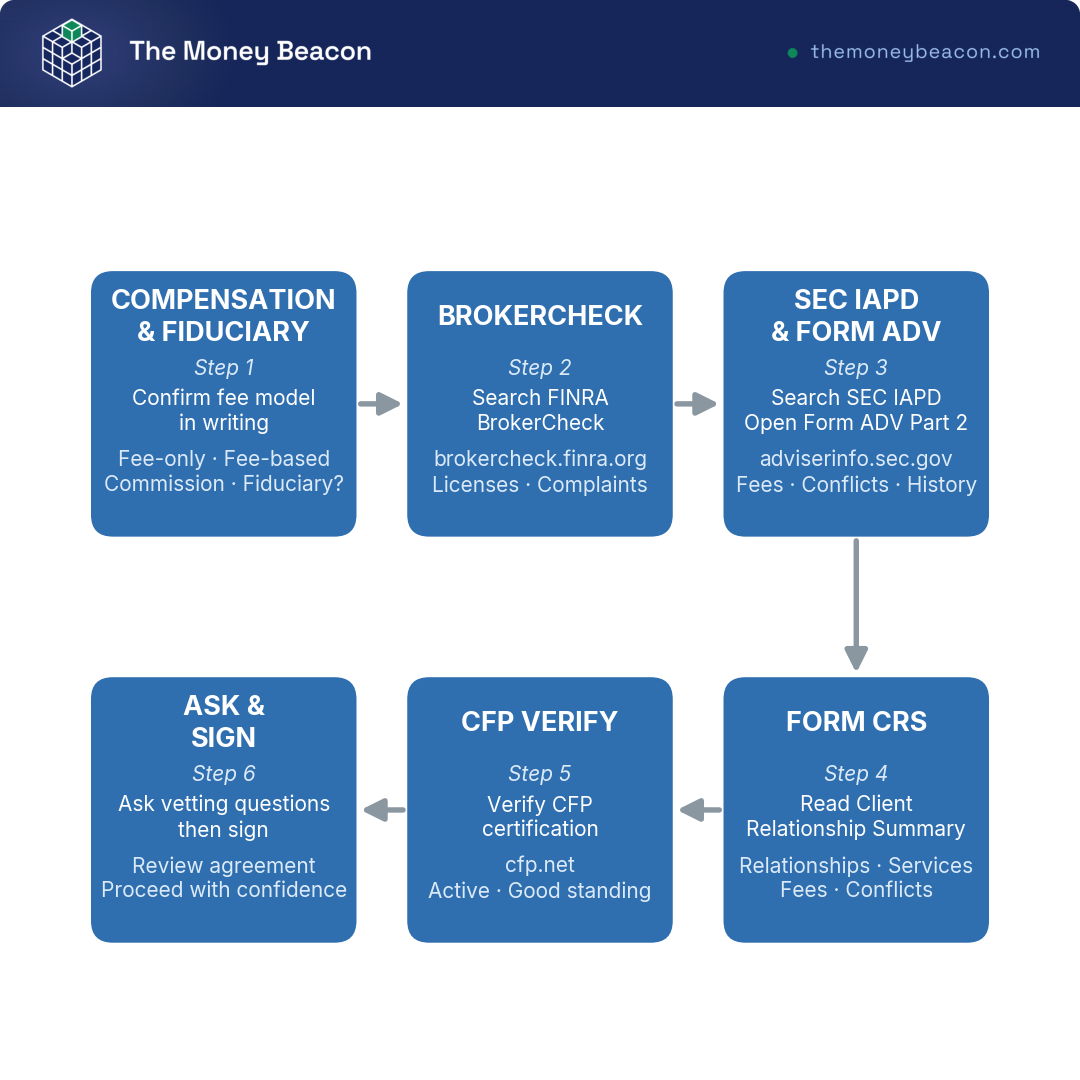
The good news is that learning how to vet a financial advisor takes four free, official tools and no permission from anyone. Run any name through FINRA BrokerCheck (brokercheck.finra.org) for licensing, employment history, and complaints, then SEC IAPD (adviserinfo.sec.gov) for the firm’s Form ADV. Open Form ADV Part 2, the “brochure,” and read Item 5 (fees and compensation) and Item 9 (disciplinary history). Read the Form CRS, a short standardized summary of fees, conflicts, and relationships. If the advisor claims a CFP, verify it on cfp.net. Do these in order, because each check tells you what to look for in the next.
The self-vetting toolkit (all free, all official)
| Tool | Operator | URL | What it shows |
|---|---|---|---|
| BrokerCheck | FINRA | brokercheck.finra.org | Broker/adviser employment history, licenses, complaints, disciplinary events (free) |
| IAPD | SEC | adviserinfo.sec.gov | Investment Adviser Public Disclosure: Form ADV, fees, conflicts, disciplinary history |
| Verify a CFP | CFP Board | letsmakeaplan.org / cfp.net | Confirms current CFP certification and any board discipline |
| Investor.gov | SEC | investor.gov | Investor education and a quick “check your professional” entry point |
One practical note: advisers managing under $100 million generally register with a state regulator, while larger ones register with the SEC, so a smaller firm’s record may live at the state level. Either way, the ADV is public.
The six paths at a glance
Here are all six side by side so you can compare them at a glance. This is the opening view; the full recap sits in the final section.
Table XIII.1 (opening summary view): The six search paths at a glance
| Path | Family | Fee model | Cost to use tool | Client cost (typical) | Asset minimum | Fiduciary / fee-only | Delivery | Best for |
|---|---|---|---|---|---|---|---|---|
| NAPFA | Directory | Varies by firm | Free | Set by hired firm | None to search | Fee-only + fiduciary members | Local/virtual | Local fee-only fiduciary you vet yourself |
| CFP Board LMAP | Directory | Varies by firm | Free | Set by hired firm | None to search | Fiduciary when advising; not always fee-only | Local/virtual | Credential-first search |
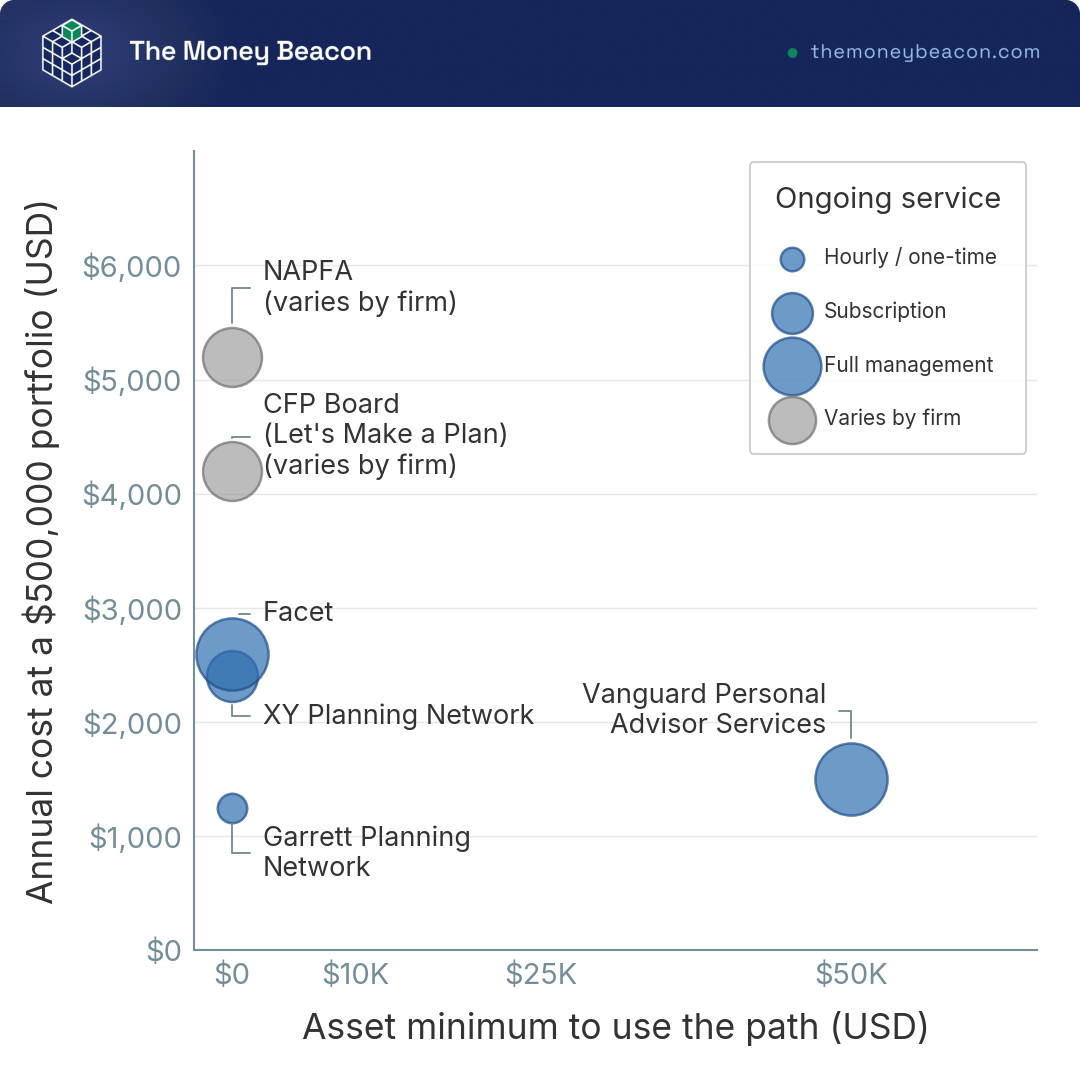
| XY Planning Network | Network | Monthly subscription + setup | Free to search | ~$200/mo + setup | None | Fee-only + fiduciary | Mostly virtual | Young/lower-asset ongoing planning |
| Garrett Planning Network | Network | Hourly | Free to search | ~$150-$300/hr | None | Fee-only + fiduciary | Local/virtual | One-time hourly checkup |
| Vanguard Personal Advisor | Direct | AUM % | Fee is the service | ~0.30%/yr | $50,000 | Fiduciary; fee-only | Digital + human | Hands-off, cost-obsessed, $50k+ |
| Facet | Direct | Flat annual | Fee is the service | ~$2,600-$8,700/yr | None | Fiduciary; fee-only | Virtual | Ongoing CFP planning, no AUM % |
Data current as of July 2026.
We take them in family order: directories, then networks, then direct services. So let’s start with NAPFA.
2. NAPFA: the free directory of fee-only, fiduciary advisors
Overview
NAPFA, the National Association of Personal Financial Advisors, runs a free consumer “Find an Advisor” directory at napfa.org listing fee only fiduciary financial advisor members, more than 4,600 practitioners nationwide. Its defining rule is simple: members work only in a fee-only structure and accept no commissions, so a fee-based practice isn’t consistent with membership. Read that as a screen, not a service. NAPFA hands you a vetted shortlist; it doesn’t manage a dollar for you.
Strengths
The headline strength is that the compensation guesswork is done for you: every listed advisor is fee-only and fiduciary by association standard, so you’re not left decoding a business card. The directory itself is free and searchable by location and specialty. And the bar to get listed is higher than a simple credential lookup, because members submit a comprehensive financial plan and meet continuing-education requirements. You’re starting from a pool where the trust question is already settled, which is a real head start on the vetting work.
Weaknesses
The flip side of “directory, not service” is that the work isn’t finished when the search is. You still interview and hire an independent firm, and fees among listed firms vary widely, from AUM percentages to flat, hourly, or retainer billing. Coverage runs thinner in rural areas, so you may end up accepting a virtual relationship even from a local-first directory. And being fee-only tells you how a firm gets paid, not whether it fits your asset level or what its percentage actually works out to in dollars. That last check stays on you.
Pricing & fees
Using the directory costs nothing. The real cost is whatever the advisor you hire charges, since NAPFA sets no client fees at all. A fee-only member might bill hourly, on a retainer, as a percentage of assets, or as a flat fee, and each firm discloses its own numbers in Form ADV Part 2, which is exactly why you open the ADV before you sign.
Table: NAPFA pricing & fees (cost to search, client cost, asset minimum, fee models)
| Item | Detail |
|---|---|
| Cost to search the directory | Free |
| Client cost | Set by the hired firm (NAPFA sets no client fees) |
| Asset minimum to search | None |
| Fee models among members | Hourly, retainer, percentage of assets, or flat fee (each disclosed in Form ADV Part 2) |
Data current as of July 2026.
Who it’s for
NAPFA is ideal for a reader who specifically wants a local, fee-only fiduciary and is comfortable interviewing a firm and reading its Form ADV. It is not the right choice for someone who wants a single company to onboard and manage them the same week, because the hiring is still yours to do.
3. CFP Board Let’s Make a Plan: the credential-first directory
Overview
Let’s Make a Plan (letsmakeaplan.org) is the CFP Board’s free consumer directory for finding a CFP professional. The pool is large and growing: 107,529 people held CFP certification in the US as of December 31, 2025, a 4.3% year-over-year increase. The directory is opt-in, though, which matters more than it sounds: it lists only certificants who choose to appear, of any compensation model, rather than every CFP in the country.
Strengths
The credential is the guarantee here. Every listed professional currently holds CFP certification and, when giving financial advice, is bound by the CFP Board’s fiduciary standard. The tool is free and searchable by location, focus area, and planning topic, so you can narrow to someone who actually works on your kind of problem. A separate CFP Board verification tool then confirms certification status and flags any board discipline, which is the check I’d run before a first call.
Weaknesses
The catch is that “CFP” and “fee-only” are not the same guarantee. The directory lists CFP professionals regardless of compensation model, so a search for a fiduciary financial advisor in this directory can still surface fee-based or commission advisors, and confirming compensation stays your job. Opt-in listing means some excellent CFP professionals simply aren’t in the results. And the credential signals competency and an ethics obligation; it doesn’t promise a good personal fit or the lowest fee at your balance.
Pricing & fees
Both the directory and the CFP Board verification tool are free to consumers. What you actually pay depends entirely on the individual professional’s firm and its own fee model, which the directory neither sets nor equalizes.
Table: CFP Board Let’s Make a Plan pricing & fees (cost to search, client cost, asset minimum, compensation status)
| Item | Detail |
|---|---|
| Cost to search the directory | Free |
| Cost of the verification tool | Free |
| Client cost | Set by the individual CFP professional’s firm |
| Asset minimum to search | None |
| Compensation status | CFP fiduciary when advising; any compensation model (confirm fee-only yourself) |
Data current as of July 2026.
Who it’s for
This is the right route for a reader learning how to choose a financial advisor who wants the CFP credential as the primary filter and is willing to screen out non-fee-only advisors themselves. It is not the right choice for someone who wants a guaranteed fee-only list without doing their own compensation check.
4. XY Planning Network: subscription planning with no asset minimum
Both directories you just saw hand you a shortlist and then step back, leaving the hiring and the fee-verification work squarely on you. A network of planners changes that trade. Instead of a raw list, you get a curated group of firms held to a shared fee standard, so some of the guesswork is settled before you make a single call. XY Planning Network is the first of those networks, and its shared standard is unusually specific. Every member operates fee-only, and every member has to offer a subscription, which means the firms come already priced in a way a directory never is.
Overview
XY Planning Network is a network of fee-only planners built around a monthly retainer, or subscription, with no required minimum asset level. It was designed for a client the traditional AUM firm tends to turn away: a younger saver with real cash flow but a modest investable balance. Members must operate fee-only and must offer that subscription option, and the public find-an-advisor listing requires CFP certification. So this is still a network, not a direct service. You engage an independent member firm, but you engage it on a fee model the network has already fixed in shape.
This is the model built to answer how much is a financial advisor per month when you don’t have a six-figure portfolio.
Strengths
The defining strength is that the fee isn’t tied to your assets, so the network explicitly serves savers without a big portfolio. That’s the opposite of an AUM firm quietly nudging you toward a higher balance before it takes your call. Subscription pricing also makes ongoing advice predictable: you know the monthly number, you can put it in a budget, and it doesn’t swell as your accounts grow. And the trust layer is built in, because members are fee-only fiduciaries and the public listing requires CFP certification, so the compensation and credential checks are largely settled before you interview anyone.
Weaknesses
Delivery is often virtual, which cleanly excludes a reader who wants to sit across a desk from someone. The cost math has a catch too. A monthly subscription plus a possible upfront setup fee can, over a single year, add up to more than a low AUM percentage would cost someone with modest assets who only needs a one-time plan. Say a firm charges $150 a month with a $525 setup: that’s $2,325 in year one, while a 0.30% AUM fee on a $100,000 balance is $300. And because the network sets a model, not a price, the actual retainer varies firm to firm, so you still compare two or three members before you sign.
Pricing & fees
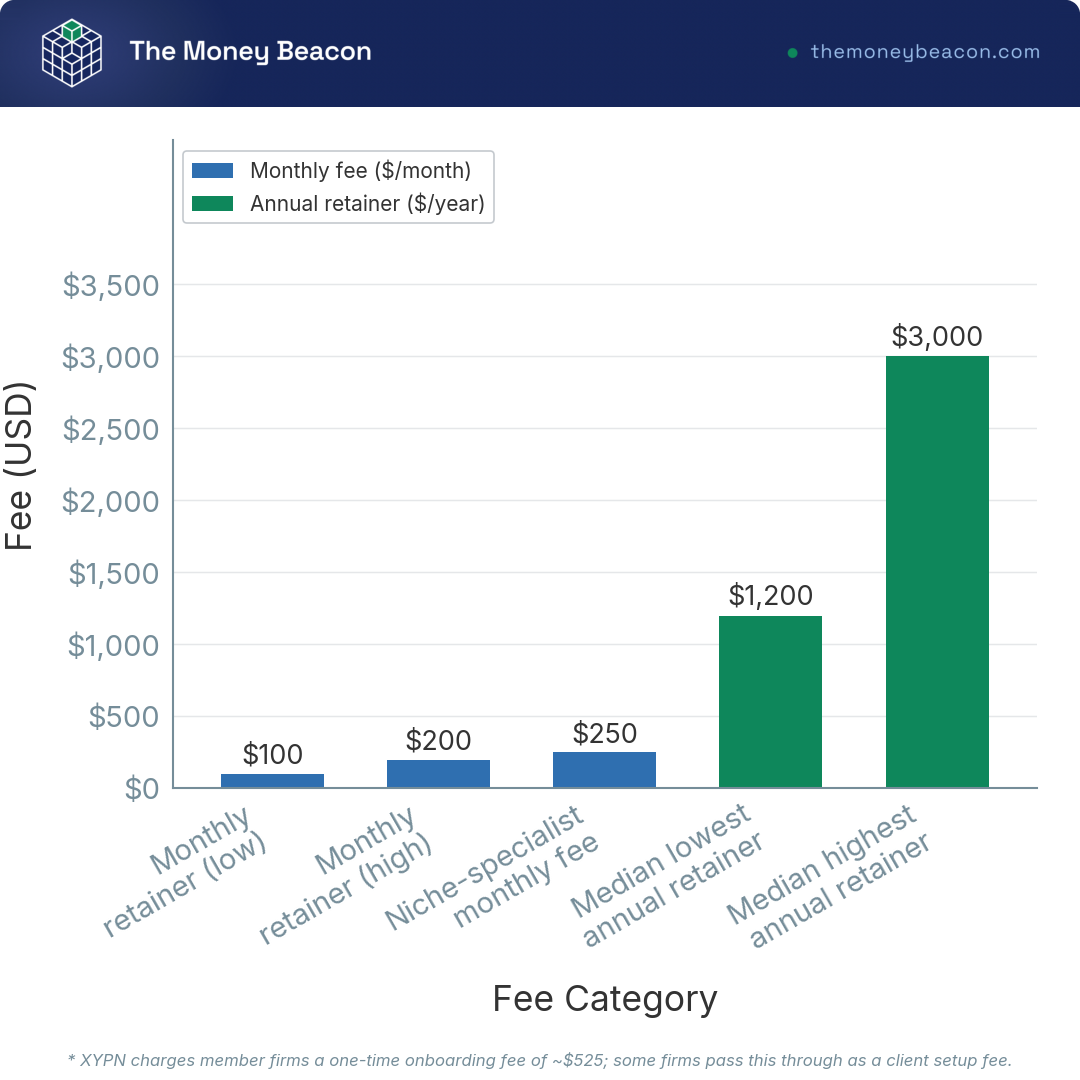
Searching the network is free. Member firms typically charge a monthly retainer, commonly in the $100 to $200 range and closer to $250 for niche specialists, plus, in many cases, an upfront setup fee. Benchmarking data points to a median lowest annual retainer near $1,200 and a median highest near $3,000. Separately, XYPN charges its member firms a one-time onboarding fee of about $525, and some firms pass that through to a new client as a setup charge, each disclosing its own client-facing number in Form ADV Part 2.
Table: XY Planning Network pricing & fees (monthly retainer band, annual retainer range, setup fee, asset minimum)
| Item | Detail |
|---|---|
| Cost to search the network | Free |
| Monthly retainer (common) | $100 to $200 (closer to $250 for niche specialists) |
| Annual retainer range (median) | Lowest near $1,200, highest near $3,000 |
| Setup fee | Often passed through from XYPN’s ~$525 one-time member onboarding fee; firm sets its own |
| Asset minimum | None |
Data current as of July 2026.
That’s the honest answer to what does a financial advisor cost per year on this path, before any setup charge.
Who it’s for
XY Planning Network is ideal for a young or mid-career saver who wants ongoing comprehensive planning and has the cash flow to fund a monthly retainer, but doesn’t yet have the investable assets an AUM firm wants to see. It fits best if you’re comfortable meeting virtually. It pairs naturally with the long-horizon questions we cover in how much you need to retire and where to save it. It is not the right choice for someone who wants in-person meetings, or for a reader with a single one-time question who doesn’t need an ongoing relationship at all.
5. Garrett Planning Network: hourly, as-needed fee-only help
XY solves ongoing planning for the saver who wants a standing relationship and a predictable monthly bill. Garrett Planning Network is the same fee-only network idea pointed at the opposite need: the reader who doesn’t want a subscription or a manager at all, just a few hours of qualified help on one specific question. Here the shared standard is hourly billing, so you pay for time, not for a relationship.
Overview
Garrett Planning Network is a national network of hourly, as-needed, fee-only planners founded in 2000. Members take no commissions, so all of their compensation is paid directly by clients, and the network imposes no minimum income, investment, or net-worth requirement to become a client. It’s built for as-needed help rather than continuous management, which makes it the natural home for a discrete question you want a fiduciary to weigh in on once.
Strengths
The hourly, no-minimum model is the most accessible path in this comparison for a one-time checkup or a second opinion, because nothing about it assumes you have assets to manage. Being fee-only and client-paid removes the product-sales conflict entirely, so the advice you buy isn’t shaded by what someone earns selling you a product. And you pay only for the hours you actually use, which fits a discrete task cleanly: a home purchase, a plan review, or the decision to roll over an old 401(k) without committing to a standing fee. That last point is why Garrett tends to be the fee-only financial advisor a self-directed saver goes to first.
Weaknesses
Hourly billing has an obvious soft spot: if the scope of the work grows, the bill grows with it, and the total is harder to predict up front than a flat retainer. The model also isn’t built for a hands-off investor who wants someone else to run the portfolio continuously, because there’s no ongoing management wrapped into it. And since each advisor sets a rate and coverage varies by geography, both availability and price shift depending on where you are and who’s near you.
Pricing & fees
Searching the network is free. Member advisors bill hourly, each setting their own rate, and those rates commonly fall in the $150 to $300 per hour range. A focused single-plan review commonly takes a few hours, so a five-hour engagement at $250 an hour lands around $1,250, paid once rather than every year. Advisor network dues of about $210 per month go to Garrett and never appear on the client’s bill, so what you pay is simply hours times rate.
Table: Garrett Planning Network pricing & fees (hourly rate range, typical engagement cost, asset minimum)
| Item | Detail |
|---|---|
| Cost to search the network | Free |
| Hourly rate range | $150 to $300 per hour (each advisor sets their own) |
| Typical engagement cost | A focused single-plan review takes a few hours (about $1,250 for five hours at $250) |
| Advisor network dues | ~$210 per month, paid to Garrett, not billed to the client |
| Asset minimum | None |
Data current as of July 2026.
The takeaway on cost is that you’re buying a defined block of time, so the total is set by the scope you agree to, not by the size of your portfolio.
Who it’s for
Garrett Planning Network is ideal for the do-it-yourselfer who wants a fiduciary to sanity-check a plan by the hour, and for anyone with a discrete, one-time question they’d rather pay for once. It is not the right choice for someone who wants ongoing portfolio management, since that’s a standing job the hourly model deliberately doesn’t take on.
6. Vanguard Personal Advisor: low-cost hybrid managed investing
The two networks price planning by the month or the hour, and neither one manages your investments. The last of the direct services does exactly that. Vanguard Personal Advisor is a direct service, so the fee is the service: one company both plans and manages under a single contract, and it prices that all-in bundle as a percentage of the assets it runs for you.
Overview
Vanguard Personal Advisor is a human-plus-digital hybrid. An algorithm builds and maintains a portfolio in mostly Vanguard funds, and you also get access to human advisors, all under a fiduciary registered investment adviser. There’s no separate firm to go hire here, because the service is the advisor. If you want the fund lineup this service builds around, we cover it in Vanguard’s own low-cost funds. For a reader scanning vanguard financial advisor reviews to decide whether a managed service is worth it, the pitch is simple: professional management at a fraction of the usual price.
Strengths
The headline is cost. The all-in advisory fee is about 0.30% net, roughly $30 per $10,000 invested, which sits well below the roughly 1% benchmark a full-service human advisor typically charges. Because the underlying funds carry low expense ratios, your total cost of ownership stays low too, not just the advisory line. And you’re not trading service for that price: you get a plan, ongoing management, and access to human advisors, built on the kind of low-cost index funds that keep the whole package cheap to run.
Weaknesses
Three real limits. A $50,000 asset minimum genuinely excludes a lower-asset saver, so you can’t enroll until you’ve got a five-figure balance. The AUM percentage also means your dollar cost climbs as the portfolio grows: 0.30% of $100,000 is $300 a year, but 0.30% of $1,000,000 is $3,000, for the same service. And portfolios are built mainly from Vanguard products, so you get less customization than an independent planner might offer.
Tom’s take

I’ve shopped managed services against the private banks I use, and the pattern is always the same. A percentage fee feels tiny when you read it, then you multiply it by a growing balance and it stops feeling tiny. Vanguard’s 0.30% is genuinely low, but I still convert it to dollars every year before I decide it’s worth paying, because that’s the number that actually leaves your account.
Pricing & fees
The fee is about 0.30% of enrolled assets per year, net of fund costs. An all-index portfolio is close to 0.30%, and an ESG or active-index build ranges from roughly 0.26% to 0.36%. On larger balances the fee tiers down by breakpoint: about 0.30% on the first $5 million, 0.20% on $5 million to $10 million, 0.10% on $10 million to $25 million, and 0.05% above $25 million.
Table: Vanguard Personal Advisor pricing & fees (AUM fee, breakpoint tiers, asset minimum)
| Item | Detail |
|---|---|
| Base advisory fee | ~0.30% of enrolled assets per year, net of fund costs (all-index ~0.30%; ESG/active-index ~0.26% to 0.36%) |
| Breakpoint: first $5 million | ~0.30% |
| Breakpoint: $5 million to $10 million | ~0.20% |
| Breakpoint: $10 million to $25 million | ~0.10% |
| Breakpoint: above $25 million | ~0.05% |
| Asset minimum | $50,000 (higher-wealth tiers require $5 million) |
Data current as of July 2026.
That schedule is why vanguard financial advisor fees stay a favorite reference point for a cost-focused investor.
Who it’s for
Vanguard Personal Advisor is ideal for a hands-off investor with at least $50,000 who wants low-cost managed investing with occasional human guidance and doesn’t need deep custom planning. It is not the right choice for a saver under the $50,000 minimum, or for a reader who needs complex, tax-and-estate planning that a percentage-of-assets managed service isn’t built to deliver.
7. Facet: flat-fee, CFP-led planning with no AUM percentage
Vanguard gives you low-cost management, but it prices that management as a slice of your assets and it won’t open the door under $50,000. Facet answers the reader that model turns away. It’s the other direct service in this comparison, and it drops both barriers at once: ongoing CFP-led planning at a flat annual fee, no percentage of assets, and no minimum to start. Where Vanguard’s bill grows every time your balance does, Facet’s stays put.
Overview
Facet is an SEC-registered RIA offering flat-fee, virtual, CFP-led financial planning. There’s no AUM fee and no asset minimum to begin, though a small minimum applies if you have Facet directly manage the money. Every Facet CFP professional acts as a fiduciary for members, and investment management is folded into the membership, so there’s no separate management charge stacked on top. In shape, it’s a direct service like Vanguard: one company plans for you under one contract. The difference is entirely in how it charges.
Strengths
The defining strength is that a flat annual fee decouples your cost from your portfolio size. You pay the same number whether you hold $200,000 or $2,000,000. The absence of a minimum matters just as much. It opens comprehensive CFP planning to a saver who doesn’t yet have a large investable balance, the same person a percentage-of-assets firm tends to wave off. And the service itself is real: a dedicated CFP professional, unlimited messaging, and virtual meetings, not a stripped-down robo wrapper. For anyone comparing fee-only financial advisor cost against AUM percentages that scale with your success, this is the model built to break that link.
Weaknesses
Three honest limits. Delivery is virtual-only, so a reader who wants to sit across a desk from a planner is out. At a very small portfolio the flat fee flips from bargain to burden: about $2,600 on a $30,000 balance is close to 9% of assets, well above what a 1% AUM fee would cost that saver. And the pricing isn’t frictionless. A one-time enrollment fee can apply if you pay quarterly, and the flat fee itself steps up as your plan gets more complex, so the cheapest tier isn’t automatically your tier.
Pricing & fees
Facet charges flat membership fees across three tiers, priced by planning complexity rather than portfolio size: Core about $2,600 a year, Plus about $4,300, and Complete about $8,700. A limited-time promotion has reduced Core to roughly $2,350. You can pay annually or quarterly, and a one-time enrollment fee of about $300 applies to quarterly billing, waived for members who pay annually or enroll under a current promotion.
Table: Facet pricing & fees (flat tier fees, enrollment fee, asset minimum)
| Item | Detail |
|---|---|
| Core tier | ~$2,600 per year (recently ~$2,350 under promotion) |
| Plus tier | ~$4,300 per year |
| Complete tier | ~$8,700 per year |
| Enrollment fee | ~$300 one-time, for quarterly billing; waived for annual payers |
| Asset minimum | None to begin (small minimum only if Facet manages assets) |
Data current as of July 2026.
Who it’s for
Facet is ideal for a reader who wants ongoing comprehensive CFP planning without an AUM percentage, especially at a mid-to-large balance where a flat fee beats 1%, and who is comfortable working entirely virtually. It is not the right choice for someone with a very small portfolio, where the flat fee becomes a heavy percentage of assets, or for a reader who wants to meet a planner in person.
8. The verdict: which advisor path wins for you
You’ve now seen all six. The mini-reviews tell you what each path is; they don’t tell you which one is yours. So let’s work the cost math and route you to a pick.
The six paths side by side
Here are all six on a single grid. This table is the single source of truth for the comparison.
Table: The six search paths side by side (the single source of truth for comparative claims)
| Path | Family | Fee model | Cost to use tool | Client cost (typical) | Asset minimum | Fiduciary / fee-only | Delivery | Best for |
|---|---|---|---|---|---|---|---|---|
| NAPFA | Directory | Varies by firm | Free | Set by hired firm | None to search | Fee-only + fiduciary members | Local/virtual | Local fee-only fiduciary you vet yourself |
| CFP Board LMAP | Directory | Varies by firm | Free | Set by hired firm | None to search | Fiduciary when advising; not always fee-only | Local/virtual | Credential-first search |
| XY Planning Network | Network | Monthly subscription + setup | Free to search | ~$200/mo + setup | None | Fee-only + fiduciary | Mostly virtual | Young/lower-asset ongoing planning |
| Garrett Planning Network | Network | Hourly | Free to search | ~$150 to $300/hr | None | Fee-only + fiduciary | Local/virtual | One-time hourly checkup |
| Vanguard Personal Advisor | Direct | AUM % | Fee is the service | ~0.30%/yr | $50,000 | Fiduciary; fee-only | Digital + human | Hands-off, cost-obsessed, $50k+ |
| Facet | Direct | Flat annual | Fee is the service | ~$2,600 to $8,700/yr | None | Fiduciary; fee-only | Virtual | Ongoing CFP planning, no AUM % |
Master comparison, current as of July 2026.
Where a flat fee beats a 1% AUM fee
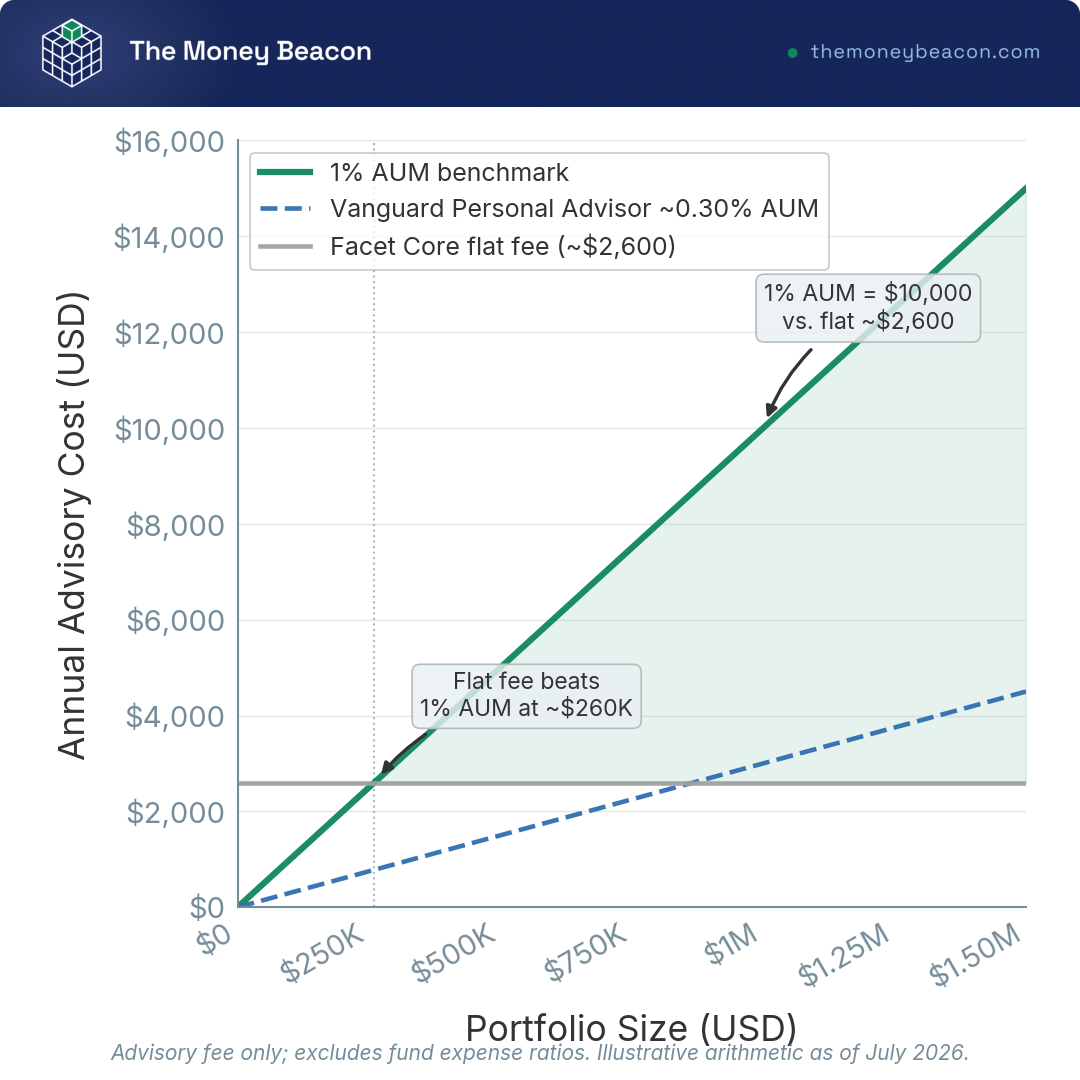
The one number that flips the whole decision is the crossover. Below roughly $260,000, an AUM percentage is usually the cheaper way to buy managed advice; above it, a flat Core fee near $2,600 wins, because 1% of $260,000 is $2,600 and 1% of everything past that is pure extra cost the flat fee never charges. Push the flat fee to $3,000 and the crossover moves up to about $300,000.
Hank’s take
after years spent picking apart data, you learn the number that matters is almost never the one on the label. A 1% fee sounds like a rounding error until you do the multiplication at your own balance and watch it turn into $10,000 a year on a million dollars. I convert every percentage to real dollars before I judge it.
The same crossover logic explains why a saver who could hire a full-service percentage firm might still prefer a flat fee or even a self-directed setup, the sort you can run through an online brokerage account for a fraction of any advisory line.
The cheapest path on a large portfolio
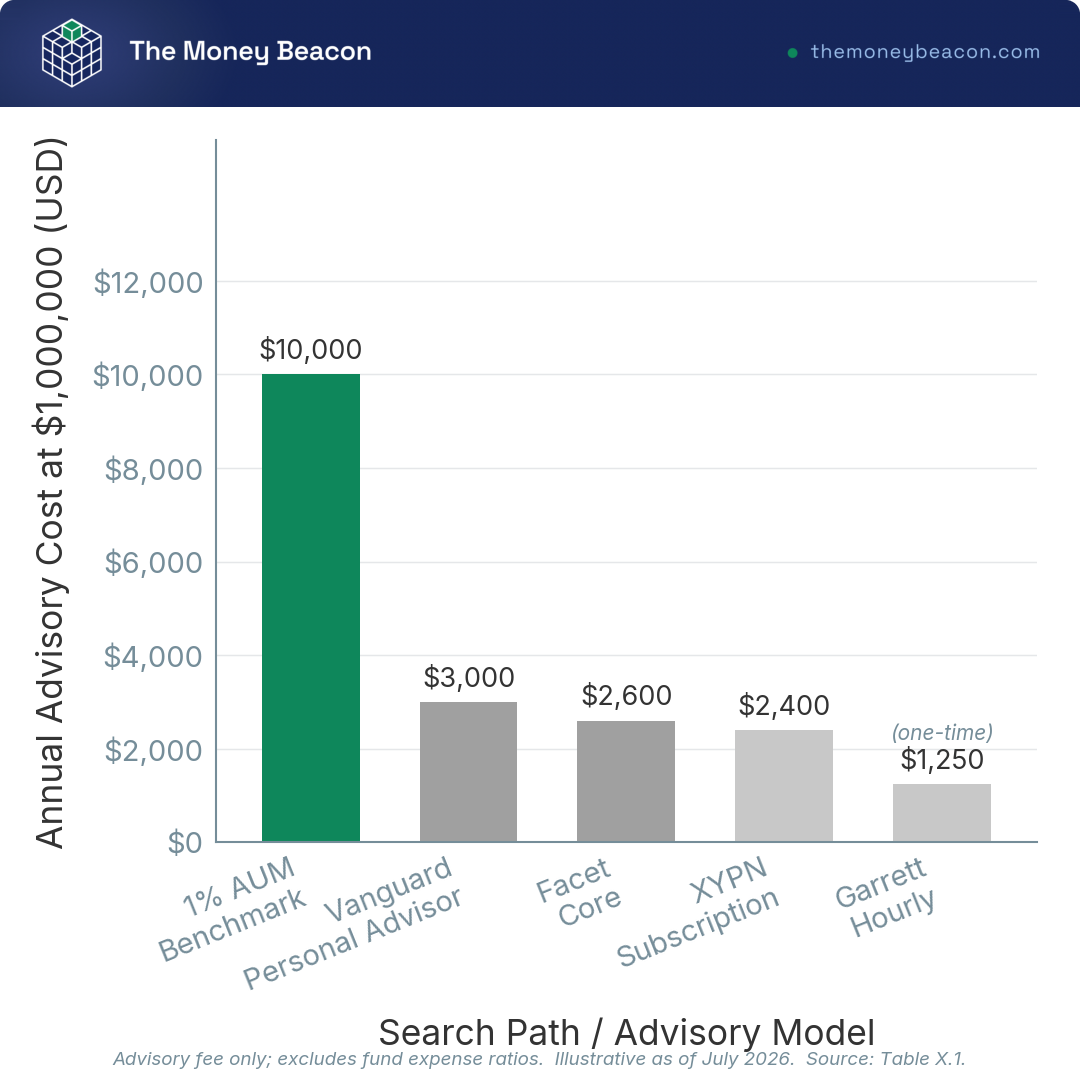
At scale the paths spread wide. On a $1,000,000 portfolio, a 1% AUM fee costs $10,000 a year, Vanguard’s 0.30% costs $3,000, Facet Core runs about $2,600, an XYPN subscription lands near $2,400, and a five-hour Garrett engagement is about $1,250 paid once, not annually. The lesson for a high-balance reader is simple: a 1% AUM fee is roughly four times the cost of every flat, subscription, or hourly alternative here, for advice that isn’t four times better.
Which paths a lower-asset saver can actually use
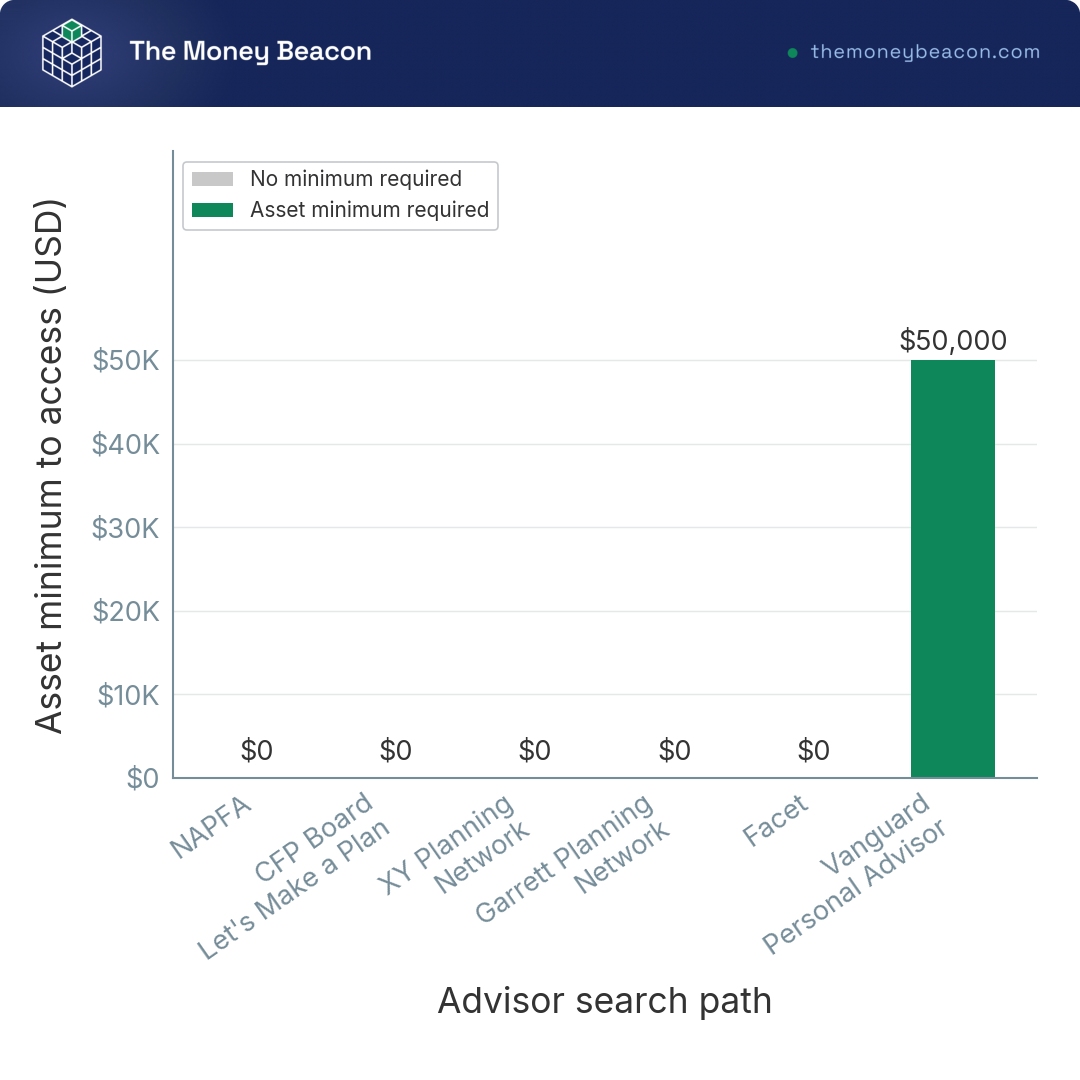
If your balance is small, the question flips from cost to access. Five of the six paths, NAPFA, CFP Board, XY Planning Network, Garrett, and Facet, have no asset minimum to begin, so they’re open on day one. Only Vanguard Personal Advisor gates entry, at $50,000. A young saver with income but a modest portfolio has plenty of doors, just not that one, and if even a flat planning fee feels like too much for now, a low-cost robo-advisor can cover you until the balance grows.
Verdict by reader profile
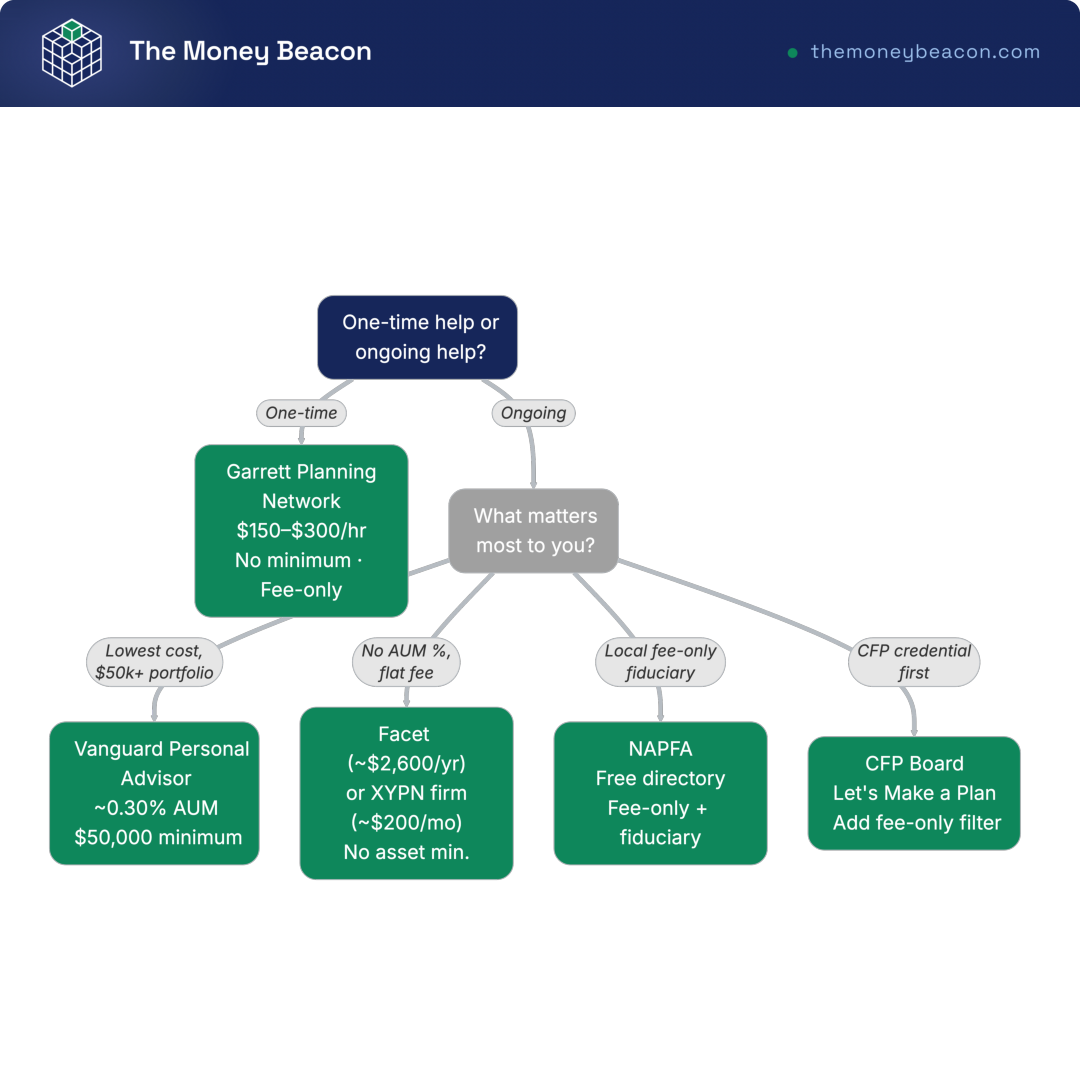
Now route yourself. If you’re a young or lower-asset saver with income but a small portfolio, XY Planning Network or Facet is the right choice, because both decouple planning from assets and neither imposes a minimum. If you’re a do-it-yourselfer who wants a one-time checkup, Garrett is ideal: you pay for the hours you use and walk away with no standing fee. If you’re a hands-off, cost-obsessed investor with six figures already invested, Vanguard Personal Advisor at about 0.30% is the right choice, though you should price Facet’s flat fee against it once your balance clears the ~$260,000 crossover.
Two more. If you want ongoing comprehensive planning but refuse an AUM percentage, Facet’s flat fee or an XYPN subscription is your pick. And if you specifically want a local, fee-only fiduciary you interview and vet yourself, NAPFA is the right choice, or CFP Board Let’s Make a Plan with your own fee-only check bolted on. Whichever you land on, remember that fees are only half the after-tax picture; how your accounts are arranged drives the rest, which we cover in capital gains and asset location.
How to hire, step by step
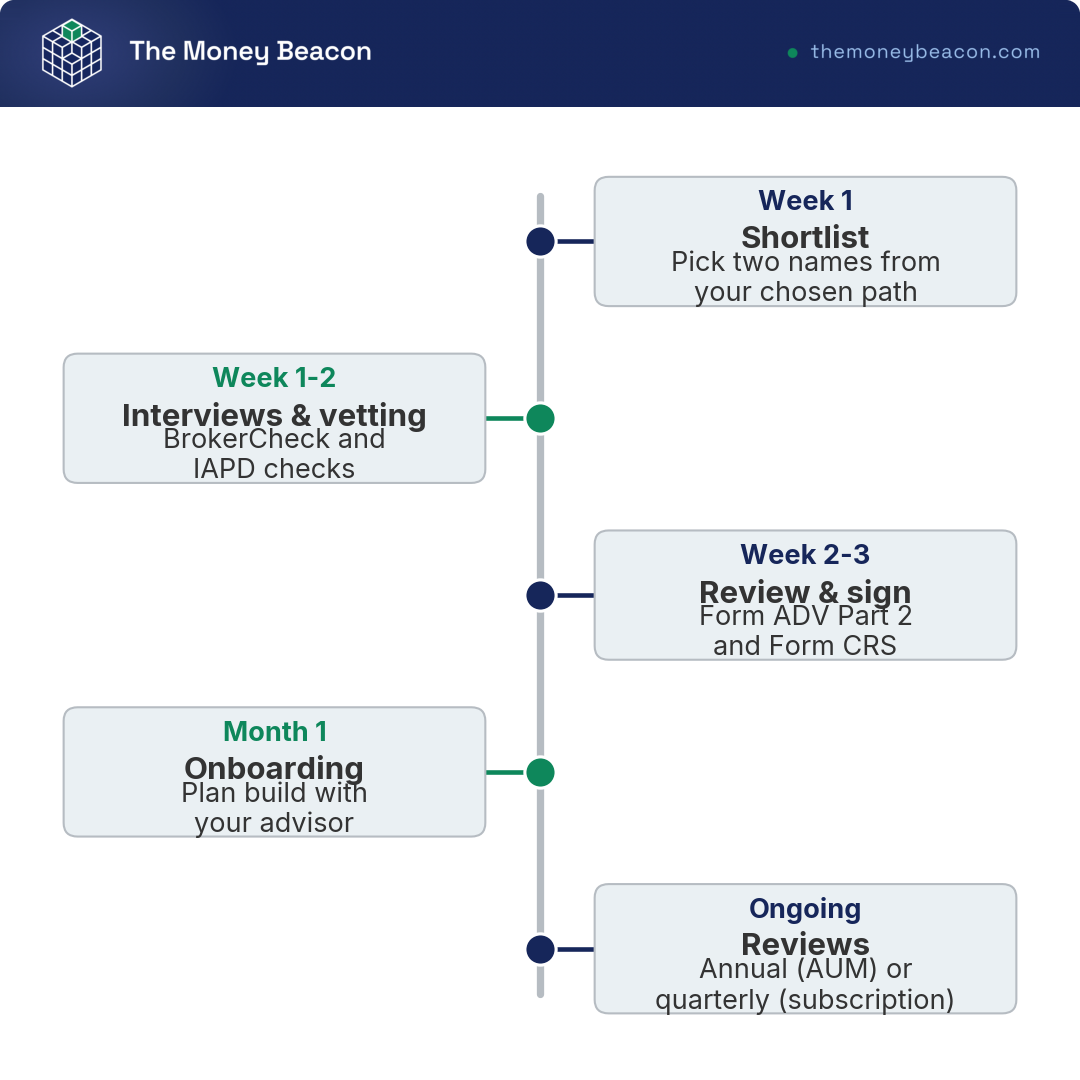
Once you’ve picked a path, hiring is a short, ordered sequence, not an open-ended hunt. In week one, shortlist two names from the path that fits. Over the next week or two, run both through FINRA BrokerCheck and SEC IAPD and interview them. Before you sign, read each firm’s Form ADV Part 2 (Item 5 for fees, Item 9 for discipline) and its Form CRS. Then sign, onboard, and build the plan in month one, with reviews after that, annual for an AUM service, quarterly or as scheduled for a subscription. Never sign before you’ve cleared both databases and read the Form ADV yourself, because that one hour of reading is the whole point of vetting.
Reading a Form ADV before you sign
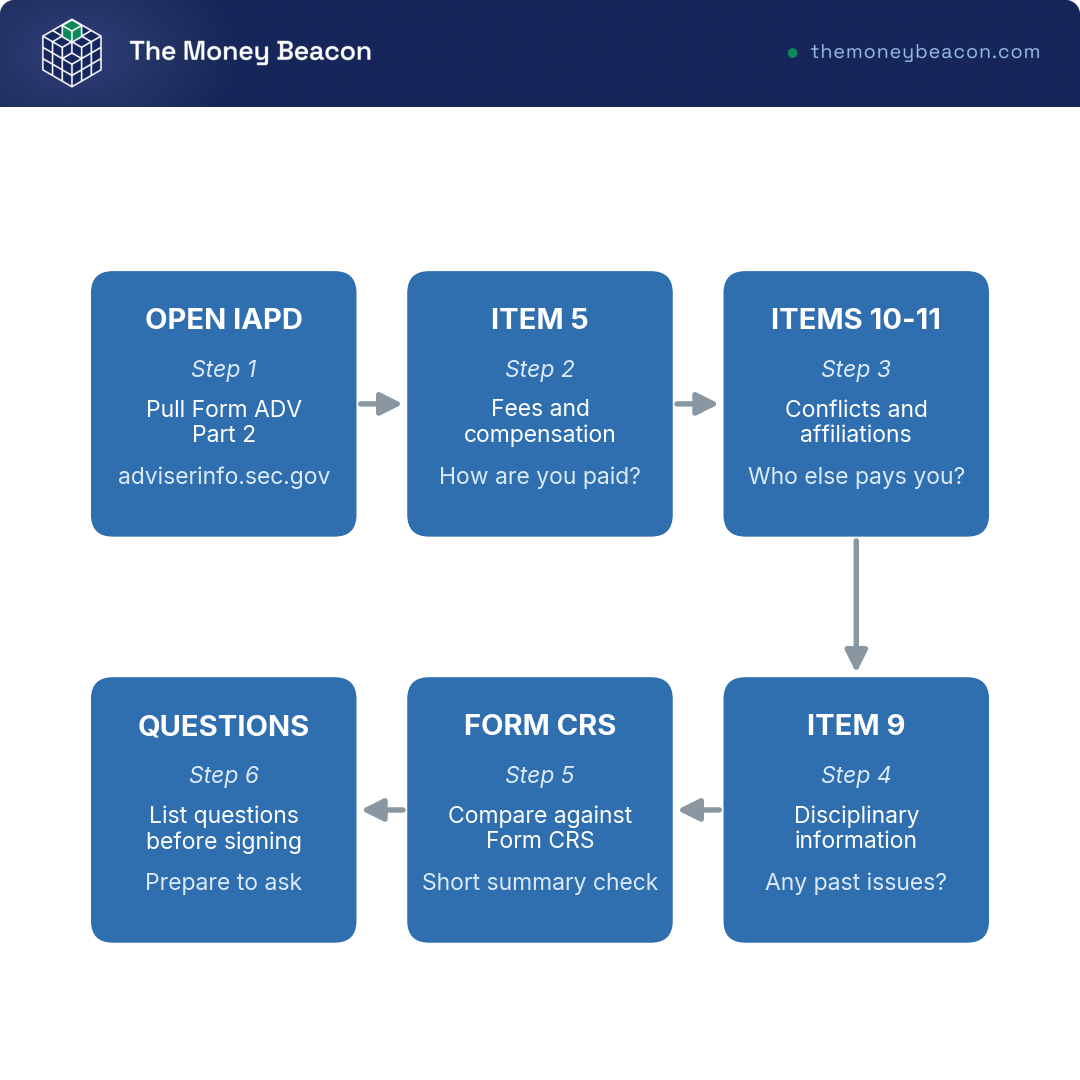
The Form ADV Part 2 is where an RIA has to tell the truth in writing, so it’s worth reading in order. Open the firm’s brochure through IAPD. Start at Item 5 for fees and compensation, so you see exactly how they get paid and can convert any percentage to dollars at your balance. Read Items 10 and 11 for conflicts and outside affiliations, then Item 9 for any disciplinary history. Compare all of it against the plain-language Form CRS, and jot down the questions each item raises. Three mistakes sink most readers here: taking “fee-based” to mean “fee-only,” checking only one database instead of both, and comparing a percentage to a flat fee without ever doing the dollar math. Avoid those three and you’ve done more due diligence than most people who hire an advisor ever do.
Conclusion
Here’s the thing to walk away with: finding a good advisor isn’t about landing on the single best name in the country, it’s about picking the door that matches your situation, then running the four free checks before you sign anything. The word “advisor” won’t protect you, but BrokerCheck, IAPD, Form ADV Part 2, and Form CRS will, and they cost you nothing but a few minutes.
So match the path to what you actually need. If you want a local fee-only fiduciary and don’t mind interviewing a firm yourself, start with NAPFA’s free directory. If the CFP credential is your first filter, Let’s Make a Plan gets you there, as long as you confirm compensation on your own. Want ongoing planning without a six-figure portfolio? XY Planning Network prices it by the month, and Facet does it as a flat annual fee with no percentage on your assets. Just have one discrete question, like a rollover or a plan review? Garrett bills you by the hour, once, and sends you on your way. Want someone to run a low-cost portfolio and you’ve got at least $50,000? Vanguard Personal Advisor does it for about 0.30% a year.
None of these is the right answer for everyone, and that’s the point. Convert every fee to real dollars at your balance, decide whether you need a one-time checkup or a standing relationship, and pick the family that fits. Then verify the individual before the first meeting, not after.
For the questions a good advisor helps you answer, keep reading: our retirement planning guide covers how much you’ll need and where to save it, our robo-advisors comparison weighs the automated alternative to a human, and our investment taxes guide unpacks the capital-gains and dividend rules any advisor should be steering you around.
FAQ: Finding and vetting a financial advisor
What is the difference between a fee-only and a fee-based financial advisor?
The two labels look almost identical, but I treat them as completely different things. A fee-only advisor is paid only by you, whether that’s a flat fee, an hourly rate, a monthly subscription, or a percentage of the assets they manage, and never a commission for selling you a product. A fee-based advisor charges you client fees too, but can also collect commissions, and that second income stream creates a real conflict of interest. So when someone tells me they’re “fee-based,” I ask directly whether they earn any commissions, because a yes means they aren’t fee-only. NAPFA, XY Planning Network, Garrett, and Facet members are all fee-only by rule, while the CFP Board directory can list fee-based advisors too. One more wrinkle worth knowing: CFP certificants who take third-party compensation now have to describe themselves as “commission-and-fee,” not “fee-based.”
How do I check if a financial advisor is a fiduciary and trustworthy?
I run every advisor through two free public records before I take anything they say at face value. Start with FINRA BrokerCheck at brokercheck.finra.org and the SEC’s Investment Adviser Public Disclosure (IAPD) site at adviserinfo.sec.gov, and read both, not just one. IAPD pulls up the firm’s Form ADV, which spells out fees, conflicts, and any disciplinary history in plain English; I open Item 5 for fees and Item 9 for discipline before I go any further. Then ask the advisor to state in writing that they act as a fiduciary, and read their Form CRS (Client Relationship Summary). A registered investment adviser owes you a fiduciary duty under the Investment Advisers Act of 1940, while a broker is only held to Regulation Best Interest (Reg BI), a lower standard. If they claim to be a Certified Financial Planner (CFP), you can confirm that credential separately on cfp.net.
What is a normal fee for a financial advisor, and what is the lowest?
The number most people quote is roughly 1% of your assets per year, and the 2026 Envestnet/MoneyGuide fee study puts the blended figure near 0.96%, so that benchmark holds up. But 1% is far from your only option. A hybrid service like Vanguard Personal Advisor is about 0.30%, a flat annual fee at Facet lands somewhere between roughly $2,600 and $8,700, an hourly engagement through Garrett is about $150 to $300 an hour, and a monthly subscription through XY Planning Network is around $200 a month. Which one is actually cheapest depends entirely on your balance, so I always convert percentages to real dollars first. Below about $300,000, a small percentage-of-assets fee often wins; above it, a flat fee usually comes out ahead. This is educational, not a recommendation to buy any one service.
Can I get a financial advisor with little money? Is $200,000 enough?
Yes on both counts, and this is one of the biggest changes in the field over the past few years. Several fee-only services carry no asset minimum at all, including XY Planning Network, Garrett Planning Network, and Facet, and they’re built specifically for savers who have income but little or no investable portfolio yet. Instead of charging a percentage of assets you may not have, they bill by subscription, by the hour, or by flat fee. So if you’re just getting started, you can still get comprehensive planning without clearing some big threshold first. And with $200,000 you’re comfortably past the $50,000 minimum for Vanguard Personal Advisor, which opens up the low-cost hybrid path too. If a rollover or retirement-income question is what’s pushing you to hire someone, my retirement planning guide walks through the decision first.
Is a robo or hybrid service like Vanguard Personal Advisor as good as a human advisor?
It depends on what you actually need, and I try hard not to get swept up in the hype either way. For low-cost, hands-off portfolio management, a hybrid like Vanguard at about 0.30% can be excellent, and it’s far cheaper than a full 1% relationship. But for complex, personalized planning, think tax-aware moves, estate questions, business decisions, insurance, or plain behavior coaching when markets get scary, a dedicated human CFP through Facet, XY, Garrett, or a NAPFA firm generally does more. So I match the tool to the job. If you mainly want automated investing, my robo-advisor comparison covers that path; if tax-aware planning is the real strength, the investment taxes guide shows where a human planner earns their fee.



Comments
Questions and corrections welcome. We read everything.