


You want a diversified portfolio on autopilot, and a robo-advisor will build it, rebalance it, and quietly harvest losses while you get on with your life. The catch is choosing one. Every platform leads with the same three words, “low fees,” yet the real all-in cost, the minimum to start, and whether a human is ever on the other end differ enough to matter. So you’re left guessing which one actually fits how much you have and how you invest, and one wrong guess follows you for years.
Here’s why that guess is expensive. A robo’s advisory fee runs from about 0.15% to 0.35% a year, trivial-sounding until you compound it over decades. And the advertised percentage is never the whole story: a few platforms bury their real cost in a mandatory cash sleeve or a threshold that flips you from free to 0.35% the moment your balance crosses it.
Before I rank a single robo-advisor, I’ll lay out the exact method I use to compare them on fees, minimums, tax-loss harvesting, and human access.
1. How we compared the six robo-advisors
So what does a robo actually do with your money, and how do I rank these six? Let me start with the method.
What a robo-advisor does, and the six criteria we scored
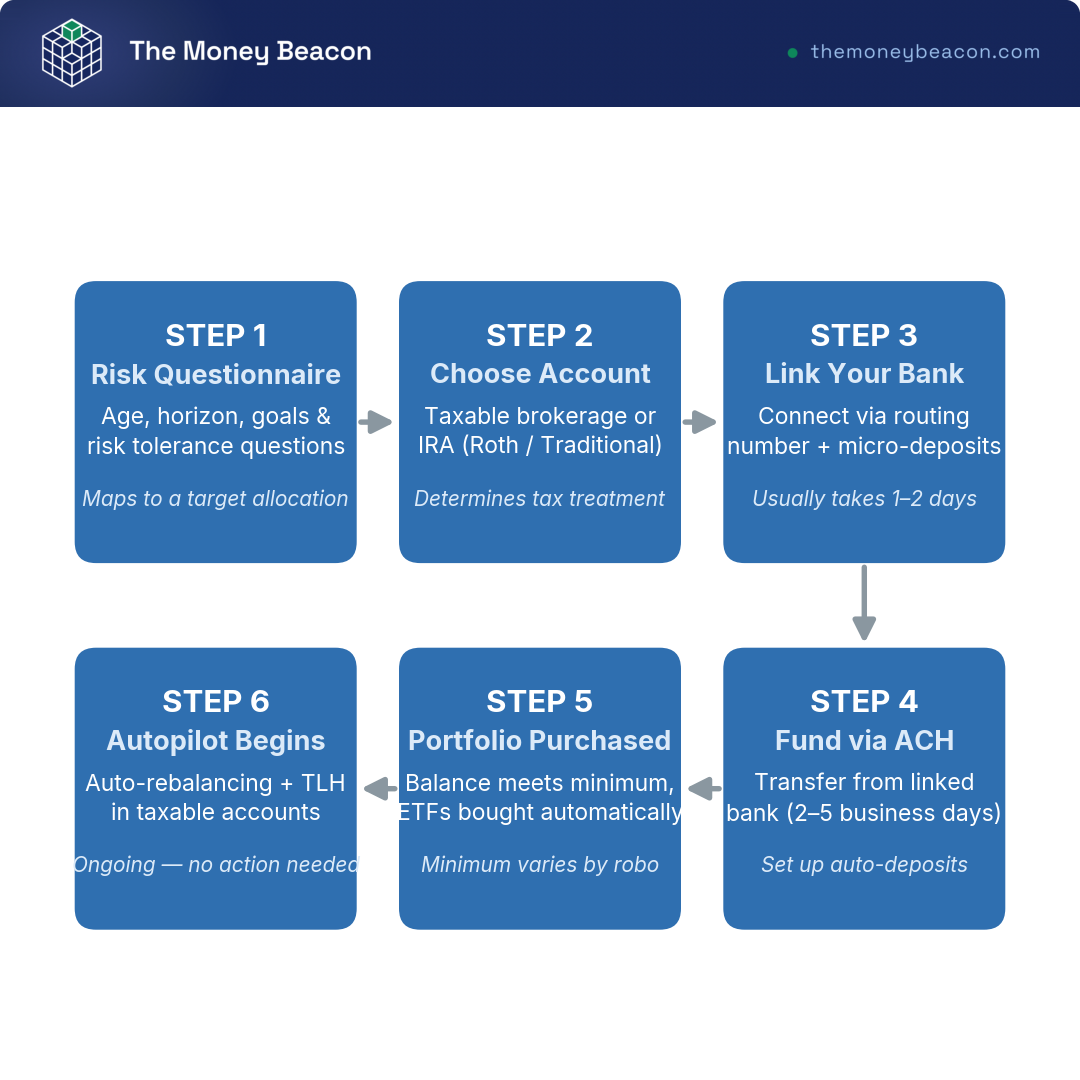
A robo-advisor is a registered investment adviser (RIA), registered with the Securities and Exchange Commission (SEC) and bound by a fiduciary duty to act in your interest. The mechanics are the same on all six platforms. You answer a short risk questionnaire, your answers map to a target allocation, the software buys low-cost funds to match it, and it rebalances whenever the mix drifts (Vanguard discloses a 5% drift trigger). In a taxable account, some platforms also run tax-loss harvesting, selling a position at a loss to bank a deductible capital loss, then buying a similar fund to stay invested.
Six criteria drive almost every real decision: the all-in fee, the minimum to start, whether tax-loss harvesting is included, whether a human advisor is reachable, which account types are supported, and the standout features and hidden costs. Software that builds, rebalances, and harvests on your behalf has long let a hands-off investor quietly beat most active managers.
The six platforms at a glance
With the criteria now set, here’s where all six land on the four numbers most people check first.
| Platform | Standard advisory fee | Minimum to invest | Auto TLH | Human advisor |
|---|---|---|---|---|
| Betterment | 0.25%/yr (or $5/mo small balances) | $0 | Yes, included | Premium 0.65% at $100k |
| Wealthfront | 0.25%/yr flat | $500 | Yes, daily | No (software-only) |
| Schwab Intelligent Portfolios | 0% (cash-drag model) | $5,000 | Yes, at $50k+ | Premium retiring Q1 2026 |
| Vanguard Digital Advisor | ~0.15% net | $100 | Yes | No (hybrid is separate) |
| Fidelity Go | $0 under $25k; 0.35% at $25k+ | $10 | Yes, at $25k+ (taxable) | Coaching at $25k |
| SoFi Automated Investing | 0.25%/yr | $50 | No | Complimentary CFP (1 session) |
Data current as of June 2026.
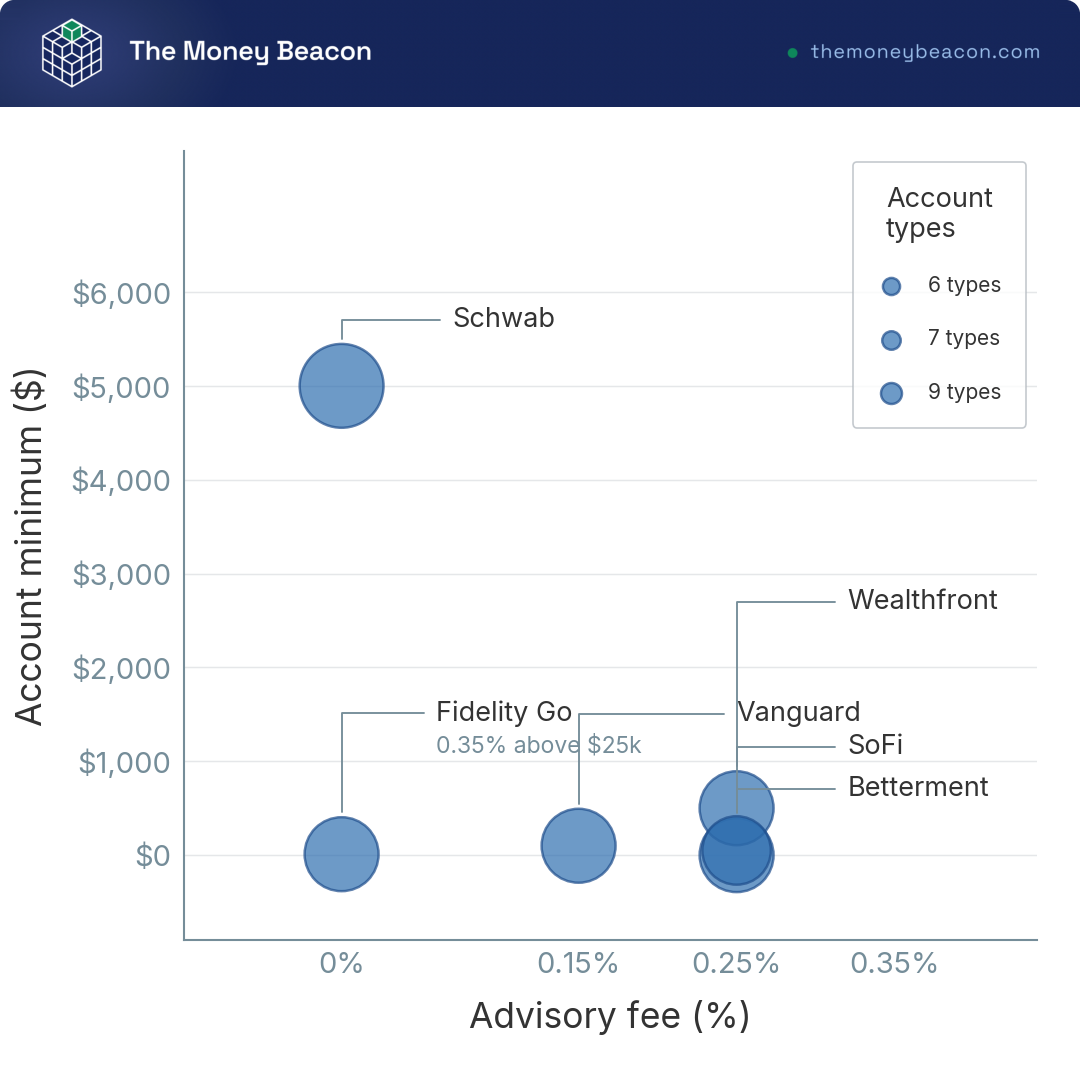
Two outliers stand out in this robo-advisor comparison. Schwab and Fidelity Go (under $25,000) charge no stated advisory fee, while the standard is 0.25% for everyone else, including Vanguard at ~0.15%. The minimum spread is just as wide, running from $0 at Betterment to $5,000 at Schwab.
What changed in the field, 2024 to 2026
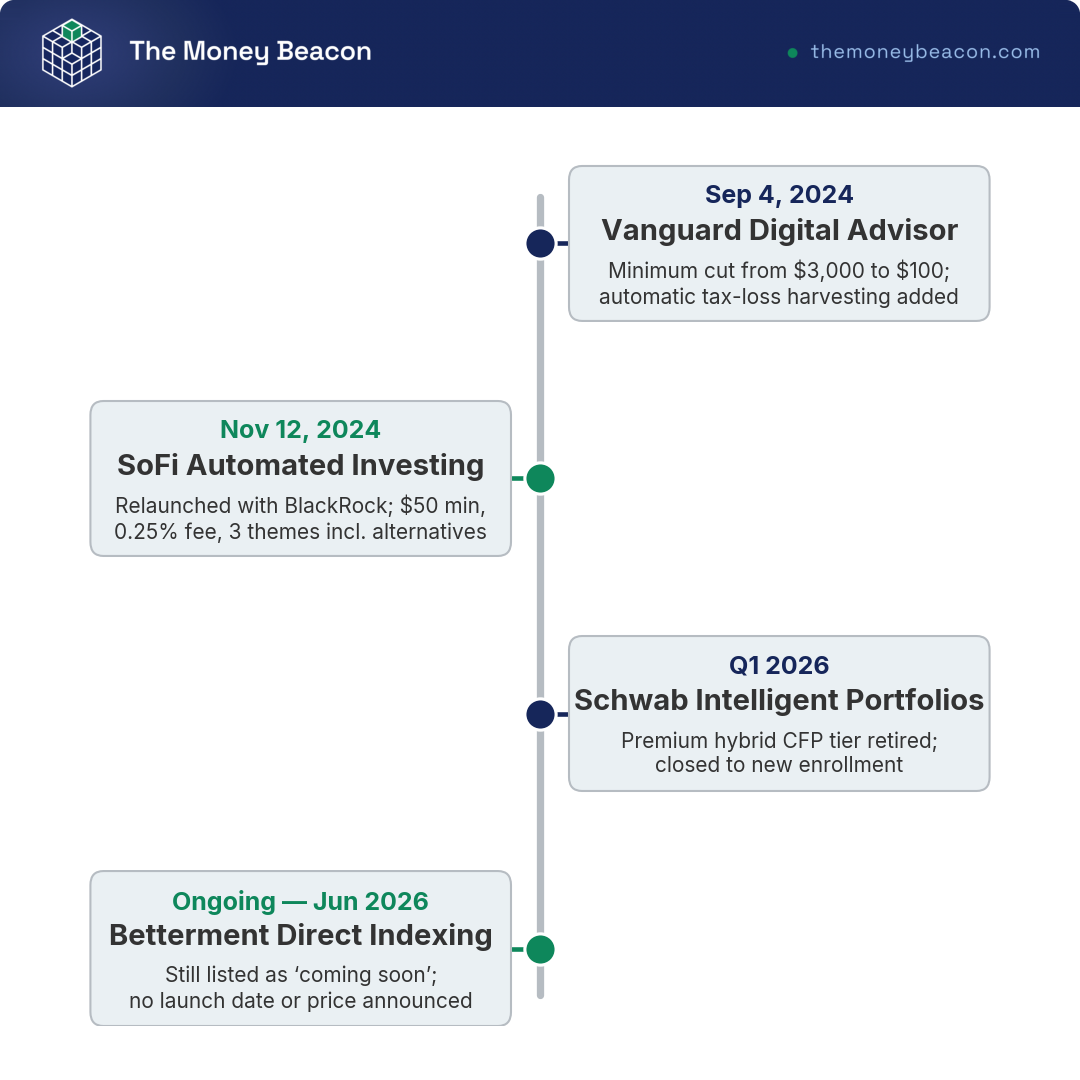
The robo-advisor field looks different than it did two years ago, and four changes are important for a buyer in 2026. In September 2024, Vanguard cut Digital Advisor’s minimum from $3,000 to $100 and added automatic tax-loss harvesting, which turned it from a premium option into a genuine beginner pick. On November 12, 2024, SoFi relaunched its robo in partnership with BlackRock, replacing its old proprietary funds with third-party iShares ETFs. In Q1 2026, Schwab is retiring its Premium human-CFP tier and has closed it to new enrollment, so a new investor gets only the $0-fee standard product. Betterment still lists direct indexing as “coming soon” with no release date, so if stock-level harvesting is your goal, it isn’t available yet.
Where each platform sits: cost versus accessibility
Picture the field as a map: cheap fee and low entry point in one corner, steep barriers in the other. A few platforms pair a low fee with a low minimum and broad account support, the sweet spot for a beginner. Others are at the edges of the spectrum, like Schwab’s high $5,000 minimum or Wealthfront’s $500. A robo is often the simplest way into an online brokerage account if you’d rather not pick funds yourself.
The fee math: what a fraction of a percent really costs
A fraction of a percent sounds like nothing until you let it run for decades. Take a $100,000 portfolio earning 6% gross a year for 30 years. At 0.15% (Vanguard’s level), you net 5.85%; at 0.25% (Betterment, Wealthfront, SoFi), 5.75%; at 0.35% (Fidelity Go above $25,000), 5.65%. Now add the sneaky version: a platform with a 0% advertised fee that parks part of your money in cash. If roughly 8% of the balance earns the ~3.21% sweep rate instead of your 6% target, that held cash compounds against you the same way a fee does, just without a line item.
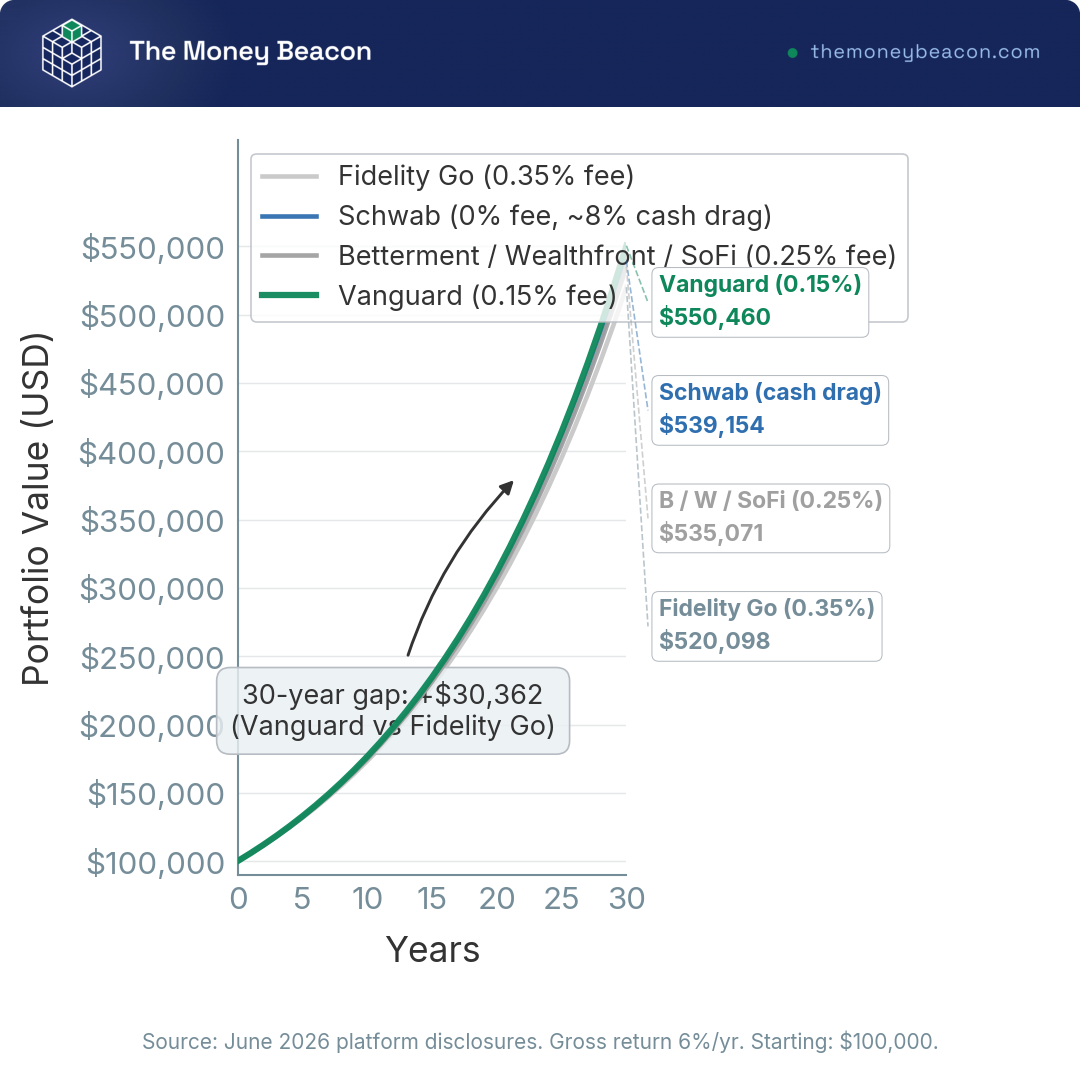
So the lesson a low fee robo-advisor teaches is that the advertised percentage is not the whole cost; held cash compounds against you the same way a fee does.
Hank’s take

follow the behavioral-finance research and one bias keeps showing up, we treat a 0% fee as free and an 8% cash sleeve as harmless, when the after-inflation math says the held cash is one of the most expensive lines a hands-off investor never sees.
Stated cost per $10,000, ranked
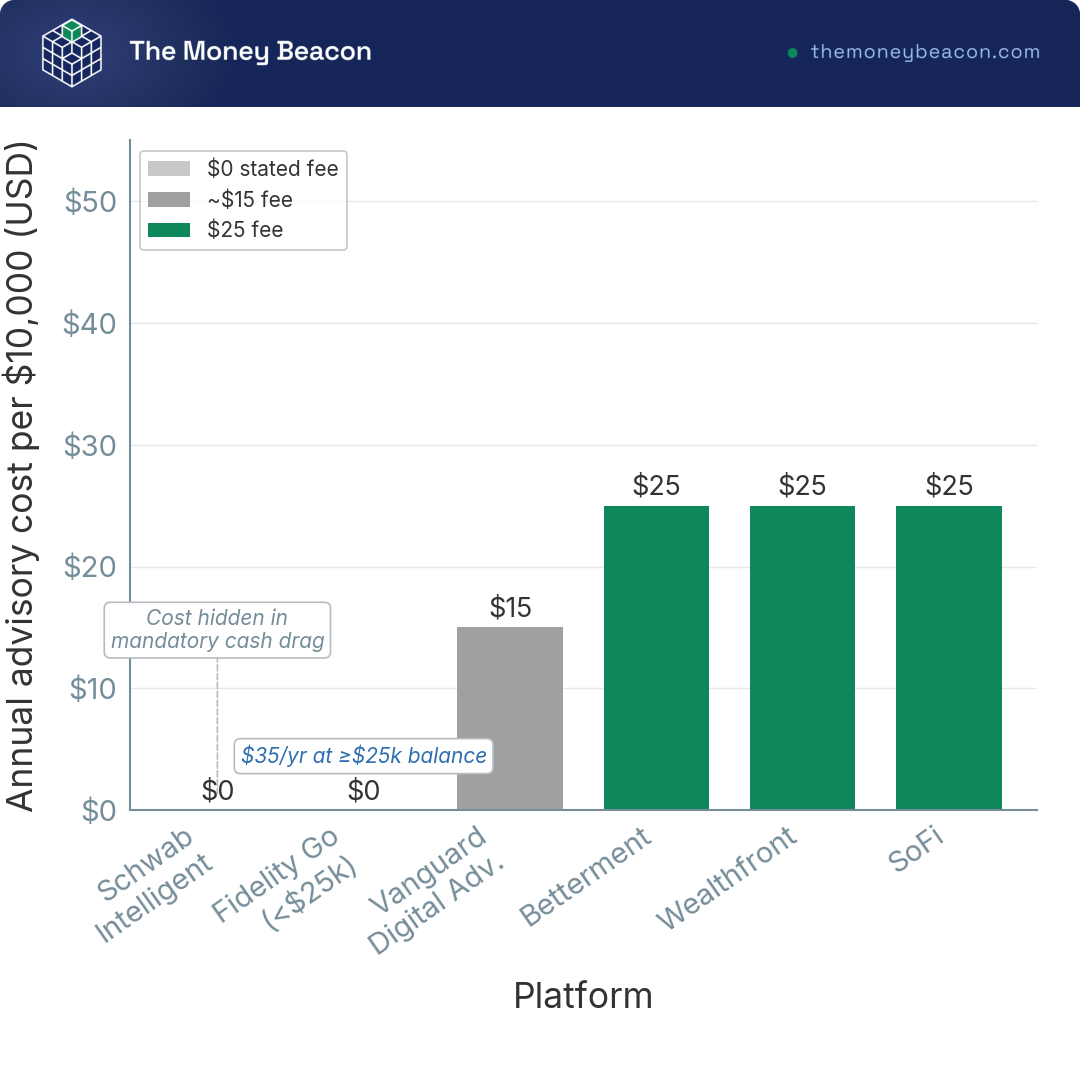
Translate those percentages into one comparable dollar figure and the ranking becomes clear. Per $10,000 invested per year, Schwab and Fidelity Go (under $25,000) show $0 stated, Vanguard runs about $15, and Betterment, Wealthfront, and SoFi each cost $25. But two of those zeros carry a catch. Schwab’s cost hides inside a mandatory cash allocation, not an advisory fee, and Fidelity Go flips to 0.35% (about $35 per $10,000) the moment your balance reaches $25,000. Keep that figure in mind, because the best robo-advisor returns often come down to which fee model fits your balance.
With the criteria and the field now set, the first review is Betterment, the original independent robo and my top all-around pick.
2. Betterment: best all-around pick for a beginner who wants free tax-loss harvesting
Betterment overview
Betterment was the first independent US robo-advisor, and it still feels like one built for a beginner. Its portfolios use broadly diversified, low-cost third-party ETFs across a 101-step Core range that runs from all-bond to all-stock. You also get Flexible, socially responsible (SRI), Smart Beta, and crypto options. The business model is a 0.25% advisory fee with a Premium step-up for those who want a human. You’ll find the full picture in our Betterment review.
Betterment strengths
The first thing to know in this Betterment review is the price of admission: a true $0 minimum, so you can start with whatever you have. Free automatic tax-loss harvesting comes on the digital tier, and it’s worth real money. Betterment reports that over 2022-2023, nearly 70% of customers who used tax-loss harvesting saw potential tax savings exceeding the advisory fee on their taxable accounts. The cash side is strong too, with a Cash Reserve account carrying up to $2 million individual and $4 million joint in FDIC coverage through a multi-bank sweep. Add fractional shares, goal-based planning, crypto, and SRI portfolios, and you get a platform that grows with you rather than one you outgrow.
Betterment weaknesses
The gaps are mostly about depth, not basics. There’s no direct indexing yet; Betterment lists it as “coming soon” with no date, which leaves a larger taxable investor without stock-level harvesting. The bigger trap is the small-balance fee. Below $24,000, the digital tier switches from 0.25% to a flat $5 a month, and on a $2,000 balance that $60 a year becomes roughly 3%, a steep toll on a tiny account. Premium, with its unlimited certified financial planner (CFP) access, needs $100,000 to unlock and raises the all-in cost to 0.65%. Betterment also publishes little detail on its exact ETF holdings, and it offers no custodial (UTMA) account for a child.
Betterment pricing and fees
Here’s how each Betterment tier converts into a yearly dollar cost on $10,000. The digital fee is 0.25% once your household balance reaches $24,000 or you set up recurring deposits of at least $200 a month; below that, it’s the $5 monthly flat fee. Premium runs 0.65% at $100,000 for unlimited CFP access, and the Cash Reserve pays a ~3.25% base rate.
| Betterment fee | Rate | Cost per $10,000/yr |
|---|---|---|
| Digital (≥$24k or $200/mo) | 0.25% | $25 |
| Digital small-balance | $5/month flat | $60 (= 6% on $1k; 0.6% on $10k) |
| Premium (≥$100k) | 0.65% | $65 |
Data current as of June 2026.
Watch the small-balance line. At 0.25% the cost is ordinary, but the flat $5 a month only makes sense once your balance is large enough to dilute it, which is exactly why the $0-minimum pitch comes with an asterisk for very small accounts.
Who Betterment is for
Betterment is ideal for a beginner-to-intermediate taxable investor who wants free tax-loss harvesting, a $0 start, and the option to add a CFP later as the balance grows. This betterment robo-advisor is not the right choice for someone who needs direct indexing today, a custodial account for a child, or the rock-bottom fee a Vanguard loyalist can already get.
3. Wealthfront: best for aggressive automated tax optimization
Wealthfront overview
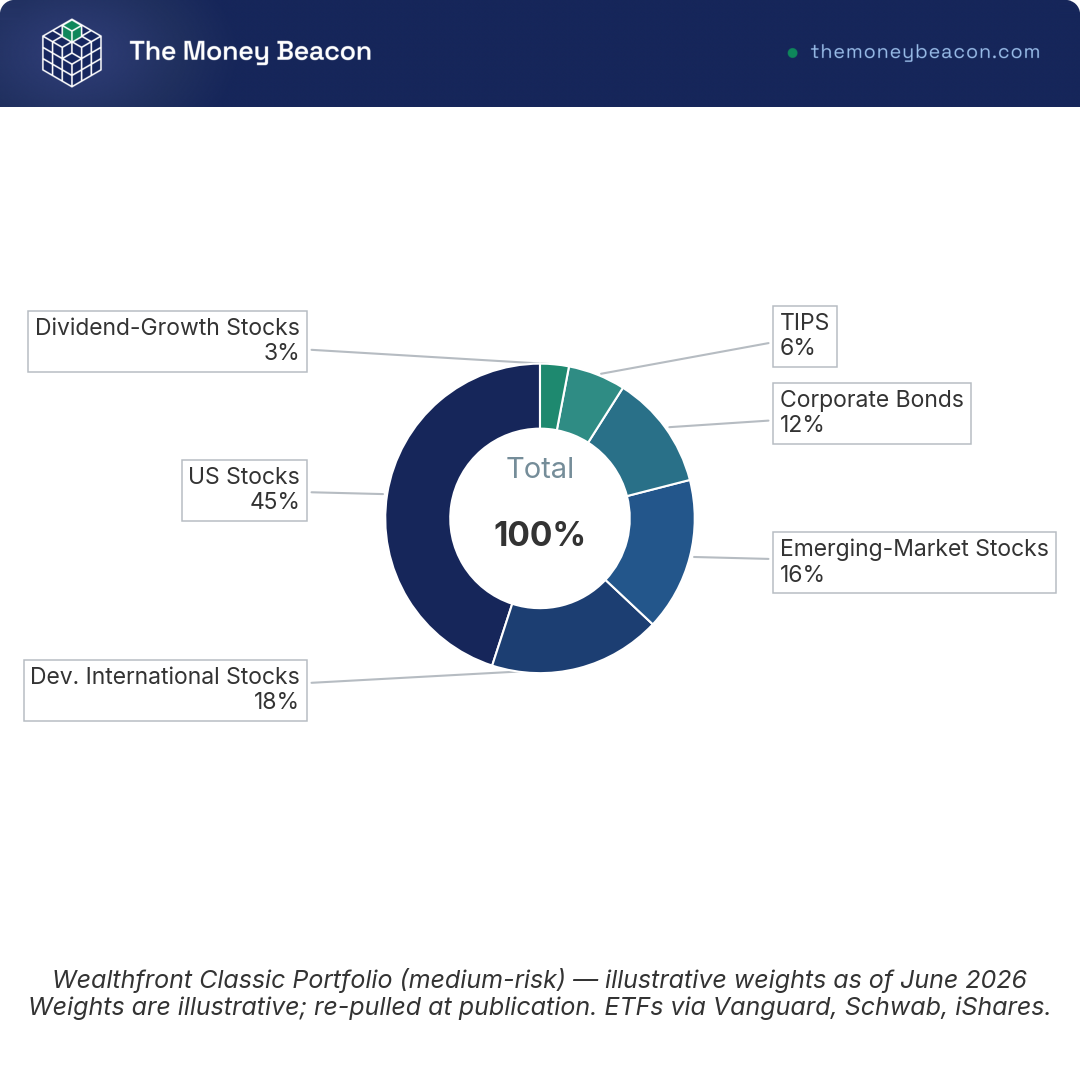
Where Betterment is the all-rounder, Wealthfront is the specialist, a fully digital platform built around aggressive tax optimization. Its Classic Portfolio uses third-party ETFs from Vanguard, Schwab, and iShares spread across US, international, and emerging-market stocks, plus bonds, Treasury Inflation-Protected Securities (TIPS), and real estate, then layers on direct indexing and automated bond products. The donut below shows what a single medium-risk level actually holds, so “diversified” stops being an abstraction. Our full Wealthfront review goes deeper on each sleeve.
Wealthfront strengths
Tax optimization is where Wealthfront really shines, and the wealthfront tax-loss harvesting engine is the reason. Daily tax-loss harvesting is included free, and US Direct Indexing (stock-level harvesting) switches on for taxable accounts of $100,000 or more at no added fee, with direct-index portfolios available from $5,000. The fee stays flat at 0.25%, and new accounts get $5,000 managed free, so the first slice of your money costs nothing. The entry point is a modest $500. The cash side is strong as well: a Cash Account paying a 3.30% base rate, up to 4.20% boosted, with up to $8 million single and $16 million joint in FDIC coverage. Add rich fixed-income products on top, including a Treasury-only bond ladder, and you have one of the most complete tax-aware setups in this comparison.
Wealthfront weaknesses
The trade-off is human contact, or rather the lack of it. Wealthfront has no human advisors at all, which is a dealbreaker if you ever want to talk to a person. Direct indexing, its signature feature, is gated at $100,000 in the flagship account, so a smaller taxable investor gets daily fund-level harvesting but not the stock-level version. Wealthfront also publishes no portfolio-average expense ratio, leaving that second fee layer undisclosed. And the standalone Automated Bond Portfolio holds no municipal bonds, which makes it slightly less tax-efficient for a very high earner using that specific product.
Wealthfront pricing and fees
Wealthfront keeps the pricing refreshingly simple, but the add-on products carry their own rates worth knowing.
| Product | Fee | Cost per $10,000/yr or note |
|---|---|---|
| Automated Investing (management) | 0.25% | $25 |
| Automated Bond Ladder | 0.15% | $15 |
| S&P 500 Direct | 0.09% | $9 |
| Minimum to invest | $500 | Automated Investing account |
| Protection | SIPC $500,000 + $500M excess | Covers broker failure, not market losses |
Data current as of June 2026.
The flat 0.25% covers management, daily harvesting, rebalancing, and reinvestment, with no trading or account fees on top. For a taxable investor, the harvesting can plausibly offset more than the fee itself, which is what makes Wealthfront’s headline price look cheaper after tax than the number suggests.
Who Wealthfront is for
Wealthfront is ideal for a taxable-account investor who wants the most aggressive automated tax optimization available and is comfortable going fully digital. It is not the right choice for anyone who wants to talk to a human advisor, or for a starter balance below $500.
4. Schwab Intelligent Portfolios: best for a Schwab loyalist who accepts the cash drag
Schwab Intelligent Portfolios overview
Schwab builds its portfolios from ETFs spanning more than 20 asset classes, drawing on a pool of about 51 Schwab and third-party funds. The catch is inside every one of those portfolios: a mandated cash allocation. There’s no advisory fee, because that held cash is how Schwab gets paid, the bank earns the spread on it while you hold it. One more thing you should know going in is that the Premium human-CFP tier is retiring in Q1 2026, so today you can only sign up for the standard, no-fee product. If you already bank with Charles Schwab, the Schwab Intelligent Portfolios will feel like a natural extension of an account you already trust.
Schwab Intelligent Portfolios strengths
The headline draw is real: $0 advisory fee on the standard tier, so the only direct cost is the underlying fund expense ratios. The account menu is unusually deep too. You can open an individual, joint, tenants-in-common, community-property, custodial, or revocable living trust account, plus the full IRA suite, including the SEP and SIMPLE versions a small-business owner needs. Underneath, the software rebalances automatically across those 20-plus asset classes, so you don’t have to touch it. And the support backbone is strong: 24/7 US-based help, FDIC insurance on the cash portion, and SIPC protection on the securities. For a Schwab household, that combination is hard to match elsewhere without paying a percentage fee.
Schwab Intelligent Portfolios weaknesses
The cash allocation is the flaw, and it’s well documented. The SEC charged three Schwab adviser subsidiaries in June 2022, and they paid about $187 million to settle claims that they didn’t adequately disclose how the mandated cash sleeve, historically 6% to 29.4% of the portfolio from 2015 to 2018, lowered client returns while Schwab earned the spread. You can’t opt out of the cash, so it compounds against you like a fee with no line item. The other gaps are simpler. The minimum is a steep $5,000, well above the $0 to $500 rivals charge. Tax-loss harvesting only switches on at $50,000 in a taxable account. And new investors lose the bundled human-CFP planning as Premium is retired.
Schwab Intelligent Portfolios pricing and fees
The stated price sheet is the easy part, since almost every line reads zero. The standard tier charges a 0% advisory fee, $0 commissions, and no account-service fee; the real cost is indirect, through the cash drag and the revenue on Schwab’s own ETFs. The legacy Premium tier, a $300 one-time planning fee plus $30 a month, was terminated in Q1 2026 and no longer accepts new enrollment. The swept cash earns a 3.21% sweep APY effective June 1, 2026, and the weighted-average fund expense ratio ranges from about 0.02% to 0.15% depending on the risk profile. What actually determines your cost is how much of the portfolio Schwab keeps in cash.
| Schwab cash band (SEC-documented, 2015-2018) | Effect |
|---|---|
| Most conservative profile | up to ~29.4% in cash |
| Most aggressive profile | as low as ~6% in cash |
| Sweep APY (June 2026) | 3.21% |
Data current as of June 2026.
An aggressive investor near the 6% floor barely feels it; a conservative one near 29.4% gives up the most.
Who Schwab Intelligent Portfolios is for
Schwab Intelligent Portfolios is ideal for a Schwab loyalist with $5,000 or more who values the broad account menu, the trust and full-IRA options, and 24/7 support, and who accepts the cash drag as the price to pay for a $0 advisory fee. With Premium retiring, it is not the right choice for someone whose main draw was bundled human-CFP planning. It’s also a poor fit for a small-balance saver or anyone sensitive to held cash earning less than the rest of their portfolio.
5. Vanguard Digital Advisor: best for the fee-minimizer who wants the cheapest all-index robo
Vanguard Digital Advisor overview
If the last review was about a hidden cost, this one is about the absence of one. Vanguard Digital Advisor is the index purist of the bunch, and its All-Index option holds just four total-market Vanguard ETFs: VTI for US stocks, VXUS for international stocks, BND for US bonds, and BNDX for international bonds. The mix sits on a glide path that de-risks toward more bonds as your goal nears, and there’s no large mandated cash bucket eating your returns. You get Active/Index and ESG variants too. The whole thing runs on a net fee of about 0.15%, and in short, this Vanguard Digital Advisor review concludes that the low-cost Vanguard lineup is the obvious choice for someone committed to minimizing fees.
Vanguard Digital Advisor strengths
The fee is the whole pitch, and it delivers. The net all-in advisory fee is about 0.15%, or about $15 per year for every $10,000 managed, among the lowest you’ll find anywhere. The gross 0.20% all-index fee gets reduced by the revenue Vanguard keeps on its own funds, so the actual fee is closer to 0.15%. The minimum is a reasonable $100, cut from $3,000 back in September 2024, which is what turned this from a high-bar product into a genuine starter pick. Automatic tax-loss harvesting is included at no added cost, new enrollees get a 90-day fee waiver, and the glide path comes with a debt-payoff tool. You can even manage some employer 401(k)s here for a $5 minimum.
Vanguard Digital Advisor weaknesses
The cost-cutting comes with hard edges. There’s no human advisor at this tier at all: if you want one, you step up to the separate Vanguard Personal Advisor hybrid service, which costs 0.35% on the all-index mix (0.40% active-index) and requires $50,000 to start. You’re also limited to Vanguard funds, with no outside funds and no single-stock customization, so anyone who wants to build something bespoke is in the wrong place. The net fee isn’t a flat guaranteed number either; it shifts a little with the rebated fund revenue. Vanguard does not publicly disclose the mechanics of the tax-loss harvesting opt-in or any thresholds. Therefore, this information is best treated as not disclosed until you enroll.
Vanguard Digital Advisor pricing and fees
Pricing here is genuinely simple, with one wrinkle worth a closer look: the difference between the gross fee and what you actually pay. The gross rate is 0.20% on the all-index option, 0.25% on the active mix, and 0.20% on ESG, and the fund-revenue rebate pulls the net down to about 0.15%. In dollars, that’s roughly $15 a year per $10,000 net, or about $20 gross before the rebate. The brokerage minimum is $100, an eligible 401(k) starts at $5, and the 90-day fee waiver means your first three months cost nothing in advisory fees. Here is how the options line up.
| Option | Gross fee | Net fee | Cost per $10,000/yr |
|---|---|---|---|
| All-index | 0.20% | ~0.15% | ~$15 net (~$20 gross) |
| Active mix | 0.25% | ~0.15% | ~$15 net (~$20 gross) |
| ESG | 0.20% | ~0.15% | ~$15 net (~$20 gross) |
Data current as of June 2026.
Put another way, whichever option you pick, you end up paying about $15 a year for every $10,000. That net 0.15% is the cheapest credible advisory fee among the percentage-fee robos, and it’s the reason a fee-minimizer keeps landing here.
Who Vanguard Digital Advisor is for
Vanguard Digital Advisor is ideal for a Vanguard loyalist or fee-minimizer who wants the cheapest credible all-index robo and doesn’t need a human at this tier. The roughly 0.15% net fee, the $100 minimum, and free tax-loss harvesting make it a clean, low-cost autopilot. It is not the right choice for someone who wants direct indexing, the ability to hold outside funds, or built-in human advice without stepping up to the pricier Personal Advisor service.
6. Fidelity Go: best for a sub-$25,000 beginner who wants a genuinely free account
Fidelity Go overview
Fidelity Go takes a different route to cheap: it removes the fund fee entirely. The portfolios are built only from Fidelity Flex mutual funds, which carry a 0.00% expense ratio, so you pay the advisory fee and never a fund-level fee on top. The defining trait follows from the price structure. Below $25,000, the account is genuinely free, with no advisory fee at all; cross that line and a transparent 0.35% takes over. The takeaway of this Fidelity Go review is that it’s the simplest possible on-ramp for a beginner who’s also plugged into the Fidelity ecosystem for a checking account, a 401(k), or a brokerage.
Fidelity Go strengths
The free tier is the real headline, and it’s not a gimmick. Under $25,000 you pay $0 all-in, because there’s no advisory fee and the Flex funds charge a 0.00% expense ratio. No fund-level expense ratios ever apply, at any balance, which is rare. Once your balance reaches $25,000, two things switch on at no extra charge: unlimited 30-minute phone coaching calls, and tax-loss harvesting for taxable accounts using the equity Flex funds. You can start investing with just $10, the integration with the rest of your Fidelity accounts is deep, and the account menu is broad, including a SEP IRA and an HSA for those who need them.
Fidelity Go weaknesses
The threshold cuts the other way once you cross it. The 0.35% fee applies to your entire balance, not just the slice above $25,000, so stepping a dollar over the line is charged on the whole account. Both perks, tax-loss harvesting and the human coaching, are gated at that same $25,000, with nothing for smaller accounts. The portfolios use proprietary Flex funds only: no third-party ETFs, no direct indexing, and very little to customize. Those Flex funds are force-sold when you leave and can’t transfer out in kind. There are no trust accounts, advice is phone-only, and the cash sweep goes to a money market fund that isn’t FDIC-insured.
Fidelity Go pricing and fees
The pricing tells a clean two-act story, free up to a point, then a flat percentage on everything. Below $25,000 you pay nothing in advisory fees. At $25,000 and above, the rate is 0.35% a year charged on the entire balance, which works out to exactly $87.50 a year at $25,000, or $35 per $10,000 within the paid tier. You can open for $0 and start investing with $10, and the underlying Flex funds keep their 0.00% expense ratio throughout. The two tiers lay out like this.
| Tier | Advisory fee | Cost per $10,000/yr |
|---|---|---|
| Under $25,000 | $0 | $0 |
| $25,000 and above | 0.35% on the entire balance | $35 |
Data current as of June 2026.
So the value is genuinely zero while you’re below the line, then it converts to a real cost the moment you cross it. The thing to watch is that the 0.35% hits your whole balance, not just the amount over $25,000, so a balance sitting just past the threshold pays the most relative to what it gets.
Who Fidelity Go is for
Fidelity Go is ideal for a beginner or Fidelity loyalist with a balance under $25,000 who wants a genuinely free, set-and-forget account, and it stays strong at $25,000 and up, where tax-loss harvesting and phone coaching switch on. The $10 start and the 0.00%-ER funds make it a clean first robo. It is not the right choice for someone who wants third-party ETFs, direct indexing, a trust account, or who wants to avoid having the 0.35% charged on the whole balance once the account grows large.
7. SoFi Automated Investing: best for a $50 starter who wants a free CFP session
SoFi Automated Investing overview
SoFi rebuilt this product from the ground up. It relaunched on November 12, 2024 in partnership with BlackRock, so the portfolios are now BlackRock and iShares third-party ETFs, not the old proprietary SoFi funds. You pick one of three themes: Classic, Classic with Alternatives, or Sustainable. What sets this SoFi Automated Investing review apart is the human help bundled in: you get complimentary access to a certified financial planner (CFP) as a member benefit. If you already use the rest of SoFi for a loan or a checking account, the robo fits in right alongside it.
SoFi Automated Investing strengths
The minimum is a low $50, and the complimentary CFP access is the standout feature: standard members get one 30-minute session, while SoFi Plus members get unlimited sessions, each valued at roughly $250. The BlackRock-built portfolios include an alternatives theme that adds real estate and multi-strategy funds, which is unusual at this price. You also get a flat 0.25% fee with automatic rebalancing and tight integration with the rest of the SoFi app. For a beginner who wants software running the portfolio and a real person to call when a question comes up, that combination is rare under $100 to start.
SoFi Automated Investing weaknesses
The big gap is tax efficiency. SoFi offers no tax-loss harvesting at all, which is a real miss for anyone investing taxable money, since every other platform in this comparison harvests at some balance. The 0.25% fee, in place since the 2024 relaunch, also cost SoFi its old free-robo advantage. The platform itself is newer and less proven, live only since November 2024, and a 2019 proprietary-ETF dispute with the SEC (now remediated, a $300,000 settlement in August 2021) sits on its record. There are no trust or custodial robo accounts. And SoFi doesn’t publish its portfolio holdings or cash allocation, so a couple of details remain undisclosed until you enroll.
SoFi Automated Investing pricing and fees
The price sheet is short, with one detail worth a closer look: SoFi bills the fee monthly in arrears rather than upfront. The advisory fee is 0.25% a year, about $25 per $10,000, plus whatever the underlying funds charge. You can start with $50. SoFi Securities carries SIPC protection of $500,000, including $250,000 for cash, with clearing and custody through Apex Clearing. The one number SoFi keeps to itself is the blended underlying fund expense ratio. Here is how it lays out.
| Item | Detail | Cost per $10,000/yr |
|---|---|---|
| Advisory fee | 0.25% (billed monthly in arrears) | $25 |
| Minimum to invest | $50 | n/a |
| Underlying fund ER | Not disclosed (blended) | Not disclosed |
| Protection | SIPC $500,000 (incl. $250,000 cash) | Covers broker failure, not market losses |
Data current as of June 2026.
You pay the same $25 per $10,000 as Betterment and Wealthfront, but you give up tax-loss harvesting to get the free CFP session in return. Whether that trade is worth it depends entirely on whether you’re investing taxable money.
Who SoFi Automated Investing is for
SoFi is ideal for a beginner or an existing SoFi customer who wants a low $50 start plus free access to a human CFP, and it’s especially strong for a SoFi Plus member who gets unlimited sessions at no cost. It is not the right choice for a taxable investor who needs tax-loss harvesting, anyone who wants a trust account, or anyone who wants full holdings transparency and a long track record behind the platform.
8. Side-by-side recap and which robo fits your profile
The full comparison, side by side
With all six reviewed on the same criteria, here is the single table that settles every comparative claim in this article, the source of truth for the whole comparison.
| Criterion | Betterment | Wealthfront | Schwab Intelligent Portfolios | Vanguard Digital Advisor | Fidelity Go | SoFi Automated Investing |
|---|---|---|---|---|---|---|
| Advisory fee | 0.25% (or $5/mo) | 0.25% flat | 0% (standard) | ~0.15% net | $0 <$25k; 0.35% ≥$25k | 0.25% |
| $ per $10,000/yr | $25 | $25 | $0 stated | ~$15 | $0 / $35 | $25 |
| Minimum to invest | $0 | $500 | $5,000 | $100 | $10 | $50 |
| Funds used | Third-party ETFs | Third-party ETFs | Schwab + 3rd-party ETFs | Vanguard index ETFs | Fidelity Flex (0% ER) | BlackRock/iShares ETFs |
| Auto TLH | Yes, free | Yes, daily | Yes, at $50k | Yes | Yes, at $25k (taxable) | No |
| Direct indexing | Coming soon | Yes, at $100k | No | No | No | No |
| Human advisor | Premium $100k (CFP) | No | Premium retiring Q1 2026 | No (hybrid separate) | Coaching at $25k | Complimentary CFP (1 session) |
| Cash drag risk | Low (operational) | Low | High (mandatory) | Low | Modest | Not disclosed |
| Best-fit profile | All-around beginner + TLH | Taxable TLH maximizer | Schwab loyalist (accepts cash drag) | Fee-minimizer / Vanguard loyalist | Sub-$25k beginner; Fidelity loyalist | $50 starter + free CFP |
Data current as of June 2026.
If you are starting small: the minimums compared
How much do you actually need to begin? The entry barrier ranges from $0 at Betterment up to $5,000 at Schwab, a wide spread for what is, functionally, the same kind of product. Three platforms cluster at the bottom as a genuine beginner on-ramp: Betterment at $0, Fidelity Go at $10, and SoFi at $50.
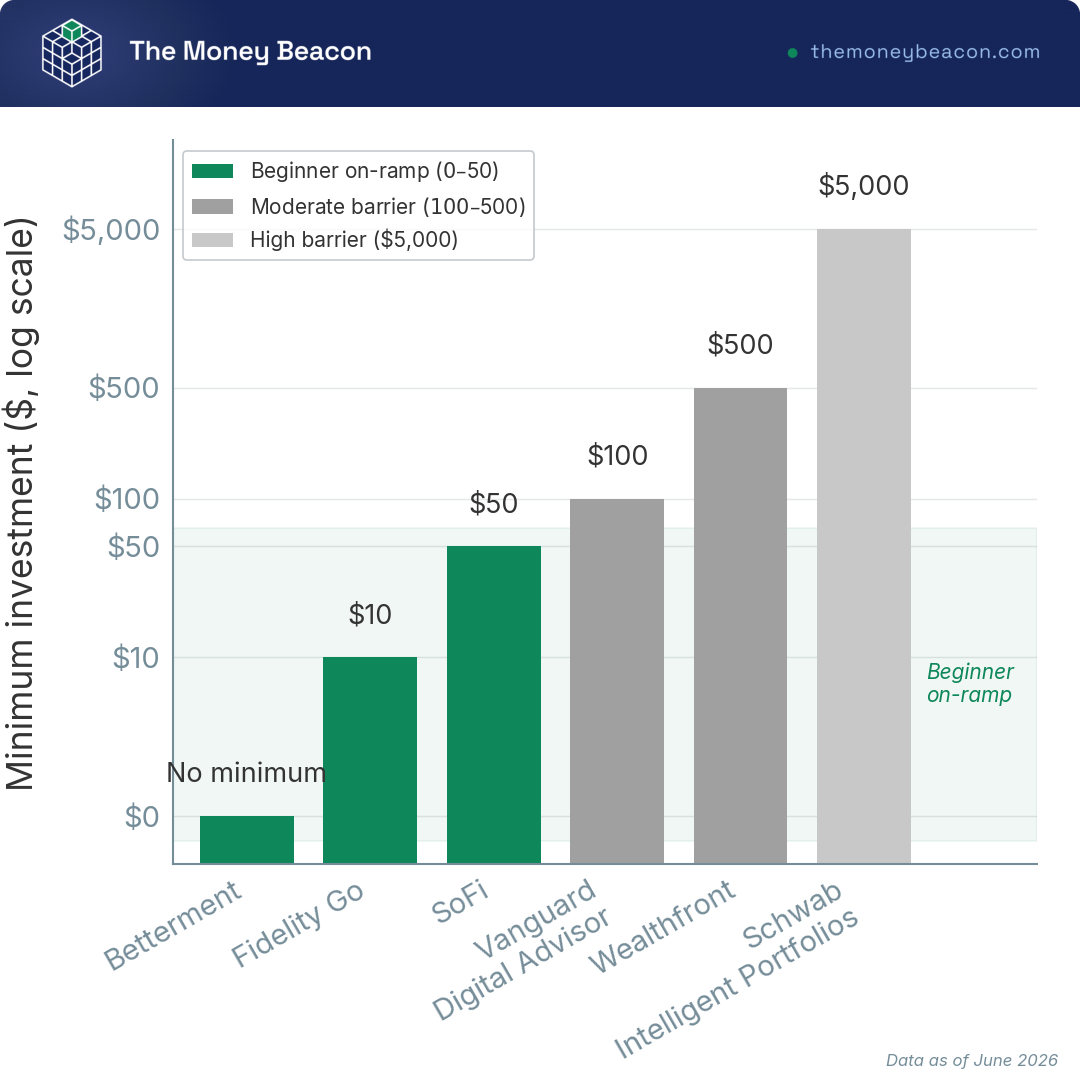
If you’re below about $24,000, favor a $0-fee platform and skip Betterment’s $5-a-month flat fee, which turns into a heavy percentage drag on a tiny balance.
If you invest in a taxable account: where TLH kicks in
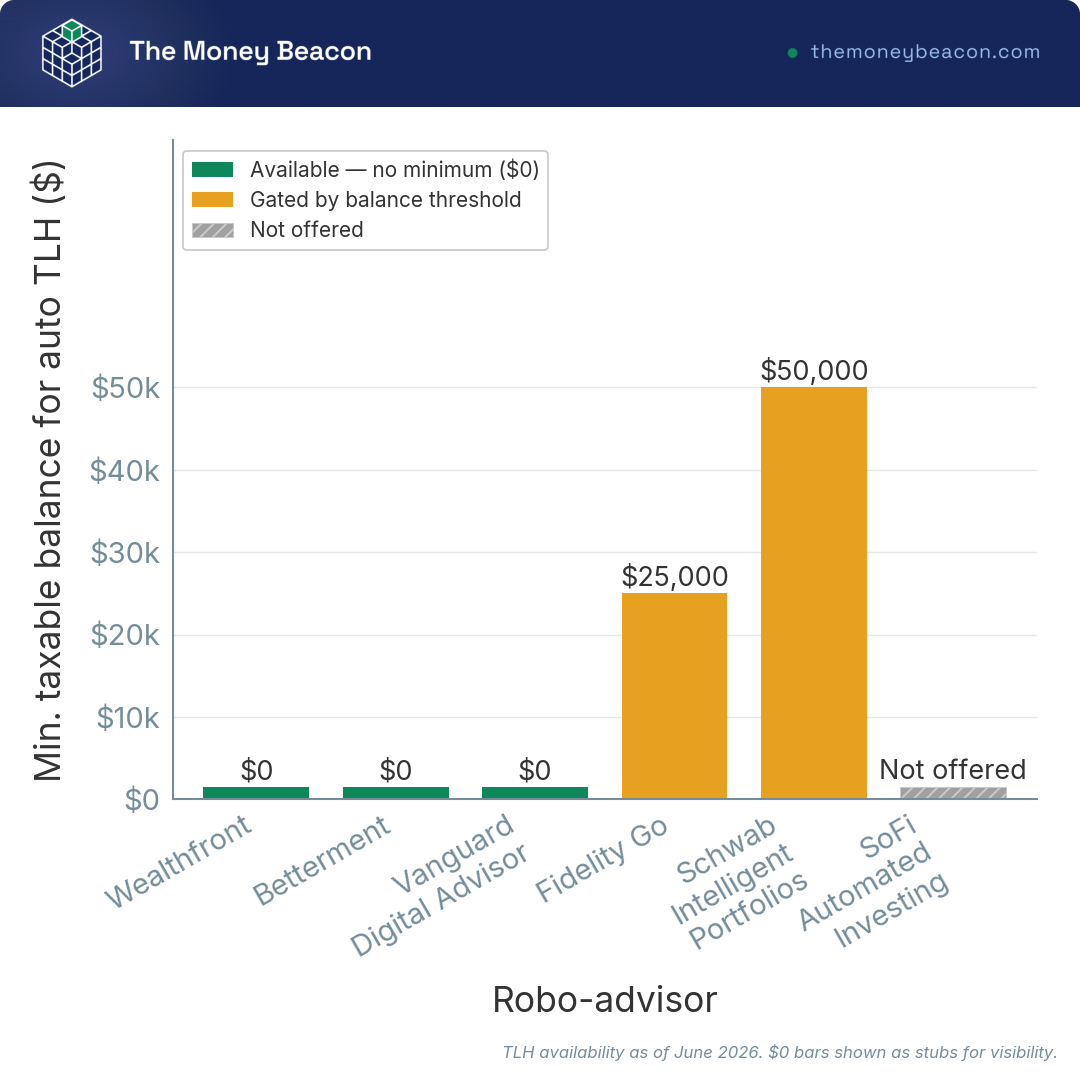
For taxable money, the question becomes at what balance each robo starts harvesting losses. Wealthfront, Betterment, and Vanguard harvest with no minimum; Fidelity Go switches it on at $25,000; Schwab gates it at $50,000; and SoFi doesn’t offer it at all. Free tax-loss harvesting can offset your capital gains and up to $3,000 of ordinary income a year.
One trap to watch: if you separately hold the same index fund in a 401(k) that keeps auto-investing, your own purchases can wash-sale the robo’s harvested loss, since the wash-sale rule reaches across your accounts. Our guide to the wash-sale rule and capital-gains treatment walks through how to stagger purchases so you don’t undo the benefit. And remember, harvesting only matters in a taxable account; inside any IRA there’s nothing to harvest.
If you want a human or a specific feature mix
What if a person to call matters more than the last basis point? Human access splits the field cleanly. Betterment, Fidelity Go, and SoFi each bundle some human help, at different balances. Wealthfront and Vanguard at this tier are software-only, with no human at all. Schwab’s Premium human tier is retiring in Q1 2026, so a new Schwab investor no longer gets bundled planning. The Venn diagram below places each platform across low-cost harvesting, human access, and a sub-0.20% fee.
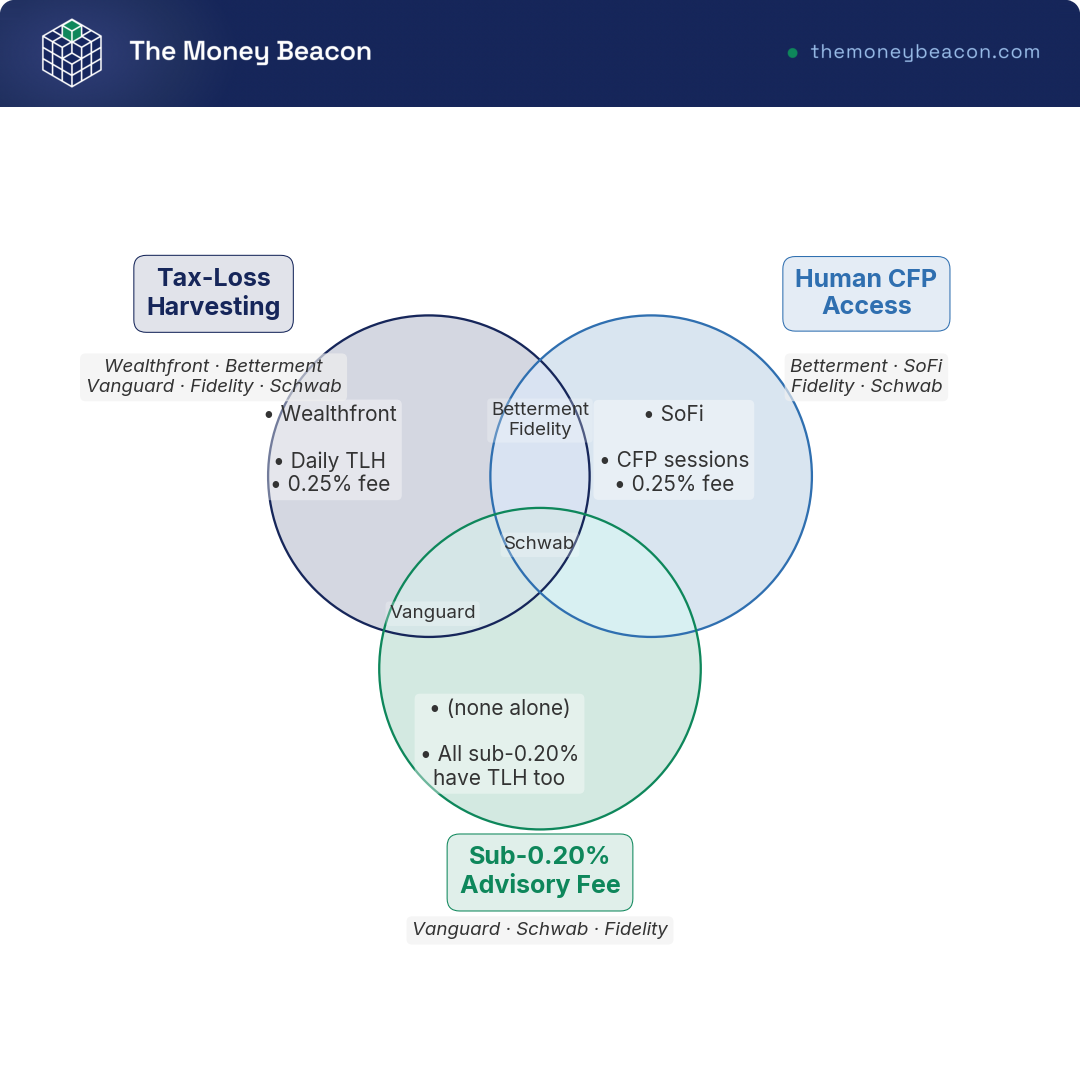
If your real need is sustained, personalized guidance rather than an occasional check-in, a robo’s bundled coaching only goes so far, and it’s worth looking at how to find a fee-only fiduciary advisor instead.
How fee models cross over as your balance grows
The cheapest robo depends on how much you hold, because the fee models cross over as the balance grows. Vanguard’s ~0.15% stays the cheapest percentage model at every size. Fidelity Go is free under $25,000, then its 0.35% overtakes the 0.25% robos once the balance climbs. The legacy flat fee only wins at high balances. The line chart shows exactly where the curves cross.
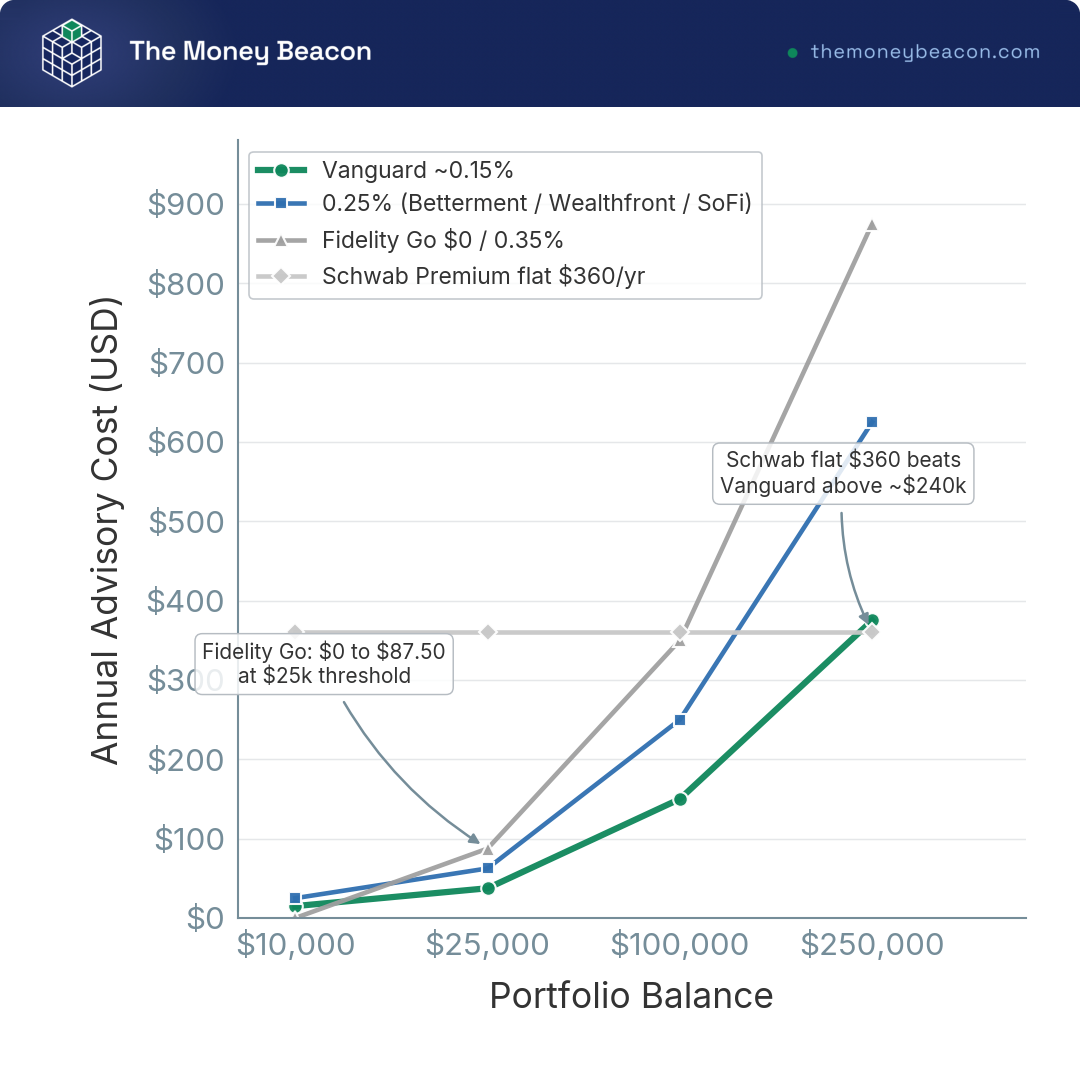
The takeaway is to pick the fee model for the balance you actually hold, not the one with the lowest advertised percentage.
The verdict: which robo for which investor
So which one should you actually use? It comes down to three profiles. A small-balance beginner is best served by Fidelity Go under $25,000 for genuinely zero cost, or by Betterment for a $0 start with free tax-loss harvesting. A taxable-account investor who wants aggressive harvesting should go with Wealthfront for daily TLH and direct indexing. Betterment is a strong second choice for free harvesting. An ecosystem loyalist or fee-minimizer has two good options: Vanguard Digital Advisor at ~0.15% net for the lowest credible percentage fee, or simply the in-house robo of the broker that already holds their money, Schwab included if they accept the cash drag for the broad account menu.
Tom’s take
I’ve tested most of these platforms, and the one that already holds your money usually wins on friction alone. The held cash, though, is the part people wave off, and once you’re running a real multi-asset portfolio you learn to treat idle cash as a drag you’re paying for, not a free safety blanket.
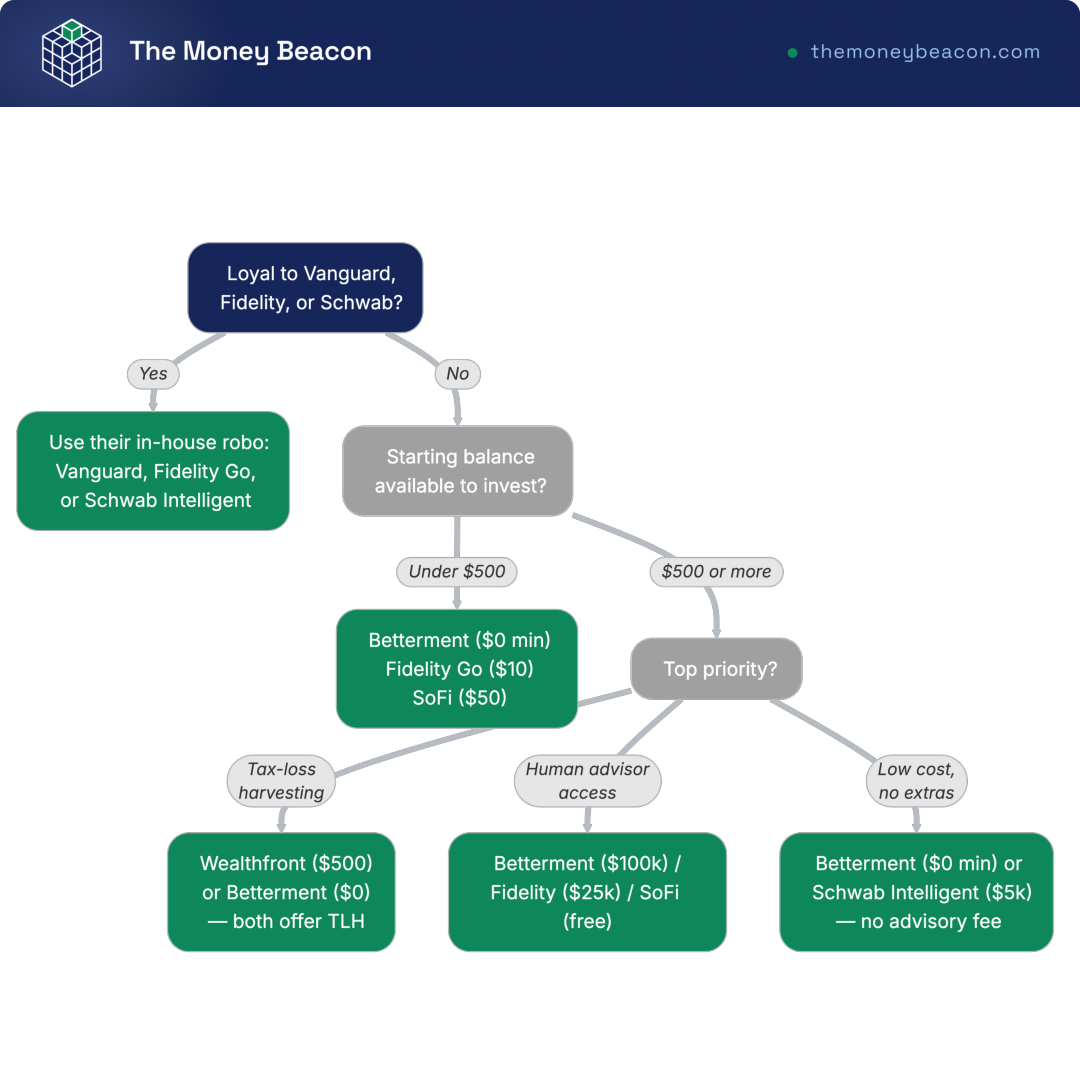
The decision tree below routes you to a platform by budget, taxable harvesting need, human-advisor need, and existing-broker loyalty.
Conclusion
After evaluating all six based on the same criteria, I’ve come to the same conclusion: there isn’t one best robo-advisor, there’s the one that fits your balance, your account type, and whether you ever want a human on the other end. The headline fee is never the whole price. A tenth of a percent and a held-cash sleeve both compound against you for decades, so a $0-fee account with a forced cash allocation can quietly cost you more than a 0.25% account that puts every dollar to work. Match the robo to how you actually invest, not to the loudest number on the marketing page.
The issue that most people discover too late is that the value of the feature changes with your balance. Free tax-loss harvesting only helps in a taxable account, the threshold that flips you from a free tier to 0.35% only bites once you cross it, and a low fee on $5,000 is a different story than the same fee on $200,000. So before you open anything, write down two things: roughly how much you’re starting with, and whether it’s a taxable account or an IRA. With those two numbers in hand, the verdicts above point to a clear pick, and you’ll skip the gap between the advertised cost and what you actually keep.
If you want to go further, our comparison of low-cost index funds and ETFs shows what these robos are buying under the hood, our comparison of online brokerage accounts covers the do-it-yourself route if you’d rather avoid the advisory fee, and our guide to investment taxes explains tax-loss harvesting and the wash-sale rule that make a robo’s tax features worth the math.
FAQ: Choosing a robo-advisor in 2026
Are robo-advisors worth it compared to investing on my own?
For a hands-off investor, usually yes. A robo charges roughly 0.15% to 0.35% a year, about $15 to $35 per $10,000, to handle your allocation, automatic rebalancing, and on some platforms tax-loss harvesting. You can do it cheaper yourself with one low-cost index ETF, but most self-directed investors skip rebalancing and let cash sit idle. Against a traditional human advisor at roughly 1% a year, a robo saves you about three-quarters of the cost.
What is the cheapest robo-advisor in 2026?
On stated advisory fees, two stand out: Fidelity Go is free under $25,000 and uses zero-expense-ratio Flex funds, and Schwab Intelligent Portfolios charges no advisory fee at all. Among percentage-fee robos, Vanguard Digital Advisor at about 0.15% net is the lowest. But Schwab’s “free” is paid for through a mandatory cash allocation the SEC found reduces returns, and Fidelity Go’s 0.35% above $25,000 stops being the cheapest at higher balances.
Which robo-advisor has the lowest account minimum?
Betterment lets you start with $0, Fidelity Go with $10, and SoFi with $50. Vanguard Digital Advisor needs $100, Wealthfront $500, and Schwab a steeper $5,000. So if you’re a true beginner with little to put in, the $0 to $50 platforms remove the entry barrier entirely and let you get invested today.
Which robo-advisor is best for tax-loss harvesting?
Wealthfront is the most aggressive: daily tax-loss harvesting (TLH) at no minimum, plus US Direct Indexing for stock-level harvesting on taxable accounts of $100,000 or more. Betterment also includes free TLH at its digital tier. Fidelity Go adds it for taxable accounts at $25,000, Schwab at $50,000, Vanguard now includes it, and SoFi doesn’t offer it at all. One rule worth keeping in mind, explained in our guide to investment taxes: TLH only helps in a taxable account, never inside an IRA.
Do robo-advisors offer access to human financial advisors?
Some do. Betterment Premium ($100,000) includes unlimited access to a certified financial planner (CFP); Fidelity Go adds unlimited 30-minute coaching calls once you reach $25,000; SoFi includes one complimentary CFP session, unlimited with SoFi Plus. Schwab is retiring its Premium human tier in Q1 2026, so its standard robo no longer bundles planning. Wealthfront is deliberately software-only. If a human is your priority, our comparison of fee-only advisors is worth a look.
Is my money safe with a robo-advisor, with SIPC and FDIC protection?
Your invested portfolio is held at a broker-dealer that belongs to the Securities Investor Protection Corporation (SIPC), so it’s protected up to $500,000, including $250,000 for cash, if the broker fails. SIPC doesn’t cover market losses. Any cash in a robo’s cash-management account is FDIC-insured, the standard $250,000 per bank multiplied across program banks, which is how Betterment and Wealthfront advertise multi-million coverage. The investments themselves are never FDIC-insured.
Can a robo-advisor manage my Roth or traditional IRA?
Yes. All six manage Roth and traditional IRAs, and all six support a SEP IRA for the self-employed, including Fidelity Go and SoFi. One thing to remember: tax-loss harvesting provides no benefit inside any IRA, so for an IRA you should weigh fees and account support, not TLH. If you’re still picking a wrapper, start with our guide to the Roth IRA before you pick a platform.
How much does a robo-advisor cost per $10,000 invested?
At the standard tiers, here’s what you’d pay each year: Vanguard about $15; Betterment, Wealthfront, and SoFi $25; Fidelity Go $0 under $25,000 or $35 above it; and Schwab $0 stated, though with an indirect cost from its mandated cash allocation. Then add the underlying fund expense ratios, which are near zero at Fidelity Go and very low at Vanguard. Past performance doesn’t guarantee future results, but on cost alone the gaps are real.




Comments
Questions and corrections welcome. We read everything.