


You did the hard part. You opened a taxable brokerage account, you bought good funds, you let them grow. Then a 1099 lands in February and a chunk of those gains is gone before you ever see it, taxed at a rate you never chose and barely understood. Most people only meet their investment taxes after the fact, once the bill is locked in, and never realize that selling on day 364 instead of day 366, or parking a bond fund in the wrong account, can quietly cost them thousands of dollars a year they will never get back. The frustrating part is that almost none of it comes from picking the wrong stock. It comes from the rules, and the rules reward whoever bothers to read them.
Those rules are quietly tightening in one specific spot. The 3.8% net investment income tax kicks in once your income clears $200,000 single or $250,000 married filing jointly, and unlike almost every other figure the IRS publishes, those thresholds are not adjusted for inflation. So every year, raises and growing portfolios push a few more households over a line that has not moved since the tax was written, turning a top long-term rate of 20% into 23.8% for people who never thought of themselves as high earners.
Before you can keep more of what your portfolio earns, you have to understand exactly where the tax comes from. The distinction that drives nearly everything else is the difference between the account that holds your money and the asset inside it, and why the IRS treats a dollar of long-term capital gains so differently from a dollar of interest.
1. How Investment Income Is Actually Taxed: The Foundations
Before any clever move, two questions decide your whole bill: what triggers a tax on your investments, and on what number.
1.1 Accounts vs asset classes: where the tax actually lives
The most expensive confusion in investing taxes is treating an account and an asset class as the same kind of thing. They are two different layers, and your tax depends on both. A Roth IRA is not an alternative to an exchange-traded fund; you hold the fund inside the Roth. So when you ask “how is this taxed,” you are really asking two questions at once.
The first layer is the account, or tax wrapper: a taxable brokerage account, a traditional IRA, a Roth IRA, a 401(k), an HSA, a 529. The wrapper decides when and whether the income is taxed at all. The second layer is the asset class you hold inside it: stocks, bonds, money market funds, index funds, ETFs, REITs, Treasurys, crypto. The asset decides the character of the income, whether it shows up as interest, a qualified dividend, or a capital gain. The same fund held in two different wrappers is taxed two different ways, so keeping the two layers separate is the first thing to get right.
| Layer | Examples | What it controls | Note |
|---|---|---|---|
| Account (wrapper) | Taxable brokerage, Traditional IRA, Roth IRA, 401(k), HSA, 529 | When/whether income is taxed | Insurance differs: bank deposits FDIC/NCUA, brokerage assets SIPC |
| Asset class (holding) | Stocks, bonds, ETFs, REITs, Treasurys, money market funds | Character of the income (interest, dividend, gain) | Same asset is taxed differently by account |
One safety point belongs squarely to the account layer, because people mix it up constantly. Deposit insurance and brokerage protection are not the same thing. FDIC (banks) and NCUA (credit unions) insure deposits up to $250,000 per depositor, per insured institution, per ownership category. SIPC instead covers the failure of a brokerage, meaning missing securities and cash, up to $500,000 per customer including a $250,000 cash limit. SIPC does not cover market losses, and a stock or ETF in your brokerage is never “FDIC-insured.” When you open or compare a taxable account, this is one of the details worth checking before you fund it, and it is one we cover in our brokerage account comparison. With the wrapper separated from the asset, the next question is what actually flips the switch on a tax bill.
1.2 Taxable events: when you actually owe something
Here is the relief most new investors do not expect: unrealized gains are not taxed. A stock that doubled but that you never sold creates no tax this year, none. The tax does not attach to the gain on paper; it attaches to a realization event, the moment something is sold, paid out, or distributed. So the question is never “did my portfolio go up,” it is “did I trigger one of these events.”
The table below sorts the events you will actually run into, with a yes or no on whether tax lands this year and what character it carries.
| Event | Taxable now? | Character |
|---|---|---|
| Holding an appreciated stock you did not sell | No | None until sold |
| Selling a stock/ETF/fund for a gain | Yes | Capital gain (short or long) |
| Receiving a dividend (cash or reinvested) | Yes | Qualified or ordinary dividend |
| Receiving bond/CD/savings interest | Yes | Ordinary income |
| A mutual fund passing through a capital-gains distribution | Yes | Usually long-term gain, even if you did not sell |
| Moving shares between two of your own taxable accounts (in-kind) | No | Basis carries over |
Two lines on that table catch people off guard. A mutual fund can hand you a taxable capital-gains distribution in December even though you never sold a share, because the fund sold inside the portfolio and passed the gain through to you. And if you reinvest dividends automatically, you still owe tax on them in the year you receive them, even though no cash hit your bank account. Each reinvestment also creates a new tax lot with its own cost basis and its own holding-period clock, which matters more than it sounds, as the next two subsections show.
1.3 Cost basis: the number the whole bill hinges on
Every gain you will ever report comes out of one subtraction: proceeds minus cost basis. Basis is what you paid, plus commissions, plus any reinvested dividends you already paid tax on. That last piece is where money quietly leaks. Get basis wrong by leaving out reinvested dividends and you pay tax twice on the same dollars, once as a dividend and again because you forgot to add it to basis.
Your broker does some of this tracking for you, but only on what the IRS calls covered securities. Stock counts as covered if you acquired it in 2011 or later (2012 for mutual-fund or dividend-reinvestment shares), with most debt, options, and securities futures covered from 2014, and digital assets becoming covered for purchases in 2026 and later. For non-covered lots, the older holdings and shares transferred in from another firm, the broker may not have your basis, so you have to supply it yourself or risk the IRS treating the full sale price as gain.
When you sell only part of a position, the method you use to pick which shares leave decides the size of the gain.
| Method | How it picks shares | Best when |
|---|---|---|
| FIFO (default at most brokers) | Sells oldest lots first | Simple, but can realize larger gains |
| Specific identification | You name the exact lots at sale | Lowest tax: sell high-basis lots first |
| Average cost (mutual funds only) | Averages all lots’ basis | Convenience; once elected, hard to change |
The default at most brokers is FIFO, first-in-first-out, and the oldest lots usually have the lowest basis and the biggest built-in gain. Electing specific-share identification at the time of the trade, before settlement, lets you sell your highest-basis lots first and report the smallest possible gain. The broker has to confirm the lots you named in writing, so this is a click you make in the moment, not a fix you apply in April. This same basis tracking is the foundation for the year-end harvesting moves later in the guide.
1.4 Holding period: why the calendar is a tax lever
Cost basis tells you how big the gain is. The holding period decides what rate it is taxed at, and that is where the calendar quietly becomes a tool. Your holding period runs from the day after you buy to the day you sell. Held more than one year, the gain is long-term; held one year or less, it is short-term. Because the rate gap between the two is large, ordinary rates run up to 37% while long-term rates top out at 20%, a single day on the calendar can be worth real money.
The timeline below shows why a single holding is never on just one clock. Four separate windows run at once on the same position, and each one belongs to a rule we cover later in the guide.
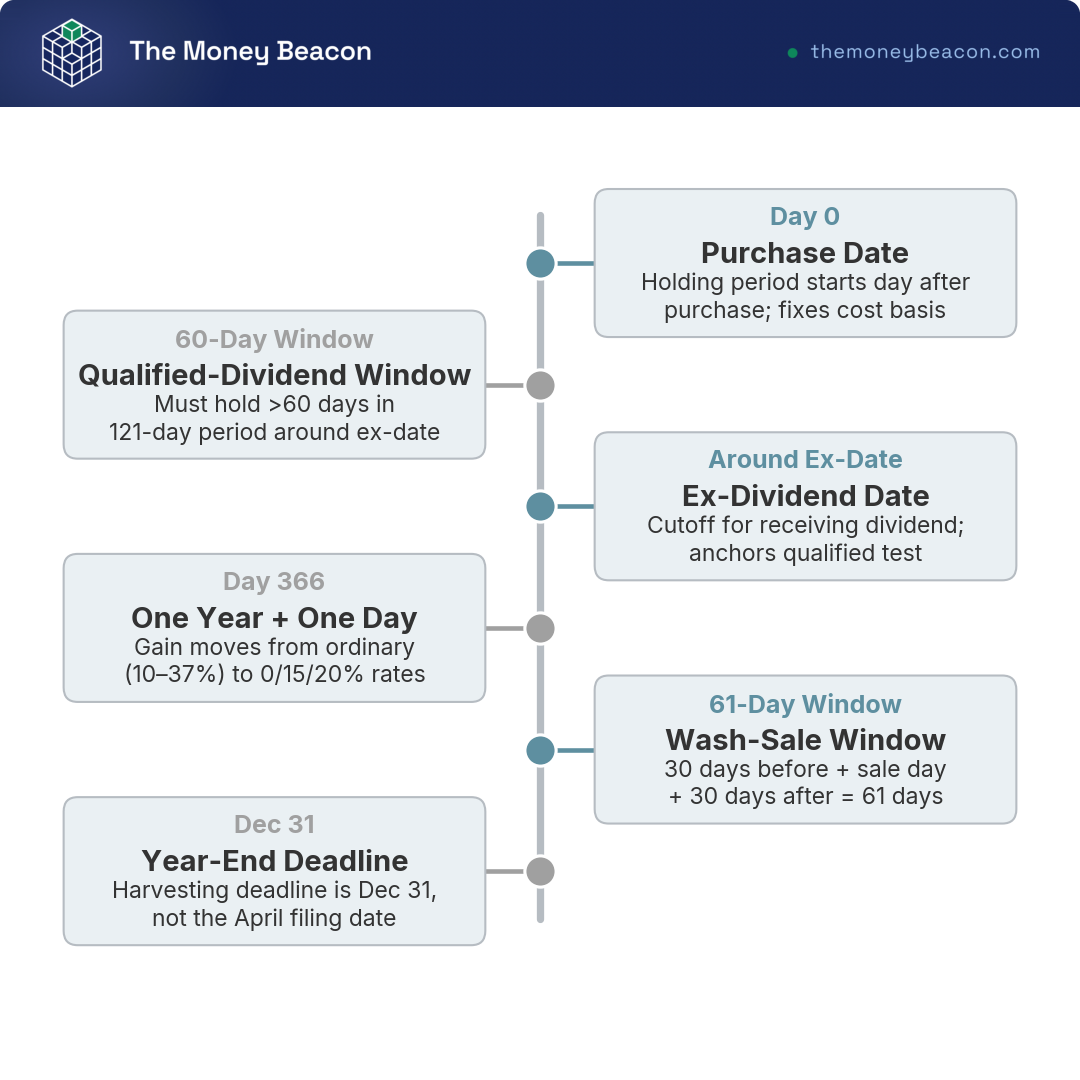
The practical takeaway is small but worth real dollars. If a sale would land just short of a year and you do not need the cash, waiting past the 366th day can move the gain from your ordinary rate down to 0/15/20%. That holding-period line is the hinge of the whole next section, so let’s put a dollar figure on exactly how much that one year is worth.
2. Capital Gains: Short-Term, Long-Term, and the 0/15/20% Brackets
A sale triggers the tax and the one-year line splits short-term from long-term. So how much is a gain actually taxed, and how do you land in the cheapest bracket?
2.1 Short-term gains are taxed like your paycheck
Start with the expensive case, because it is the one people stumble into. A gain on something you held one year or less is short-term, and it is taxed at your ordinary marginal rate, the same 10% to 37% schedule that applies to your salary. There is no preferential rate here at all. Sell a winner eleven months in and the IRS treats that profit like an extra paycheck. If you have losses too, short-term losses first offset short-term gains, and any net short-term loss then offsets long-term gains.
To know your rate, you need your bracket. The 2026 ordinary brackets run 10/12/22/24/32/35/37%. For a single filer, the 2026 breakpoints are 10% up to $12,400, 12% to $50,400, 22% to $105,700, 24% to $201,775, 32% to $256,225, 35% to $640,600, and 37% above $640,600. For married couples filing jointly, the bands run 10% up to $24,800, 12% to $100,800, 22% to $211,400, 24% to $403,550, 32% to $512,450, 35% to $768,700, and 37% above $768,700. The 2026 standard deduction is $16,100 single (and married filing separately), $32,200 married filing jointly, and $24,150 head of household. Data current as of June 2026.
The chart below makes the one-year line tangible. It takes a single $50,000 gain and shows the federal tax on it across the three long-term brackets, against the same gain taxed as a short-term gain at a 32% rate.
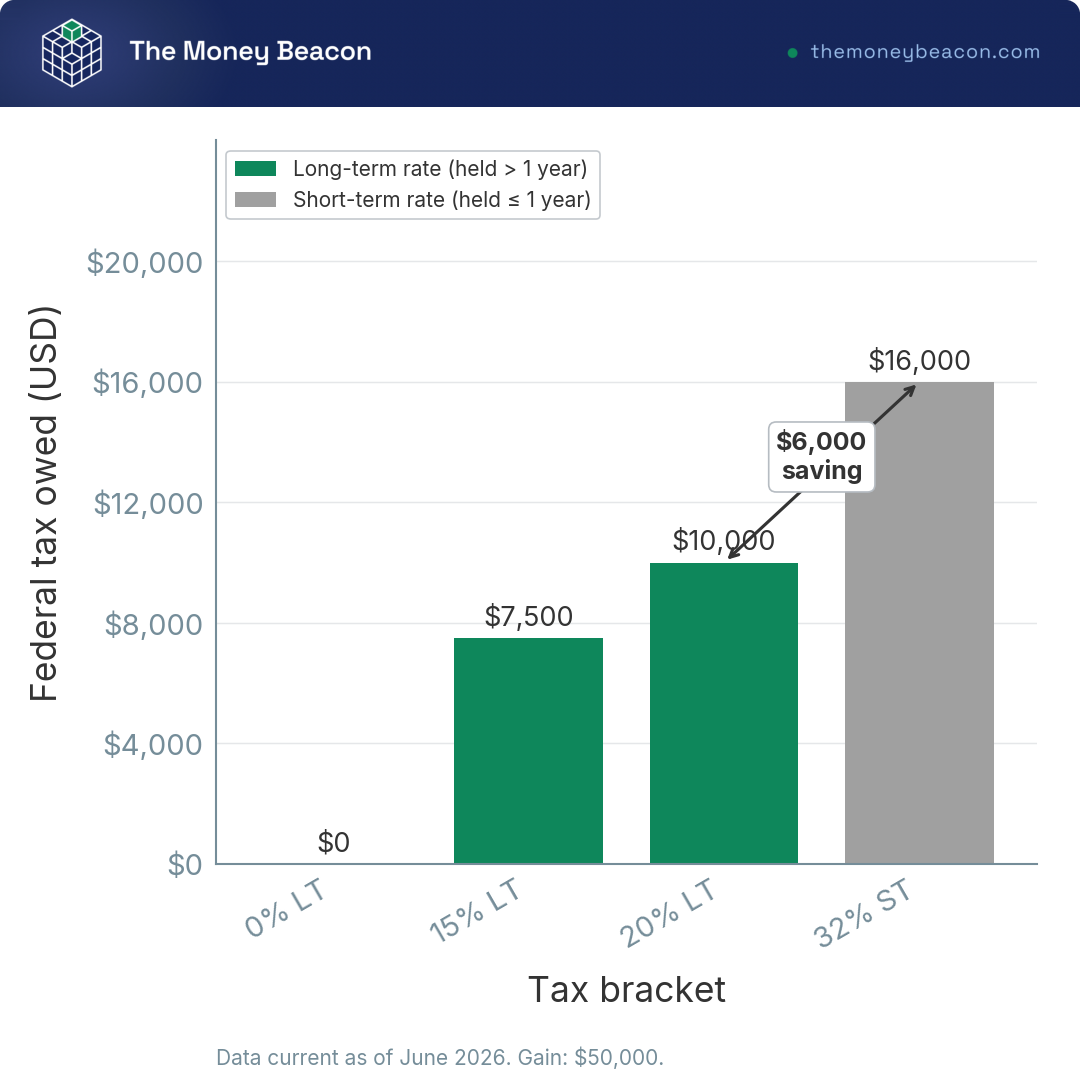
The numbers are blunt. That same $50,000 gain costs $0 in the 0% long-term bracket, $7,500 at 15%, and $10,000 at 20%, but $16,000 if it is short-term at a 32% rate. The gap between the 20% long-term result and the short-term result is $6,000 on one sale, the price of selling on day 364 instead of day 366. This is also why we lean toward holding low-cost index funds rather than active trading in a taxable account, since less churning means fewer short-term gains taxed at the painful rate. The next subsection tables out the long-term schedule those three friendly bars come from.
2.2 The 0%, 15%, and 20% long-term brackets for 2026
So what decides whether your long-term gain lands at 0%, 15%, or 20%? Not your gross income, but your taxable income, the number after deductions, measured against a separate schedule keyed to your filing status. The breakpoints below are the reference the bar chart you just saw is built on.
| Filing status | 0% rate up to | 15% rate | 20% rate above |
|---|---|---|---|
| Single | $49,450 | $49,451 to $545,500 | $545,500 |
| Married filing jointly | $98,900 | $98,901 to $613,700 | $613,700 |
| Head of household | $66,200 | $66,201 to $579,600 | $579,600 |
| Married filing separately | $49,450 | $49,451 to $306,850 | $306,850 |
Data current as of June 2026.
Read it as a ladder. A single filer keeps the 0% rate on long-term gains while taxable income sits at or below $49,450, pays 15% through the wide middle band, and only reaches the 20% rate above $545,500. A married couple filing jointly gets the 0% rate up to $98,900 and does not hit 20% until taxable income clears $613,700. The 0% long-term bracket is real, not a rounding quirk, and a household with modest taxable income can owe nothing on a long-term gain. What the table does not yet show is how the gain interacts with the rest of your income, which is exactly where most people miscount.
2.3 How gains stack on ordinary income, and capturing the 0% bracket on purpose
The mistake here is natural: people assume a long-term gain gets its own bracket in isolation. It does not. Long-term gains stack on top of your ordinary income. Wages, interest, and short-term gains fill the lower brackets first, then the long-term gain sits on top of that stack, and the 0/15/20% rate is set by where the total lands.
A worked single-filer example shows the stacking in dollars. Say you have $40,000 of taxable ordinary income and realize a $20,000 long-term gain. Your ordinary income fills the space up to $40,000, so only the slice of the gain that fits under the $49,450 0% ceiling, about $9,450, is taxed at 0%. The remaining $10,550 spills above the ceiling and is taxed at 15%, which is roughly $1,583 of federal tax. The point worth keeping in mind: you do not pay 15% on the whole $20,000, because part of the gain still fits inside the 0% band. Stacking is what splits one gain across two rates.
That same stacking rule opens a deliberate move in the other direction. In a genuinely low-income year, a sabbatical, early retirement before Social Security and required minimum distributions kick in, or a gap year between jobs, you can sell appreciated long-term holdings up to the top of the 0% bracket, pay $0 in federal tax, then immediately rebuy to reset your basis higher. The wash-sale rule does not block this, because it only disallows losses, never gains, so there is no waiting period on a sale you made at a profit. The decision tree below routes a year-end position, gain or loss, your income level, and the account it sits in, to one concrete action.
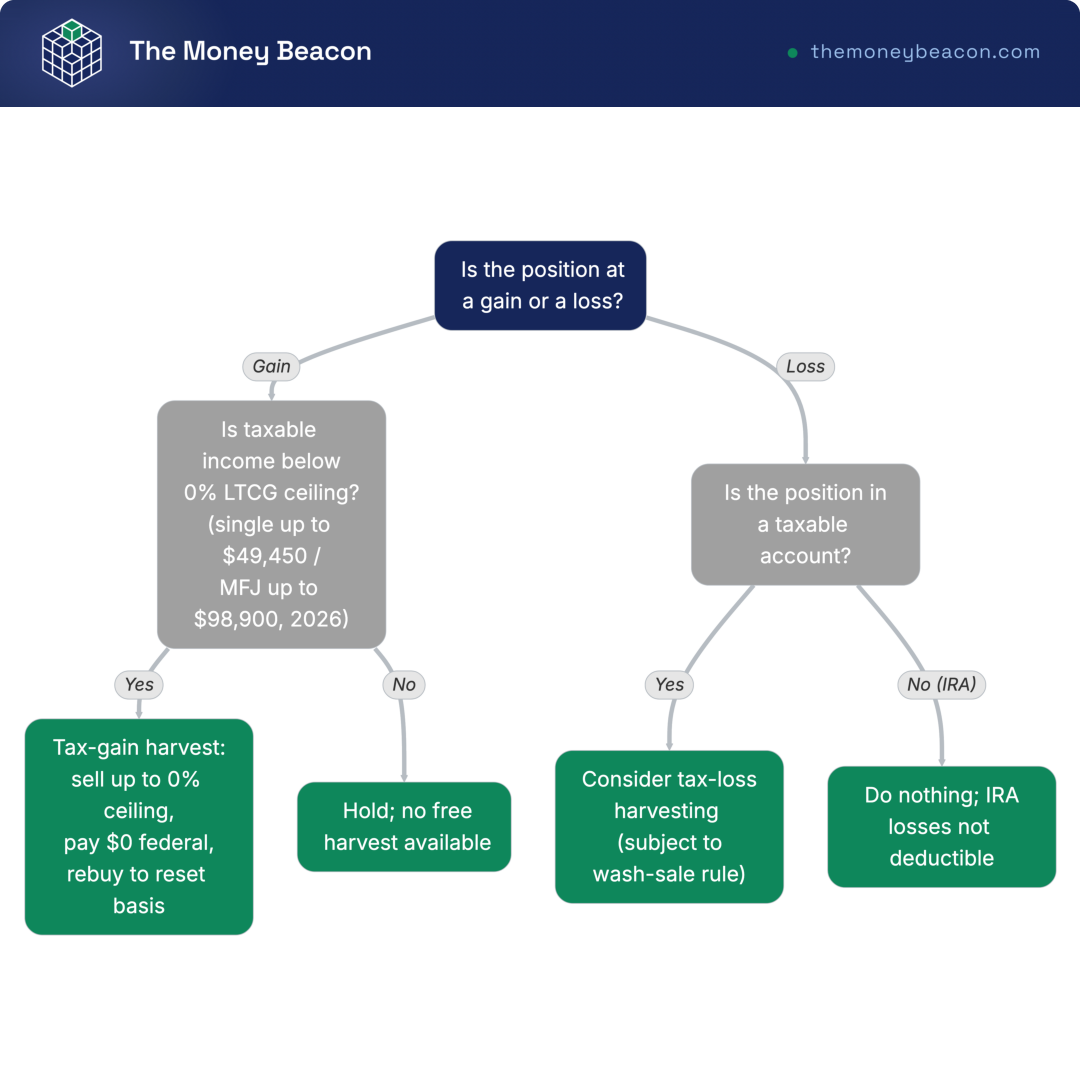
One branch on that tree is a trap worth naming now: a loss inside an IRA is not deductible, so there is nothing to harvest there. It sits alongside the other levers to lower what you owe we cover across the site.
Hank’s take

the behavioral-finance research is blunt about this, people anchor on the headline “15% capital gains rate” they half-remember and never check whether a chunk of the gain actually fits inside the 0% band first. In a low-income year that anchoring quietly leaves free basis resets on the table.
2.4 The special-rate exceptions: collectibles, 1250 gain, and QSBS
The clean 0/15/20% story has three carve-outs worth knowing, even if most fund investors never touch them. Collectibles, meaning art, coins, physical gold and silver, and the bullion ETFs that hold them, are taxed at a maximum long-term rate of 28%, not 20%. Unrecaptured Section 1250 gain, the depreciation portion of a gain on real property, is taxed up to 25%, which lands mostly on people who own directly owned rental property rather than real-estate funds.
The third carve-out cuts the other way. Qualified Small Business Stock under Section 1202 can exclude a large share of the gain on eligible C-corp stock. For stock acquired after July 4, 2025, the exclusion phases in by holding period, 50% after 3 years, 75% after 4 years, and 100% after 5 years, with a per-issuer cap of the greater of $15 million or 10 times your basis. Stock acquired on or before July 4, 2025 follows the older rule, generally a 5-year hold for full exclusion and a cap of the greater of $10 million or 10 times basis. One softener sits at the far end of the timeline: inherited assets get a step-up in basis to fair market value on the date of death under IRC Section 1014, which wipes out the heir’s tax on a lifetime of appreciation and remains in force for 2026. With the gain side mapped, the next question is the other half of what a portfolio pays out, your dividends.
3. Dividend Taxation: Qualified vs Ordinary
Gains come from selling. Dividends arrive whether you sell or not, and two checks of the same size can be taxed at completely different rates. So how do you tell which is which?
3.1 Qualified dividends, the 60-day test, and why character sets the rate
Dividends split into two tax buckets, and conflating them is a classic, costly error. Qualified dividends are taxed at the long-term capital-gains rates, the same friendly 0/15/20% schedule from the last section. Ordinary, non-qualified dividends and plain interest are taxed as ordinary income at 10% to 37%. So there is no single “dividend tax rate,” and quoting one is how people misjudge their bill.
What separates the two buckets is partly the payer and partly the calendar. To be qualified, a dividend has to come from a US corporation or a qualified foreign corporation, and it has to pass a holding-period test: you must hold the underlying share more than 60 days during the 121-day period that begins 60 days before the ex-dividend date. Buy a stock right before the ex-date, grab the dividend, and sell a week later, and that dividend is taxed as ordinary income, not at the preferential rate. The test exists precisely to catch dividend-chasing. The Venn below cements the rule that runs under all of this: character, not the word “dividend” or “gain,” sets the rate.
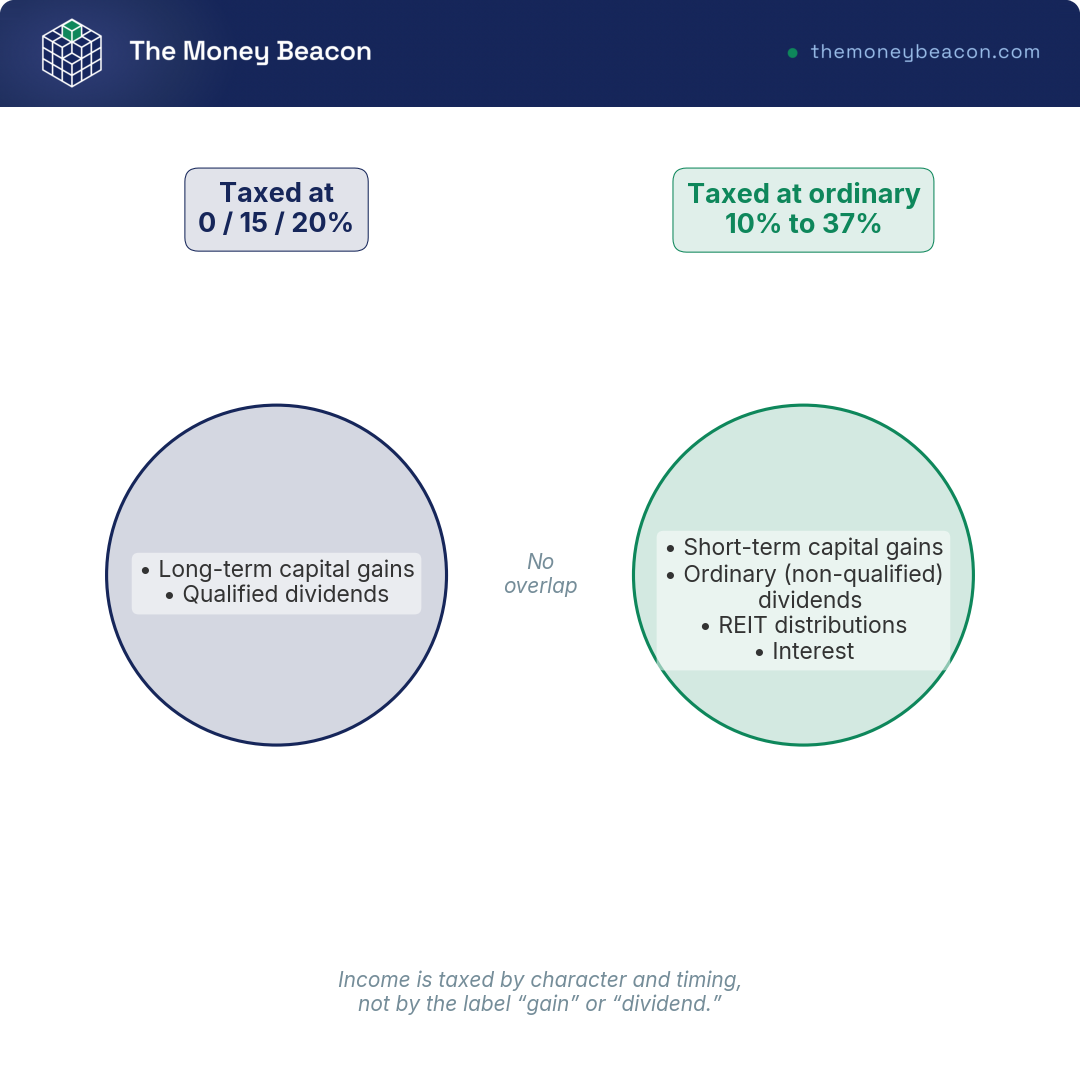
The two circles never overlap, which is the whole lesson: sort income by character, not by its label, and the next question is obvious. Which common income streams quietly miss the preferential rate?
3.2 Ordinary dividends, REITs, and bond interest
Plenty of income you might assume is “dividend-like” never gets the break. The table below maps the streams you actually hold to their character and rate, including the muni, Treasury, and foreign-dividend cases the two-bucket Venn leaves out.
| Income source | Usual tax character | Rate |
|---|---|---|
| Qualified dividend (most large US stocks, stock index funds) | Qualified | 0/15/20% |
| REIT distributions | Mostly ordinary | Ordinary brackets (with 199A relief below) |
| Bond fund / CD / savings interest | Ordinary income | Ordinary brackets |
| Money market fund income | Ordinary income | Ordinary brackets |
| Municipal bond interest | Federally tax-exempt | 0% federal (may be state-taxable) |
| Treasury interest (T-bills, notes) | Ordinary federal, state-exempt | Federal ordinary, no state tax |
| Foreign-stock dividends (qualified foreign corp) | Often qualified | 0/15/20% if test met |
Data current as of June 2026.
A few rows reset common assumptions. REIT distributions are mostly ordinary income, not qualified, which surprises income investors who expected the dividend rate. Municipal bond interest is federally tax-exempt, and Treasury interest is taxed at ordinary federal rates but exempt from state tax, a split that matters more the higher your state rate. REITs do get a partial break worth naming: the Section 199A 20% deduction on qualified REIT dividends remains in force for 2026 and is not subject to the wage and income limits that apply to other qualified business income, which lowers the effective rate on those ordinary REIT dividends below the headline number. None of this changes that the dependable source of qualified dividends is a broad low-cost index fund of large US stocks, where most of the payout qualifies.
3.3 Reading the 1099-DIV boxes
All of this character-sorting shows up on one form, the 1099-DIV your broker sends, and reading its boxes correctly is what keeps you from overpaying. You do not need every line, just the handful that decide your rate.
| Box | Label | What it means for tax |
|---|---|---|
| 1a | Total ordinary dividends | The full dividend total (includes qualified) |
| 1b | Qualified dividends | Subset of 1a that gets the 0/15/20% rate |
| 2a | Total capital gain distributions | Long-term gains passed through by funds |
| 2d | Collectibles (28%) gain | Portion of 2a taxed at the 28% collectibles rate |
| 3 | Nondividend distributions | Return of capital; reduces your basis, not taxed now |
| 5 | Section 199A dividends | REIT dividends eligible for the 20% deduction |
Data current as of June 2026.
The one comparison to make every year is Box 1a against Box 1b. Box 1a is your full dividend total and Box 1b is the qualified subset that gets the 0/15/20% rate, so the gap between them is the share taxed at ordinary rates. When Box 1b is much smaller than Box 1a, a large part of your dividends is ordinary, common with bond funds and REITs, and you should expect ordinary-rate tax on the difference. Box 3 is the quiet one to watch too: a nondividend distribution is a return of capital that is not taxed now but reduces your basis, which means a bigger gain whenever you eventually sell.
Sorting every dollar your portfolio throws off by its character, gain or dividend, long-term or ordinary, answers the “what rate” question for most households. For higher earners, though, a separate surtax sits on top of both the qualified-dividend bucket and the capital-gains bucket, regardless of which friendly rate applied first. That surtax is the 3.8% net investment income tax, and the next section explains who it reaches and what to do about it.
4. The 3.8% Net Investment Income Tax (NIIT)
That 3.8% surtax sits on top of the long-term and qualified-dividend rates you just learned, regardless of which friendly rate applied first. The only question that matters here is whether it lands on you.
4.1 Who owes it and the MAGI thresholds
The net investment income tax (NIIT), written into law as IRC Section 1411, is an extra 3.8% charged on the lesser of two numbers: your net investment income, or the amount by which your modified adjusted gross income (MAGI) clears a fixed threshold. So before anything else, you check one figure against one line.
The thresholds are straightforward and, unusually, frozen in place. A single filer or head of household crosses the line at $200,000 of MAGI, a married couple filing jointly at $250,000, and married filing separately at just $125,000. None of these numbers is adjusted for inflation, and that is the detail worth flagging.
| Filing status | MAGI threshold | Indexed for inflation? |
|---|---|---|
| Single / Head of household | $200,000 | No |
| Married filing jointly | $250,000 | No |
| Married filing separately | $125,000 | No |
Data current as of June 2026.
Because almost every other figure the IRS publishes moves with inflation while these do not, the un-indexed thresholds quietly pull in more households every year. A raise, a strong market, or a one-time gain that nudges your income over the line can hand you a surtax that someone with the identical real income avoided a decade ago. So the question is not only “am I over the line today,” but “how close am I, and what is about to push me across?” Once you know you might cross it, the next thing to settle is which of your dollars the 3.8% actually touches.
4.2 What counts as net investment income
Here is where many people overcorrect and assume the surtax hits everything once they clear the threshold. It does not. The 3.8% reaches only your investment income, and the IRS draws the boundary clearly.
Net investment income includes interest, dividends, capital gains, rental and royalty income, and income from non-qualified annuities, minus the investment expenses you can allocate against it. What it leaves out matters just as much: your wages, your self-employment income, Social Security benefits, distributions from a traditional IRA or 401(k), and municipal bond interest all sit outside the NII base. That last group is no footnote, because the exclusion of retirement-account withdrawals and muni interest is itself a lever you can pull, as the next subsection shows.
The chart below makes the threshold effect concrete. It tracks the marginal federal rate on the next dollar of a single filer’s long-term gain as MAGI rises, and you can watch it step from 15% to 23.8% the moment income crosses $200,000.
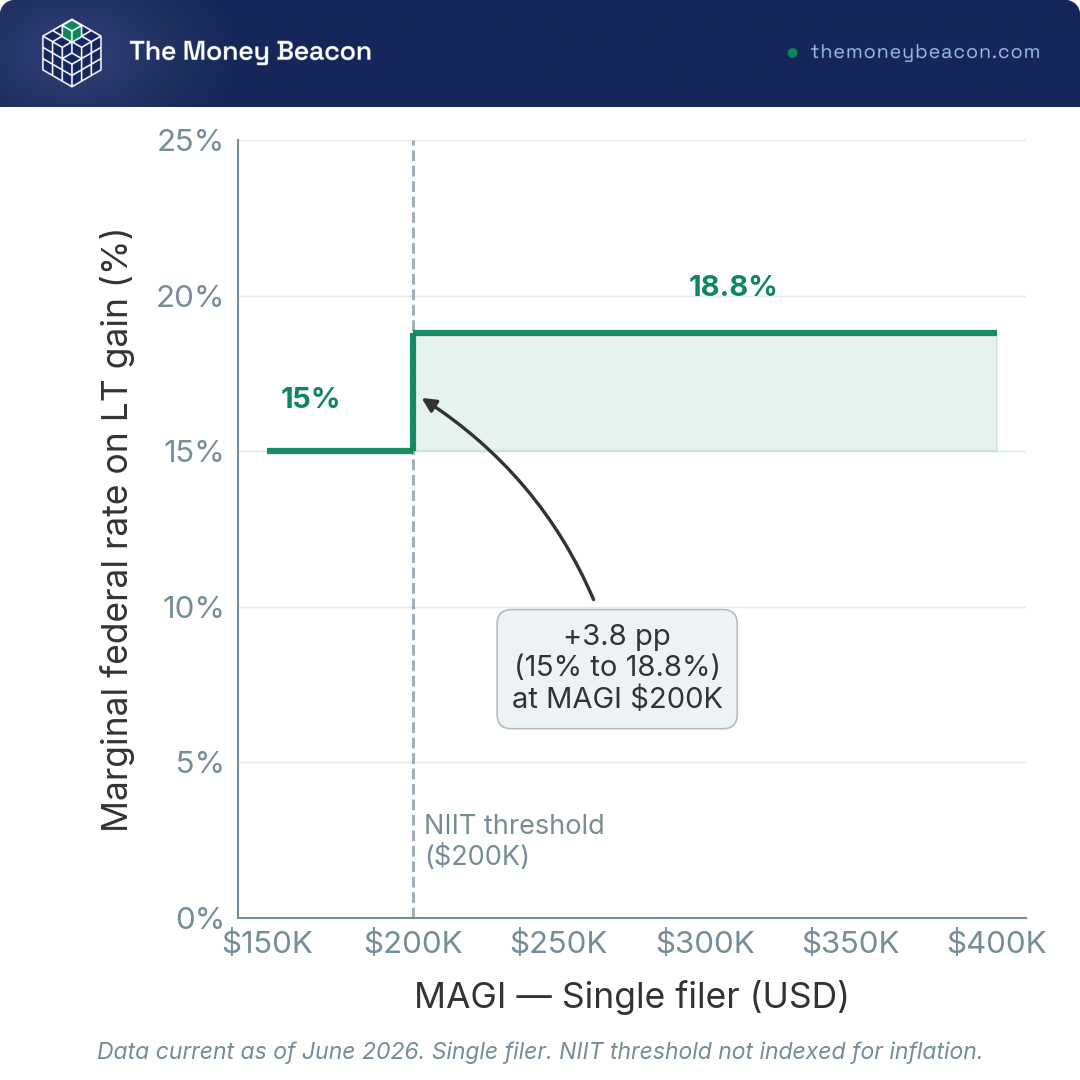
The surtax does not rewrite your whole bill; it raises the rate on the investment dollars sitting above the threshold. That jump from 15% to 23.8% is also where the single most common NIIT mistake lives, so it pays to get the arithmetic exactly right.
4.3 How the 3.8% stacks, and levers to stay under the threshold
The error here is so common it is worth stating flatly. The NIIT is added on top of your capital-gains or ordinary rate; it never replaces it. A high earner does not pay 3.8% instead of 20%. They pay 20% plus 3.8%, for a top federal long-term rate of 23.8%. On short-term gains and ordinary dividends taxed at the top ordinary bracket, the stack is 37% plus 3.8%, which lands at 40.8%. The bar chart below puts the base rate and the added surtax side by side for both income types.
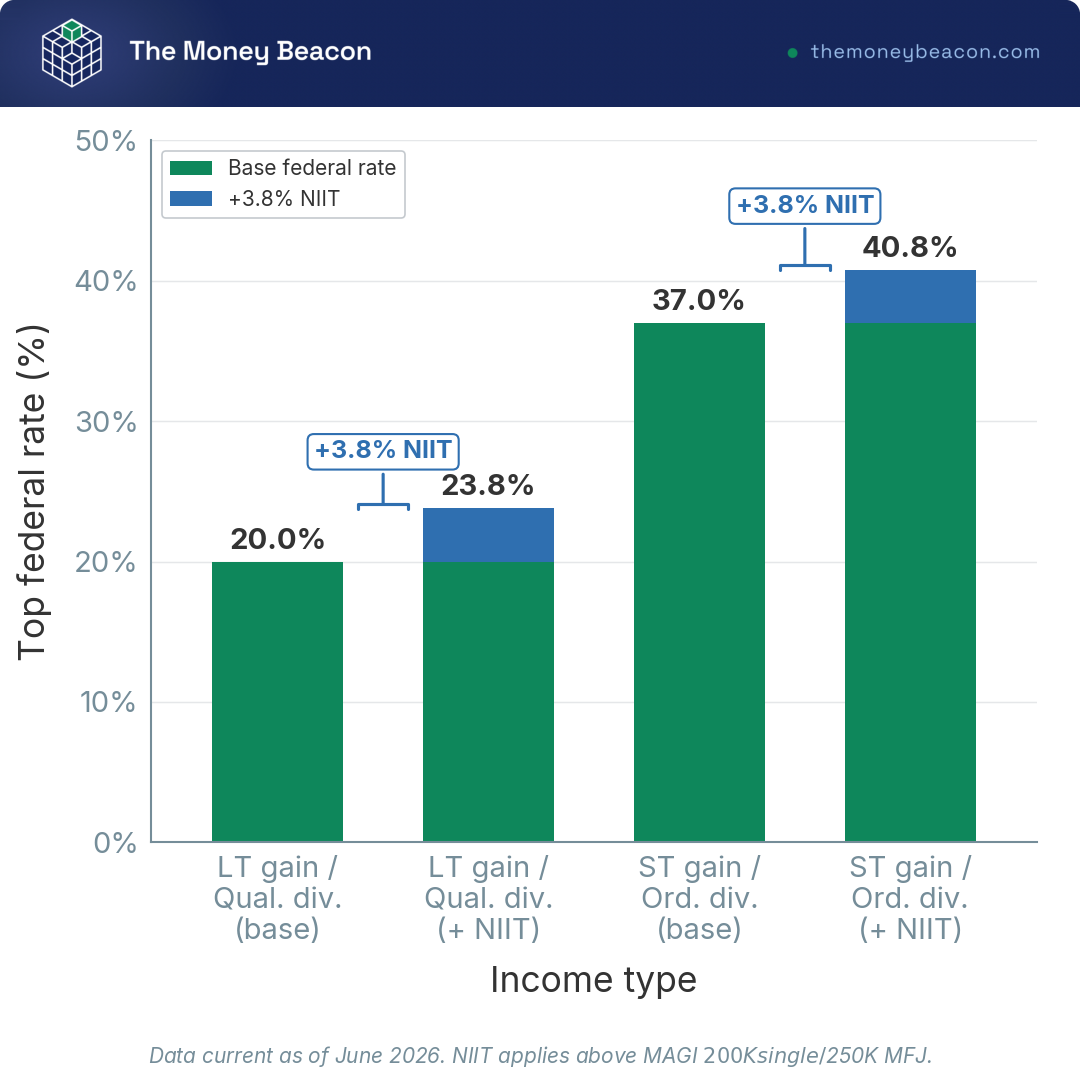
Put a dollar figure on the misconception and it gets expensive: a $50,000 long-term gain that already costs $10,000 at the 20% rate picks up another $1,900 of NIIT, for a total of about $11,900, not the $1,900 you might expect if you wrongly thought the surtax replaced the base rate. Once you see it that way, the planning question becomes obvious: how do you keep MAGI or net investment income below the line so the surtax never attaches?
Four levers do most of the work, each targeting a different part of the calculation. Raising your pre-tax 401(k) or HSA contributions lowers your MAGI directly and can pull you back under the threshold in a close year, one of the cleaner uses of pre-tax 401(k) contributions beyond the deduction itself. Shifting a slice of taxable-bond income into municipal bonds removes that interest from the NII base entirely, because muni interest is federally tax-exempt. Spreading a large sale across two tax years, or pairing it with harvested losses, can keep net investment income or MAGI below the line in any single year. And if you give to charity anyway, donating appreciated shares lets you skip the gain and the 3.8% surtax on it while still taking the deduction.
5. Tax-Loss Harvesting and the Wash-Sale Rule
Evaluating the surtax tells you what you might owe. Harvesting is the first move that lets you actively shrink it. The idea is simple at the core: a position that is down can be turned into a usable tax asset.
5.1 How tax-loss harvesting works
Tax-loss harvesting means selling a holding that has dropped below what you paid, booking the loss, using it to offset gains elsewhere, then staying invested by buying a similar but not identical replacement. It does not undo the loss economically, you are still down on the position, but it converts a paper loss into something the IRS lets you write against your tax bill.
The order of operations matters, because the loss flows through a fixed sequence. A realized loss first offsets realized gains of the same type, short against short and long against long. Whatever is left then crosses over to offset the other type. After that, up to $3,000 of net loss offsets your ordinary income for the year, $1,500 if you are married filing separately, and anything still unused carries forward to future years with no expiration. The flowchart below lays out the six steps in order and, just as important, shows you exactly where the wash-sale check has to sit before you ever hit “sell.”
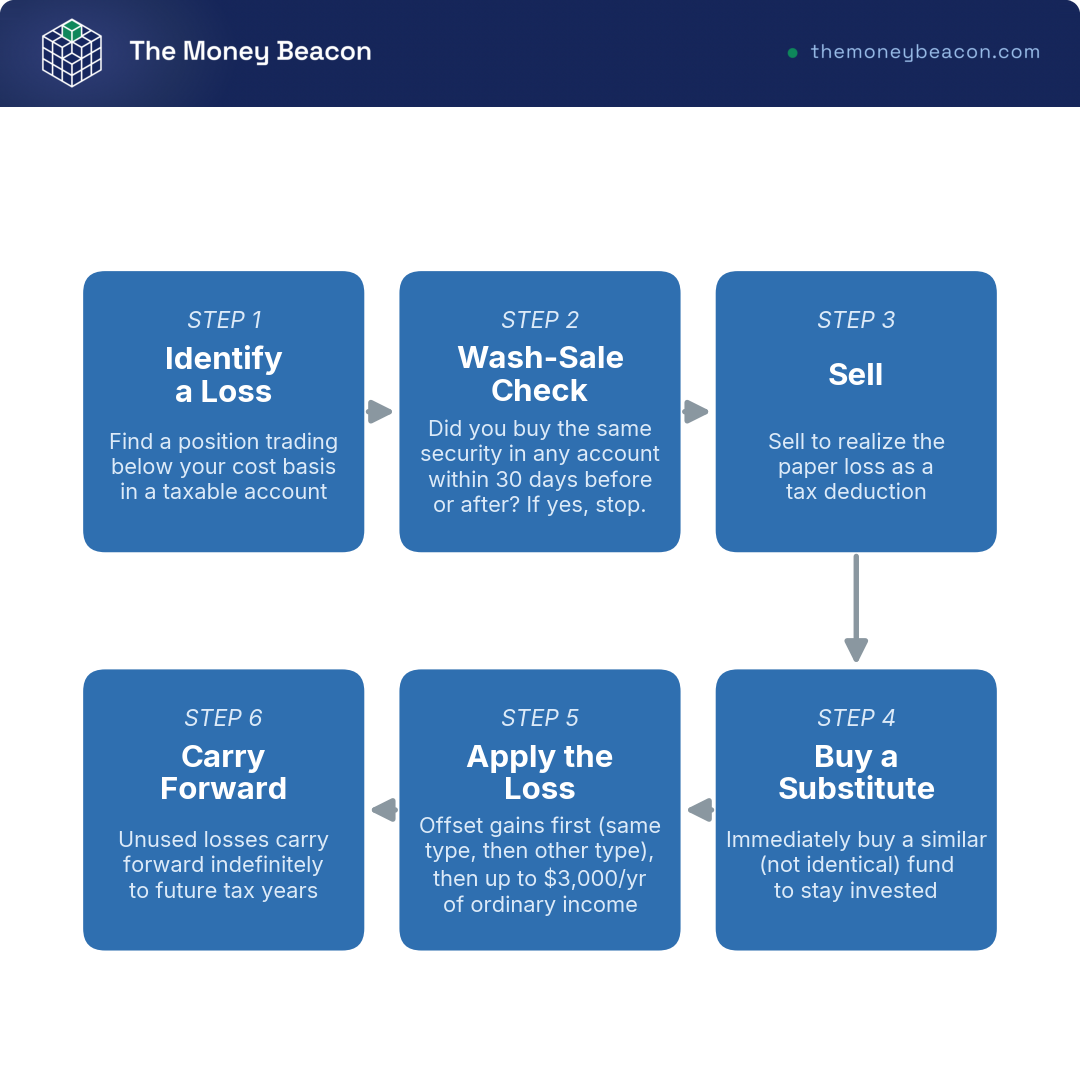
First, though, the ceiling that stops harvesting from being a one-year miracle.
5.2 The $3,000 deduction and loss carryforwards
The natural impulse after learning the mechanics is to harvest everything in sight. One rule keeps that in check. The $3,000 cap on offsetting ordinary income is an annual limit, not a per-trade one, so booking five separate losses in a year does not unlock five separate deductions against your salary.
What softens the cap is that nothing expires. Say you harvest a $30,000 loss in a flat year with no gains to offset it against. At $3,000 a year against ordinary income, that single loss takes ten years to use up, unless future capital gains absorb it faster, which they usually do. The four-step table below lays out the mechanics and where each limit bites.
| Step | Rule | Limit |
|---|---|---|
| 1. Offset same-type gains | Short loss vs short gain; long loss vs long gain | No limit |
| 2. Offset other-type gains | Net loss crosses over | No limit |
| 3. Offset ordinary income | Remaining net loss | $3,000/year ($1,500 MFS) |
| 4. Carry forward | Anything still unused | Indefinite |
The two no-limit rows are where the real power sits. Against your gains, a harvested loss works dollar for dollar with no ceiling at all; the $3,000 cap only ever applies to the leftover that spills onto ordinary income. So harvesting pays off most in years you already have realized gains to soak up the loss. Capturing that benefit, though, depends entirely on not tripping the one rule that disallows the loss outright.
5.3 The wash-sale rule, compliant substitutes, and the robo-advisor option
This is the trip wire, and it is the reason the harvesting check has to happen before you sell. The wash-sale rule, IRC Section 1091, disallows your loss if you buy the same or a substantially identical security within 30 days before or 30 days after the sale. Count the sale date itself and that is a 61-day window in total, not a clean 30 days afterward. The disallowed loss is not gone forever; it gets added to the basis of your replacement shares and recovered when you eventually sell those. But for the year in question, the deduction vanishes.
Two traps catch people who think they followed the rule. Because the window runs 30 days on each side, a purchase before the sale can trigger it, including an automatic dividend reinvestment you forgot was switched on. And the rule reaches across all your accounts, not just the one you sold in. Sell at a loss in your taxable account and rebuy the same fund in your IRA, or in your spouse’s account, within the window, and the loss is disallowed with no basis recovery at all, because the replacement shares sit in a tax-sheltered account. One boundary is worth knowing: under current law the wash-sale rule does not apply to cryptocurrency, since crypto is treated as property rather than a security, and no 2026 change has altered that. The decision tree below walks a loss sale through a clean go or no-go check.
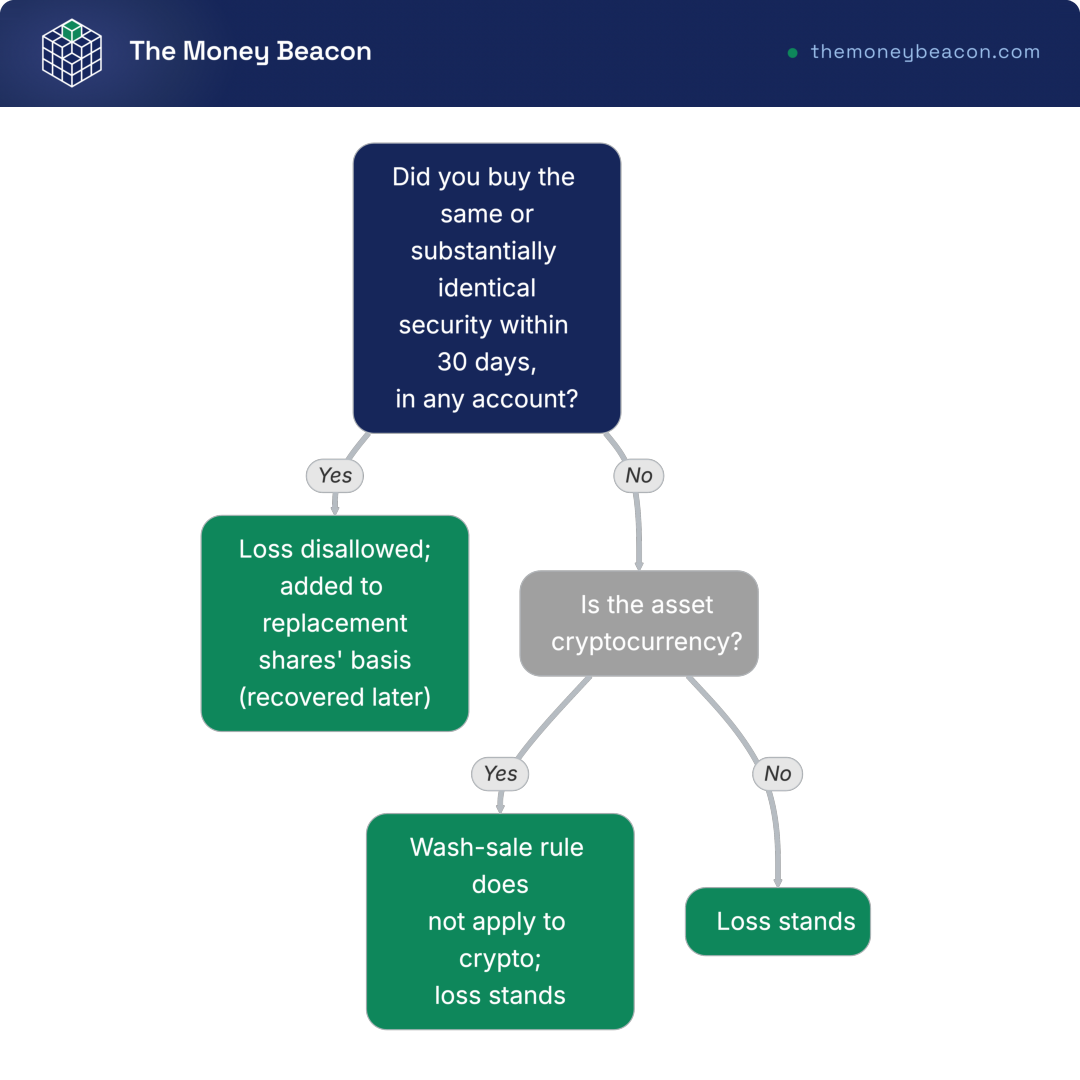
So how do you stay invested without breaking the rule? You swap into a fund that is similar but not substantially identical, say selling an S&P 500 ETF and buying a total-market or large-cap fund built on a different index from a different provider. IRS Publication 550 sets no bright-line test, only a facts-and-circumstances standard, but in practice investors treat a different index or a different provider as safe and treat rebuying the identical ticker as plainly off-limits. The companion habit is to turn off automatic dividend reinvestment on the harvested position, so a stray reinvested dividend does not quietly re-trigger the rule.
If running that check on every position sounds like work, it is, which is why some hands-off platforms automate the harvesting for you at roughly 0.25% of assets a year. Whether that fee earns its keep depends on you. Harvesting rewards higher-bracket investors with frequent volatility far more than someone who only ever captures the flat $3,000 ordinary offset, so weigh the fee against the tax it actually saves.
Tom’s take
once you are running a multi-asset portfolio across several accounts, the wash-sale rule stops being a footnote and becomes a coordination problem. I optimize every decision across the financial, tax, legal, and estate angles, and the trap I watch hardest is a harvest in one account quietly undone by a rebuy in another. The cross-account reach is the part people miss.
A harvested loss tells you how to handle a position that is down. The bigger question it leaves open is where each holding should have lived in the first place, so that less of its income and gains ever became taxable. That is the asset-location problem, and it is what we turn to next.
6. Asset Location: The Right Investment in the Right Account
Harvesting is a reaction; it cleans up a position after it has fallen. Asset location is the move you make upstream, before any of that, and it decides how much of a holding’s income ever becomes taxable in the first place. Put the right asset in the right account and there is simply less to clean up later. So the question shifts from “this holding is down, what now” to a sharper one: which of your holdings belongs in your taxable brokerage, which in your IRA or 401(k), and which in your Roth?
6.1 Tax efficiency by asset class, and the three account buckets
Asset location decides which account holds which asset to minimize lifetime tax, and it is a separate question from asset allocation, which is how much of each asset you own. The principle behind it is one line: tax-inefficient assets belong in sheltered accounts, tax-efficient assets are fine in taxable. What makes an asset efficient or not is how much tax it throws off year by year while you simply hold it.
The table below ranks the common holdings by how well they sit in a taxable account, and the reason for each ranking is the kind of income it generates.
Tax efficiency by asset class
| Asset class | Tax efficiency in a taxable account | Why |
|---|---|---|
| Broad index ETFs / total-market funds | High | Low turnover, few capital-gains distributions, mostly qualified dividends |
| Individual buy-and-hold stocks | High | Gains deferred until you sell; often qualified dividends |
| Municipal bonds | High | Interest federally tax-exempt |
| Actively managed mutual funds | Low | Frequent capital-gains distributions passed to you |
| Taxable bonds / bond funds | Low | Interest taxed as ordinary income yearly |
| REITs | Low | Distributions mostly ordinary income |
The split is clean: anything that spins off ordinary-income interest or frequent distributions sits at the bottom, while assets that defer their gain or pay qualified dividends sit at the top. That ranking only pays off once it meets the three account buckets it gets sorted into.
A taxable brokerage takes after-tax money, and its dividends and gains are taxed yearly or at sale. A tax-deferred account, the traditional IRA or 401(k), takes pre-tax or deductible money and taxes nothing until you withdraw, when it comes out as ordinary income. A Roth takes after-tax money and then makes qualified withdrawals tax-free. One point here trips up more people than any other, so it is worth stating plainly: Roth contributions are after-tax and not deductible, and the payoff is tax-free qualified growth, not an upfront break. Direct Roth contributions also phase out by income, with a 2026 MAGI range of $153,000 to $168,000 for single filers and $242,000 to $252,000 for married filing jointly; above the top of the range the backdoor Roth is a workaround, not a guaranteed contribution. The ranking and these three buckets are the two inputs the placement matrix combines next.
6.2 The asset-location placement matrix
With the efficiency ranking on one axis and the three buckets on the other, the placement question stops being a judgment call and becomes a lookup. The matrix below maps each asset class to its best fit across taxable, tax-deferred, and Roth.
Asset-location placement matrix
| Asset class | Taxable brokerage | Tax-deferred (IRA/401k) | Roth |
|---|---|---|---|
| Broad index ETFs (tax-efficient equity) | Best fit | OK | Good (highest-growth here) |
| Taxable bonds / bond funds | Avoid | Best fit | OK |
| REITs | Avoid | Best fit | Good |
| Actively managed funds (high distributions) | Avoid | Best fit | OK |
| Municipal bonds | Best fit (already tax-exempt) | Never (wastes the shelter) | Never |
| Highest-expected-growth assets | OK | OK | Best fit (tax-free upside) |
Three rules do all the work in that grid. You put the ordinary-income generators, your bonds and REITs, into tax-deferred accounts where their yearly income is sheltered. You steer your highest-expected-growth holdings into the Roth, where the gain is never taxed no matter how large it grows. And you never bury municipal bonds in a sheltered account, since their interest is already federally tax-exempt and a shelter would waste an exemption you already hold, a point we expand on in our guide to the Roth, where the gain is never taxed. The matrix tells you where each class belongs in the abstract; now you run your own holdings through it one at a time.
6.3 Placing each of your own holdings
A matrix is a reference; a decision tree is an action. The chart below routes any single holding by three questions, its income character, whether it is already tax-exempt, and its growth potential, to the one account where it does the least tax damage.
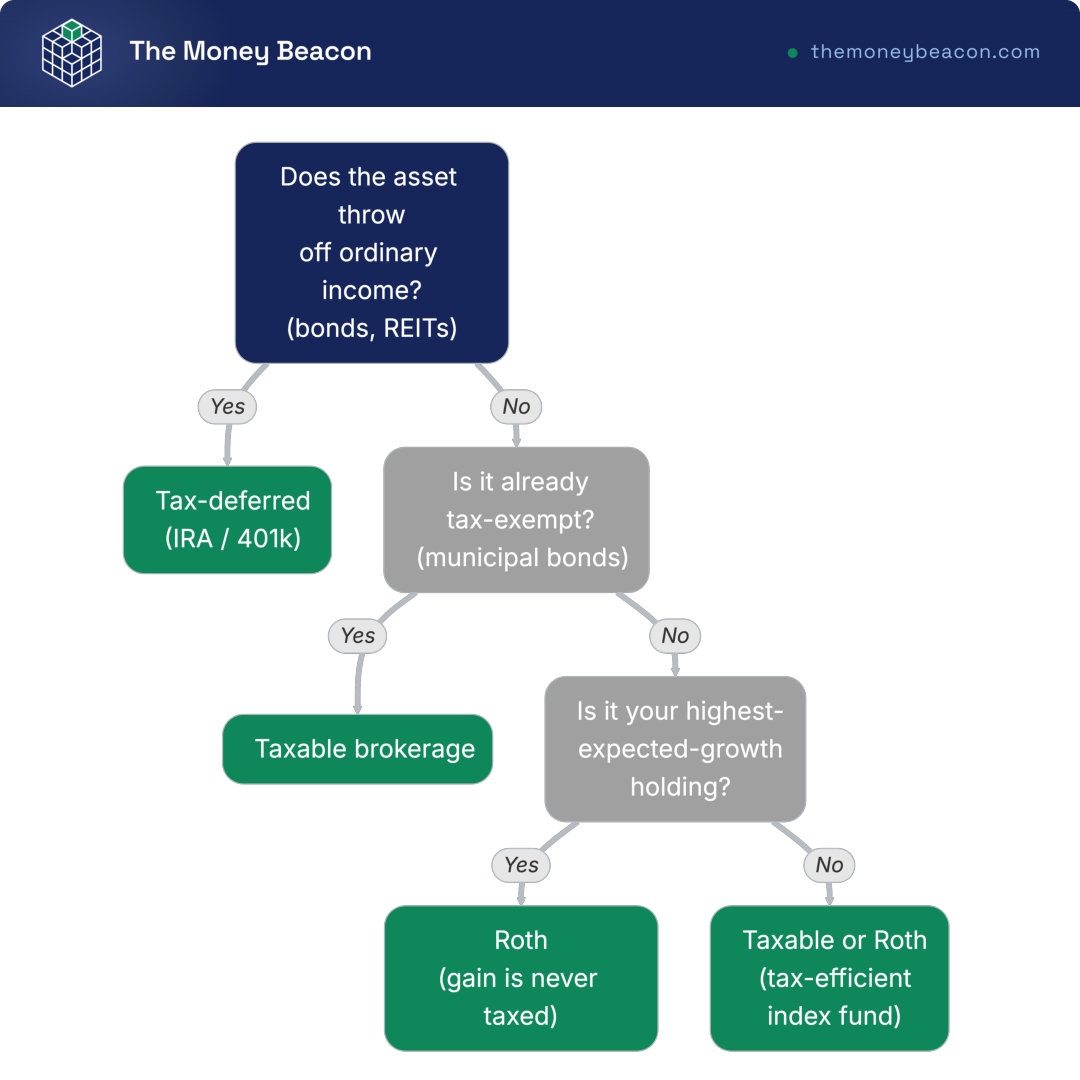
Walk a couple of real holdings through it. Take a taxable-bond fund: it throws off ordinary-income interest every year, so the tree sends it straight to your tax-deferred IRA or 401(k), away from a yearly tax bill. Now take a broad total-market index ETF you expect to grow for decades: it is tax-efficient enough for taxable, but because its upside is large, the tree prefers the Roth where that growth is never taxed. A municipal-bond holding short-circuits the whole thing and stays in taxable, since sheltering it would throw away the exemption. Run each holding through those questions and you stop guessing; what the placement looks like across a full portfolio is what the next subsection shows.
6.4 A sample portfolio and when location is not worth it
The donut chart below splits a sample $300,000 household portfolio by account first, then by the asset class held inside each, with the bonds concentrated in the 401(k) and the index equity living in taxable and Roth, exactly as the matrix prescribes.
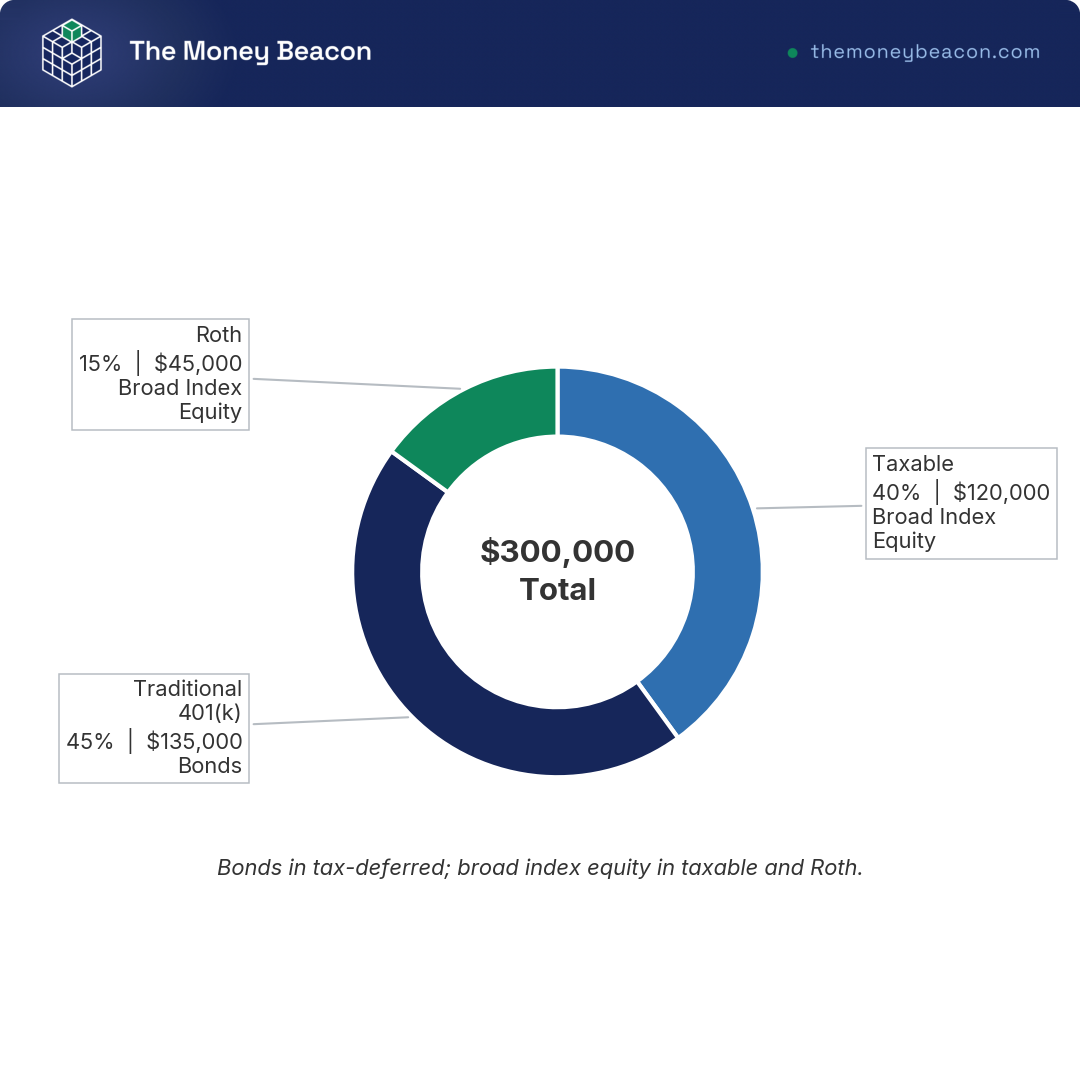
Now the honest part, because asset location is not free, and for plenty of readers it is not worth doing at all. If your taxable account is small relative to your sheltered accounts, the savings are tiny and a single balanced fund held everywhere is the better, simpler call. If you rebalance often, splitting holdings across account types makes that harder and can force taxable sales you did not want. And if you are sitting in the 0% long-term bracket, equity in your taxable account is already nearly tax-free, so there is little left for location to save. The benefit scales with portfolio size, your bracket, and the share of tax-inefficient assets you hold; it is a high-six-figure-and-up optimization, not a starter move.
Hank’s take
the behavioral-finance research is blunt about this: investors love a clever optimization far more than the math justifies. On a small portfolio the tax saved from perfect asset location is a rounding error against the time and tracking it costs you. Do the simple thing until the dollars are large enough to earn the complexity.
Once your holdings sit in the right accounts, the last job is purely administrative: reporting all of it correctly and knowing when the paperwork outgrows you.
7. Filing, Records, and When to Bring in a CPA
Knowing where every holding belongs settles the strategy; what remains is the mechanics of putting it on a return. The reporting itself is more procedural than hard once you see how the pieces connect. The question every reader eventually reaches is the last one: when does this get complicated enough to pay a professional?
7.1 The forms: 1099-B, Form 8949, Schedule D, and Form 8960
The reporting chain looks intimidating until you see it as a relay, where each form hands its numbers to the next. The table below names every piece and who produces it.
The capital-gains reporting forms
| Form | Who produces it | Purpose |
|---|---|---|
| 1099-B | Your broker | Reports each sale: proceeds, basis (if covered), dates |
| 1099-DIV | Your broker | Reports dividends and capital-gain distributions |
| Form 8949 | You | Lists each sale, reconciles to 1099-B, flags adjustments (wash sales coded “W”) |
| Schedule D | You | Totals short-term and long-term gains/losses, computes the net |
| Form 8960 | You (if applicable) | Computes the 3.8% NIIT |
Two dates govern the calendar. Brokers must furnish your 1099-B and 1099-DIV by February 17, 2027 for tax year 2026, and because consolidated 1099s are sometimes corrected weeks later, filing too early can force an amended return. The individual filing deadline for tax year 2026 is April 15, 2027. Knowing which numbers the broker supplies, though, raises the next question: which ones are you on the hook for yourself?
7.2 Records, basis you must track yourself, and the year-end workflow
The broker does not track everything, and the gaps are exactly where returns go wrong. For covered securities the broker reports basis to the IRS for you; for non-covered lots, meaning older holdings, shares transferred in from another broker, or inherited and gifted shares, you keep the records yourself. That means holding on to buy confirmations, dividend-reinvestment records, corporate-action notices, and prior-year 1099s, because no one else is keeping them for you.
Your single best self-protection is one annual habit: reconcile the broker’s 1099-B against your own basis records every year. Transfers between brokers are a frequent source of missing or wrong basis, and the stakes are concrete, because a 0 or blank basis means the IRS treats the full proceeds as a gain unless you correct it on Form 8949. The workflow chart below lays out the ordered sequence, and its real value is separating the two deadlines that readers most often blur.
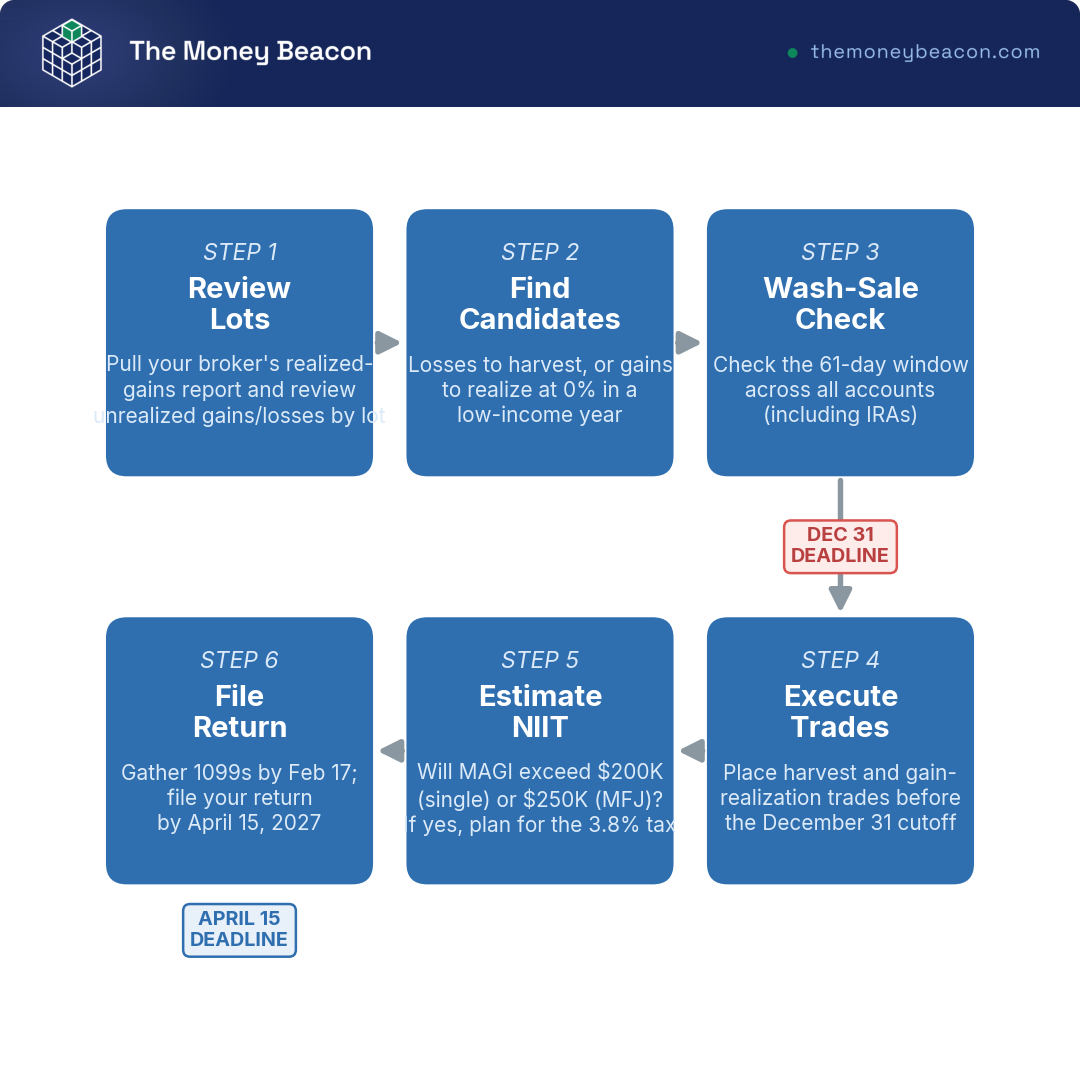
The workflow breaks at one clear seam: every action that changes your tax happens by December 31, while the filing that reports it happens months later, by April 15.
7.3 Year-end tax checklist (to do / to avoid)
Most of this guide has built toward a handful of moves you make before the calendar turns. The checklist below gathers them into a scan-friendly list of what to do, what to avoid, and the mistake each one prevents.
Year-end checklist (to do / to avoid)
| To do (before December 31) | To avoid | Common mistake |
|---|---|---|
| Review unrealized gains/losses by lot | Selling at a loss then rebuying within 30 days | Triggering a wash sale and losing the deduction |
| Harvest losses to offset realized gains | Forgetting reinvested dividends count as purchases | Wash sale via auto-DRIP |
| In a low-income year, harvest gains in the 0% bracket | Realizing short-term gains needlessly | Paying ordinary rates instead of waiting past one year |
| Check whether MAGI is near the NIIT threshold | Letting a big gain push MAGI over $200k/$250k | Owing surprise 3.8% NIIT |
| Use specific-ID to sell high-basis lots | Defaulting to FIFO on partial sales | Realizing the largest possible gain |
| Confirm donations of appreciated shares before year-end | Donating cash when shares would avoid a gain | Missing the gain-avoidance benefit |
| Max pre-tax 401(k)/HSA to lower MAGI | Waiting until April (deadline is December 31 for most) | Missing the calendar-year cutoff |
Data current as of June 2026.
If you remember only one line from this table, make it this one: the deadline for harvesting and realizing gains is December 31, not the April filing date. Almost every lever in this guide has to be pulled before the year ends, because April is for reporting what you already did, not for doing it. This list is also where a return starts to outgrow do-it-yourself software.
7.4 When to hire a CPA or enrolled agent
There is a clean dividing line between the returns you can file yourself and the ones worth paying for. Tax software like TurboTax, H&R Block, or FreeTaxUSA handles a straightforward return with a clean consolidated 1099 perfectly well. A CPA or enrolled agent starts to earn the fee the moment complexity climbs, and the triggers are specific: large or concentrated gains, RSUs, ESPP shares or options, a backdoor or mega-backdoor Roth, multi-state income, a Section 1202 QSBS claim, an estate or inherited account with a basis step-up, K-1s from partnerships, or any year you genuinely cannot tell whether the NIIT applies to you. The decision tree below routes you on those triggers and carries the cost ranges directly, so you can weigh the choice without a separate table.
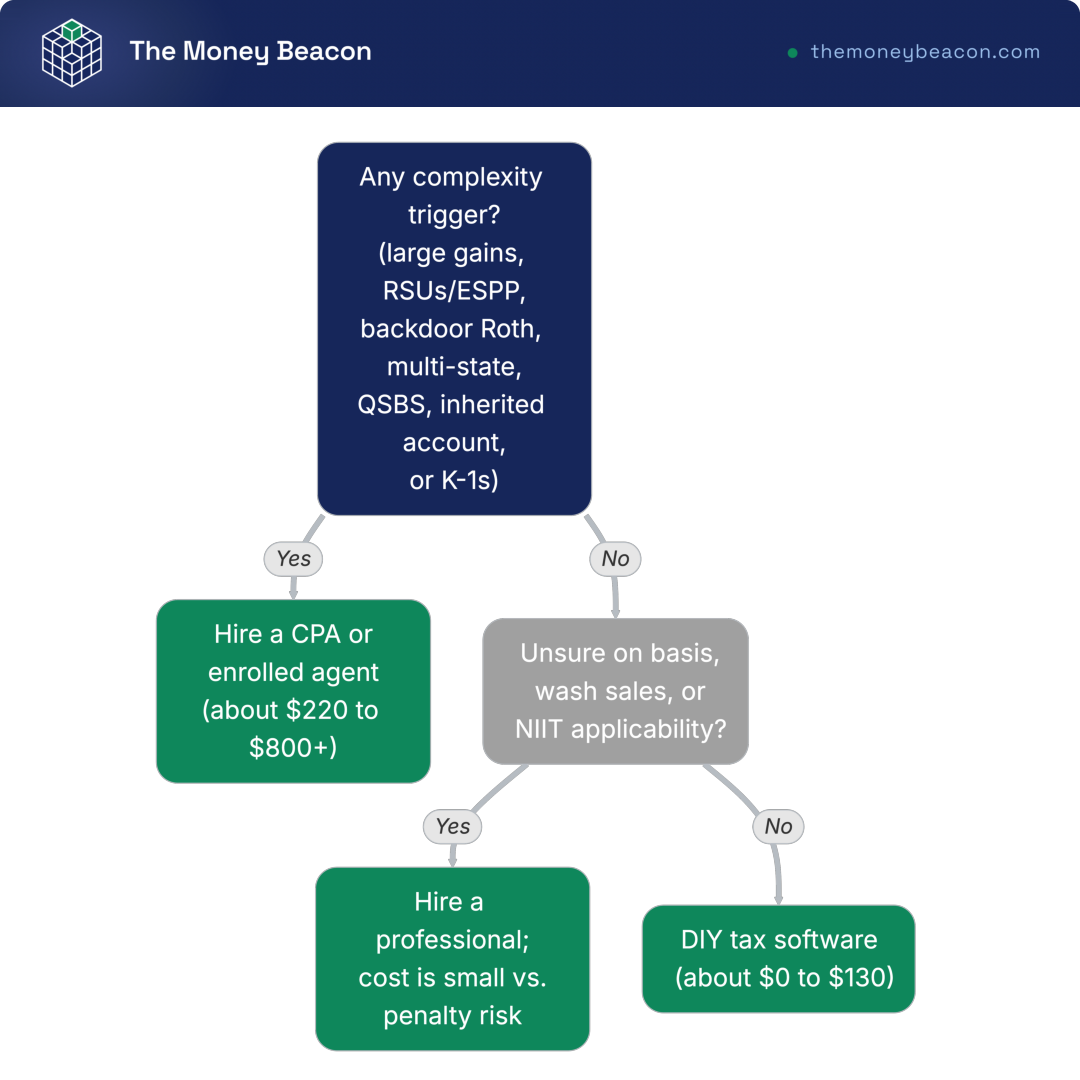
The tree puts a price on the decision: a DIY return runs roughly $0 to $130, while a CPA or enrolled agent runs about $220 to $800 or more, and the gap is the question. Here is the rule that resolves it, and it closes out the whole guide: if preparing your own return makes you guess on basis, wash sales, or the NIIT, a professional’s fee is small against the penalty and amended-return risk of getting it wrong. That instinct, knowing when a number is over your head, is worth as much as a tax tool itself, and it is where finding a fee-only professional you can trust earns its keep. The table below gathers every one of those levers into a single reference.
The legal levers to keep more of every investment dollar (2026)
| Lever | Core rule (2026) | The move | Deadline | Main trap |
|---|---|---|---|---|
| Holding period | Over 1 year = 0/15/20%; 1 year or less = ordinary (10 to 37%) | Hold past 366 days before selling | Sale date | Selling at day 360 |
| 0% LTCG bracket | Single up to $49,450 / MFJ up to $98,900 taxable income | Tax-gain harvest in low-income years | Dec 31 | Letting other income fill the bracket |
| Qualified dividends | Taxed at 0/15/20% if 60/121-day test met | Hold dividend payers past the window | Around ex-date | Dividend chasing (loses the rate) |
| NIIT | +3.8% on NII above $200k single / $250k MFJ MAGI | Lower MAGI; spread big gains | Dec 31 | Thinking it replaces, not adds to, the 20% |
| Tax-loss harvesting | Offset gains, then $3,000 ordinary, carry rest forward | Sell losers, buy non-identical substitute | Dec 31 | Wash sale (61-day window, all accounts) |
| Asset location | Ordinary-income assets in tax-deferred; growth in Roth | Place bonds/REITs in IRA/401k | Anytime | Munis in a sheltered account |
| Basis method | Spec-ID beats FIFO on partial sales | Elect specific lots at sale | At trade | Defaulting to FIFO |
Data current as of June 2026.
Conclusion
The single idea worth remembering out of this guide is that two layers decide your bill: the account that holds your money sets when you are taxed, and the asset inside it sets the character of the income. Once you read your portfolio that way, the levers stop looking like tricks and start looking like the rules they are. A gain held past the 366th day drops from your ordinary rate to the 0/15/20% schedule, and because long-term gains stack on top of your other income, a single filer can even realize them at 0% while taxable income stays under $49,450. A dividend that passes the 60-day test rides those same preferential rates, while interest, REIT distributions, and a dividend you chased for a week do not. A position that is down can offset your gains and then up to $3,000 of ordinary income a year, and asset location quietly decides how much of all this ever becomes taxable in the first place.
Two subtleties trip people up most, and by now you know both. The 3.8% net investment income tax is added on top of your rate, never a substitute, so a high earner pays 23.8% on long-term gains, not 3.8% instead of 20%, and the thresholds of $200,000 single and $250,000 married filing jointly do not move with inflation. The other is the calendar: almost every move here has to be made by December 31, because April is for reporting what you already did, not for doing it. Reconcile your broker’s 1099-B against your own basis records, and you close the most common gap that turns a clean return into an amended one.
If you want to go further, the natural next step is to move from these accounts to your whole tax picture, which we lay out in our guide to cutting your taxable income legally in 2026. Asset location leans hard on the Roth, so it pays to understand its income limits and the backdoor route in our full Roth IRA guide. And since the tax-efficient core of a taxable account is usually a low-turnover fund, our comparison of low-cost index funds and ETFs shows which holdings throw off the least tax in the first place. Run the year-end checklist each December, and the dollars you keep start to compound on their own.
FAQ
What’s the difference between short-term and long-term capital gains tax?
Short-term means you held the asset one year or less, and the gain is taxed at your ordinary marginal rate, from 10% to 37%, exactly like wages. Long-term means held more than one year, and the gain qualifies for the preferential 0%, 15%, or 20% schedule. The holding-period clock runs from the day after you buy to the day you sell, so waiting past the 366th day is the single largest controllable lever most investors have. On a $50,000 gain, the difference between selling at day 364 in a 32% bracket ($16,000 in tax) and selling at day 367 in the 15% bracket ($7,500) is $8,500 in savings from one calendar decision.
How much can I make in investments before I owe capital-gains tax?
The 0% rate on long-term gains is a real bracket, not a rounding error, but it is keyed to your total taxable income, not the gain alone. For 2026, a single filer pays 0% on long-term gains as long as taxable income stays below $49,450; married filing jointly, the ceiling is $98,900. The mechanic that trips people up is stacking: ordinary income (wages, interest, short-term gains) fills the lower brackets first, and the long-term gain sits on top. A single filer with $40,000 of ordinary income and a $20,000 long-term gain pays 0% only on the slice of the gain that lands below $49,450, roughly $9,450, and 15% on the remaining $10,550, which works out to about $1,583 in federal tax on the gain. That is not 15% on the full $20,000; the stacking rule cuts the bill in half.
Are qualified dividends taxed differently than ordinary dividends?
Yes, significantly. Qualified dividends use the same 0%, 15%, 20% schedule as long-term capital gains; ordinary dividends and bond interest are taxed at ordinary rates, up to 37%. The rate difference is not cosmetic: a $10,000 qualified dividend in the 15% long-term bracket costs $1,500 in federal tax; the same $10,000 as an ordinary dividend in a 24% ordinary bracket costs $2,400. To earn the preferential rate, the dividend must come from a US corporation or a qualified foreign corporation, and you must have held the underlying shares more than 60 days during the 121-day window centered on the ex-dividend date. Buying right before the ex-date to grab the payout and selling a week later produces an ordinary dividend, not a qualified one. Your 1099-DIV breaks this out clearly: Box 1a is total ordinary dividends, Box 1b is the qualified subset that gets the lower rate.
Who has to pay the 3.8% net investment income tax?
The net investment income tax (NIIT) applies to filers whose modified adjusted gross income (MAGI) exceeds $200,000 if single, $250,000 if married filing jointly, or $125,000 if married filing separately. The 3.8% applies to the lesser of your net investment income or the amount by which MAGI exceeds the threshold, so a single filer with $210,000 of MAGI and $30,000 of investment income pays 3.8% on $10,000 (the excess over $200,000), not on the full $30,000. One point that regularly gets misread: the NIIT is added on top of the capital-gains or ordinary rate, never a replacement. The top federal long-term rate is 20% plus 3.8%, equaling 23.8%; for short-term gains and ordinary dividends in the top bracket, the stack is 37% plus 3.8%, equaling 40.8%. The thresholds are not indexed for inflation, which means more households cross them each year as incomes rise. If you are near the line, increasing pre-tax 401(k) or HSA contributions lowers MAGI, and shifting taxable bond income into municipal bonds removes that interest from net investment income entirely.
How does tax-loss harvesting actually lower my tax bill?
You sell a holding that is down from your purchase price, which books the loss as a realized loss in the current tax year. That loss first offsets capital gains of the same type, short-term losses against short-term gains and long-term losses against long-term gains, and then crosses over to offset the other type. Once gains are zeroed out, up to $3,000 of net loss per year offsets ordinary income ($1,500 if married filing separately), reducing your taxable wages, interest, or other ordinary income dollar for dollar. Any remainder carries forward indefinitely until used. To stay invested through the process, you immediately buy a similar but not substantially identical fund, so you keep roughly the same market exposure while locking in the tax savings. A $20,000 harvested loss that offsets $20,000 of long-term gains in the 15% bracket saves $3,000 in federal tax on the spot, with no waiting required.
What is the wash-sale rule and how do I avoid breaking it?
The wash-sale rule (IRC Section 1091) disallows a loss if you buy the same or a substantially identical security within 30 days before or after the sale that generated it. Counting the sale date itself, that is a 61-day window total. The disallowed loss is not gone permanently; it is added to the cost basis of the replacement shares and recovered when you eventually sell them. Two traps are worth keeping in mind. First, the rule covers all of your accounts, including IRAs and your spouse’s accounts, so selling at a loss in a taxable account and rebuying the same fund inside your IRA within 30 days disallows the loss with no basis recovery on the IRA shares. Second, automatic dividend reinvestment can trigger it: if your fund reinvests a dividend into the same holding within the window around a loss sale, the repurchase counts. The practical fix is to swap into a genuinely different fund after the harvest, think selling an S&P 500 ETF and buying a total-market or large-cap ETF from a different index provider, and to turn off automatic dividend reinvestment on the harvested position. Under current law the rule does not apply to cryptocurrency. If you’d rather automate the process, robo-advisors like Betterment and Wealthfront handle the harvest and the substitute purchase automatically, at an annual fee of about 0.25% of assets; whether that fee is worth it depends on your bracket and how much volatility your portfolio sees.
Which investments should I hold in a Roth IRA versus a taxable account?
Asset location, matching each holding to the account that taxes it most lightly, is one of the higher-value moves available to a multi-account investor. The rule of thumb is to put your highest-expected-growth assets in the Roth, since qualified withdrawals are tax-free and the gain is never taxed regardless of how large it becomes. Ordinary-income generators like bonds and REITs belong in a tax-deferred account (a traditional 401(k) or traditional IRA), where the interest and distributions are sheltered from tax until withdrawal rather than taxed every year. Tax-efficient assets like broad index ETFs and municipal bonds fit well in a taxable brokerage account: index ETFs throw off few capital-gains distributions and generate mostly qualified dividends, while municipal bond interest is already federally tax-exempt, so sheltering munis in a tax-advantaged account wastes an exemption you already have. The payoff from location grows with portfolio size and tax bracket; if your taxable account is small relative to your sheltered accounts, keeping a single balanced fund across all accounts is simpler and nearly as effective. Our guide to the Roth IRA covers contribution limits and phase-out ranges if you are still deciding how much to put in.
Do I owe taxes on investments I haven’t sold yet?
Generally no. Unrealized gains are not a taxable event; a stock that has doubled in your account creates no tax until you sell. That said, a taxable brokerage account produces two kinds of annual income that are taxed in the year received even if you reinvest them: dividends and interest. If you hold a mutual fund in a taxable account, the fund may also pass through capital-gains distributions at year-end even if you did not sell a single share, and those distributions are taxable. Reinvested dividends are especially worth tracking: even though the cash goes right back into buying more shares, you owe tax on it in the year it is paid, and each reinvestment creates a new lot with its own cost basis and holding period. Inside a traditional IRA, a Roth IRA, or a 401(k), none of this applies; growth, dividends, and interest compound without annual tax. The account wrapper, not the asset, decides when and whether you owe. For a broader look at accounts that shelter investment growth, our retirement planning guide walks through the contribution order across 401(k)s, IRAs, and taxable accounts.




Comments
Questions and corrections welcome. We read everything.