


In 2026, picking a brokerage account should be easy. Every “best brokerage accounts” list names a winner, the apps all look sleek, and most people open the account that a friend mentioned or that they saw in an ad. But then the account quietly starts costing them. Not with a visible headline fee, but with hidden costs that add up: a cash sweep that pays almost nothing on idle money, an options charge that bleeds an active trader, or an exit fee that locks them in on the day they want to leave.
Here’s what changed and why brand alone is now a poor way to make a decision. All seven of the largest online brokerages — Fidelity, Charles Schwab, Vanguard, Robinhood, E*TRADE, Interactive Brokers, and SoFi Invest — now charge $0 commissions on US-listed stock and ETF trades. That used to be the whole ballgame. Now that it’s universal, the real cost differences have shifted to areas that are harder to spot, such as options pricing ($0 per contract at some brokers and $1.00 at Vanguard), the yield on uninvested cash, transfer-out fees of up to about $100, and margin rates.
So “best brokerage account” doesn’t mean much without knowing how you actually invest. In this comparison, I evaluate all seven brokers on nine criteria and present them in one table. Then, I provide short, honest reviews of each broker before selecting a winner for five types of investors, ranging from buy-and-hold index savers to global traders.
1. How we compared the seven brokers (and the costs that actually decide it)
1.1 What a taxable brokerage account is, and the nine criteria we score
Before judging a broker, it helps to understand what you’re opening. A taxable brokerage account is a wrapper, not an investment. You put cash into the account, and then you use it to buy assets such as stocks, ETFs, mutual funds, bonds, Treasurys, options, and sometimes cryptocurrency. The account is the box, and the asset classes are the things you put inside it. Unlike an IRA or a 401(k), there is no contribution limit, early-withdrawal penalty, or required minimum distribution for this box. The trade-off is that you receive no tax deferral, so your dividends, interest, and realized gains are taxable in the year they occur, regardless of whether you withdraw the money. Several of these brokers allow you to start with as little as $1, so the barrier to entry is essentially nonexistent.
So I rate every broker on the same nine criteria, which are as follows:
Table: The nine criteria rated on every broker
| # | Criterion | What it measures for you |
|---|---|---|
| 1 | Commissions (stocks, ETFs, options, mutual funds) | Direct cost per trade |
| 2 | Account minimum / opening deposit | Barrier to entry for small starters |
| 3 | Fractional shares | Ability to start with a few dollars |
| 4 | Available investments | Stocks, ETFs, options, mutual funds, bonds/CDs/Treasurys, crypto |
| 5 | Research, tools, platform (mobile + desktop) | Usability and analytical depth |
| 6 | Uninvested-cash sweep yield | Recurring drag or benefit on idle cash |
| 7 | SIPC protection and safety | Account protection if the broker fails |
| 8 | Account fees (transfer-out, inactivity, wire, paper) | Quiet costs |
| 9 | Margin rates | Cost of leverage for active traders |
Criteria fixed as of June 2026.
1.2 The protection and rules behind every broker (SIPC, ACATS, margin, the 2026 PDT change)
All seven brokers are US broker-dealers registered with the Securities and Exchange Commission (SEC), members of the Financial Industry Regulatory Authority (FINRA), and members of the Securities Investor Protection Corporation (SIPC). SIPC matters most, so let’s be precise about it. SIPC protects up to $500,000 per customer, including a $250,000 limit for cash, but only if the brokerage fails and your securities or cash go missing. It doesn’t cover market losses, and it’s not FDIC. FDIC ($250,000 per depositor, per institution, per ownership category) covers bank deposits, which for a broker means only the bank-sweep portion of your idle cash, never your invested securities. One more detail to keep in mind is that crypto held at a broker’s crypto affiliate is generally not SIPC-protected.
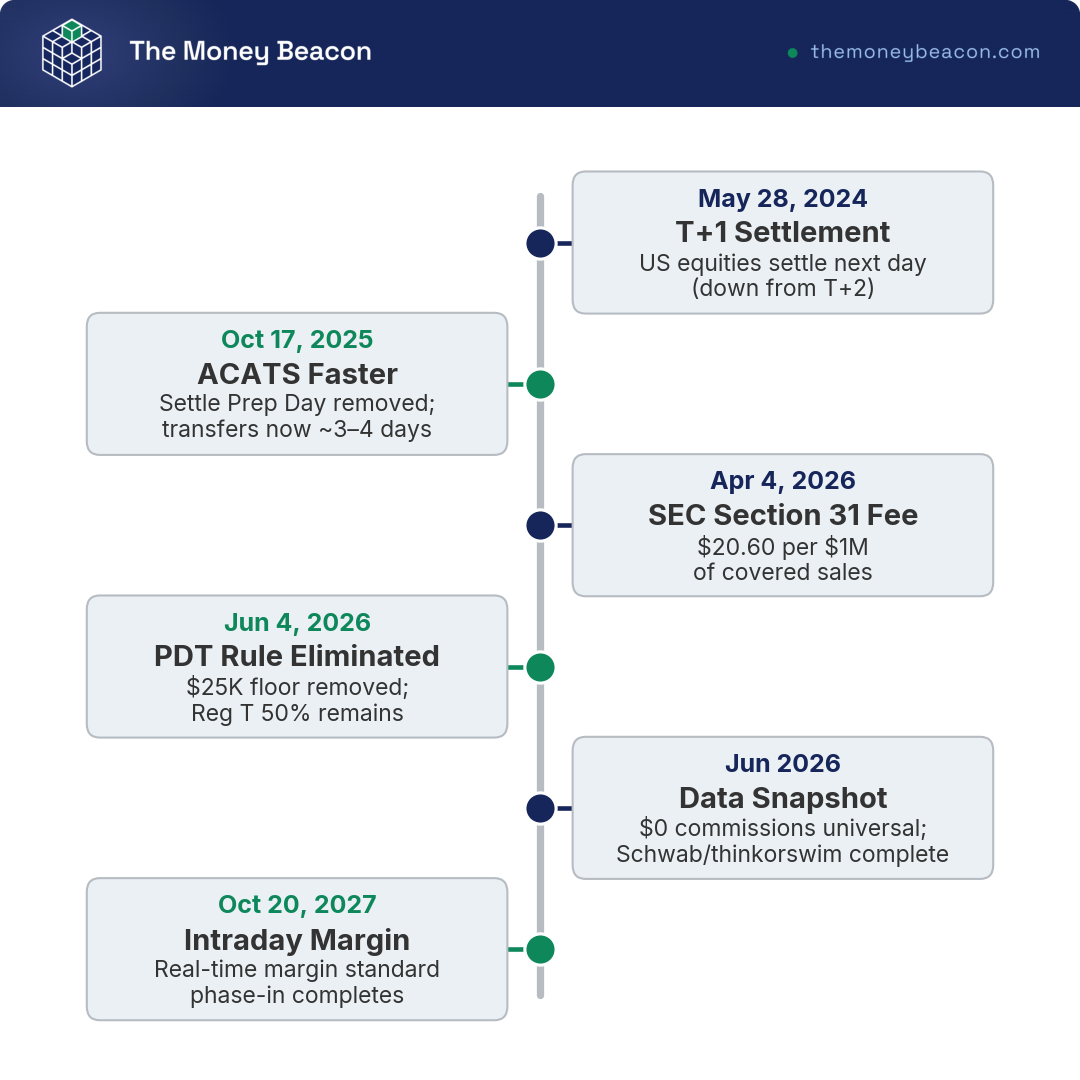
A few mechanical rules apply to everyone here. Margin operates under Regulation T’s initial 50% requirement and FINRA’s maintenance minimum of 25%, both of which are still in force. Account transfers move through ACATS (Automated Customer Account Transfer Service), and a full transfer now typically takes about three to four business days, down from six to ten. US stock settlement is T+1, meaning one business day. Stock sales also incur a small SEC Section 31 pass-through fee. The big change of the year is that FINRA has eliminated the Pattern Day Trader (PDT) rule, including the $25,000 minimum equity requirement, effective June 4, 2026. This will be replaced with a real-time Intraday Margin Standard that will be phased in by October 20, 2027.
1.3 The seven brokers at a glance, and which asset classes each can hold
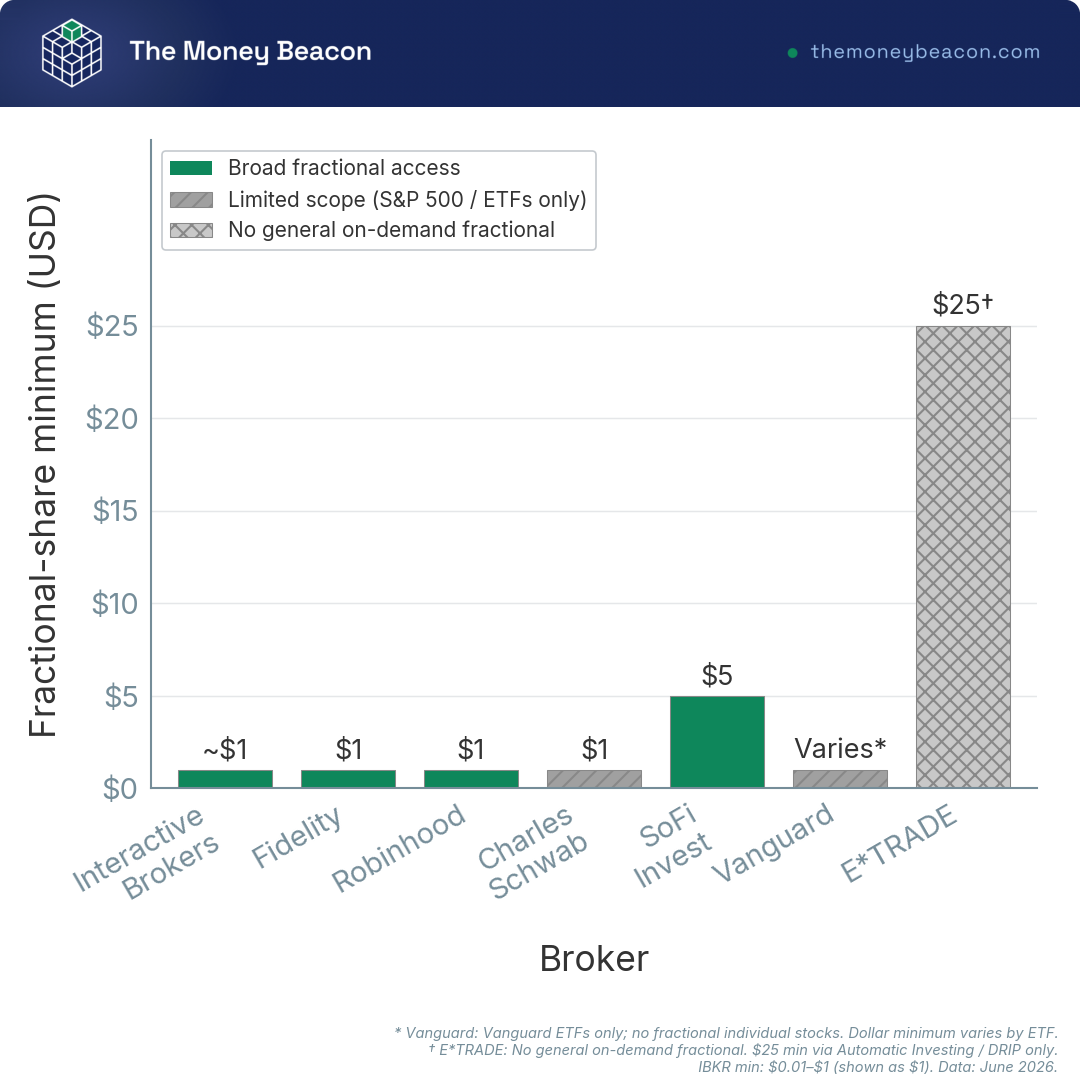
Now that you have safety and the criteria in mind, you can scan the field. The most important difference is in options pricing. Options are free at Robinhood and SoFi, $0.65 at Fidelity, Schwab, E*TRADE, and IBKR Lite, and $1.00 at Vanguard. The table also makes it clear that fractional-share access is not universal and varies significantly from broker to broker. This is something to check if you plan to start with a small amount of money.
Table: At-a-glance: the seven brokers side by side
| Broker | Stock/ETF commission | Options per contract | Account minimum | Fractional shares | Crypto |
|---|---|---|---|---|---|
| Fidelity | $0 | $0.65 | $0 | Yes ($1) | Yes (Fidelity Crypto, eligible states) |
| Charles Schwab | $0 | $0.65 | $0 | Yes ($1, “Stock Slices,” S&P 500 only) | Coming soon (spot); futures via thinkorswim |
| Vanguard | $0 | $1.00 | $0 | ETFs only (Vanguard ETFs) | No (crypto ETFs/MFs only) |
| Robinhood | $0 | $0.00 | $0 | Yes ($1) | Yes |
| E*TRADE | $0 | $0.65 | $0 | No on-demand (Automatic Investing $25 min / DRIP only) | No (direct spot); futures available |
| Interactive Brokers | $0 (Lite) | $0.65 (Lite); $0.15 to $0.65 (Pro tiered) | $0 | Yes (low) | Yes (via Paxos partner) |
| SoFi Invest | $0 | $0.00 | $0 | Yes ($5) | Yes (reintroduced) |
Data current as of June 2026.
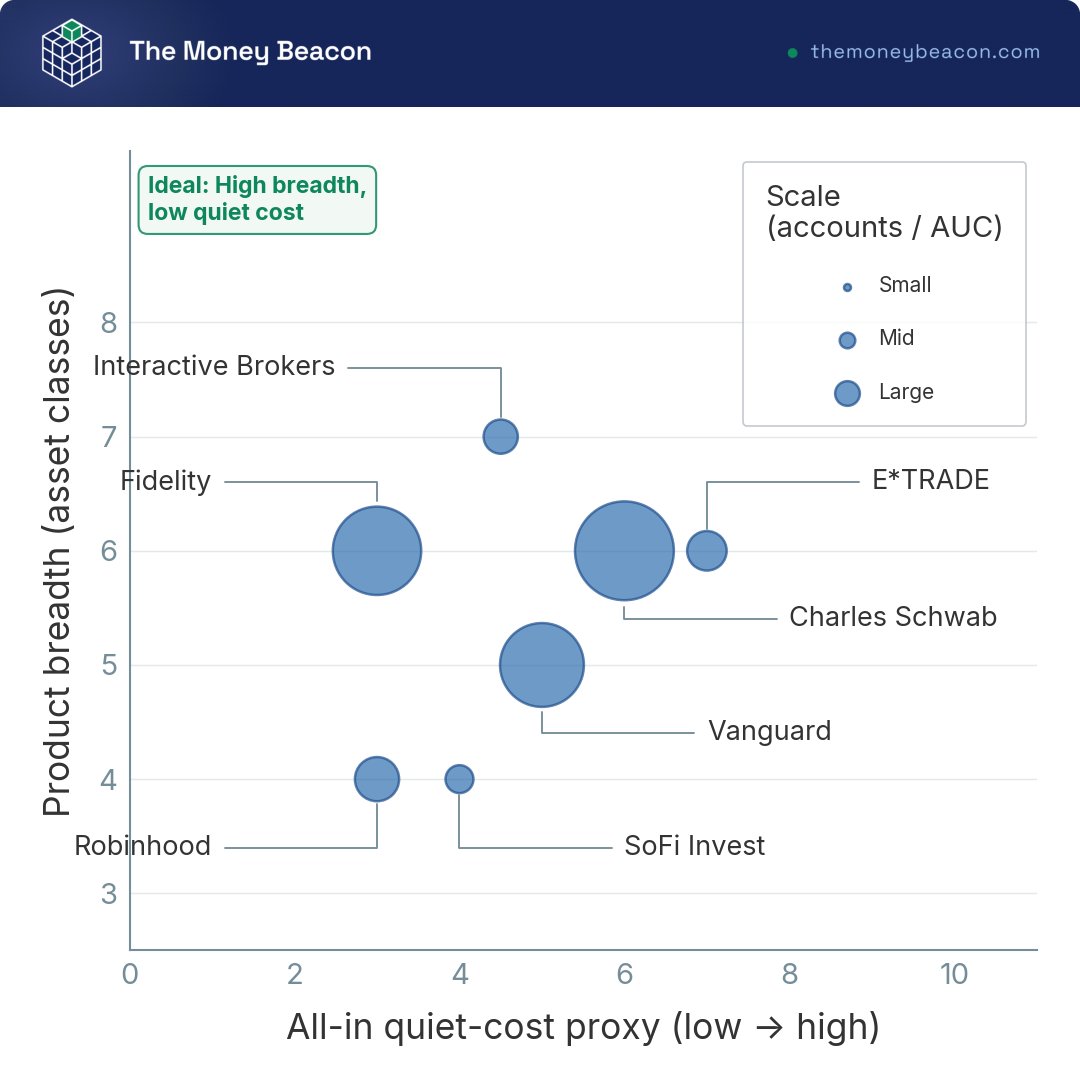
1.4 Where the field sits on coverage versus quiet cost
Plot the same seven on a map, and the trade-off becomes apparent. The horizontal axis represents cost, so brokers with $0 options and a money-market default land on the low-cost left side of the map, while those with higher options fees or a limited bank sweep slide to the right. The vertical axis is product breadth, or how many asset classes you can hold. Bubble size shows scale. Schwab is the largest after the TD Ameritrade integration, followed closely by Fidelity and Vanguard. You want to be in the top-left quadrant: high breadth and low quiet cost. This combination lets you buy almost anything without losing money on the cash you leave sitting around.
1.5 Which brokers cover every asset class you want
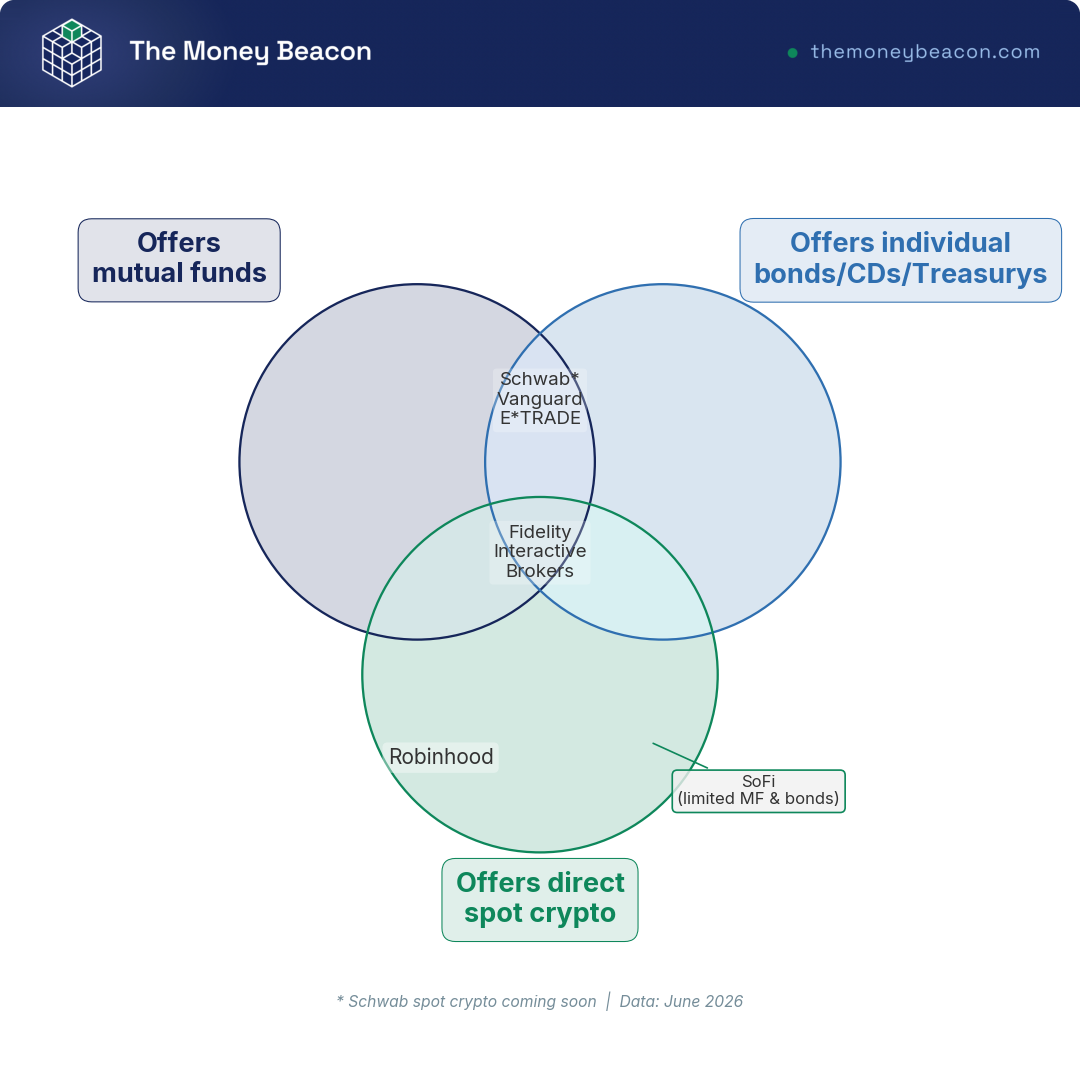
The most practical question is whether a broker even carries what you plan to buy. Fidelity, Schwab, Vanguard, E*TRADE, and IBKR offer mutual funds, individual bonds, and Treasurys. SoFi is limited in this regard, and Robinhood does not offer either (only bond ETFs). Direct spot crypto is a different story: it’s available at Fidelity (in eligible states), Robinhood, SoFi, and IBKR (via the Paxos partnership), will be available at Schwab (which already offers crypto futures through thinkorswim), and is not available at Vanguard and E*TRADE. Keep the wrapper-versus-contents distinction in mind here: the broker is the account, the crypto is the asset class, and a small direct crypto position held at a crypto affiliate is not protected by SIPC.
Now that the field has been mapped and the safety baseline has been set, here’s the first broker review.
2. Fidelity: the low-cost all-arounder for long-term investors
2.1 Overview
Fidelity is the best all-around broker for low-cost, long-term investors who want broad coverage and strong idle cash management. The standard taxable account is the Fidelity Account, which is available as an individual or joint account. It sits alongside a Cash Management Account, IRAs, a Solo 401(k), and a Youth Account, should you need them. You can find a Fidelity review with the full account lineup, but the short version is simple: $0 minimum to open, US residency with an SSN or ITIN, and you’re in.
2.2 Strengths
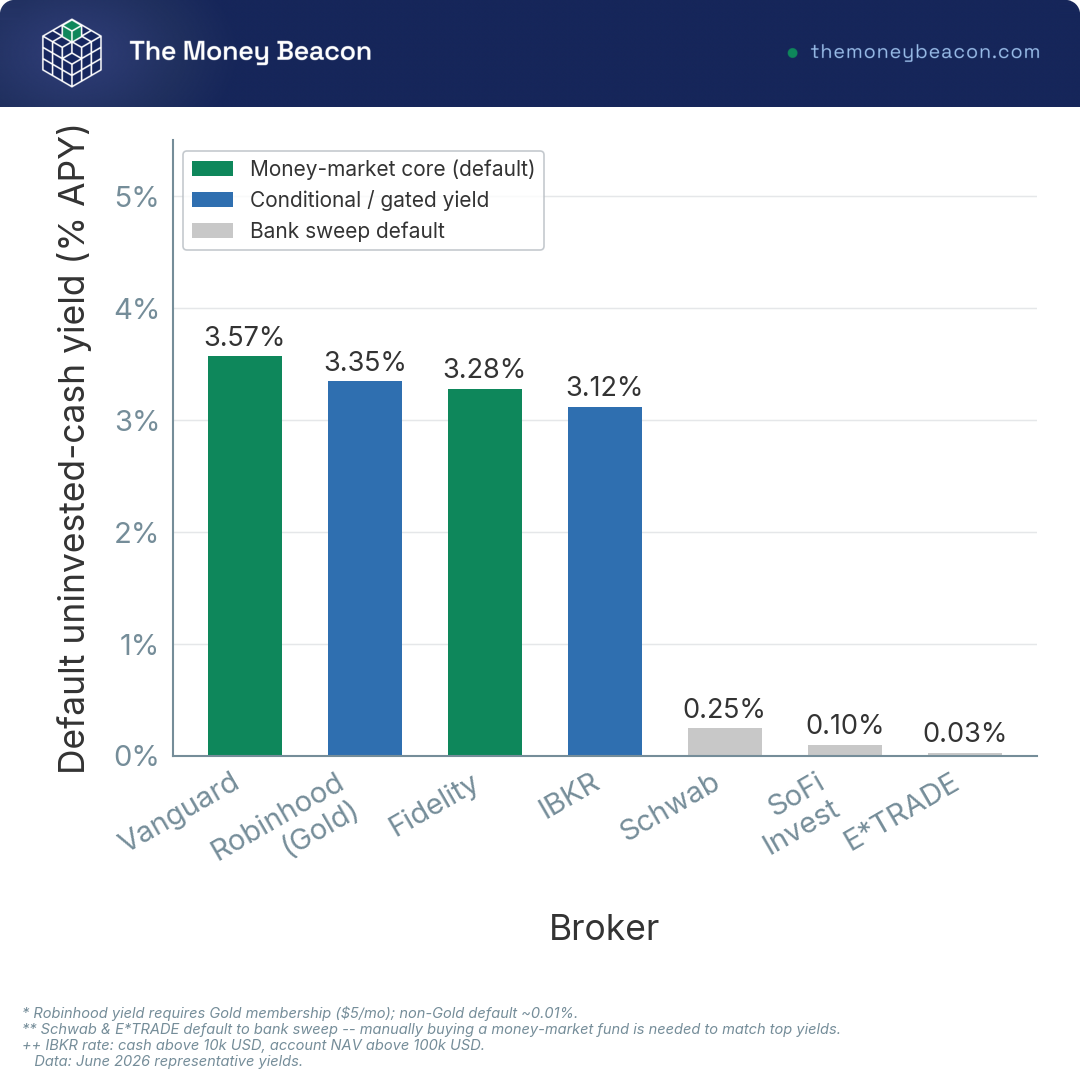
Fidelity’s signature edge is cost. Its Fidelity ZERO index mutual funds carry a 0.00% expense ratio, which is exactly what it sounds like: you own the fund and pay nothing to hold it. The second edge is the one most savers underestimate. Fidelity’s default core position can be a government money-market fund, SPAXX, which yielded about 3.28% (7-day yield, as of June 24, 2026), so your idle cash earns close to short-term rates without you lifting a finger. On top of that, Fidelity states it does not receive payment for order flow (PFOF) on US equities, the practice of selling your order routing for revenue, and it charges $0 to transfer your entire account. Coverage is broad (stocks, ETFs, options, mutual funds, bonds, and Fidelity Crypto in eligible states), and the app is well rated at 4.8 on the Apple App Store and 4.1 on Google Play. There is 24/7 phone support, as well as the Active Trader Pro desktop platform.
2.3 Weaknesses
However, there are a few drawbacks to mention. Options cost $0.65 per contract, which is more than the $0 you’d pay at the cheapest brokers in this comparison. Therefore, a high-volume options trader will pay a significant amount here. Crypto trading is only available in certain states, so depending on where you live, direct spot crypto trading may simply not be available to you. The platform’s depth, which active investors love, can overwhelm a true beginner who just wants a simple interface. Beyond that, there’s no meaningful gap in core coverage to flag as not disclosed.
2.4 Pricing & fees
Here’s what Fidelity actually costs.
Table: Fidelity pricing and fees (stock/ETF, options, minimum, transfer-out, cash sweep, margin)
| Cost item | Fidelity |
|---|---|
| Stock/ETF commission | $0 |
| Options per contract | $0.65 |
| Account minimum | $0 |
| Maintenance / inactivity fee | $0 |
| ACATS transfer-out (full) | $0 |
| Default cash sweep | SPAXX money-market fund, about 3.28% |
| Margin rate | Base about 10.6%, falling toward 7.5% on large balances |
Data current as of June 2026.
2.5 Who it’s for
Fidelity is ideal for low-cost, long-term buy-and-hold investors who want to keep some cash idle and have broad coverage in one place. Its underrated money-market core is a notable advantage: $10,000 in SPAXX at 3.28% earns you about $328 a year, compared to a few dollars in a low bank sweep for doing nothing. However, it’s not the best choice for a high-volume options trader chasing $0 per contract, as they’ll feel the $0.65 toll on every order.
Hank’s take

the part most savers underestimate is how much idle cash quietly leaks out at a low default sweep; with short-term rates where they’ve been, a money-market core like SPAXX is the difference between cash that works and cash that just sits there losing ground to inflation.
3. Charles Schwab: breadth of investments plus serious trading tools
3.1 Overview
Schwab is the broker to turn to when you want a wide range of products and serious trading tools under one roof. The TD Ameritrade integration is complete, bringing roughly 17 million accounts and approximately $1.9 trillion in assets, as well as the thinkorswim platform, which is highly regarded by active traders. Schwab opens accounts with no minimum balance requirement, maintains a large branch network, and pairs that reach with strong research capabilities. The full account lineup is in the Charles Schwab review.
3.2 Strengths
The standout is thinkorswim, one of the most capable active trading platforms available. It is now fully integrated into Schwab following the TD Ameritrade acquisition. Its wide range of products is another plus: stocks, ETFs, options, mutual funds, bonds, and futures. Direct spot crypto is coming soon (crypto futures are already available through thinkorswim). Schwab also offers a large branch and support network, robust research, and free account transfers. For those just starting out, the Stock Slices fractional program now begins at a $1 minimum, down from $5.
3.3 Weaknesses
The key quiet cost is the cash sweep. Schwab’s default for idle cash is a low-yield bank sweep. Avoiding this requires manually purchasing a money-market fund or Treasurys; a high yield by default simply isn’t an option. Fractional shares are limited to S&P 500 stocks, so you can’t buy partial shares of mid-cap or non-index stocks. Options cost $0.65 per contract, which is above the $0 floor that some brokers offer. Direct spot crypto is still rolling out and not yet widely available, so depending on the timing, it may not be available to you yet.
3.4 Pricing & fees
Schwab’s costs.
Table: Charles Schwab pricing and fees (stock/ETF, options, minimum, transfer-out, cash sweep, margin)
| Cost item | Charles Schwab |
|---|---|
| Stock/ETF commission | $0 |
| Options per contract | $0.65 |
| Account minimum | $0 |
| Inactivity fee | $0 |
| ACATS transfer-out (full) | $0 |
| Default cash sweep | Low-yield bank sweep (Intelligent Portfolios sweep about 3.21% APY is a separate program) |
| Margin rate | Base about 10%, effective about 10.4% at $50k to $100k |
Data current as of June 2026.
3.5 Who it’s for
Schwab is ideal for investors who want a wide range of products and a genuine active-trading platform in one place. It’s also ideal for those willing to do a little housekeeping, such as manually parking idle cash in a money-market fund rather than leaving it in the low default sweep. If you actively trade and value thinkorswim and in-depth research, Schwab’s offerings are hard to match. However, it’s not the best choice for someone who wants a high cash yield with no effort or broad fractional investing beyond the S&P 500.
4. Vanguard: the home base for hands-off index and mutual-fund investors
4.1 Overview
Vanguard is ideal for the hands-off index and mutual fund investor who buys and holds for decades. What sets it apart from every other broker in this comparison is its ownership structure. The funds themselves own Vanguard, so there are no outside shareholders pulling profit out. This is the driving force behind its famously low fund expense ratios. Vanguard opens with a $0 account minimum, though some Admiral-share index mutual funds require an initial investment of at least $3,000. Vanguard is a broker built for set-and-forget investing, not active trading. You will find the full account lineup in the Vanguard review.
4.2 Strengths
Vanguard is known for its core strength: the lowest-cost index, mutual, and target-date funds available. You can trade Vanguard’s own funds and ETFs commission-free. The second strength is the one savers tend to overlook. Vanguard’s settlement fund is a money-market fund (VMFXX), and it yielded about 3.57% (7-day yield, as of June 24, 2026), so your idle cash earns close to short-term rates by default, the highest default cash yield in this comparison. Pair that with the client-owned structure, and you’ve got a broker whose incentives align with those of a buy-and-hold investor. This makes Vanguard the obvious choice for someone who selects the lowest-cost index funds and ETFs and leaves them alone for thirty years.
4.3 Weaknesses
The knocks are real. At $1.00 per contract, options are the most expensive in this comparison, so options traders pay a high price here. The trading tools and app are the weakest of the seven. This platform is built for buying funds, not charting trades. Fractional shares are limited to Vanguard ETFs, so it’s not possible to buy a fractional individual stock. There is no direct spot crypto; only crypto ETFs and mutual funds can be traded inside the account. There’s also a $25 annual account service fee, though it’s waived when you enroll in e-delivery or hold $5 million or more in assets.
4.4 Pricing & fees
Here’s what Vanguard actually costs.
Table: Vanguard pricing and fees (stock/ETF, options, minimum, service fee, transfer-out, cash sweep, margin)
| Cost item | Vanguard |
|---|---|
| Stock/ETF commission | $0 |
| Options per contract | $1.00 |
| Account minimum | $0 (some fund minimums $3,000) |
| Annual account-service fee | $25, waived with e-delivery |
| ACATS transfer-out (full) | $0 |
| Default cash sweep | VMFXX money-market fund, about 3.57% |
| Margin rate | Tiered, high (not a trading-focused broker) |
Data current as of June 2026.
4.5 Who it’s for
Vanguard is ideal for long-term index investors who purchase low-cost funds, keep cash in the money market settlement fund, and select e-delivery to avoid the $25 fee. If your plan is to dollar-cost-average into a couple of broad funds and not look at the account for years, Vanguard is the cleanest, cheapest place to keep that money. However, it is not the right choice for active traders, options traders, or anyone who wants fractional stocks, a polished trading app, or direct crypto.
5. Robinhood: the simplest app for beginners and fractional investing
5.1 Overview
Robinhood is the simplest app for a beginner and for fractional investing, full stop. It’s mobile-first, it offers cash and margin accounts, and it opens at a $0 minimum with fractional buys starting at just $1 (you can own a slice as small as one-millionth of a share). For a first-time investor who wants to put $20 into a stock today without reading a manual, nothing here is faster. The app is top-rated for beginners, around 4.3 on the Apple App Store. You can find the full account walkthrough in our Robinhood review.
5.2 Strengths
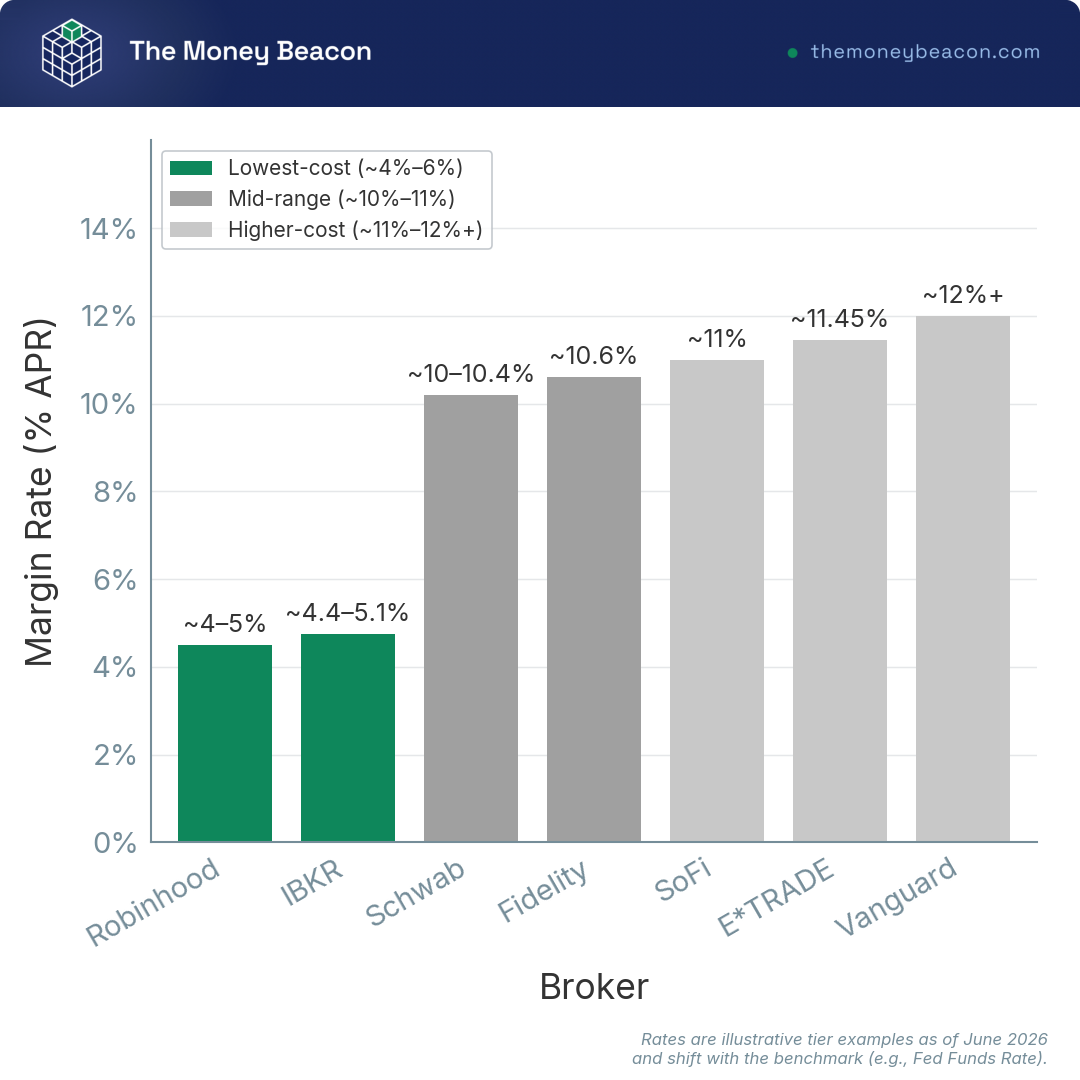
The main strengths are the low price and the simple, top-rated app that beginners can easily navigate. Investors interested in investing small amounts of money are well served, as fractional shares start at $1 across roughly 7,000 stocks and ETFs. Crypto is integrated directly, more than 60 coins, with self-custody wallet withdrawals supported, which most legacy brokers can’t match. Margin, if you use it, runs low when tied to the Gold tier (about 3.95% to 5%). And swept cash is FDIC-insured at program banks up to $2.5 million, a genuinely high ceiling.
5.3 Weaknesses
Let’s be clear-eyed about the weaknesses. There are no mutual funds or individual bonds, only bond ETFs. This rules out Robinhood for a fixed-income-heavy plan. The best cash yield (approximately 3.35% APY) requires the $5/month Gold subscription. Without Gold, the sweep account pays about 0.01%, so essentially, idle cash earns nothing. Robinhood’s revenue model relies on payment for order flow (PFOF). Its research and tools are inferior to those of legacy brokers, and the full ACATS transfer-out fee is about $100, the highest in this comparison. Therefore, leaving Robinhood later carries a real cost. One important safety note: Crypto held with Robinhood Crypto is not SIPC-protected.
5.4 Pricing & fees
Here’s what Robinhood actually costs.
Table: Robinhood pricing and fees (stock/ETF, options, minimum, Gold, transfer-out, cash sweep, margin)
| Cost item | Robinhood |
|---|---|
| Stock/ETF commission | $0 |
| Options per contract | $0.00 |
| Account minimum | $0 |
| Robinhood Gold | $5/month (unlocks higher cash yield and pro features) |
| ACATS transfer-out (full) | About $100 |
| Default cash sweep | About 0.01% (non-Gold); about 3.35% with Gold |
| Margin rate | About 3.95% to 5% (Gold) |
Data current as of June 2026.
5.5 Who it’s for
Robinhood is ideal for beginners who want a clean app, $1 fractional shares, $0 options, and integrated crypto. It’s also ideal for those who either keep little idle cash or are willing to pay for Gold to increase their yield. If your goal is to start investing with small amounts of money and minimal effort, this is the easiest way to get started. However, it is not the right choice for those who need mutual funds, individual bonds, in-depth research, or a $0 exit fee.
6. E*TRADE: usable trading tools across a broad product line
6.1 Overview
E*TRADE offers a balance of user-friendly trading tools and a wide range of products. It’s a wholly owned subsidiary of Morgan Stanley, which completed its acquisition in October 2020. Now trading as E*TRADE from Morgan Stanley, the company is backed by one of the country’s largest financial institutions. It has a $0 minimum opening balance and offers unusually strong educational content.
6.2 Strengths
The standout is Power E*TRADE, a genuinely capable platform for options and active trading. It has technical studies, drawing tools, customizable options chains, and trading ladders — the kind of tools serious traders actually use. Its product breadth backs it up: stocks, ETFs, options, mutual funds, bonds, and futures are all available. Backing from Morgan Stanley adds institutional research and a branch network. The educational library is one of the deepest in the group, so newer traders can grow into the tools rather than outgrow the broker.
6.3 Weaknesses
The limitations are clear. There is no general on-demand fractional trading. Fractional exposure exists only through Automatic Investing for select ETFs and mutual funds, with a $25 minimum per position, and through dividend reinvestment (DRIP). Therefore, the investor who wants to buy exactly $30 of a stock today is out of luck. The full ACATS transfer-out fee is approximately $75. The default bank sweep rate is low, ranging from 0.01% to 0.05% for small balances. Therefore, idle cash must be manually transferred into a money-market fund to earn interest. Direct spot crypto is unavailable, though futures are available, and live chat is currently unavailable.
6.4 Pricing & fees
Here’s what E*TRADE costs.
Table: E*TRADE pricing and fees (stock/ETF, options, minimum, transfer-out, cash sweep, margin)
| Cost item | E*TRADE |
|---|---|
| Stock/ETF commission | $0 |
| Options per contract | $0.65 ($0.50 with 30+ trades/quarter) |
| Account minimum | $0 |
| Inactivity fee | $0 |
| ACATS transfer-out (full) | About $75 |
| Default cash sweep | Low bank sweep, about 0.01% to 0.05% |
| Margin rate | About 11.45% at standard tiers, falls with balance |
Data current as of June 2026.
6.5 Who it’s for
E*TRADE is ideal for options and active traders who want Power E*TRADE, a broad product line, and Morgan Stanley backing. It’s not ideal for those who need to buy fractional shares on demand. If you trade options and value a robust platform with substantial educational resources, E*TRADE is a strong, well-resourced home. Beginning to trade with a cash account is straightforward, and the tools scale with you. However, it is not the right choice for someone who wants to buy fractional stocks on demand or for anyone counting on a high default cash yield.
7. Interactive Brokers: the deepest reach for advanced and global traders
7.1 Overview
Interactive Brokers is the most complete and widest-reaching broker in this comparison. It is built for advanced traders and investors who buy outside of the US It opens the door to over 170 markets worldwide and offers the lowest margin rates of any broker in this comparison. There are two tiers: IBKR Lite, which has $0 stock and ETF commissions and uses a payment-for-order-flow model, and IBKR Pro, which has low per-share commissions and no PFOF. In either case, the minimum account deposit for an individual is $0, so the only barrier is the learning curve.
7.2 Strengths
The standout feature is the cost of leverage. If you borrow against your portfolio, IBKR Pro charges about 5.1% for amounts under $100,000 and about 4.4% for amounts above $1 million. This is the lowest rate among the seven brokers. Another strength is its reach. IBKR Pro offers stocks, ETFs, options, mutual funds, bonds, futures, forex, and crypto through the Paxos partnership. It also provides access to equities across 170+ countries and exchanges, a feature that no other broker can match. Idle cash earns interest too. About 3.12% is paid on USD balances above $10,000 for clients with a net asset value (NAV) above $100,000. Fractional trading is also extensive, ranging from $0.01 to $1 across over 10,500 stocks, so investors with smaller budgets aren’t shut out either.
7.3 Weaknesses
The price of all that depth is complexity. Trader Workstation (TWS) is genuinely powerful, but the learning curve is steep, and a chunk of the platform assumes you already trade like a professional, which makes it overkill for a simple buy-and-hold plan. One myth worth debunking: IBKR Lite does not charge $0 for options; it charges $0.65 per contract, the same as Fidelity, Schwab, and E*TRADE. IBKR Pro charges between $0.15 and $0.65 per contract on a tiered schedule.
7.4 Pricing & fees
Here’s what Interactive Brokers costs
Table: Interactive Brokers pricing and fees (Lite vs Pro: stock/ETF, options, minimum, transfer-out, cash interest, margin)
| Cost item | Interactive Brokers |
|---|---|
| Stock/ETF commission | $0 (Lite); $0.0005 to $0.0035 per share Tiered, or $0.005 Fixed (Pro) |
| Options per contract | $0.65 (Lite); $0.15 to $0.65 tiered (Pro) |
| Account minimum | $0 |
| ACATS transfer-out (full) | $0 |
| Cash interest | About 3.12% above $10,000 (NAV above $100,000) |
| Margin rate | Lowest in class, about 4.4% to 5.1% (Pro) |
Data current as of June 2026.
7.5 Who it’s for
Interactive Brokers is ideal for advanced or global traders who want the lowest margin, the widest market access, and granular Pro pricing that rewards high volume. However, you must be willing to spend hours on TWS. If your portfolio spans foreign exchanges or relies on leverage, nothing is cheaper or more extensive. However, it is not the right choice for a simple buy-and-hold investor or a beginner who wants a one-tap app. Any IBKR Lite buyer should know that options cost $0.65 per contract, not $0.
8. SoFi Invest: banking and investing together in one app
8.1 Overview
SoFi Invest is an all-in-one platform for investing, banking, and loans. It’s mobile-first, has a $0 minimum opening balance, and supports fractional purchases of $5 or more across roughly 4,700 eligible stocks and ETFs. The clean, beginner-friendly app is rated about 4.7 on the Apple App Store and 3.8 on Google Play. A full account walkthrough is available in the SoFi review.
8.2 Strengths
The defining strength is consolidation: banking and investing under one login with an added member-benefit ecosystem. In terms of price, SoFi is inexpensive, with $0 commissions and $0 per options contract. Fractional shares start at $5, so a small, first-time investor can get started for the cost of a coffee. Crypto has been reintroduced after an earlier exit, which rounds out the beginner toolkit. The cash side is also competitive. SoFi Checking and Savings pays about 3.30% interest on balances up to $15,000, and up to 3.80% with the direct-deposit Boost.
8.3 Weaknesses
Access to individual bonds is limited or nonexistent, and the overall product menu is narrower than that of legacy brokers, so a plan heavy in fixed income won’t fit. There is no advanced desktop trading platform, and the research tools are limited, so SoFi is not suitable for serious traders. Keep in mind that the competitive yield is found in SoFi banking, not the brokerage cash sweep, which is modest and variable. Therefore, don’t assume that idle cash in the investing account earns the headline rate. The full ACATS transfer-out fee is about $100.
8.4 Pricing & fees
Here’s what SoFi Invest costs.
Table: SoFi Invest pricing and fees (stock/ETF, options, minimum, fractional, transfer-out, cash sweep, margin)
| Cost item | SoFi Invest |
|---|---|
| Stock/ETF commission | $0 |
| Options per contract | $0.00 |
| Account minimum | $0 |
| Fractional minimum | $5 |
| ACATS transfer-out (full) | About $100 |
| Brokerage cash sweep | Modest/variable (banking APY about 3.30% to 3.80% is separate) |
| Margin rate | Limited/varies |
Data current as of June 2026.
8.5 Who it’s for
SoFi Invest is ideal for investors who want checking, savings, and investing all in one app. It offers member benefits, accepts a $5 minimum investment, and doesn’t require a large fixed-income investment. If you want to manage your entire financial life with a single login and keep investing simple, this is the cleanest option. However, it is not the right choice for bond-heavy investors, advanced traders who need a desktop platform, or anyone counting on a high brokerage cash sweep.
9. The full comparison and which broker fits you
This is the one place where the seven brokers go head-to-head. Below is a full recap table, followed by themed charts that detail each quiet cost. Finally, there is a verdict matched to five concrete reader profiles.
9.1 The seven brokers, side by side
The table below is the definitive reference for all comparative claims in this article.
Table: Summary table
| Broker | Best for | Standout strength | Main quiet cost | Options/contract | Crypto |
|---|---|---|---|---|---|
| Fidelity | Low-cost long-term all-arounder | ZERO funds + MMF core (~3.28%) + no equity PFOF | $0.65 options | $0.65 | Yes (eligible states) |
| Charles Schwab | Breadth + active tools | thinkorswim, full product line, $0 transfer-out | Low bank sweep | $0.65 | Coming soon (futures via thinkorswim) |
| Vanguard | Hands-off index/mutual-fund | Lowest fund ERs + MMF settlement (~3.57%) | $1.00 options, weak app, $25 fee unless e-delivery | $1.00 | No (crypto ETFs/MFs only) |
| Robinhood | Beginners + fractional | $0 options, simple app, fractional $1 | Best yield gated behind $5/mo Gold; no mutual funds/bonds; ~$100 transfer-out | $0.00 | Yes |
| E*TRADE | Usable tools + broad products | Power E*TRADE | ~$75 transfer-out; no general fractional | $0.65 | No (direct spot) |
| Interactive Brokers | Advanced/global traders | Lowest margin + 170+ markets | TWS learning curve; Lite options are $0.65, not $0 | $0.65 (Lite) / $0.15 to $0.65 (Pro) | Via partner (Paxos) |
| SoFi Invest | All-in-one invest + banking | Banking + investing in one app; $0 options | Thin bonds; ~$100 transfer-out | $0.00 | Yes (reintroduced) |
Data current as of June 2026.
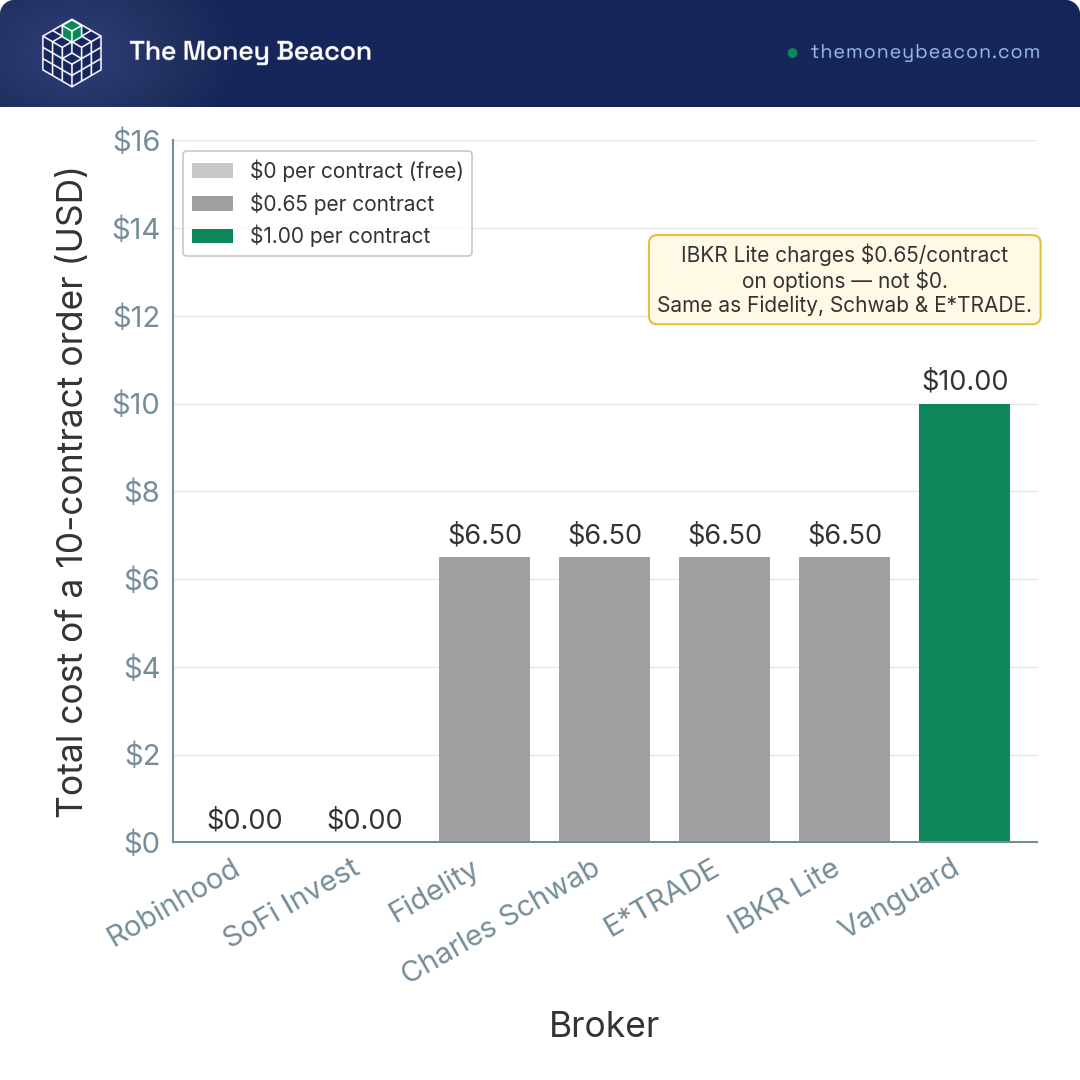
9.2 What options really cost per order
If you often trade options, choose a broker that charges $0 per contract (such as Robinhood or SoFi), or pay $0.65 for better platforms. Steer clear of Vanguard’s $1.00 fee.
9.3 The idle-cash drag, and what each broker pays by default
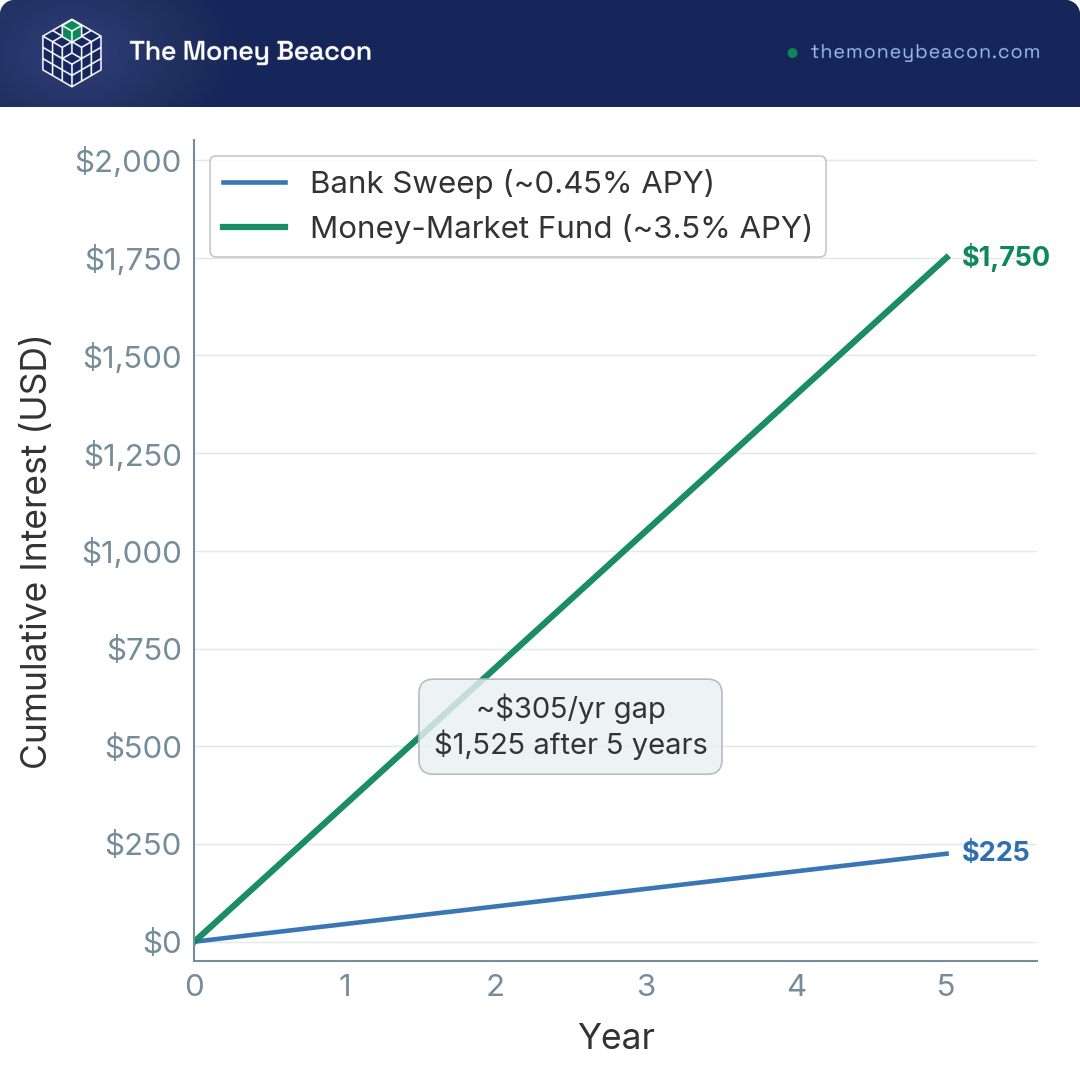
Idle cash is the quietest leak of all. For every $10,000 left uninvested, the difference between a 0.45% bank sweep and a 3.5% money market fund amounts to approximately $305 per year. This gap grows to about $350 when compared to a 0.01% sweep. The solution is straightforward: if the default is a low bank sweep, transfer the funds to a money market account yourself. Just remember that sweep and money market interest are taxed as ordinary income, not at the lower long-term rate.
9.4 Default cash yield, broker by broker
There are two caveats regarding the default cash yield. Robinhood’s competitive 3.35% yield is only available if you pay for Gold. Schwab and E*TRADE only offer a similar yield once you manually purchase a money-market fund. If you want a high yield on spare cash with little effort, a dedicated high-yield savings account outside the brokerage can also do the job.
9.5 Exit costs and the price of leverage
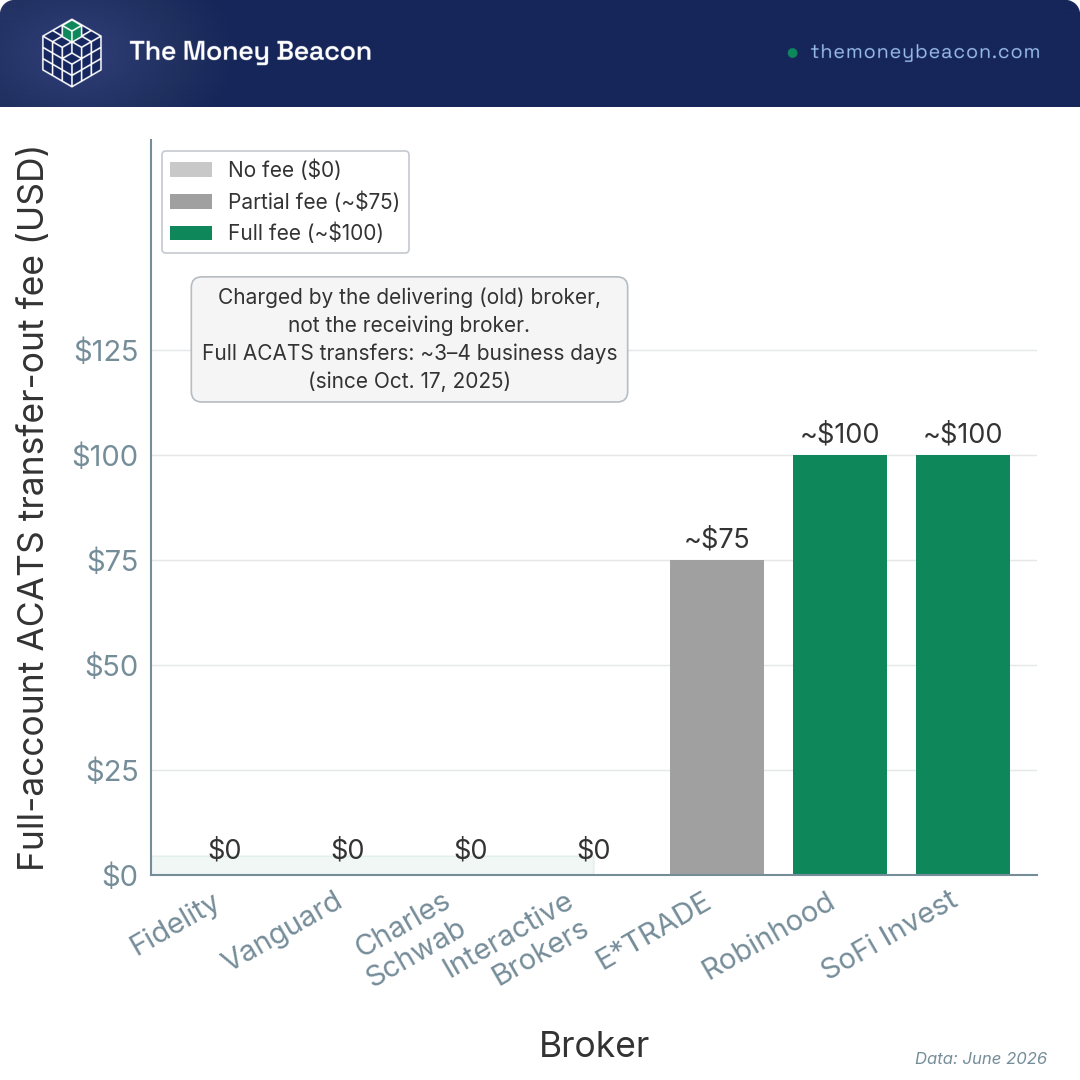
Leaving a broker can cost you. The old broker bills the fee, and the ACATS transfer now takes about three to four business days. If you think you might switch later, choose a broker with a $0 transfer-out fee to begin with.
9.6 The cost of leverage, if you borrow
If you borrow against your portfolio, the margin rate overshadows any difference in commission. These are illustrative tiers that fluctuate with the benchmark, but the ranking remains consistent. On a real margin balance, that spread is worth thousands of dollars a year.
9.7 Starting small: fractional minimums side by side
If you’re investing small dollars, fractional scope is not universal, so check it before you commit.
9.8 Verdict by reader profile
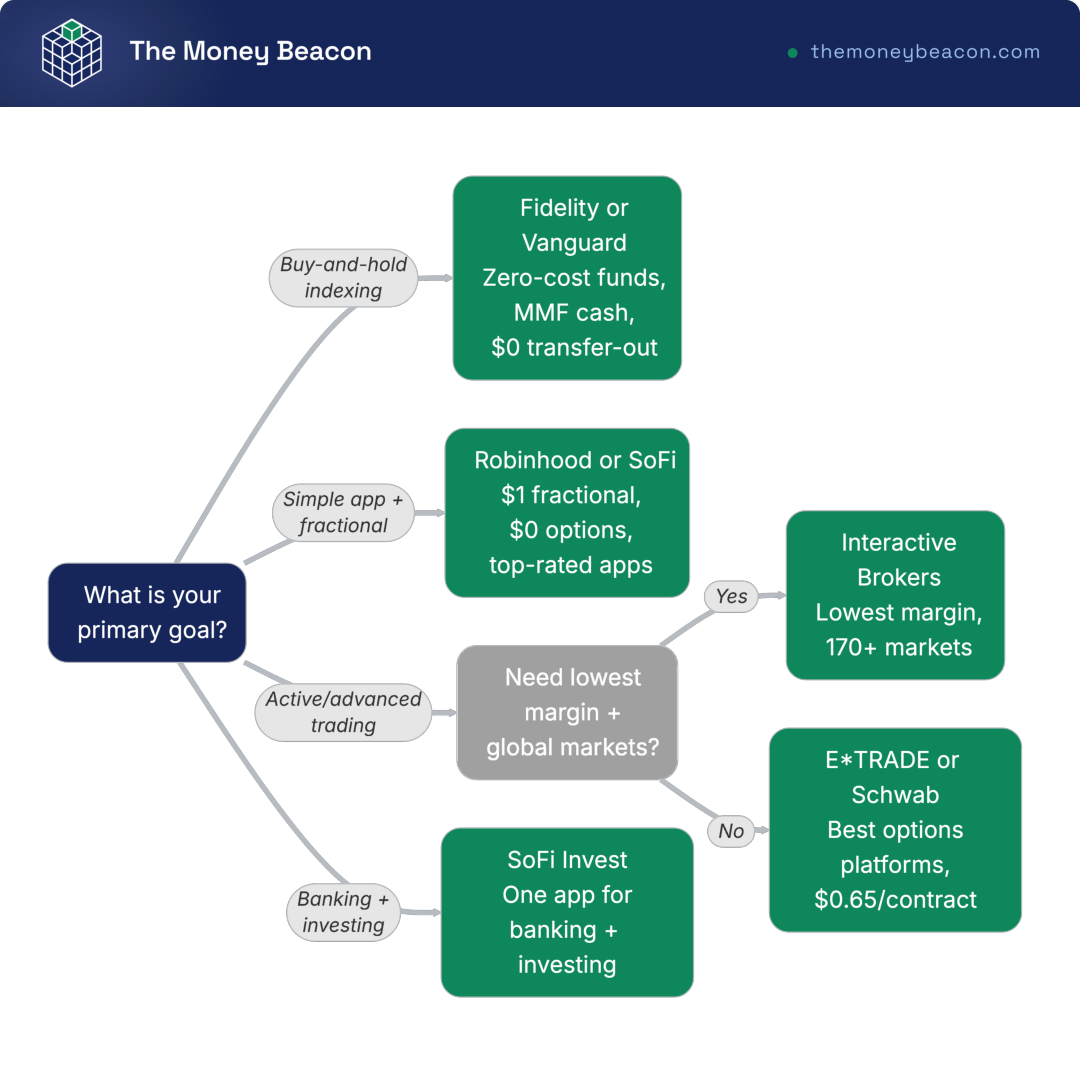
Here’s the call, matched to how you actually invest.
- Buy-and-hold index investor: Fidelity, or Vanguard. Both give you near-zero fund expense ratios, a money-market default on idle cash, and $0 transfer-out; Fidelity edges ahead on app and crypto optionality and skips Vanguard’s $25 service fee.
- Beginner who wants a simple app and fractional: Robinhood. The cleanest app, $1 fractional shares, $0 options, and integrated crypto make it the fastest on-ramp; SoFi is the alternative if you want banking in the same place.
- Active or options trader: Power E*TRADE or Schwab thinkorswim. Both deliver a genuine pro-grade options platform at $0.65 per contract, so pick the interface you prefer.
- All-in-one banking plus investing: SoFi Invest. One login for checking, savings, and investing with member benefits, as long as you accept the thinner bond lineup.
- Advanced or global trader: Interactive Brokers. The lowest margin rates, access to 170+ markets, and granular Pro pricing win it, provided you’ll learn TWS.
Tom’s take
I’ve moved real money between several of these brokers, and the lesson stuck: shop the after-cost number, not the headline. Make them compete on the margin rate, the sweep yield, and the exit fee, because those three lines decide far more of your return than the $0 commission everyone advertises.
If you’d rather not pick stocks at all, a robo-advisor can manage the entire portfolio for you. Either way, it pays to fit your account into a retirement plan that you can follow.
9.9 How to open and fund the account you chose
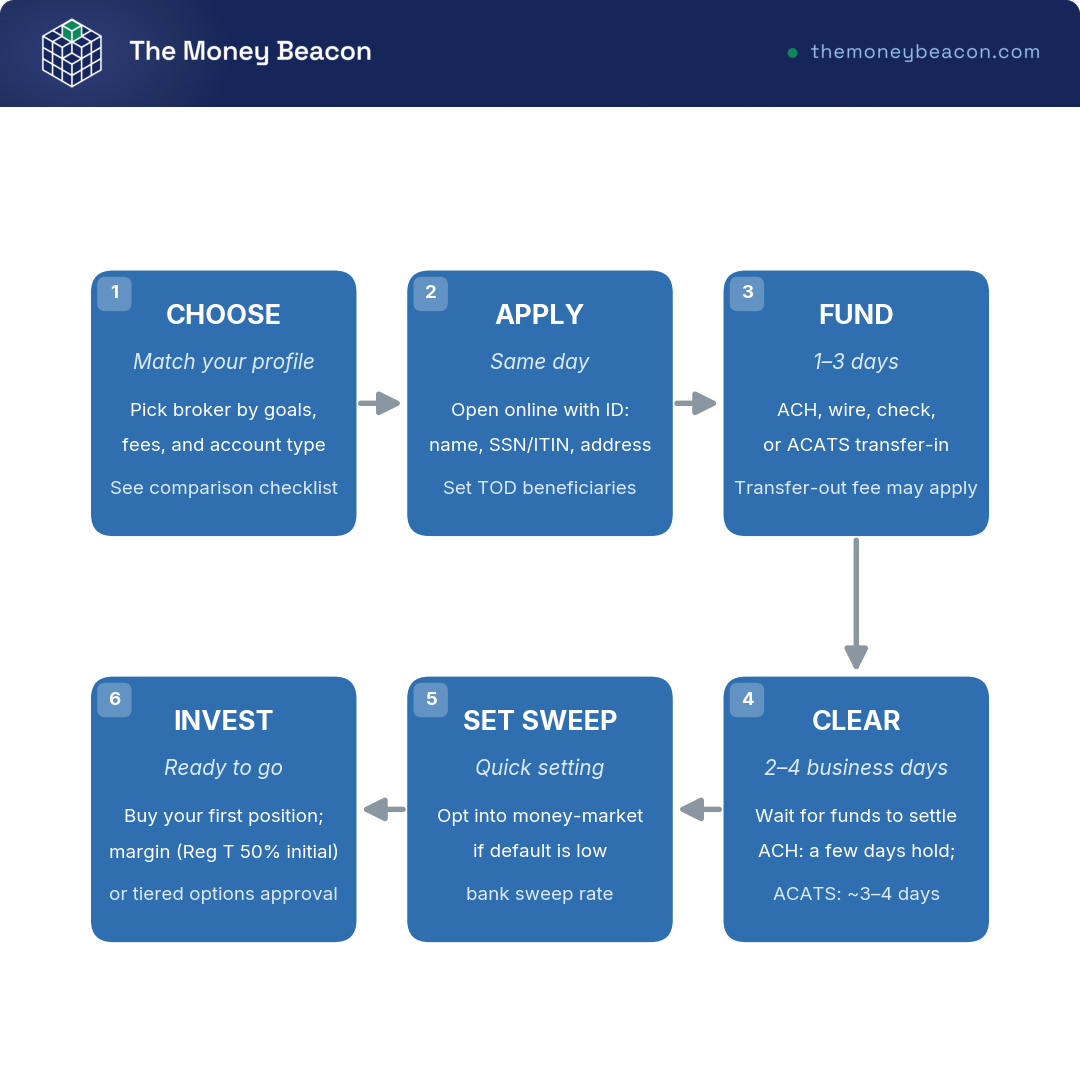
The path to a funded account is short once you’ve picked it: apply online and fund your account via ACH, wire transfer, check, or ACATS transfer (now about three to four business days). Then, switch your bank sweep to a money market option and buy your first position. The figure below illustrates the six steps.
Conclusion
If you take one thing from this comparison, make it this: the $0 commission that all seven brokers advertise is no longer a reason to pick one over another because they all have it. The real money is in the costs that don’t make the headlines: options pricing, the yield on idle cash, the transfer-out fee on your departure date, and the margin rate if you ever borrow money.
The right account isn’t the one with the slickest app or the loudest ad. It’s the one whose quiet costs match how you actually invest. Run your own numbers down the recap table, find the row that describes your habit, and let that decide.
Then act today. Pick the broker that fits your profile, open the account online, fund it, and if the default sweep is a low bank rate, switch it to a money-market option so your spare cash starts earning interest right away.
Once the account is open, the next question is what to put in it: our comparison of low-cost index funds and ETFs covers that. If you’re placing your first trades, our guide to getting started in the stock market walks through the mechanics. And when the gains start adding up, our guide to investment taxes covers what you’ll owe.
Frequently asked questions
What is the best brokerage account for beginners in 2026?
For a beginner who wants a simple app and fractional shares, Robinhood and SoFi Invest are the easiest on-ramps: $0 commissions, $0 options per contract, fractional shares from $1 (Robinhood) or $5 (SoFi), and clean mobile-first apps. If you also want low-cost index funds and a money-market default for idle cash, Fidelity is the better long-term home despite a slightly deeper interface.
Are online brokerage accounts safe, and what does SIPC protection actually cover?
All seven brokers are SEC/FINRA-registered and SIPC members. SIPC protects up to $500,000 per customer, including a $250,000 limit for cash, but only if the brokerage fails and assets go missing. It does not cover market losses, and it is not FDIC deposit insurance (which covers bank deposits up to $250,000 per depositor, per bank, per ownership category). Crypto held at a broker’s crypto affiliate is generally not SIPC-protected.
Do the best brokers really charge zero commissions on stocks and ETFs?
Yes. All seven charge $0 for online US-listed stock and ETF trades. The real cost differences hide elsewhere: options per-contract fees ($0 at Robinhood and SoFi, $0.65 at Fidelity, Schwab, E*TRADE, and IBKR Lite, $1.00 at Vanguard), cash-sweep yields, transfer-out fees, and margin rates. A common myth is that IBKR Lite is $0 on options; it is $0.65 per contract, the same as the legacy retail brokers.
What is a cash sweep, and why does the uninvested-cash interest rate matter?
A cash sweep automatically parks your idle cash in either a bank sweep (often 0.01% to 0.45%) or a money-market fund (roughly 3.3% to 3.6% as of June 2026). On $10,000 of idle cash, a 0.45% bank sweep versus a 3.5% money-market fund is roughly $305 a year in forgone interest. Vanguard (VMFXX, about 3.57%) and Fidelity (SPAXX, about 3.28%) default to money-market vehicles. Schwab and E*TRADE default to a low bank sweep, so you have to manually buy a money-market fund to catch up. Robinhood’s best yield (about 3.35%) requires the $5/month Gold subscription.
Can I transfer my account to another broker, and what does a transfer-out fee cost?
Yes, via ACATS, now typically completing in about 3 to 4 business days (faster since the Settle Prep Day was removed in October 2025). The delivering broker (your current one) charges the transfer-out fee, not the receiving broker. Full-transfer fees range from $0 (Fidelity, Vanguard, Schwab, and Interactive Brokers) to about $75 (E*TRADE) to about $100 (Robinhood and SoFi). Pick a $0 transfer-out broker if you think you might switch later.
Do I owe taxes on a taxable brokerage account even if I don’t withdraw money?
Yes. A taxable account has no tax shelter: dividends, interest (including sweep interest), and realized capital gains are taxable in the year they occur, regardless of withdrawals. Long-term gains and qualified dividends get the 0/15/20% rates; short-term gains and ordinary dividends and interest are taxed as ordinary income. High earners may owe an extra 3.8% NIIT above MAGI thresholds of $200,000 (single) or $250,000 (married filing jointly), bringing the top combined federal long-term rate to 23.8%. Brokers issue a 1099 each year. See the investment taxes guide for a deeper walk-through of capital gains, the wash-sale rule, and tax-loss harvesting.
Is a self-directed brokerage account worth it, and how do I open one?
For most investors who want to choose their own low-cost funds and control costs, yes: a self-directed taxable brokerage account has no contribution limit, no early-withdrawal penalty, and full flexibility across index funds and ETFs, individual stocks, bonds, and more. To open one, pick the broker that fits your profile, apply online (you’ll need your SSN, bank routing numbers, and employer details; set a beneficiary), fund via ACH, wire, check, or an ACATS transfer-in, set the cash sweep to a money-market option if the default is low, then buy your first position.




Comments
Questions and corrections welcome. We read everything.