


SoFi doesn’t really sell you a savings rate. It sells consolidation: your paycheck and your portfolio in one app, with member perks as the reward for bringing everything over. That’s an easy pitch to say yes to and a hard one to price, so the decision usually gets made on convenience. Then nobody goes back to check what it actually paid.
Paying $10 a month is the only way into SoFi Plus now. That $120 a year buys you a 4.50% annual percentage yield (APY), and only on the portion of your savings at or below $20,000.
The 3.80% on the landing page isn’t a rate you keep either. It’s a limited-time 0.70% boost on a 3.10% base, available to new members for up to six months. And the 3.10% base on SoFi Checking and Savings comes with its own condition, an eligible direct deposit or $5,000 in qualifying deposits every 31 days. Miss that window and your savings APY drops to 0.80%. On $10,000, that’s $80 a year instead of $310.
I read SoFi’s own rate sheet and fee sheet line by line, because the 4.50% tier never appears on the banking page. In this SoFi review I work out what the account really pays a household like yours, and what that $10 a month buys back.
1. What SoFi actually pays: four savings rates, not one
1.1 The rate card: four savings APYs and the rule that assigns each one
SoFi Bank’s rate sheet, effective May 28, 2026, publishes four savings APYs. Which one you get depends on your status, not on how much you deposit.
| Your status | Savings APY | Checking APY | Interest rate on savings |
|---|---|---|---|
| SoFi Plus subscriber, first $20,000 | 4.50% | 0.50% | 4.40977% |
| SoFi Plus subscriber, portion above $20,000 | 3.10% | 0.50% | 3.05681% |
| Eligible Direct Deposit or $5,000 Qualifying Deposits, no subscription | 3.10% | 0.50% | 3.05681% |
| None of the above (Standard rate) | 0.80% | 0.50% | 0.79708% |
Rates effective May 28, 2026, SoFi Bank Rate Sheet.
Two rows in there matter more than the rates do. The 4.50% is a tier, not a rate: it needs the paid SoFi Plus subscription, and everything above $20,000 earns the same 3.10% an eligible direct deposit earns for free, so a subscriber holding $100,000 gets a blended 3.38%.
Then there’s the checking column, which never changes. Checking pays 0.50% at every tier, at every balance, for every member, so all the yield here comes from savings. Need a spendable balance that still pays? That’s what a money market account with spending access is for.
1.2 The two doors to the free 3.10%, and the day the rate falls back to 0.80%
So what counts? SoFi runs two tests over a rolling 31 calendar days, and you only have to pass one.
Door one is an Eligible Direct Deposit, a recurring automated clearing house (ACH) deposit of regular income from an employer, payroll provider or government agency. There’s no minimum: a $600 paycheck earns you the same 3.10% as a $6,000 one.
Door two is Qualifying Deposits, $5,000 or more in total every 31 days, counting ACH transfers, inbound wires, peer-to-peer payments, check deposits and cash.
The exclusion lists differ, and that’s where people get caught. Money pushed over from your outside bank is a Qualifying Deposit, not a direct deposit, so it takes $5,000 every 31 days instead of a $1,200 paycheck every two weeks. Transfers between your own SoFi accounts or Vaults, the savings sub-accounts inside the app, count as neither, and neither do interest, bonuses or merchant refunds.
Then there’s the confusion that costs the most. SoFi runs three separate $1,000 thresholds and not one of them governs the savings APY. Get $1,000 or more in eligible direct deposits per 31 days and it decides whether your welcome bonus is $50 or $400. It also unlocks Overdraft Coverage and qualifies you for the up-to-two-days-early paycheck.
Miss the window and, after whatever grace period SoFi decides to give you, savings reverts to 0.80%. I couldn’t find a fixed length for that grace period anywhere in the rate sheet or the deposit account agreement, so plan on the drop at day 32. And check the APY Details page the day after payday, because SoFi admits some employers don’t tag their payments as direct deposit.
1.3 What each rate is worth on $25,000, and why the advertised 3.80% is the least representative number SoFi prints
Rules get real in dollars, so take $25,000 held a full year with no withdrawals. At the Federal Deposit Insurance Corporation (FDIC) national average savings rate of 0.38% as of August 17, 2026, you earn $95. At SoFi’s 0.80% Standard rate, $200. At the free 3.10%, with a qualifying deposit, $775. At the advertised 3.80%, open to new members only and annualized here so it compares, $950. On the SoFi Plus tier, 4.50% on the first $20,000 and 3.10% on the last $5,000, $1,055.
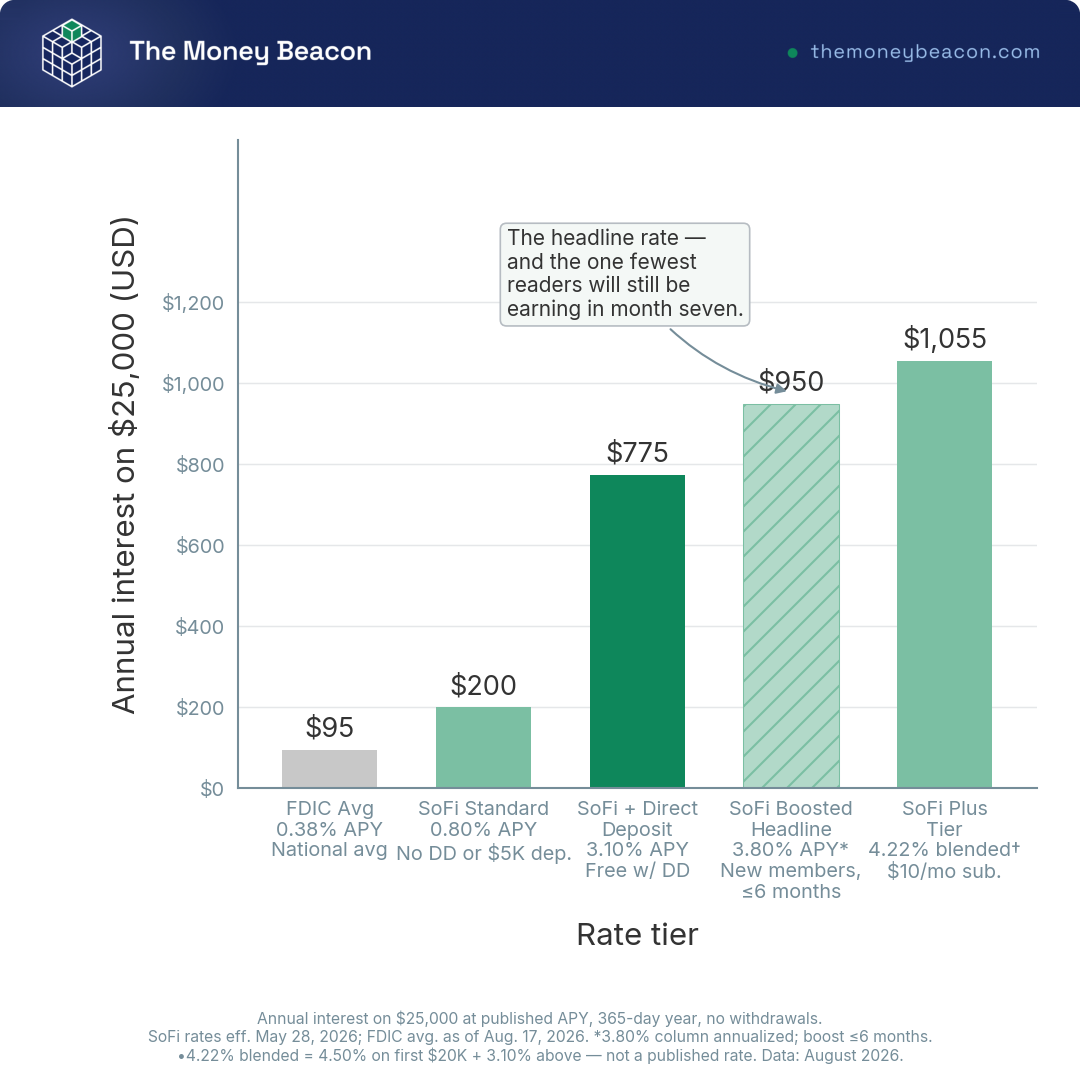
The fourth bar is the one to distrust. That 3.80% comes with an account-opening deadline of 12/31/26, and it still demands the same qualification every 31 days. SoFi’s terms also bar a promotional boost on balances already earning 4.50%, where the 4.50% applies first. So a subscriber collects the boost only above $20,000.
The upgrade worth chasing is the free one. Ignoring the direct-deposit condition costs you $115 a year at $5,000, $230 at $10,000, $575 at $25,000 and $2,300 at $100,000, and closing it costs nothing. At roughly eight times the national average, the free 3.10% puts this account in real contention with the accounts actually competing for cash. But a rate is only half of what an account is worth. The other half is what it charges you to run.
2. What the account costs to run, and what the alternatives ask instead
2.1 The fee sheet is genuinely clean, with one hole in it
SoFi Bank’s fee sheet, effective May 18, 2026, is short. No monthly maintenance fee, no minimum balance fee, no overdraft fee. Here’s what still costs something.
| Transactional fee | Amount |
|---|---|
| Outgoing domestic wire | $30 per wire, non-refundable once processed |
| Incoming wire | $0 |
| Outgoing Instant Transfer (withdrawal) | 0.75% of the amount, minimum $1, maximum $30 |
| Incoming Instant Transfer | $0 |
| Global remittance transfer | 0.50% of the amount |
| Allpoint ATM, domestic and international | $0 |
| Non-Allpoint ATM | SoFi charges $0; the operator may charge |
| Zelle and P2P, Bill Pay, mobile deposit, point of sale | $0 |
| Cash deposit | SoFi charges $0; Green Dot retail partners may charge up to $4.95 |
Fees current as of May 18, 2026.
Everything left on that list is about moving money out in a hurry.
One line is the exception, and it’s the most consequential everyday cost in this review. Step outside the Allpoint network and SoFi charges nothing, but it reimburses nothing either. Price your own habit first, because two $3.50 withdrawals a month comes to about $84 a year, a real part of the rate advantage. Others don’t work that way, so check which banks refund an out-of-network surcharge before you commit.
Behind that $0 overdraft fee are two features with confusingly similar names. Overdraft Protection is free to every member from day one and pulls from your SoFi Savings, never your Vaults, to cover any payment type. Overdraft Coverage lets your checking run to negative $50 on debit card and digital wallet purchases only, and it takes $1,000 or more in eligible direct deposits per rolling 31 days.
2.2 SoFi has the highest ceiling and the lowest floor of the three, and the only top rate you have to buy
Cheap to keep, then. So what do the alternatives ask for a comparable rate?
SoFi pays you 0.80% with nothing qualified, 3.10% free with a qualifying deposit, and 4.50% only with the $10-a-month subscription and only on the first $20,000. Chime pays 0.75% standard and 2.75% at Chime Plus, which needs one qualifying direct deposit of $200 or more, or $400 cumulative, in the preceding 34 days. Its top rate of 3.75% at Chime Prime is free, with no subscription and no paid route. But it demands $3,000 or more in qualifying direct deposits in the preceding 34 days, and the account drops back a tier after a grace period if those deposits stop. Ally pays 3.00% on every balance tier, with no direct deposit, no minimum balance and no subscription.
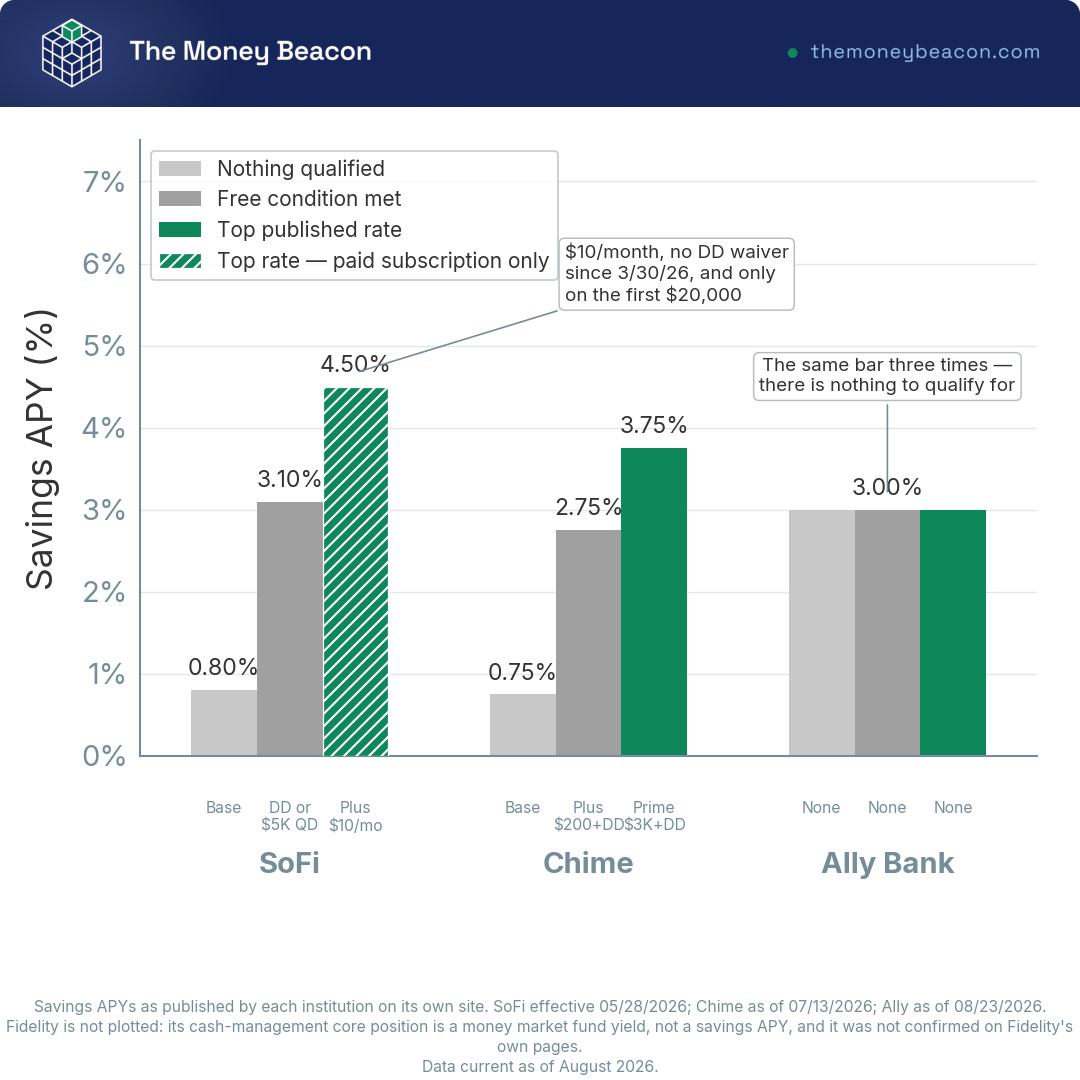
SoFi is also the only one that falls to 0.80% the month a paycheck stops arriving. Chime’s free top tier isn’t the soft option it looks like, because $3,000 every 34 days is a steeper gate than SoFi’s no-minimum direct deposit. And Ally’s flat 3.00% is what an unconditional rate looks like, under SoFi’s free 3.10% but immune to the qualification test entirely.
Tom’s take

I’ve shopped a lot of banks and made them compete, and the first thing I price is never the rate, it’s the condition attached to it. A rate you re-qualify for every 31 days comes with a chore, and the chore is part of the price.
3. SoFi Plus: $120 a year, priced against what it buys
3.1 $10 a month, and there has been no free door since March 30, 2026
That leaves the one rung you can’t reach by qualifying for anything. The current rule is in the terms of use, last updated August 18, 2026, and I found it in a single line: “New and existing SoFi members who pay the SoFi Plus Subscription Fee of $10 every month qualify as SoFi Plus members.” Complimentary Plus for direct-deposit members ran from 12/9/25 to 3/30/26, so any source still saying a paycheck unlocks it is out of date. Here’s what the $120 buys you on savings against the free 3.10%.
| Savings balance | Interest at 3.10% (free) | Interest at Plus tier | Uplift | Uplift minus $120 |
|---|---|---|---|---|
| $5,000 | $155 | $225 | $70 | -$50 |
| $8,572 | $266 | $386 | $120 | $0 (break-even) |
| $10,000 | $310 | $450 | $140 | +$20 |
| $15,000 | $465 | $675 | $210 | +$90 |
| $20,000 | $620 | $900 | $280 | +$160 |
| $50,000 | $1,550 | $1,830 | $280 | +$160 |
| $100,000 | $3,100 | $3,380 | $280 | +$160 |
Data current as of May 2026.
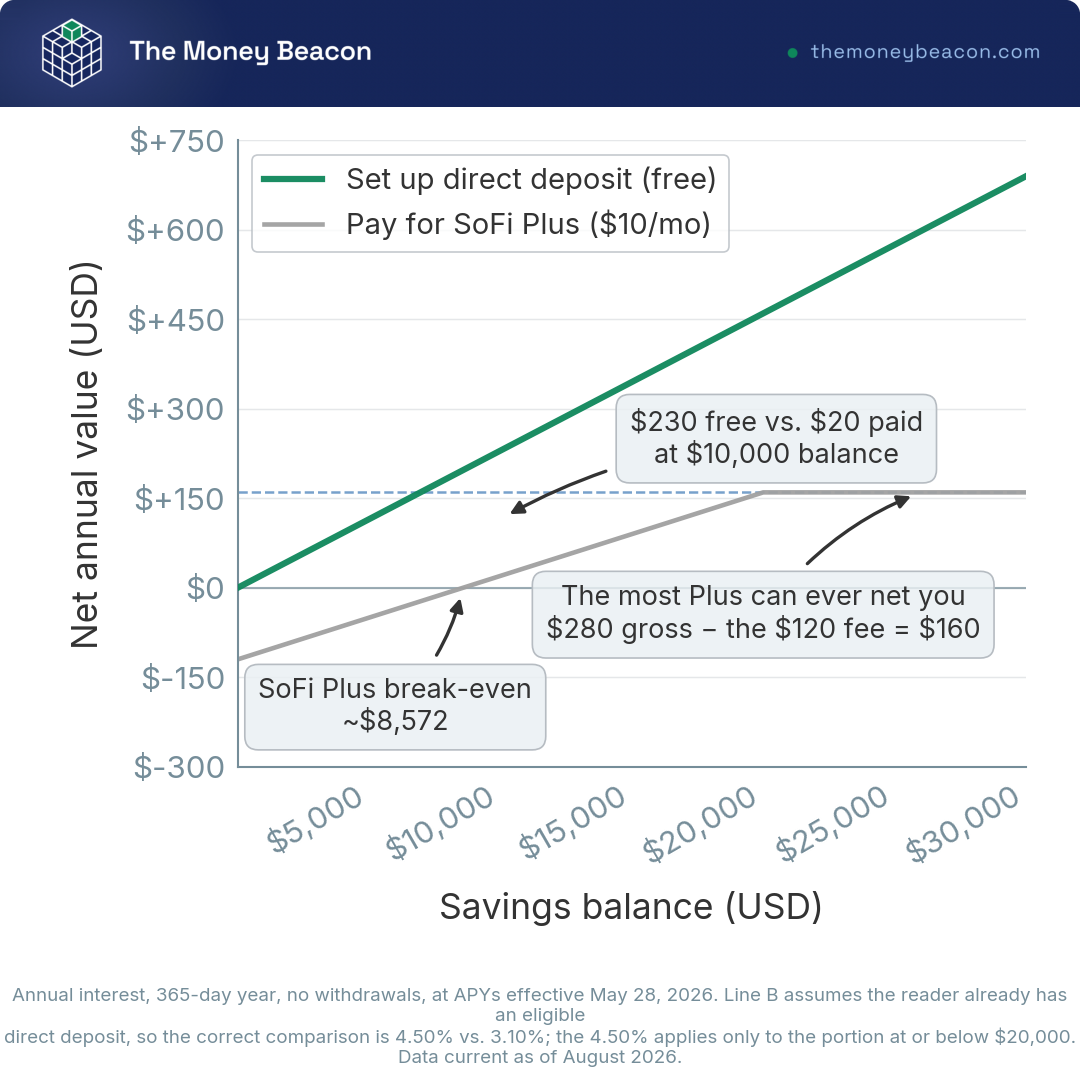
Break-even arrives at $8,572, and the gain stops at $160, because the tier ends at $20,000 and every dollar above it earns the free 3.10%.
That interest is the only benefit with a clean dollar value, and two advertised items aren’t exclusive to subscribers. The 0.25% member rate discount on a personal loan and the 0.125% on student loan refinancing and parent loans come equally with an eligible direct deposit or $5,000 in qualifying deposits. And non-Plus members already get a free 30-minute planner session. Counting those as subscription value counts them twice.
SoFi’s own “$1,000+ in value” footnote uses the same arithmetic. It counts total interest on $20,000 at the Plus tier, $900, rather than the $280 earned above the free rate, and it assumes the invite-only Unlimited 2% Card. Rebuild it on incremental value and it comes to roughly $310 plus soft value. Price it against a flat 2% card you can actually get.
3.2 The comparison that matters is against the free move, not against zero
That’s the subscription measured against zero. Against the free move it reads differently, because two distinct moves are on offer.
The free one is the direct deposit, which lifts your savings from the 0.80% Standard rate to 3.10% with no balance cap. That 2.30 point gap is worth $460 a year at $20,000 and $690 at $30,000, and it keeps growing.
The paid one is SoFi Plus on top. It lifts 3.10% to 4.50% on the first $20,000 only, a 1.40 point uplift worth $280 gross at most and $160 net of the $120 fee. A direct-deposit member can still buy it, so these are two separate routes, not alternatives.
Couples get one exception. When both joint holders subscribe and neither holds an individual savings account, the 4.50% covers the first $40,000 of the joint balance. SoFi’s own example puts $45,000 joint at 4.50% on $40,000 and 3.10% on $5,000, a blended 4.34%. Two subscriptions cost $240 and buy up to $560, so the couple break-even is about $17,143 and $30,000 nets about $180 a year. One trap cancels all of it. Open an individual savings account alongside the joint one and the 4.50% tier moves there, dropping the joint account to a flat 3.10% by the following business day. Cancel, and your rate reverts the day the subscription ends, with no partial refund.
But deposits were never the whole pitch. Bringing a paycheck here was supposed to bring everything else with it.
4. Borrowing and investing: is the rest of the bundle good enough to keep?
4.1 The advertised APR already includes every discount, and the average borrower pays 15.89%
Start with the personal loan, where the advertised number does more work than it should. The fixed range as of August 24, 2026 is 6.99% annual percentage rate (APR) to 35.49% APR, and both discounts are already included: the 0.25% for autopay and the 0.25% member rate your direct deposit already earns you. So 6.99% is the best case for the best borrower with everything switched on.
SoFi publishes the average too: 15.89% on 7-year loans funded between March 15, 2025 and March 15, 2026, on an average loan of about $33,000. Loans range from $5,000 to $100,000.
Then there’s the origination fee, where two true statements share one page. The product page markets “no origination fees required.” The footnote discloses a fee of 0% to 7%, deducted from the proceeds and reflected in the APR. Both are true, because the fee is optional and buys a lower stated rate. Accept 5% on a $30,000 loan and you receive $28,500 while repaying on $30,000.
The member discount is small. On that average loan it moves the payment from $658 to $653, $399 over seven years, and it’s re-tested every 31 days. Price yourself off the average, not the floor, before comparing SoFi with what other lenders charge on the same loan.
4.2 Refinancing a federal student loan is the one move you cannot undo
The other half of the lending arm is the one move you can’t take back. SoFi publishes 3.99% to 10.99% fixed and 5.74% to 10.99% variable as of August 24, 2026. The variable rate is indexed to the 30-day average secured overnight financing rate (SOFR) and capped at 13.95%. Autopay and the member discount are already applied here too. The minimum is $5,000, and the loans must have funded tuition at a Title IV accredited school at 50% time or more, meaning at least half time.
Now let’s price the trade. On SoFi’s own example of $50,000 over ten years at 6.34%, the 0.125% discount saves $3.16 a month, $379 across the decade. Here’s what that $379 costs a federal borrower.
| Federal protection lost | Practical consequence |
|---|---|
| Income-driven repayment | No payment floor tied to income if you lose your job or take a pay cut |
| Public Service Loan Forgiveness (PSLF) | Permanently ineligible, even if you later take a qualifying public-service job |
| Federal forbearance and deferment | Only whatever hardship policy the private lender offers |
| Death and disability discharge | Governed by the private loan contract, not federal law |
| Future federal relief programs | Ineligible by definition |
Data current as of August 2026.
SoFi spells the forfeiture out in capital letters in its own disclosure. A federal balance moved to a private lender never becomes federal again, whatever happens to your income later.
One wrinkle in that wording: the disclosure still names SAVE, a plan that no longer exists. The older income-driven plans (IBR, ICR and PAYE) remain, and the Repayment Assistance Plan is scheduled to be the only income-driven option for loans borrowed on or after July 1, 2026. Plan names change, the forfeiture doesn’t, so check studentaid.gov first. A purely private balance is a different question, and it’s a straight rate comparison against how private refinancing lenders price the same loan.
4.3 SoFi Invest is cheap to run and expensive to leave
The brokerage is a separate entity with its own fee schedule, so SoFi Bank’s clean fee sheet buys you nothing here. What you pay to get in is genuinely good: zero commissions on US listed securities, exchange-traded funds (ETFs) and options, no opening or annual fee, and $5 to start. Robo Investing costs 0.25% a year, and contributions to an individual retirement account (IRA) get a 1% match.
The fees that aren’t zero are the ones a long-term holder runs into. An outgoing automated customer account transfer (ACAT) is $100, charged on partial transfers as well as full ones, so moving three positions out costs the same as moving everything. Inactivity costs $25 per account every six months you don’t log in. That’s $50 a year for doing exactly what buy-and-hold investing asks of you, and closing an IRA is $100.
Each 1% match also has its own five-year clock. A $7,500 contribution earns $75 you keep only from year five, and leaving in year three costs that $75 plus the $100 ACAT, so a 1% incentive becomes a negative $25 exit.
Hank’s take
the behavioral research is clear here. The charges that change what savers actually do aren’t the big ones, they’re the small ones attached to leaving and to sitting still.
SoFi discloses a conflict of its own. Its Form ADV concedes a financial incentive to hold SoFi-sponsored ETFs “instead of potentially more-favorable alternatives,” and its April 2026 portfolio document puts the SoFi Select 500 ETF at up to 31% of the aggressive taxable Classic portfolio. The Securities and Exchange Commission (SEC) fined SoFi Wealth $300,000 in 2021 for moving about 20,000 robo accounts into two proprietary ETFs without disclosing the conflict.
For a lot of readers, the gaps are the deal-breaker. There are no individual bonds, Treasurys or brokered certificates of deposit (CDs), so no Treasury ladder here, while a broker that charges nothing to leave offers over 150,000 bonds and charges $0 to transfer an account out. There are no joint, trust or custodial accounts, and no automated tax-loss harvesting, which is standard at robos that harvest losses at no extra cost.
5. The verdict: who should consolidate at SoFi, and who should not
5.1 Run it on your own numbers
Four routes come out of all that, and which one is yours turns on a single question. Will a real direct deposit from your employer arrive at SoFi every 31 days, or can you move $5,000 of qualifying deposits inside that window?
If not, bank elsewhere for now. Without a qualifying deposit you’re at 0.80%, while Ally pays 3.00% on every balance with no condition attached. So fix the direct deposit first and come back. If yes, the free 3.10% is yours, and what’s left is how much cash you hold and what else you were moving. That splits three ways.
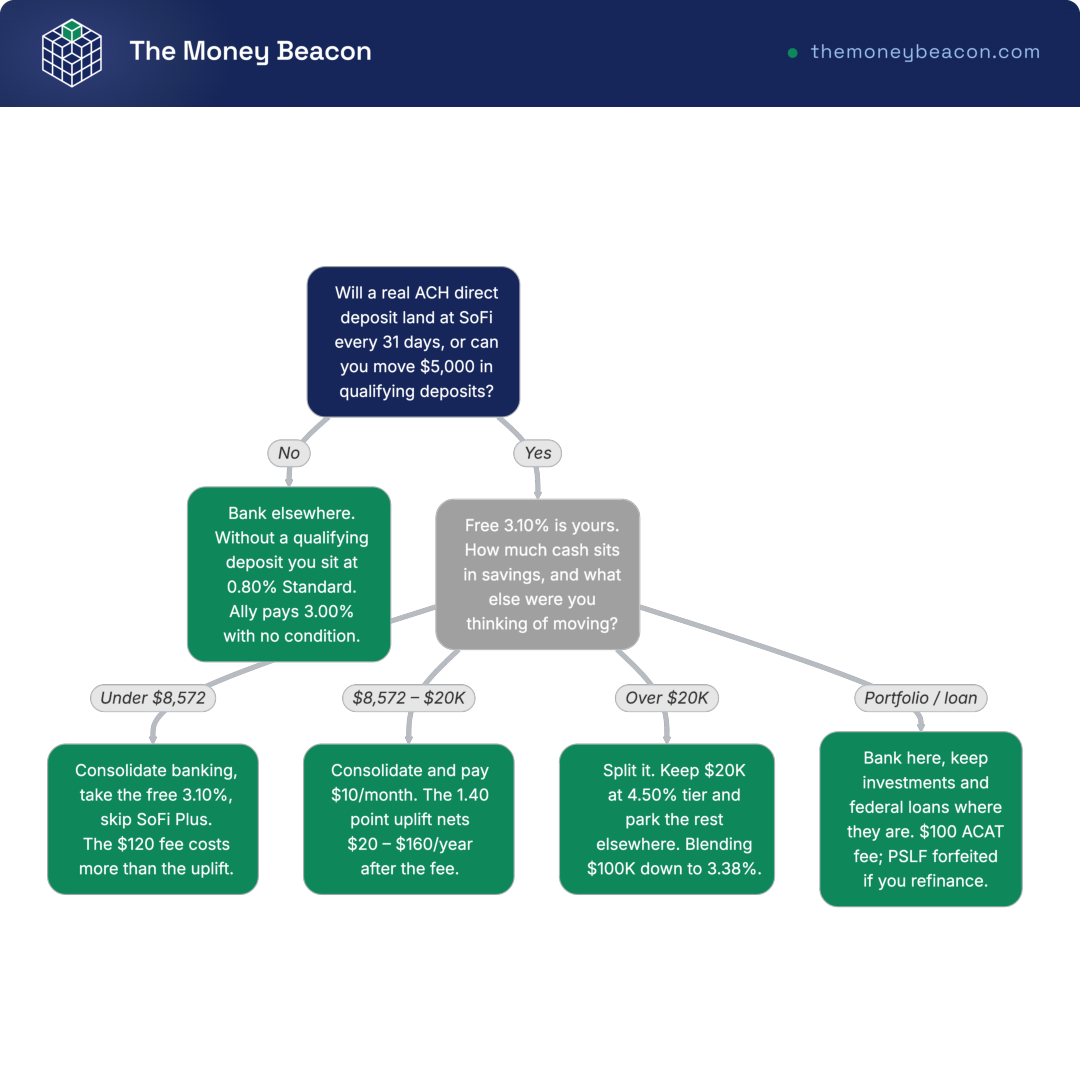
Under about $8,572 in savings, consolidate the banking, take the free 3.10% and skip SoFi Plus, because the $120 costs more than the uplift returns. Between about $8,572 and $20,000, consolidate and pay the $10 a month, because the uplift nets $20 to $160 a year after the fee. Above $20,000 in cash, split it. Keep $20,000 at the 4.50% tier and park the rest elsewhere, because the uplift is capped at $280 gross however much you add, and $100,000 blends down to 3.38%. And if a portfolio or a federal student loan was coming with you, bank here and leave those where they are.
That last route is really just matching each pot of cash to its horizon.
5.2 Who this fits, who it does not, and what you would be choosing against
Three profiles, three answers.
The direct-deposit household consolidating checking and savings: yes, conditionally. You get 3.10% free against a national average of 0.38%. The fee sheet has little more than a $30 wire on it. You get Overdraft Coverage to $50 and a paycheck up to two days early, and the subscription pays for itself between $8,572 and $20,000. Price your out-of-network ATM habit first, about $84 a year, and don’t expect Plus to scale past $160.
The federal student loan borrower: no, not for the federal portion, at any rate SoFi offers. $379 over ten years does not buy back PSLF, income-driven repayment or federal forbearance, and the forfeiture is permanent.
The investor looking for a primary brokerage: no. It’s fine as a satellite for stocks, ETFs and a robo sleeve. But the partial-transfer ACAT, the inactivity charge and the five-year clawback rule it out as the account that holds everything. So do the disclosed fund conflict and the missing Treasurys and tax-loss harvesting. I’d put the core of the portfolio where the primary account should sit instead.
Two things temper even the yes. Live phone support closes at 7 p.m. Pacific Monday to Thursday and 5 p.m. Friday to Sunday, with no published response time for chat or secure message. So if your account gets frozen, there’s no service level you can hold them to. And 2,268 of the 3,516 complaints filed against SoFi with the Consumer Financial Protection Bureau (CFPB) in the year to August 1, 2026 concern the checking or savings account, though all were answered on time and 8.0% closed with monetary relief.
Here’s what you’d be choosing against on the banking side.
| Positioning point | SoFi | Ally Bank | Fidelity Cash Management | Chime |
|---|---|---|---|---|
| Monthly fee and minimum balance | $0 and $0 | $0 and $0 | $0 and $0 | $0 and $0 |
| Out-of-network ATM | Charges $0, reimburses nothing | Up to $10 per statement cycle reimbursed | All fees reimbursed at Visa, Plus and Star ATMs | $2.50 per withdrawal, operator may add its own |
| Fee-free ATM network | 55,000+ Allpoint worldwide | 75,000+ | Reimbursed rather than networked | Over 50,000 in-network |
| Outgoing domestic wire | $30 | $20 | $0 | Not offered |
| Who holds the deposit | SoFi Bank, N.A.; FDIC to $250,000, up to $3 million via the opt-in sweep | Ally Bank | A Fidelity brokerage account; cash in SPAXX or the FDIC-insured sweep | Not a bank; The Bancorp Bank, N.A. and Stride Bank, N.A., Members FDIC |
Data current as of August 2026.
SoFi is the only one of the four that charges $30 to wire money out and reimburses nothing at an out-of-network ATM, and the only one whose best rate you rent by the month.
Conclusion
SoFi is cheap to join and costly to leave. Getting in is genuinely cheap, with no monthly fee, no minimum balance, zero commissions and $5 to start investing. Almost every real charge shows up on the way out instead. There’s $100 to transfer a brokerage account you’ve outgrown, $25 every six months you don’t log in, a five-year clock on the retirement match, and a federal student loan protection that no rate discount ever buys back. None of that is on the page that sold you the rate.
The second thing worth remembering is that the two upgrades on offer here aren’t the same upgrade, and people routinely buy the smaller one first. Ten dollars a month raises the rate on only part of your savings, and it stops adding anything past about $160 a year. Set up an eligible direct deposit, or move $5,000 of qualifying deposits within a rolling 31 days, and your savings goes from the 0.80% standard rate to 3.10% on every dollar you hold. So make the free move this week, check the APY Details page after your next payday to confirm it, and only then work out whether the subscription is worth buying on top.
For the cash that won’t fit under that $20,000 tier, the next thing to read is where CD rates stand right now. If you came to SoFi for the loan rather than the account, you’ll get more from how consolidation math works on a real card balance, and if you’re keeping your portfolio elsewhere, start with what the big index funds charge to hold them.
FAQ: SoFi insurance, limits, taxes and the cards
Is SoFi a real bank, and is my money FDIC insured?
Yes, and this is one place SoFi is stronger than most banking apps. SoFi Bank, N.A. holds its own national charter from the Office of the Comptroller of the Currency (OCC), granted January 18, 2022, and carries FDIC certificate 26881, so your deposits aren’t parked at a partner bank. Standard coverage is $250,000 per depositor per ownership category, or $500,000 on a joint account.
Above that, a free opt-in sweep called the SoFi Insured Deposit Program spreads your balance across partner banks, with two catches. Money you already hold at a participating bank counts toward your limit there, in SoFi’s own words, so the sweep creates no new capacity. And SoFi’s pages disagree on the ceiling: its FDIC and banking pages say up to $3 million, its SIPC page says $2 million, and nothing it publishes reconciles the two.
Which SoFi company actually holds my money?
Three different ones, and the distinction decides what protects you. Deposits and cards sit with SoFi Bank, N.A. under the OCC and the FDIC. The brokerage is carried by SoFi Securities LLC, registered with the SEC and the Financial Industry Regulatory Authority (FINRA) under CRD 151717, with Apex Clearing Corporation holding the accounts and securities. Robo Investing is run by SoFi Wealth LLC, a registered investment adviser.
So brokerage money isn’t FDIC insured. Securities Investor Protection Corporation (SIPC) coverage of $500,000, including a $250,000 cash sub-limit, protects you if the broker fails, not if your investments fall. And SoFi Wealth’s Form ADV discloses a financial incentive to hold SoFi’s own funds, so guidance with no product incentive behind it is a fee-only fiduciary search rather than a robo one.
What are SoFi’s limits on moving money in and out?
Two daily caps matter, both from SoFi’s support pages: $50,000 for an automated clearing house transfer, $1,000 at an ATM. Cash is the awkward one: SoFi charges nothing to take a deposit, but you make it at a Green Dot retail partner, and the partner can charge up to $4.95. Spend abroad and a 0.2% Mastercard foreign exchange fee applies on top of whatever the ATM operator adds.
Why won’t SoFi let me overdraft more than $50?
Because Overdraft Coverage is a fee-free courtesy, not a credit line. It lets checking run to negative $50 on debit card and digital wallet purchases only, and takes $1,000 or more in eligible direct deposits over a rolling 31 days to switch on. Push past the $50 and the purchase is declined, which is the trade: SoFi charges no overdraft fee at all. It doesn’t cover ATM or counter cash, ACH, peer-to-peer transfers or Bill Pay, and it’s the lowest ceiling of the three: Chime’s SpotMe reaches $200, Ally’s CoverDraft $250.
Overdraft Protection is the separate feature every member gets from day one, pulling from your own SoFi Savings to cover any payment type, never from Vaults, at no charge. One switching note: a new direct deposit can take two weeks to register.
Is the SoFi checking and savings bonus taxable?
Yes, and it’s the part people forget when they price the offer. The welcome bonus, $50 or $400 depending on how much eligible direct deposit lands in the qualifying window, is miscellaneous income in the year you receive it, which SoFi may report on a 1099-MISC. At a 24% federal bracket, $400 is really about $304 before state tax.
Interest works the same way. It’s ordinary income on a 1099-INT once it reaches $10, so the 4.50% that a paid SoFi Plus subscription buys on your first $20,000 is nearer 3.42% after federal tax at that bracket. Gains and dividends in a taxable account follow the rules I’ve set out in the guide to how investment income is taxed, while inside a Roth IRA qualified withdrawals come out tax free.
Can I actually apply for the SoFi credit card everyone quotes?
Probably not. SoFi has three cards and two are invite only: the flat Unlimited 2% card that most SoFi coverage quotes, and the credit-building SoFi Essential. The card with an open application is the Everyday Cash Rewards, paying 3% on dining, 2% on groceries and 1% on everything else, with no annual fee and points worth 1 cent each. SoFi recommends it for excellent credit, and offers no secured card.
Read the pricing terms first, because the marketing page doesn’t show them. As published in August 2026, the purchase annual percentage rate (APR) ranges from 19.24% to 32.99% variable, the late fee reaches $41, and a cash advance or balance transfer costs the greater of $10 or 5% of it. At that 19.24% floor, carrying a balance costs more than 3% back can return.




Comments
Questions and corrections welcome. We read everything.