


Your financial aid award letter arrives, you accept every federal dollar on it, and the total still doesn’t cover the bill. So the private loan search starts. Every lender advertises a rate “as low as” some floor that almost no applicant gets. The terms that actually decide what you pay are buried in a disclosure document nobody opens.
2026 is the year that gap got wider. On July 1, 2026, the One Big Beautiful Bill Act ended Direct PLUS loans for graduate and professional students. It also capped Parent PLUS for the first time. Graduate borrowers used to have a federal backstop that covered the full cost of attendance. That’s gone now, and losing it is the single biggest driver of new private borrowing this year.
Two rules come before any rate comparison. Take every federal dollar first: federal student loans are priced at 6.52% fixed for undergraduates this award year, and they come with protections no private contract matches. Private money is for the gap that’s left, not a substitute for the federal loan you skipped. And student loan refinancing has a catch. Move federal debt to a private lender and you permanently give up income-driven repayment and forgiveness, with no path back into the federal system.
1. How we compared the six lenders, and why federal loans still come first
Six lenders, eight criteria, and one rule that outranks all of them. Before a private rate means anything, you need the federal benchmark it has to beat.
1.1 Federal loans first, and the 2026 numbers that prove it
For loans first disbursed between July 1, 2026 and June 30, 2027, the federal student loans interest rate is 6.52% fixed for undergraduates, 8.07% for graduate and professional students, and 9.07% on Direct PLUS. Origination fees are 1.057% on Subsidized and Unsubsidized loans and 4.228% on PLUS, deducted before the money reaches your school.
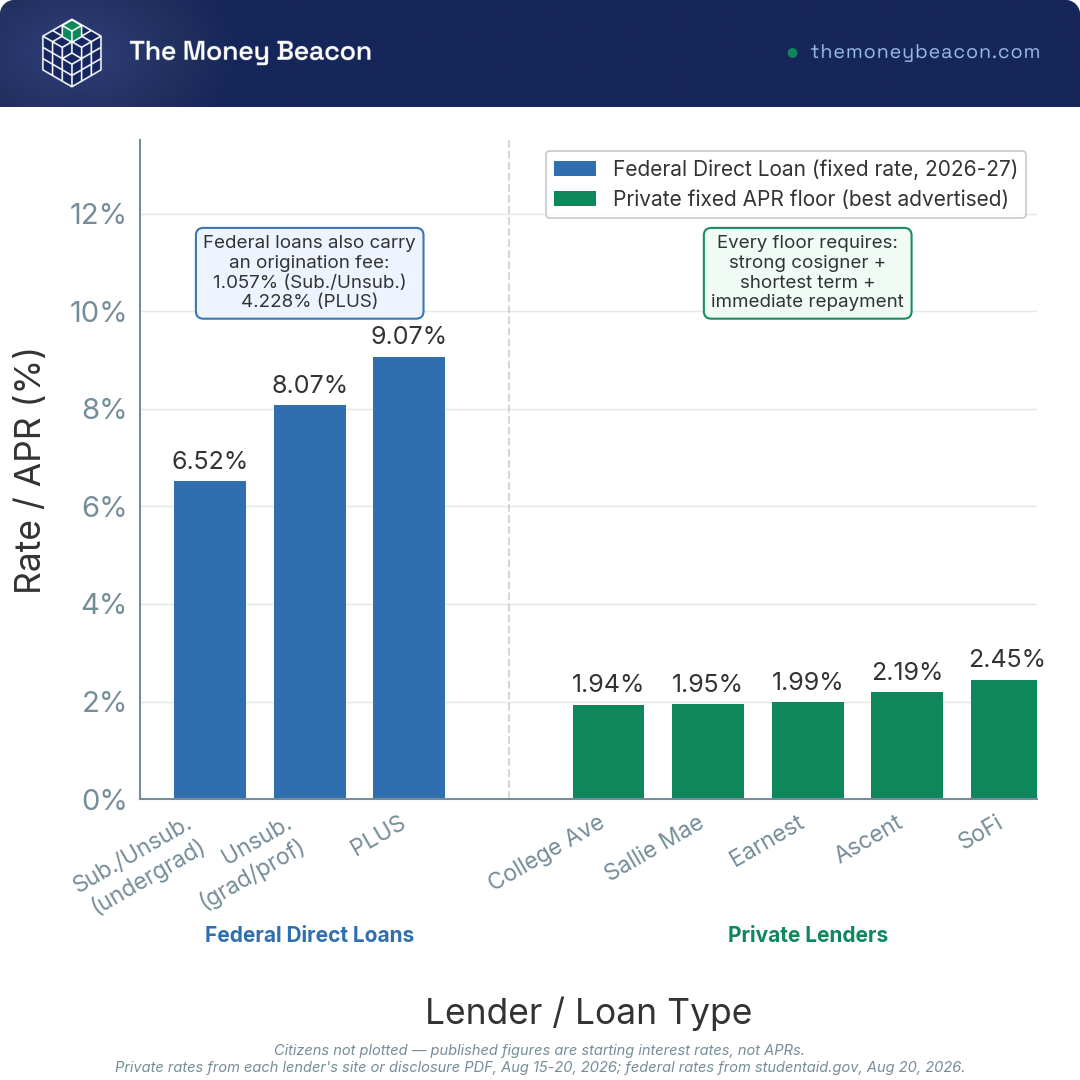
Yes, five private floors come in below the federal bars. But every one is an annual percentage rate (APR) that only the strongest applicants are offered, for reasons section 1.5 takes apart. So take every federal Direct dollar first, then borrow only the remainder of your school-certified cost of attendance.
1.2 What OBBBA changed on July 1, 2026
The One Big Beautiful Bill Act (OBBBA), signed July 4, 2025, applies to loans first disbursed on or after July 1, 2026. Grad PLUS is gone: graduate students are now capped at $20,500 a year and $100,000 total, professional students at $50,000 and $200,000, with no cost-of-attendance backstop. Parent PLUS caps at $20,000 a year per student and $65,000 across all parents, under a $257,500 student lifetime maximum. Federal student loans repayment now happens through the Repayment Assistance Plan (RAP) or a Tiered Standard Plan.
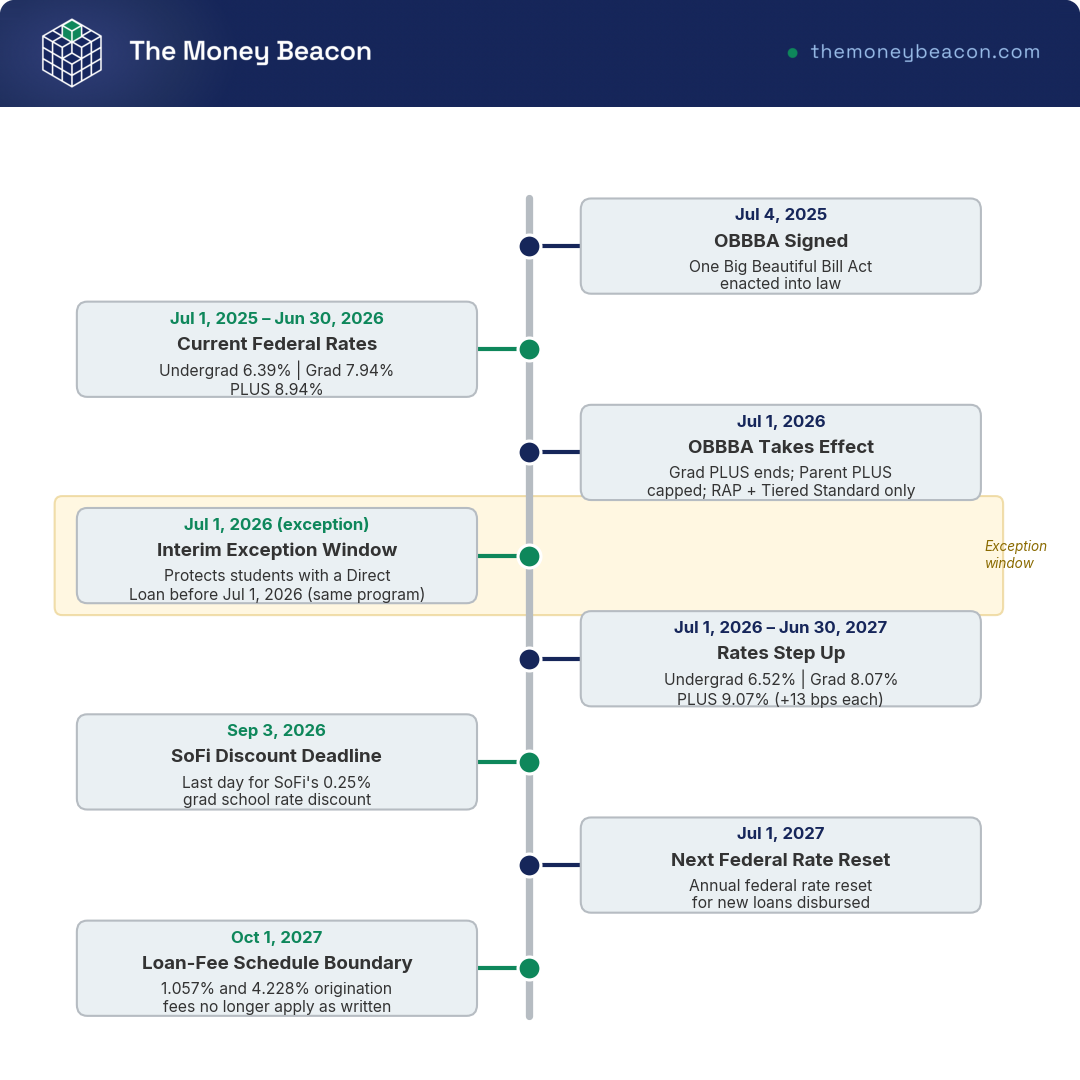
Took a Direct Loan for the same program and school before July 1, 2026, and stayed enrolled? You keep the old limits, and you can’t opt out.
Hank’s take

ending Grad PLUS didn’t make graduate school cheaper. It moved the financing from a statutory program to an underwriting desk, and that explains most of this year’s jump in private borrowing.
1.3 Refinancing federal debt is a one-way door
Refinancing a federal loan into a private one is the only decision in this comparison that can never be undone. Each row below is a right you hand back, starting with a payment tied to your adjusted gross income (AGI).
Protections lost when a federal loan is refinanced into a private loan
| Protection | Federal Direct Loan | Private loan after refinance |
|---|---|---|
| Income-driven payment (RAP or legacy IDR) | Yes, payment tied to AGI | No, payment fixed by amortization |
| Interest subsidy while enrolled in RAP | Yes | No |
| Balance discharged after 360 payments | Yes | No |
| Public Service Loan Forgiveness | Yes, on qualifying plans | No, permanently ineligible |
| Death discharge | Yes, statutory | Lender policy: published by Sallie Mae, College Ave, and SoFi; not published by Earnest, Citizens, or Ascent |
| Total and permanent disability discharge | Yes, statutory | Lender policy: published by Sallie Mae and College Ave; SoFi states disability discharge does not apply to its private student loans; not published by Earnest, Citizens, or Ascent |
| Unemployment and economic hardship deferment | Yes, statutory | Lender policy only, months capped |
| Rate set by Congress | Yes | No, set by underwriting |
| Consolidation back into federal | Not applicable | Impossible |
Sign, and they all go at once, every route to student loan forgiveness included. Read that silence as a term you haven’t seen yet, not as a refusal.
1.4 The eight criteria this comparison scores
Eight things decide what a private loan costs you, and they don’t carry equal weight.
Comparison criteria, weight, and why it matters to the borrower
| Criterion | Weight | Why it changes the dollar outcome |
|---|---|---|
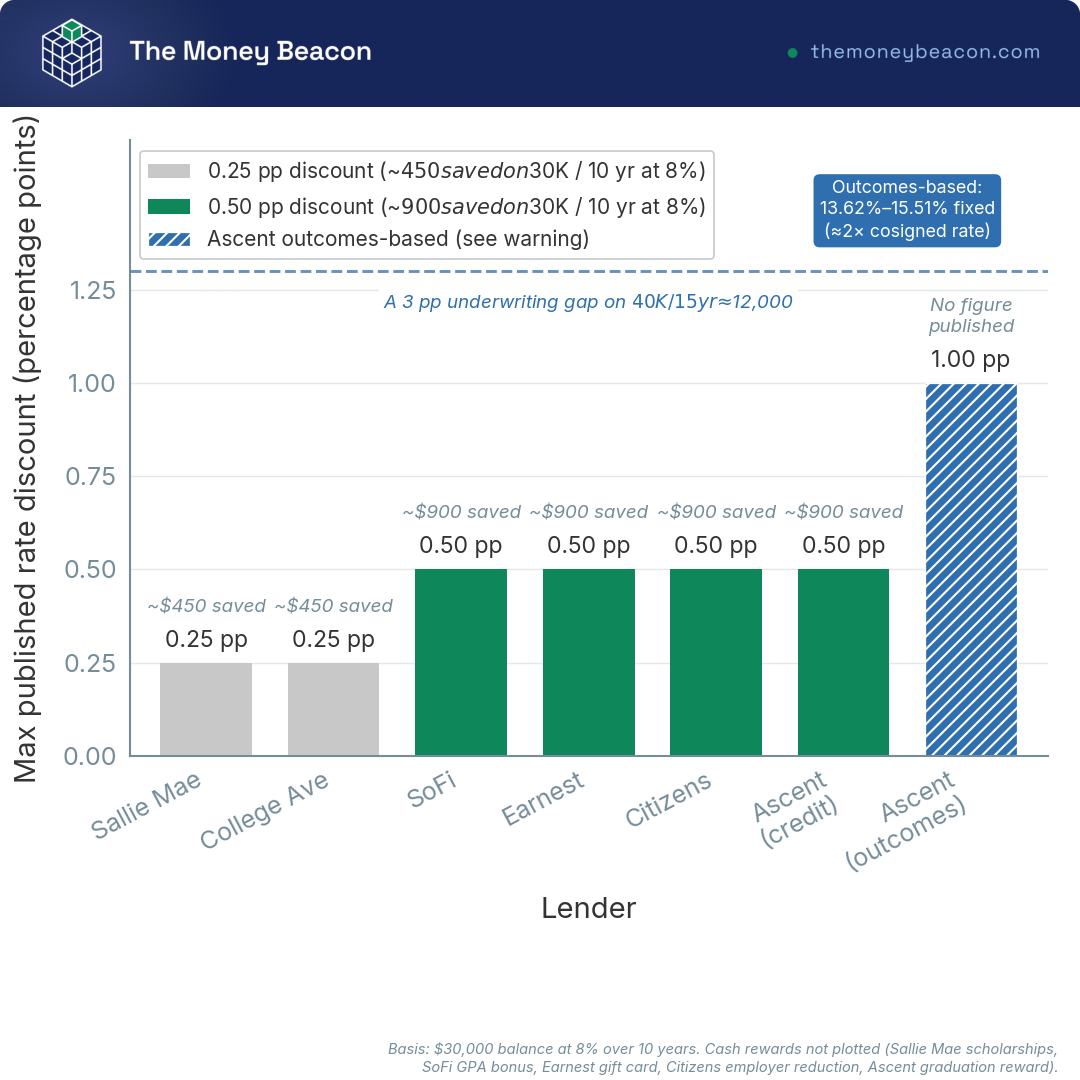
| APR range, fixed and variable, with discounts | High | The single largest cost driver; a 3-point difference on $40,000 over 15 years is roughly $12,000 |
| Fees (origination, application, late, prepayment) | High | An origination fee is paid whether or not the loan is prepaid |
| Loan amounts and available terms | Medium | Term length changes total interest more than a small rate difference |
| In-school repayment options | High | Deferred repayment capitalizes interest and permanently raises the balance |
| Cosigner requirement and release conditions | High | Release conditions decide how long a parent’s credit stays exposed |
| Grace, deferment, forbearance | Medium | The only downside protection a private borrower has |
| Eligibility (school type, citizenship, credit) | Gate | A lender that will not lend to your school or status has no rate |
| Rewards and discounts | Low | Real but small: 0.25% autopay is about $16 a year on $10,000 |
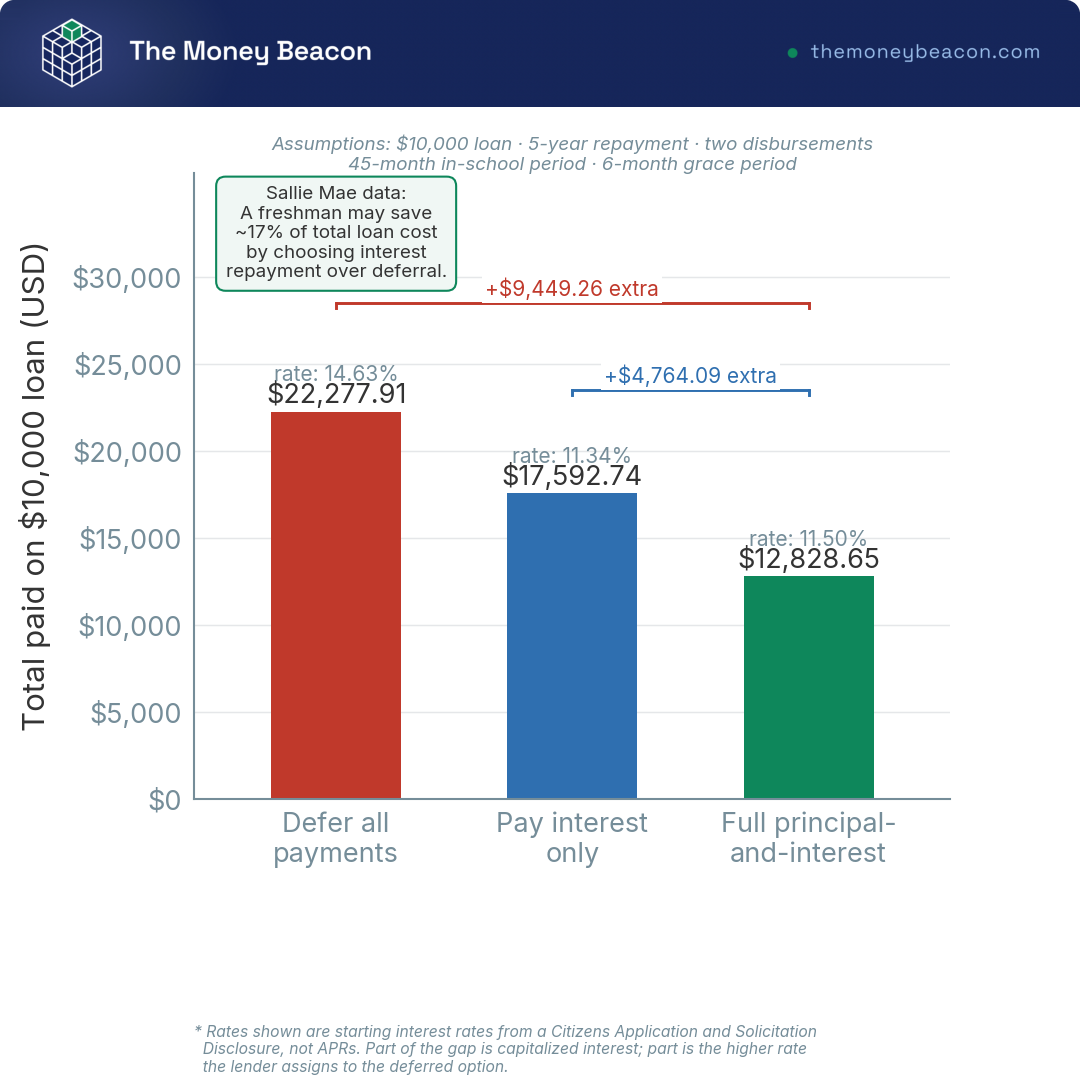
The in-school line is the one borrowers underrate. Choose deferred payments and the unpaid interest capitalizes: it’s added to principal when your grace period ends, and from there on you pay interest on the bigger balance.
1.5 Why the advertised floor is almost never your rate
Every lender in this comparison attaches the same three conditions to its floor: a strong cosigner, the shortest term, and full principal-and-interest payments while you’re enrolled.
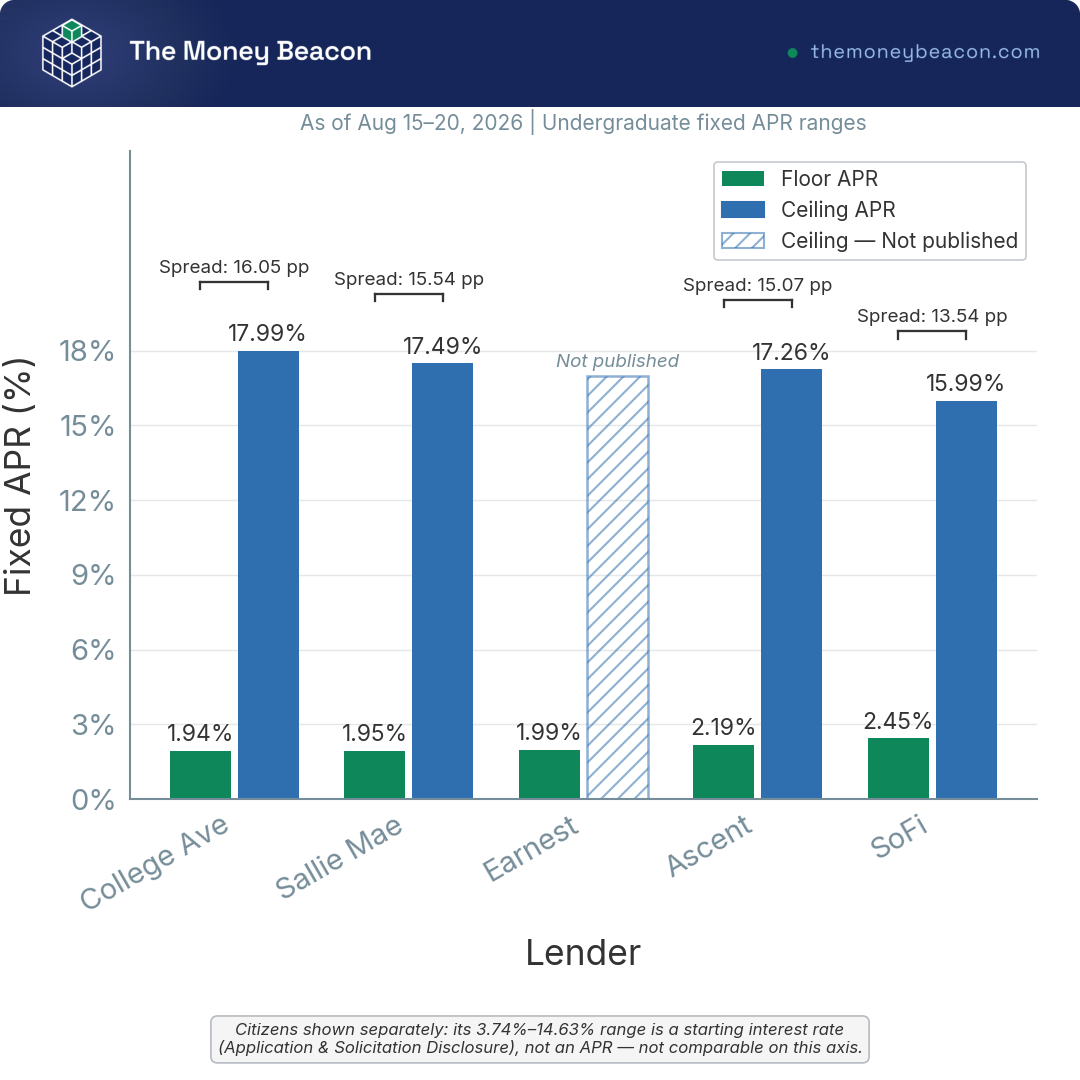
A single lender can price a spread of more than 15 percentage points, so the floor tells you almost nothing about your own offer. So prequalify at two or three lenders and compare real offers, not marketing floors.
1.6 Two features that shrink the field before rates matter
Two yes-or-no questions rule lenders out faster than any rate ranks them. Does this lender refinance? And does it publish a cosigner release path, the process for getting a cosigner’s name off the loan?
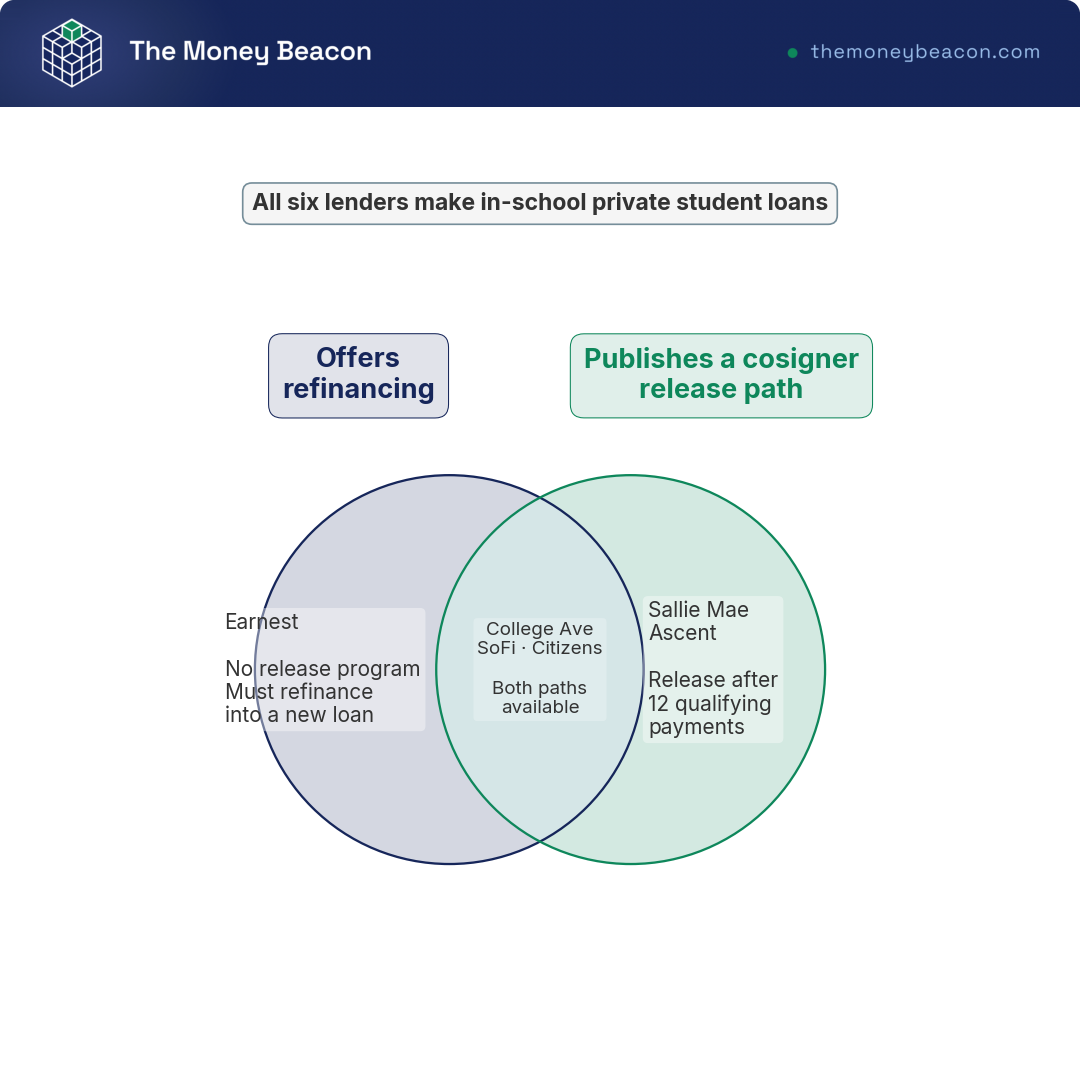
All six lend in school. Only College Ave, SoFi, Earnest, and Citizens are student loan refinancing lenders, and only Sallie Mae, College Ave, SoFi, Citizens, and Ascent publish a release path. Earnest is the exception: it refinances but runs no release program, so freeing a cosigner there means a brand new loan.
1.7 The six lenders at a glance
The six lenders at a glance
| Lender | Products | Advertised fixed APR (in-school) | Advertised variable APR (in-school) | Refinancing | Standout |
|---|---|---|---|---|---|
| Sallie Mae | Undergrad, career training, grad, parent | 1.95% to 17.49% | 3.62% to 16.83% | No, not offered | Widest school and program coverage |
| College Ave | Undergrad, grad, parent, refi | 1.94% to 17.99% | 3.89% to 17.99% | Yes, 6.99% to 13.99% | Choose your own term and repayment option |
| SoFi | Undergrad, grad, parent, refi | 2.45% to 15.99% | 4.39% to 15.99% | Yes, 3.99% to 10.99% | Lowest published refinance ceiling |
| Earnest | Undergrad, grad, parent, refi, Parent PLUS refi | Starting 1.99% (cosigned) | Starting 5.62% | Yes, from 4.45% fixed | 9-month grace, skip a payment yearly |
| Citizens | Undergrad, grad, parent, refi, residency refi | 3.74% to 14.63% (interest rate, not APR) | 5.44% to 14.21% (interest rate, not APR) | Yes, 6.39% to 10.64% (interest rate, not APR) | Multi-Year Approval, 0.50% stacked discounts |
| Ascent | Undergrad, grad, parent, bootcamp | 2.19% to 17.26% (cosigned) | 3.64% to 16.30% (cosigned) | No, not offered | Non-cosigned and outcomes-based underwriting |
Data current as of August 2026.
Two rules for reading it. The Citizens figures are starting interest rates from its Application and Solicitation Disclosures, not APRs. An interest rate prices the balance, while an APR also takes into account required fees and the repayment structure. So the Citizens cells can’t be read straight down the column. And Earnest publishes starting rates rather than complete ranges, so its ceiling is unknown, not low. A blank ceiling is not a low ceiling.
2. Sallie Mae: the widest program coverage in the group, and no refinancing
2.1 Overview
Sallie Mae Bank covers more ground than anyone else in this comparison: associate and bachelor’s degrees, career training and certificate programs, ten graduate and professional loan types, plus a parent loan added in 2026. What it won’t do is lend to you twice: no consolidation, no refinancing, so a student loan refinance later means changing lenders. And 91% of its undergraduate loans were cosigned last year.
2.2 Strengths
Coverage is the main strength. The published fixed floor is 1.95% APR, and one of the three in-school repayment options is a flat $25 a month that keeps some interest from capitalizing. Cosigner release counts payments, not elapsed years: 12 on-time principal-and-interest payments. There’s a $2,000 no-essay undergraduate scholarship plus a $5,000 graduate scholarship sweepstakes.
2.3 Weaknesses
A family that wants one relationship through payoff will move on. Interest-only and $25 fixed payments made in school don’t count toward the 12 payments release requires, and parent loans originated after May 2026 are shut out of release entirely. Maximum cumulative forbearance isn’t published; that term is in the promissory note.
2.4 Pricing & fees
Sallie Mae pricing and fees
| Item | Value |
|---|---|
| Fixed APR, undergraduate | 1.95% to 17.49% |
| Variable APR, undergraduate | 3.62% to 16.83% |
| Variable index | 30-day average SOFR, rounded up to nearest one-eighth of one percent |
| Autopay discount | 0.25 percentage points, active repayment only |
| Origination, application, disbursement fee | None |
| Late charge | 5% of the past due payment, capped at $25 |
| Minimum loan | $1,000 |
| Maximum loan | 100% of school-certified cost of attendance |
| Terms | 10 to 15 years on most products; up to 20 years, and in some cases 25, on the Medical School Loan |
| Grace period | 6 months |
| In-school options | Interest-only, $25 fixed, deferred |
| Cosigner release | After graduation plus 12 on-time principal-and-interest payments |
| Refinancing | Not offered |
Data current as of August 2026.
The index is the 30-day average Secured Overnight Financing Rate (SOFR), so a variable loan resets with the market and the 3.62% floor is a starting point, not a promise. The autopay discount applies in active repayment only, so it saves you nothing while you’re enrolled.
2.5 Who it’s for
Sallie Mae is ideal for the undergraduate with a creditworthy cosigner, especially at a career training or certificate program narrower lenders won’t certify. It’s not the right choice if you have no cosigner, or if you’re counting on refinancing with the same lender later.
3. College Ave: pick your own term and your own in-school payment
3.1 Overview
College Ave student loans let you make the big decisions yourself: four in-school repayment options and a term you pick (5, 8, 10, or 15 years on undergraduate loans) instead of one the lender assigns. It does refinance, from 6.99% to 13.99% APR on terms of 5 to 20 years, with maximums scaled by degree.
3.2 Strengths
The published fixed floor is 1.94% APR on undergraduate loans, the lowest in this comparison. Cosigner release doesn’t wait for graduation; it opens at the halfway point of the original term. Grace ranges from 6 months on undergraduate loans to 36 months on medical, the longest in this comparison. Refinance ceilings reach $500,000 for medical, dental, pharmacy or veterinary doctorates, $300,000 for other graduate degrees, $150,000 otherwise.
3.3 Weaknesses
The ceiling is 17.99% APR on both fixed and variable, the highest in this comparison. Release is time-based, not payment-based, so a 15-year loan needs 7.5 years of principal-and-interest payments before release is possible. The 6.99% APR refinance floor is three points above the cheapest in this comparison. The variable-rate lifetime cap and the late payment fee aren’t on the product pages; both are in the Application and Solicitation Disclosure.
3.4 Pricing & fees
College Ave prices three products, and they don’t behave alike.
College Ave pricing and fees
| Item | Undergraduate | Graduate | Refinance |
|---|---|---|---|
| Fixed APR | 1.94% to 17.99% | 2.09% to 15.99% | 6.99% to 13.99% |
| Variable APR | 3.89% to 17.99% | 3.89% to 15.99% | 6.99% to 13.99% |
| Application / origination fee | None | None | None |
| Autopay discount | 0.25% | 0.25% | 0.25% |
| Minimum loan | $1,000 | $1,000 | $5,000 |
| Maximum loan | 100% of certified cost of attendance | 100% of costs | $150,000 to $500,000 by degree |
| Terms | 5, 8, 10, 15 years | Varies by program | 5 to 20 years |
| Grace period | 6 months | 9 months (grad, MBA, law, health professions), 12 months dental, 36 months medical | Not applicable |
| Refinancing | Offered | Offered | Offered |
Data current as of August 2026. Refinance figures valid as of August 18, 2026; grace periods per the College Ave help center.
Don’t carry that 1.94% floor across to the refinance column. The two products are underwritten differently, and the refinance floor is 6.99%, five points higher at the same lender.
3.5 Who it’s for
College Ave is ideal if you want to set the term and the in-school payment yourself, or if you need a refinance ceiling above $300,000 for a doctorate. It’s not the right choice for a family whose priority is freeing the cosigner quickly.
4. SoFi: the strongest published refinancing numbers, and the tightest eligibility
4.1 Overview
SoFi’s offer is a straight trade. A SoFi student loan refinance is priced from 3.99% to 10.99% APR fixed, with the variable rate capped at 13.95% by contract. The catch is who gets in: the private student loan needs a bachelor’s degree program or higher, so associate-degree students are out.
4.2 Strengths
Almost everything SoFi does well shows up once you already hold a degree and a real balance.
- That 10.99% APR refinance ceiling is the lowest in this comparison, and the variable rate can’t exceed 13.95%.
- No dollar ceiling on a refinance, terms out to 20 years, and Parent PLUS and resident debt qualify.
- No fees of any kind, including no late fee. A $250 cash bonus at a 3.0 or higher GPA.
- A graduate promotion prices as low as 2.45% APR for applications by September 3, 2026.
- Discounts stack: 0.25% autopay, 0.125% member rate, 0.125% for returning in-school borrowers. The member rate needs an account, so weigh its banking, investing, and lending products first.
4.3 Weaknesses
The price of those terms is a narrow front door and thin cover once you’ve signed.
- Associate-degree students can’t get the private student loan at all, and bar and residency loans can’t be refinanced.
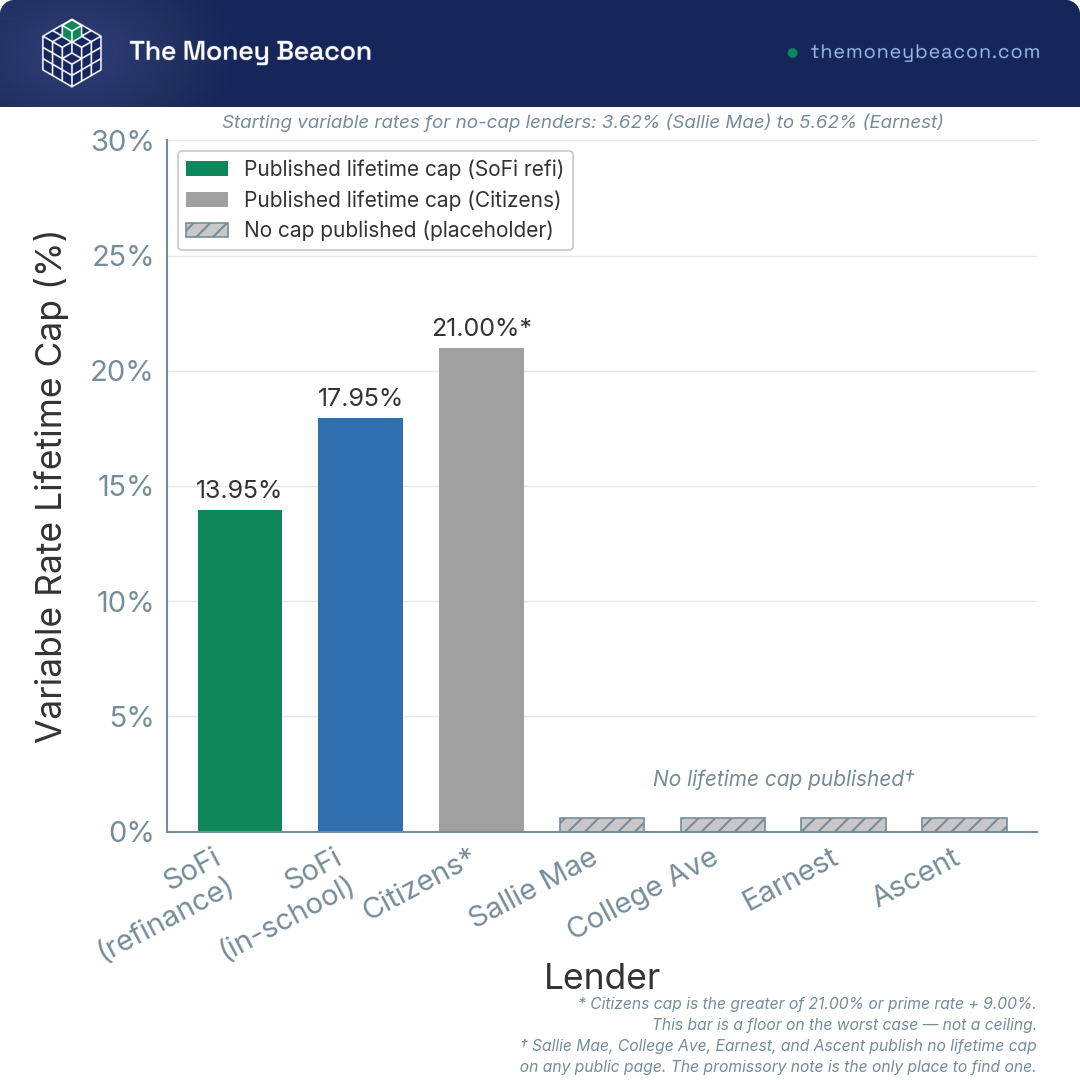
- The in-school variable rate can reach a 17.95% cap, the highest contractual cap in this comparison.
- Cosigner release takes 24 consecutive on-time full principal-and-interest payments, the longest published requirement in this comparison.
- SoFi’s materials say a private loan may be discharged at death, but disability discharge doesn’t apply to its private student loans.
4.4 Pricing & fees
SoFi pricing and fees
| Item | Private student loan | Refinance |
|---|---|---|
| Fixed APR | 2.45% to 15.99% | 3.99% to 10.99% |
| Variable APR | 4.39% to 15.99% | 5.74% to 10.99% |
| Variable rate cap | 17.95% | 13.95% |
| Rates as of | 8/19/26 | 8/20/26 |
| Discounts included | 0.25% autopay | 0.25% autopay plus 0.125% member |
| Fees | None | None |
| Minimum loan | $1,000 | $5,000 |
| Maximum loan | 100% of school-certified expenses | Full balance of qualified education loans |
| Terms | 5, 7, 10, 15 years | 5, 7, 10, 15, 20 years |
| Grace period | 6 months | Not applicable |
| Cosigner release | 24 consecutive on-time principal-and-interest payments | Not applicable |
| Index | 30-day average SOFR | 30-day average SOFR |
Data current as of August 2026. Terms, maximum refinance amount, and grace period per SoFi Support.
The SoFi student loan refinance rates in that table already include the autopay and member discounts. If you don’t qualify for the member rate, your real floor starts higher, so read it upward before comparing offers.
4.5 Who it’s for
SoFi is the best choice for the graduate with a completed bachelor’s degree and a big enough balance. That’s where a three to four point rate cut outweighs permanently losing federal protections. It’s not the right choice for an associate-degree student.
5. Earnest: published rules, a nine-month grace, and no cosigner release
5.1 Overview
Earnest publishes what it actually requires, in numbers. Earnest student loans come with printed floors on the FICO score, the credit score most US lenders underwrite from: 650 to refinance with a completed degree, 665 for a Parent PLUS refinance or an incomplete degree, and 650 with three years of credit history for a cosigner. It refinances from 4.45% fixed and treats Parent PLUS refinancing as a named product.
5.2 Strengths
Earnest competes on breathing room rather than on the cheapest advertised number.
- A nine-month grace period, three months longer than the standard, on in-school loans not on the principal-and-interest plan.
- Skip one payment every 12 months after six consecutive on-time principal-and-interest payments.
- No origination, late payment, returned check, or prepayment fees on either product.
- In-school borrowing to 100% of the certified cost of attendance, with a $400,000 lifetime maximum.
- A rate-match guarantee pays a $100 Amazon gift card if a competitor beats the offer.
5.3 Weaknesses
Two of these are hard stops rather than drawbacks you can plan around.
- Earnest publishes no cosigner release at all; removing a cosigner means refinancing into a brand-new loan.
- It doesn’t lend in Mississippi, and variable rates are unavailable in Alaska, Illinois, Minnesota, New Hampshire, Ohio, Tennessee, and Texas.
- In-school loans require a Title IV-qualified school, meaning one approved for federal student aid, and it must be not-for-profit and four-year, so community colleges, for-profit schools, and trade programs are out.
- No death or disability discharge policy appears on its public pages, and no forbearance cap.
5.4 Pricing & fees
Here’s what both Earnest products cost, with their eligibility rules.
Earnest pricing and fees
| Item | Private student loan | Refinance |
|---|---|---|
| Fixed APR | Starting 1.99% (cosigned) | Starting 4.45% |
| Variable APR | Starting 5.62% | Starting 5.89% |
| Discounts | 0.25% autopay plus 0.25% loyalty | 0.25% autopay |
| Fees | None (Florida stamp tax $0.35 per $100) | None |
| Minimum loan | $1,000 ($1,501 in Hawaii) | $5,000 ($10,000 CA, $10,001 NM) |
| Maximum loan | 100% of certified cost of attendance, $400,000 lifetime | Full qualified balance |
| Terms | 5 to 15 years | 5, 7, 10, 12, 15 years |
| Grace period | 9 months (not with in-school P and I) | Match up to 9 months of existing grace |
| Skip a payment | One per 12 months after 6 on-time payments | Same |
| Minimum FICO | 650 (cosigner or independent borrower) | 650, or 600 primary with a 650 cosigner |
| Cosigner release | Not offered; refinancing is the only path | Not applicable |
Data current as of August 2026. Earnest states its in-school rate examples as of 03/19/2026 and its feature comparison as of May 12, 2026; the page itself was last updated 08/11/2026.
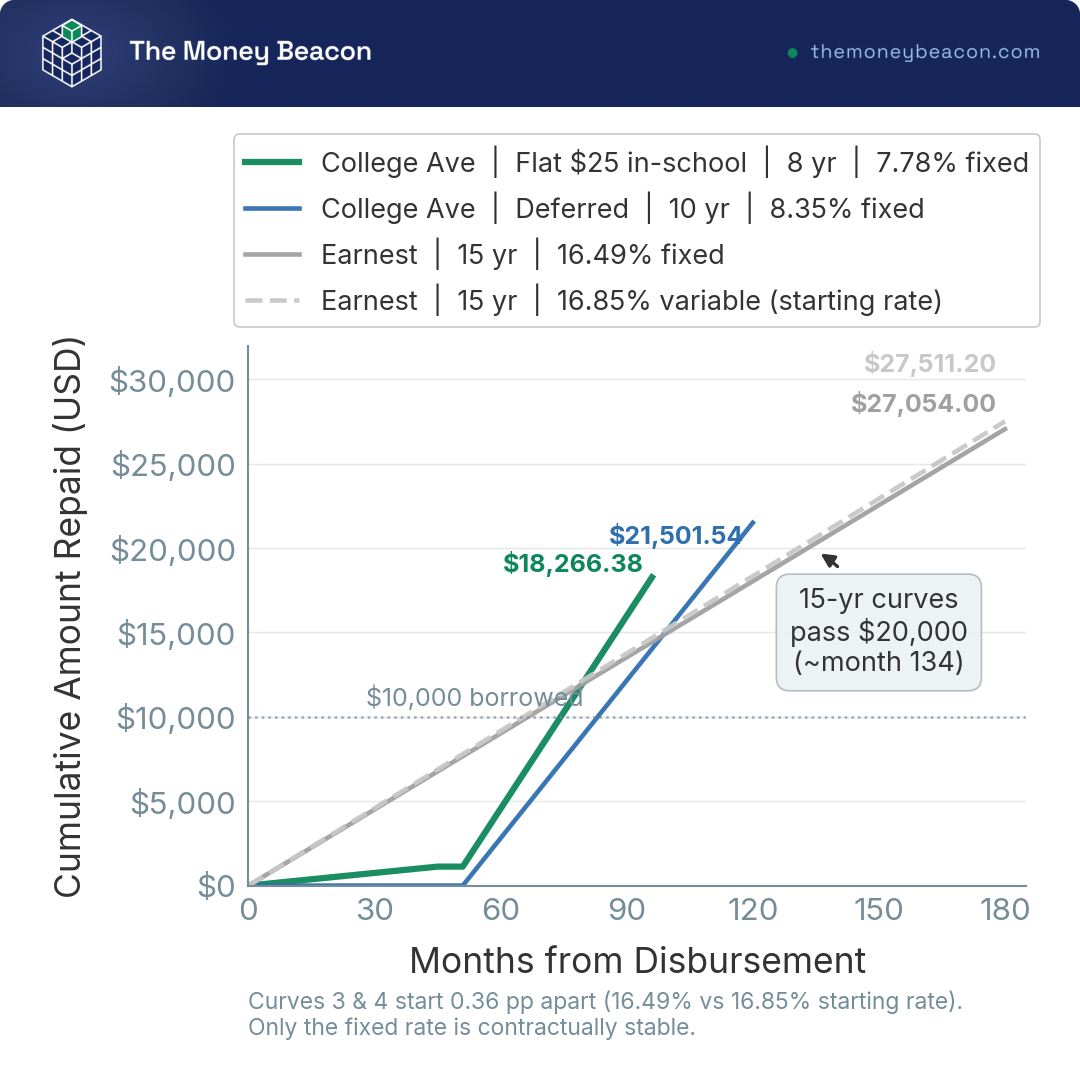
Earnest’s own dated examples are the only clue to the top: a 16.85% variable and a 16.49% fixed interest rate without autopay, both dated March 19, 2026. Those are examples, not a current ceiling.
5.5 Who it’s for
Earnest is ideal for the borrower who wants published rules rather than discretionary underwriting, and for the parent weighing an Earnest student loan refinance. It’s not the right choice for a family that plans to free the cosigner within a year or two.
6. Citizens: the bank-relationship play, priced in interest rates rather than APRs
6.1 Overview
A 0.25% loyalty discount for existing customers stacks on the 0.25% autopay discount, a combined 0.50%. It’s also the only lender in this comparison offering Multi-Year Approval: apply once, then request funds in later years on a soft credit pull. It will refinance private student loans from $10,000 to $500,000, with a completed bachelor’s degree required. And it publishes starting interest rates rather than APRs.
6.2 Strengths
Citizens pays you for staying put, and most of its advantages compound over a full degree.
- The loyalty and autopay discounts combine to 0.50%, the largest stacked discount in this comparison. The loyalty half assumes you already bank there, so pick where you keep your everyday checking on its own merits.
- Multi-Year Approval had a 99% approval rate on later fund requests over the year to October 1, 2025.
- No origination, application, or disbursement fees, and no prepayment penalty.
- A Medical Residency Refinance Loan allows $100 monthly payments for up to 48 months of residency.
- Across 5,311 refinance customers who got a lower payment, the average saving was $4,104 a year.
6.3 Weaknesses
The trade for that loyalty pricing is who Citizens will lend to, and what it puts in writing.
- Eligibility is the narrowest in this comparison: four-year Title IV institutions only, at least half time, no community colleges or for-profit schools.
- Cosigner release needs full principal-and-interest repayment, so interest-only payments don’t count. You can apply once every 12 months. It isn’t available at all on the Student Loan for Parents.
- The variable rate cap is the greater of 21.00% or prime plus 9.00%, the highest in this comparison.
- The marketing page shows no readable rate range at all: the site renders it through a token that never loads.
6.4 Pricing & fees
Citizens prices both a student loan and a refinance loan.
Citizens pricing and fees
| Item | Student Loan (5-year term ASD) | Education Refinance Loan |
|---|---|---|
| Fixed starting interest rate (not APR) | 3.74% to 14.63% | 6.39% to 10.64% |
| Variable starting interest rate (not APR) | 5.44% to 14.21% | 6.40% to 10.91% |
| Variable rate cap | Greater of 21.00% or prime plus 9.00% | Same |
| Origination / application / disbursement fee | None | None |
| Late charge | 5% of the payment, after 15 days | 5% of the payment, after 15 days |
| Prepayment penalty | None | None |
| Discounts | 0.25% loyalty plus 0.25% autopay | 0.25% loyalty plus 0.25% autopay |
| Minimum loan | $1,000 | $10,000 |
| Maximum loan | 100% of certified cost of attendance less aid | $500,000 |
| Terms | 5, 7, 10, 12, 15 years | 5, 7, 10, 15, 20 years |
Data current as of August 2026. Every Citizens rate in this table is a starting interest rate from its Application and Solicitation Disclosures, not an APR, and cannot be compared like for like against the APR ranges quoted by the other five lenders.
Term length changes the floor. The five-year disclosure starts at 3.74% fixed; the seven-year version starts at 6.77% and still reaches 14.63%. A longer term buys a smaller payment and a worse starting rate at once.
6.5 Who it’s for
Citizens is ideal for the family that already banks there and will spend four years at a four-year school. The loyalty discount and Multi-Year Approval compound across a whole degree. It’s not the right choice for a community college student.
7. Ascent: the lender that underwrites a student with no cosigner
7.1 Overview
Ascent Funding is one of the few no cosigner student loan lenders in this comparison. It underwrites three products: a Non-Cosigned Credit-Based Loan, a Non-Cosigned Outcomes-Based Loan, and a Parent Credit-Based Loan. The outcomes-based one is for juniors and seniors, and it’s judged on a 3.0 GPA rather than a credit file. It funded more than 220,000 borrowers between January 2018 and March 2026. It doesn’t refinance, so consolidating later means changing lenders.
7.2 Strengths
Ascent’s advantages start with who it will approve and continue into what it pays you back.
- Two non-cosigned paths, one underwritten on GPA and program instead of credit.
- The largest autopay discount in this comparison, 0.5% on credit-based loans, 1.00% on outcomes-based.
- Cosigner release after 12 consecutive on-time payments, the shortest published requirement in this comparison.
- A 1% cash-back graduation reward, averaging about $365, capped at $500.
- A nine-month grace period, and no application, origination, disbursement, late or NSF fees on college loans.
- DACA recipients with a valid SSN qualify, as do international students with a cosigner.
7.3 Weaknesses
Lending to a student with no credit file has to be paid for somewhere, and this is where.
- Outcomes-based pricing is 12.55% to 14.62% variable and 13.62% to 15.51% fixed, roughly double the cosigned rate. It’s deferred only and caps at $20,000 a year.
- Bootcamp loans have a one-time 5.0% origination fee, the only one in this comparison. It never applies to a college loan.
- The minimum loan is $2,001, $6,001 in Massachusetts, the highest in this comparison. And there’s no refinance product.
- The non-cosigned credit-based loan needs $30,000 of annual income plus an unpublished credit score.
- A Temporary Hardship Forbearance exists, but its cap is in the promissory note.
7.4 Pricing & fees
Ascent pricing and fees, by product
| Ascent product | Variable APR | Fixed APR | Terms | Repayment options |
|---|---|---|---|---|
| Cosigned Credit-Based | 3.64% to 16.30% | 2.19% to 17.26% | 5, 7, 10, 12, 15 years | Deferred, interest-only, $25, immediate |
| Non-Cosigned Credit-Based | 5.59% to 14.55% | 6.95% to 16.01% | 5, 7, 10, 12, 15 years | Deferred, interest-only, $25, immediate |
| Parent Credit-Based | 5.09% to 13.65% | 5.95% to 15.31% | 5, 7, 10, 12, 15 years | Interest-only, immediate |
| Non-Cosigned Outcomes-Based | 12.55% to 14.62% | 13.62% to 15.51% | 10 or 15 years | Deferred only |
Data current as of August 2026. APRs effective as of 08/15/2026 and include a 0.5% automatic payment discount on credit-based loans and a 1.00% discount on outcomes-based loans. Refinancing is not offered on any Ascent product.
The distance between the top row and the bottom row is what borrowing without a cosigner costs you, and it’s whole points rather than fractions of one.
7.5 Who it’s for
Ascent is the best choice for the student with no cosigner, and for the DACA or international student, as long as they accept a rate roughly double the cosigned one. It’s not the right choice for a bootcamp student who can borrow elsewhere.
8. The full comparison, and the verdict by borrower profile
8.1 Rate structure across the six
Every lender on rate structure
| Lender | In-school fixed | In-school variable | Refinance fixed | Index | Variable cap |
|---|---|---|---|---|---|
| Sallie Mae | 1.95% to 17.49% | 3.62% to 16.83% | Not offered | 30-day avg SOFR, rounded up to 1/8% | Not published |
| College Ave | 1.94% to 17.99% | 3.89% to 17.99% | 6.99% to 13.99% | Market index, SOFR-based | Not published |
| SoFi | 2.45% to 15.99% | 4.39% to 15.99% | 3.99% to 10.99% | 30-day avg SOFR | 17.95% in-school, 13.95% refi |
| Earnest | Starting 1.99% | Starting 5.62% | Starting 4.45% | Not published | Not published |
| Citizens | 3.74% to 14.63% (interest rate) | 5.44% to 14.21% (interest rate) | 6.39% to 10.64% (interest rate) | 30-day avg SOFR | Greater of 21.00% or prime plus 9.00% |
| Ascent | 2.19% to 17.26% | 3.64% to 16.30% | Not offered | Not published | Not published |
Data current as of August 2026. Citizens values are starting interest rates, not APRs. Earnest publishes starting rates rather than complete ranges.
Two of these rows can’t be ranked against the others: Citizens quotes starting interest rates, and Earnest publishes only a floor.
8.2 The variable rate ceiling nobody looks up
Only SoFi and Citizens publish a variable rate cap. The other four publish none; the cap is a term of the promissory note, not a marketing number. Before you take a variable rate, find the cap in your promissory note and run the payment at that number.
8.3 Fees and discounts, side by side
Fee and discount comparison
| Lender | Origination | Application | Late fee | Prepayment | Autopay discount | Other discounts and rewards |
|---|---|---|---|---|---|---|
| Sallie Mae | None | None | 5% of the past due payment, capped at $25 | None | 0.25% | $2,000 and $5,000 scholarships |
| College Ave | None | None | Not published | None | 0.25% | Multi-year approval, 90% repeat approval |
| SoFi | None | None | None | None | 0.25% | 0.125% member, 0.125% family or continuing scholar, $250 GPA bonus |
| Earnest | None | None | None | None | 0.25% | 0.25% loyalty, $100 rate-match gift card, FL stamp tax applies |
| Citizens | None | None | 5% of payment after 15 days | None | 0.25% | 0.25% loyalty, 1% principal reduction via employer partnerships (max $1,000) |
| Ascent | None on college loans, 5.0% on bootcamp | None | None | None | 0.5% credit-based, 1.00% outcomes-based | 1% cash-back graduation reward, about $365 average, $500 cap |
Data current as of August 2026. Late fees per each lender’s own product page or Application and Solicitation Disclosure.
Fees are zero at all six, with one exception: the 5.0% fee on an Ascent bootcamp loan. A fee that size is routine on a general-purpose personal loan, which makes its near-absence here worth noticing.
8.4 What a discount stack is actually worth
Read the stacks in dollars, not percentages. On a $30,000 balance at 8% over 10 years, a 0.25% autopay discount saves roughly $450 in total interest, about $3.75 a month. Ascent’s 0.5% and Citizens’ stacked 0.50% are worth twice that, and twice small money is still small next to a two-point difference in the rate you’re underwritten at.
8.5 Cosigner release, condition by condition
Cosigner release conditions, side by side
| Lender | Trigger | Payment requirement | Other conditions |
|---|---|---|---|
| Sallie Mae | Graduation or certificate completion | 12 on-time principal-and-interest payments, or a lump sum equal to 12 | US citizen or permanent resident, proof of income, no 30-day delinquency in 12 months, no hardship forbearance in 12 months, credit review. In-school interest-only or $25 payments do not count. Parent loans after May 2026 excluded |
| College Ave | Half the original repayment term elapsed | Principal-and-interest payments through the halfway point | US citizen or permanent resident, documented income at least 2x the outstanding balance, no 30-day delinquency in 12 months, no bankruptcy, foreclosure, or repossession in 24 months; borrower must apply |
| SoFi | Consecutive on-time repayment history | 24 consecutive on-time full principal-and-interest payments | Underwriting review; the additional documentation requirements are not itemized publicly |
| Earnest | No cosigner release program | Not applicable | Removing a cosigner requires refinancing into a new loan, with the borrower approved alone or with a different cosigner |
| Citizens | Entry into full principal-and-interest repayment | Interest-only payments do not qualify | Application once every 12 months, income verification, US citizen or permanent resident, credit and eligibility guidelines; not available on the Student Loan for Parents |
| Ascent | 12 consecutive on-time payments | 12 consecutive on-time payments | Proof of income, US citizen or permanent resident status with proof of any change in citizenship or residence, age of majority, and the lender’s credit and eligibility review |
Data current as of August 2026.
Release timing goes from one year to never. Two conditions trip families up. In-school interest-only or $25 payments don’t count toward Sallie Mae’s twelve, and Citizens offers no release on its parent loan.
8.6 Downside protection when income stops
Downside protection, by lender
| Lender | Grace period | Skip-a-payment | Hardship forbearance | Death or disability discharge |
|---|---|---|---|---|
| Sallie Mae | 6 months | Not offered | Deferment and forbearance available, cumulative months not published | Death and disability discharge published |
| College Ave | 6 months undergrad, 9 months most grad, 12 dental, 36 medical | Not offered | Deferment offered, tailored for residency, clerkship, and fellowship; cumulative months not published | Death and disability discharge published |
| SoFi | 6 months | Not offered | Not published | Death discharge indicated; disability discharge does not apply to private student loans |
| Earnest | 9 months (not on the in-school P and I plan) | One per 12 months after 6 on-time payments | Skipped payments count toward the forbearance limit; cumulative limit not published | Not published |
| Citizens | 6 months (residency refi example) | Not offered | Forbearance exists (autopay discount suspended during it); cumulative months not published | Not published |
| Ascent | 9 months | Not published | Temporary Hardship Forbearance offered, cumulative cap not published | Not published |
Data current as of August 2026. Maximum cumulative forbearance months are contractual terms in the promissory note and appear on no public page at any of the six.
None of the six publishes a forbearance cap; yours is in the promissory note. None of this is guaranteed the way federal deferment is, so the practical hedge is a few months of payments kept in an FDIC-insured savings account you can touch, meaning one covered by Federal Deposit Insurance Corporation (FDIC) insurance.
8.7 Who can actually get approved
Who can actually get approved
| Lender | Citizenship | Non-citizen path | Published credit minimum | State limits |
|---|---|---|---|---|
| Sallie Mae | US citizen or permanent resident | Non-citizens may borrow with a US citizen or permanent resident cosigner, must reside and study in the US | None published | Not published |
| College Ave | US citizen or permanent resident | International grad students with an SSN and a qualified cosigner | None published | Not published |
| SoFi | Citizen, permanent resident, or non-permanent resident alien | Non-permanent resident aliens eligible | None published | Refi in 50 states, DC, PR, USVI, American Samoa |
| Earnest | Citizen, permanent resident, DACA, asylee, some H-1B | DACA and asylee eligible; international primary without an SSN must contact the lender | FICO 650 (665 in some cases), 3 years of credit history | No lending in MS; no variable rates in AK, IL, MN, NH, OH, TN, TX |
| Citizens | US citizen, permanent resident, or eligible non-citizen with a qualified cosigner | Eligible non-citizen with a creditworthy US cosigner | None published | Loyalty-eligible deposit accounts only in 15 states and DC |
| Ascent | US citizen, permanent resident, or DACA with a valid SSN | International students with a US citizen or permanent resident cosigner | Score not published; $30,000 minimum annual income on non-cosigned credit-based loans | Minimum loan differs in MA |
Data current as of August 2026.
Earnest is the only lender publishing a credit floor. Ascent publishes a $30,000 income minimum on its non-cosigned credit-based loan but not the score behind it. The other four publish no floor at all, so any number attached to them is somebody’s estimate.
8.8 The in-school payment box that costs more than any rate discount
Take the same $10,000 loan and three in-school choices, on Citizens’ figures. Deferring everything at a 14.63% starting rate totals $22,277.91. Paying interest only at 11.34% totals $17,592.74. Full principal-and-interest payments at 11.50% total $12,828.65. That’s about $9,400 between the first choice and the last. Part of the difference is capitalization, part is the higher rate assigned to deferral. If you have any income at all while enrolled, pay at least the interest.
8.9 And what stretching the term does to the same balance
Four repayment paths on the same $10,000 principal end more than $9,000 apart, and the only thing changing between them is the term. The lesson matters most on a refinance. Cutting your rate while stretching a remaining 7-year balance onto a new 15-year term lowers the payment and can still raise total interest.
Tom’s take
every offer I’ve been shown leads with the monthly payment. I ask for the total repaid over the term instead, and more than once the cheaper-looking one was the expensive one.
8.10 The verdict table
Best lender by borrower profile, with the deciding fact
| Borrower profile | Best fit | Deciding fact | Runner-up |
|---|---|---|---|
| Undergraduate with a strong cosigner | Sallie Mae | Cosigner release after 12 on-time payments, widest school coverage, 1.95% fixed floor | Ascent |
| Borrower who wants to control term and payment | College Ave | Four in-school options and borrower-chosen terms of 5, 8, 10, or 15 years | Ascent |
| High-earning graduate refinancing | SoFi | Refinance ceiling of 10.99% APR and a 13.95% variable cap, the lowest published in the group | Earnest |
| Borrower who wants published rules and a safety valve | Earnest | 9-month grace, one skipped payment per year, published FICO floors | College Ave |
| Existing Citizens customer at a four-year school | Citizens | 0.50% stacked discounts plus Multi-Year Approval with a 99% future-draw approval rate | Sallie Mae |
| Student with no cosigner | Ascent | Non-cosigned credit-based and outcomes-based underwriting, 12-payment cosigner release | None in this group |
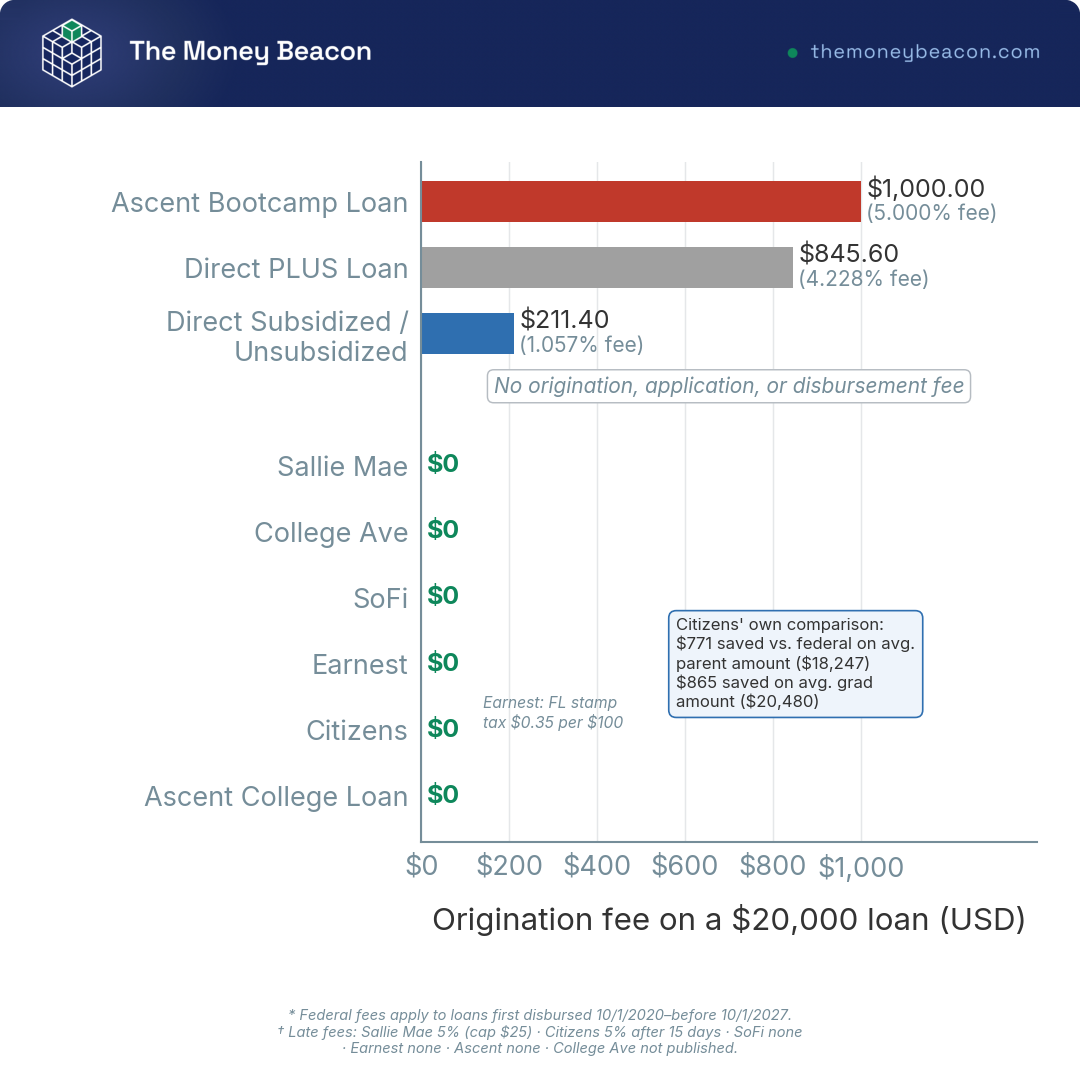
| Parent comparing PLUS at 9.07% plus 4.228% fee | Compare Ascent parent (from 5.09% variable) and Citizens parent | No origination fee versus a $845.60 fee on $20,000 | Sallie Mae Parent Loan |
| Anyone with unused federal eligibility | Federal Direct Loan | 6.52% fixed undergraduate, RAP, deferment, statutory discharge rights | None |
Data current as of August 2026. Citizens figures are interest rates, not APRs.
One caveat on the table. Read the Earnest row as a disqualifier if you expect to free a parent within a year or two. And the last row isn’t a consolation prize: unused federal eligibility beats every private offer above it.
8.11 If you’re an undergraduate with a creditworthy cosigner
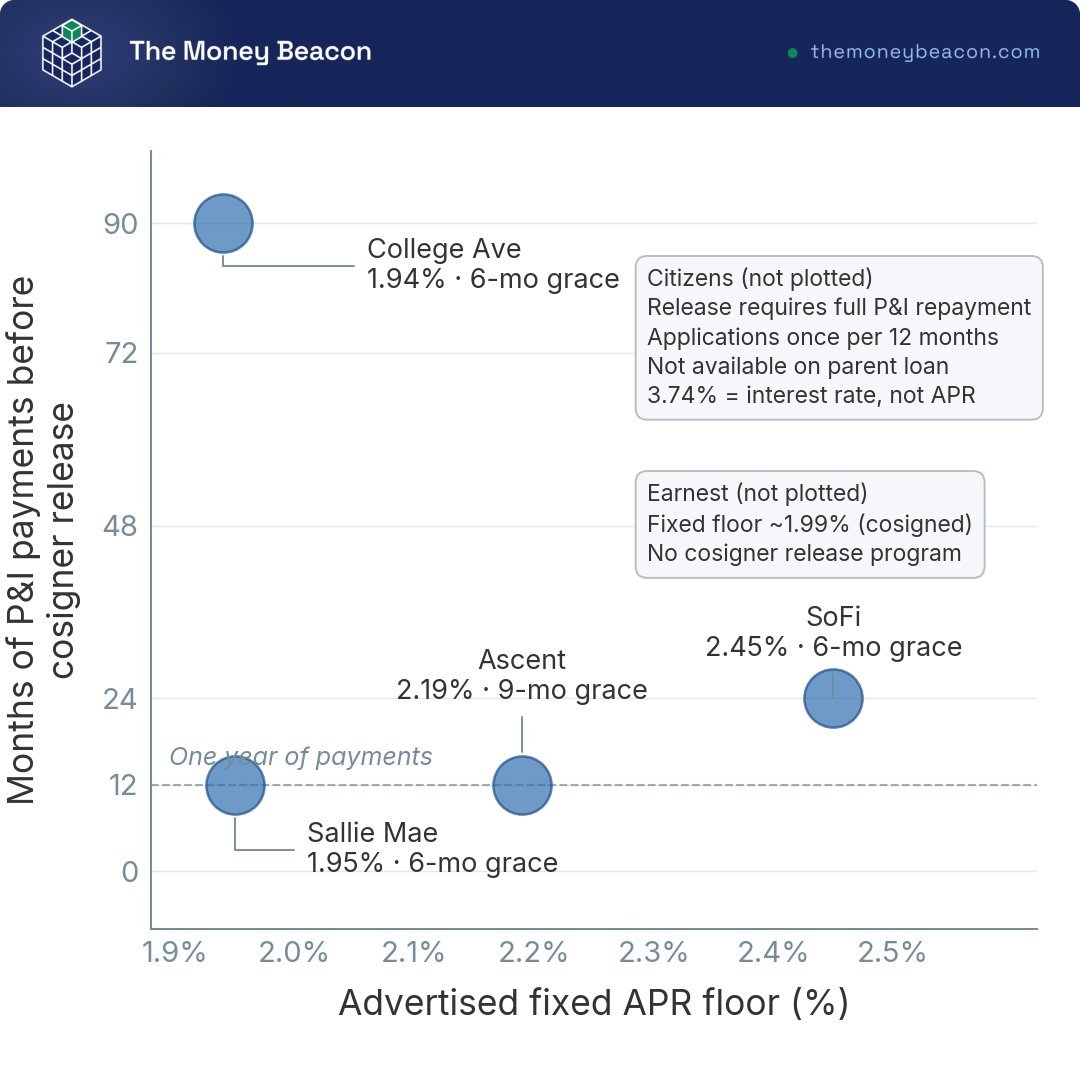
All six will lend to this profile once the school qualifies, so the decision turns on release timing rather than approval. The lowest advertised floor in this comparison, College Ave at 1.94% fixed, comes with the longest wait, 7.5 years on a 15-year loan. Sallie Mae is the best choice for this profile, releasing the cosigner after 12 on-time payments. Dependent undergraduate federal limits survived OBBBA, so your shortfall is usually small.
8.12 If you have no cosigner, a thin file, DACA status, or a non-four-year school
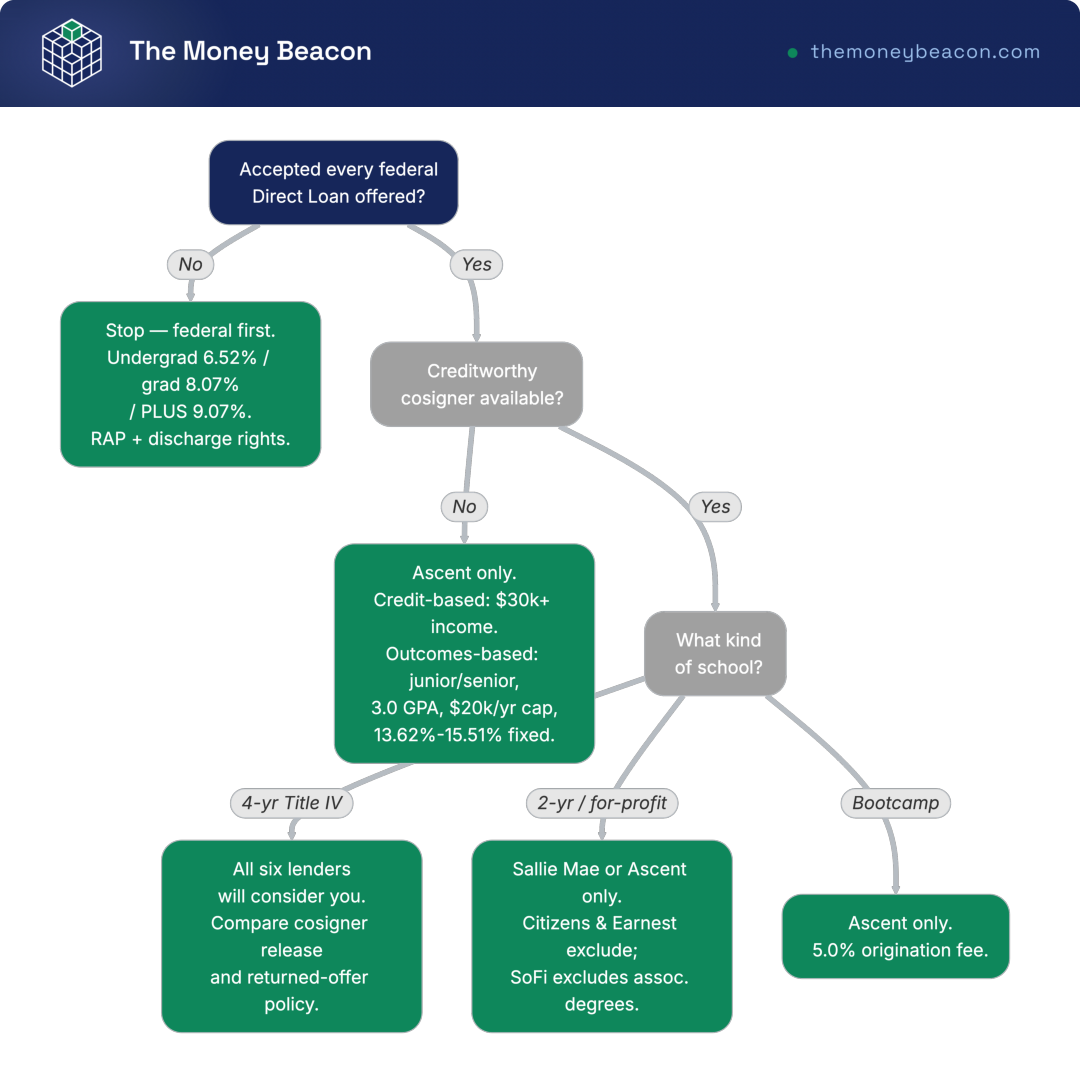
Start with federal student loans. No cosigner, no credit file, no underwriting at all, which is why it’s the first branch in the chart below. School type is the next gate, removing lenders before pricing matters: four-year Title IV only at Citizens, not-for-profit four-year at Earnest, a bachelor’s or higher at SoFi, bootcamps at Ascent alone. Ascent is the best choice for this profile, the only lender in this comparison that underwrites without a cosigner. But outcomes-based pricing is roughly double the cosigned rate.
8.13 If you’re a graduate or professional student borrowing after the end of Grad PLUS
With Direct PLUS gone, federal student loans now stop at $20,500 a year for graduate students. Sallie Mae is the best choice for a program-specific need, writing medical residency, dental residency and bar exam loans. College Ave is ideal when the grace period has to match the program. One trap: SoFi won’t refinance bar or residency loans.
8.14 If you’re a parent borrowing for your child
Parent PLUS, the FAFSA PLUS parent loan most families default to, prices at 9.07% plus a 4.228% origination fee: $845.60 gone from a $20,000 loan before it reaches the school. Every private lender charges zero on that line. Price the Ascent parent loan, from 5.09% variable, against the Citizens one. For the shortfall, the usual next idea is borrowing against the equity in your home, which swaps unsecured debt for debt your house secures. Cosigner release is rare on a parent product, and moving PLUS debt into your child’s name transfers liability.
8.15 If you’re refinancing existing debt and weighing whether to include federal loans
Only four of the six do student loan refinancing at all. SoFi is the best choice for the high-earning graduate, on a 10.99% APR ceiling and a 13.95% variable cap. The same total-cost test applies to folding card balances into a single payment.
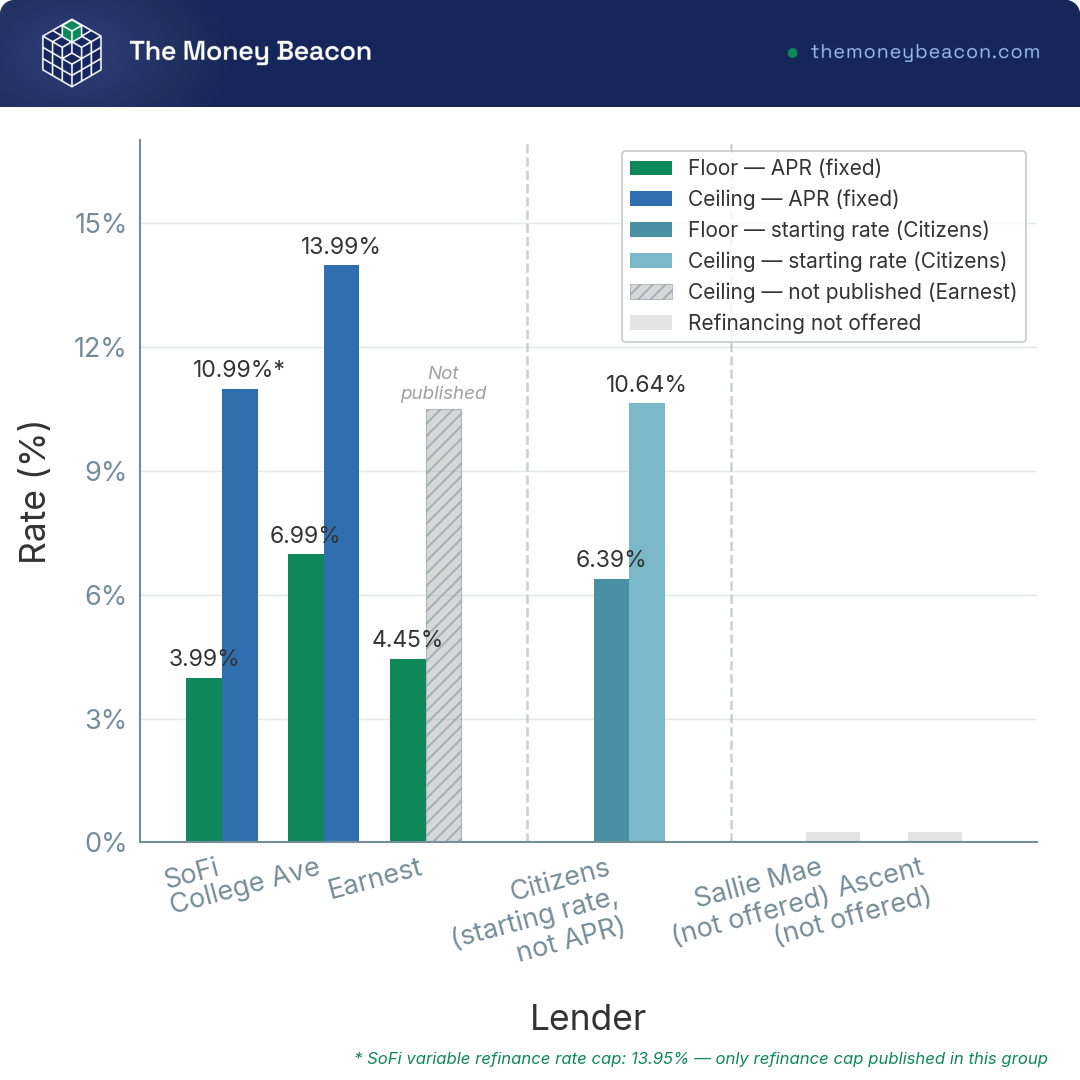
Include a federal loan and you permanently hand back RAP, the interest subsidy, discharge after 360 payments, statutory deferment and discharge, and PSLF. Refinance private debt freely, federal debt only if none of those protections will ever matter.
Conclusion
The order you borrow in matters more than the lender you pick. Federal money comes first, every dollar of it. Private money covers only what’s left after grants, work-study, and family contributions are counted. And refinancing federal debt into a private loan is the one decision in all of this you can’t reverse. No lender can put you back.
Two things determine what you actually pay, and neither is the number on the homepage. One is the rate you’re approved for. At a single lender the floor and the ceiling can be more than 15 percentage points apart, so the advertised figure says almost nothing about your own rate. The other is how the loan is structured. The term you choose, and whether you pay interest while you’re in school, change your total cost far more than a quarter-point autopay discount ever will. So do this today: work out your gap on paper, then prequalify at two or three lenders within one week. A soft pull doesn’t affect your score, and only the offers that come back are real.
From here, two things usually come next. Maybe you’re paying interest during school, or building the cash reserve that replaces the federal safety net you give up in a refinance. Either way, our comparison of money market accounts shows where that money earns something while staying available. A cosigned balance also shows up on the parent’s credit report, which matters if our look at current mortgage rates is your next stop. And building your own credit file starts with our comparison of US credit cards.
FAQ: Student loans, cosigners, and refinancing in 2026
Should I take federal student loans before a private student loan?
Yes, every time, and it isn’t close. A Direct undergraduate loan disbursed in the 2026-2027 award year is fixed at 6.52% with a 1.057% loan fee, and it carries protections no private contract copies. So subtract grants, work-study, every federal dollar offered, and your family contribution, then borrow only the gap that’s left.
Do I need a cosigner, and how does cosigner release work?
Usually yes. Sallie Mae says 91% of its undergraduate loans last year were cosigned, and Citizens says you’re 4x more likely to be approved with a qualified cosigner. Release rules are where the six differ most. Sallie Mae and Ascent release after 12 on-time payments, SoFi after 24, College Ave only at the halfway point of the original term, Citizens only in full principal-and-interest repayment. Earnest has no release program at all.
Can I get a private student loan with no cosigner?
Ascent is the only lender in this comparison that publishes a path. Its non-cosigned credit-based loan asks for two years of credit history and $30,000 of annual income; its outcomes-based loan is open to juniors and seniors with a 3.0 grade point average, capped at $20,000 a year. Only Earnest publishes a credit-score floor. Otherwise the real alternatives are the federal Direct dollars you haven’t accepted yet and lowering the cost of attendance itself.
Should I take a fixed or a variable rate?
Fixed, unless you’ll pay the balance off in a few years. Variable rates start lower, but your real risk is the ceiling. Only SoFi and Citizens publish one, and for the other four the promissory note is the only place to find a cap. Earnest’s own example makes the point: $10,000 over 15 years totals $27,054.00 at 16.49% fixed against $27,511.20 at a 16.85% variable start.
Deferred, interest-only, or $25 a month while I’m in school?
Interest-only, if you can find the cash, because it stops capitalization and usually gets you a lower rate at the same time. On one Citizens $10,000 five-year disclosure, deferring everything totals $22,277.91, interest-only totals $17,592.74, and full payments total $12,828.65. That’s about $9,400 between the first choice and the last. The $25 flat option slows capitalization; it doesn’t stop it.
Is it ever a good idea to refinance student loans?
For private and high-rate balances, yes, and the downside is little more than a hard inquiry. Federal loans are a different question, because refinancing federal debt into a private loan permanently forfeits income-driven repayment, deferment, forbearance, and forgiveness. So refinance federal debt only if public service is off the table, your income is stable and well above the payment, and the rate cut comes at the same or a shorter term. Only four of these six refinance at all.
What happens if I lose my job or go back to school?
Federal loans come with statutory deferment and forbearance, plus a RAP payment that can fall to $10 a month. Private protection is much thinner. Earnest lets you skip one payment a year after six on-time ones, and that skipped payment counts against your forbearance limit. No lender here publishes a maximum forbearance, so read yours in the promissory note before you sign, and keep a few months of payments in cash; our guide to splitting your savings by goal covers where to keep it.
Can I deduct student loan interest?
Yes, up to $2,500 a year, and it’s an above-the-line deduction under Section 221 of the tax code, so you don’t have to itemize. For 2025, the most recent year IRS Publication 970 spells out, it phased out between $85,000 and $100,000 of modified adjusted gross income (MAGI) for single filers, and between $170,000 and $200,000 for joint filers. Those ranges are indexed, so pull the 2026 figures from irs.gov before you file. If you’re close to the top of a range, the moves that lower your taxable income can also decide whether you keep it.



Comments
Questions and corrections welcome. We read everything.