


Every cash back card shouts a big number at you. Unlimited 2%, a rotating 5%, even 6% on groceries. The trouble is that the headline rate almost never applies to all of your spending, so the rate you actually pocket on your own groceries, gas, dining, and everyday purchases is a different number entirely. Pick by the advertised percentage and you quietly leave real dollars on the table, because no two of the best cash back credit cards earn it the same way.
The stakes get higher once you remember this only pays off if you clear the balance each month. The average rate on credit card accounts assessed interest is 22.32% in 2026, so one carried month of interest on a $2,000 balance runs about $37, more than a whole month of 2% rewards. Choosing the right card matters, but only once you pay the bill in full.
So the real game is matching the card to how you actually spend. Divide the field into three earning structures, flat-rate, rotating 5% categories, and fixed category bonuses, then run each one against your own monthly budget, and the right pick stops being a guess. In this comparison I rate the six leading 2026 cash back cards using the same criteria, then name the winner for three types of spenders: those who want a simple rate, those who will chase categories, and those with high grocery and dining expenses.
1. How we compared the 2026 cash back cards: the three earning structures and our criteria
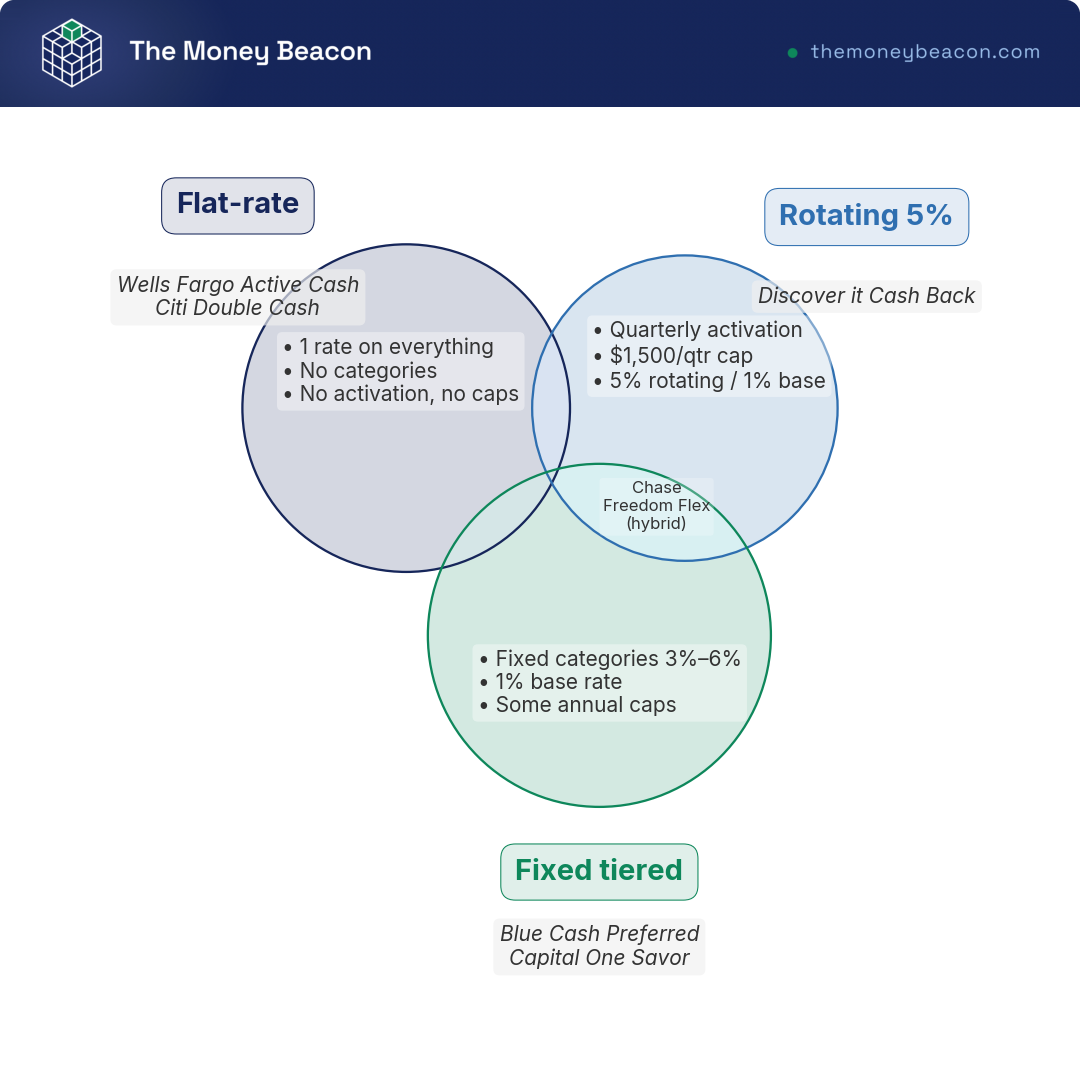
How can you fairly compare six cash back cards when each one has a different headline number? You stop reading the percentages and start sorting the cards by the machinery underpinning them. That machinery, so the rule that decides which of your dollars actually earn the bonus, comes in only three flavors, and once you can name them the whole picture gets clearer.
The three cash back earning structures, and why structure beats headline rate
A flat-rate card pays one rate on everything, with no categories, no caps, and nothing to activate. Active Cash and Double Cash both are flat-rate paying 2% on every dollar. A rotating 5% card pays 5% on a handful of categories that change every quarter, up to a $1,500-per-quarter cap, and you have to switch the bonus on yourself. Everything outside the bonus earns 1%. Discover and the rotating half of Freedom Flex are both rotating cards. A fixed tiered card pays an elevated 3% to 6% on a permanent set of everyday categories like groceries, dining, and streaming, with 1% on the rest. Blue Cash Preferred and Capital One Savor are the fixed-tier cards in this comparison.
Here’s the thing: the advertised numbers don’t tell the whole story. The structure that wins is the one that matches how concentrated or spread out your spending is, not the one with the biggest percentage on the billboard. A 5% rate you trigger on $200 of quarterly spending is worth less than a flat 2% you earn on all $24,000 a year, and a 6% grocery rate only pulls ahead once your grocery bill is big enough to matter. So first, look at your spending, and then check the rate.
If you’re interested in seeing how these same issuers compare in other areas, like travel, balance transfers, and so on, here is how the top cards stack up across categories.
Our scoring criteria and the model household budget
I scored each card on the same five things: the effective earn rate it produces on real spending, the annual fee, the redemption options and any minimum, the foreign transaction fee, and the sign-up bonus along with the spending it demands. Notice that effective earn rate comes first, because it is the only number that already takes into account caps, exclusions, and your actual category mix.
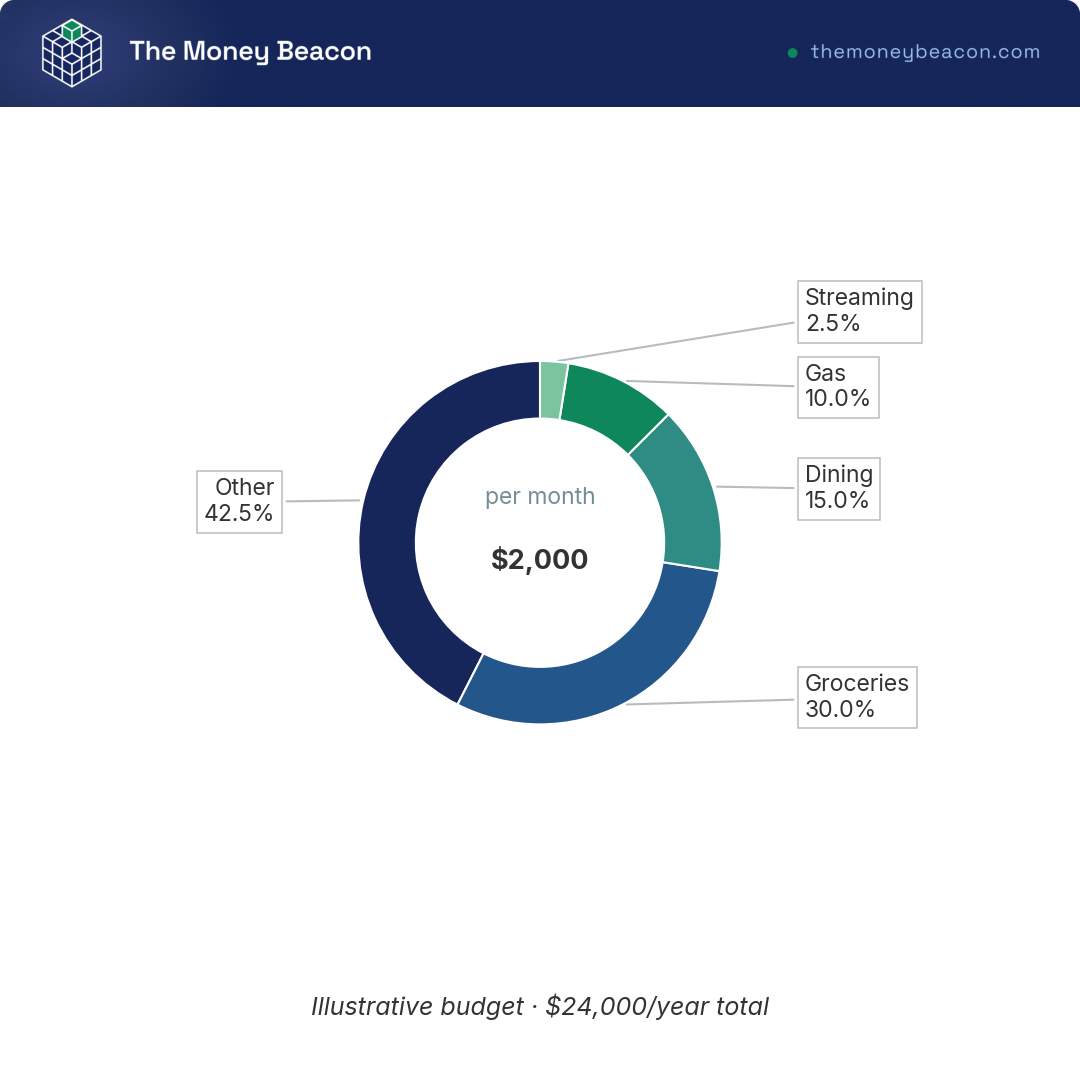
To compare like with like, every earn-rate figure in this article is based on one model budget of $2,000 a month, or $24,000 a year, split as follows: groceries 30%, everything else 42.5%, dining 15%, gas 10%, and streaming 2.5%. That big 42.5% “other” bucket is the reason why category cards can’t seem to beat a flat 2% here. Most of those dollars end up on the 1% base rate, no matter how generous the headline category is. The budget is illustrative, picked for clean maths rather than pulled from a current government survey. So, the idea is to compare your spending to it, not to take it as the absolute truth.
At a glance: all six cards on one screen
Before the individual reviews, here’s the whole field in a single table. Check it out by structure, not by the highest percentage at the top, because that 6% in the top-rate column means something totally different from the flat 2% next to it.
| Card | Structure | Annual fee | Base rate | Top rate(s) | Network |
|---|---|---|---|---|---|
| WF Active Cash | Flat-rate | $0 | 2% | 2% (all) | Visa |
| Citi Double Cash | Flat-rate (1%+1%) | $0 | 2% | 2% (all); 5% Citi Travel | Mastercard |
| Chase Freedom Flex | Rotating + fixed | $0 | 1% | 5% rotating (cap), 5% Chase Travel, 3% dining/drugstores | Mastercard (World Elite) |
| Discover it Cash Back | Rotating | $0 | 1% | 5% rotating (cap) + Year-1 match | Discover |
| Blue Cash Preferred | Fixed tiered | $0 yr 1, then $95 | 1% | 6% US supermarkets (cap), 6% select streaming, 3% transit, 3% US gas | American Express |
| Capital One Savor | Fixed tiered | $0 | 1% | 8% Cap One Entertainment, 5% Cap One Travel, 3% dining/grocery/entertainment/streaming | Mastercard |
Data current as of June 2026. Rates and fees are issuer-stated; verify against each issuer’s Schumer box before relying on a specific number.
That flat-rate row at the top is where the simplest card lives, so that’s where we start.
2. Wells Fargo Active Cash review: the flat-rate 2% workhorse
Is an unlimited flat 2% card the right pick if you want one rate and zero tracking? For a lot of households, yes, and the Active Cash is the cleanest version of it.
Overview
Wells Fargo Active Cash pays unlimited 2% cash rewards on every purchase, with no categories to chase, no caps to watch, and nothing to activate each quarter. It runs on the Visa network, so acceptance is about as broad as it gets at home and abroad. This is the no-maintenance flat-rate option: one rate, all the time.
Strengths
The whole pitch is simplicity, but it still works. You earn flat 2% on every dollar with zero tracking, and there’s no annual fee to earn back. The welcome bonus is unusually easy to hit, $200 after just $500 in spending in the first 3 months, which most households cover with normal groceries and gas. New cardholders also get 0% intro annual percentage rate (APR) for 12 months on purchases and balance transfers, and the Visa network means the card works almost everywhere you go.
If you’re looking to use the intro-APR window to pay off an existing balance interest-free, here’s how to do it.
Weaknesses
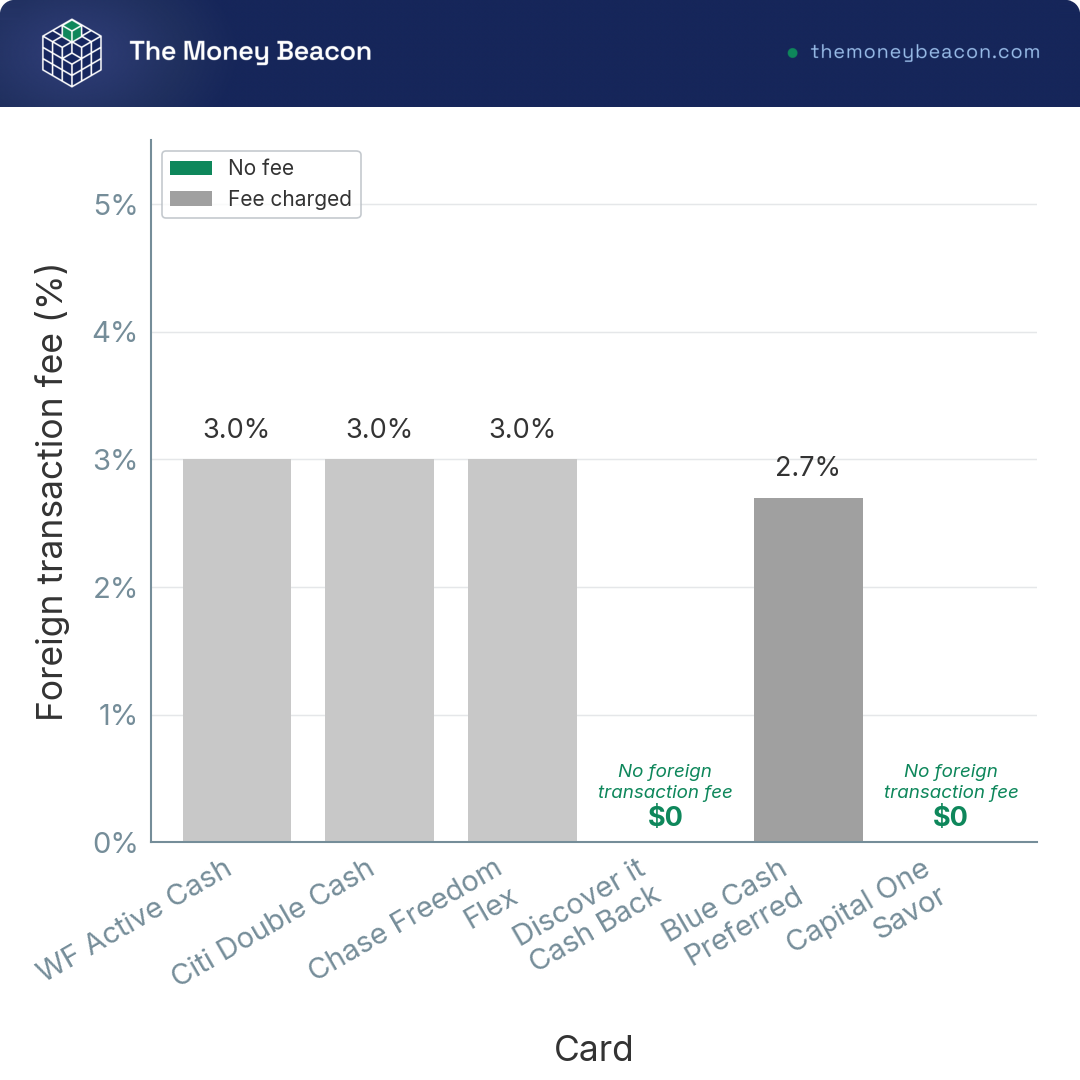
The thing about having one flat rate is that no category ever beats 2%, so if you’re someone who shops for groceries or dines out a lot, you’re missing out on some savings here. The 3% foreign transaction fee also makes it a poor travel companion, adding $3 to every $100 you spend overseas. Just a couple of minor things to be aware of: automatic redemptions and paper checks come in $25 increments, and the rewards are cash only, with no option to transfer them to airline or hotel partners.
If foreign spending is a big slice of your year, a dedicated travel card will usually serve you better abroad.
Pricing & fees
| Item | Value |
|---|---|
| Annual fee | $0 |
| Welcome bonus | $200 after $500 spend in first 3 months |
| Intro APR (purchases & BT) | 0% for 12 months |
| Regular purchase APR | 18.49% / 24.49% / 28.49% variable |
| Balance transfer fee | Up to 5%, $5 min (intro fee within 120 days not separately confirmed) |
| Cash advance fee | $10 or 5%, greater |
| Foreign transaction fee | 3% |
| Late payment fee | Up to $40 |
| Redemption minimum | $25 increments (auto/check); any amount (manual online/phone) |
Data current as of June 2026.
The two terms that most people skip are the 3% foreign transaction fee and the $25-increment minimum on automatic redemptions, so if you redeem on autopilot or travel often, read those two lines twice.
Who it’s for
This is the card for the simplicity-first spender whose dollars are spread across many categories and who wants one predictable rate with no activation and no caps to babysit. It’s not the pick for the heavy grocery, dining, or international spender, who can clear well past 2% with a category card or a no-foreign-fee card. If your spending is not concentrated, forget it.
3. Citi Double Cash review: 2% in two parts and a points-or-cash twist
Does splitting that 2% into 1% at purchase plus 1% at payment change who the card suits? It does, in one specific way worth understanding before you apply.
Overview
Citi Double Cash earns an effective 2%, paid as 1% when you buy plus 1% when you pay the bill off, with no annual fee, on the Mastercard network. You’ll earn rewards as ThankYou points, and on this card, you can redeem them as cash back at 1 cent each. It’s got the same 2% destination as a flat card, but you get there a bit differently.
Strengths
You get effective flat 2% with no annual fee, and the best part is one of the longest balance-transfer deals out there: 0% intro APR for 18 months on balance transfers (a 3% intro transfer fee in the first four months, then 5%). The welcome bonus is $200 after $1,500 in spending over 6 months. There’s also an optional path worth knowing about: because rewards post as ThankYou points, you can later pool them into a premium Citi card like the Citi Strata Premier to open up airline and hotel transfers down the road.
If a long zero-interest window is what you actually need, this is a clean way to pay down a balance interest-free for a year and a half.
Tom’s take

I keep a no-frills 2% card like this one in the rotation precisely because I never carry a balance, so the rewards are pure return. The trick is to treat the card as a tool, not a loan; the second I’d let a balance ride at these rates, the whole math flips against me.
Weaknesses
The catch is built into the name: the full 2% only lands if you actually pay the bill, since the second 1% accrues on payment, not at purchase. There is also no intro APR on purchases here (the 0% offer is balance transfers only), a 3% foreign transaction fee, and a $5 minimum on check-by-mail redemptions. And that partner-transfer path is conditional, because it requires also holding a separate eligible premium Citi card; the Double Cash alone doesn’t unlock it.
If you spend heavily overseas, a purpose-built travel card avoids that 3% drag.
Pricing & fees
| Item | Value |
|---|---|
| Annual fee | $0 |
| Welcome bonus | $200 cash back after $1,500 spend in first 6 months |
| Intro APR (purchases) | None |
| Intro APR (balance transfers) | 0% for 18 months (transfer within 4 months) |
| Regular purchase APR | 17.49% to 28.24% variable |
| Balance transfer fee | 3% intro (first 4 months), then 5%; $5 min |
| Cash advance fee | $10 or 5%, greater; cash advance APR 29.74% variable |
| Foreign transaction fee | 3% |
| Penalty APR | Up to 29.99% variable |
| Late payment fee | Up to $41 |
| Redemption minimum | $5 for check by mail; cash redemptions at 1 cent/point |
Data current as of June 2026.
Two lines deserve a second look: the 18-month balance-transfer window, the longest of this comparison, and the pay-to-earn second 1%, which means your real rate is below 2% on anything you let revolve.
Who it’s for
This card fits the simplicity-first spender who always pays in full and likes the idea of optional points flexibility or a long balance-transfer runway. It’s not for someone who carries purchase balances, since there’s no intro purchase APR to soften that, or for someone who wants elevated earning on specific everyday categories. Pay in full and it’s an excellent 2% workhorse.
4. Chase Freedom Flex review: rotating 5% categories plus fixed bonuses
Two flat-rate cards just set the benchmark at 2% on everything for no effort. Now the field changes shape. The question stops being “what’s the easiest 2%?” and becomes “what does working the card actually buy you?” The Freedom Flex is the first card here that asks for a little quarterly labor in exchange for a much higher top rate.
Overview
Chase Freedom Flex is a hybrid, and once you see how the pieces stack you understand why people love it. It pays 5% on quarterly rotating categories (up to $1,500 in spending per quarter, activation required), 5% on travel booked through Chase Travel, a permanent 3% on dining and drugstores all year, and 1% on everything else, with no annual fee. Rewards post as Chase Ultimate Rewards points. The rotating half is the headline; the standing 3% on dining and drugstores is the part people forget the card even has.
Strengths
What makes this card work is the stacked ceiling: that high 5% rotating rate sits on top of a permanent 3% on dining and drugstores that never needs activating, and there is no annual fee holding any of it back. The welcome bonus is easy to clear, $200 after just $500 in spending in the first 3 months, and you also get 0% intro APR for 15 months on purchases and balance transfers. The points have a hidden upgrade too: pool them into a premium Sapphire or Ink card later and your Ultimate Rewards points can move to airline and hotel transfer partners instead of staying plain cash.
If your real goal is the intro window to clear an old balance, here is how to pay down a balance interest-free while the 15-month clock runs.
Weaknesses
The whole 5% depends on one fragile condition: you have to activate every quarter, or the rate falls to 1%. And even when you do activate, the 5% only applies to the first $1,500 of spending per quarter ($6,000 a year), which caps the bonus at $75 a quarter; everything past that earns the 1% base rate. That same 1% applies to all your uncapped, non-bonus spending, so a scattered budget leaves a lot on the table. There is a 3% foreign transaction fee, and the partner-transfer trick only works if you also hold a separate premium Chase card.
Hank’s take
the behavioral-finance research is blunt about this: a reward that depends on you doing something every quarter is a reward most people quietly forfeit. The 5% looks like the headline, but the real rate you earn is the one your future, busier self actually triggers, and that number is usually closer to 1%.
If carrying a balance is the real problem you’re solving, a travel card won’t fix it; pay the balance down first.
Pricing & fees
| Item | Value |
|---|---|
| Annual fee | $0 |
| Welcome bonus | $200 after $500 spend in first 3 months |
| Intro APR (purchases & BT) | 0% for 15 months |
| Regular purchase APR | 18.24% to 27.74% variable |
| Balance transfer fee | 3% intro (within 60 days), then 5%; $5 min |
| Cash advance fee | $10 or 5%, greater |
| Foreign transaction fee | 3% |
| Late payment fee | Up to $40 |
| Redemption minimum | None for cash back |
Data current as of June 2026.
If one line decides this card’s whole value, it’s the quarterly activation requirement, because that single step is the difference between earning 5% and earning 1% on the same purchases.
Who it’s for
This card fits the category optimizer who will reliably activate each quarter, steer real spending into the 5% lanes and the standing 3% on dining and drugstores, and maybe wants Ultimate Rewards transfer value later. It’s the wrong card for the set-and-forget spender who means to activate, doesn’t, and ends up earning 1% on everything. If a calendar reminder sounds like too much, this is not your card.
5. Discover it Cash Back review: rotating 5% with a first-year match
The Freedom Flex showed what the rotating structure asks of you: activate, steer, and watch the cap. Discover it uses the same 5%-and-cap-and-activation machinery, and then adds a single first-year twist that changes the year-one math more than any headline rate in this whole field.
Overview
Discover it Cash Back pays 5% on rotating quarterly categories (up to a $1,500-per-quarter cap, activation required) and 1% on everything else, with no annual fee. The headline extra is the first-year Cashback Match, which I’ll cover just below. One thing about the actor: Discover is now part of Capital One after the May 18, 2025 acquisition, but the card is still marketed under the Discover brand at discover.com as of June 2026.
Strengths
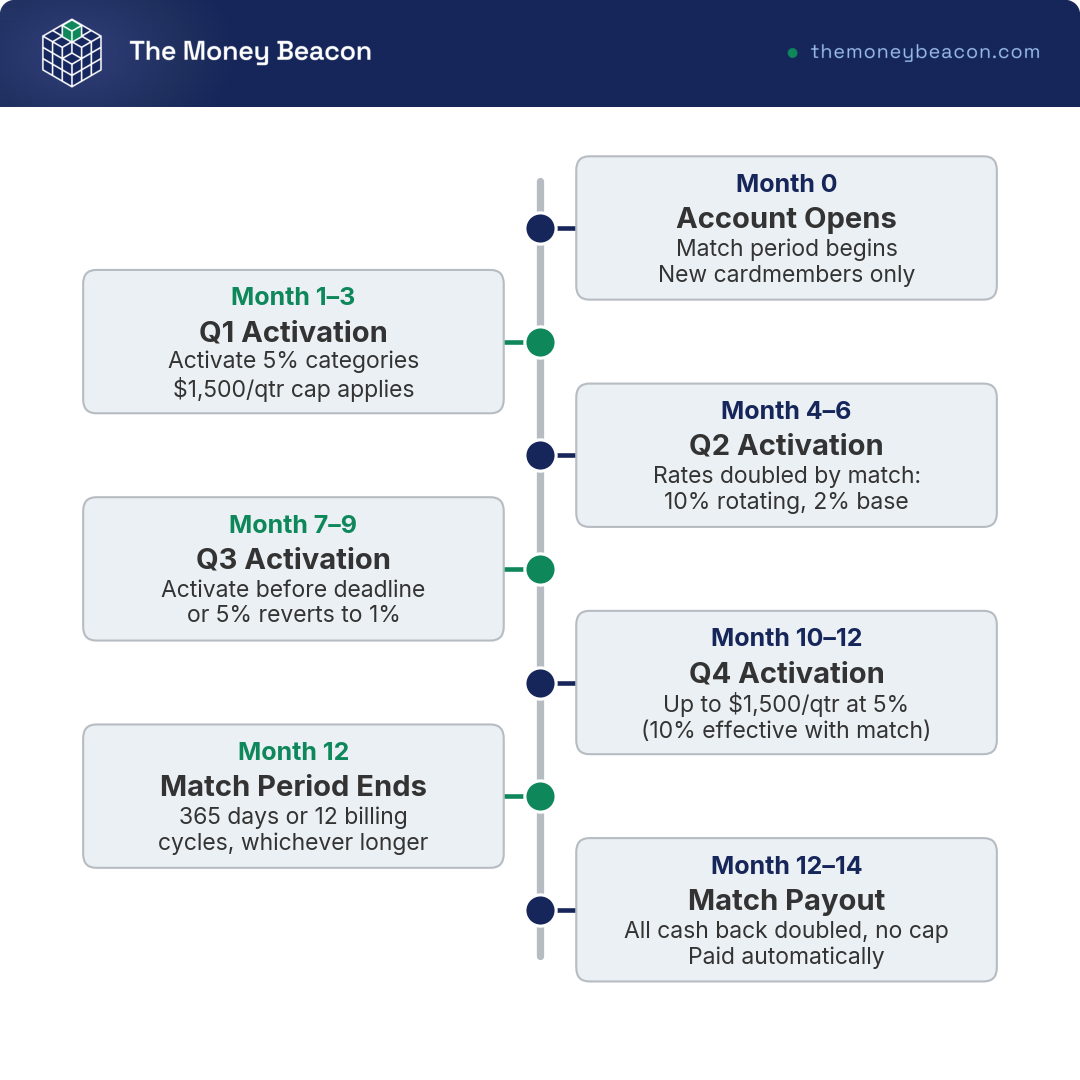
Here is the part that makes year one unusual. The first-year Cashback Match doubles every dollar of cash back you earn, with no cap. It’s set up to pay out automatically at the end of the match period. So basically, that means the 5% categories become 10%, and the 1% base becomes 2% for your whole first year. On top of that you get no annual fee, a rare $0 foreign transaction fee for a rotating card, 0% intro APR for 15 months, and cash redemption with no minimum on rewards that never expire.
If you opened this section mainly for the long 0% window, here is the clean way to pay down a balance interest-free before the rate resets.
Weaknesses
The Match is the catch as much as the draw: it is one-time, first year only, not an annual benefit, so year two reverts to standard 5% (capped) and 1% with no doubling. The rotating structure still needs quarterly activation or the 5% drops to 1%, and the 5% is still capped at $1,500 a quarter. Acceptance is the other soft spot, because the Discover network is narrower than Visa or Mastercard, especially when you are traveling abroad.
Pricing & fees
| Item | Value |
|---|---|
| Annual fee | $0 |
| Welcome offer | Cashback Match (all year-1 cash back doubled) |
| Intro APR (purchases & BT) | 0% for 15 months |
| Regular purchase APR | 17.49% to 26.49% variable |
| Balance transfer fee | 3% intro, then 5% |
| Cash advance fee | $10 or 5%, greater |
| Foreign transaction fee | $0 |
| Late payment fee | None on first; up to $41 thereafter |
| Redemption minimum | None; rewards never expire |
Data current as of June 2026.
There are two things to look at here. First, the $0 foreign transaction fee is unusual for a rotating card. Second, the welcome “offer” is the one-time Match, not a fixed lump sum, so its value depends on how much you spend in that first year.
Who it’s for
This card suits the category optimizer who wants a great first year from the Match, easy cash redemption, and no foreign transaction fee, and who will actually activate each quarter to get all the benefits. It is the wrong pick for someone chasing steady multi-year category leadership, since year two brings back the ordinary rates, or for anyone who needs guaranteed acceptance everywhere abroad.
6. Blue Cash Preferred from American Express review: the grocery and streaming powerhouse
Every card so far has been free to hold. This last one in the lineup is not, and that single fact reframes the whole decision. The Blue Cash Preferred charges a fee, so the only question that matters is whether its category rates earn that fee back and then some.
Overview
The Blue Cash Preferred is the preferred grocery credit card out there. It pays 6% at US supermarkets (on up to $6,000 a year, then 1%), 6% on select US streaming, 3% on transit and US gas, and 1% on everything else, on the American Express network. It is $0 the first year, then $95 annually, the only card in this comparison that charges a fee.
Strengths
This is the highest headline rate in the comparison and the strongest grocery rewards credit card for a household that really cooks at home: 6% at US supermarkets plus 6% on select US streaming, then 3% on transit and US gas. The welcome bonus is the best here, $250 after $3,000 in spending in the first 6 months, and you get a 0% intro APR for 12 months. Two quieter wins that are worth mentioning: the 2.7% foreign transaction fee is actually lower than the 3% on the Visa and Mastercard flat cards, and a Disney Bundle statement credit returns up to $10 a month when you enroll an eligible subscription.
Weaknesses
The obvious one is the $95 annual fee from year two, the only fee in the field, which the card has to earn back before it nets you anything. The 6% grocery rate is capped at $6,000 a year, after which supermarket spending drops to 1%. And here is the trap that catches the most people: warehouse clubs and superstores like Walmart, Target, and Costco are coded outside the supermarket category, so groceries bought there earn only 1%, not 6%. Large non-bonus spending also lands at 1%, and Amex acceptance is narrower than Visa or Mastercard.
Pricing & fees
| Item | Value |
|---|---|
| Annual fee | $0 year 1, then $95 |
| Welcome bonus | $250 cash back after $3,000 spend in first 6 months (some public offers as high as $300) |
| Intro APR (purchases & BT) | 0% for 12 months (BT within 60 days) |
| Regular purchase APR | 19.49% to 28.49% variable (not to exceed 29.99%) |
| Balance transfer fee | $5 or 3%, greater |
| Cash advance fee | $10 or 5%, greater; cash advance APR 28.74% |
| Foreign transaction fee | 2.7% |
| Late payment fee | Up to $40 ($29 first, $40 within next 6 cycles) |
| Redemption minimum | None (Reward Dollars as statement credit) |
Data current as of June 2026.
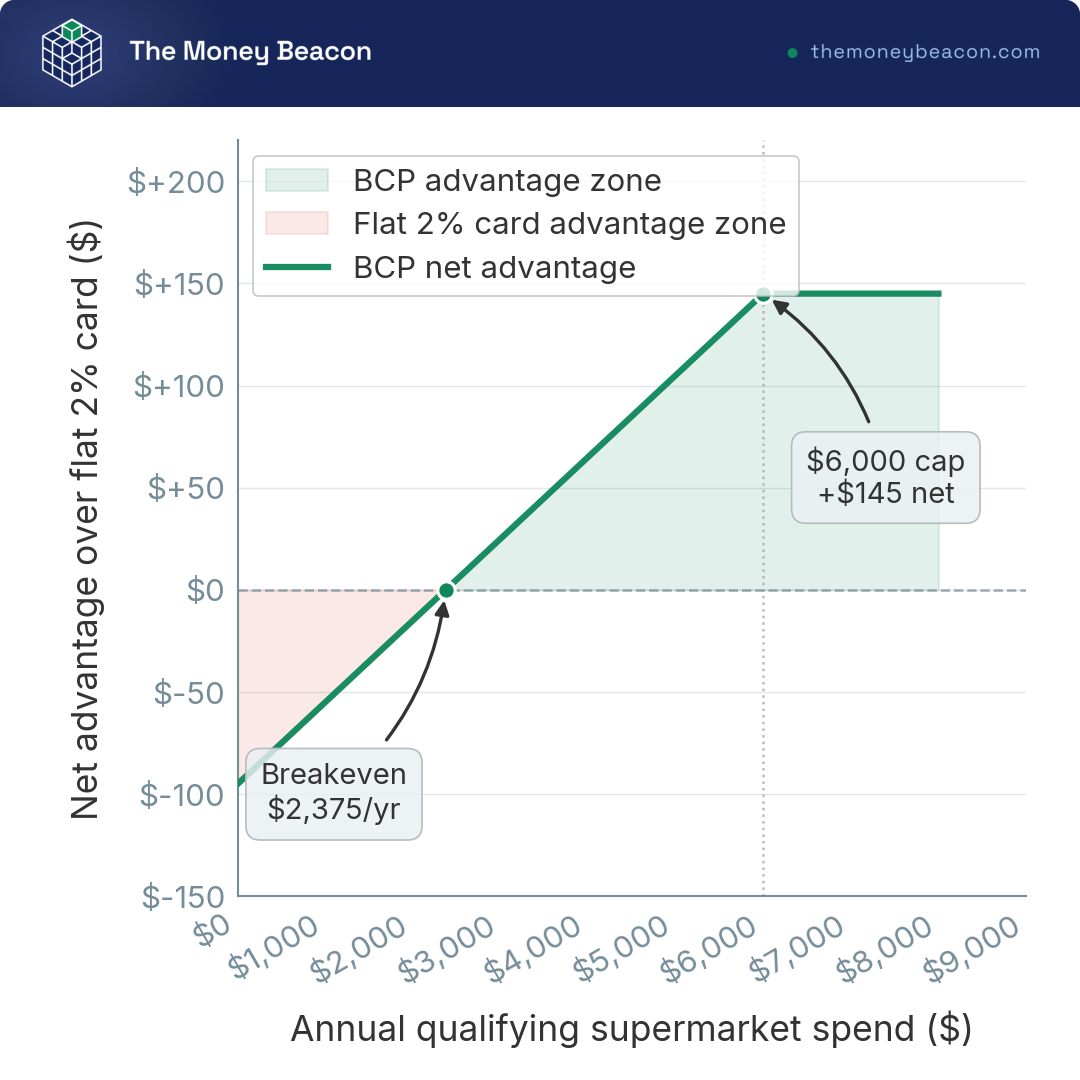
So when does a $95 fee actually pay for itself? The Blue Cash Preferred earns 6% at supermarkets where a flat card earns 2%, a 4% spread, and that spread has to cover the $95. Divide it out: $95 divided by 0.04 is $2,375 in qualifying-supermarket spending before the card breaks even against a no-fee 2% card on groceries alone. Below that, the flat card wins; above it, the Blue Cash Preferred pulls ahead, all the way up to the $6,000 cap where the marginal grocery rate falls back to 1%.
| Annual qualifying supermarket spend | BCP grocery bonus over 2% | Net vs $95 fee | Verdict |
|---|---|---|---|
| $1,500 | $60 | -$35 | Flat 2% wins |
| $2,375 | $95 | $0 | Breakeven |
| $4,000 | $160 | +$65 | BCP wins |
| $6,000 (cap) | $240 | +$145 | BCP wins (max) |
| $8,000 | $240 | +$145 | No further gain (1% above cap) |
Data current as of June 2026. Grocery-only; streaming, transit, and gas bonuses add further advantage and lower the true breakeven.
Who it’s for
This is the best cash back card for groceries for the heavy supermarket and streaming household whose qualifying-supermarket spending clears that roughly $2,375 breakeven on the $95 fee. As a grocery cash back credit card it rewards the family that genuinely runs $3,000 to $6,000 a year through real supermarkets. It is the wrong card for for anyone who shops mainly at Walmart, Target, or Costco, where the 6% never triggers, who spends little on groceries, or who simply refuses to pay an annual fee at all.
7. Capital One Savor Cash Rewards review: dining, entertainment, and grocery, no annual fee
The last card in the lineup answers the objection the previous one left you with. If you liked the idea of permanent category earning but didn’t love paying $95 a year for it, the Capital One Savor is built for you: a no-fee fixed-category card that still pays an elevated rate on the everyday stuff you actually buy.
Overview
Capital One Savor pays 3% on four everyday categories, dining, grocery stores, entertainment, and popular streaming, then 1% on everything else, with no annual fee and no foreign transaction fee, on the Mastercard network. There are two higher rates inside Capital One’s own portals: you’ll get 8% back on Capital One Entertainment and 5% on hotels and rental cars booked through Capital One Travel. What most people care about, though, is that clean 3% on four categories that never needs activating.
Strengths
The pitch here is broad category earning that costs you nothing to hold. You get 3% on dining, grocery stores, entertainment, and popular streaming with no annual fee and no caps stated on those base categories, so there’s nothing to track and nothing to earn back. The card also carries a $0 foreign transaction fee, which makes it a card you can genuinely use abroad. The welcome bonus is easy to clear, $250 after just $500 in spending in the first 3 months, and new cardholders get 0% intro APR for 12 months on purchases and balance transfers. Rewards never expire and have no redemption minimum.
Weaknesses
The soft spot is the same one every fixed-category card shares: everything outside the four bonus categories earns just 1%, so a budget weighted toward general purchases can fall below a flat 2% card on the whole mix. The grocery category also runs on merchant codes, which means superstores and warehouse clubs like Walmart and Target are excluded, so groceries bought there land at 1% rather than 3%. The eye-catching 8% and 5% rates apply only inside Capital One’s own entertainment and travel portals, not to dining or hotels booked anywhere else. There is one disclosure gap worth knowing about: the cash advance APR isn’t separately confirmed on the live disclosure, so check the current pricing-and-terms page before you rely on it.
Pricing & fees
| Item | Value |
|---|---|
| Annual fee | $0 |
| Welcome bonus | $250 cash bonus after $500 spend in first 3 months (some offers as high as $300) |
| Intro APR (purchases & BT) | 0% for 12 months |
| Regular purchase APR | 18.49% to 28.49% variable |
| Balance transfer fee | 3% of each transfer, $5 min |
| Cash advance fee | $5 or 5%, greater |
| Foreign transaction fee | $0 |
| Late payment fee | Up to $40 |
| Redemption minimum | None; rewards never expire |
Data current as of June 2026. Cash advance APR not separately confirmed on the live disclosure; verify on the Capital One Savor pricing-and-terms page.
The two lines that carry the value here are the $0 annual fee and the $0 foreign transaction fee. Together they mean the card costs you nothing to own and nothing extra to use on a trip.
Who it’s for
This is the card for the heavy dining and entertainment household that wants real category earning without paying an annual fee or a foreign transaction fee. It also suits the grocery shopper who wants a steady 3% on supermarkets with no $6,000 cap to watch. It’s the wrong pick if your spending is dominated by that 1% “other” bucket, where a flat 2% card does better, or if you buy groceries mainly at the excluded superstores.
8. Which cash back card wins for you: full comparison and verdict by profile
Laid side by side on one real budget, which of these cards actually pays you the most? This is where the headline rates finally convert to dollars, and a few of them trade places.
The full comparison: all six cards on every criterion
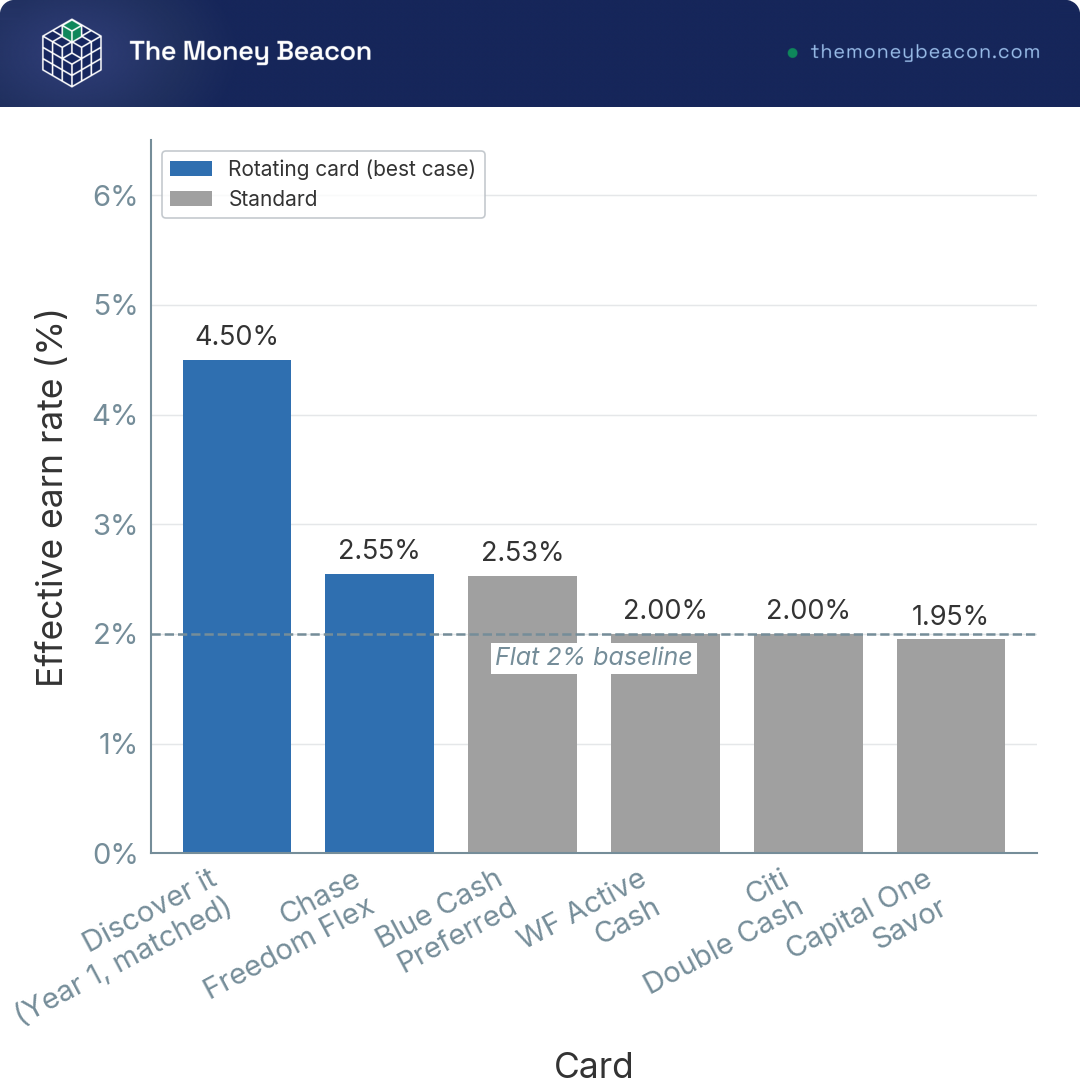
To compare like with like, every figure below runs against the same model budget, $24,000 a year split as groceries $7,200, gas $2,400, dining $3,600, streaming $600, and everything else $10,200. The rotating-card numbers assume you activate every quarter and fill the full $6,000 of 5% spending, which is the best case, so treat those two as ceilings rather than averages.
| Card | Grocery | Gas | Dining | Streaming | Other | Annual cash back | Effective rate | Minus fee |
|---|---|---|---|---|---|---|---|---|
| WF Active Cash (2% flat) | $144 | $48 | $72 | $12 | $204 | $480 | 2.00% | $480 |
| Citi Double Cash (2% flat) | $144 | $48 | $72 | $12 | $204 | $480 | 2.00% | $480 |
| Chase Freedom Flex | $72 | $24 | $108 | $6 | $102+$300* | $612* | 2.55%* | $612 |
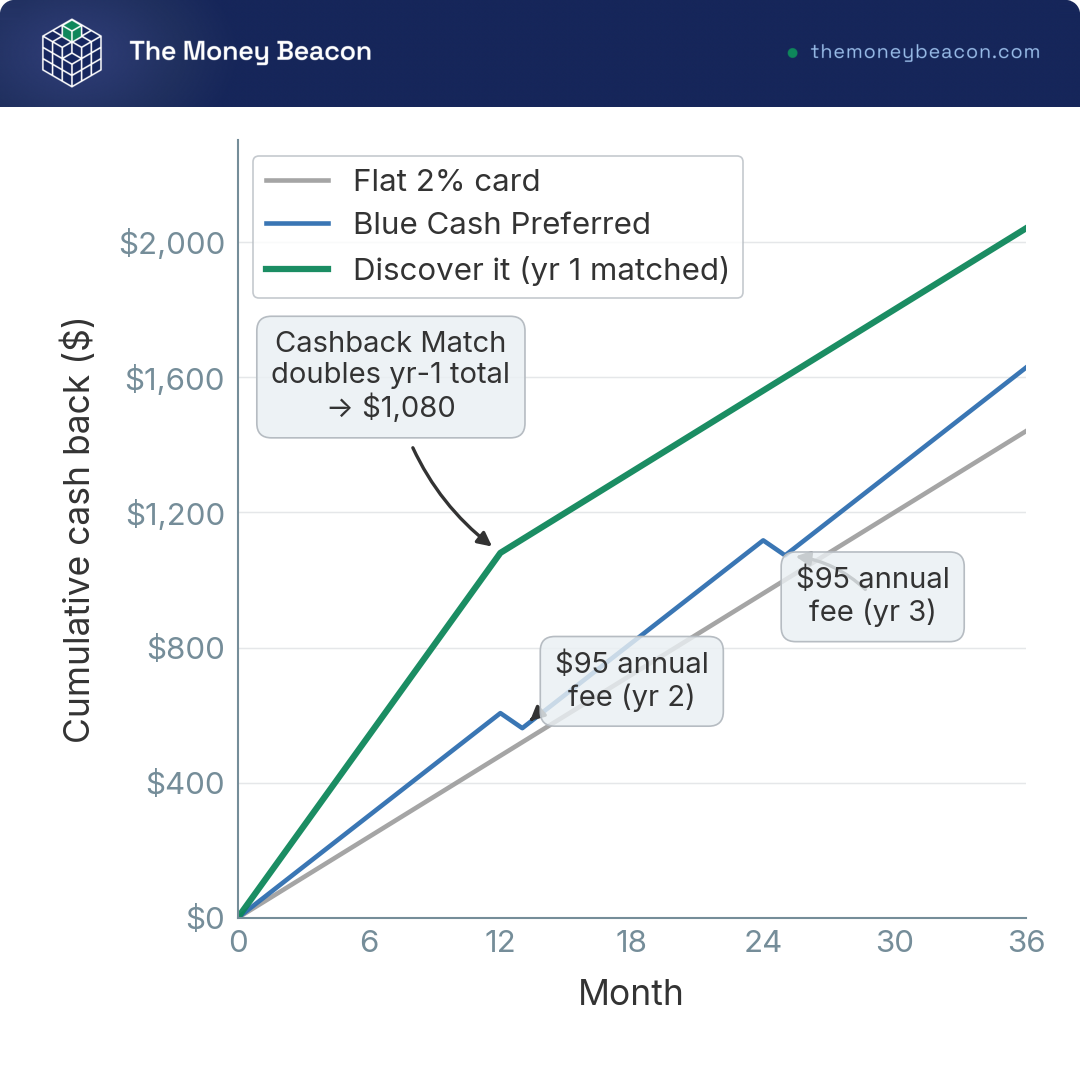
| Discover it (yr 1, matched) | $144 | $48 | $72 | $12 | $204+$600* | $1,080* | 4.50%* | $1,080 |
| Blue Cash Preferred | $360** | $72 | $36 | $36 | $102 | $606 | 2.53% | $511 (after $95) |
| Capital One Savor | $216 | $24 | $108 | $18 | $102 | $468 | 1.95% | $468 |
Rotating-card figures assume the full $6,000/yr 5% allotment is captured on base-rate spending (best case); the $300 (Freedom Flex) and $600 (Discover, doubled by the Match in year one) reflect 5%/10% on that $6,000 slice. Blue Cash Preferred grocery is capped at 6% on the first $6,000, so the model’s $7,200 grocery earns 6% on $6,000 plus 1% on the rest; the bonus portion is rounded and approximate.
Data current as of June 2026.
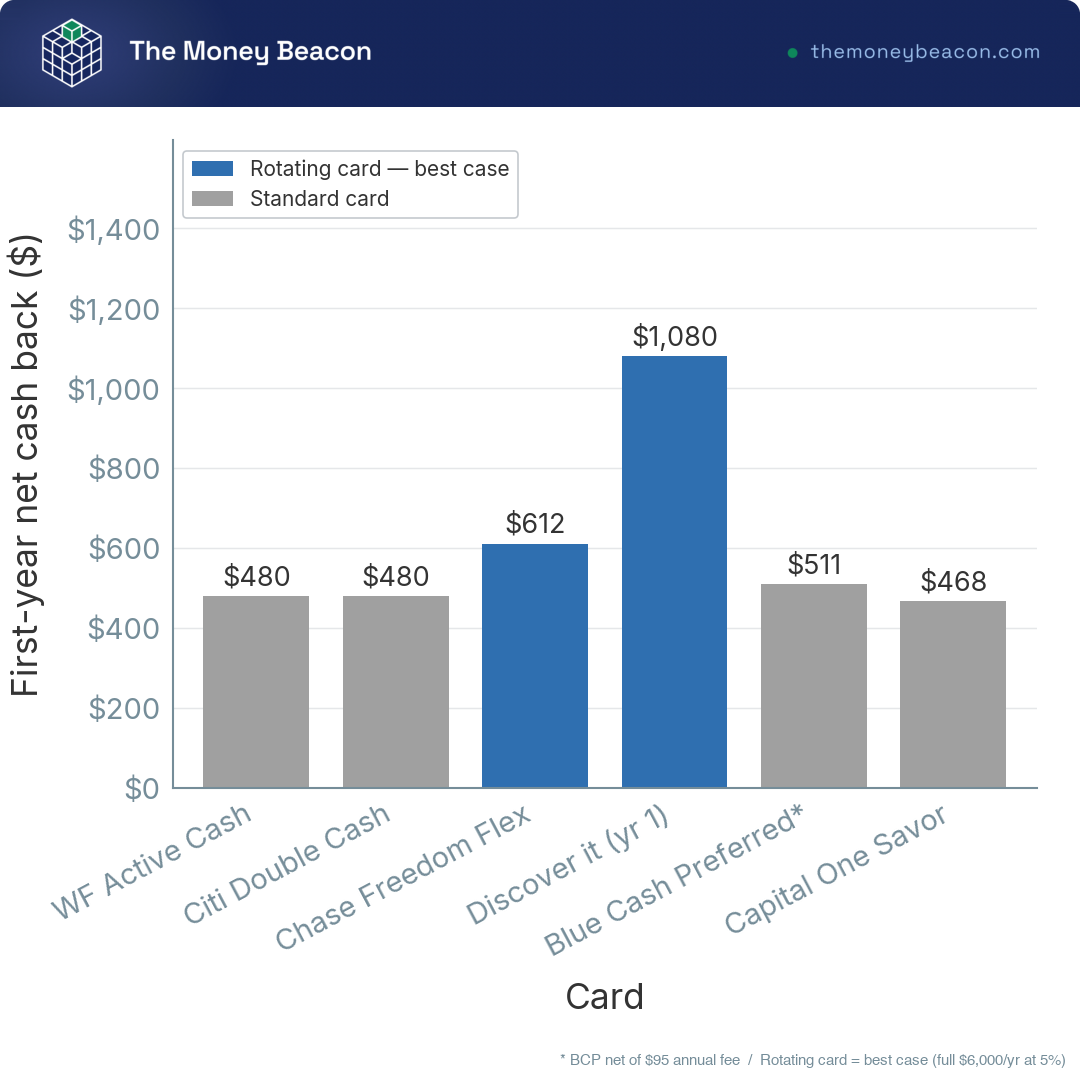
The number that breaks the spell is in the “minus fee” column. The two flat 2% cards both hand you $480 for zero effort, the 6% grocery card nets only about $31 more after its fee, and the Savor actually trails flat 2% because its 3% strengths can’t beat that large 1% “other” bucket. The rotating cards lead only on the best-case assumption. So here’s the lesson the whole article has been building toward: the highest headline rate is rarely the highest effective earner.
Now look at the same field in raw first-year dollars, which is what actually lands in your pocket.
Rate versus fee, and the welcome bonuses
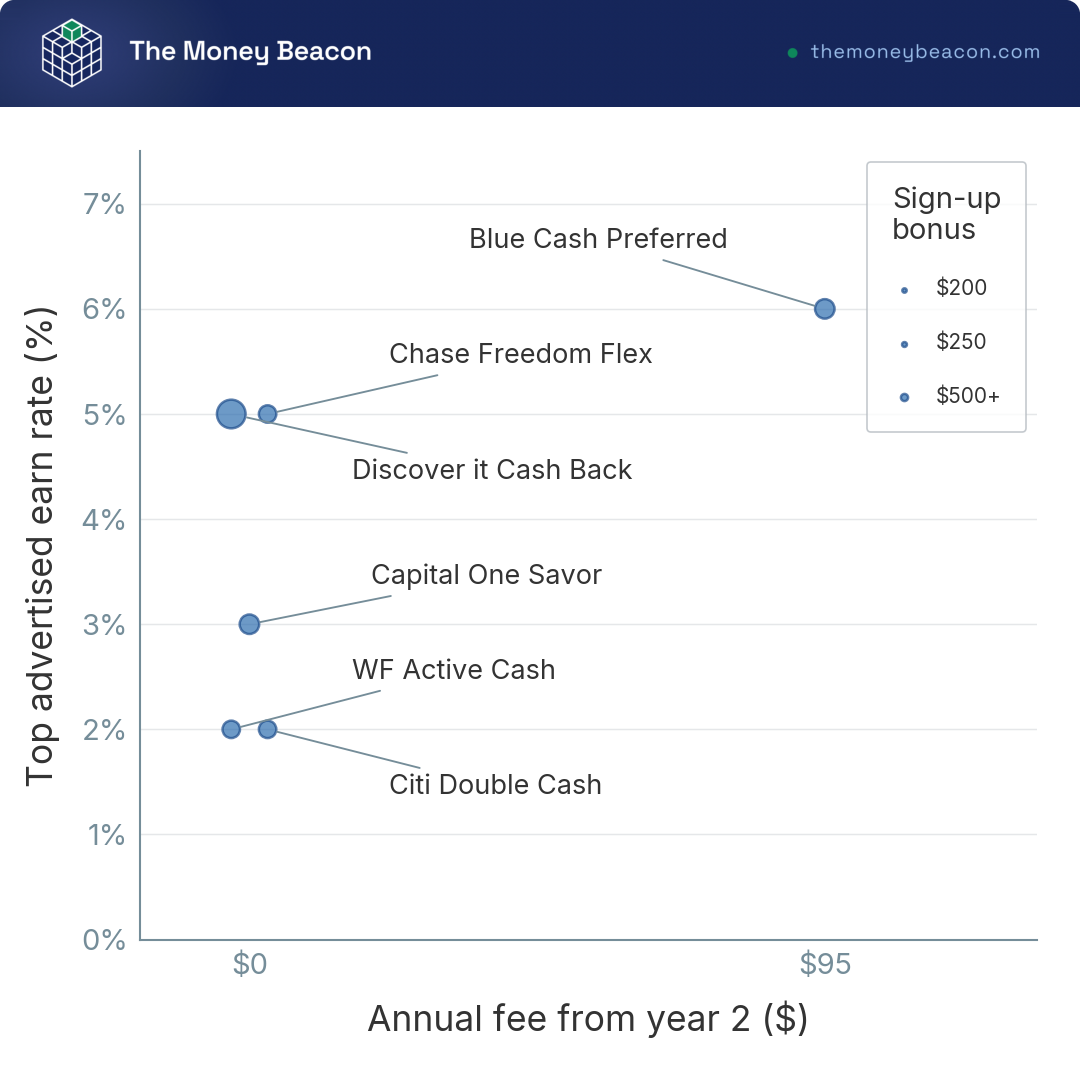
This map plots each card’s top earn rate against what it costs you to hold, so you can see which rates you actually pay for.
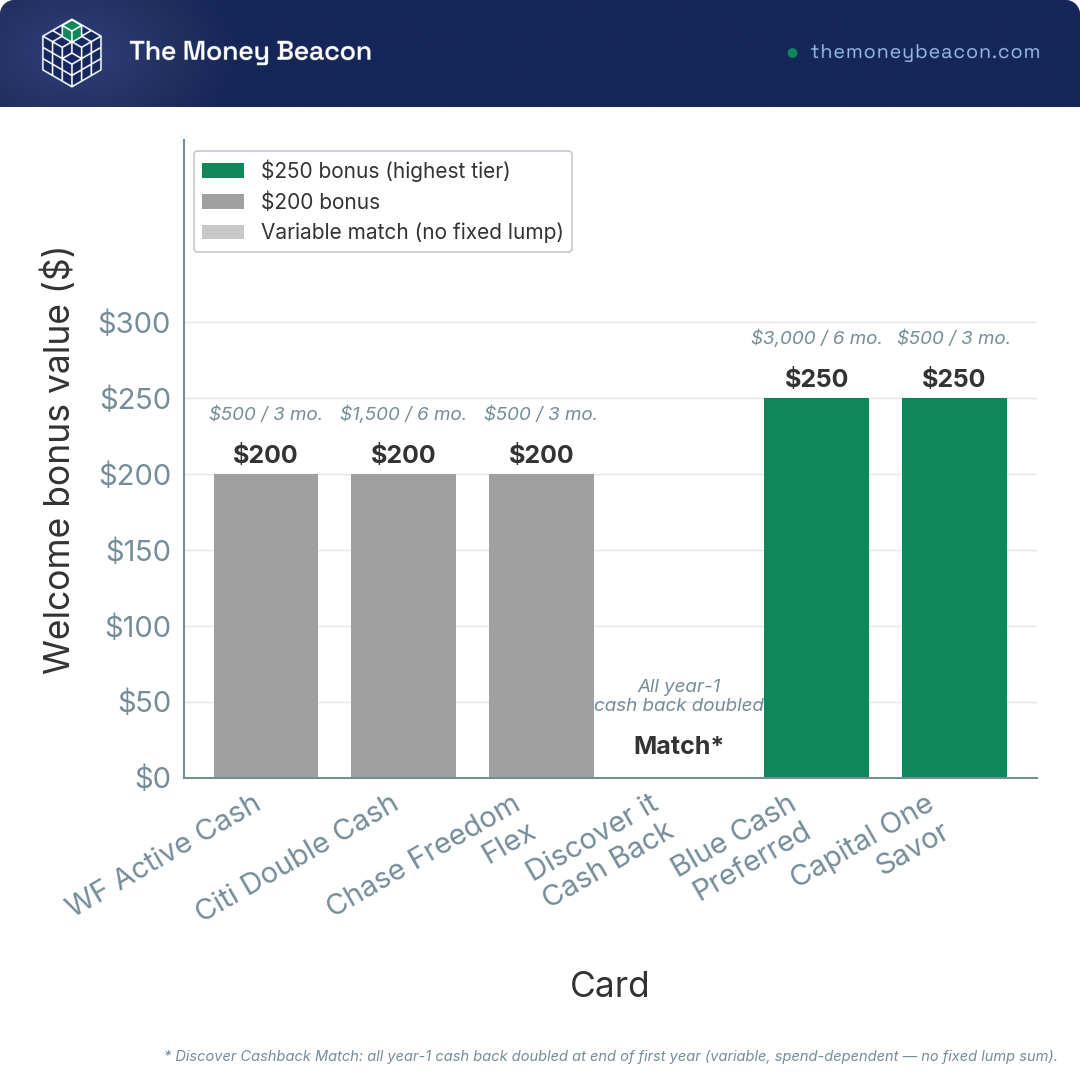
The welcome bonuses tell their own story once you weigh each payout against the spending it demands.
Boiled down to a single recommendation per spending shape, the field sorts cleanly.
| Reader profile | Spending shape | Best-fit card | Why | Watch-out |
|---|---|---|---|---|
| Simplicity-first | Spread across categories | WF Active Cash or Citi Double Cash | Flat 2%, no effort, no fee | 3% FX fee abroad |
| Category optimizer | Will activate, steer spending | Chase Freedom Flex (or Discover it yr 1) | 5% rotating + 3% dining; Discover doubles yr 1 | Quarterly cap + activation |
| Heavy grocery/streaming | $2,375 to $6,000/yr groceries | Blue Cash Preferred | 6% groceries beats 2% above breakeven | $95 fee, $6,000 cap, superstore exclusion |
| Heavy dining/entertainment | Restaurants, streaming | Capital One Savor | 3% dining/grocery/entertainment, no fee | Large “other” spending earns 1% |
| Balance to move | Carrying old debt | Citi Double Cash | 0% BT 18 months | BT fee 3% then 5% |
Data current as of June 2026. “Best-fit” assumes you pay in full; carried interest at about 22% reverses every result.
| To do | To avoid | Common mistake per step |
|---|---|---|
| Map your real monthly spending by category first | Don’t pick by headline rate | Choosing 5% you rarely trigger |
| Pay the statement in full every month | Don’t carry a balance | ~22% interest erasing all rewards |
| Activate rotating categories each quarter | Don’t assume auto-activation | Earning 1% instead of 5% |
| Confirm the merchant codes as your category | Don’t assume Walmart/Target = grocery | 1% on “groceries” at a superstore |
| Earn the welcome bonus by required spending | Don’t overspend to chase a bonus | Spending $1 to “earn” 2 cents |
| Redeem before closing the account | Don’t close an account with unredeemed cash | Forfeiting earned rewards |
Data current as of June 2026.
With the numbers settled, the verdict comes down to matching your own spending shape to the right row. If you want the wider view of how these same issuers stack up beyond cash back, here are the best credit cards overall.
Best for the simplicity-first spender
If your spending refuses to concentrate and scatters across many categories, stop optimizing and take the flat 2%. Wells Fargo Active Cash and Citi Double Cash both earn $480 on the model budget with zero activation, zero caps, and nothing to track. The two are close enough that the tiebreaker is whatever else you need from the card. Pick Active Cash if you want a 0% intro purchase APR to carry a new expense interest-free for a year. Pick Double Cash if the 18-month balance-transfer runway matters more, or if you might later pool its ThankYou points into a premium Citi card for transfer value. For most spread-out households, either one is the right answer, and the choice between them is genuinely small.
The one watch-out for both flat cards is travel, because each charges a 3% foreign transaction fee while two rivals charge nothing abroad.
Best for the category optimizer
If you’ll reliably activate every quarter and steer your spending into the bonus lanes, a rotating card can top the field. Chase Freedom Flex leads on an ongoing basis with its 5% rotating categories stacked on a permanent 3% on dining and drugstores, which is why it reaches about $612 best case on the model budget. Discover it wins year one outright, because the Cashback Match doubles everything you earn to roughly $1,080 before it reverts to standard rates in year two. The catch is the discipline both demand: the 5% caps at $1,500 a quarter, and an activation you forget drops the rate to 1%. These cards reward the engaged optimizer and punish the set-and-forget spender.
One trap a single-year snapshot hides is year two, when Discover’s Match advantage fades and the $95 fee resets.
Best for the heavy grocery and dining household
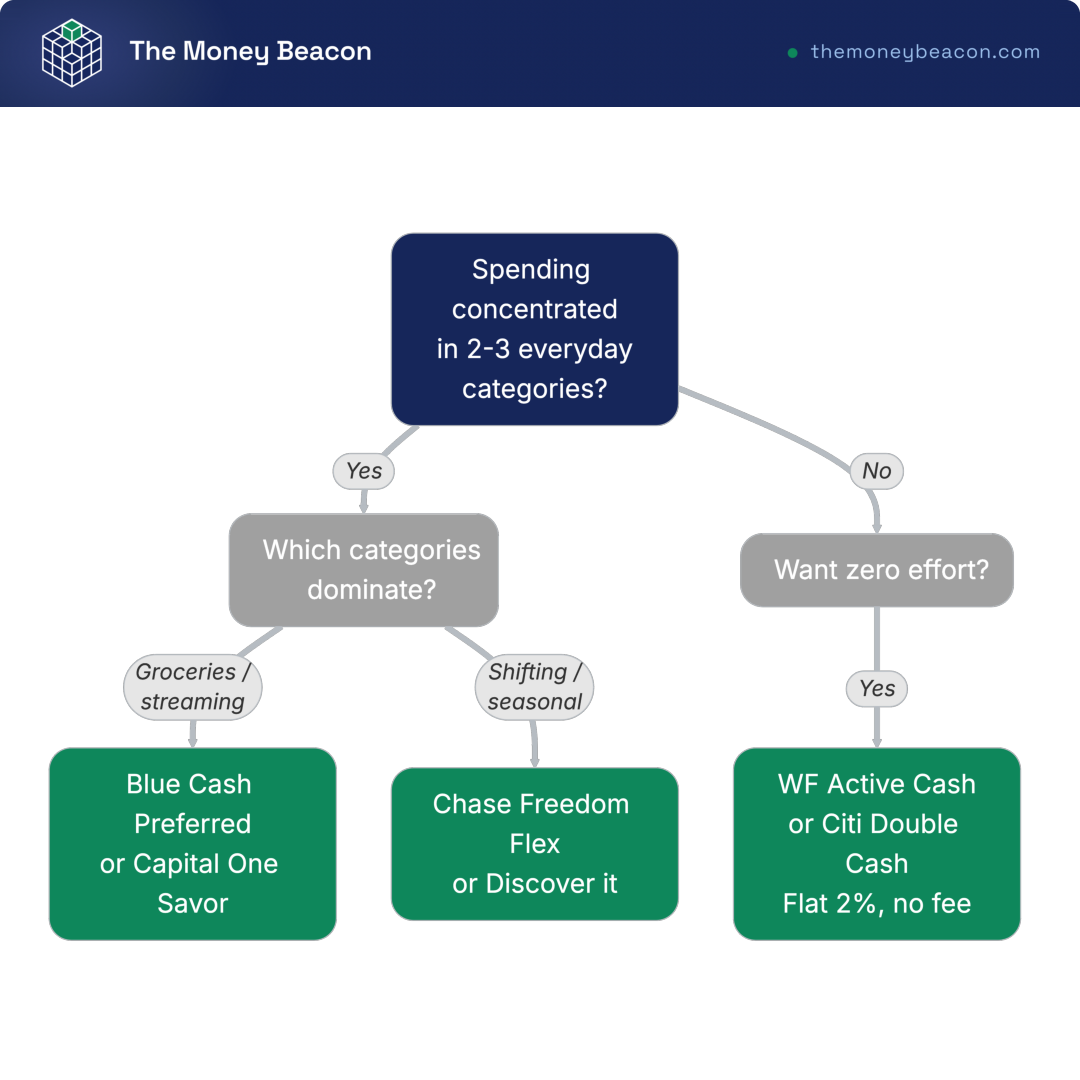
This is where the hardest call lives, and it splits by what you actually buy. For a grocery-heavy household, Blue Cash Preferred wins once your qualifying-supermarket spending clears the roughly $2,375 breakeven on the $95 fee. For dining and entertainment without paying a fee, Capital One Savor’s 3% is the better pick. The practical move is to map your real category mix first, then consider pairing a category card with a flat 2% card only if no single card already covers roughly 80% of your bonus spending. The decision tree below routes you from your spending shape to the right short list.
Conclusion
Here’s the thing: the headline rates kept hiding all the way down this page. The rate that’s advertised is almost never the amount of money you’ll actually get. With a budget of $24,000, the two flat 2% cards often did better than more flashy cards, even after counting the fees and 1% buckets. The percentages shout. The dollars whisper. You came here to listen to the dollars.
So, the bottom line is that there’s one simple step you can take at your kitchen table tonight. Pull up three months of statements and categorize your spending: groceries, gas, dining, streaming, and everything else. That last bucket is the one that decides everything. If your “everything else” pile is bigger, a flat 2% card will win, and a fancy category card won’t have a chance. You don’t need a spreadsheet or an app. A scrap of paper and ten minutes will show you which of the three structures fits your life: one simple rate, rotating categories you’ll actually activate, or a fixed bonus on the stuff you buy most.
Once you know your shape, the answer is already there. If your spending scatters, take the flat 2% and stop optimizing. If you’ll reliably activate every quarter and steer your purchases, a rotating card can be a good option. If groceries dominate and clear that breakeven, the 6% card will be worth ir; if it’s dining and entertainment without a fee, the 3% Savor might be a better choice. Just match the row to your actual numbers and you’re all set.
One rule sits above all the others. Every figure in this comparison assumes you pay the statement in full. At roughly 22% on a carried balance, a single month of interest erases many months of rewards, so the best cash back card for someone who carries a balance is no card at all until the balance is cleared. Earn the reward only on money you were going to spend anyway, then redeem it before you ever close an account. Cash back is a small, steady advantage, not a reason to buy something you don’t need.
For the broader perspective, here are the best credit cards overall if your needs run past cash back, the best balance transfer cards if an old balance has to clear before any rewards make sense, and a good high-yield savings account to park the cash back you redeem so it keeps earning.
FAQ
What is the difference between flat-rate, rotating, and fixed-category cash back cards?
The three structures differ in which dollars earn the bonus rate and how much effort they require. Flat-rate cards (Wells Fargo Active Cash and Citi Double Cash both pay 2%) pay one rate on everything with no categories, no activation, and no caps, so they’re the lowest-maintenance option. Rotating cards (Chase Freedom Flex, Discover it) pay a high rate (5%) on categories that change each quarter, capped at $1,500 in combined purchases per quarter and requiring activation; everything else earns 1%. Fixed-category cards (Blue Cash Preferred, Capital One Savor) pay elevated rates permanently on a set of everyday categories (3% to 6% on groceries, dining, streaming) with 1% on everything else, and some categories carry annual caps.
The structure that actually pays you most depends on whether your spending is scattered or concentrated. A household whose budget is spread thinly across dozens of categories will rarely beat a flat 2% card with any category structure. A household that reliably spends several hundred dollars a month at qualifying supermarkets or restaurants will likely come out ahead with a fixed-category card, and an engaged optimizer willing to activate quarterly can sometimes top both with a rotating card on the capped slice.
Does Discover do a Cashback Match, and is it every year?
The Cashback Match is a first-year benefit only, not a recurring annual one. Discover matches all cash back you earn in the first year, dollar for dollar, with no cap on the match amount, and pays it automatically at the end of the first 365 days or 12 consecutive billing cycles (whichever is longer). Because it doubles your earnings, a rotating card that normally pays 5% on qualifying categories effectively pays 10% on those categories in year one, and the standard 1% base becomes 2%, which puts Discover’s first-year yield roughly on par with a flat 2% card even on uncapped everyday spending.
Year two is a different picture. The Match doesn’t repeat, so you revert to the standard 5% (rotating, capped) and 1% rates. If your plan is to use Discover long-term, budget year two at standard rates; the Match is best thought of as an unusually generous welcome offer, not a structural feature of the card.
What credit card gives you 6% back on groceries?
The Blue Cash Preferred Card from American Express pays 6% at US supermarkets on up to $6,000 per year in purchases, then 1% after the cap. It carries no annual fee the first year, then $95 from year two. To net ahead of a no-fee 2% flat card, your qualifying-supermarket spending needs to clear roughly $2,375 per year, since the 4% spread (6% minus 2%) must cover that $95 fee.
Two exclusions trip up a lot of grocery households. First, the 6% rate applies only at qualifying US supermarkets as classified by merchant category code; warehouse clubs and superstores (Walmart, Target, Costco) are coded separately and typically earn only 1%, no matter how much food you buy there. Second, the cap means spending above $6,000 per year at qualifying stores earns just 1% on the overflow, at which point pairing Blue Cash Preferred with another card starts to make sense.
Does carrying a balance wipe out my cash back?
Yes, and faster than most people expect. The Federal Reserve G.19 report (released June 5, 2026) puts the average APR on credit card accounts assessed interest at 22.32%. At that rate, the interest on a $2,000 balance carried for one month runs about $37, which is roughly what 2% cash back earns on $2,000 of spending in a month. The interest cost and the reward are essentially the same dollar amount, so you’re working for free. On a higher balance the interest easily runs several times the monthly cash back earned.
Every effective earn rate in this comparison assumes you pay the statement in full every month. If you’re carrying a revolving balance, the first financial move is to pay it down, not to optimize rewards. Our comparison of balance transfer cards covers the 0% intro APR options (including Citi Double Cash’s 18-month balance transfer window) for readers who want a runway to clear existing debt before focusing on rewards.
Can I have two cash back cards at once, and should I?
Yes, and for many households a two-card setup is the highest-return approach, but only if the pairing is deliberate. The most common setup is a fixed-category card for the categories where you spend the most (Blue Cash Preferred for groceries and streaming, Capital One Savor for dining and entertainment) plus a flat 2% card (Wells Fargo Active Cash or Citi Double Cash) for everything else. That way you capture elevated rates on your top categories and still earn 2% on the rest instead of falling to 1%.
The check worth running first: does one card already cover roughly 80% or more of your bonus spending? If it does, adding a second card mostly adds tracking overhead without meaningfully lifting your effective earn rate. A second card only makes sense when there’s a clear and consistent category gap your primary card doesn’t cover. If you want to see how cash back cards stack up against travel and points cards before committing to a setup, our comparison of travel rewards cards walks through the trade-offs.



Comments
Questions and corrections welcome. We read everything.