


You are paying four or five separate minimums every month, the due dates blur together, and the balances barely move because the interest keeps clawing most of it back. The average credit card now charges around 21% APR, a level that has stayed stubbornly high into 2026, so a $25,000 balance can cost you more than $400 in interest in a single month. Then a “one easy payment” pitch lands in your inbox and sounds like relief, and you cannot tell whether it actually saves you money or just hides the same debt behind a new label. That uncertainty is exactly what pushes people to consolidate at the wrong rate, on the wrong term, and end up paying more over the life of the loan.
In this guide, I walk through what consolidating your debt really does to your interest, your payoff timeline, and your credit, comparing each method on the numbers rather than the marketing. You will see when a lower interest rate genuinely wins, and the traps that quietly turn a smart move into an expensive one.
1. What Debt Consolidation Actually Is (and What It Never Does)
Before you compare a single offer, settle one question: when you consolidate, what actually changes about your debt, and what stays exactly the same? Get that straight first and the four methods later slot into place. Skip it, and you risk treating a repackaged balance as if it had shrunk.
1.1 The one-payment idea, and the part that never changes
You probably picture consolidation as one clean payment replacing four or five messy ones, and that is the right picture. Consolidation swaps several debts for one new debt, ideally at a lower rate, so you write a single check instead of juggling a fistful. The mechanics are not complicated. You borrow a lump sum, or open a new line of credit, and you use that money to pay your existing balances down to zero. The old accounts go quiet, and the new account now carries the combined principal.
Two pieces of vocabulary make the rest of this guide click. The principal is the amount you actually borrowed; the interest is what the lender charges you for the use of it, which is why a card balance can sit nearly still while you pay every month. Debt also comes in two flavors: unsecured debt (credit cards, personal loans) is backed by nothing but your promise to repay, while secured debt is tied to an asset the lender can take, such as your home. That distinction will matter a great deal when we reach the home-equity options.
Consolidation itself takes two basic forms. You can roll the balances into an installment loan, which has a fixed payoff date, or you can roll them onto a revolving balance-transfer card with a promotional window. Either way, no one negotiates with your creditors. You simply pay them in full with new money, which is what separates consolidation from the debt-relief routes we get to next.
Now the part that never moves. If you owe $25,000 across four cards, you still owe roughly $25,000 the morning after you consolidate, plus any origination or transfer fee. What changes is the rate, the schedule, and the number of bills you track, never the size of the debt itself. Your lifetime cost falls only when the new effective rate, after fees, is genuinely lower across the whole term. With average credit card debt sitting on rates near 21%, that gap is often real, but it is never automatic.
1.2 Consolidation vs. settlement, bankruptcy, and a debt management plan
People reach for “consolidation” as a catch-all word, and that is where the trouble starts. Four routes get jumbled together, and they differ on three things that decide everything: who you owe afterward, what happens to the principal, and what it does to your credit. The table below lines them up.
| Route | What happens to principal | Credit-report effect | Best fit |
|---|---|---|---|
| Consolidation | Paid in full with new debt; you still owe 100% | Small temporary dip; new account/inquiry | Can afford payments; wants lower rate/simplicity |
| Debt management plan (DMP) | Paid in full over 3-5 yrs; creditors may cut APR | Accounts often closed; minimal score harm long-term | Overwhelmed but solvent; wants structure |
| Debt settlement | Creditor accepts less than owed (lump or staged) | Severe; “settled for less” stays ~7 yrs | Already delinquent; cannot repay in full |
| Bankruptcy (Ch. 7 / 13) | Discharged (Ch.7) or restructured (Ch.13) | Most severe; 7-10 yrs on report | Insolvent; no realistic repayment path |
Data current as of June 2026.
Here is the split that matters: consolidation and a debt management plan both repay every dollar you owe and protect your credit standing, while settlement and bankruptcy involve paying less than owed and leave lasting damage. A bankruptcy stays on your report for up to 10 years for Chapter 7 and up to 7 years for Chapter 13, and settlement and most negative marks generally linger about 7 years under the Fair Credit Reporting Act, counted from your first missed payment.
One guardrail belongs here, because it is the first scam test you will use. Under the FTC’s Telemarketing Sales Rule, a for-profit company that sells debt-relief services over the phone cannot charge you a fee until it has actually settled or renegotiated at least one debt, a written agreement is in place, and you have made a payment under it. Anyone demanding money up front, before they have done a thing, is not a debt-relief firm; they are a scam.
1.3 When consolidation helps and when it just moves the problem
You have the vocabulary now, so you can judge whether consolidation is even the right tool, which is a separate question from which product to pick. The logic comes down to a short if/then chain. If the new rate, with all fees spread across the term, lands meaningfully below your old blended rate, and the term is not materially longer, then you cut lifetime cost. If the payment drops only because the term stretched, lifetime interest can climb even at a lower rate. And if you keep charging on the now-empty cards, you simply double the debt, owing the new loan plus fresh balances.
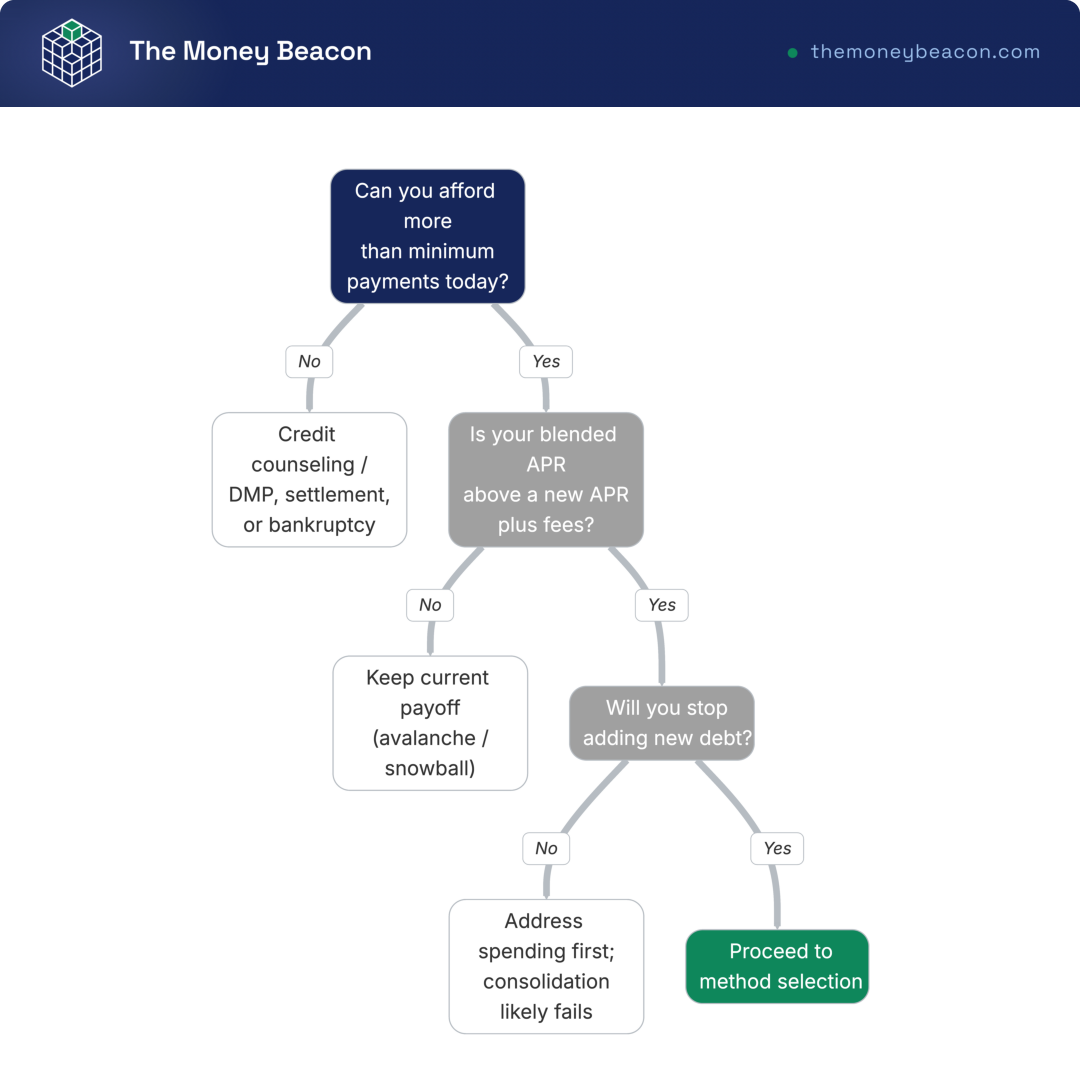
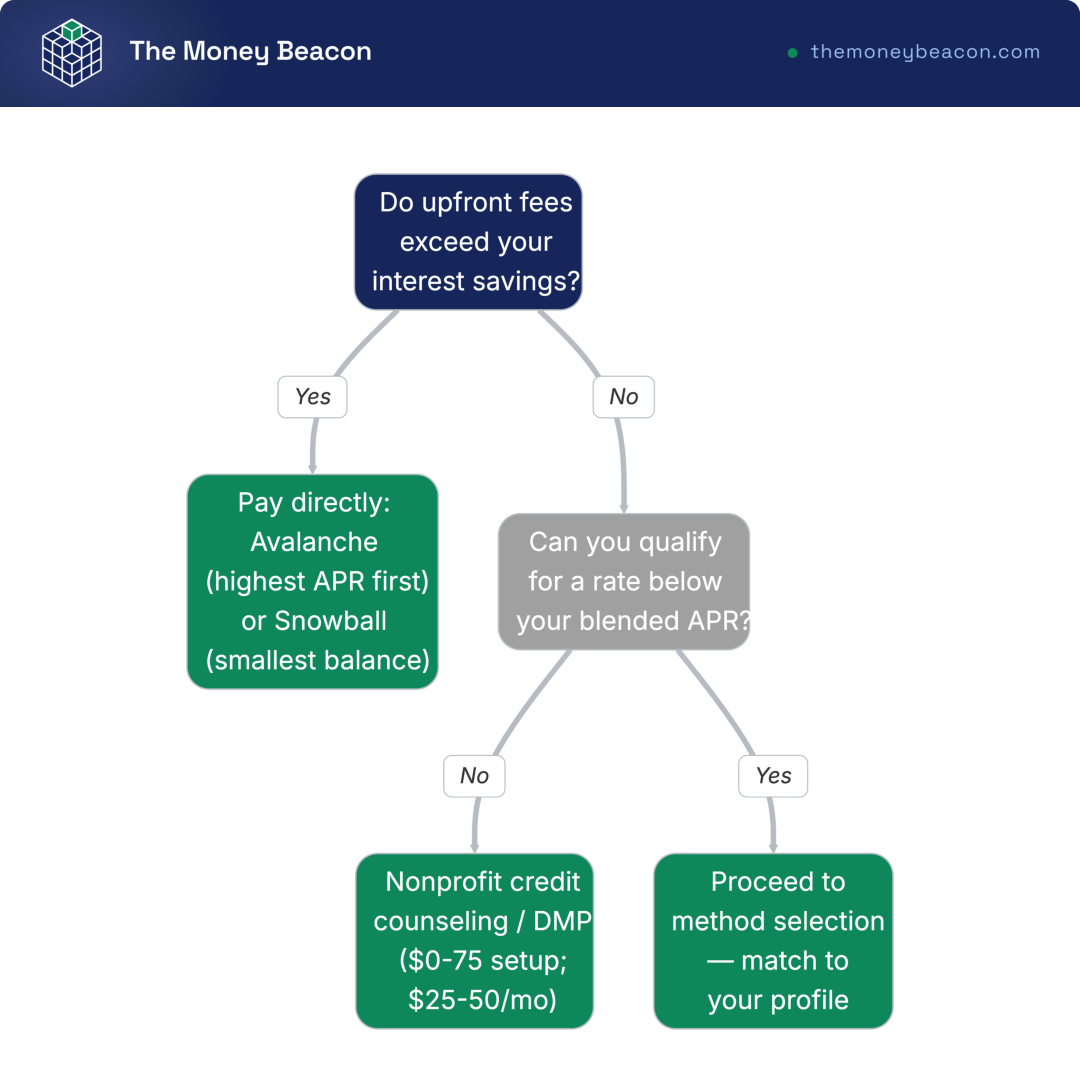
That leaves one rule worth keeping in mind before you shop anything. Consolidation pays off only when the new rate plus every fee beats your old blended rate, and you stop adding new debt; the number to compare is total lifetime cost, never the monthly payment. The decision tree below walks that threshold question for you, so you confirm consolidation makes sense before you ever look at a lender. Clear it, and you are ready to map your options.
2. The Four Main Methods (Plus the Honorable Mentions)
So consolidation, in principle, fits your situation. The next question is which instrument to actually use, and there are four serious ones plus a few honorable mentions. We move from the cleanest unsecured swap to the deadline-driven 0% card, then to the home-secured options with their foreclosure trade-off, and finally to borrowing from your own retirement.
2.1 Personal loan: the default consolidation tool
Start with the workhorse. A personal loan is an unsecured installment loan: a fixed lump sum, a fixed rate (usually), a fixed term, and a fixed monthly payment, with no collateral on the line. It is the default tool for credit card debt because it turns a revolving balance that never seems to end into a structured payoff with a real finish date.
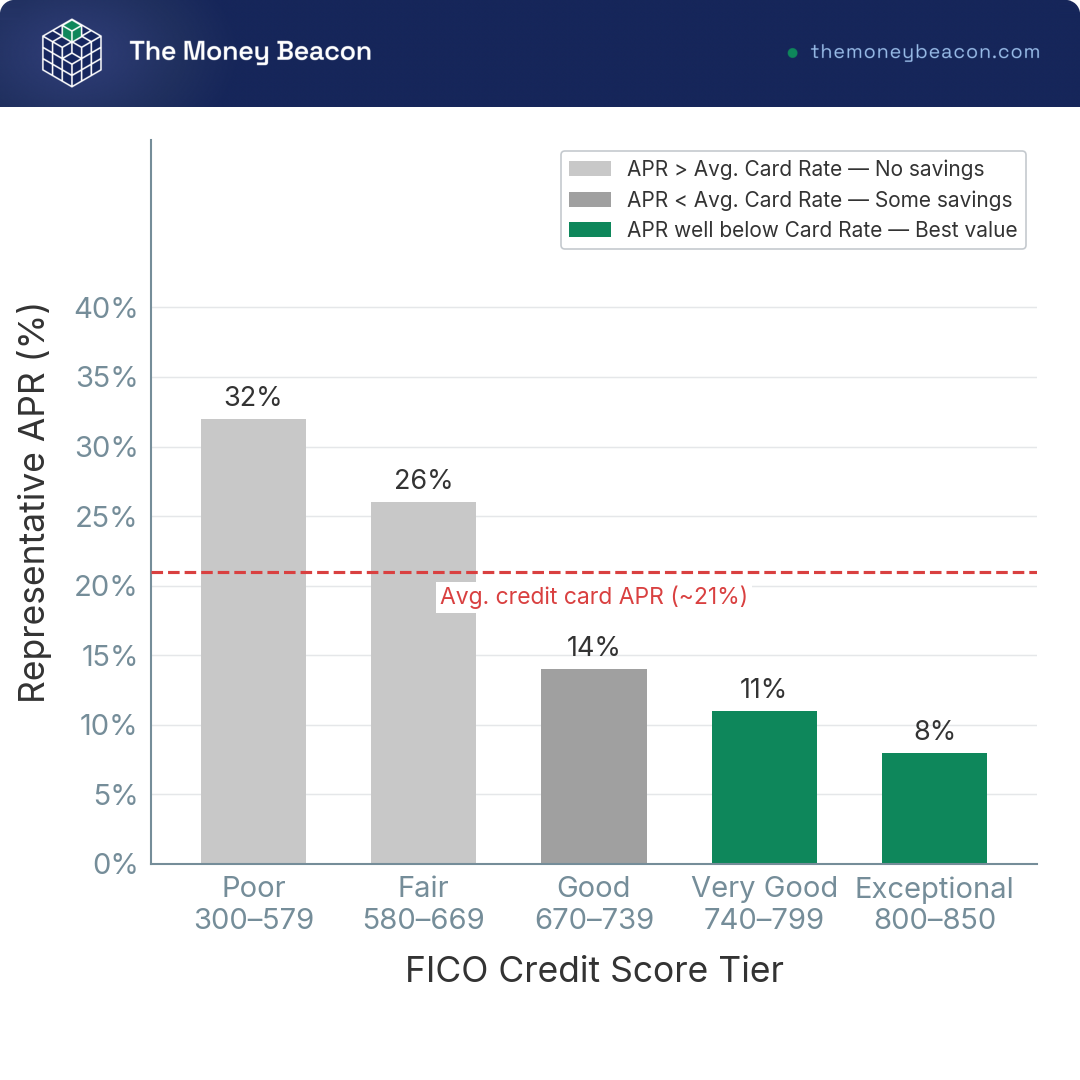
The rate is the whole reason you would bother. Personal-loan APRs run roughly 7% to 36% by credit tier, with well-qualified borrowers landing in the low-to-mid teens; the average rate on a 24-month bank personal loan sat near 11% in early 2026, though that figure blends every approved borrower. Set that against the 21% your cards charge and the appeal is obvious. The chart below shows how the rate you can expect tracks your credit score, so you can pre-judge whether a personal loan beats your cards before you apply.
A few practical numbers round out the picture. The origination fee commonly runs 1% to 10% of the loan and is deducted from the proceeds, terms stretch from 24 to 84 months, and funding usually lands 1 to 7 business days after approval. Lenders frequently used for consolidation include SoFi, LightStream, Discover, Upstart, and LendingClub; LightStream, SoFi, and Discover typically charge no required origination fee, while Upstart and LendingClub commonly do. One name to drop from any old list: Marcus by Goldman Sachs no longer originates new personal loans, so it is not an option for new borrowers.
Hank’s take

the personal loan is the cleanest apples-to-apples swap precisely because the rate does not reset on you. After years picking apart rate spreads, that fixed payoff date is the feature I would not give up lightly, since a 0% promo that expires is a very different animal.
Before you settle on one, it helps to compare personal loan rates, terms, and lenders to see where the real rates and fees land right now.
2.2 Balance-transfer card: 0% for a window, then a cliff
The personal loan locks in one rate for the whole ride. A balance-transfer card does the opposite: it offers a stretch of 0% and then a hard edge. You move existing card balances onto a new card carrying a 0% or low promotional APR for a defined window, and during that window every dollar you pay attacks principal instead of interest.
The details are where this lives or dies. Promo windows commonly run 12 to 21 months, with the longest offers around 21 billing cycles; the transfer fee is commonly 3% to 5% charged up front; and when the promo ends, the rate reverts to the card’s standard purchase APR, often in the high-teens to high-20s. The transfer itself takes 1 to 3 weeks to post, so you keep paying the old cards until it clears. Issuers that have offered these products include Citi (Citi Simplicity, with windows commonly in the 18-to-21-month range) and U.S. Bank (some products up to 21 billing cycles), though lineups change, so confirm the current window on the issuer’s page.
One eligibility catch trips people up. Your credit limit depends on your credit standing, and a thin or fair-credit file may get a limit below the debt you are trying to move, which defeats the purpose; issuers also generally bar transfers between two cards from the same issuer. The Credit CARD Act of 2009 works in your favor here, requiring payments above the minimum to hit the highest-APR balance first, mandating 45-day notice of rate increases, and limiting hikes on existing balances. The chart below shows how a 0% promo retires a $10,000 balance faster than a 21% card at the same payment, and whether that transfer fee eats the gain.
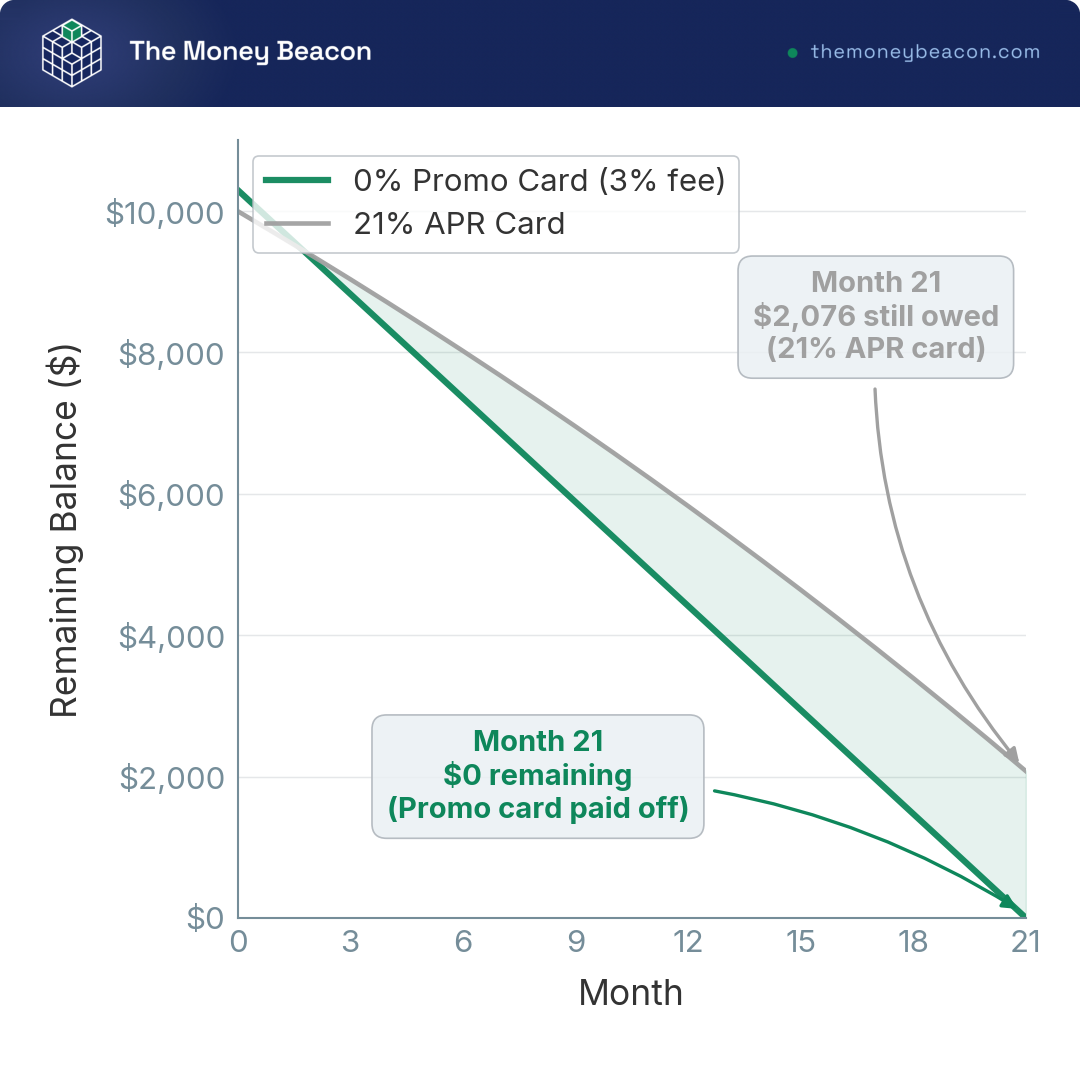
The catch is the deadline. A balance-transfer card rewards a borrower who can clear the balance inside the window and punishes one who cannot, which is why it suits short payoffs best. To find the longest current windows, our roundup of the longest 0% intro APR offers and transfer fees available in 2026 is a useful starting point.
2.3 HELOC or home equity loan: the homeowner’s lower rate, with a catch
Both options so far leave no asset on the line. The next two change that, starting with the one open to homeowners. A home equity loan hands you a fixed lump sum at a fixed rate; a HELOC (home equity line of credit) is a revolving, usually variable line tied to the prime rate, with a draw period and then a repayment period. Both are secured by your home, which is exactly why they price below unsecured options.
The trade-off is not small, so here are the moving parts. Rates typically sit below personal-loan rates because the home is collateral, though there is no single official federal average, so confirm pricing with lenders. Expect closing costs, an appraisal, and possibly an annual fee; some lenders waive closing costs but claw them back if you close early. Lenders usually cap combined loan-to-value, or CLTV (mortgage plus the new line divided by home value), around 80% to 90%, with roughly 85% common, and underwriting often runs several weeks. The diagram below sorts which risk attaches to which family of method.
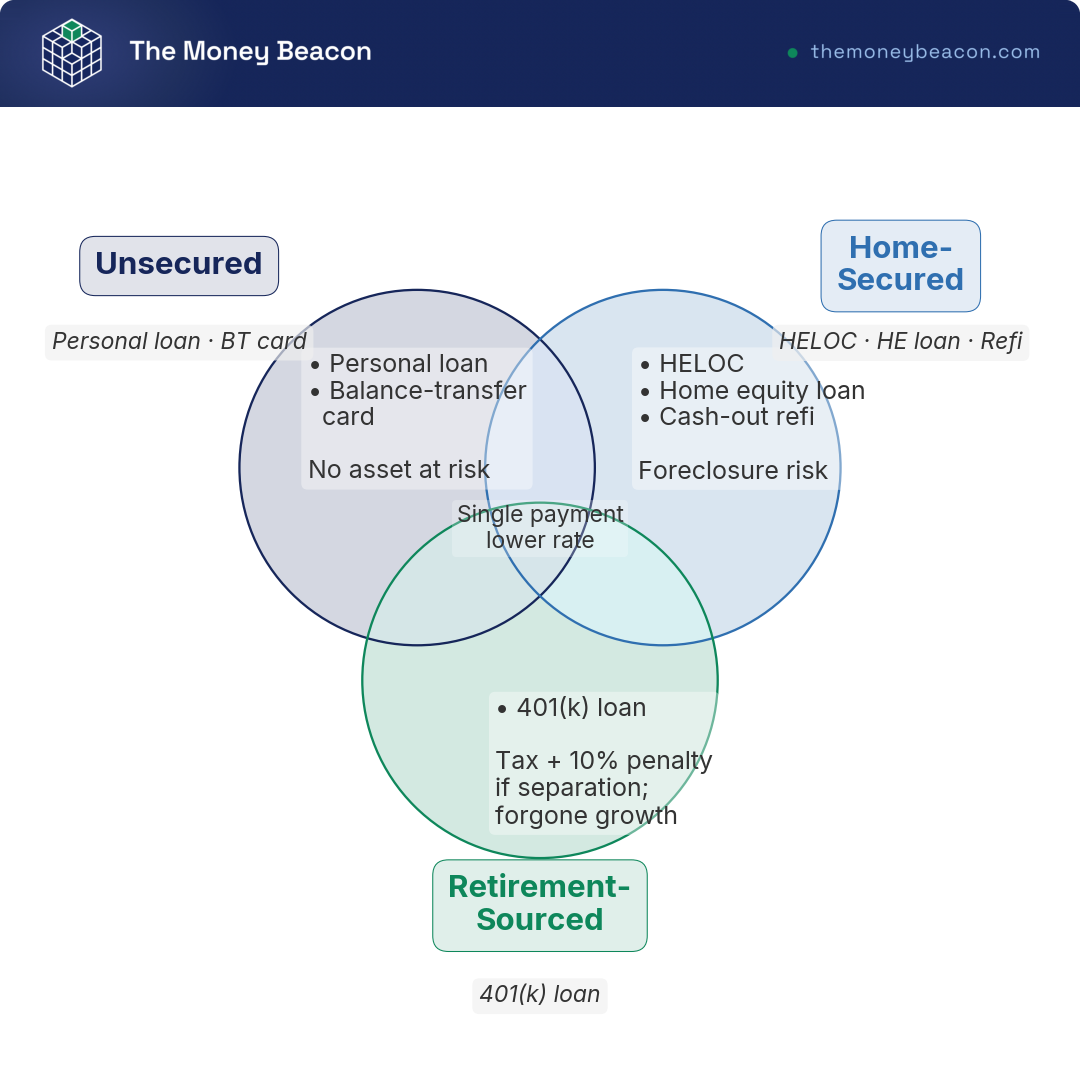
Now the part that should give any homeowner pause. This route converts unsecured card debt into secured debt, so a default no longer means collection calls; it can mean foreclosure. The tax angle disappoints people too: interest on home-equity debt is deductible only when the funds buy, build, or substantially improve the home (per IRS Publication 936), so paying off credit cards with a HELOC earns you no deduction at all. The Home Ownership and Equity Protection Act adds disclosures for certain high-cost home-secured loans. Used well, by a homeowner with stable income and real cushion, the lower rate is genuine, and you can dig into the mechanics in our HELOC guide.
2.4 401(k) loan: borrowing from your future self
The home-equity route pledges your house. The last main method pledges something arguably more personal: your retirement. A 401(k) loan lets you borrow from your own balance and repay it, with interest, back into the account through payroll deduction. The interest goes to you, not a bank, and there is no credit check and no new tradeline on your report.
The limits and risks are specific. You can borrow the lesser of $50,000 or 50% of your vested balance, with the plan allowed to permit up to $10,000 if half your balance falls below that (under IRC 72(p)); the rate is commonly prime plus about 1%, and the term generally runs up to 5 years. Two risks dominate. The first is opportunity cost: the borrowed money leaves the market, so you forgo whatever growth it would have earned. The second is the separation trigger, which is the real trap. If you leave or lose the job, the outstanding balance generally must be repaid by your tax-filing deadline (with extensions), or it becomes a deemed distribution, taxed as ordinary income plus a 10% early-withdrawal penalty if you are under 59½. Plans are not required to offer loans at all, so check your summary plan description; administrators include Fidelity, Vanguard, and Empower. Treat this one as a last resort, reserved for a secure job, a point we revisit in our 401(k) loan guide.
2.5 Honorable mentions: cash-out refinance, nonprofit DMP, and why an HSA is not a tool
Beyond the four, three more names come up often enough to address head-on, two as real options and one as a warning. A cash-out refinance replaces your mortgage with a larger one and hands you the difference in cash; it is home-secured, it resets the mortgage, and it rarely makes sense when today’s rates sit above your existing rate, though it can suit specific cases worth checking in a cash-out refinance comparison.
The more broadly useful option is a nonprofit debt management plan. A credit-counseling agency negotiates lower rates with your creditors, and you make one payment to the agency, which distributes it. Fees stay modest: a one-time setup commonly $0 to $75 and a monthly fee commonly $25 to $50 (some agencies average roughly $30 to $37 setup and $26 to $28 monthly). Reputable agencies belong to the National Foundation for Credit Counseling, and the U.S. Department of Justice, U.S. Trustee Program, publishes an approved list; named nonprofits include Money Management International and GreenPath. As for the HSA: it is a tax-advantaged medical account, not a debt tool, and tapping it for non-medical use before age 65 triggers income tax plus a 20% penalty (per IRS Publication 969), so it earns a mention only as a caution against misuse.
With all four methods explained, the table below lines them up side by side so the differences are easy to scan.
| Method | Secured? | Typical APR posture | Main fee | Term | Credit-score line |
|---|---|---|---|---|---|
| Personal loan | No | Low-mid teens (good credit) | Origination 1-10% | 24-84 mo | New tradeline + inquiry |
| Balance-transfer card | No | 0% promo, then high | Transfer 3-5% | 12-21 mo promo | New tradeline + inquiry |
| HELOC / home equity loan | Yes (home) | Below unsecured | Closing/appraisal | 5-30 yr | New tradeline + inquiry |
| 401(k) loan | No (own money) | Prime + ~1% | Origination/maint. | Up to 5 yr | Not reported |
Data current as of June 2026.
Two methods carry no asset risk, one pledges your house, and one pledges your retirement. Knowing the lineup is one thing, but knowing which one costs you the least is another, and that turns entirely on three numbers.
3. How to Compare the Methods: APR, Fees, and Term
You have the full option set by now. Here is the part the marketing works hardest to obscure: which one actually costs you the least, and how you run that number yourself. The answer rests on three levers, the rate, the fees, and the term, so we take them in that order before running one real $25,000 debt load through all four methods in dollars.
3.1 Why APR, not the monthly payment, is the real number
Here is a mistake you see constantly: a borrower picks the option with the lowest monthly payment and assumes they got the best deal. The monthly payment is the most-marketed and most-misleading figure there is, because a lender can shrink it simply by lengthening the term, which quietly raises the total interest. The number that actually compares two offers is the annual percentage rate, or APR, which under the Truth in Lending Act bundles the interest rate plus certain required charges into one annualized cost.
So the working rule is simple to state and easy to forget: compare APRs and total lifetime cost across options with the same payoff horizon, not the monthly payments. One caveat applies to the balance-transfer card, because its “0% APR” is promotional and leaves out the transfer fee. Its true cost is the transfer fee plus any interest charged after the promo ends, never the headline 0%. The chart below makes the term trap visible: on a fixed $20,000 at 12%, the total interest climbs far faster than the payment falls as you stretch the term.
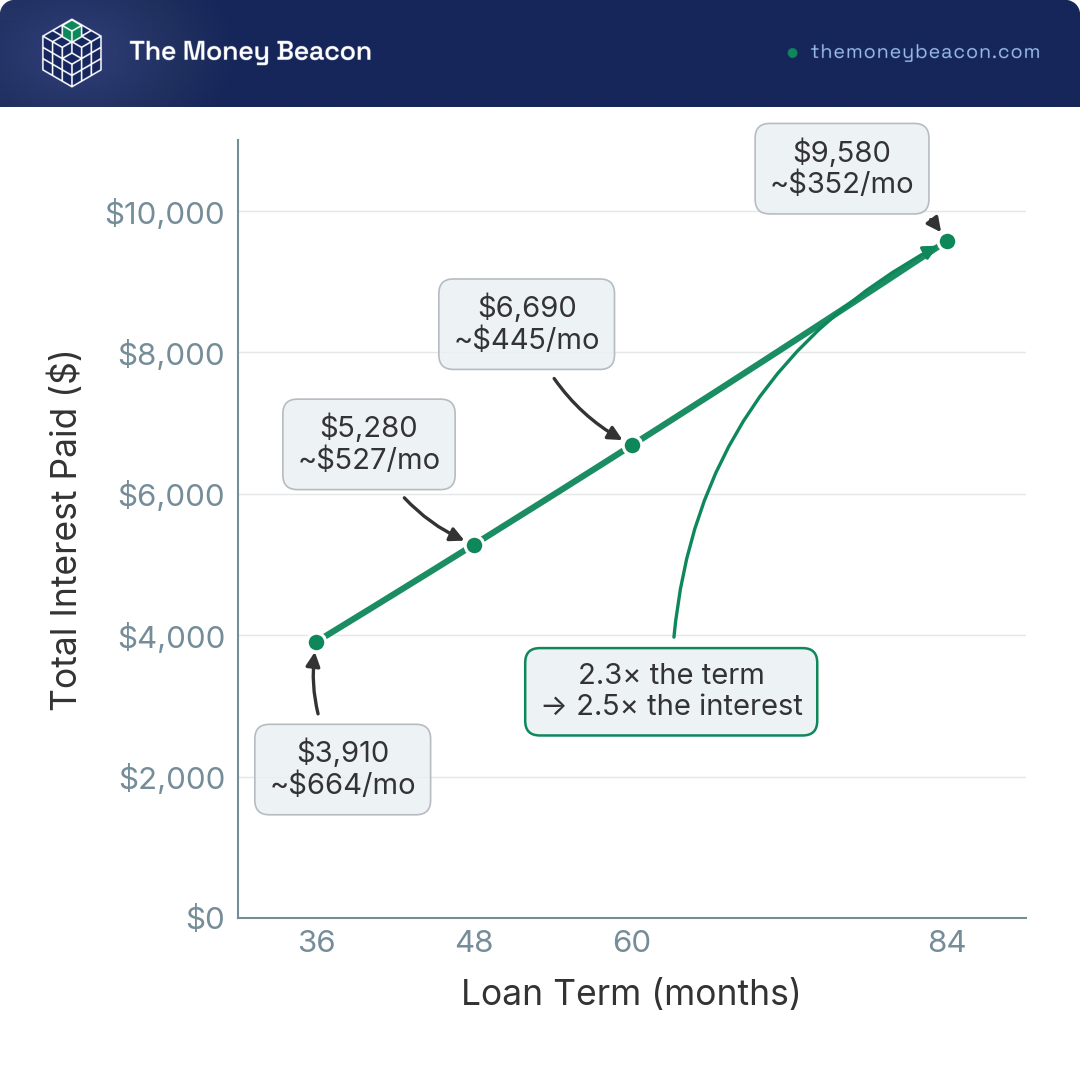
That curve bends upward for a reason, and the fees do something similar to the math, so they come next.
3.2 The fees that quietly change the math
The rate gets the attention, but the fees decide the close calls. They fall into four buckets, and they vary sharply by method, so the table below walks the structure across every option.
| Fee type | Personal loan | Balance-transfer card | HELOC / HE loan | 401(k) loan | DMP |
|---|---|---|---|---|---|
| Up-front | Origination 1-10% | Transfer 3-5% | Closing/appraisal | Origination (small) | Setup fee $0-75 |
| Recurring | None typical | None during promo | Possible annual fee | Maintenance fee | Monthly fee $25-50 |
| Penalty | Late fee; rare prepay penalty | Late fee; lost promo on late pay | Late fee; early-closure cost | None to lender | Drop from plan if missed |
| Hidden cost | None | Post-promo APR cliff | Foreclosure exposure | Lost market growth | APR not always lowered |
Data current as of June 2026.
One detail in that top row trips up almost everyone, so it is worth stating plainly. An origination fee is deducted from the loan proceeds, which means a $20,000 loan with a 5% fee disburses only $19,000 to you, yet charges interest on the full $20,000. The fix is to size the loan to cover the fee, so the cash that actually lands in your account clears your debt. With the rate and the fees in hand, the last lever is the one borrowers reach for to lower the payment, and it is the one that costs the most.
3.3 Term length and the lifetime-cost trade-off
Stretching the term is the easiest way to shrink a monthly payment, and the most expensive. Because the principal sits outstanding longer, more interest accrues, even when the rate never changes. The table below lays out the trade-off on that same $20,000 at 12%.
| Term | Approx. monthly payment | Approx. total interest | Total repaid |
|---|---|---|---|
| 36 months | ~$664 | ~$3,910 | ~$23,910 |
| 48 months | ~$527 | ~$5,280 | ~$25,280 |
| 60 months | ~$445 | ~$6,690 | ~$26,690 |
| 84 months | ~$352 | ~$9,580 | ~$29,580 |
Illustrative amortization at a fixed 12% APR. Data current as of June 2026.
So look at what that costs you: the 84-month loan more than doubles the interest of the 36-month loan at the identical rate, turning roughly $3,910 into about $9,580. The deeper lesson is the one that catches careful shoppers off guard: a lower APR on a much longer term can still cost more than a higher APR on a short one. So set a target. Aim for a term no longer than the time it would have taken to clear the old debt at your current payment, and pick the shortest term whose payment still fits your budget. With all three levers established, you can finally run them together.
3.4 A side-by-side worked example: one $25,000 debt load, four outcomes
Numbers in the abstract only go so far, so take one realistic borrower through all four methods. The profile: $25,000 in card debt at a 21% blended APR, paying about $625 a month, which would take many years to clear. The table below runs the same debt through each option.
| Option | Effective rate / structure | Up-front fee | ~Monthly (target ~3 yr) | Est. total interest | Net vs. status quo |
|---|---|---|---|---|---|
| Status quo (21% card) | 21% revolving | None | $625 (slow) | Very high; years to clear | Baseline |
| Personal loan 13%, 36 mo | 13% fixed | 5% origination ($1,250) | ~$842 | ~$5,300 + fee | Large interest saving if rate holds |
| Balance-transfer 0%/18 mo | 0% then ~24% | 4% transfer ($1,000) | ~$1,389 to clear in promo | ~$0 if cleared in promo + $1,000 fee | Best if fully repaid in window |
| HELOC ~9% variable, 60 mo | ~9% variable | ~$500 closing | ~$519 | ~$6,100 + fee + foreclosure risk | Low payment, secured-debt risk |
Illustrative; rates reflect H1 2026 conditions and should be confirmed with the lender. Data current as of June 2026.
So which one wins? It depends on what you can carry. The balance-transfer card is cheapest, but only if you can afford about $1,389 a month to clear it inside the promo; miss that, and the post-promo rate can erase the advantage. The personal loan is the balanced pick for a borrower who needs a sustainable ~$842 payment and a guaranteed payoff date. And the HELOC offers the lowest payment but pledges your home as the price. Same debt, four very different bargains, and the right one is the one your budget can actually sustain. Knowing the cheapest path on paper, though, is only half the battle, because even a winning calculation can come undone by what happens after you sign.
4. The Pitfalls That Turn Consolidation Into a Trap
The cheapest option on a comparison table is only the cheapest if nothing goes wrong after you sign, and four things routinely do. You can run the old cards back up, pledge your house when you did not have to, stretch the term until the lower rate stops mattering, or get blindsided by a fee or a promo deadline you never planned around. We take them in the order they sink plans most often, and each one comes paired with the safeguard that defuses it.
4.1 Running the old balances back up
Start with the failure that wrecks more plans than any rate calculation ever does. The chart below ranks our four outcomes for the $25,000 load by total interest plus fees, so you can read the cheapest path at a glance.
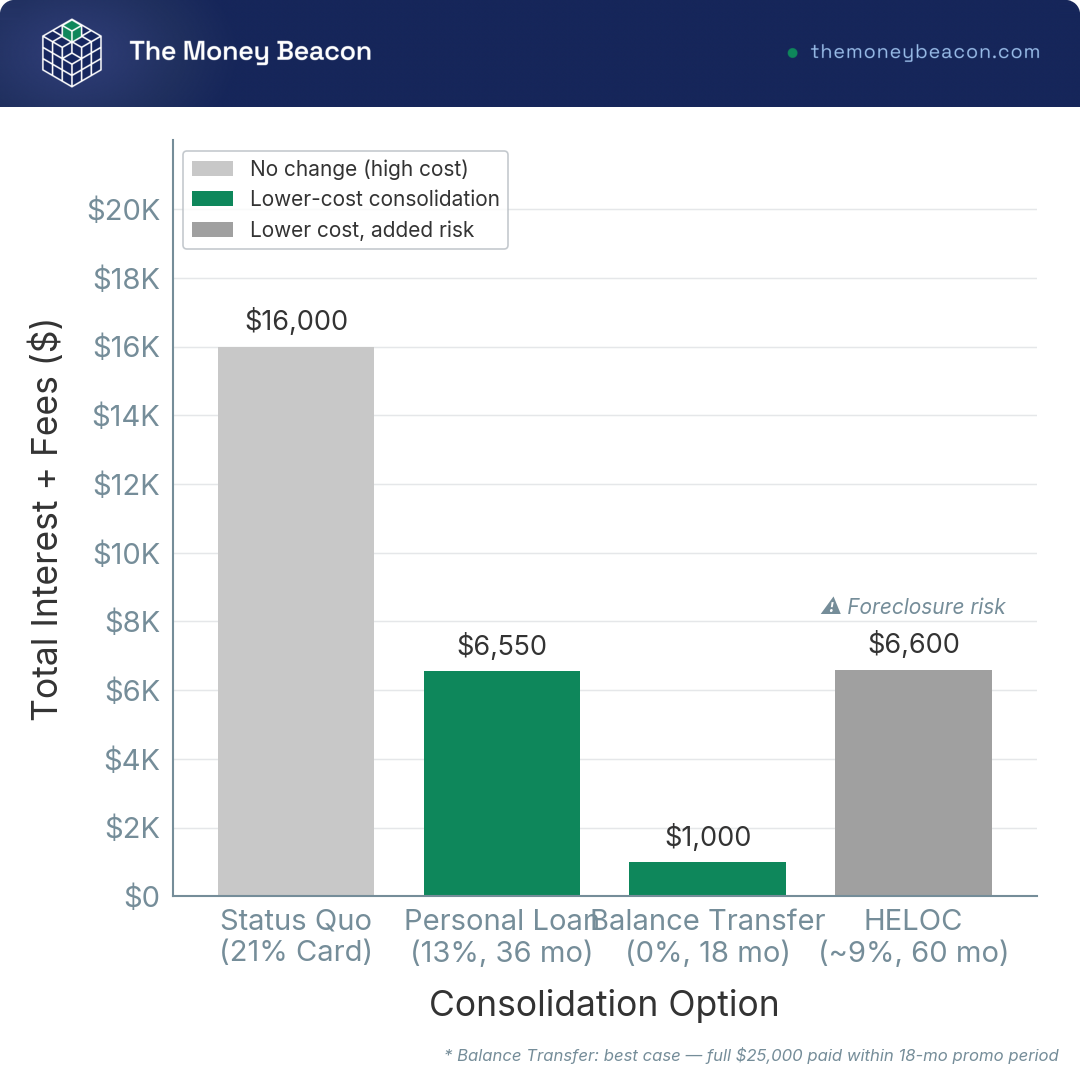
Here is the catch that bar chart cannot show you. Once you consolidate, the old cards sit at zero with their full limits open again, and that empty space is the trap. Keep charging and you now owe the consolidation loan plus a fresh card balance, which means you have doubled the very problem you set out to solve. This is the single most common way a sound plan unravels, and no APR you negotiate can protect you from it.
The safeguard here is behavioral, not financial. Pair the consolidation with a flat no-new-debt commitment and a small cash cushion, so a surprise car repair does not send you straight back to the cards. Even a $1,000 buffer parked in high-yield savings acts as the firewall against re-borrowing, which is exactly why it belongs in the plan from day one. Get the behavior right and the math finally gets to work; get it wrong and the next pitfall, pledging your home, costs you far more than a re-run card ever would.
4.2 Pledging the house, and stretching the timeline
The danger we just covered was about spending. This next one is about what you put on the line to get the lower rate. Credit card and personal-loan debt is unsecured, which is painful to default on but forfeits no specific asset. A HELOC, a home equity loan, or a cash-out refinance is secured by your home, so the moment you roll card debt onto one of them, you change the consequence of falling behind. A job loss that would once have meant a delinquent card now threatens the house itself.
That trade can still be the right one, but only on a narrow set of facts. Reserve home-secured consolidation for stable income and a real cushion, because the lower rate is genuine and so is the foreclosure risk. If your income is variable or your buffer is thin, the unsecured route is worth the extra interest.
The second trap in this pair hides inside the monthly payment. The term table back in Section 3 made the mechanics plain: a longer term shrinks the payment and inflates lifetime interest, because the balance accrues for more years. Lenders lean on the “one low monthly payment” pitch precisely because it works on borrowers who never run the total. Target a term no longer than the time it would have taken to clear the old debt at your current payment, and pick the shortest term whose payment still fits the budget. Hold that line and the only traps left are the ones written into the fee schedule.
4.3 Fees, teaser rates, and the post-promo cliff
Two structural traps live in the fine print, and both punish the borrower who reads only the headline rate. The first is the fee that quietly swallows the savings. On a small balance, an up-front fee can wipe out a modest rate cut: a 5% transfer fee on a $3,000 balance is $150, and once you add a short promo window, you may do better attacking that card directly than moving it at all.
The second is the post-promo cliff, the hard edge a balance-transfer card hides behind its 0% window. When the promo ends, any balance still sitting on the card jumps to the standard purchase APR, often higher than the card you left. Deferred-interest structures, more common in store financing, are worse: miss the payoff and they charge interest retroactively from day one, as if the 0% offer never existed. The timeline below maps the deadlines that decide whether you beat the cliff or fall off it.
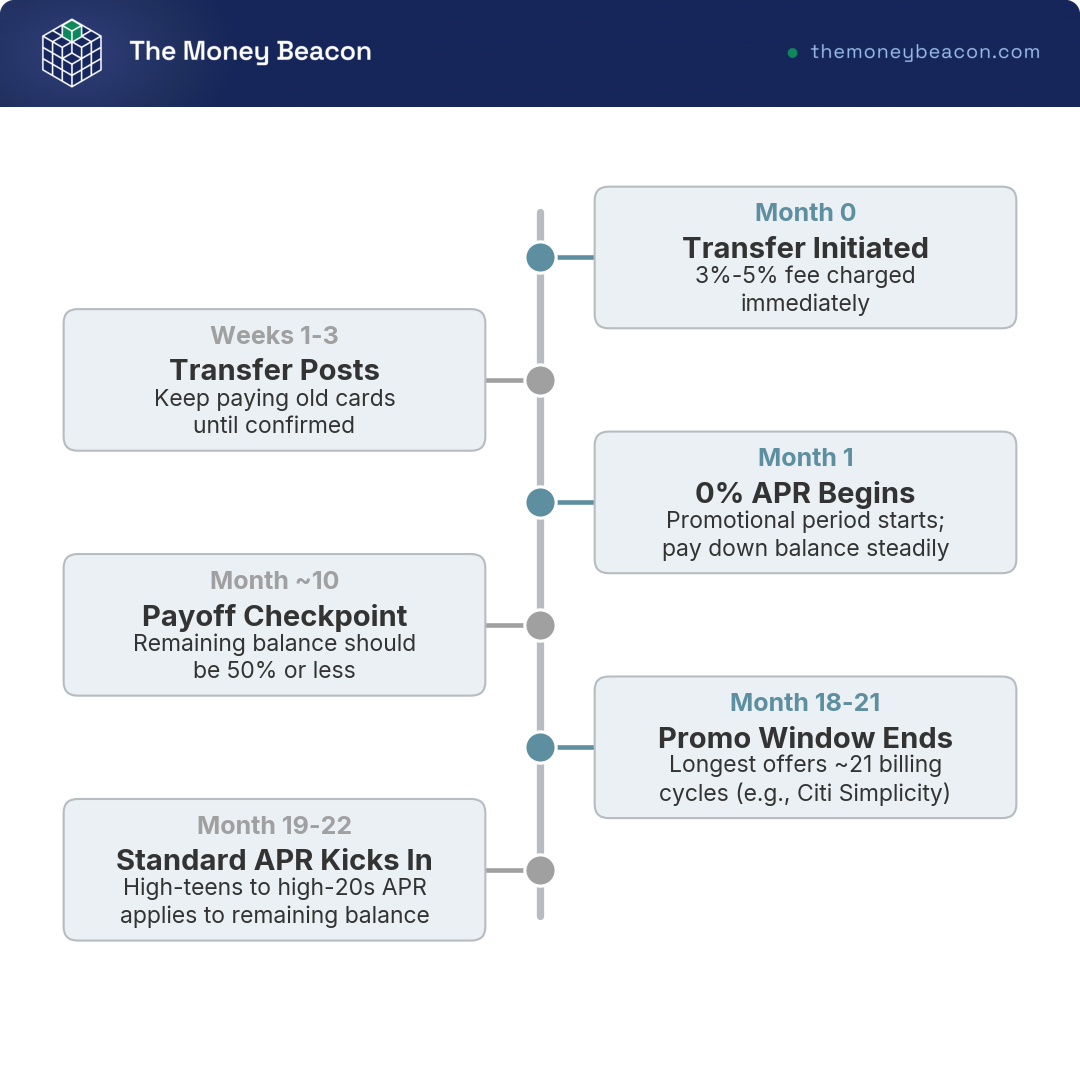
So a balance-transfer card rewards the borrower who tracks those dates and punishes the one who forgets them. Dodge all four pitfalls and the plan should hold, which raises the question most readers worry about next: what does any of this do to your credit score?
5. What Consolidation Does to Your Credit Score
Now that you have seen what can go wrong with the math, the next worry is usually the one that either drives the decision or freezes it: will consolidating help or hurt my credit? The honest answer has two halves. There are small, temporary drags the day you apply, and there are larger forces that usually more than offset them within a few months. We start with the drags, move to the factors that drive the recovery, then put it all on a month-by-month timeline.
5.1 The hard inquiry and the new account
The day you apply for a personal loan, a balance-transfer card, or a HELOC, the lender runs a hard inquiry, and that is the first small cost. For most people a hard inquiry trims fewer than 5 points; FICO counts it for about 12 months and it drops off the report after roughly two years. Opening the new account also lowers the average age of your accounts, a second, smaller drag. A 401(k) loan is the exception on both counts, because it triggers no inquiry and adds no new tradeline, since it is simply not reported to the bureaus.
One habit keeps even that small dip from stacking up. Before any hard application, prequalify with a soft pull, which previews your likely rate and does not touch your score, then submit the single hard application that gives you the best offer. The chart below sets the expectation for the whole section: a brief dip at month zero from the inquiry and the new account, then the recovery the rest of this section explains.
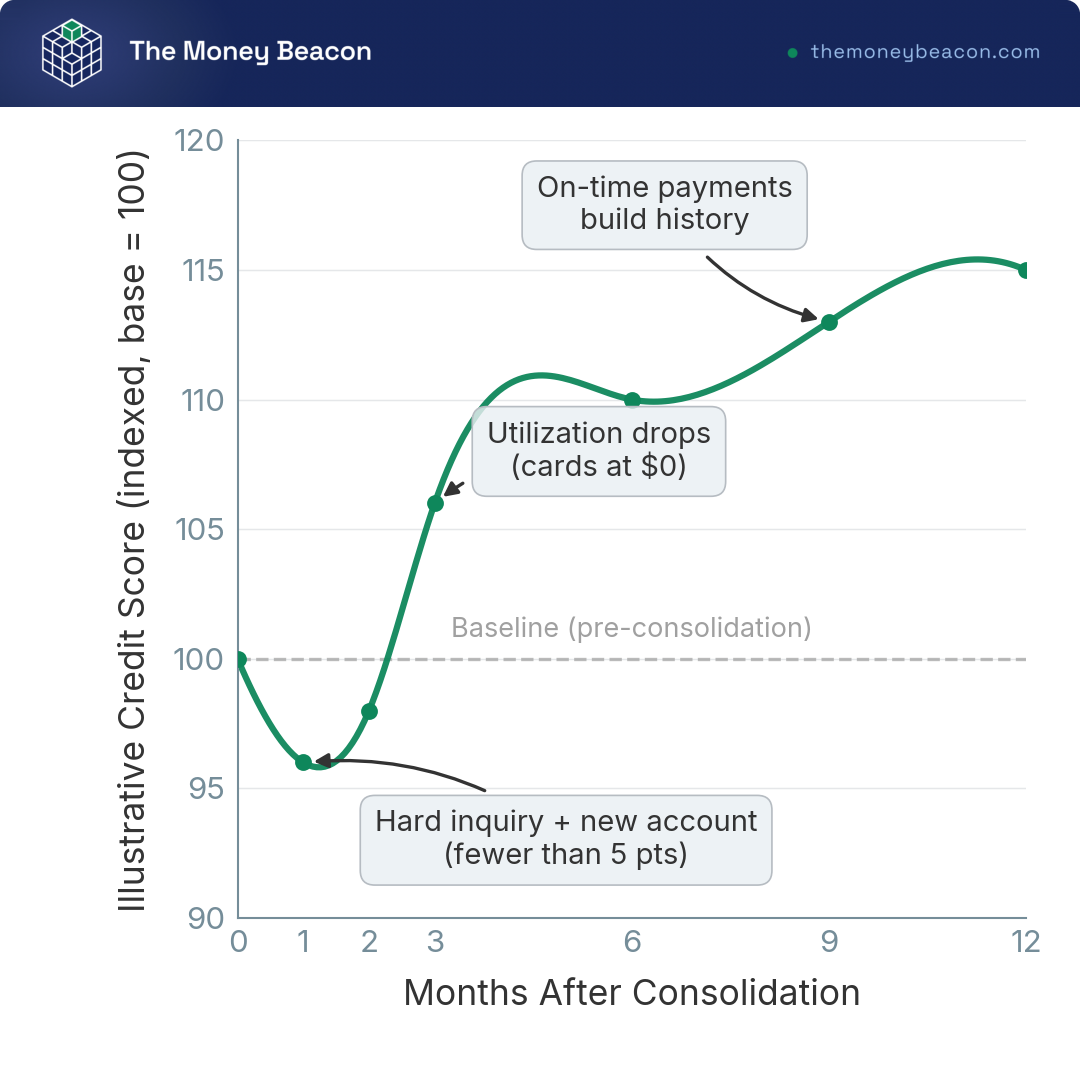
That dip is real but shallow. What pulls the line back up, and usually well past where it started, comes down to two factors most borrowers underestimate.
5.2 Utilization and payment history: the factors that drive recovery
The single biggest reason a personal-loan consolidation tends to help your score is credit utilization, the ratio of your revolving balances to your revolving limits. It is a major scoring factor, and paying your cards to zero with a personal loan cuts it sharply, because installment-loan balances are not counted in revolving utilization at all. The card balances vanish from the calculation while the new loan sits outside it, which is why a score often rises within one to two billing cycles even with the fresh inquiry weighing it down. A useful target is to keep utilization under 30%, a rule of thumb per myFICO rather than a hard cutoff, with under 10% better still.
A balance-transfer card carries one wrinkle here worth knowing. It piles your debt onto a single card, which can push that one card’s utilization close to 100% even when your overall utilization has not moved. Both the per-card and the aggregate figure matter to the score, so a maxed-out transfer card can hold your score down temporarily, even as the total debt stays the same.
The second force is payment history, the single largest scoring factor of all, and this is where consolidation does its quiet long-term work. Collapsing several due dates into one autopaid loan is simply easier to keep current, and that lowers the odds of the most damaging single event there is, a missed payment. One more move protects the gains you make. Keep the old cards open at a zero balance rather than closing them, because they preserve your credit age and your total available limit, and closing them can shorten your average account age and push utilization back up.
5.3 The realistic timeline for recovery
So how does that net out, month by month? The table pulls the four factors together with the direction each moves and how long it takes to play out.
| Factor | Direction at consolidation | Typical magnitude | Recovery / payoff window |
|---|---|---|---|
| Hard inquiry | Down | Fewer than 5 points | Counted ~12 mo; off report ~24 mo |
| New account age | Down | Small | Improves as account ages |
| Utilization (cards -> $0) | Up (good) | Often the largest mover | 1-2 billing cycles |
| Payment history | Up over time | Largest factor long-term | Builds month by month |
Data current as of June 2026.
Read the two columns on the right together and the trajectory chart from the start of this section makes sense. The drags are small and front-loaded, while the gains are larger and compound over time. The realistic picture is a modest dip in the first month or two, frequently followed by a net gain within a few months as utilization falls and on-time payments accumulate, on the one condition that you do not run the cards back up. With the pitfalls mapped and the credit effect understood, you finally have everything you need to make the call for your own situation.
6. Deciding Whether Consolidation Fits Your Situation
You know by now what can go wrong and what it does to your credit, which means the abstract question becomes a personal one: given your credit, your home, and your job, which method do you pick, and when should you walk away entirely? This section turns everything so far into a decision. We run a quick self-check, match a method to your profile, handle the profiles that change the answer, then cover when to skip consolidation and exactly how to execute.
6.1 A quick self-check before you consolidate
Before you shop a single offer, six steps separate a clean consolidation from a costly one. The checklist below pairs each step with the mistake it heads off.
| Step (To do) | To avoid | Common mistake |
|---|---|---|
| Total your balances and blended APR | Guessing the numbers | Underestimating the true blended rate |
| Prequalify (soft pull) at 3+ lenders | Submitting hard applications first | Multiple hard pulls before comparing |
| Compare APR + fees + total cost | Comparing monthly payments only | Choosing the lowest payment, longest term |
| Pick the shortest affordable term | Maxing the term for a low payment | Stretching to 84 months reflexively |
| Set up autopay | Manual payments | Missing a due date, losing a promo rate |
| Commit to no new card debt + buffer | Leaving cards in the wallet | Re-running balances after consolidating |
Data current as of June 2026.
The thread running through every row is the same discipline. Know your real numbers, compare on total cost, take the shortest term you can carry, and lock in the behavior before you borrow. Clear the self-check and the next question is which instrument actually fits a borrower like you.
6.2 Matching the method to your profile
The right method depends less on which one is cheapest in the abstract and more on the credit, the equity, and the job security you bring to it. The table below lines up five common profiles with the method that tends to fit each one.
| Profile | Best-fit method | Why |
|---|---|---|
| Good-to-excellent credit, moderate balance | Personal loan | Fixed payoff, no collateral, rate beats cards |
| Strong credit, can repay in ~12-18 mo | Balance-transfer card | 0% promo retires principal fast |
| Homeowner, ample equity, stable income | HELOC / HE loan (with caution) | Lowest rate; accepts secured-debt risk |
| Plan allows loan, last-resort, secure job | 401(k) loan | No credit check; but separation/opportunity risk |
| Overwhelmed but solvent, fair credit | Nonprofit DMP | Negotiated APRs, structure, low fee |
Data current as of June 2026.
The pattern is clean for the mainstream cases. Strong credit and a moderate balance point to a personal loan; a short payoff horizon favors the balance-transfer card; a homeowner with stable income can reach for the lowest rate by accepting secured risk. The trouble is that plenty of readers do not fit any of those rows cleanly, which is exactly where the answer changes.
6.3 Profiles that change the answer: bad credit, renters, the self-employed, and shaky jobs
Some borrowers sit outside the standard cases, and for them the right method shifts. The decision tree below lets you self-route by profile in a single pass before we walk the edge cases one by one.
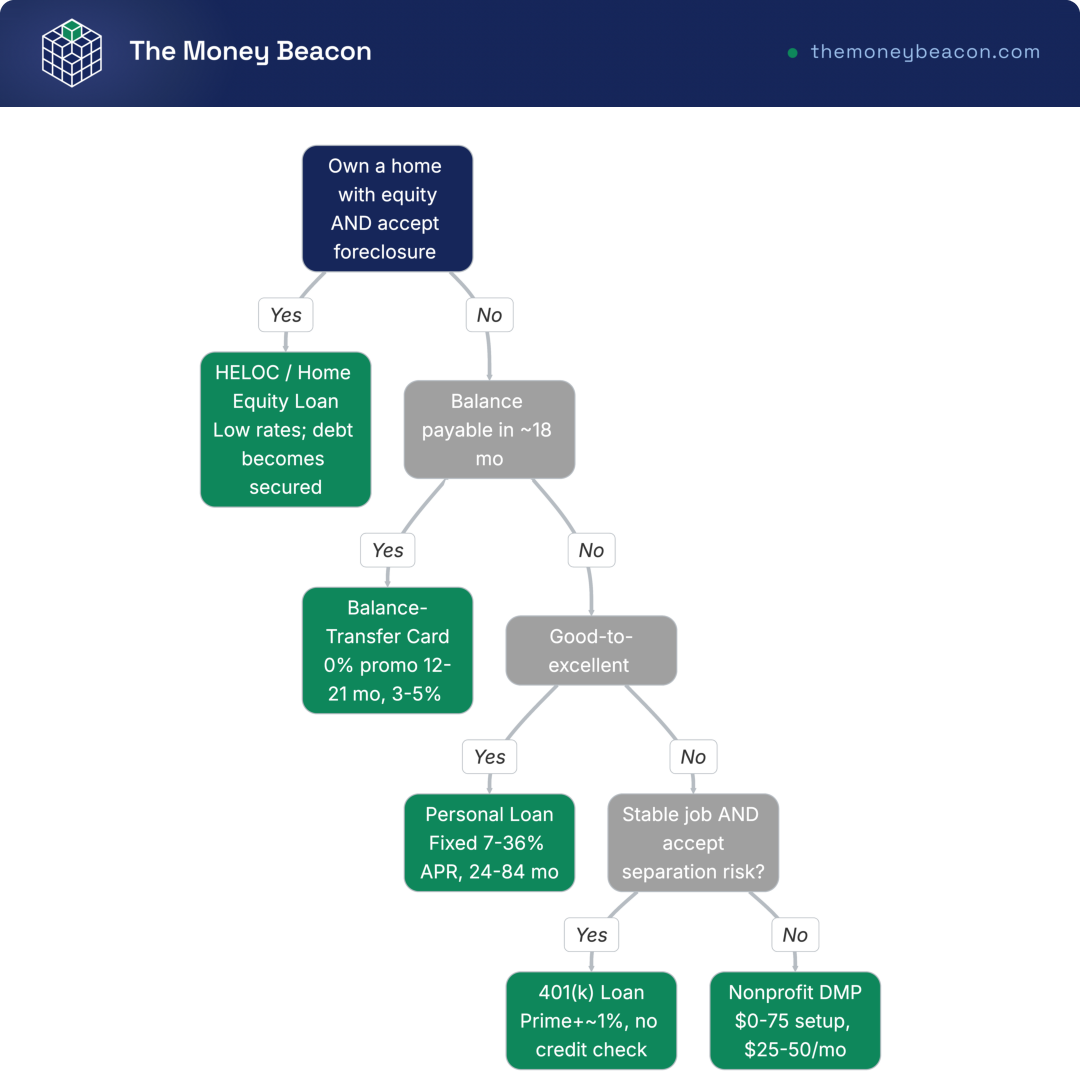
Start with bad credit or a thin file, the profile the standard advice serves worst. You may not qualify for a personal loan priced below your card rate, or for a balance-transfer limit large enough to be useful, so a nonprofit debt management plan or credit counseling is often the better road, because the agency negotiates APRs directly and enrollment does not hinge on a strong score (though creditors are not obligated to take part). The trap to avoid is the predatory “guaranteed approval” offer, which preys on exactly this situation.
Renters and anyone with little or no home equity face a simpler cut. The HELOC and home equity loan come off the table entirely, since combined loan-to-value caps put them out of reach, which leaves the personal loan, the balance-transfer card, the 401(k) loan, or a DMP. There is no foreclosure risk to weigh, but no access to the lowest secured rates either. The self-employed and 1099 borrower can still qualify, just with heavier paperwork, so expect to document tax returns, 1099s, and bank statements while the lender weighs net business income.
Finally, anyone facing a possible job change or layoff should steer clear of the 401(k) loan, because leaving the job can trigger the deemed-distribution tax and a 10% penalty before age 59½.
Tom’s take
I borrow through a securities-backed line of credit against my own portfolio, and the discipline that keeps it from blowing up is the same one a 401(k) loan demands. The cheap rate is real, but so is the trigger, so I only ever borrow against something when my income could absorb the worst case. If your job is the shaky variable, the collateral is the wrong place to be brave.
6.4 When to skip consolidation entirely, and where to get unbiased help
The best move sometimes is not to consolidate at all. Skip it when the balance is too small for the fees to be worth it, when you cannot qualify for a rate below your blended APR, when you are already delinquent (where settlement or counseling may fit better), or when consolidating would mean pledging your home against unsecured debt without stable income to back it. For a small balance, paying directly usually wins, either by the avalanche method (highest APR first) or the snowball method (smallest balance first). The decision tree below pins down that threshold.
When you do want outside help, go where the incentives are clean. Nonprofit credit counseling through National Foundation for Credit Counseling member agencies, the U.S. Department of Justice U.S. Trustee approved list, and the consumer resources from the CFPB and FTC all serve you rather than a sales quota, unlike most for-profit “debt-relief” advertisers. The FTC’s scam test is worth keeping in mind: only a scammer asks you to pay an up-front fee before settling any debt or enrolling you in a plan. If you would rather talk it through with someone paid only by you, our roundup of how to find a fee-only fiduciary advisor is a sensible starting point. Decide consolidation is right, and all that remains is the order of operations.
6.5 Your step-by-step consolidation roadmap
Everything in this guide collapses into one ordered process, and running it in sequence is what keeps a good plan from going sideways. The flowchart below lays out the six steps from first tally to final buffer.
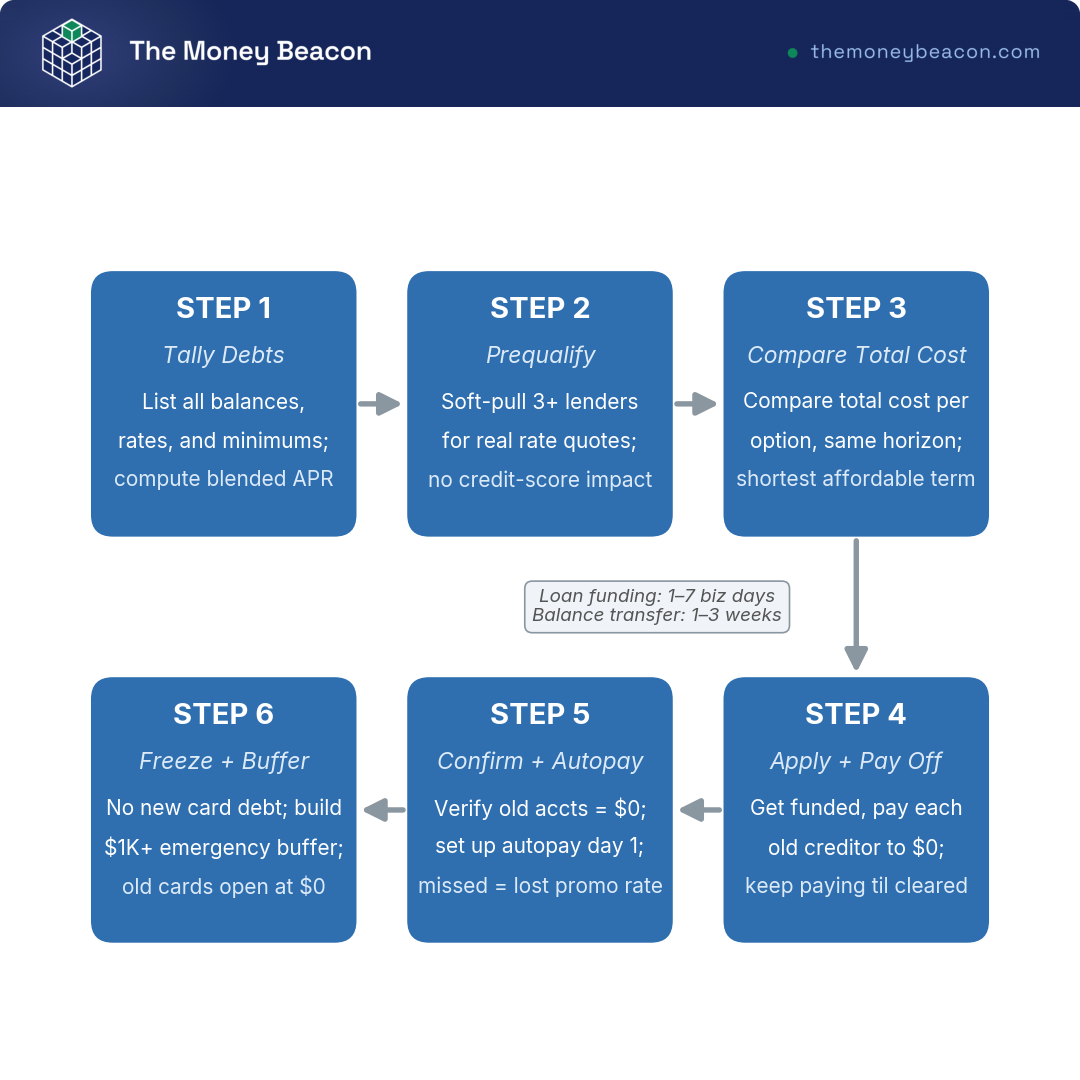
Begin by tallying every debt and your true blended APR, then prequalify with soft pulls at several lenders so you compare real offers without stacking inquiries. Compare those offers on APR plus all fees and total cost over the same horizon, never on the monthly payment. Then apply, get funded, and clear the old balances, keeping the timing in mind: a personal loan funds in 1 to 7 business days, a balance transfer posts in 1 to 3 weeks (so you keep paying the old cards until it clears), and a HELOC runs several weeks of underwriting. Confirm every old account reads $0 and switch on autopay the day the new account funds. Finally, freeze new card spending and build at least a $1,000 buffer, leaving the old cards open at zero so they keep working for your score rather than against your resolve.
7. The Rules Working in Your Favor
By now you have a method matched to your profile and an ordered plan to run it. Before you sign anything, it helps to know that the plan does not operate in a vacuum. Every step you are about to take, from comparing APRs to reading a promo deadline to spotting a scam, rests on a layer of federal rules that standardize disclosures, cap a few predatory moves, and ban upfront fees. None of this turns a bad deal into a good one, but knowing the framework lets you walk into the application with your eyes open and your guard up.
7.1 The disclosure, card, credit-report, home-equity, retirement, and debt-relief rules
The rules read less like a legal catalog when you tie each one to a decision you have already made. Start with the habit at the center of this whole guide: comparing the APR rather than the monthly payment. That habit only works because the Truth in Lending Act and its Regulation Z force lenders to disclose a standardized APR for consumer credit, so you can line a loan and a card up against each other on the same terms. Business credit sits outside it, but for your cards and installment loans, the comparable number is there by law.
The protections then attach, one by one, to the choices in front of you. Reach for a balance-transfer card and the Credit CARD Act of 2009 is quietly on your side: it sends payments above the minimum to your highest-APR balance first, mandates 45-day notice of rate increases, limits hikes on balances you already carry, and caps penalty fees. Wondering where your expectations about the credit report come from? They come from the Fair Credit Reporting Act, which gives you dispute rights (agencies generally must investigate within 30 days) and sets the retention limits: roughly 7 years for most negative marks, and up to 10 for bankruptcy.
Three more rules cover the higher-stakes routes. If you borrow from your 401(k), IRC 72(p) is the source of the $50,000-or-50% limit (with the $10,000 floor), the generally 5-year term, and the deemed-distribution tax you trigger by defaulting or leaving the job. Pledge your home and the Home Ownership and Equity Protection Act adds disclosures for certain high-cost home-secured loans, including HELOCs; a loan trips the high-cost test when, among other triggers, its APR runs more than 6.5 points above the average prime offer rate on a first lien (8.5 points on a subordinate lien), or its points and fees top 5% of the loan, with the 2026 adjusted total-loan-amount threshold set at $27,592. And the scam test you learned earlier is the law itself: the FTC Telemarketing Sales Rule bans advance fees for debt-relief services until at least one debt is actually settled or renegotiated, a written agreement is in place, and you have paid under it.
Behind those rules sit the agencies that enforce and record everything. The CFPB writes rules and takes complaints, the FTC polices debt-relief scams, the Federal Reserve publishes the G.19 data behind the averages quoted in this guide, the IRS governs the 401(k) loan, and the DOJ U.S. Trustee maintains the approved counseling-agency list. Your three credit bureaus, Experian, Equifax, and TransUnion, hold the data, and FICO and VantageScore turn it into the scores that decide your rate. That is the protective backdrop. The only thing left is to gather every thread of this guide into a single decision you can hold against your own numbers.
8. The Bottom Line: Will Consolidation Save You Money?
This guide has built its answer in pieces: the cost comparison, the term math, the behavior trap, the secured-versus-unsecured stakes, the method-to-profile fit, and the credit-score path. Each of those threads carries its own save-or-backfire condition, so the honest answer to “will consolidation save me money?” is that it depends on getting all six to fall on the right side at once. The table below collapses them into one place so you can check your own plan factor by factor before you sign.
8.1 The decisive factors, side by side
Six factors decide whether consolidation works for you, and each one cuts both ways. The synthesis below pairs every factor with the condition under which it saves you money and the condition under which it quietly backfires.
| Decisive factor | Saves money / accelerates payoff when… | Backfires when… |
|---|---|---|
| New APR + fees vs. old blended APR | New all-in cost is clearly lower | Fees offset a small rate gap (small balances) |
| Term length | Term <= original payoff horizon | Term stretched (e.g., 84 mo) raises total interest |
| Behavior after | No new card debt; buffer built | Old cards run back up (debt doubles) |
| Secured vs. unsecured | Stable income; risk understood | Home pledged without a cushion (foreclosure risk) |
| Method fit | Method matches credit/equity/job profile | 401(k) loan + job change; balance transfer can’t fit budget |
| Credit-score path | Utilization drops; on-time autopay | Maxed transfer card; missed payment voids promo |
Data current as of June 2026.
Read down the right-hand column and a pattern emerges: nearly every way consolidation backfires comes from chasing a lower payment instead of a lower lifetime cost, or from skipping the behavior change that the new structure was supposed to support. Get the all-in cost lower, keep the term short, change the spending, and match the method to your life, and the same tool that traps careless borrowers becomes the one that clears the debt years faster. If you remember only one sentence from this guide, make it this one: consolidation saves money only when the new APR plus fees beats your old blended rate over a term no longer than your current payoff, and you stop adding new debt. Everything else in these eight sections is just the work of confirming that one rule holds for your numbers.
Conclusion
Strip away the marketing and consolidation comes down to one test you can run yourself. It pays off only when the all-in cost of the new loan, rate plus every fee, lands below your old blended rate over a term no longer than your current payoff, and only if you stop charging the cards you just cleared. By now you’ve seen that the plan usually fails not on the math but on the behavior, when someone chases a lower monthly payment and quietly stretches the term, or runs the old balances back up. Keep the term short, build even a small buffer so an emergency doesn’t push you back to the cards, and the same tool that traps careless borrowers clears the debt years faster.
Two points are worth keeping in mind. A 0% balance transfer is never truly free once you count the 3% to 5% fee and the post-promo cliff, and pledging your home for a lower rate trades a painful card default for genuine foreclosure risk, so reserve secured borrowing for stable income. Before you apply, do one thing: total your balances, find your true blended APR, then prequalify with soft pulls at three or more lenders so you compare real offers, not headline rates.
If a fixed-rate swap looks right, our guide to comparing personal loans walks through rates and terms by lender, and if you can clear the balance in a year or so, the best balance transfer cards lay out the longest 0% windows. Homeowners weighing the lower-rate, higher-stakes route should read our HELOC guide before putting the house on the line.
FAQ
Does debt consolidation hurt your credit score?
Usually only a little, and often temporarily. Applying for a loan or card triggers a hard inquiry that typically costs fewer than 5 points, and the new account lowers your average account age slightly. Those are both small, short-lived drags. What can more than offset them is the drop in revolving utilization when you pay your cards to zero with a personal loan, because installment balances are not counted in revolving utilization. Many borrowers see a net score increase within one or two billing cycles. The score falls in only two scenarios: you miss a payment, or you run the old cards back up.
What is a good APR for a debt-consolidation loan, and what score do you need?
A good rate is one clearly below your blended card APR. Average APRs on interest-bearing credit card accounts ran around 21% in early 2026 (Federal Reserve G.19 series, Q1 2026), while a well-qualified borrower could land a personal loan in the low-to-mid teens. The Federal Reserve’s average rate on a 24-month commercial-bank personal loan ran near 11% in early 2026, though that average blends all approved credit tiers. On the score side, lenders rarely publish a hard cutoff, but the lowest rates generally require a FICO in the good range (roughly 670 and above), with the best pricing reserved for scores at 740 and above. Below the fair range, expect either higher rates or an outright denial. Prequalify with soft pulls at three or more lenders to see real offers without stacking hard inquiries on your report.
How much is the payment on a $50,000 consolidation loan?
It depends entirely on rate and term. As a rough guide, $50,000 at a 12% APR works out to about $1,656 per month over 36 months, about $1,112 over 60 months, and about $838 over 84 months. The 84-month option has the lowest payment but carries the highest total interest because the balance accrues for more than twice as long. The useful comparison is not which payment fits the monthly budget most comfortably, it is which option costs the least in total dollars from now to payoff. Run the full amortization at each term before you sign; a personal loan comparison can help you pull real rate offers across lenders in one pass.
Can you consolidate debt with bad credit, and can you be denied?
Yes, you can be denied. Lenders evaluate credit score, income, and debt-to-income ratio together, so a low score or thin income documentation can result in rejection or a rate so high it defeats the entire purpose. With bad credit, a personal loan at a rate below your card APR is often out of reach, and a balance-transfer card may only approve a limit too small to matter. The better path in that situation is a nonprofit credit-counseling agency and a debt management plan (DMP), where the agency negotiates reduced APRs directly with your creditors and enrollment does not require strong credit, though creditors are not obligated to participate. Verify any agency through the National Foundation for Credit Counseling (NFCC) or the U.S. Department of Justice U.S. Trustee approved list, and avoid any advertiser promising guaranteed approval.
Should you use a HELOC or a 401(k) loan to consolidate?
Both can carry lower rates than unsecured options, but both layer on risks that a personal loan or balance-transfer card do not. A home equity line of credit (HELOC) or home equity loan is secured by your house, so a default that would otherwise mean collection calls now means foreclosure risk. The interest is also generally not tax-deductible when the funds go toward paying off credit cards; under IRS Publication 936, the deduction applies only when the money buys, builds, or substantially improves the home that secures the loan. A 401(k) loan carries a different danger: if you leave or lose your job, the outstanding balance typically must be repaid by the federal tax-filing deadline (with extensions), or the unpaid amount becomes a deemed distribution, taxed as ordinary income plus a 10% penalty if you are under age 59½. The borrowed money also misses any market growth while it is out of the account. Reserve both options for situations where your income is stable, your emergency cushion is real, and no unsecured route is available.
Why do some experts say not to consolidate?
The objection is behavioral, not mathematical. Consolidation lowers the monthly payment and empties the cards, which can create a false sense of progress. If that breathing room becomes permission to spend again, the borrower ends up with the consolidation loan and a fresh pile of card balances, sometimes more total debt than before. The argument against consolidation really means this: do not consolidate unless the all-in rate is lower, the term is not materially longer, and you address the spending pattern that built the debt in the first place. Consolidation paired with a strict no-new-debt rule, the shortest term your budget allows, and a small emergency buffer (even $1,000 in a high-yield savings account so a surprise expense does not push you back to the cards) is a legitimate and often effective tool.
Are there free government debt-consolidation programs?
There is no federal program that consolidates private credit card debt for free. Offers claiming to be “government debt-relief programs” for credit cards are generally marketing, not federal benefits; the Federal Trade Commission cautions consumers to verify any “government program” claim directly with a government agency. Federal student-loan consolidation is a genuine separate program, but it is out of scope for credit card and personal-loan debt. What does exist for private debt is nonprofit credit counseling, often free for the initial session, followed by a low-fee debt management plan. Setup fees typically run $0 to $75 and monthly fees commonly $25 to $50. Verify any agency through the NFCC or the DOJ U.S. Trustee approved list before you enroll.
How long does debt consolidation stay on your credit report?
The consolidation account itself behaves like any other account: an open tradeline reports while the account is active, and a closed account in good standing can remain on your report for years, where it continues to help your credit history. The temporary negatives are brief. A hard inquiry is counted by FICO for about 12 months and drops off the report after roughly two years. Consolidation is not a negative mark on its own; only missed payments or defaults would be, and those follow the roughly 7-year retention rule under the Fair Credit Reporting Act (FCRA). If you automate the payment and keep the old cards open at a zero balance, the credit story from a consolidation is, for most people, neutral to positive within a few months.



Comments
Questions and corrections welcome. We read everything.