


You already invest in index funds or a 401(k), you have an emergency fund, and now you are watching crypto headlines swing between someone’s life-changing gain and someone else’s total wipeout. The honest fear runs both ways: you do not want to miss out, and you do not want to lose real money to a crash, a hacked exchange, or a scam. What you are missing is not nerve, it is a framework, a way to decide how much to buy, where to hold it, and how it gets taxed. That gap is expensive, because the real threat to a careful beginner is not the volatility everyone warns you about. And the wrong first move, a hacked exchange or a scam, can wipe out your entire position before the market ever gets the chance, which is the threat most beginners underrate.
In this guide for crypto beginners, we treat crypto as one small, high-volatility slice of a diversified portfolio, and we take the decision in the order you actually face it: how to size the position, where to buy and store it, how to sidestep the scams, and how to handle the IRS rules. Each step builds on the one before, so you act on a plan instead of the hype cycle.
1. What You Are Actually Buying When You Buy Crypto
Every plan starts where this one does, with the asset itself. Before you can decide how much crypto to own, where to keep it, or how the IRS will treat it, you need a working picture of what a crypto-asset actually is and why its price behaves nothing like the index fund sitting next to it.
1.1 Crypto as an asset class, the four tiers, and how small a slice is
A crypto-asset is, at bottom, a digital token recorded on a blockchain. That is the whole definition, and for a beginner the thousands of tokens out there collapse into four tiers, ordered by track record and risk.
The first tier is large-cap: Bitcoin (BTC) and Ethereum (ETH), the two with the longest track records, the deepest liquidity, and ETF wrappers you can buy in a normal brokerage. These are the core of any small position. The second tier is stablecoins like USDC and USDT, tokens pegged roughly 1:1 to the US dollar. A stablecoin is a cash leg for moving money around on-chain, not an investment, and a de-peg can still hand you a taxable loss, which we get to in the tax section. Third come the mid-cap “alts,” assorted layer-1 and layer-2 tokens that are smaller and more speculative, optional at best for a beginner. Fourth is the long tail and memecoins, thousands of micro-cap tokens where most eventually fail; treat that tier as gambling, not investing.
How concentrated is the top? Bitcoin alone runs about 58% of total crypto market capitalization, with Ethereum second at roughly 9% to 10%. That is the whole argument for a Bitcoin-heavy core: the two oldest, most liquid assets dominate the market, and everything below them is a steeper bet.
One distinction trips up almost every newcomer, so let’s clear it now. Crypto is an asset class, in the same family as stocks or bonds. A Roth IRA, a traditional IRA, a 401(k), or a taxable brokerage is an account, a tax wrapper that holds assets. You hold crypto inside an account; you never line up “a Roth IRA” against “Bitcoin” as if they were the same kind of thing, any more than you would compare a wallet against a $20 bill. Match each dollar to its job and its time horizon first, a habit we walk through in our guide to spreading savings across goals, and crypto’s place becomes obvious.
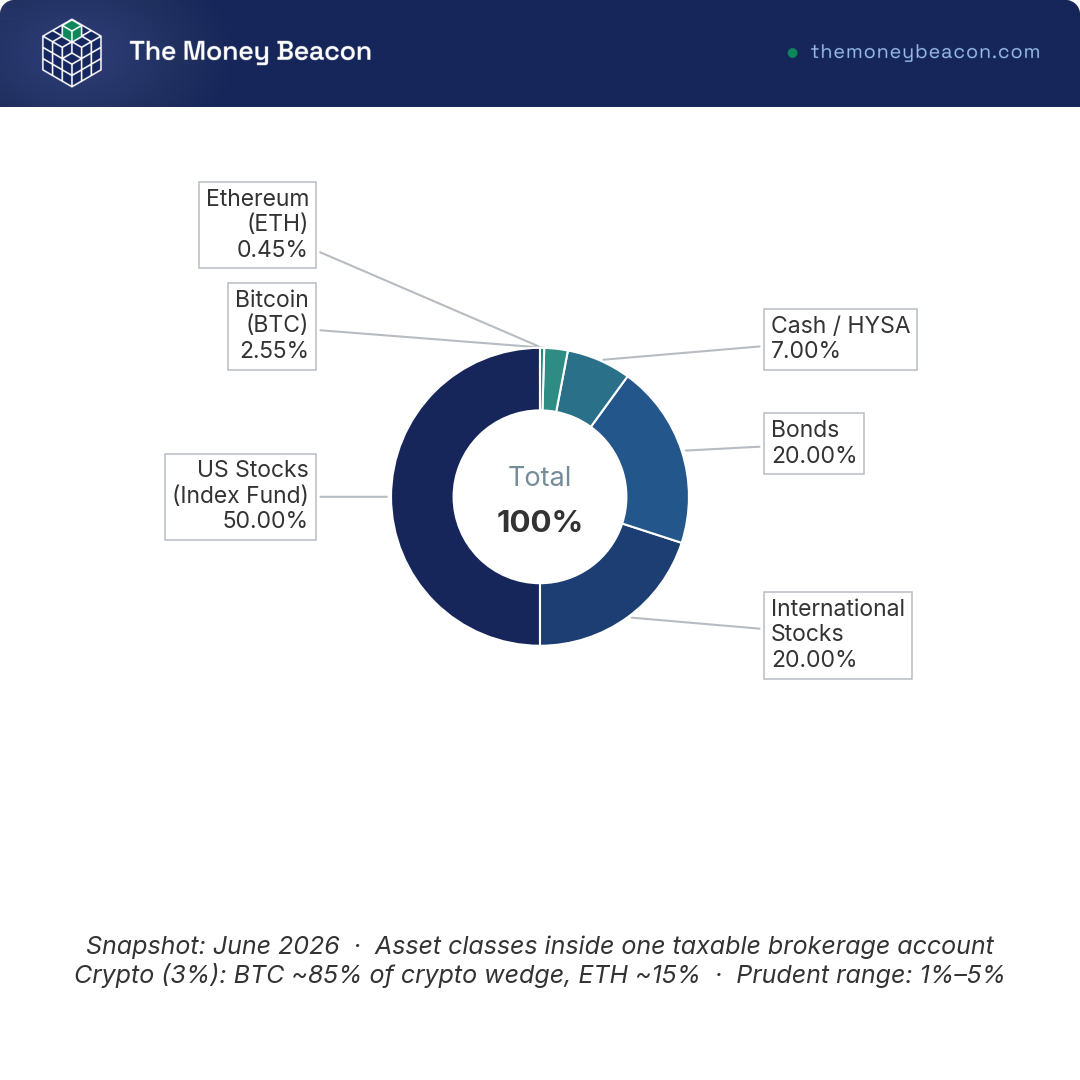
How thin? The chart below shows a sample diversified portfolio holding a 3% crypto wedge inside one taxable brokerage account, with that small slice split between BTC and ETH. That is what a sensible answer to “what is a good crypto portfolio” looks like for most beginners: a thin slice, not a core holding.
1.2 Crypto is not a savings account: the volatility and insurance gap
You know what the asset is by now, and how small a slice belongs in a portfolio. But why does that slice swing so violently, and why does the word “insured” not apply to it the way it does to the cash in your bank?
Start with the swings. A stock pays you a slice of company earnings, a bond pays a coupon, a rental pays rent. Crypto pays none of that, so its price rests entirely on supply, demand, and sentiment, with no cash flow underneath to anchor it. The result shows up in the numbers: annualized Bitcoin volatility has historically run roughly 3 to 4 times that of the S&P 500. Set that against the S&P 500’s long-run annualized total return of about 10% nominal, the anchor your diversified core is built on, and the gap in temperament is stark. Past performance does not guarantee future results, for either asset, but the difference in how hard they move is stark.
Here is how crypto stacks up against the things already in your portfolio.
| Asset class | Typical role | Volatility | Income | Insurance |
|---|---|---|---|---|
| Cash / HYSA | Liquidity, emergency fund | Very low | Interest | FDIC/NCUA to $250k |
| US Treasurys | Capital preservation | Low | Coupon | Backed by US govt |
| Broad stock index fund | Long-run growth | Moderate-high | Dividends | SIPC (broker failure only) |
| Crypto (BTC/ETH) | Small speculative satellite | Very high | None | None |
Data current as of June 2026.
Look at the last column, because that is where beginners get hurt. FDIC and NCUA cover bank and credit-union deposits up to $250,000 per depositor, per institution, per ownership category, and that coverage protects your principal even if the bank fails. SIPC is narrower than people assume: it protects brokerage customers only if the broker itself fails and customer securities or cash go missing, up to $500,000 per customer including a $250,000 cash sub-limit, and it does not cover market losses or, as a rule, crypto at all. Exchange-held crypto sits outside every one of these programs. So the practical rule is simple: never let the phrase “FDIC-insured” attach itself to a crypto product in your head. If you want a place where $250,000 of insured principal genuinely cannot fall, that is an FDIC-insured high-yield savings account, a different tool for a different job. Crypto is not that, and treating it as such is the first costly mistake.
2. Does Crypto Belong in Your Portfolio Right Now?
You understand the asset by now: high volatility, no cash flow, no safety net. The next question is personal. Given that risk, is your financial situation actually ready for crypto, and, just as important, could you honestly stomach the losses it can deliver?
2.1 The financial foundation you need before any crypto
Crypto is the last dollar in a sound financial plan, not the first. Here is the order that has to be in place before any of it makes sense.
| Priority | Step | Rationale |
|---|---|---|
| 1 | High-interest debt cleared | Card APRs (the average is about 21.5% per the Federal Reserve’s G.19) commonly exceed any plausible crypto return |
| 2 | Emergency fund (3-6 months) | Volatile assets must never be forced sellers |
| 3 | Employer 401(k) match captured | Immediate, guaranteed return |
| 4 | Tax-advantaged investing on track | Roth/traditional IRA, HSA, 401(k) |
| 5 | Diversified core built | Broad index funds, bonds |
| 6 | Then a small crypto satellite | Only risk capital you can fully lose |
Data current as of June 2026.
Work the top of that list before anything else. Carrying a credit-card balance at roughly 21.5% while buying a speculative asset is paying 21.5% certain to chase an uncertain return, which is a losing trade on the math alone. Once the debt is gone and three to six months of expenses are parked in cash, the next two rungs are about not leaving free money on the table. Capturing your employer 401(k) match is an immediate, guaranteed return no token can promise, and the tax-advantaged wrappers come next: the 2026 IRA contribution limit is $7,500, plus a $1,100 catch-up at age 50 and over (a combined $8,600), and the 401(k) elective-deferral limit is $24,500. Fill those before you put risk capital into crypto, because the wrapper usually beats the unwrapped bet. Only after rungs one through five are solid does a small crypto satellite, money you could lose entirely without flinching, earn a place.
2.2 Am I ready to buy crypto yet?
So how do you know you have actually cleared the foundation rather than just hoping you have? Walk the gates in order, and let any honest “no” send you back to the rung it belongs to.
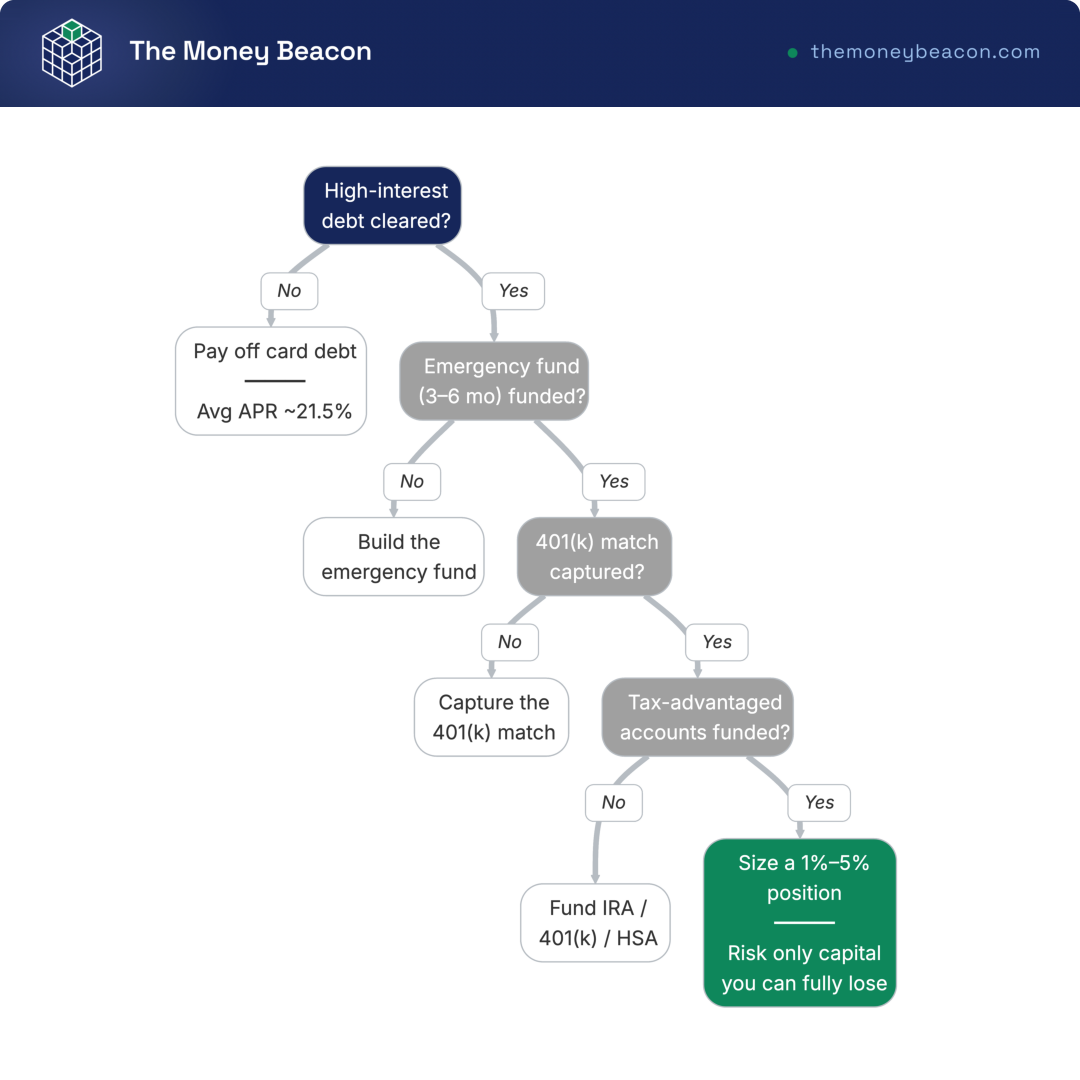
The test runs as four questions, each a prerequisite for the next. Is your high-interest debt cleared? Is your emergency fund funded? Have you captured the full 401(k) match? Are your tax-advantaged accounts on track? A “no” at any gate is not a small problem to paper over; it is the signal to fix that piece first and leave crypto alone for now. Only an unbroken run of four “yes” answers gets you to the next decision, sizing a 1% to 5% position. The flowchart below walks the same logic step by step.
2.3 Could you stomach an 80% drawdown, and when the answer is no
The foundation can be flawless and the answer can still be no, because money readiness and emotional readiness are two different things. Risk capacity asks whether your finances can absorb a loss; risk tolerance asks whether you can sit through one without panicking. Both have to clear, and the second is where most people overestimate themselves.
How big a loss are we talking about? Bitcoin has historically fallen 75% to 85% peak-to-trough in past cycles, roughly 84% after the 2013 peak and commonly 77% to 83% in later ones. The line chart below puts a broad stock index fund and Bitcoin on the same indexed scale so you can see how much wider the crypto swings get, with callouts on the worst drawdowns.
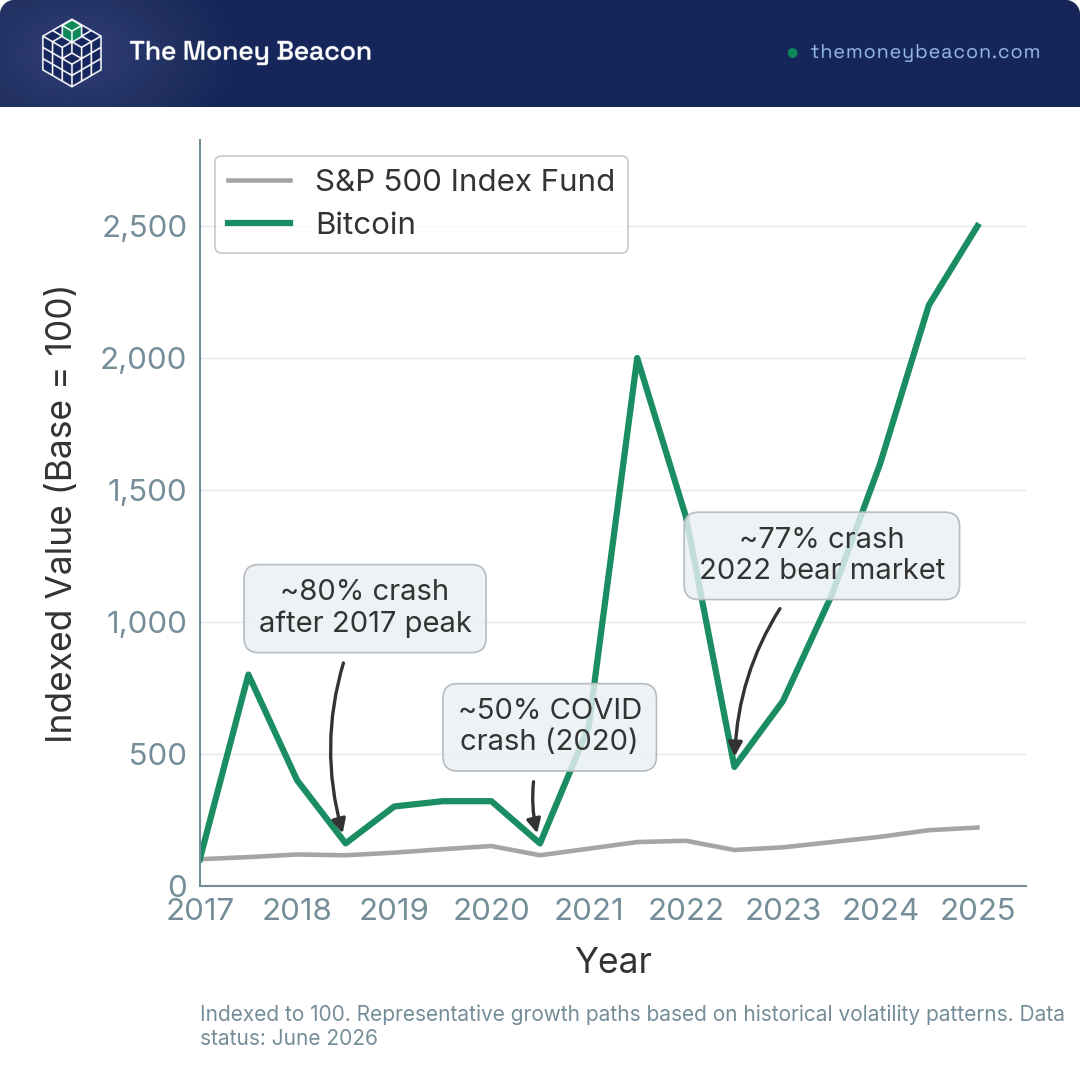
That history gives you a clean stress test, the 80% test. Take the dollars you plan to allocate and multiply by 0.2. That figure is roughly what the position could be worth after a brutal crash. Now picture it sitting there, down 80%, for a year or more. If watching that number would make you sell at the bottom or cost you sleep, the position is too large, full stop. This is the single most useful question to ask before buying, and it answers “how much crypto should I own” more honestly than any chart, because it is calibrated to your stomach, not someone else’s.
Hank’s take

the behavioral-finance research is blunt about this. The investor who sizes a position by how exciting the upside feels, then sells in the panic of a deep drawdown, locks in the loss at the worst possible moment. Sizing by what you can hold through, not what you hope to make, is the cheapest edge a regular investor has.
A word on what crypto does for the rest of the portfolio, because the diversification story is oversold. Bitcoin’s correlation to equities has been variable and tends to rise during broad risk-off shocks; the 30-day Bitcoin-to-S&P 500 correlation has recently sat near a modestly positive 0.3, but it can spike in market stress and has historically drifted back toward zero over longer horizons. So crypto is a small, asymmetric satellite, not a crash hedge you can lean on when stocks are falling, which is often exactly when crypto falls too. If you want the genuine diversifier behind your plan, that is your broad-market stock investments, with crypto riding alongside in a slice you can afford to lose.
That leaves the guardrails. If you have no emergency fund, carry card debt, will need the money within about five years, could not tolerate an 80% paper loss, or would borrow to buy, then the disciplined answer is no for now. Any one of those is enough.
3. How Much Crypto Is Safe: Sizing and Entry
You are ready: the foundation holds and you have passed the 80% test. Now the dollars-and-cents question, how many dollars should actually go in, and should you buy all at once or spread it out over time?
3.1 The 1% to 5% rule and what a crash really costs you
The widely cited ceiling for a cautious investor is 1% to 5% of investable assets, with published analyses putting roughly 3% as the risk-adjusted sweet spot and 5% as a prudent cap. This is practitioner consensus, not a regulatory rule, so treat it as a sane default rather than a law.
The logic is pure damage control. Push the slice much higher and, at crypto’s volatility, that one asset starts to dominate your total-portfolio risk, so a normal crypto swing can swamp the steady gains from everything else. The bar chart below makes the asymmetry visible across a $50,000 portfolio, with the prudent range set apart from a reckless 20%.
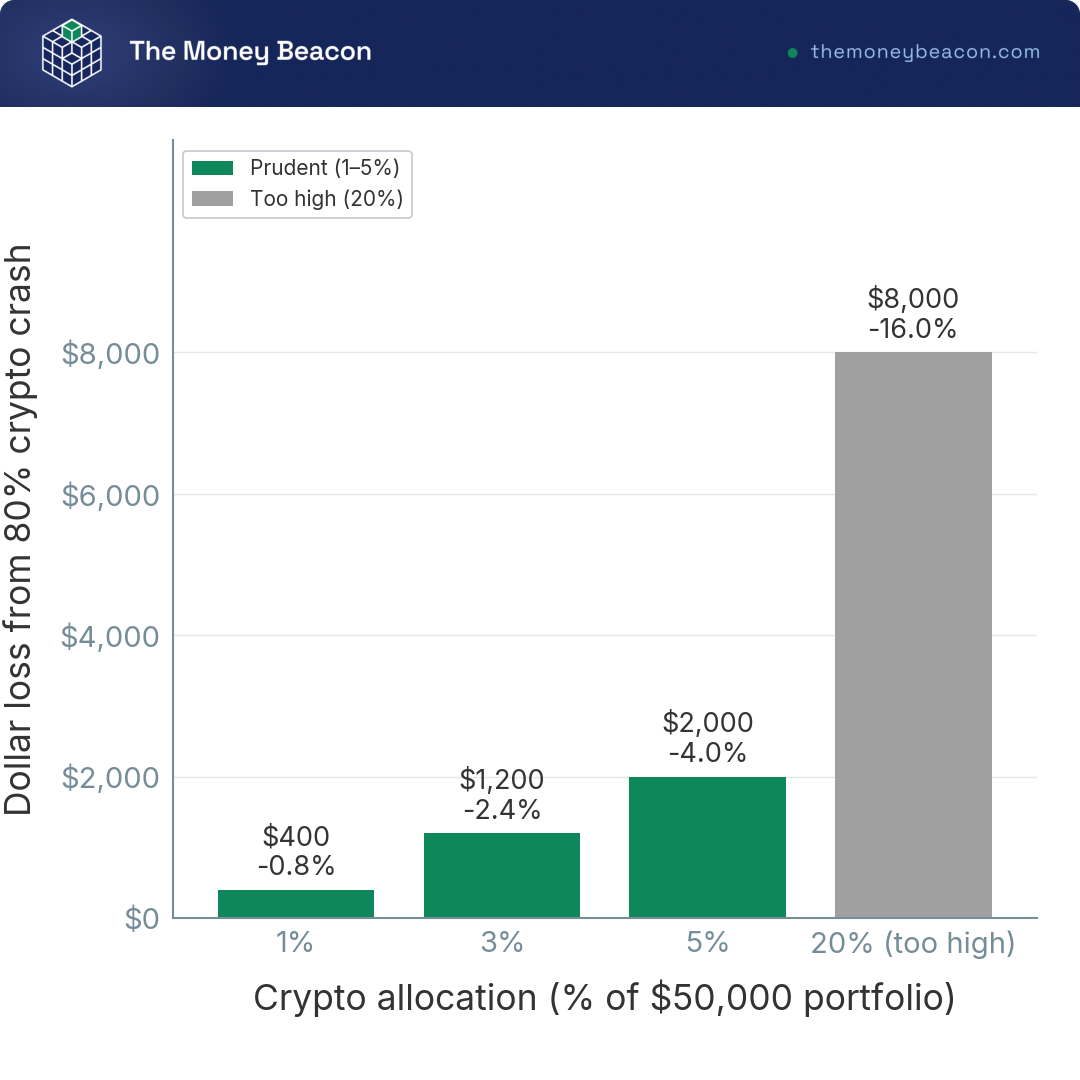
The takeaway behind sensible crypto portfolio percentages is that the right size is the one where a complete loss is survivable, and for most beginners that lands between 1% and 5%.
3.2 Worked example: sizing crypto in a $50,000 portfolio
Here is the same logic in real dollars, on a $50,000 portfolio.
| Allocation | Crypto dollars | Value after an 80% crypto drop | Portfolio impact |
|---|---|---|---|
| 1% | $500 | $100 | -0.8% |
| 3% | $1,500 | $300 | -2.4% |
| 5% | $2,500 | $500 | -4.0% |
| 20% (too high) | $10,000 | $2,000 | -16.0% |
Data current as of June 2026.
Run the disciplined middle row and the point lands hard. A 3% slice is $1,500, and an 80% crash takes $1,200 of it, which is just 2.4% of the full $50,000. That is annoying, but it does not touch your retirement timeline or your sleep. Now read the bottom row: a 20% bet means $10,000 in crypto, and the same crash erases $8,000, a 16% hit to everything you own. That is the entire case for sizing in one comparison, and it is what makes these the crypto portfolio examples worth copying.
3.3 DCA or lump sum, which entry method fits you, and trimming without a tax shock
The target dollars are set by now. The next question is how to get them into the market, and then, much later, how to take some off the table without a tax shock.
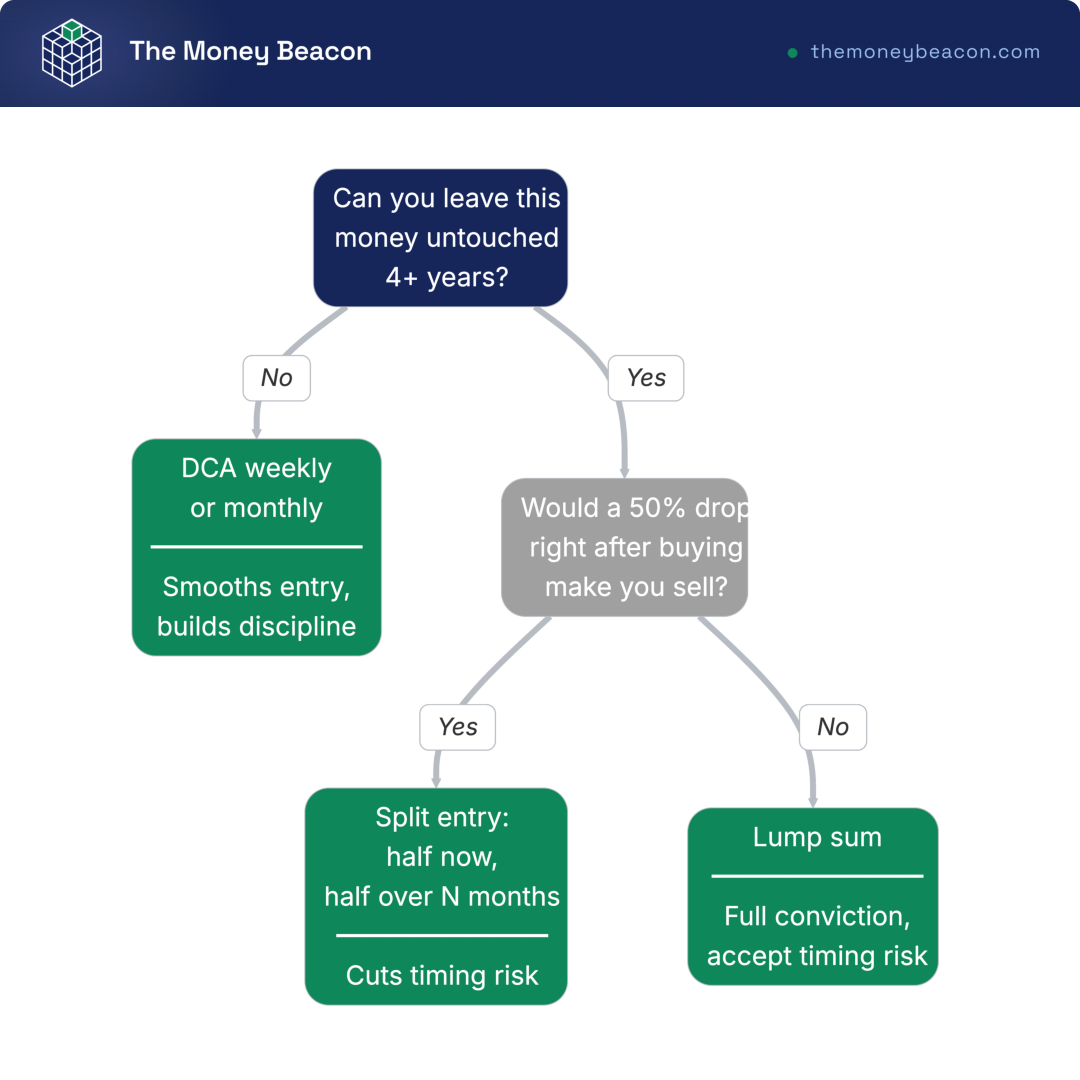
There are two honest ways in. Dollar-cost averaging (DCA) puts a fixed dollar amount in on a schedule, which suits volatile assets and shaky nerves; the trade-off is that it can lag a market that only rises. A lump sum puts the full target in at once, which is the stronger move when you have real conviction and the cash on hand, at the cost of full exposure to bad timing if you happen to buy the day before a drop. For a high-volatility asset bought by a nervous first-timer, DCA is usually the better behavioral choice, because it removes the urge to time the top and smooths your entry price across the swings. One caveat worth knowing: DCA multiplies the number of taxable lots you have to track, so the recordkeeping habit in the tax section matters even more.
How do you pick? The decision tree below routes you on three questions: can you leave the money untouched four or more years, would a 50% drop right after buying make you sell, and do you have a lump now or income to spread? It lands you on DCA, a split (half now, half over a few months), or a lump sum.
Then there is the back half of sizing that beginners forget. If crypto rips higher and blows past your target, trimming it back to size is a taxable sale, not a free reset. To keep the tax bill down, prefer selling lots you have held more than a year so the gain is taxed at long-term rates, and you can harvest losses elsewhere in the portfolio to offset what you realize. Set a mechanical band so the decision is not emotional, for example trim only when crypto runs past 1.5 times its target weight, and if you hold inside a crypto IRA, rebalancing trades there are not immediately taxable, both points we unpack in the tax section.
4. Where to Buy: Exchanges, Brokers, and Spot ETFs
The money still has to land somewhere, and where it lands decides how much you overpay and how much control you keep.
4.1 US-regulated exchanges and brokers compared
The buying venues split into three kinds. Crypto-native exchanges (Coinbase, Kraken, Gemini) let you withdraw coins to your own wallet. Brokers (Robinhood, Fidelity Crypto) bolt crypto onto a regular investing app, sometimes custodial-only. And ETF issuers, which we get to next, never hand you a coin at all. Every US exchange registers as a money-services business with FinCEN, complies with the Bank Secrecy Act and anti-money-laundering rules, and holds state money-transmitter licenses, so the regulated venues are not the wild west the headlines suggest.
Here is how the main US venues line up.
| Venue | Type | Self-custody withdrawal? | Notable trait | Fee note |
|---|---|---|---|---|
| Coinbase | Exchange | Yes | Largest US-listed exchange | Fee tiers vary by product; the simple-buy flow carries a ~0.5% spread, advanced-trade uses maker/taker fees |
| Kraken | Exchange | Yes | Pro interface, lower maker/taker | Spot maker/taker around 0.25%/0.40% at the entry tier, falling with volume |
| Gemini | Exchange | Yes | NY-regulated trust | NYDFS trust charter; fees vary by product (Instant vs. ActiveTrader) |
| Robinhood | Broker | Yes, for supported assets | Commission-free, spread-based | Spread embedded in the price; wallet withdrawals supported |
| Fidelity Crypto | Broker | Yes, for eligible accounts | Integrated with your brokerage | Limited coin selection; transfers available for eligible accounts |
Data current as of June 2026.
The column that matters most to you is the third one. If you ever want to move coins off the platform to a hardware wallet, you need an exchange that allows self-custody withdrawal, which rules out the most locked-down broker setups. For a first purchase of Bitcoin or Ethereum, any of these is a defensible choice, and the differences really live in the fee column, which is where beginners quietly bleed. Coinbase is the most common on-ramp for US beginners, and you can compare its fee tiers and account types in our full Coinbase review before you fund anything.
4.2 Spot Bitcoin and Ethereum ETFs: crypto without the wallet
What if you never want to touch a wallet, a seed phrase, or a withdrawal screen at all? That is exactly what a spot ETF is for. A spot Bitcoin or Ethereum ETF holds the actual coin and trades like any stock, so you buy Bitcoin exposure inside a regular brokerage account or an IRA, with standard 1099-B and 1099-DA tax reporting and nothing new to learn. The trade-off cuts both ways: you pay an annual expense ratio, and you cannot withdraw real coins to spend or self-custody.
| ETF | Ticker | Underlying | Expense ratio | Issuer |
|---|---|---|---|---|
| iShares Bitcoin Trust | IBIT | Bitcoin | 0.25% | BlackRock |
| Fidelity Wise Origin Bitcoin Fund | FBTC | Bitcoin | 0.25% | Fidelity |
| Grayscale Bitcoin Trust ETF | GBTC | Bitcoin | 1.50% (higher than IBIT/FBTC) | Grayscale |
| iShares Ethereum Trust | ETHA | Ethereum | ~0.25% (waivers may apply) | BlackRock |
| Fidelity Ethereum Fund | FETH | Ethereum | 0.25% | Fidelity |
Data current as of June 2026.
The spread between the cheap funds and the expensive one is real money over time. IBIT and FBTC sit at 0.25% a year, while GBTC still charges 1.50%, six times as much, for the same underlying Bitcoin. On a $5,000 position that is the difference between about $12.50 and $75 a year, every year, for identical exposure. Other Ethereum funds exist too, including Franklin’s EZET, Bitwise’s ETHW, and Invesco Galaxy’s QETH, and because several issuers run temporary fee waivers, confirm the current net expense ratio on the issuer fact sheet before you buy. Here is the clean way to think about it: a spot ETF is just one more holding in a standard brokerage account, taxed and reported like the rest of it.
4.3 ETF or direct coin? Matching the wrapper to your goals
So which wrapper is yours, the fund or the coin? It comes down to three honest questions. Do you ever need to withdraw real coins, to spend them or self-custody them? Do you want the position inside an IRA or 401(k) for the tax treatment? And is keeping your recordkeeping dead simple a priority? If you want IRA-eligible, tax-clean, hands-off exposure and have no plan to hold actual coins, a spot ETF in a brokerage or IRA wins. If you want to move and eventually self-custody the coins, you buy on an exchange, and the only question left is whether you leave them custodial or push them to a hardware wallet. The decision tree below routes you through it.
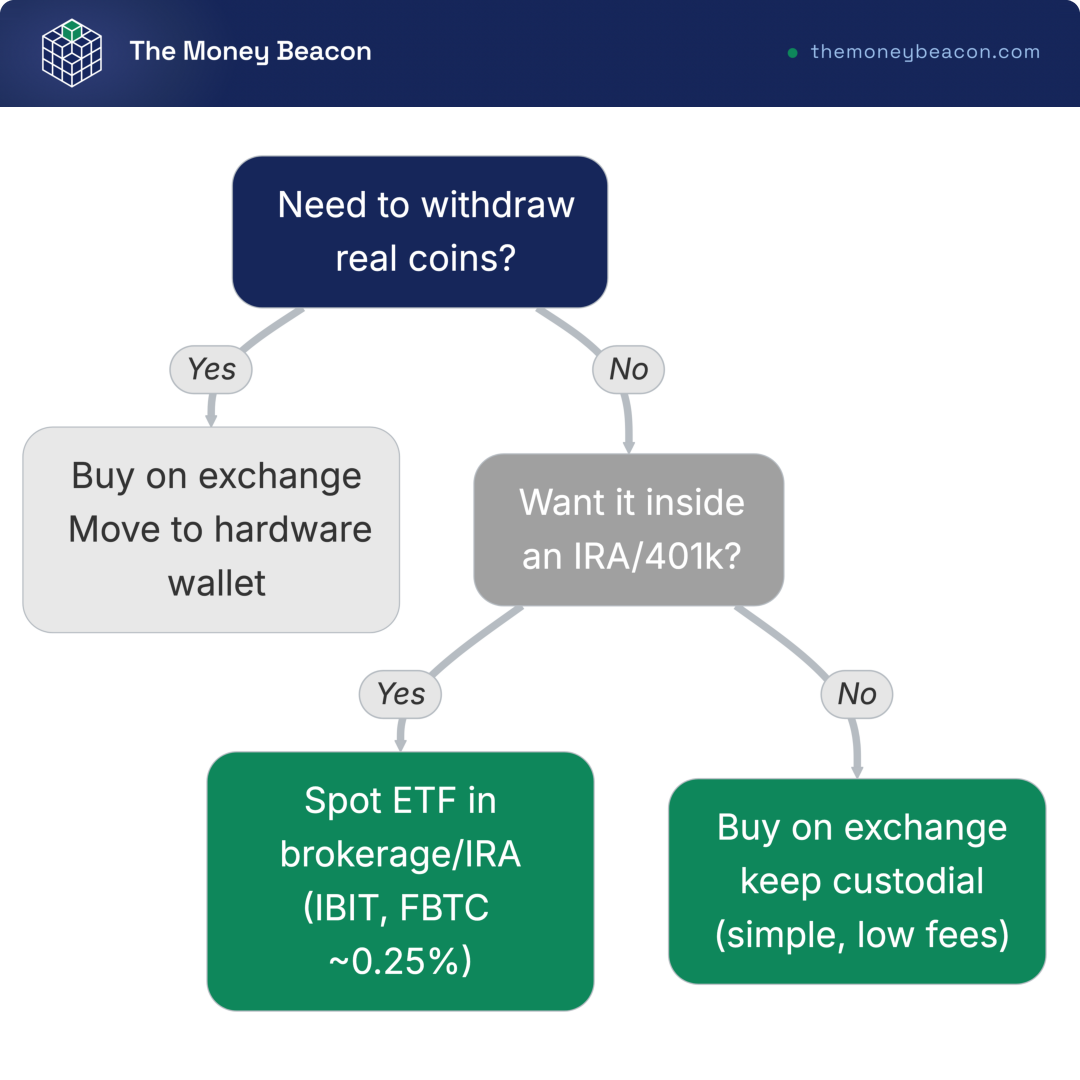
For a lot of cautious beginners the answer is the ETF, and a broker like Fidelity lets you hold it next to your index funds without ever opening a wallet. The coin route earns its place only when self-custody is a genuine goal, not a vague someday.
4.4 Fees that eat returns, and vetting a platform
Here is the mistake that costs beginners the most, and it is not the headline trading fee. It is the spread baked into the “instant buy” button. Four cost types are in play, and they are not equal. The maker/taker trading fee on the advanced order screen is low and tiered by volume, roughly 0.0% to 0.6% at retail tiers. The simple-buy spread on the one-click button is the silent one, commonly 0.5% to 1.5% embedded in the price, and more on card or PayPal flows. The network or gas fee hits when you withdraw on-chain, anywhere from a few dollars to tens of dollars depending on congestion. And the ETF expense ratio is the annual cost inside a fund, which we just covered.
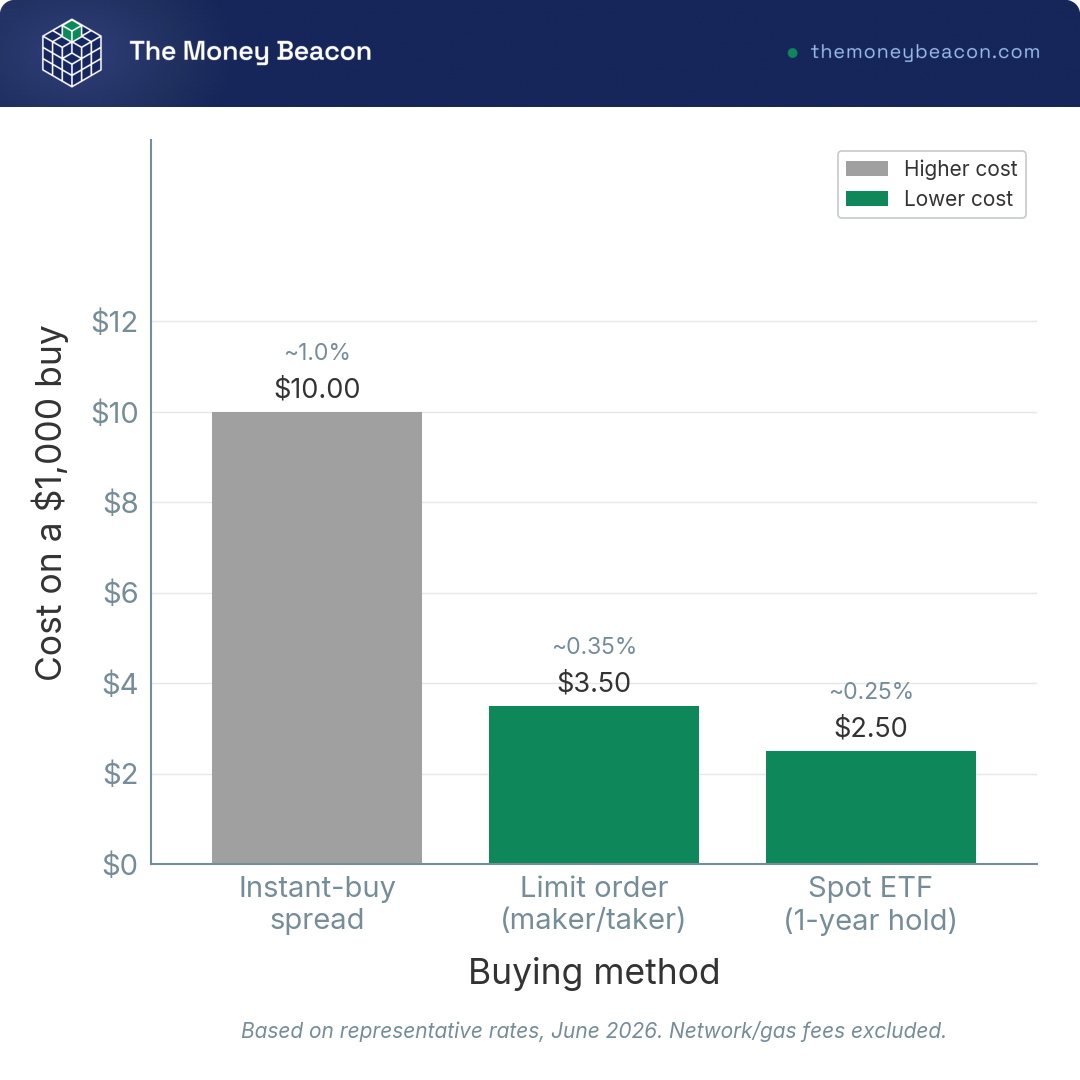
The instant-buy spread can quietly take $5 to $15 on that single purchase, where an advanced limit order at a 0.4% taker fee costs about $4, and a one-year hold in a 0.25% ETF runs about $2.50. The fix is free: place your order on the advanced or limit screen instead of the instant-buy button. Do that every time you dollar-cost average and you stop handing back a chunk of every purchase.
Picking the platform is the other half of the job. Run a short vetting checklist before you fund anyone: confirm the regulatory footprint (FinCEN registration, state money-transmitter licenses, and for brokers a clean record on FINRA BrokerCheck); look for proof of reserves or published audits; understand the custody model (a cold-storage majority and any private insurance, which is not FDIC coverage); check the track record for outages, hacks, or SEC and CFTC enforcement actions; and verify withdrawal freedom, that you can actually move coins out and on what holds. That last point carries the lesson that decides the next section. Coins on a failed platform can turn into an unsecured claim in a bankruptcy proceeding, which is the entire argument for holding your own keys on anything you cannot afford to lose to a platform’s collapse.
5. Custody: Who Actually Controls Your Crypto
You have chosen a venue and you know the spread to dodge. But buying the coin and controlling it are two different things, and the vetting lesson you just learned, that a failed platform can swallow “your” coins, is exactly why custody is its own decision.
5.1 Not your keys, not your coins, and the risks you trade away
Whoever holds the private keys controls the crypto. That is the whole principle, and it has two outcomes. On an exchange, the platform holds the keys for you (custodial), which is convenient but ties your coins to that company’s solvency. With a hardware wallet, you hold the keys (self-custody), which removes the company from the equation and hands you the full responsibility. The 12- or 24-word seed phrase is the wallet: anyone who has it controls the funds, and losing it with no backup means the money is gone forever, with no support line and no reset.
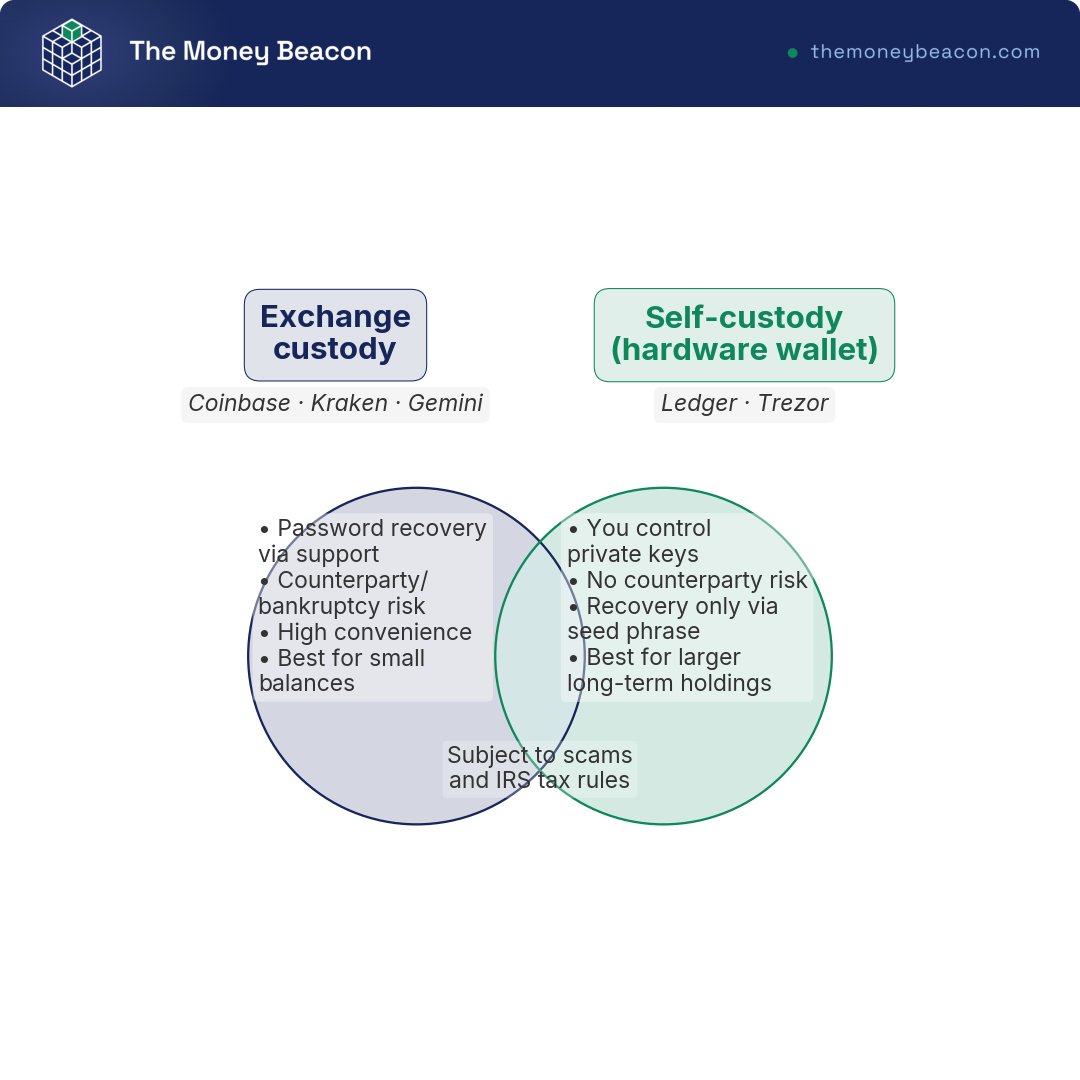
Moving to self-custody is a trade, not a pure upgrade. Exchange custody gives you password recovery and a support team, at the cost of bankruptcy exposure. Self-custody removes the counterparty entirely, at the cost of a new attack surface: your seed phrase, which you alone must protect. And the overlap in the middle matters just as much, because scams and the same IRS tax rules apply to you no matter who holds the keys. Self-custody is not a tax shelter and it is not scam-proof.
5.2 Exchange custody vs. hardware-wallet self-custody
So which side of that trade is right for you? It depends almost entirely on how much you hold and how long you plan to hold it.
| Factor | Exchange custody | Hardware wallet (self-custody) |
|---|---|---|
| Who holds keys | Platform | You |
| Recovery if you lose password | Often possible (support) | Only via your seed phrase |
| Counterparty/bankruptcy risk | Yes | No |
| Hacking surface | Platform breach, account takeover | Physical theft, seed-phrase exposure |
| Convenience to buy/sell | High | Lower (transfer first) |
| Best for | Small balances, active buying | Larger long-term holdings |
The rule that falls out of this table is clean. If your position is small and you are actively buying, a reputable, regulated custodial exchange is fine, because the convenience is worth more than the counterparty risk on a balance you could rebuild. Once the position is large or you intend to hold for years, move it to self-custody, because at that point the bankruptcy risk you read about in the vetting checklist is the bigger threat, and a hardware wallet removes it. Size and horizon decide, not ideology.
Tom’s take
I hold Bitcoin long term and I am honest that I am not a crypto specialist, so I treat custody the way I treat any single point of failure in the rest of my portfolio. A balance I would actually miss does not sit on someone else’s platform indefinitely. The counterparty question is the same one I ask of any institution holding my money, and on crypto the honest answer is that no exchange is too big to fail.
5.3 Setting up a hardware wallet, step by step
Say the balance has grown and self-custody is now the call. What does it actually look like? Hardware wallets like Ledger and Trezor keep your keys offline on a small physical device, and consumer models run roughly $50 for an entry unit to around $400 for a premium one. The order of operations is what keeps you safe, so follow it exactly.
- Buy only from the manufacturer or an authorized reseller. A device from a random marketplace seller can be tampered with before it reaches you.
- Initialize the device offline and let it generate the seed phrase on-device. The phrase should never come from a website or an app.
- Write the seed phrase on paper or, better, stamped metal. Never a photo, a cloud note, or a screenshot.
- Set a device PIN, and optionally add a passphrase (the “25th word”) for an extra layer.
- Send a tiny test transfer from the exchange first and confirm it arrives before you move anything else.
- Verify the receiving address on the device screen itself, not just on your computer, then move the full balance.
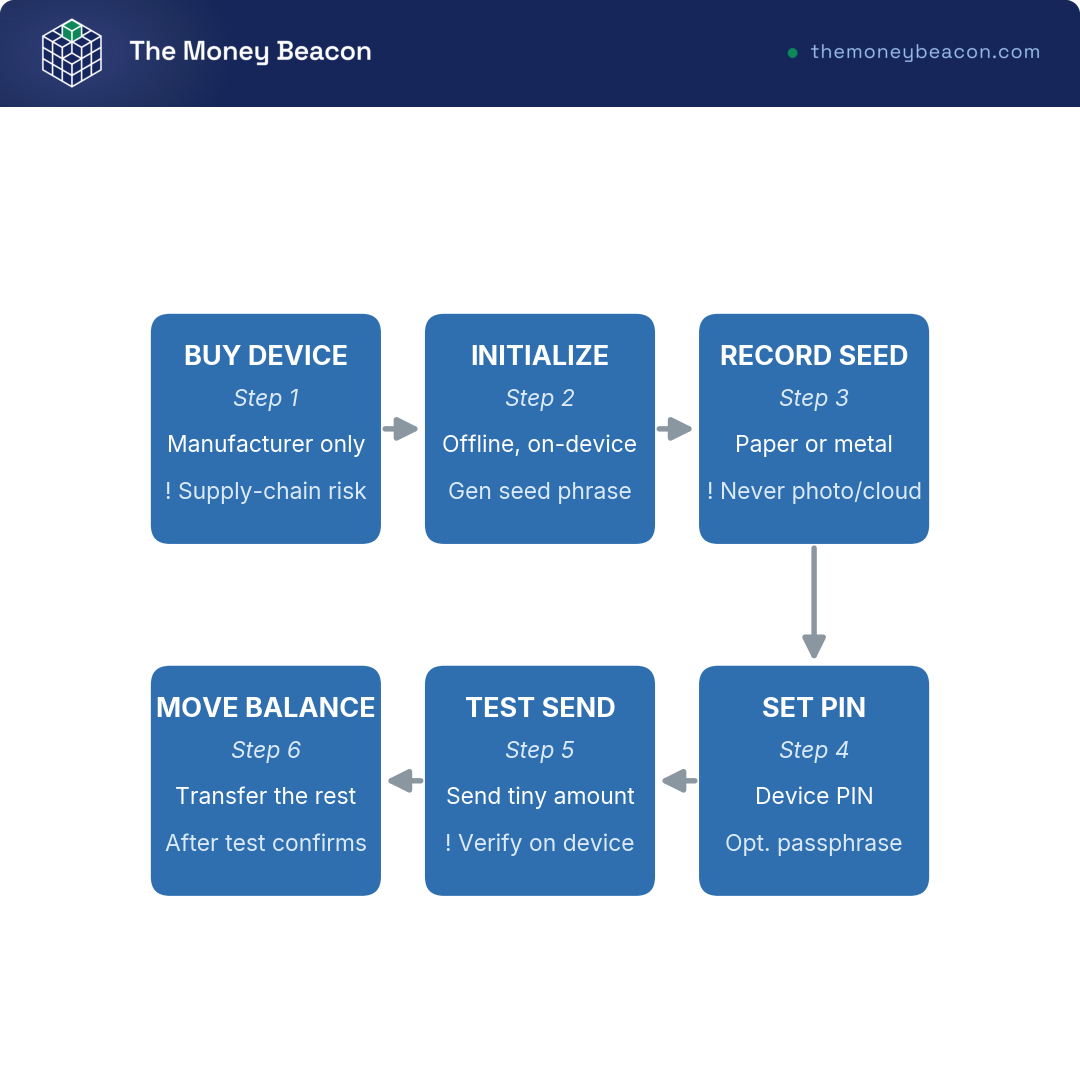
The test transfer in step five is the cheapest insurance you will ever buy. Sending a few dollars first and confirming it lands before you move the whole balance turns a catastrophic wrong-address mistake into a rounding error. Skip it, and a single mistyped or maliciously swapped address can send everything to a destination you do not control.
5.4 Seed-phrase security and backup strategies
The device is set up, the balance is moved, and now the entire safety of your crypto rests on a string of words. How you store that string is the whole game. The practices below are the difference between a recoverable setback and a permanent loss.
| Practice | Do | Avoid |
|---|---|---|
| Storage medium | Paper, ideally stamped metal | Photos, cloud, password managers, email |
| Copies | 2-3 in separate secure locations | A single copy (fire/flood = total loss) |
| Sharing | Never share, ever | Entering it into any website or “support” tool |
| Inheritance | Documented plan for heirs | Heirs locked out forever |
| Verification | Test recovery on a spare device | Assuming the backup works untested |
Two rows decide most of the bad outcomes. Keeping a single copy means a fire or a flood is a total, unrecoverable loss, so hold two or three copies in separate secure places, ideally stamped into metal that survives what paper does not. And the sharing row is the one scammers exploit directly, so memorize the rule and never bend it: no legitimate service, wallet, or support agent will ever ask for your seed phrase. Anyone who does, by email, by chat, by phone, or through a website field, is trying to steal your coins.
6. Scams and Behavioral Mistakes That Wipe Out Beginners
You know who controls the coins and why the seed phrase is sacred. Now to the risk that actually drains the most money from careful beginners, and it is not a market crash.
6.1 The big scam playbook: pig butchering, fake apps, giveaways
Crypto-related losses reported to the FBI’s IC3 reached about $9.3 billion in 2024, and the FTC logged roughly $1.4 billion in reported cryptocurrency-scam losses that same year, inside a broader $5.7 billion of investment-scam losses. You can size your position perfectly and still lose everything to a single convincing message, so learn the playbook before you ever send a dollar.
| Scam | How it works | Tell-tale sign | Defense |
|---|---|---|---|
| Pig butchering | Long-con “romance” or friendship steering you to a fake platform | Unsolicited contact, then “investment” tips | Never invest via someone who DM’d you |
| Fake apps/sites | Cloned exchange app or look-alike URL | Slight URL misspelling, app outside the official store | Bookmark the real site; verify the app publisher |
| Giveaway/airdrop | “Send 1 BTC, get 2 back” | Any “double your money” promise | It is always a scam |
| Wallet drainer | Malicious “connect wallet” or sign request | Unexpected signature pop-up | Never sign unknown transactions |
The thread running through all four is that someone reaches you first and manufactures urgency. The defenses are habits, not heroics. Type exchange URLs yourself rather than clicking links, enable app-based two-factor authentication rather than SMS (SIM-swap attacks defeat texts), never approve a wallet transaction you did not personally initiate, and treat any inbound “support” message as hostile until proven otherwise. Real support never DMs you first, never asks for your seed phrase, and never asks for remote access to your device.
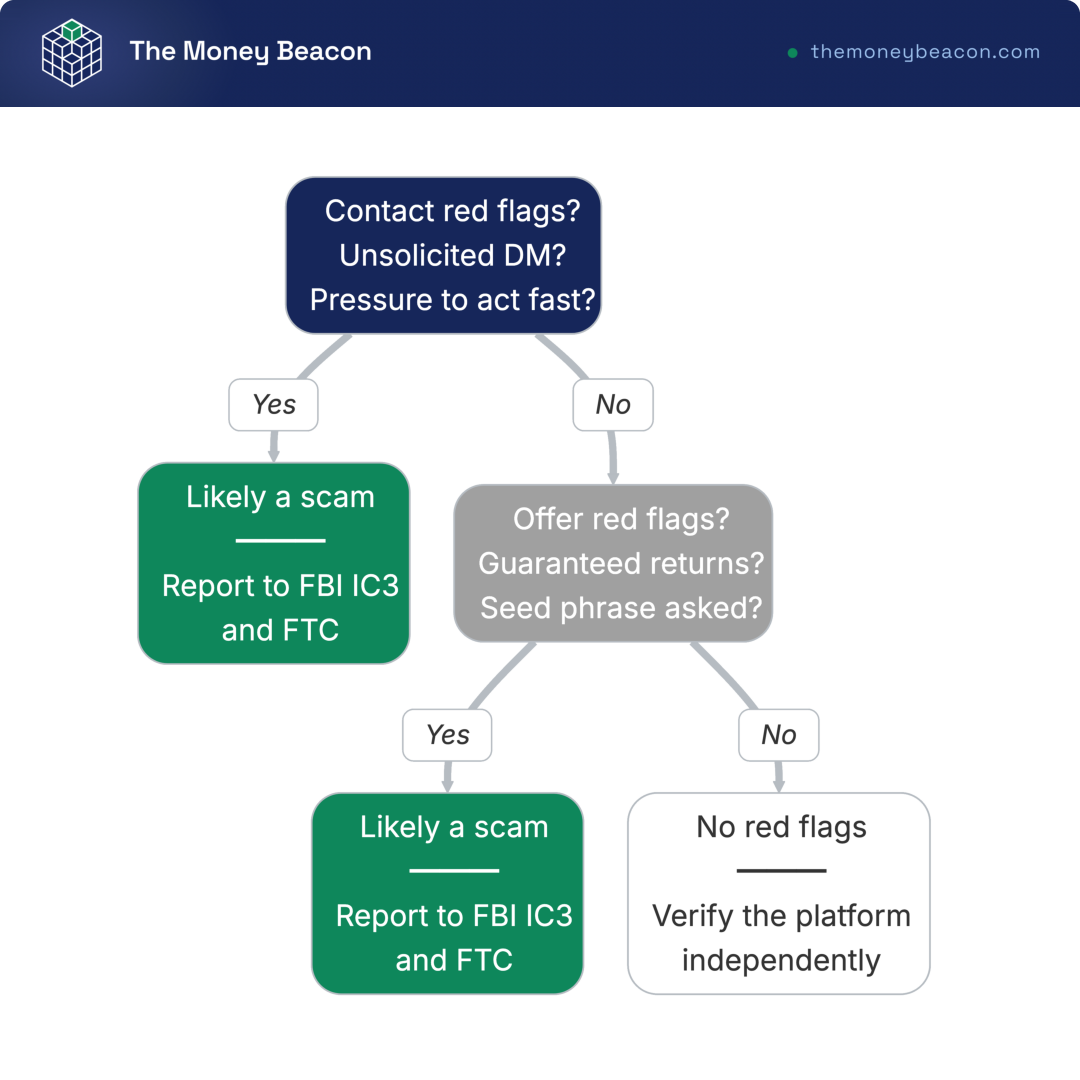
6.2 Screen any offer before you send money
So how do you run that filter in real time, before the money is gone? Four questions, and a single yes is enough to stop. Did they contact you first? Did they promise guaranteed or doubled returns? Did they ask for your seed phrase or remote access to your computer? Are they pressuring you to act fast before the “opportunity” closes? Any yes means stop and report, because there is no version of a legitimate offer that needs your seed phrase or a countdown clock. Even an all-no path is not a green light on its own, because you still verify the platform independently before funding it. The decision tree below is the same logic, laid out to run in under a minute.
6.3 Behavioral mistakes and where to report fraud
The scammers are external. The next set of losses you cause yourself, and they are just as expensive. These are the five that wreck beginners most.
| Mistake | Why it hurts | Guardrail |
|---|---|---|
| FOMO buying the top | Buying after a parabolic run | Stick to your DCA schedule |
| Leverage/margin | Liquidation wipes you out on a normal swing | No leverage as a beginner |
| Chasing “high-yield” staking/lending | Yield often masks platform or de-peg risk | Treat double-digit “guaranteed” yields as red flags |
| Panic selling the bottom | Locks in the loss | Pre-commit to your 80%-test sizing |
| Overtrading | Fees, short-term tax, and bad timing | Buy-and-hold the sized position |
Every guardrail in the right column is a pre-commitment you already made earlier in this guide, the DCA schedule, the 80% test, the sized position, each one built to stop you from buying the euphoric top and selling the terrified bottom. The two newest traps are worth naming directly. Leverage can liquidate your entire position on an ordinary swing, not even a crash, so as a beginner you use none. And a double-digit “guaranteed” yield is a warning label, not a feature, because it almost always hides platform or stablecoin de-peg risk that can vaporize the principal you were chasing extra yield on.
When something does go wrong, you have specific places to report it, and reporting matters because it feeds the investigations that shut these operations down. Send any internet or crypto fraud to the FBI’s IC3 at ic3.gov, deceptive practices and scam losses to the FTC at reportfraud.ftc.gov, securities-type fraud or an unregistered offering to the SEC at sec.gov/tcr (and check a firm at investor.gov), derivatives and commodity fraud to the CFTC at cftc.gov, and financial-product complaints to the CFPB at consumerfinance.gov. To check whether a broker is legitimate before you trust it, run it through FINRA BrokerCheck. Report unsolicited contact even when you did not lose money, because the pattern you flag may stop the next person from losing theirs.
7. US Taxes on Crypto Without Nasty Surprises
Every move you have learned to make so far, buying, holding, moving coins to a hardware wallet, trimming a winner, carries a tax dimension, and getting it wrong is the avoidable loss we flagged at the end of the last section. Here is the reassuring part: the IRS framework is not a minefield, it is a learnable set of rules, and a disciplined investor with a tracking habit and the right venues can handle it systematically.
7.1 Crypto is property, and the taxable events you may not notice
The single fact to anchor on is this: the IRS does not treat your crypto as money. Under Notice 2014-21, virtual currency is property, not currency, for federal tax, and the digital-asset guidance still points back to that notice. That one call runs through everything else, because the capital-gains rules apply the same way they would to a stock or a slice of land. You owe tax on the gain, which is proceeds minus your cost basis (what you paid plus fees), and only when you actually dispose of the coin. Just holding crypto, or moving it between your own wallets, triggers nothing at all.
So which actions count as a disposition, and which are invisible to the IRS? The table sorts them.
| Event | Taxable? | Type |
|---|---|---|
| Buying crypto with USD | No | No |
| Holding crypto | No | No |
| Moving between your own wallets | No | No |
| Selling crypto for USD | Yes | Capital gain/loss |
| Swapping one coin for another (e.g., BTC to ETH) | Yes | Capital gain/loss |
| Spending crypto on goods/services | Yes | Capital gain/loss |
| Receiving staking/reward income | Yes | Ordinary income at FMV on receipt (per Rev. Rul. 2023-14, when you gain dominion and control) |
| Getting paid in crypto for work | Yes | Ordinary income (then basis = that FMV) |
| Receiving an airdrop/fork | Generally yes | Ordinary income at FMV on receipt (per Rev. Rul. 2019-24) |
The right column splits into two families. Selling, swapping, or spending a coin is a capital event, taxed on the gain since you bought it. Getting paid in crypto, whether through staking, work, or an airdrop, is ordinary income at the coin’s fair market value the moment you receive it, and that value then becomes your basis for the eventual sale. Notice that the same coin can be taxed twice in its life, once as income when it lands and again as a capital gain when you sell it, on the appreciation in between.
One line in that table costs beginners more than any other. Swapping BTC for ETH is a taxable disposition of the BTC, even though no dollars ever hit your bank account. People assume a coin-to-coin trade is free because they never “cashed out,” and it is the most common crypto tax mistake there is. The same logic on holding periods and rates that governs stock gains, which we lay out in our guide to how short and long-term gains are taxed, applies to each of these crypto dispositions too.
7.2 Classify the transaction: did I trigger a taxable event?
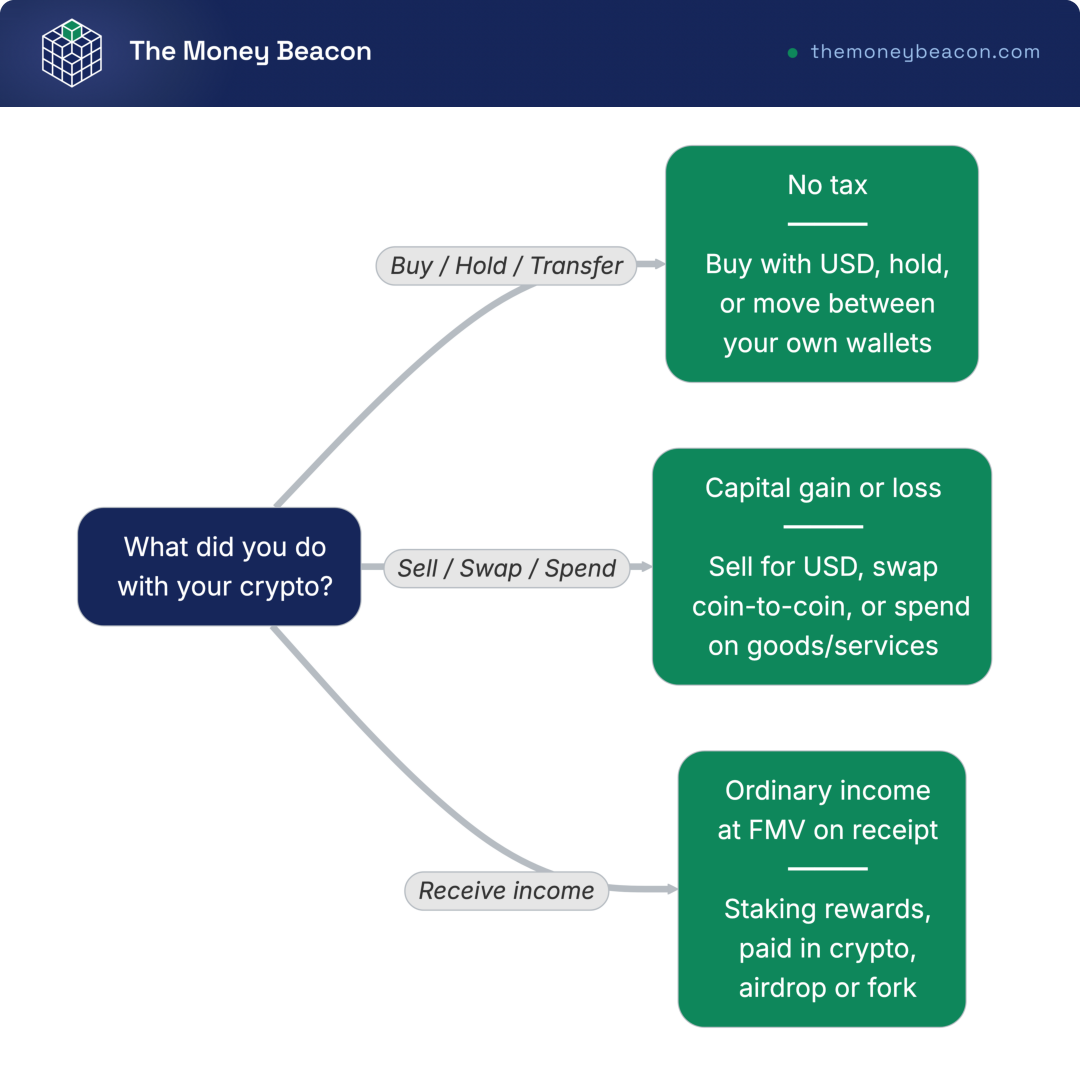
The table becomes a habit of mind once you can run any action through it in your head. Group your moves into three lanes: buy, hold, or self-transfer routes to no tax; sell, swap, or spend routes to a capital gain or loss; and staking, getting paid in crypto, or an airdrop routes to ordinary income at fair market value on receipt. The decision tree below is the version to keep in front of you the first few months, until the sorting becomes automatic.
7.3 Short-term vs. long-term gains and the one-year lever
So a disposition creates a gain. How much you hand over depends almost entirely on one number: how long you held the coin before you sold it. The clock runs from the day after you acquired the coin to the day you dispose of it, and it splits every gain into two rate worlds.
| Holding period | Classification | Federal rate |
|---|---|---|
| 1 year or less | Short-term | Ordinary income rates, 10% to 37% |
| More than 1 year | Long-term | 0% / 15% / 20%, by taxable-income bracket |
Data current as of June 2026.
Sell a coin you have held a year or less and the gain is short-term, taxed at your ordinary income rate, anywhere from 10% to 37%. Hold for more than a year and the same gain becomes long-term, taxed at 0%, 15%, or 20% depending on your taxable income. There is no flat “15% on crypto,” the rate depends on your bracket. For 2026, the 0% long-term rate runs up to $49,450 of taxable income for a single filer, $98,900 married filing jointly, and $66,200 for head of household; the 15% rate then runs up to $545,500 single, $613,700 married filing jointly, and $579,600 head of household, with 20% above those lines. The 2026 standard deduction ($16,100 single, $32,200 married filing jointly, $24,150 head of household) comes off your income before you land in any of those brackets.
High earners pay one more layer. The Net Investment Income Tax adds 3.8% on net investment income once your modified adjusted gross income clears $200,000 single or $250,000 married filing jointly ($125,000 married filing separately), and these thresholds are not indexed for inflation. It stacks on top rather than replacing the rate, so the top long-term rate on a crypto gain becomes 20% plus 3.8%, or 23.8%. Most households never touch it, but if you are sitting near those thresholds, plan around it.
This is where the holding period turns into real money. Say you are sitting on a $10,000 crypto gain and you fall in the 35% ordinary bracket. Sell at 11 months and you owe roughly $3,500 in federal tax. Wait past the one-year mark and the same gain often drops to the 15% long-term rate, about $1,500, a swing of $2,000 on a single decision about timing. Crossing one year before you sell can move a gain from up to 37% down to often 15%, and it is the most controllable lever you have. If you are sitting on a loss instead, there are other levers worth knowing, several of which we cover in our rundown of ways to lower your tax bill.
7.4 Edge cases (IRAs, gifts, state tax, wash-sale gap) and reporting at tax time
A handful of situations sit outside the standard sell-and-report path, and they are worth knowing before they catch you. Holding crypto inside an IRA or 401(k) changes the timing entirely: trades within the wrapper are not immediately taxable, and qualified Roth withdrawals can come out tax-free, which is why a Roth IRA is an attractive home for a long-term position. Availability varies by provider and state, though; Fidelity, for instance, offers a crypto IRA in many states but not California or Oregon, with no account, maintenance, or custody fee and a 1% trading fee. Staking rewards are ordinary income at the value on receipt, and that value becomes your basis later. A stablecoin de-peg is not just a market loss; selling or swapping the de-pegged coin realizes a capital loss, and even spending it counts as a disposition.
Gifting crypto is generally not taxable to you below the 2026 annual exclusion of $19,000 per recipient, and the recipient takes your carryover basis. Inherited crypto generally gets a stepped-up basis to fair market value at death under IRC Section 1014, wiping out the built-in gain. And state tax is its own layer: nine states levy no broad income tax on wages (Alaska, Florida, Nevada, New Hampshire, South Dakota, Tennessee, Texas, Washington, and Wyoming), though Washington taxes certain capital gains, so where you live still matters.
One quirk works in your favor for now. Because crypto is property and not a “security,” the wash-sale rule does not currently apply to it, so you can sell a coin at a loss to harvest it and rebuy the same coin immediately, with no 30-day wait like the one that applies to stocks. That could change if Congress extends the rule to digital assets, but as the law stands today it is a real edge. Harvested losses offset your capital gains first, then up to $3,000 of ordinary income a year ($1,500 married filing separately), with anything left over carried forward to future years.
When tax time comes, a short list of forms does the work. Form 8949 lists every disposition (date acquired, date sold, proceeds, basis, gain or loss); Schedule D rolls those totals into short-term and long-term buckets; Schedule 1 or Schedule C reports ordinary crypto income from staking, airdrops, or pay; and every filer has to answer the Form 1040 digital-asset question, the Yes/No checkbox asking whether you received, sold, exchanged, or otherwise disposed of a digital asset during the year. You will also start seeing Form 1099-DA from exchanges, the new broker-reporting form: it covers gross proceeds for transactions on or after January 1, 2025, with cost-basis reporting phasing in for transactions on or after January 1, 2026. That regime comes from the Infrastructure Investment and Jobs Act broker provisions amending IRC Section 6045, with final regulations published July 9, 2024, and effective September 9, 2024. The year-end sequence below puts the forms in order.
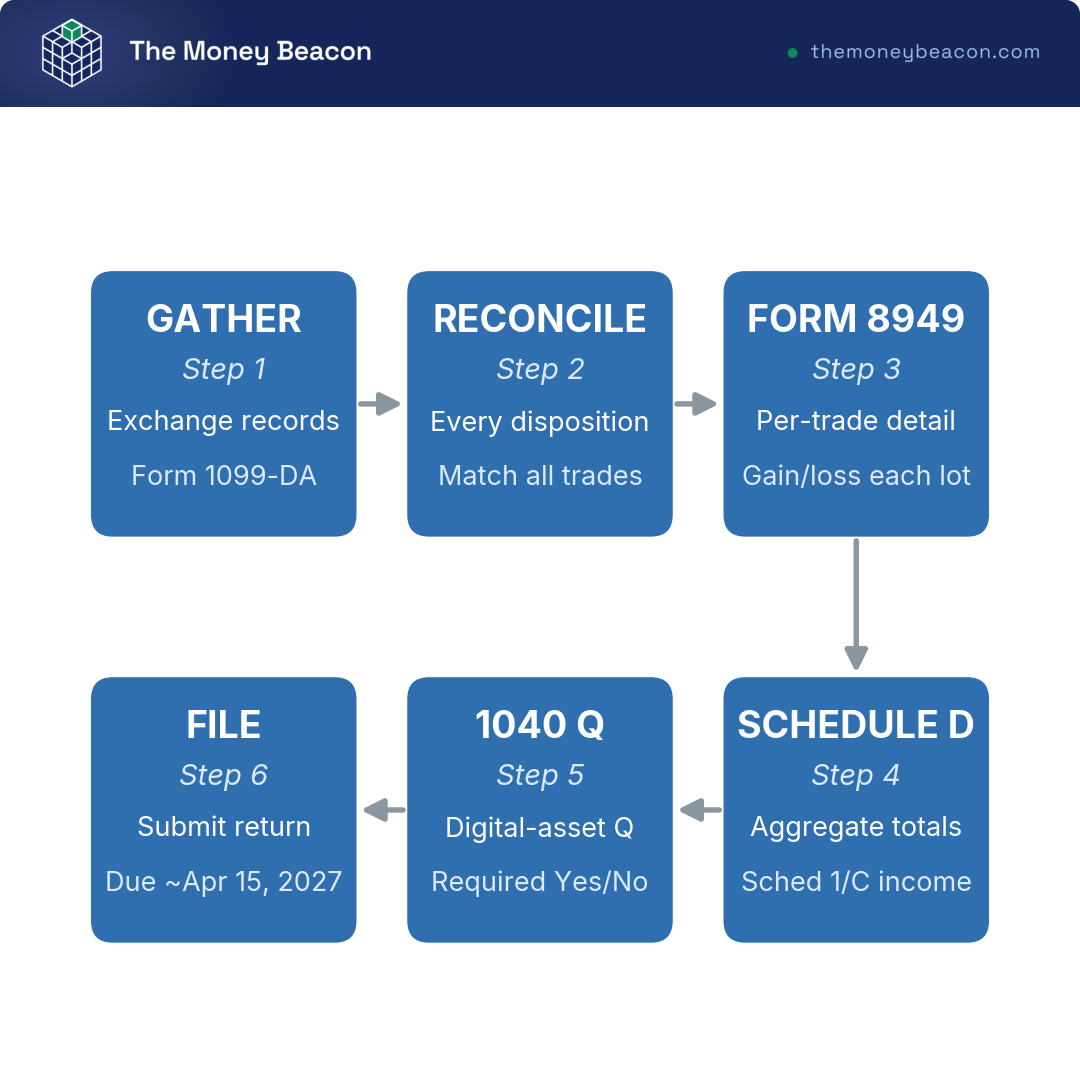
Walk it top to bottom: gather your exchange records and any 1099-DA, reconcile every disposition against your own log, fill in Form 8949, roll the totals into Schedule D, add any ordinary income on Schedule 1 or Schedule C, answer the 1040 digital-asset question, and file. Returns are generally due April 15; for the 2026 tax year covered here, that lands on or about April 15, 2027.
All of it rests on the recordkeeping habit. Crypto tax software such as CoinTracker, Koinly, or TokenTax imports your exchange and wallet history and generates the 8949 for you, running roughly $50 to $60 a year at the base tier and up to several hundred dollars for high-volume activity. Pick an accounting method (FIFO or specific identification), apply it consistently, and know that basis is now tracked on a per-wallet or per-account basis under current rules.
Hank’s take
the part most beginners underestimate is how fast the tax record degrades if you let it slide. Reconstructing two years of swaps across three platforms is genuinely painful, and the behavioral fix is boring but decisive: turn on basis tracking the day you make your first buy, so the disciplined position you sized stays a disciplined position at tax time too.
8. Your Safe-Crypto Action Plan
You now have every piece: what crypto is, whether it belongs in your portfolio, how much to buy, where to buy it, how to hold it, how to dodge the scams, and how the IRS treats every move. What is left is to put it in order, one sequence you can actually run, with the trap waiting at each step.
8.1 The seven-step safe-crypto checklist
There is no clever shortcut here, just the right order. Each step has one thing to do, one thing to avoid, and the mistake people most often make right there.
| # | To do | To avoid | Common mistake at this step |
|---|---|---|---|
| 1 | Confirm the foundation (no card debt, emergency fund, match captured) | Buying crypto before the basics | Treating crypto as the first investment |
| 2 | Set a target allocation 1% to 5% and pass the 80% test | Sizing by FOMO | Putting in money you cannot lose |
| 3 | Choose a venue: vetted exchange or spot ETF | Random app from a DM or ad | Picking by hype, not regulation |
| 4 | Fund via ACH; buy on the advanced/limit screen | “Instant buy” spread | Overpaying the hidden markup |
| 5 | Decide custody: exchange for small, hardware wallet for larger | Leaving a large stack on an exchange long-term | Ignoring counterparty risk |
| 6 | If self-custody: record the seed on metal, test-transfer, verify address | Seed in cloud/photo; no test send | Losing or exposing the seed phrase |
| 7 | Track basis from day one; report 8949/Schedule D; answer the 1040 question | Assuming swaps/spends are tax-free | The “swap is not taxable” error |
The steps build on each other, so skipping one tends to wreck the next. Skip step 1 and you are buying a volatile asset with money you may need, which makes the 80% test in step 2 impossible to pass honestly. Skip the basis tracking in step 7 and the disciplined buying you did in steps 3 and 4 turns into a tax-season scramble. Run the steps in order and most of the expensive mistakes never get the chance to happen.
8.2 The decisive answer, condensed
If you remember nothing else, this is the whole guide on one screen: the disciplined default for each decision, the number or rule that drives it, and the single mistake that does the most damage.
| Decision area | The disciplined default | Key number / rule | Top mistake to avoid |
|---|---|---|---|
| Should I buy? | Only after debt cleared, emergency fund set, match captured | Crypto is the last dollar, not the first | Buying before the foundation |
| How much? | Small satellite | 1% to 5% of investable assets; pass the 80% test | Sizing so a crash hurts your life |
| Entry method | DCA for nervous beginners | Spread buys over weeks/months | Lump-sum FOMO at the top |
| Where to buy | Regulated exchange or spot ETF | Use advanced/limit screen, not instant-buy | Paying the hidden spread |
| Wrapper | ETF for simplicity/IRA; coins for self-custody | ETF expense ratio vs. direct custody | “FDIC-insured” thinking |
| Custody | Exchange for small; hardware wallet for large/long-term | “Not your keys, not your coins” | Seed phrase lost or shared |
| Scams | Assume unsolicited = scam | No one legit asks for your seed phrase | Pig-butchering / fake-app losses |
| Taxes | Track basis from day one | Crypto = property; >1 yr = 0/15/20%, ≤1 yr = ordinary | Treating a coin-to-coin swap as tax-free |
| Reporting | File correctly | Form 8949 + Schedule D, answer 1040 question, expect 1099-DA | Not reporting; mis-answering the checkbox |
Tax rates per the 2026 federal reference. Data current as of June 2026.
Conclusion
The honest takeaway from this whole guide is smaller than the headlines suggest. Crypto can earn a place in a careful plan, but only as a thin satellite of 1% to 5%, bought after the debt is cleared and the emergency fund is set, and held in a way you actually control. Size it so an 80% crash costs a few percent of your total portfolio rather than your sleep, and the bet can fail completely without changing your life.
Two points are worth keeping in mind, because they catch even careful people. The first is the swap trap: trading one coin for another counts as a taxable sale of the first, even when no dollars ever reach your bank, and that one surprise lands on more April returns than any market crash does. The second is custody, where the rule is simple and unforgiving, because whoever holds the keys holds the coins, and a seed phrase lost with no backup is gone for good.
To go deeper on the parts that compound over time, our guide to investment taxes walks the capital-gains brackets and the wash-sale rule that crypto sidesteps for now, and our guide to diversifying your savings shows where a small crypto slice sits next to the rest of your money. If the diversified core underneath it all still feels shaky, start with our guide to investing in the stock market, because crypto only makes sense once that foundation is in place.
Frequently Asked Questions
How much of my portfolio should I put in crypto as a beginner?
The widely cited practitioner ceiling is 1% to 5% of investable assets, with roughly 3% often described as the risk-adjusted sweet spot. On a $50,000 portfolio, that works out to $500 at the low end and $2,500 at the high end. The logic behind the ceiling is worth understanding: even at 5%, a complete wipeout costs you only 5% of your total portfolio. Bitcoin has fallen 75% to 85% peak-to-trough in past cycles, so the real question to ask before you size is this one: multiply the dollars you plan to put in by 0.2, and ask whether you could watch the position sit at that figure for a year or more without selling or losing sleep. If the honest answer is no, the position is too large. The goal is for the bet to be able to fail completely without changing your plans.
Is it safer to keep crypto on an exchange like Coinbase or in a hardware wallet?
It depends on how much you hold and how long you plan to hold it. A reputable, regulated exchange is a reasonable choice for small, actively traded balances, but you carry counterparty risk the entire time: if the platform fails, your coins can become an unsecured bankruptcy claim, and there is no FDIC or NCUA backstop behind them. For larger or long-term holdings, a hardware wallet (Ledger or Trezor, running roughly $50 to $400) removes that counterparty risk because you hold the private keys yourself. The trade-off is that you become entirely responsible for the 12- or 24-word seed phrase. Lose it with no backup and the funds are gone permanently, with no company or government able to recover them. A practical rule: leave small, actively traded amounts on a vetted exchange, and move anything you plan to hold for years to self-custody. You can find a broader comparison of the brokerage and exchange accounts suited for different goals in our brokerage accounts comparison.
Do I have to pay taxes on crypto if I never cash out to my bank account?
Often, yes. The IRS classifies crypto as property under Notice 2014-21, which means capital-gains rules apply at every disposition, not just when you wire dollars to your bank. Selling for US dollars is the obvious taxable event, but so is swapping one coin for another, spending crypto on a purchase, or receiving staking rewards. Simply buying and holding crypto, or moving it between wallets you control, is not taxable. The swap point trips up many beginners: trading BTC for ETH is a taxable disposition of the BTC at its fair market value on the day of the trade, even if no cash ever left the crypto ecosystem. For a full breakdown of which transactions trigger tax and which do not, our investment taxes guide covers the capital-gains rules in depth.
What happens to my crypto taxes when I swap one coin for another?
A swap is treated as a sale of the coin you are giving up. If you trade BTC for ETH, the IRS considers you to have sold your BTC at its fair market value on that date, realizing a capital gain or loss based on what you originally paid for it. No dollars have to hit your bank account for the event to count. The holding period then determines the rate: if you held the disposed coin for more than one year, the gain is long-term, taxed at 0%, 15%, or 20% depending on your income bracket; one year or less, it is short-term and taxed at ordinary rates from 10% to 37%. For 2026, the 0% long-term bracket runs up to $49,450 for single filers and $98,900 for married filing jointly. This is the single most common beginner tax error, and it also means every swap multiplies your recordkeeping burden, so tracking your cost basis and acquisition date for each lot from day one is not optional.
Are spot Bitcoin ETFs a safer way to invest in crypto than buying the coins directly?
For many beginners, yes, in the sense of operational safety. A spot ETF such as BlackRock’s IBIT or Fidelity’s FBTC delivers Bitcoin exposure inside a normal brokerage account or Roth IRA, with no wallet to set up, no seed phrase to safeguard, and no custody decision to make. Both IBIT and FBTC carry a 0.25% annual expense ratio (temporary waivers can apply, so check the current net ratio on the issuer’s fact sheet before buying). The Grayscale Bitcoin Trust (GBTC) remains notably more expensive at 1.50%. The clear trade-off is that you cannot withdraw actual coins from an ETF, so it is the wrong tool if you ever want to move crypto off-platform or spend it directly. The price also still carries crypto’s full volatility: the ETF wrapper makes custody simpler, not the underlying asset safer. If your primary goal is straightforward exposure inside a tax-advantaged account, a spot ETF is a clean, low-friction way to get there.




Comments
Questions and corrections welcome. We read everything.