


Here’s the trap almost every buyer falls into. You spot a lender advertising the lowest rate in the market, you sign, and only later do you notice the origination charge, the discount points, and the padded closing costs that quietly made that “cheapest” loan way more expensive. The advertised rate is the bait. The fees are how lenders make their money, and they’re counting on you to look at one number and not dig deeper.
That mistake is expensive in 2026. The 30-year fixed rate has been hovering between 6.47% and 6.49%, so on a $400,000, you’re already paying a lot of money every month, even before any fees. At that level, a rate that seems a tenth of a point better can still cost you thousands more once the lender adds its charges.
So let’s do this the way that actually protects your wallet. I’ll walk you through the seven lenders most US buyers are choosing between, one mini-review at a time. I will rate each based on the only number that matters: the all-in cost. That means the annual percentage rate (APR) plus the real dollar fees on your Loan Estimate, not the teaser rate on the billboard. You’ll see who’s cheap on paper and pricey in practice, who quietly wins, and which lender fits your profile. By the end, you’ll know exactly which quote to sign, and which to walk away from.
1. How we compared the lenders: APR, fees, points, locks, and program fit
So how do you actually judge a quote instead of getting hooked by it? You rate every offer based on one number: the all-in cost, which is the APR plus the real dollar fees on your Loan Estimate.
1.1 The 2026 rate landscape and how each lender’s sample APR compares to it
How do the panel’s sample 30-year rates compare to the market as a whole in mid-2026? The Freddie Mac PMMS benchmark for the 30-year fixed averaged 6.47%, with the 15-year at 5.81%. Against that line, the sample APRs in this comparison range from a low near 6.01% up to about 6.91%, with a couple of lenders not publishing an APR with their headline rate.
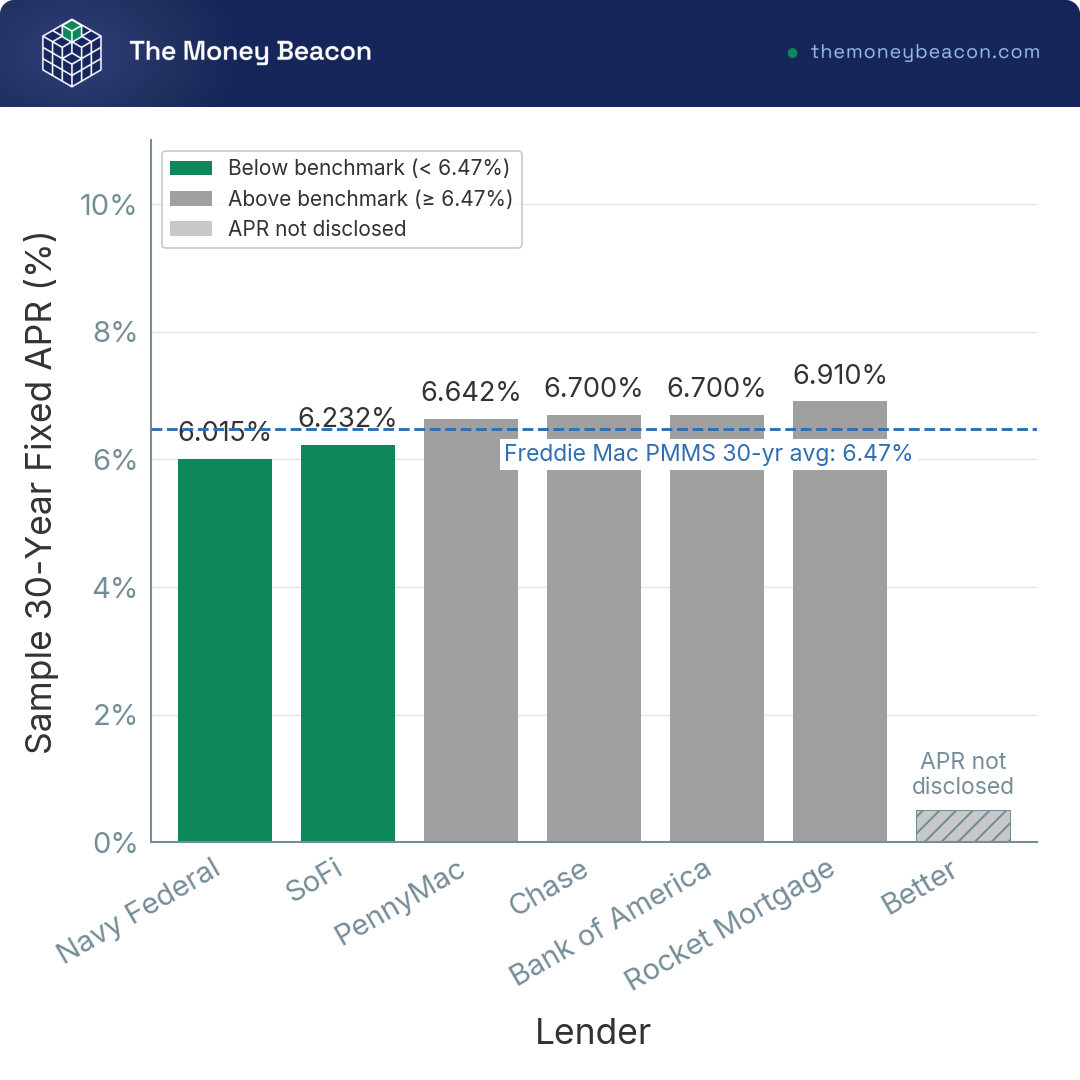
One caveat on all of these numbers is that they’re illustrative snapshots for a strong-borrower profile, and they move daily. So treat them as a starting point. These are the current 30 year fixed rate mortgage rates as of the report date, not a quote on your loan.
1.2 The all-in-cost lens: APR plus Section A dollar fees, not the teaser rate
The note rate determines how much you pay each month for your loan. The APR is the broader number that the Truth in Lending Act requires lenders to disclose. It includes most lender fees and points into a single annual cost. That’s why the APR is usually higher than the note rate. The difference is the fees.
Rate vs APR, worked illustration ($400,000, 30-year fixed)
| Offer | Note rate | Lender fees + points | APR | Monthly P&I |
|---|---|---|---|---|
| A (no points) | 6.75% | $2,000 | ~6.82% | ~$2,594 |
| B (1 point) | 6.50% | $6,000 | ~6.70% | ~$2,528 |
| C (teaser, high fees) | 6.375% | $12,000 | ~6.90% | ~$2,495 |
Data current as of July 2026.
So the APR vs interest rate question isn’t just academic; it’s about choosing the loan that looks cheapest and is actually the best deal. There’s one more thing to consider: the APR assumes you’ll hold the loan until it’s paid off. If you plan to hold the loan for a short time, you should also consider the raw fee dollars on their own.
1.3 The teaser trap, visualized: same loan, three very different APRs
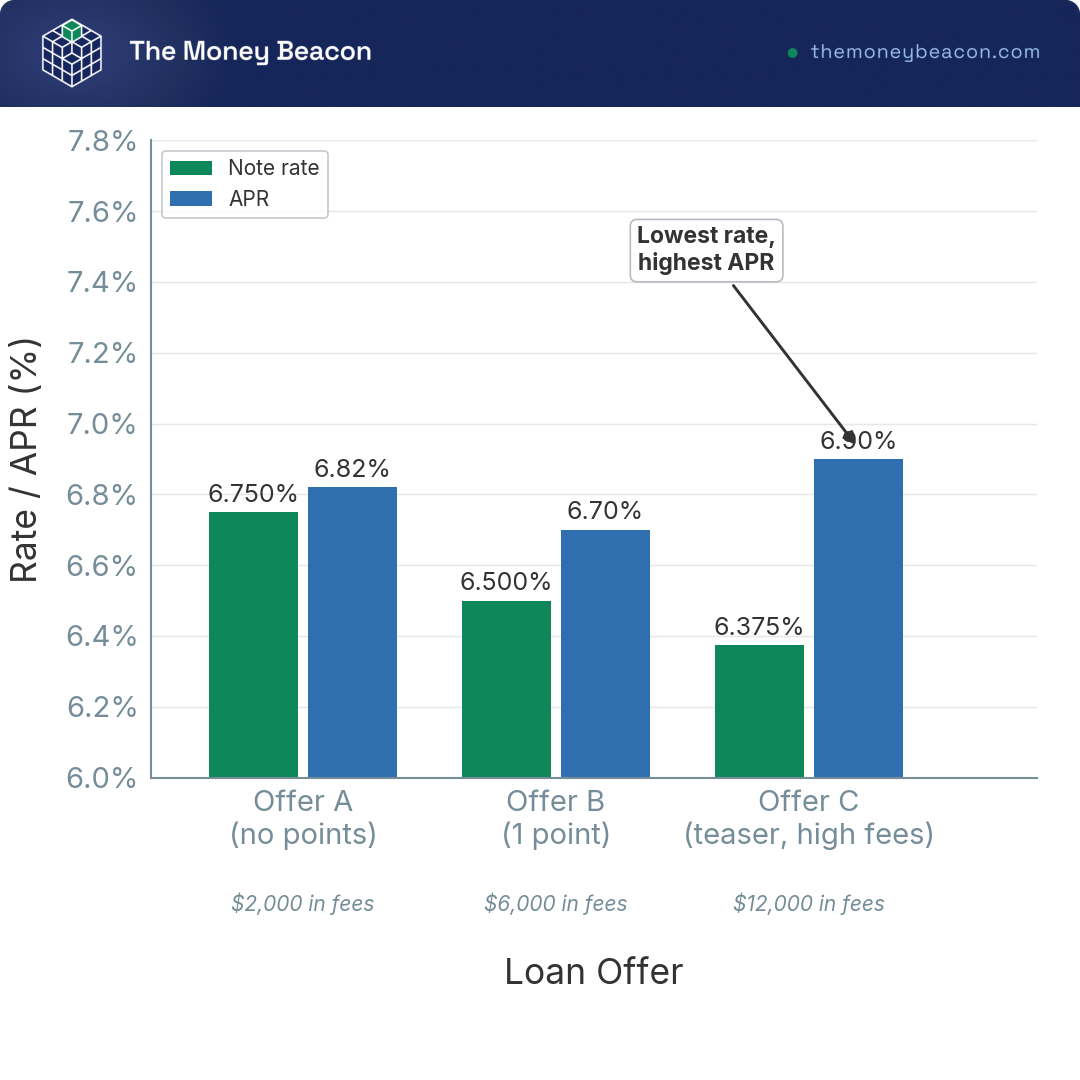
The lowest advertised rate can be the most expensive loan, so rank on APR plus the fee dollars, not just the number in the ad.
1.4 Reading the Loan Estimate and shopping lenders the right way
The federally standardized Loan Estimate is what makes lenders comparable, so learning to read it matters. A lender must deliver it within three business days of a completed application. Page 2, Section A lists the lender’s own origination charges and any discount points, which is where lenders diverge most. Page 3 shows the APR. The killer move is to line up several Loan Estimates pulled the same day and compare Section A dollars and the page-3 APR side by side, because a rate quoted Monday and one quoted Thursday aren’t comparable if the market moved between them.
Some fees are negotiable, but others aren’t.
Closing-cost fee types and whether you can shop them
| Fee | Who charges it | Shoppable? | LE location |
|---|---|---|---|
| Origination / underwriting / processing | Lender | Compare across lenders | Section A |
| Discount points | Lender | Optional | Section A |
| Appraisal | Third party | Lender-selected (no) | Section B |
| Credit report | Third party | No | Section B |
| Title / settlement / escrow | Third party | Yes | Section C |
| Recording, transfer taxes | Government | No (state-set) | Section E |
Data current as of July 2026.
Section A is the slice you actually control, so that’s the one to compare. If you cluster all your applications into a two-week sprint, they will fit into the time frame of every credit-scoring model. This makes it easy to compare mortgage lenders and barely changes your score. If part of the reason you’re shopping is to combine multiple payments into one lower payment, that same discipline applies.
1.5 Discount points: when paying to buy down your rate pays off
A discount point costs 1% of the loan amount and typically buys the rate down by about 0.25%. Does that upfront cash ever come back? Let’s do the math on a $400,000 loan: one point costs $4,000, and suppose it drops the rate from 6.75% to 6.50%, cutting your monthly P&I from about $2,594 to about $2,528. That’s roughly $66 a month saved, so your breakeven is $4,000 divided by $66, or about 61 months.
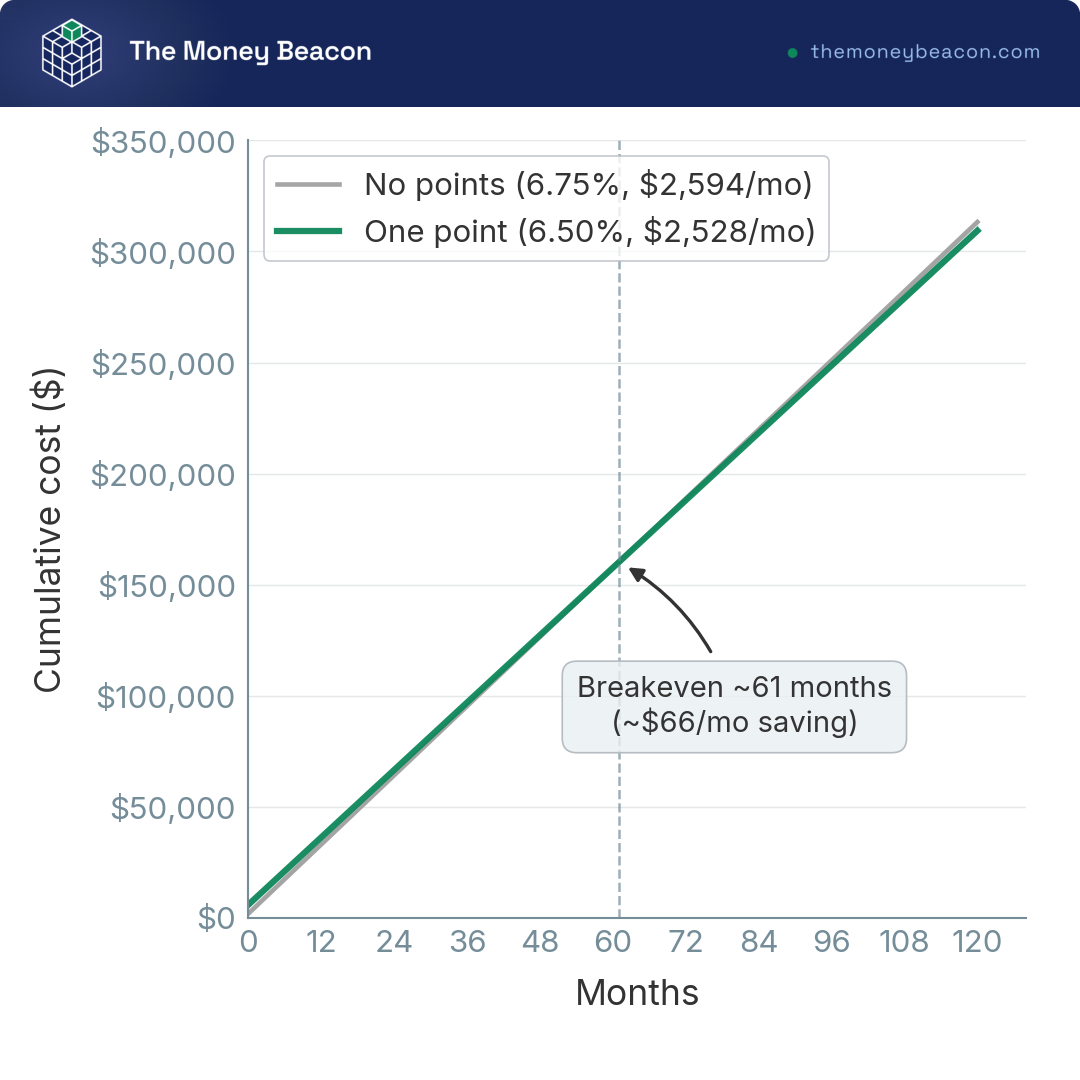
So if you’ll keep the loan longer than about five years, the point pays off; if you’ll sell or refinance sooner, skip it.
1.6 Rate locks, float-downs, and the disclosure clock you are owed
A rate lock freezes your rate for a set number of days, usually 30, 45, 60, or 90, and protects you if the market rises before closing. A true float-down is different: it lets you re-lock lower if rates fall after you lock, usually for a fee or a minimum drop threshold. Don’t confuse it with a lock-and-shop feature, which holds your rate while you hunt for a house but doesn’t capture a later drop. Several lenders in this comparison don’t offer a genuine float-down at all, so confirm the feature before you count on it.
You’re also entitled to a specific process clock, which the timeline below sets out.
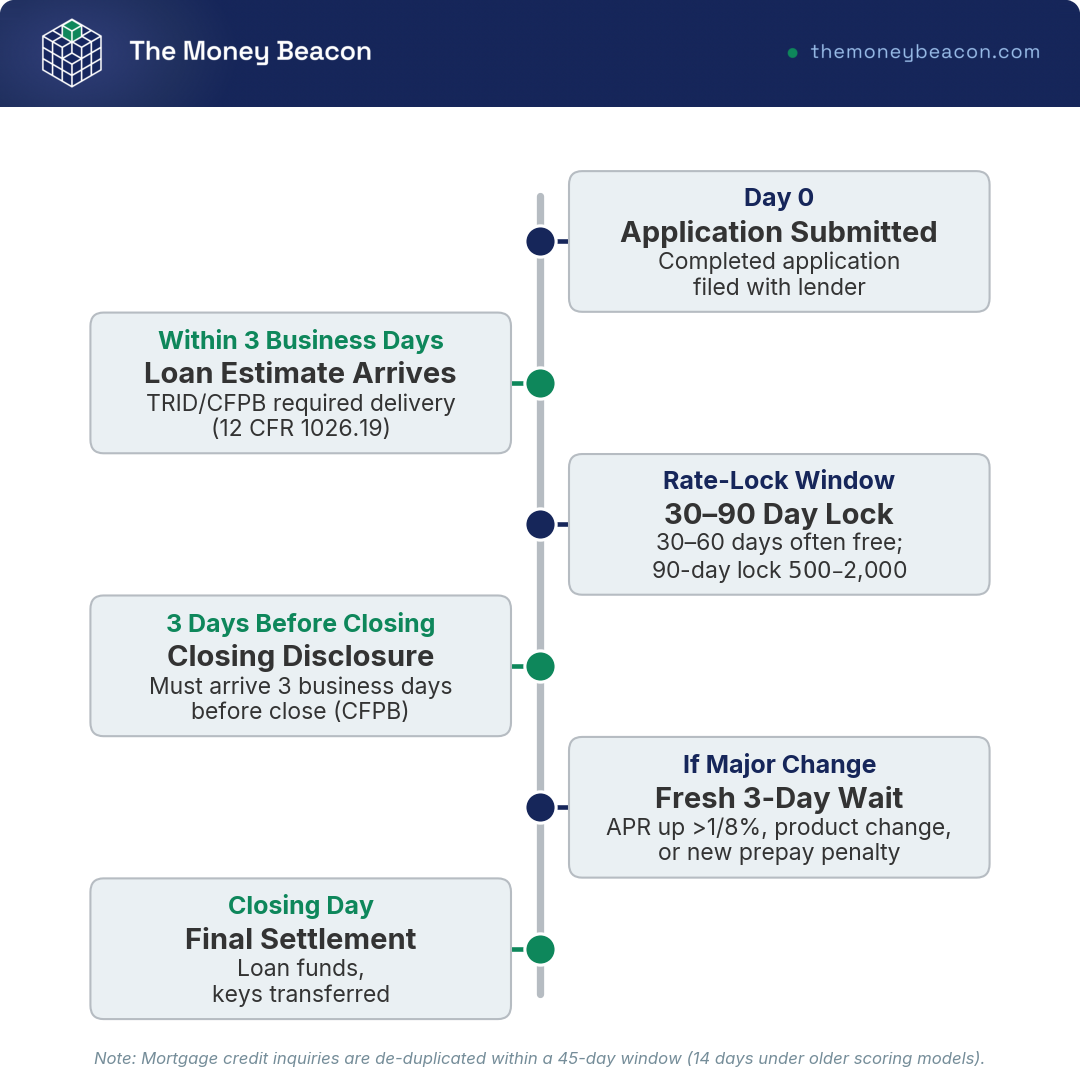
That mortgage rate lock is a right, not a favor.
1.7 Rate-lock lengths compared: how long to lock for your close date
The lock you pick should cover your closing date with a little extra time to spare, because a lock that expires before closing means an extension fee or a re-lock at whatever the market is doing that day. Here’s how the four common lengths compare.
Rate-lock length trade-offs
| Lock length | Typical cost impact | Best for |
|---|---|---|
| 30 days | Lowest / no add-on | Fast, cash or ready-to-close buyers |
| 45 days | Slight add-on | Standard purchase timeline |
| 60 days | Moderate add-on | Slower closings, new construction near-complete |
| 90 days | Higher add-on ($500-$2,000 typical) | New construction, complex files |
Data current as of July 2026.
The cheapest, shortest lock might not be the best choice if your closing might slip. So think about the price of the extension before setting it.
1.8 Which loan program to shop for: conventional, jumbo, FHA, VA, or USDA
Before any lender number means much, you need to know which lane you’re in, because program choice often matters more than lender choice. The decision tree below covers it: VA if you’re an eligible service member or veteran, USDA if you’re buying in a qualifying rural area with income under 115% of the area median, FHA if your score is under 620 or your file is thin, jumbo if your loan is above the $832,750 conforming limit, otherwise conventional.
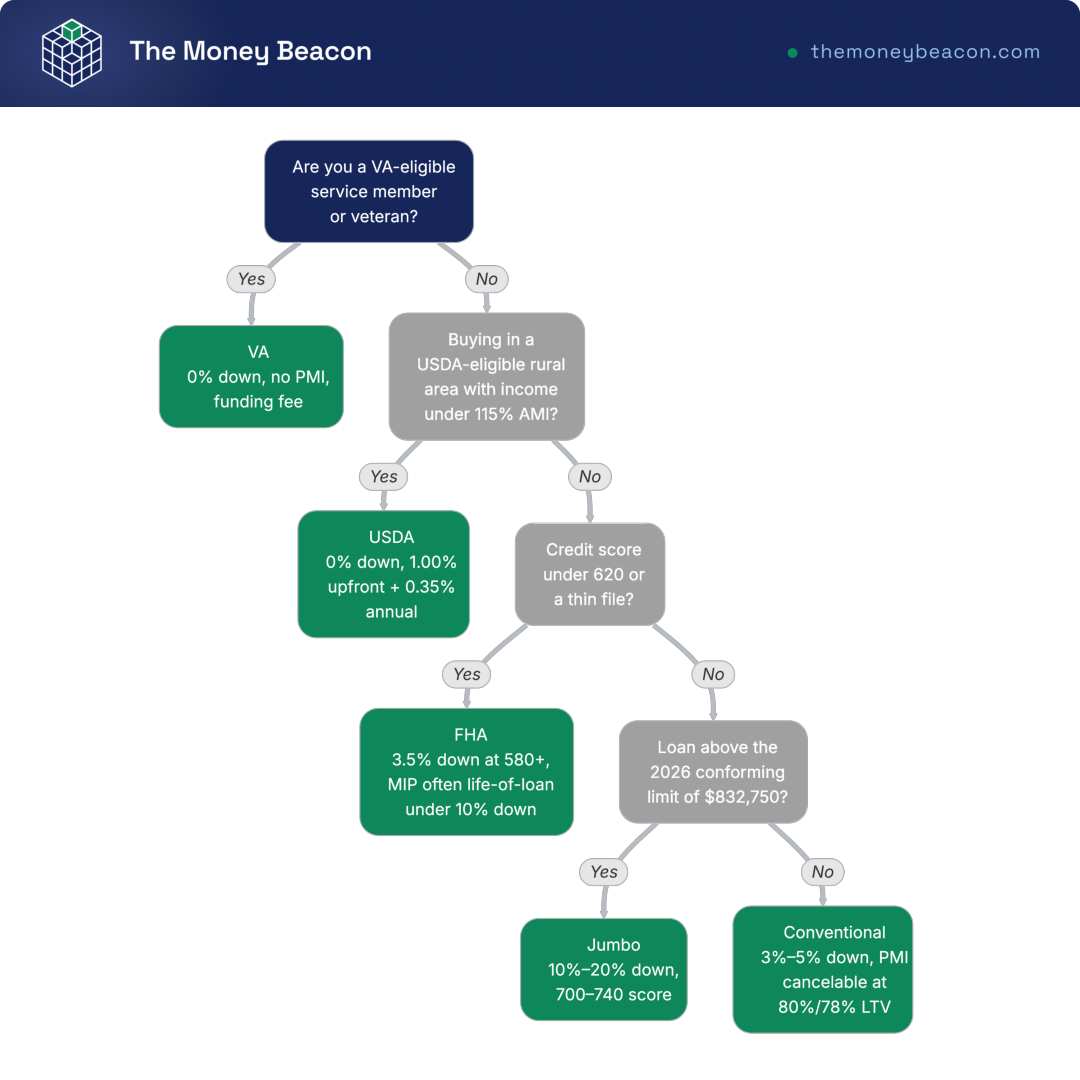
One important thing to keep in mind when choosing a loan is that conventional loans require private mortgage insurance (PMI), which ends when your loan-to-value ratio is between 80% and 78%. FHA mortgage insurance (MIP) usually lasts for the duration of the loan if you put less than 10% down.
1.9 What each program costs: minimum credit and mortgage insurance
Now the dollars behind each program.
Loan programs and who each one fits
| Program | Min. down payment | Min. credit (typical) | Mortgage insurance | Best-fit buyer |
|---|---|---|---|---|
| Conventional conforming (incl. HomeReady/Home Possible) | 3% | 620 | PMI, cancelable at 80%/78% LTV | Buyer with decent credit, wants to drop MI later |
| Jumbo / high-balance | 10%-20% | 700-740 | Lender-set (often none with 20% down) | High-cost county, loan above $832,750 |
| FHA | 3.5% (580+ score) | 580 (500 with 10% down) | Upfront MIP + annual MIP, often life-of-loan | Lower score or thin credit |
| VA | 0% | No VA minimum (lenders ~620) | None (VA funding fee instead) | Eligible service member/veteran |
| USDA (Guaranteed) | 0% | No USDA minimum (GUS ~640) | 1.00% upfront + 0.35% annual | Eligible rural area, income under 115% AMI |
Data current as of July 2026.
So don’t assume FHA is cheaper just because the score bar is lower; weigh cancelable PMI against life-of-loan MIP first.
1.10 How much cash you need up front: minimum down payment by program
The last piece is the cash you actually need to have on hand, translated into dollars on a $400,000 purchase.
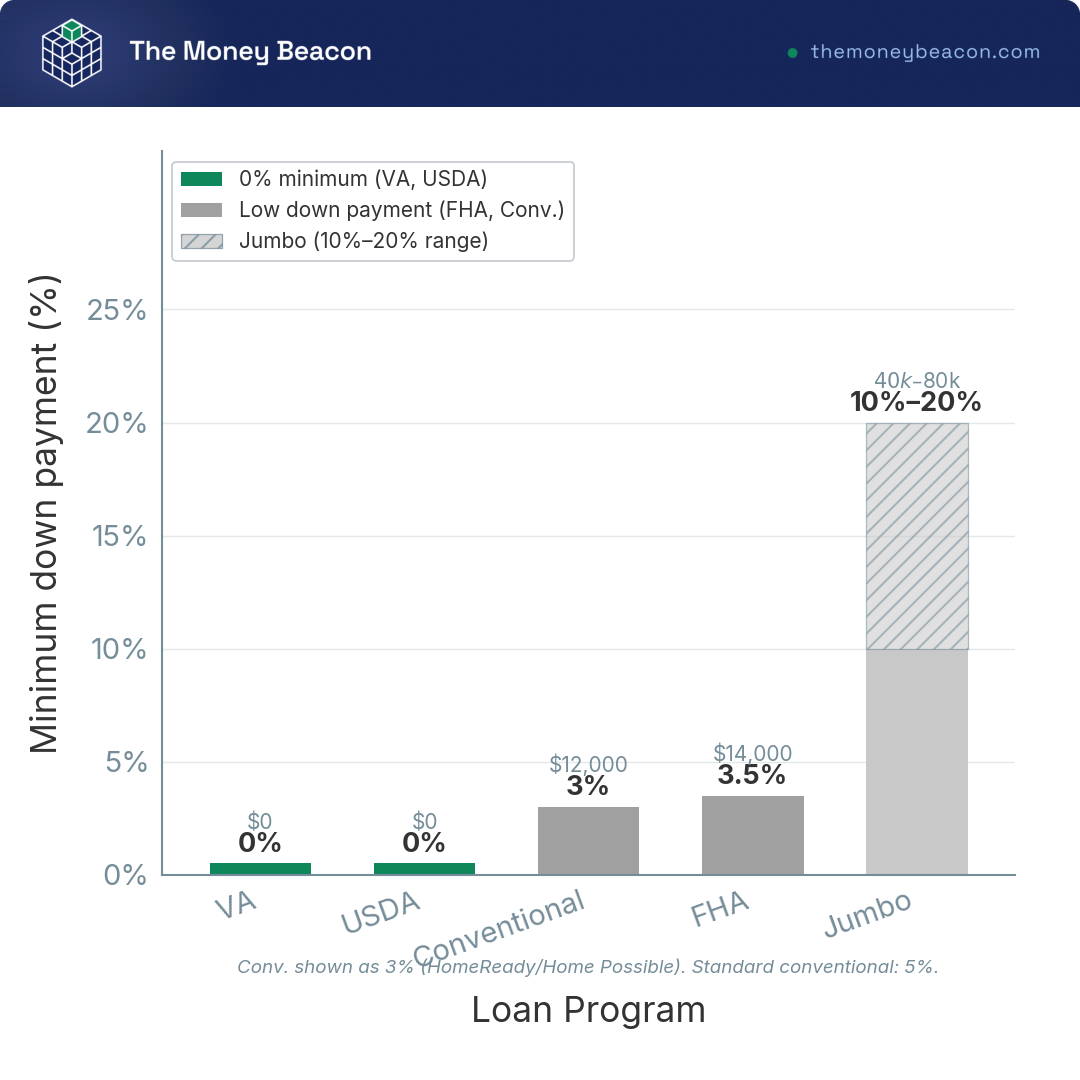
If you’re planning to save for a down payment, check out our list of the best no-fee high-yield savings accounts. With the scoring lens set and the panel in view, the reviews start with the lender most US buyers already know by name.
2. Rocket Mortgage: the digital default most buyers already know
2.1 Overview
Rocket Mortgage is the name most buyers go for first, and for a reason: it’s among the largest US retail originators and the default digital reference point for the whole category. The application is fully online with no branches, servicing is often kept in-house, and it operates under NMLS #3030. Their offer covers conventional, jumbo, FHA, and VA loans, though not USDA purchase. What sets it apart is the combination of digital speed and its ONE+ down-payment help.
2.2 Strengths
The core strength is a fast, genuinely well-built digital application that walks you from quote to close without a branch visit. The program offer is broad (conventional, jumbo, FHA, and VA), and the ONE+ program contributes 2% of the purchase price toward your down payment, up to a $7,000 grant cap. RateShield lets you lock in your rate while you shop for a home. Servicing is often kept in-house, so your point of contact doesn’t change after closing, and the credit minimums are forgiving at 620 for conventional and 580 for FHA.
2.3 Weaknesses
The problem is the price. Rocket’s 30-year rate is about 6.625%, with an APR of almost 6.91%. This means you pay for the polish. RateShield is a lock-and-shop feature, not a true float-down, so it won’t capture a rate drop after you lock. There’s no USDA purchase option and no branch to walk into. The origination fee, which is about 1% of the loan amount (or about $1,200), isn’t the lowest I’ve seen.
2.4 Pricing & fees
Rocket Mortgage pricing & fees
| Cost line | Rocket Mortgage |
|---|---|
| Sample rate / APR (30-yr fixed) | 6.625% / 6.91% |
| Origination posture | ~1% (~$1,200) |
| Discount points | Optional |
| Grants / credits | ONE+ down-payment help (2% of price, up to $7,000) |
| Rate lock / float-down | 30-90 day locks; RateShield lock-and-shop (no true float-down) |
| Min score / down (conv.) | 620 / 3% |
| Min score / down (FHA) | 580 / 3.5% |
Data current as of July 2026.
Read that fee posture against your horizon. The origination fee, which is about $1,200, and the higher APR matter most if you’ll hold the loan for years. If you might refinance soon, the fee matters more than the rate, and the ONE+ contribution can offset a chunk of your cash to close.
2.5 Who it’s for
Rocket is the ideal choice for a buyer who prizes a smooth, all-digital process and may lean on ONE+ down-payment help, and who isn’t trying to optimize to the last basis point. It’s not the right choice for an excellent-credit shopper hunting the lowest APR, a buyer who needs a USDA loan, or anyone who wants to sit across a desk from a loan officer in a branch.
3. Better: the low-fee digital lender with a price-match guarantee
3.1 Overview
Better takes the digital-first idea and applies it to fees. It’s a low-fee lender built around a fast online application, NMLS-licensed, with no branches and servicing that’s often transferred after closing. They offer conventional, jumbo, FHA, and VA (the digital VA loan launched in 2024). The calling card is a low lender fee paired with a $1,000 price-match guarantee.
3.2 Strengths
The main strength is cost. Better charges a flat lender fee of about $995, among the lowest in this comparison, and backs it with the Better Price Guarantee: if it can’t beat a competitor’s Loan Estimate by at least $1,000, it pays you $1,000. The application is fully online and quick, the program offer is broad (conventional, jumbo, FHA, and VA), and the Better Forever program waives the lender fee on a later purchase or refinance.
3.3 Weaknesses
The old “no lender fees” label is outdated; a flat fee of about $995 now applies to most loans. Better also doesn’t publish an APR with its headline rate, so a like-for-like APR check needs a personalized quote. There’s no true float-down, with the $1,000 price match standing in for one. And with no branches and servicing often transferred, the experience is mostly self-service.
3.4 Pricing & fees
Better pricing & fees
| Cost line | Better |
|---|---|
| Sample rate / APR (30-yr fixed) | 6.49% / Not disclosed |
| Origination posture | Flat ~$995 lender fee |
| Discount points | Optional |
| Grants / credits | $1,000 price-match guarantee |
| Rate lock / float-down | 30-90 day locks; no true float-down |
| Min score / down (conv.) | 620 / 3% |
| Min score / down (FHA) | 580 / 3.5% |
Data current as of July 2026.
The flat fee plus the price match is the whole pitch, and it sets a low all-in floor for a buyer willing to do the legwork. The catch is the not-disclosed APR: you’ll need a personalized quote to fold that $995 fee into an apples-to-apples number, so pull the Loan Estimate before you commit.
3.5 Who it’s for
Better is the best choice for a fee-sensitive, tech-comfortable buyer who will pull competing Loan Estimates and actually invoke the price match to drive the cost down. It’s not the right choice for a buyer who wants a branch, a guaranteed float-down to catch a falling rate, or a published APR to compare before applying.
4. Chase: the branch-plus-digital megabank with a homebuyer grant
4.1 Overview
Chase is the megabank option, the one where you can walk into a branch or run the whole thing from your couch online. It offers conventional, jumbo, FHA, and VA loans, keeps servicing in-house, and its deposits are insured by the Federal Deposit Insurance Corporation (FDIC). What sets it apart is the Chase Homebuyer Grant, paired with relationship pricing for existing customers and the DreaMaker low-down product.
4.2 Strengths
The best part is the Homebuyer Grant: you get $2,500 or $5,000 depending on the census tract, applied first to your rate, then your fees, then your down payment. The sample 30-year rate is competitive at 6.50% with an APR of 6.70%. You also get branch access plus relationship pricing if you hold deposits or investments at Chase, the DreaMaker product needs just 3% down, and there’s a genuine one-time lock-and-shop float-down. Credit minimums are forgiving too, at 620 for conventional and 580 for FHA.
4.3 Weaknesses
The origination posture is standard-bank, not the cheapest option. And the Homebuyer Grant is tied to eligible census tracts, so it may simply not exist at the address you want. USDA availability isn’t disclosed. The sharpest savings come from the grant, not the headline rate, so the case for Chase depends on whether your address qualifies.
4.4 Pricing & fees
Chase pricing & fees
| Cost line | Chase |
|---|---|
| Sample rate / APR (30-yr fixed) | 6.50% / 6.70% |
| Origination posture | Standard bank |
| Discount points | Optional |
| Grants / credits | Homebuyer Grant $2,500 / $5,000 (by census tract) |
| Rate lock / float-down | 30-90 day locks; one-time lock-and-shop float-down |
| Min score / down (conv.) | 620 / 3% |
| Min score / down (FHA) | 580 / 3.5% |
Data current as of July 2026.
A location-eligible grant can beat a marginally lower rate outright. $5,000 off your cash at closing is worth more than a few basis points shaved off an already-competitive rate. So check the grant against your exact address before you weigh the rate at all.
4.5 Who it’s for
Chase is ideal for a first-time buyer in a grant-eligible tract who wants a branch to visit and relationship pricing to lean on. It’s not the right choice for a buyer outside the grant footprint who is optimizing purely on the lowest APR and the leanest fees.
5. Bank of America: the no-PMI 3%-down bank with stackable grants
5.1 Overview
Bank of America is the other big branch-plus-digital bank in this comparison, with servicing kept in-house and FDIC-insured deposits. It offers conventional, jumbo, FHA, and VA loans. Its calling card is the Affordable Loan Solution, a no-PMI loan with as little as 3% down payment, backed by two grants that a grant-eligible first-time buyer can combine.
5.2 Strengths
The most important feature is the Stacked Assistance: a Down Payment Grant of up to $10,000, plus America’s Home Grant of up to $7,500 toward closing costs. This means that an eligible first-time buyer can receive up to $17,500 in help. The Affordable Loan Solution gives you a 3%-down payment loan with no PMI. The sample rate is competitive at 6.50% with an APR of 6.70%, branches are there when you want one, and minimums are forgiving at 620 conventional and 580 FHA.
5.3 Weaknesses
The grants are limited to eligible markets, so that assistance may not apply where you’re buying. Preferred Rewards no longer reduces your rate either; it now only reduces the origination fee by $200 to $600 depending on your tier. Origination is standard-bank. And a float-down exists only on builder loans, so a resale purchase doesn’t get one. USDA isn’t disclosed.
5.4 Pricing & fees
Bank of America pricing & fees
| Cost line | Bank of America |
|---|---|
| Sample rate / APR (30-yr fixed) | 6.50% / 6.70% |
| Origination posture | Standard bank (Preferred Rewards $200-$600 fee reduction) |
| Discount points | Optional |
| Grants / credits | Down Payment Grant up to $10,000 + America’s Home Grant up to $7,500 |
| Rate lock / float-down | 30-90 day locks; float-down builder loans only |
| Min score / down (conv.) | 620 / 3% |
| Min score / down (FHA) | 580 / 3.5% |
Data current as of July 2026.
Compare the total cost of the grants with that standard fee. If you qualify for both of these grants, you could get around $17,500 to help with your down payment and closing costs. This is more than the origination charge, and it means your monthly payment will be lower than what you would get with a conventional loan that has mortgage insurance. If neither of these apply to your situation, you can still get a standard bank loan at a good rate.
Tom’s take

I’ve shopped most of the big banks for mortgage debt on my real estate, and the lesson is simple: make them compete. A grant or a fee reduction is a real number, but you only find out how far a bank will go once it knows you have another Loan Estimate in hand.
5.5 Who it’s for
Bank of America is ideal for a grant-eligible first-time buyer who wants a branch and a no-PMI low-down loan. It’s not the right choice for a buyer outside eligible markets who is looking for the lowest APR, or one who wants a true float-down on a resale purchase.
6. Navy Federal: the VA-heavy credit union with 0% down payment and no PMI
6.1 Overview
Navy Federal is the largest US credit union, VA-heavy, with deposits insured by the National Credit Union Administration (NCUA) rather than the FDIC. Membership is limited to the military-affiliated community, so it isn’t open to everyone. For those who qualify, it offers VA, conventional, and jumbo loans, including proprietary no-down products. The standout feature is 0% down payment with no PMI for members, plus strong rate-flexibility.
6.2 Strengths
The sample numbers are low: the 30-year rate is 5.875%, and the APR is 6.015%. These among the more competitive current va home mortgage rates available. The proprietary Homebuyers Choice and Military Choice loans don’t require a down payment and no PMI. There’s a Rate Match Guarantee worth $1,000, and a 60-day no-cost Freedom Lock that allows two float-down opportunities of up to 0.25% each. Origination is low, and servicing is kept in-house.
6.3 Weaknesses
Membership is gated to the military-affiliated community, so most buyers simply can’t access any of this. Deposits are NCUA-insured rather than FDIC, which matters to your deposits, not to the loan itself. And the no-down proprietary loans carry a 1.75% funding fee unless you put 3% down. FHA and USDA aren’t disclosed, and branch access is limited.
6.4 Pricing & fees
Navy Federal pricing & fees
| Cost line | Navy Federal |
|---|---|
| Sample rate / APR (30-yr fixed) | 5.875% / 6.015% |
| Origination posture | Low |
| Discount points | Optional |
| Grants / credits | Rate Match Guarantee ($1,000) |
| No-down product / funding fee | Homebuyers Choice 0% down (1.75% funding fee unless 3% down) |
| Rate lock / float-down | 30-90 day locks; 60-day Freedom Lock with two 0.25% float-downs |
| Min score / down (conv. / FHA) | Not disclosed |
Data current as of July 2026.
Weigh that low APR against the membership gate. On a $400,000 loan, a rate near 5.875% instead of 6.50% is roughly $160 a month, real money over 30 years. The catch is the 1.75% funding fee on a 0%-down loan, about $7,000, which you can avoid by putting 3% down. So, make sure you include the funding fee in your overall calculation before deciding that 0% down is the better option.
6.5 Who it’s for
Navy Federal is ideal for a military-affiliated buyer, especially a VA-eligible one, who wants the lowest all-in cost, 0% down, and no PMI. It’s not the right choice for anyone outside the membership community, or a member who prefers a branch-heavy experience.
7. PennyMac: the transparent, low-fee direct lender with a real float-down
7.1 Overview
PennyMac is a top-tier national direct lender and one of the largest mortgage servicers in the country, run online with no branches and NMLS-licensed. Servicing is kept in-house, so the company that funds your loan is usually the one you pay for years afterward. The offer covers conventional, jumbo, FHA, and VA; USDA shows up only as a Streamlined Assist refinance, not a purchase option. What sets it apart is a pair of things buyers rarely get together: transparent published online rates and a documented float-down.
7.2 Strengths
The sample 30-year rate is about 6.499% with an APR of 6.642%, competitive pricing you can actually see before you apply. Origination is low, around $1,100 and waived periodically, and the online rate table shows the fee next to the rate instead of hiding it behind a quote form. The Lock & Shop feature is a genuine float-down: for a $595 fee, you can re-lock up to 0.50% lower if the market falls after you lock. Servicing stays put, and the credit minimums are forgiving at 620 for conventional and 580 for FHA.
7.3 Weaknesses
There are no branches, so if you want to sit across a desk from a loan officer, you’re out of luck. The USDA is only for refinancing, not for buying. There’s no first-time-buyer grant to lean on, and the float-down isn’t free; it carries that $595 fee whether or not rates end up moving. Brand recognition is weaker than for the megabanks, which matters only to the extent it makes you second-guess a lender you haven’t heard of on the evening news.
7.4 Pricing & fees
PennyMac pricing & fees
| Cost line | PennyMac |
|---|---|
| Sample rate / APR (30-yr fixed) | 6.499% / 6.642% |
| Origination posture | ~$1,100 (waived periodically) |
| Discount points | Optional |
| Float-down | Lock & Shop ($595, up to 0.50%) |
| Rate lock | 30-90 day locks |
| Min score / down (conv.) | 620 / 3% |
| Min score / down (FHA) | 580 / 3.5% |
Data current as of July 2026.
A low fee, along with a real float-down, is a strong combination for a no-branch buyer. The published rate lets you compare PennyMac with other investments without having to give up your contact information first. If you lock in a falling market, spending $595 could give you the chance to make money when the market drops. A documented float-down is rarer than the marketing suggests, so it’s worth its own line when you shop. Weigh the $595 against how likely rates are to move over your lock window before you pay for it.
7.5 Who it’s for
PennyMac is ideal for a buyer who values low fees, rates published up front, and a real float-down over a branch, including FHA and VA shoppers. It’s not the right choice for a USDA purchase buyer, someone who needs a first-time-buyer grant, or anyone who wants to walk into an office and talk to a person.
8. SoFi: the app-native lender for higher-income conventional and jumbo buyers
8.1 Overview
SoFi is the app-native option, best known to younger, higher-income W-2 buyers who may already keep their checking and investing there. SoFi Bank is FDIC-insured on deposits, there are no branches, and servicing is often transferred after closing. The loan offer is deliberately narrow: conventional and jumbo only. What sets it apart is the member ecosystem paired with a long-lock float-down called Lock and Look.
8.2 Strengths
The sample APR is about 6.232%, which is one of the lower numbers a strong-profile buyer will see. Members get an origination discount of $500 to $1,000 off the standard $1,495 fee, which is a significant amount of money to save on the total cost. Lock and Look holds your rate for 91 days pre-approval and adds a one-time float-down on top if pricing improves by 0.25% or more. That’s useful window for a buyer still house-hunting. There’s also an On-Time Close Guarantee worth up to $10,000 if a qualifying delay is SoFi’s fault, and the app experience is smooth for someone already inside the ecosystem.
8.3 Weaknesses
The narrow offer is the real limit: conventional and jumbo only, with no FHA, VA, or USDA, so a lower-score or low-down buyer is simply excluded. The best perks go to existing members, so the pricing is friendliest to people already banking there. There are no branches, servicing often moves after closing, and the underwriting is oriented to clean W-2 income, which makes it a weaker fit for a complex self-employed file.
8.4 Pricing & fees
SoFi pricing & fees
| Cost line | SoFi |
|---|---|
| Sample APR (30-yr fixed) | 6.232% |
| Origination posture | $1,495 less $500-$1,000 member discount |
| Discount points | Optional |
| Float-down | Lock and Look (0.25%+, 91-day lock) |
| Close guarantee | On-Time Close Guarantee up to $10,000 |
| Min score / down (conv.) | ~620 / 3%-5% |
| FHA / VA | Not offered |
Data current as of July 2026.
For a member, the discount and long lock are the main benefits. Take the $1,495 fee down by the full $1,000 discount and you’re at $495 in origination, low for a lender with an APR this competitive, and the 91-day Lock and Look gives you room to shop for a house without worrying about the rate the whole time. The math tips further in your favor the more of the SoFi ecosystem you already use, since that’s what unlocks the deeper discount.
8.5 Who it’s for
SoFi is ideal for a younger, higher-income W-2 buyer, often already a SoFi member, shopping a conventional or jumbo loan and wanting a long-lock float-down. It’s not the right choice for an FHA, VA, or USDA buyer, a lower-score borrower, or someone with a complex self-employed file.
9. The verdict: full lender comparison and the best pick for your profile
9.1 The full comparison table: every lender on every criterion
You’ve now seen all seven lenders one at a time. Here they are side by side, every one ranked on every criterion, with “Not disclosed” wherever a lender doesn’t publish a figure. This is the source of truth for the whole comparison; every cross-lender claim below traces back to this table.
Full cross-lender comparison recap
| Lender | Sample rate / APR | Origination posture | Float-down / rate-match | Grants / credits | Min score / down (conv. / FHA) |
|---|---|---|---|---|---|
| Rocket Mortgage | 6.625% / 6.91% | ~1% (~$1,200) | No float-down (RateShield lock-and-shop) | ONE+ (up to $7,000) | 620 / 3% ; 580 / 3.5% |
| Better | 6.49% / Not disclosed | Flat ~$995 | $1,000 price-match guarantee | $1,000 price-match | 620 / 3% ; 580 / 3.5% |
| Chase | 6.50% / 6.70% | Standard bank | One-time lock-and-shop float-down | Homebuyer Grant $2,500 / $5,000 | 620 / 3% ; 580 / 3.5% |
| Bank of America | 6.50% / 6.70% | Standard bank ($200-$600 rewards fee cut) | Float-down builder loans only | Down Payment up to $10,000 + America’s Home Grant up to $7,500 | 620 / 3% ; 580 / 3.5% |
| Navy Federal | 5.875% / 6.015% | Low | Rate Match ($1,000) + two 0.25% float-downs | Rate Match ($1,000) | Not disclosed |
| PennyMac | 6.499% / 6.642% | ~$1,100 (waived periodically) | Lock & Shop float-down ($595, up to 0.50%) | Fee waived periodically | 620 / 3% ; 580 / 3.5% |
| SoFi | Not disclosed / 6.232% | $1,495 less $500-$1,000 member discount | Lock and Look float-down (0.25%+) | Member origination discount | ~620 / 3%-5% ; no FHA |
Data current as of July 2026.
If you look at the table as a whole and compare the different mortgage deals, it becomes clear that no single lender is best in every area.
9.2 Lowest all-in cost: APR against fees, side by side
The cleanest way to see who’s actually cheap is to plot APR against lender fees. Bottom-left is where you want to be: low APR and low fees together.
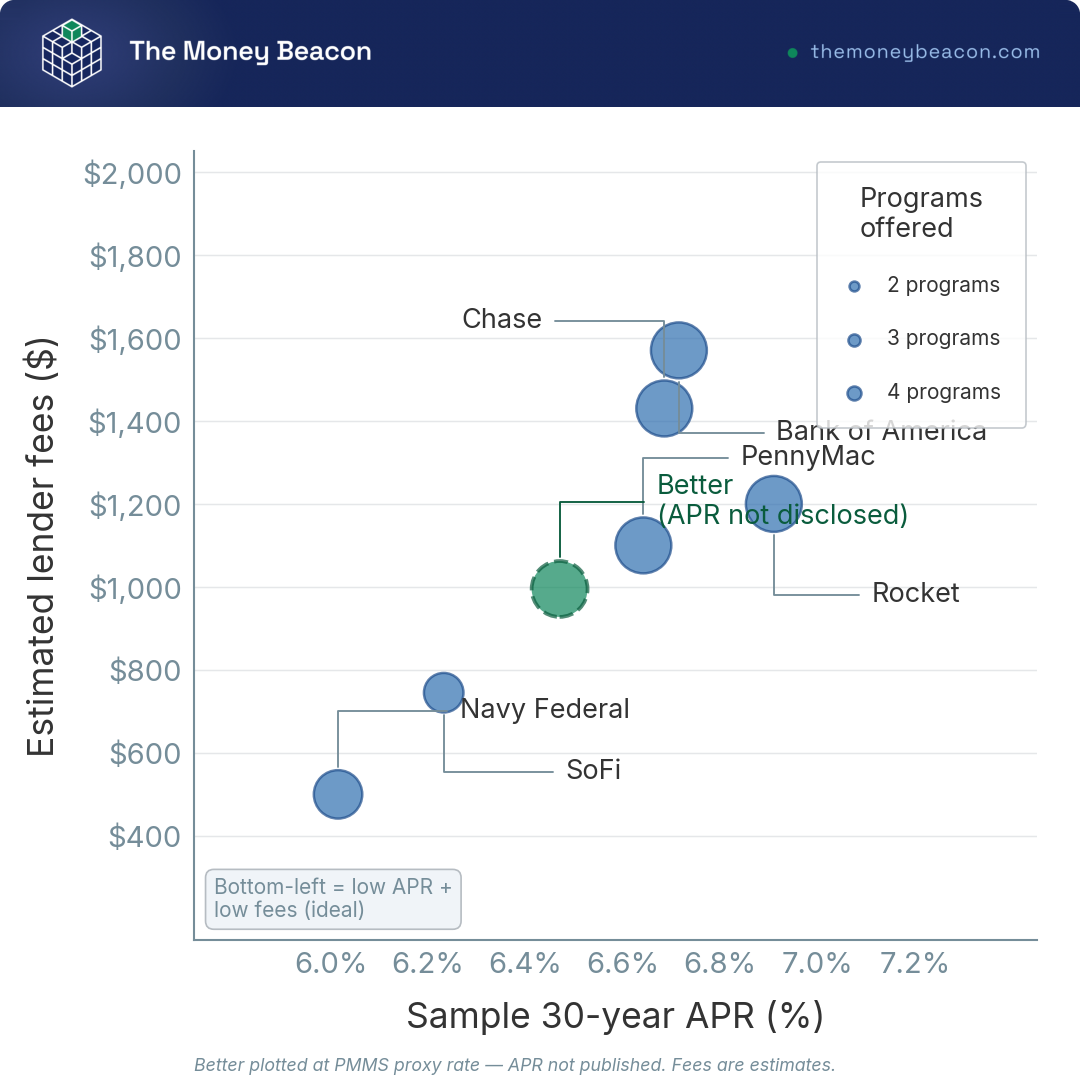
Navy Federal and SoFi have the lowest APRs (6.015% and 6.232%), while Better and PennyMac have the lowest fees (about $995 and $1,100). Rocket’s APR is close to 6.91%, so its polished offer costs you a significant amount. The lesson from section 1 is still true: the rank should be based on APR plus the Section A fee dollars, not the teaser rate.
9.3 Cash at closing: origination fees compared
Origination is the slice of your closing costs you can actually control, so it deserves its own ranking.
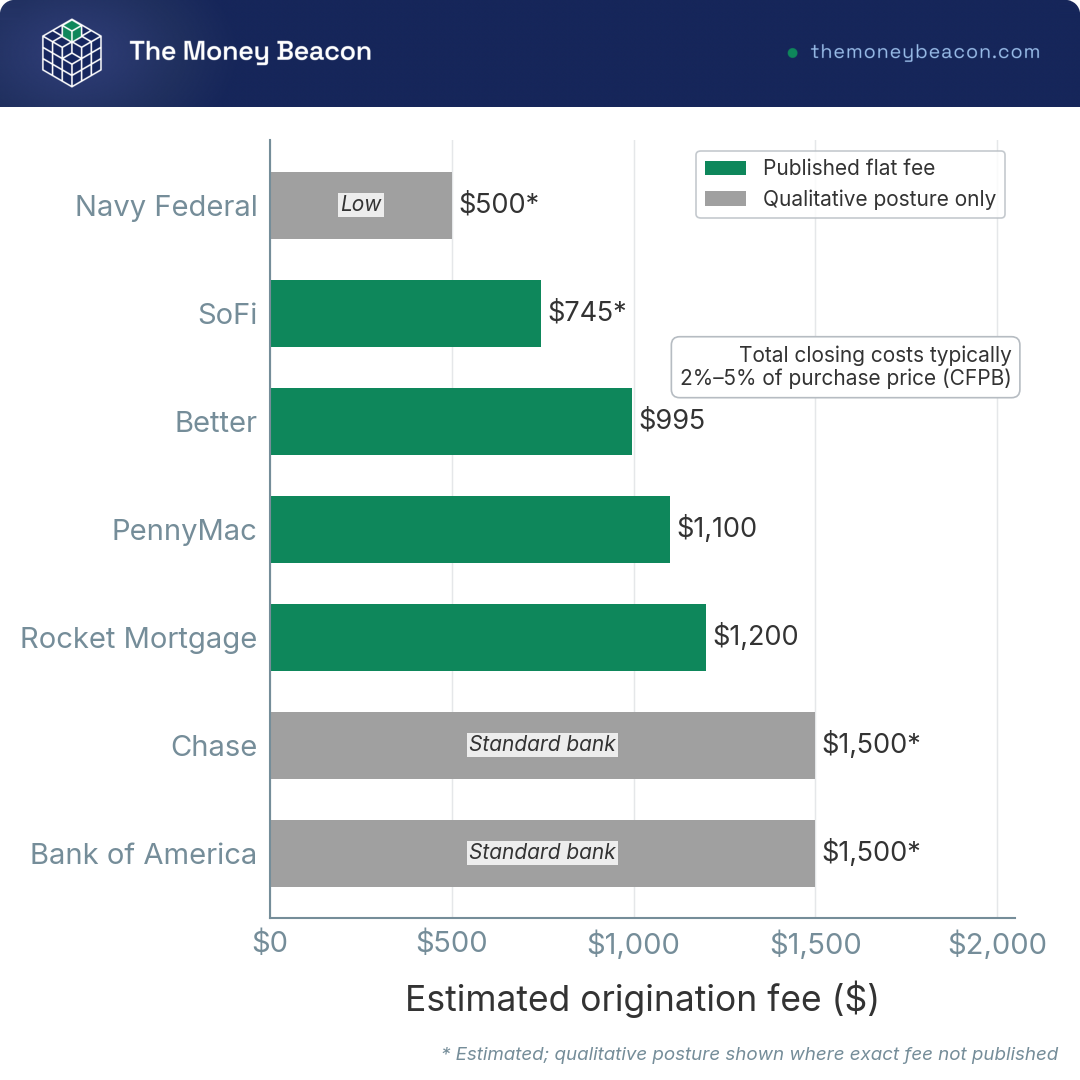
Better’s flat fee is around $995, PennyMac’s is about $1,100, and Rocket’s is about $1,200. The effective fee that SoFi charges depends on the member discount. It drops to $495 when the full $1,000 is taken off. Remember that the total closing costs are usually between 2% and 5% of the purchase price, according to the Consumer Financial Protection Bureau (CFPB).
9.4 Program coverage: who offers conventional, jumbo, FHA, VA, and USDA
Before any rate matters, the lender has to offer your program at all.
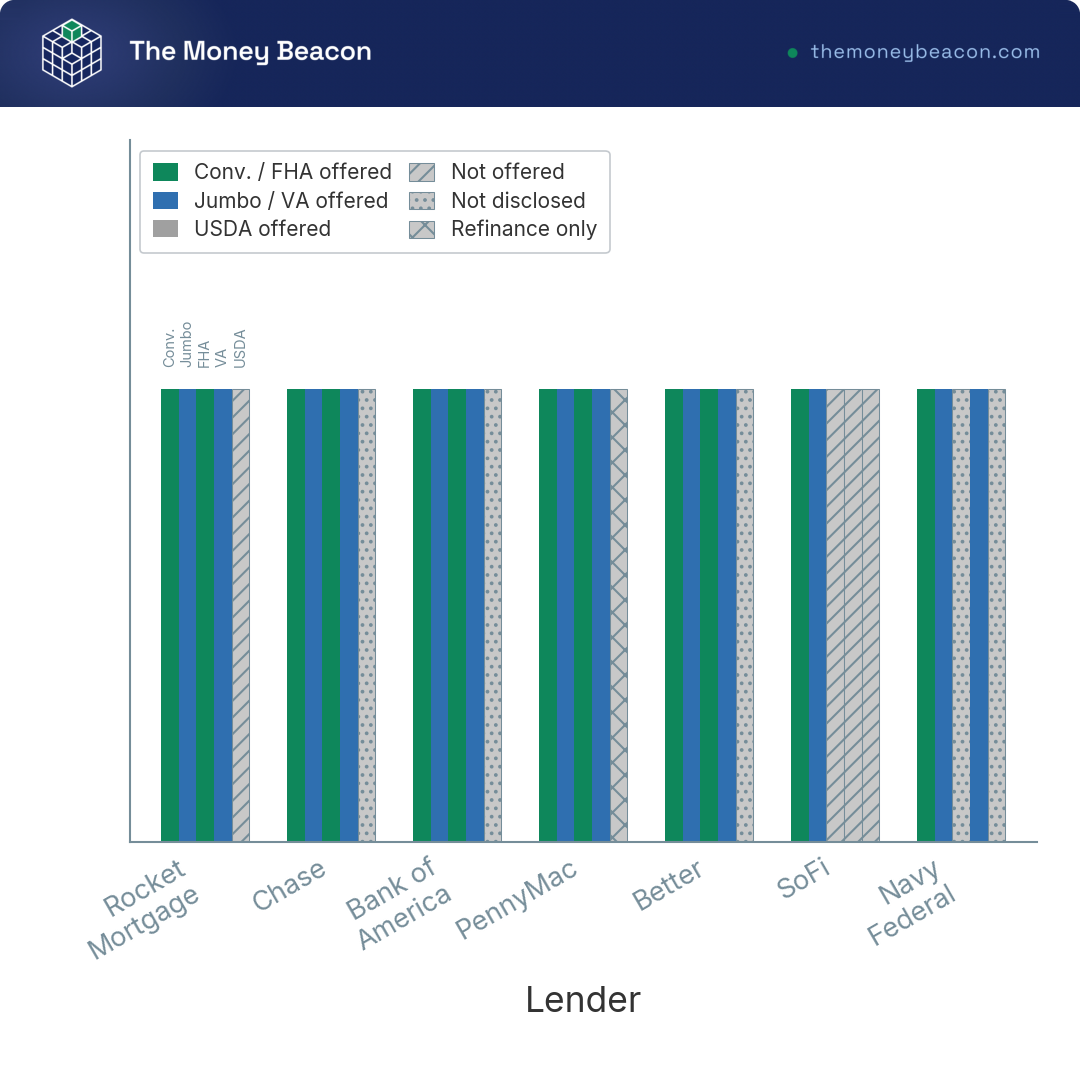
All seven offer conventional and jumbo. The differences become apparent for the government offers: SoFi has no FHA, VA, or USDA at all; Navy Federal’s FHA and USDA availability isn’t disclosed; and USDA purchase is scarce across the board, with PennyMac offering it on refinance only and Rocket and SoFi not at all. If you need a specific government loan, coverage narrows the field before price ever enters the conversation.
9.5 Rate flexibility: which lenders let you capture a rate drop
A true float-down lets you capture a drop after you lock, and it’s rarer than the ads imply. Here’s who actually offers one.
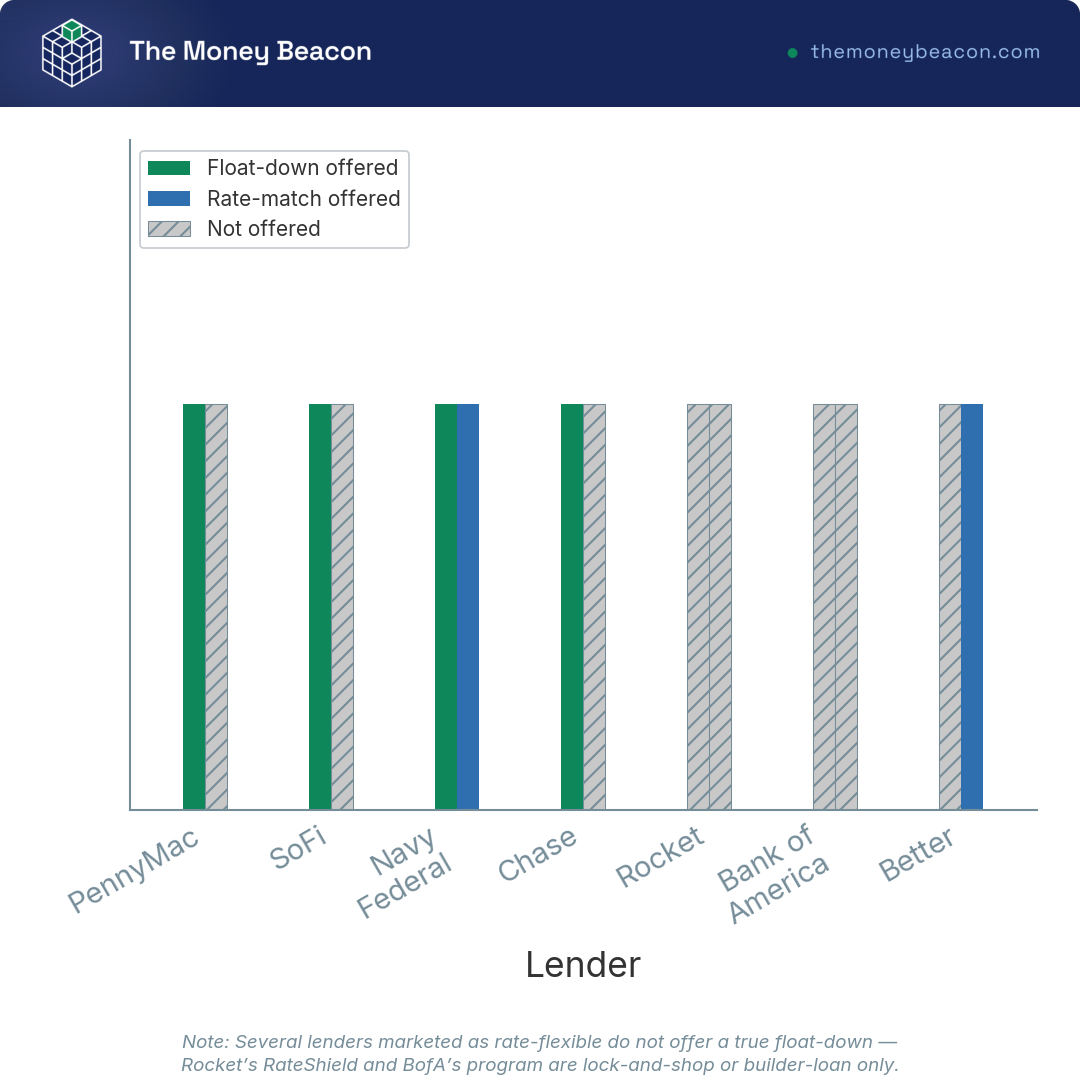
PennyMac, SoFi, Navy Federal, and Chase offer a genuine float-down. Rocket’s RateShield is a lock-and-shop, not a float-down, and Better substitutes a $1,000 price-match guarantee rather than a mechanism to re-lock lower. So confirm the exact feature before you rely on it; “lock-and-shop” and “float-down” get marketed as if they’re the same thing, and they aren’t.
Hank’s take
when you follow Fed policy closely, you learn a float-down isn’t a gimmick in a cycle where cuts are on the table; it’s the option that pays off precisely when the market moves your way, and most buyers underprice how much that optionality is worth.
9.6 Verdict: excellent-credit rate shopper (760+, 20% down)
With a 760 score and 20% down, you don’t need grants or forgiving minimums; you need the lowest all-in cost. The best choice is the low-fee digital route: Better for the flat fee plus its price-match guarantee, or PennyMac for a low fee paired with a real float-down. If you’re military-affiliated, Navy Federal’s sub-6.1% APR is hard to beat. Go conventional conforming, and lean on PMI that cancels at 80% to 78% loan-to-value rather than paying for a program you don’t need. And if you already own and are looking for a lower rate instead of buying, consult the refinance lenders for a lower rate.
9.7 Verdict: first-time buyer who needs help with cash to close
If you are short on cash, chase the grant, not the last basis point. The chart shows where the assistance dollars are.
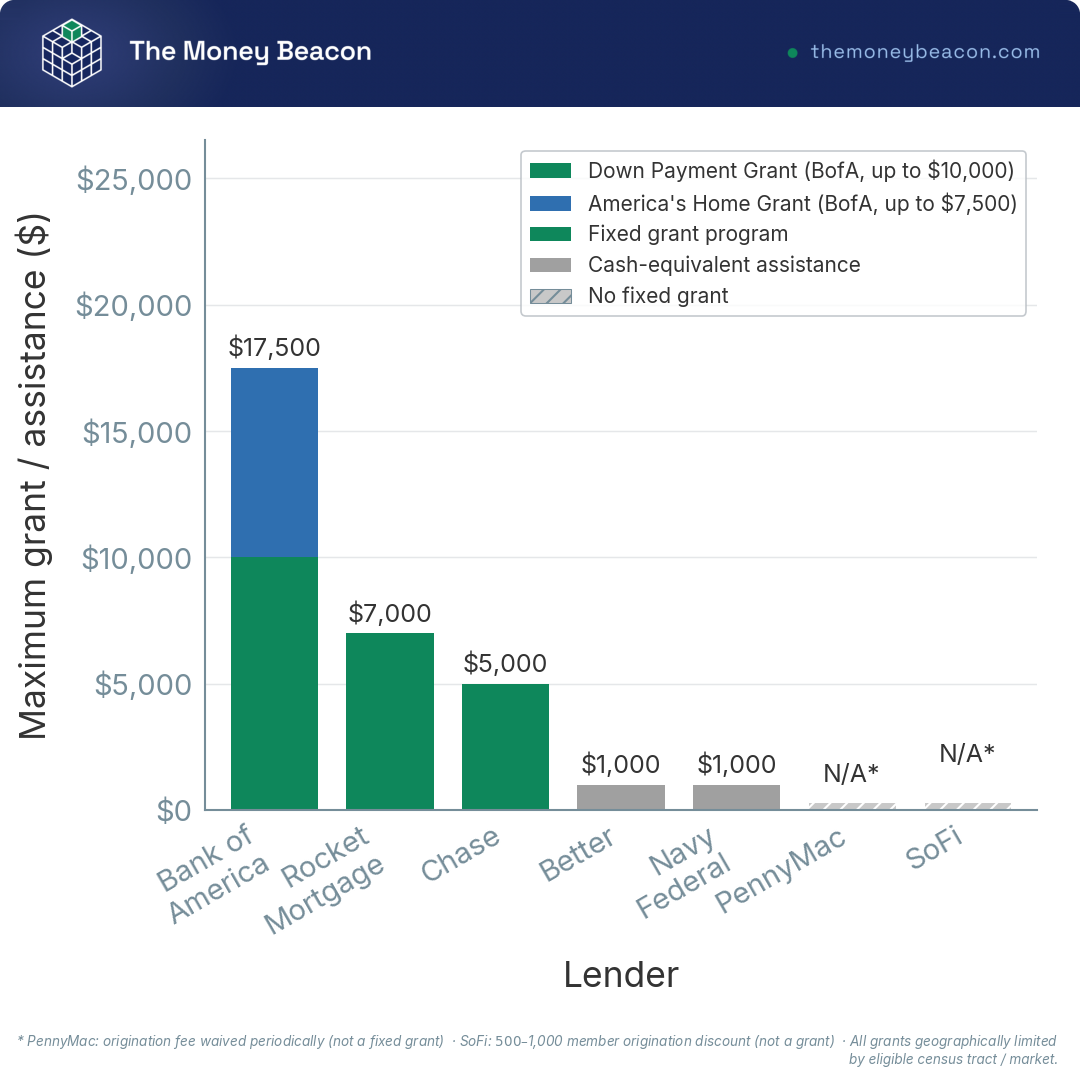
The best choice is Bank of America where you qualify, since its stackable grants reach roughly $17,500 alongside a no-PMI 3%-down loan, or Chase with its $2,500 or $5,000 grant. If your address falls outside both grant footprints, Rocket’s ONE+ down-payment help or Better’s low flat fee is the fallback. Every grant here is location-gated, so confirm each one against same-day Loan Estimates before you count on it. For the full walk through from pre-approval to closing costs, I cover the whole sequence in a separate article.
9.8 Verdict: low-down-payment / FHA buyer (score 580-660)
With a score between 580 and 660, FHA is probably the best option for you. In this case, it’s best to work with an FHA-approved lender. Rocket, PennyMac, or Chase, each at a 580 score with 3.5% down. Forgiving minimums matter more here than the sharpest headline rate, since a slightly lower rate does you no good at a lender that won’t approve your file. Before you assume FHA is the cheaper path, run the comparison from section 1: FHA MIP often runs for the life of the loan below 10% down, while conventional PMI cancels at 80% to 78% loan-to-value. If your score clears 620, price conventional with cancelable PMI against FHA before you commit.
9.9 Verdict: VA-eligible service member or veteran
If you’re VA-eligible, the best choice is Navy Federal, assuming you qualify for membership: it offers the lowest APR in this comparison, 0% down, and no PMI. A strong VA specialist is the alternative if membership isn’t open to you. One number changes the all-in math: the VA funding fee replaces mortgage insurance, and it’s exempt for veterans receiving VA compensation for a service-connected disability. That exemption can make a VA loan meaningfully cheaper than a conventional 0%-down alternative like Navy Federal’s own Homebuyers Choice, which carries a 1.75% funding fee unless you put 3% down. Weigh the funding fee, or your exemption from it, before you decide.
9.10 Verdict: jumbo / high-balance buyer above $832,750
If your loan tops the 2026 conforming limit of $832,750, you’re in jumbo territory, and the best choice is a lender that competes hard there: Chase or Bank of America with their relationship pricing, or SoFi for an app-native jumbo. Expect to bring 10% to 20% down and a 700 to 740 score, and to document reserves. One financing note for high-balance buyers: if you’re weighing whether to pull equity later rather than borrow more up front, a line of credit against your home is a different tool with its own trade-offs. The decision map below closes the loop on the whole comparison.
Summary decision map
| Decision lever | What to compare | Rule of thumb | Where it lives |
|---|---|---|---|
| True cost | APR plus Section A fee dollars | Rank on all-in cost, never the teaser rate | Recap table, section 9.1 |
| Discount points | Breakeven months vs your horizon | Skip points if you’ll leave before breakeven (~61 months) | Section 1.5 |
| Rate lock | Lock length vs your close date | Cover the close date with room; price the extension | Section 1.6 |
| Loan program | Conventional / jumbo / FHA / VA / USDA fit | Program choice often beats lender choice | Sections 1.8-1.9 |
| Profile pick | Your credit, down payment, and needs | Match the lender to your profile, not the ad | Verdicts, sections 9.6-9.10 |
Data current as of July 2026.
Line up those five levers and the central question answers itself: the lowest all-in mortgage cost comes from ranking real APR plus fees, matching the program to your profile, and picking the lender that wins your column, not the one with the loudest ad.
Conclusion
So here’s what all seven of these lenders have in common: not one of them leads with its best number. The billboard rate is the bait, and the real cost hides in the fees a tenth of a point can slip behind. On a $400,000 loan, that difference isn’t rounding error; it’s thousands of dollars you either keep or hand over.
Which is why the whole thing comes down to this. Pull a Loan Estimate from at least three lenders on the same day, and compare them on the APR and the total lender fees, never the teaser rate. Same day matters because rates move; the APR matters because it already includes the fees. Put the estimates side by side and the cheapest all-in loan is the one you sign.
There’s no single winner here, and anyone who tells you otherwise is selling something. The best lender is the one that fits your profile. A 760-credit shopper optimizing purely on price will land somewhere different from a first-time buyer who needs a grant to cover the cash-to-close gap, and a VA-eligible member has options nobody else can touch. Read your own situation first, then read the quotes. The lender that wins for your neighbor may be the wrong one for you.
Do that, and you turn a market designed to confuse you into a straightforward shopping trip. Now go make them compete.
If you’re buying your first home, our first-time homebuyer guide walks through down payments, pre-approval, and the closing costs that catch people off guard. When rates drop and you want to lower yours, our comparison of the best refinance lenders does the same fee-first math and the break-even math that decides whether it’s worth it. And once you’re in and sitting on equity, our guide to how a home equity line of credit (HELOC) works covers tapping that equity without wrecking your budget.
FAQ: Mortgage rates, APR, and shopping lenders in 2026
What is a good mortgage rate in 2026?
A good rate is one at or below the national benchmark for a borrower like you. As a dated sample, Freddie Mac’s PMMS put the 30-year fixed at 6.47% and the 15-year fixed at 5.81% as of June 18, 2026, and the following week’s release ticked up to 6.49% and 5.84%. If you bring a strong file, say a 760-plus score and 20% or more down, you can usually beat that average a little; a lower score or a smaller down payment pushes you above it. So I never judge a quote against a lender’s ad. I judge it against the current PMMS number and several same-day Loan Estimates.
What is the difference between the interest rate and the APR on a mortgage?
The interest rate is what sets your monthly principal-and-interest payment, and that’s all it does. The APR is the broader figure the Truth in Lending Act requires, and it folds most lender fees and any discount points into one annualized cost, which is why it’s almost always higher than the rate. I use the APR for a real apples-to-apples comparison between lenders. But APR assumes you keep the loan to term, and most people don’t, so I also add up the raw dollar total of lender fees on page 2 of each Loan Estimate.
How do I compare mortgage lenders the right way?
I get pre-approved first, then request a Loan Estimate from three to five lenders on the same day, since the market moves daily and same-day pulls are the only ones that line up. On each estimate I read page 2 for the origination charges and points, and page 3 for the APR, then I rank the offers on APR plus the total Section A lender fees rather than the advertised note rate. The federally standardized Loan Estimate is what makes lenders comparable line by line. I also cluster every application inside a two-week window, so the credit-scoring models count the separate inquiries as one. If you’re refinancing later, the same discipline carries straight over to shopping refinance lenders.
How does a mortgage rate lock and a float-down work?
A rate lock freezes your rate and points for a set period, commonly 30, 45, 60, or 90 days, and it protects you if the market climbs before you close. Standard locks are often free, though a longer 90-day lock can run $500 to $2,000. A float-down is the other side of that coin: it lets you re-lock lower if rates fall after you’ve locked, usually just once, and usually for a fee or a minimum drop of around 0.25% to 0.5%. Not every lender that sounds flexible actually offers a true float-down; Rocket and Better don’t, so confirm it exists in writing before you lean on it. And if closing slips past your lock, budget for an extension fee, often 0.125% to 0.5% of the loan per week.
Are discount points worth paying to lower my rate?
Sometimes, and the math tells you when. One point costs 1% of the loan and typically buys a rate cut of roughly 0.25%, so the whole question is how long it takes that lower payment to earn back the upfront cash. On a $400,000 loan, one $4,000 point that saves about $66 a month breaks even near month 61, roughly five years. So if you’ll keep the loan longer than the breakeven, the point pays off; if you expect to sell or refinance before then, skip the points and keep the cash. That same cash often earns you more in a high-yield savings account until you actually need it.



Comments
Questions and corrections welcome. We read everything.