


If your emergency fund is parked at a big branch bank, it’s earning close to nothing, and you already know it. The national average savings rate was 0.38% in August 2026, and on $25,000 that’s $95 a year. Put that same $25,000 at a 3.00% annual percentage yield (APY) and it earns $750. That’s a $655 difference, for one online application.
So why hasn’t the money moved yet?
Usually for three reasons, and none of them are silly. You can’t price what a no-fee account still costs you the day you need a wire (a same-day bank-to-bank transfer, the kind a title company demands at closing). You don’t know how cash gets into a bank with no branches. And you’re not sure locking money into a certificate of deposit (CD) buys anything.
Ally Bank is where those three questions stop being hypothetical, and one of them changed this month. On August 15, 2026, Ally narrowed its ATM fee reimbursement to fees charged by US operators inside the US and its territories. The domestic ceiling stays $10 a statement cycle, the monthly window your statement covers. A branchless bank sets the access rules, and you live with them.
So I went looking for what this account actually costs to keep. Ally’s complete published fee chart is five line items, and outgoing international wires aren’t on it because Ally doesn’t offer them at all. Whether that’s a fair trade at 3.00% is what this review works out. Then it rules.
1. What Ally Bank actually is, and what it puts on the table
There’s a question the rate never answers: who’s actually holding your money, and who’s watching them do it?
1.1 A Utah charter, one domestic office, and 3.5 million savers
Ally Bank is both the brand and the insured legal entity, which isn’t the norm. Marcus files as Goldman Sachs Bank USA and Capital One 360 as Capital One, N.A., so a brand-name search at the regulator turns up neither. Search Ally Bank and you get a Utah state-chartered commercial nonmember bank, certificate 57803, active, with $185.664 billion in assets and one domestic office as of March 31, 2026.
The Federal Deposit Insurance Corporation (FDIC) is its primary federal regulator, and the agency that covers your deposits up to $250,000 per depositor if the bank fails. The Utah Department of Financial Institutions charters and examines it, and the Consumer Financial Protection Bureau (CFPB) handles consumer protection. One domestic office is what “no branches” means in practice: the Utah address is operations, not a walk-in counter.
The scale is at the parent. Ally Financial Inc. is listed on the New York Stock Exchange and reported $143.5 billion of retail deposits and about 3.5 million retail deposit customers at December 31, 2025. Against $185.664 billion of bank assets, that’s a bank funded by ordinary savers rather than by wholesale markets. It was GMAC Bank until the 2009 rebrand, and the group still writes the car loans our comparison of US auto loan rates covers.
One enforcement item belongs on the record. In December 2013 the CFPB and the Justice Department ordered Ally Financial Inc. and Ally Bank to pay $80 million in damages plus an $18 million penalty over discriminatory indirect auto-loan pricing. That was the auto finance arm, not the deposit bank. Nothing more recent turned up, which is an unknown rather than a clean record.
1.2 The deposit lineup, product by product
Six consumer deposit products, worth seeing together before any one gets picked apart.
| Product | Rate (as of) | Minimum | Card | Checks | Transaction limit |
|---|---|---|---|---|---|
| Savings Account | 3.00% APY (08/25/2026) | $0 | No | No | 10 per statement cycle |
| Money Market Account | 3.00% APY (08/25/2026) | None to earn APY | Yes | Yes | 10 per statement cycle |
| Spending Account (checking) | 0.10% / 0.25% APY (08/24/2026) | None | Yes | Yes | Unlimited |
| High Yield CD | 2.70% to 4.00% by term (08/25/2026) | None | n/a | n/a | No partial withdrawals |
| No Penalty CD (11 month) | 2.70% APY (08/25/2026) | None | n/a | n/a | Full balance only, after day 6 |
| Raise Your Rate CD (2 yr, 4 yr) | 3.00% APY (08/25/2026) | None | n/a | n/a | No partial withdrawals |
Data current as of August 2026.
That’s the widest lineup of the four banks I use for scale in this review. Marcus sells savings and CDs only, Synchrony adds a money market account but no checking, and Capital One 360 matches Ally product for product.
One row deserves reading twice. Checking pays 0.10% below $15,000 and 0.25% at $15,000 or more as of August 24, 2026, so leaving $15,000 in Ally checking for convenience costs about $412 a year against what savings pays. For spending access without that penalty, the money market account keeps the full 3.00% and adds a debit card and checks, the setup our comparison of money market accounts with check-writing covers.
1.3 The 3.00% headline, and the strings printed beside it
Now for the number the rest of this review argues about. Ally publishes 3.00% APY on all balance tiers as of August 25, 2026, with $0 to open, no minimum stated to earn it and no monthly maintenance fee.
The tiering is the most misread line in the disclosure. Ally publishes three tiers, under $5,000, then $5,000 to $24,999.99, then $25,000 or more, and all three earn the current APY. Today $500 and $250,000 both earn 3.00%, so reading that table as a minimum reads it backwards.
The counterweight isn’t on the rate page but in the deposit agreement. Ally may change the rate on any savings, checking or money market account at any time, at its sole discretion, without notice or limit. Interest compounds daily and is credited each statement cycle.
Then there’s the limit few people read until it costs them. Savings and money market accounts allow a combined 10 withdrawals and transfers per statement cycle, and the fee for going over is $0. The penalty isn’t a charge. Ally reserves the right to restrict withdrawals or close the account if you go over on more than an occasional basis, and overdraft transfers pulled out of savings count against the same allowance.
So the rate is unconditional and revocable. Whether 3.00% is a good number depends entirely on what you put it next to.
2. Does the 3.00% savings rate actually beat what you already have?
Convert that 3.00% twice: against the money you already have somewhere, and against the banks competing for it.
2.1 Against a branch bank, the gap pays for the move in a month
The easy comparison first. The FDIC publishes a national rate for savings across insured banks, and on August 17, 2026 it was 0.38%. Ally’s 3.00% is 7.9 times that.
| Balance | Ally at 3.00% | National average 0.38% | Annual gap |
|---|---|---|---|
| $5,000 | $150.00 | $19.00 | $131.00 |
| $10,000 | $300.00 | $38.00 | $262.00 |
| $25,000 | $750.00 | $95.00 | $655.00 |
| $100,000 | $3,000.00 | $380.00 | $2,620.00 |
Data current as of August 2026.
Above roughly $4,000 of idle cash, the first month alone covers the hour of paperwork the switch costs you.
Two qualifiers come with those rows. They’re a simple annualized illustration at today’s rates, before tax. Deposit interest is also ordinary income, reported on Form 1099-INT at $10 or more, so at a 24% federal bracket you keep about $570 of that $750, a distinction our guide to how investment income gets taxed works through properly.
2.2 Against the online rivals, Ally is joint last of four
The harder comparison is against the banks that want the same deposit, and here Ally doesn’t win.
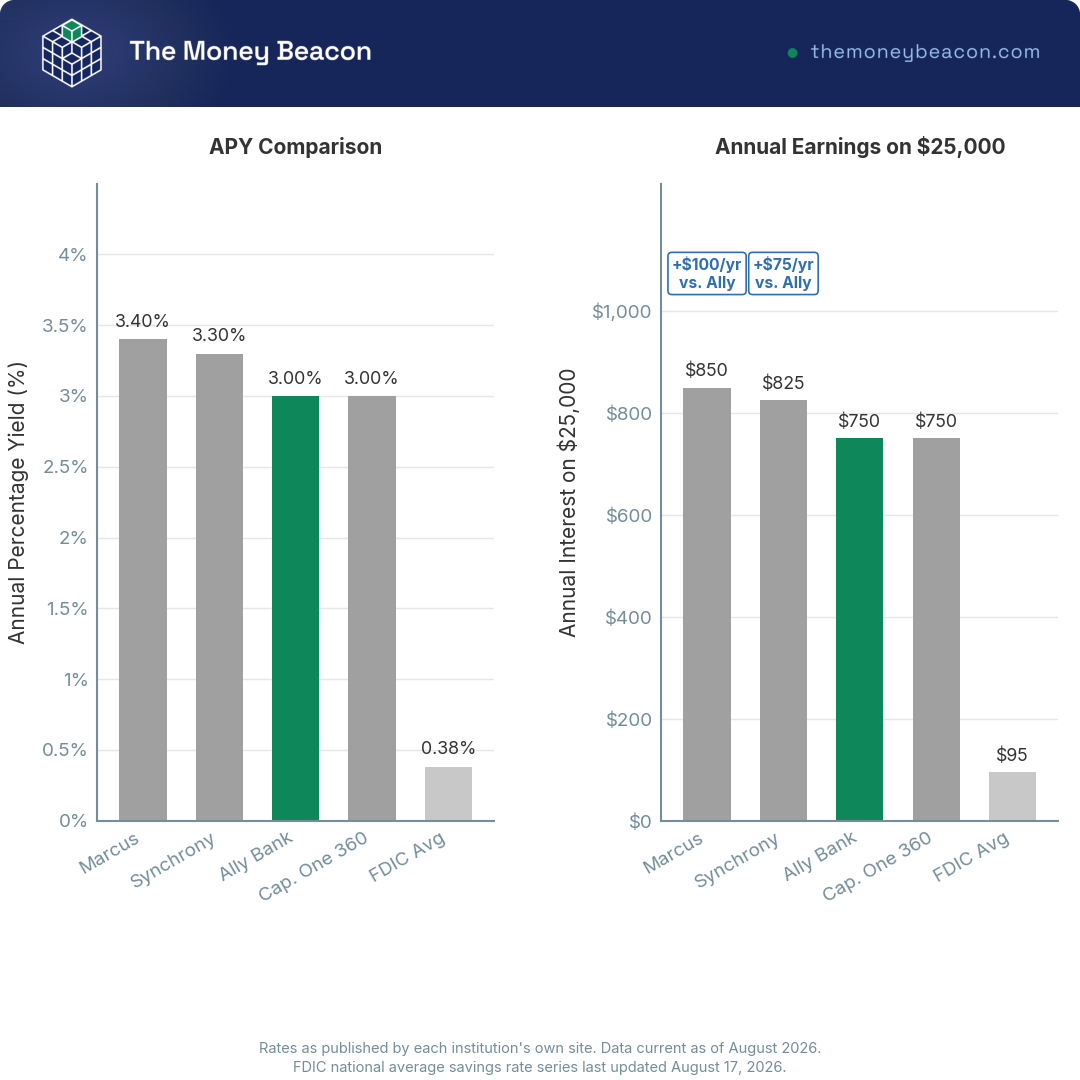
Marcus pays 3.40% as of August 24, 2026 and Synchrony 3.30% as of August 25, 2026, against Ally’s 3.00% and Capital One 360’s 3.00% on the same date. On $25,000 that’s $100 a year handed to Marcus and $75 to Synchrony. Ally is joint last of the four, tied with the rival whose selling point is branches rather than price.
Two details still favor Ally. Its 3.00% carries no promotional window and no direct-deposit test, so the number on the page is the number you keep. And both banks beating Ally publish no checking account, so chasing that 3.40% means choosing somewhere to park cash, not somewhere to bank.
The ranking flips on one product: Ally’s money market pays the full 3.00% against Synchrony’s 2.00%. Where that spread sits in the wider field is the subject of our comparison of seven no-fee savings accounts.
2.3 Buckets and boosters: real organization, no extra yield
One lever left here isn’t about price. Ally splits a single savings balance into up to 30 buckets, and interest is paid on the total account balance, so dividing it 30 ways costs you no yield.
Three automations run alongside them. Round Ups moves rounded-up spending into savings once $5 has accrued, in transfers of $5 to $20. Surprise Savings watches a linked checking account, at Ally or elsewhere, and moves what it judges safe to save. Recurring Transfers runs on your schedule.
Ally publishes a claim beside all this: people using its smart savings tools grow their balances “2x more, on average” over 12 months than those who don’t. The stated basis is average balance growth of accounts opened since the tools launched, with no methodology and no control group, so that population picks itself. It stays Ally’s claim about Ally’s customers.
Hank’s take

the behavioral-finance research is fairly consistent on this: people who label their money spend less of it. But the effect comes from the labeling, not from the bank, and 3.00% pays the same whether the balance is in one pot or thirty.
None of the three rivals publishes an equivalent, so this is where Ally leads on features rather than price.
3. What does the no-fee promise really cost?
A rate table never shows what the account charges you the day you need something from it.
3.1 Five lines, eight non-charges, and two fees that sit outside the chart
The first thing I went looking for was the fee schedule, and it’s in the deposit agreement rather than on the product page.
| Type of fee | Description | Amount | Applies to |
|---|---|---|---|
| Custom Check Printing | Custom checks | Varies by style | Checking, Money Market |
| Domestic Outgoing Wire | Funds sent to another US institution by wire | $20.00 per request | All |
| Expedited Delivery | Documents by Express Mail or overnight courier | $15.00 per package | All |
| International Transaction Fee | Point-of-sale debit or ATM transaction originated outside the US | Up to 1% | Checking, Money Market |
| Stop Payment | Stop order on a paper check, Bill Pay check or other item | $15.00 per request | Checking, Money Market, Savings, IRA Savings |
Fee schedule current as of August 13, 2024.
For ordinary use, that’s cheap. The eight charges Ally names and waives make a longer list than the chart itself, from account maintenance and its own ATM fee down to returned deposited items. The two priced items you’re likeliest to meet undercut Synchrony and Capital One: a $20 wire against $25 at Synchrony and $30 at Capital One, and a $15 stop payment against Synchrony’s $25. Marcus is the one that goes lower, at $0 for a wire.
Two charges are missing from the chart, though. Overnight bill pay is $14.95 and same-day bill pay $9.95, both on the Spending Account page and neither a Fee Chart line item.
Then there’s the distinction that costs people money: no overdraft fee isn’t overdraft coverage. CoverDraft is discretionary, isn’t part of your available balance, and only reaches $250 after two straight months of qualifying direct deposits of at least $250. It never covers a Zelle payment, an ATM withdrawal or a wire, and $250 is the ceiling, not the $1,000 that circulates in search results. Past that ceiling a transaction is declined rather than paid, the way most of this market now works, as our comparison of no-fee checking accounts shows.
3.2 Cash, wires and ATMs: where a bank with one office stops working
A fee chart can only price what a bank does. The harder costs are what it doesn’t do at all.
| Money movement | Published position |
|---|---|
| Incoming wire, domestic and international | $0 |
| Outgoing domestic wire | $20.00; 5:00 p.m. ET receipt cut-off |
| Outgoing international wire | Not offered |
| Official / cashier’s check; standard or expedited ACH bank-to-bank transfer | $0 |
| Expedited document or debit card delivery | $15.00 per package |
| Cash at a branch or ATM; cash by mail or courier | Not possible / refused |
| Cash via retailer barcode | $20 to $999 per transaction, $1,000/day, 5 times per calendar month |
Fee schedule as of August 13, 2024; Add Cash limits effective December 12, 2025.
Read the last row as a monthly ceiling. Five loads at the $1,000 daily cap is about $5,000 of cash a month. It takes a barcode presented with ID at a Walmart Money Center, and it arrives only in the Spending Account. The December 12, 2025 addendum spells out that cash sent by mail or courier is refused. Checks can go to the Philadelphia P.O. box. Cash can’t.
ATMs are a smaller version of the same problem. You get 75,000-plus free machines on the Allpoint and MoneyPass ATM networks, and Ally reimburses up to $10.00 of other operators’ surcharges per statement cycle. That’s a $120 annual maximum, and about three out-of-network withdrawals a month exhaust it. Effective August 15, 2026 it stopped reimbursing non-US operators, and the up-to-1% international transaction fee was never reimbursed anyway. Capital One 360, the rival that only matches Ally on rate, has branches you can walk into. Ally also opens no business accounts and none for non-resident aliens.
Fees and cash decide whether Ally can be your household’s only bank. Money you don’t need for a year is a different question, and Ally answers it with different products.
4. Is locking money into an Ally CD worth it?
Ally’s CD lineup is three families, and the flagship High Yield CD alone runs seven terms. The question all of them answer is whether giving up access to your money buys enough extra interest.
4.1 The curve peaks at 18 months and falls back after that
Read the whole grid before the advertised number. As of August 25, 2026, Ally publishes 2.70% at 3 months, 3.50% at 6, 3.75% at 9, 3.90% at 12, then 4.00% at 18 months, then back down to 3.50% at both 3 and 5 years. You get no minimum to open, no monthly maintenance fee, a 10-day grace period at maturity and a 0.05% Loyalty Reward on renewal. Renewal is automatic: when the term ends the CD rolls into a new one of the same length unless you act inside that 10-day window.
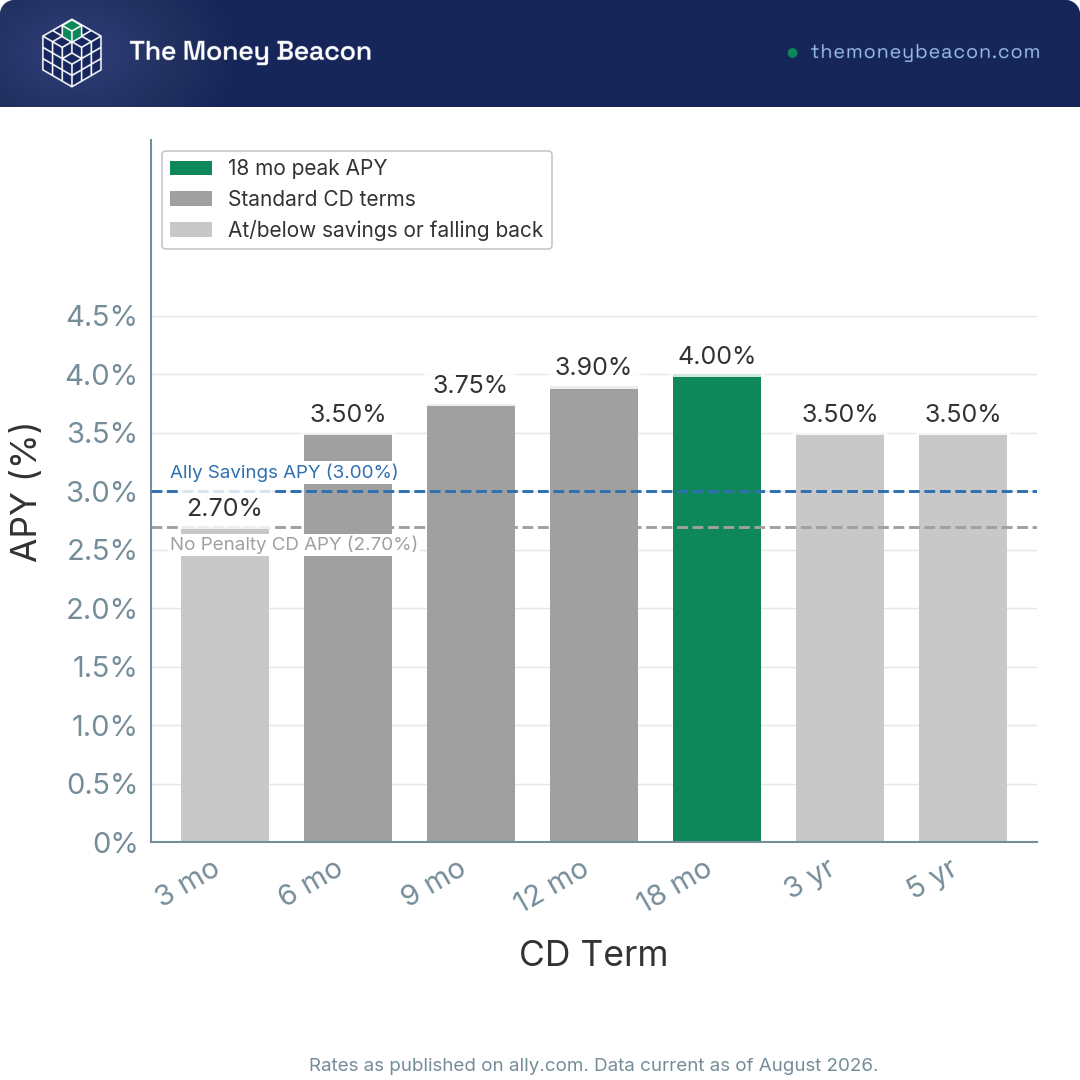
That shape tells you two things. The 3-month term at 2.70% pays less than Ally’s own savings account at 3.00%, so the shortest CD is worse than doing nothing. The long end is Ally’s weakest stretch, at 3.50% for three and five years against 4.30% and 4.35% at Synchrony on the same date, and 4.00% at Marcus at three years. The market is paying for eighteen months, not for five years, so size your lock-up to the curve, not to a round number. Our comparison of where the best CD rates sit finds the same pattern.
4.2 What $25,000 really earns, and what breaking the CD costs
A curve only becomes a decision in dollars, so price it on $25,000. Twelve months at 3.90% pays $975.00 held to maturity against $750.00 in savings, so the lock-up buys $225. Eighteen months at 4.00% pays $1,514.90, a little more than flat arithmetic on 4.00% would suggest because the interest compounds daily, and about $381.50 ahead of savings over the same stretch.
Now let’s break one. Close that 12-month CD on day 30 and it has accrued $80.14 against a penalty of 60 days’ interest, or $160.27. Ally takes the difference out of principal, so $25,000 comes back as $24,919.87, and partial withdrawals aren’t allowed. The penalty ladder is set by the term you chose, not by how long you held it: 30 days’ interest on terms under 3 months, 60 on terms of 3 to 24 months, 90 on 25 to 36, 120 on 37 to 48 and 150 beyond that, worth $55.48 to $359.59 on this balance. That band of 30 to 150 days is the lightest of the three that publish a band, against 90 to 270 days at Marcus and 90 to 365 at Synchrony.
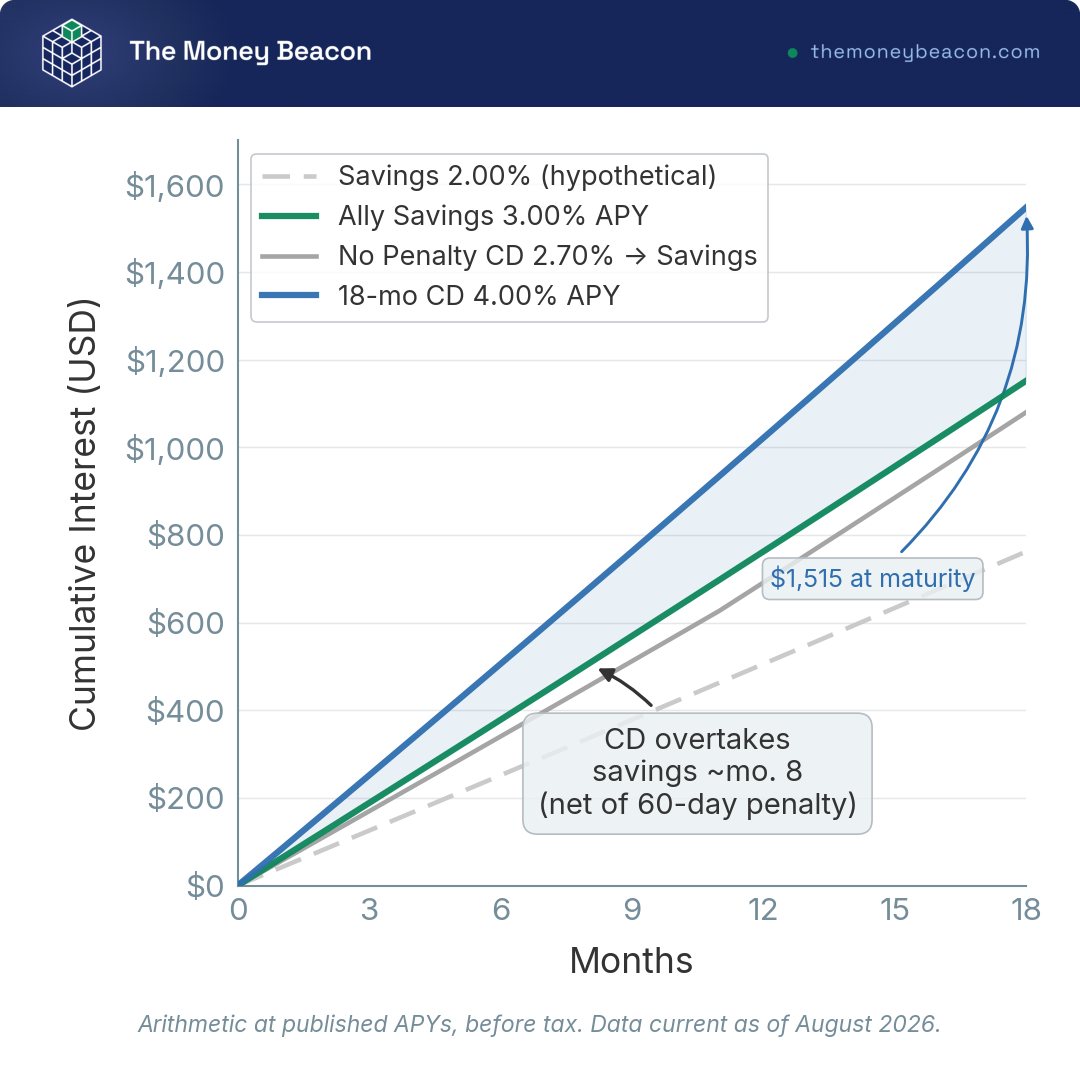
Both products sold on flexibility fail their own arithmetic. The No Penalty CD pays 2.70% and earns $618.06 on $25,000 across its 11 months, roughly $69 less than the $686.65 savings pays. Both Raise Your Rate terms pay 3.00%, exactly matching liquid savings, so the right to raise the rate once on the 2-year or twice on the 4-year delivers nothing at today’s pricing. And if you break a plain 12-month CD early, the penalty means it only overtakes savings past roughly day 260. Money you might need before then earns more sitting liquid, which is the whole of our guide to matching each account to its horizon in one line.
Tom’s take
I keep cash across more than one institution and let them compete for it. What I won’t do is lock a balance for five years to earn less than eighteen months pays.
5. The verdict: who should bank at Ally, and who should not
Every number you need is now priced. All that’s left is to line them up against the rivals and rule.
5.1 Where Ally compares to the three rivals, metric by metric
Every metric priced so far, with the rivals alongside.
| Metric | Ally Bank | Marcus | Synchrony Bank | Capital One 360 |
|---|---|---|---|---|
| Savings APY | 3.00% (08/25/2026) | 3.40% (08/24/2026) | 3.30% (8/25/2026) | 3.00% (8/25/2026) |
| Money market APY | 3.00% (08/25/2026) | Not offered | 2.00% (8/25/2026) | Not confirmed |
| Minimum to open / monthly fee | $0 / $0 | $0 / none | None / none | None / none |
| Withdrawal limit per cycle | 10, no fee | None published | 6, fee reserved | Not confirmed |
| Checking account | Yes, Spending Account | No | No | Yes, 360 Checking, $0 fee, no minimum |
| Physical counters | One domestic office, no retail branches | None | None | Branches and Cafés |
| Best CD term seen / minimum | 18 mo at 4.00% / $0 | 18 mo and 2 yr at 4.30% / $500 | 60 mo at 4.35% / $0 | Not confirmed |
| 3-year CD APY | 3.50% | 4.00% | 4.30% | Not confirmed |
| Early withdrawal penalty band | 30 to 150 days | 90 to 270 days | 90 to 365 days | Not confirmed |
| Outgoing wire / stop payment | $20 / $15 | $0 / not confirmed | $25 / $25 | $30 / $0 on 360 Checking |
| Out-of-network ATM reimbursement | $10 per cycle | No card issued | $5 per cycle, domestic | Own fleet of 70,000+; $2.00 to use another |
| Insured entity | Ally Bank, FDIC cert 57803 | Goldman Sachs Bank USA, Salt Lake City Branch | Synchrony Bank, FDIC cert 27314 | Capital One, N.A. |
Rate data current as of August 2026; Marcus and Capital One fee data as published in March 2025 and March 2026 respectively.
Read it by column, not by row. The question isn’t who wins the most rows, but which column matches how you bank.
5.2 Three households, three rulings
So is Ally worth making your primary bank? For one of these three profiles, yes. For the other two, no, and for different reasons.
Profile 1, the cashless household paid by direct deposit: yes, and this is the household Ally serves best. The deciding factor is structural, not numerical. Neither Marcus nor Synchrony publishes a checking account at all, so neither can be your primary bank at any rate. Ally can. Its Spending Account charges $0 with unlimited transactions and releases direct deposit up to two days early. It adds CoverDraft to $250 once two months of qualifying $250 deposits have landed, then links straight to savings at 3.00%. Giving up $75 to $100 a year on $25,000 is a fair price for running one institution instead of two. Keep Spending low and Savings high, because $15,000 left in checking at 0.25% earns $37.50 a year against $450 next door.
Profile 2 isn’t a household but a pot of money: a reserve or fixed-horizon lump sum whose only job is to sit still, which can easily sit inside a Profile 1 household. For that money, no. This one is decided on price alone, and on price Ally is joint last. It gives up $100 a year to Marcus, $75 to Synchrony on $25,000, and $1,239.43 to Synchrony over five years on a $25,000 CD. Two exceptions are worth naming. The money market pays the full 3.00% with checks and a card against Synchrony’s 2.00%, so a saver who wants a checkbook does better at Ally. And the light penalty band makes Ally the right place for a CD that might have to be broken early. For everything else, a higher-paying rival or a brokerage account’s cash sweep or Treasury bills is one transfer away.
Profile 3, the household with cash income, a cash side business or money to send abroad: no, and not as a second bank for the cash either. Cash enters only by barcode at a Walmart counter, capped at $1,000 a day and five times a calendar month. ATM and mailed cash deposits are refused, and outgoing international wires don’t exist at any price. Non-US ATM surcharges stopped being reimbursed on August 15, 2026, and business accounts aren’t offered at all. None of that is a teething problem you wait out.
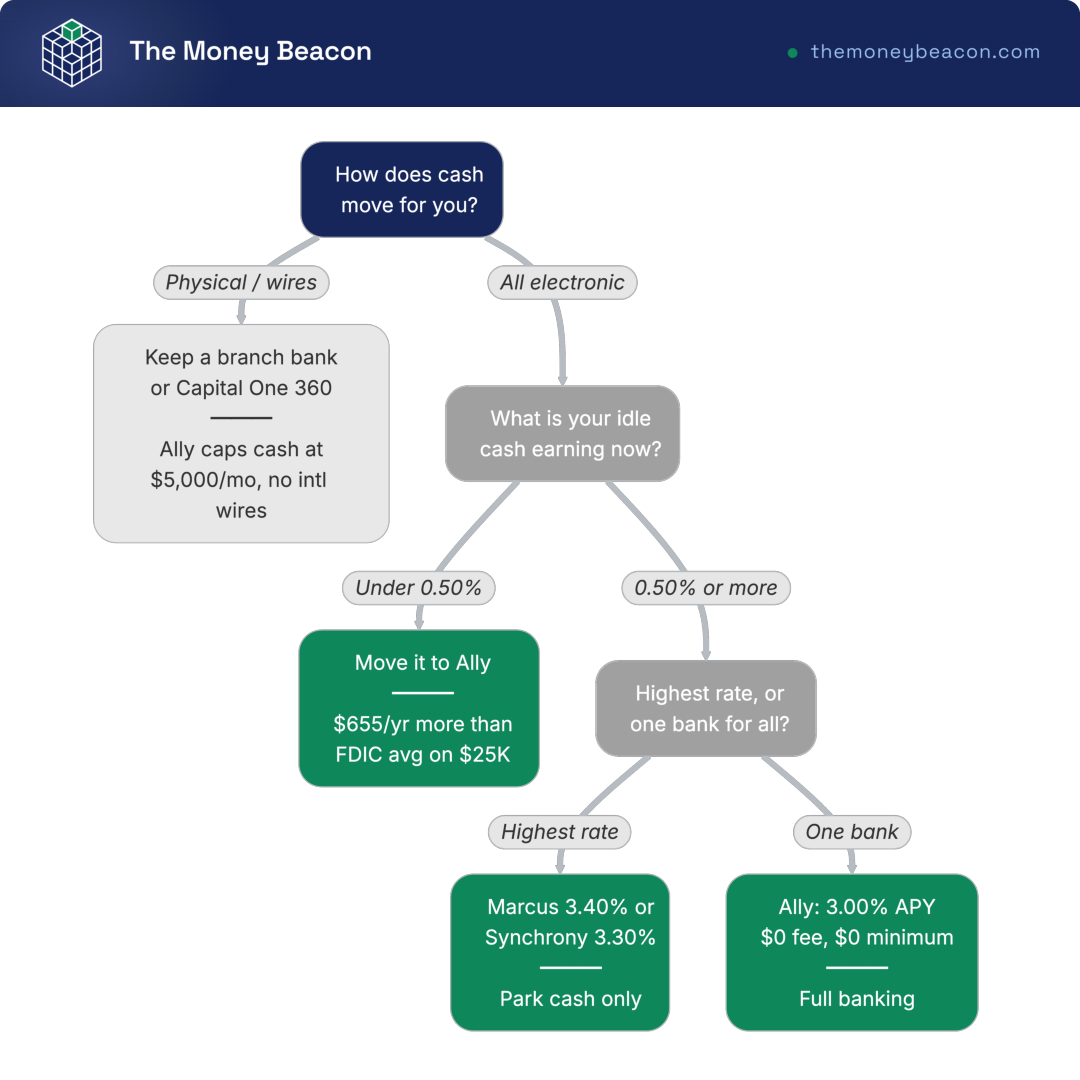
Run the tree before you move a dollar. Its first two questions disqualify Ally outright for a large minority of households, and no rate on the page changes that.
Conclusion
Ally’s rate is joint last of the four banks I put beside it, and I still spent most of this review on what a rate table never shows. How does cash get in? Can a wire get out? What does the account charge you the day something goes wrong? A rate is one number you can beat in an afternoon by opening an account elsewhere. What a bank can and can’t do is what you live with for years.
Which is why the expensive mistake here is rarely the one people worry about. Giving up $75 to $100 a year to Marcus or Synchrony on $25,000 is real. It’s also small. The money most Ally customers lose is lost inside Ally. It’s the $412 a year that evaporates when $15,000 sits in the Spending Account at 0.25% instead of in savings at 3.00%. It’s the 3-month CD paying 2.70% next to a savings account paying 3.00%.
So do the unglamorous thing tonight. Log in wherever your cash sits today and write down the APY it’s actually paying you, not the one you remember. Then move everything above one month of expenses into the highest-paying account that still gives you the access you need.
Deposit interest is taxed as ordinary income, so our guide to which accounts to fund first to cut your taxable income is worth reading first. Money you won’t need for a decade shouldn’t sit at 3.00% anywhere, which is where our guide to working out your retirement number starts. And if it has to stay liquid but earn more, our review of Fidelity and its core cash position shows what a brokerage sweep pays.
FAQ: Ally Bank, Answered
Is Ally Bank a real bank, and is my money FDIC insured?
When I looked up Ally Bank at the FDIC’s own database, it came back as a real, separately chartered institution: a Utah state-chartered commercial nonmember bank under FDIC certificate 57803, active, with $185.664 billion in assets as of March 31, 2026. That matters because Marcus files under Goldman Sachs Bank USA and Capital One 360 under Capital One, N.A., so searching either brand name at the regulator turns up nothing. Ally is the rare case where the brand and the insured entity share one name. Your deposits are insured to $250,000 per depositor, per ownership category, and that covers checking, savings, money market, CDs and even individual retirement account (IRA) products such as IRA Savings or an IRA CD. That coverage starts the moment you open the account. If a Roth IRA is part of that retirement plan, our Roth IRA guide covers the income limits and whether it beats a traditional IRA for your bracket.
What is Ally Bank’s savings APY, and is there a minimum balance to get it?
I went through the rate page expecting a catch, and right now there isn’t one. Ally pays 3.00% APY on savings, accurate as of August 25, 2026, with nothing required to open the account and no minimum balance needed to earn that rate. Ally publishes three tiers, under $5,000, $5,000 to $24,999.99, and $25,000 or more, but $500 and $250,000 both earn the same 3.00% today. There’s no direct deposit requirement, no promotional enrollment, nothing to sign up for beyond funding the account. What I’d flag is that the rate is fully variable; Ally’s own deposit agreement lets it change that number at any time, at its sole discretion, without notice. That combination of full liquidity, no minimum and a solid advertised rate suits a house down payment sitting on a one to three year clock, which is where our guide to buying your first home picks up.
Does Ally charge monthly or overdraft fees, and how much will it let me overdraft?
No monthly maintenance fee on any Ally account, and no overdraft fee at all; Ally eliminated those across the board back in June 2021. What replaces the fee is CoverDraft, and I’d read the fine print before counting on it. It starts at up to $100 and only climbs to $250, well short of the $1,000 some sites quote, once a qualifying direct deposit of at least $250 lands for two consecutive months. Go past the limit and the transaction gets declined rather than paid, and CoverDraft never covers a Zelle payment, an ATM withdrawal or a wire. Beyond that, the fee chart is five lines: a $20 domestic wire, a $15 stop payment, $15 for expedited delivery, up to 1% on a foreign transaction, and custom checks priced by style.
How do I deposit cash into an Ally account with no branches?
There’s exactly one route, and it runs through the app. You generate a barcode in the Ally app, carry it into a Walmart Money Center or customer service desk with ID, and hand over the cash; Ally says it should post within minutes, or by 3 a.m. Eastern if you add it after 9 p.m. As of December 12, 2025 that route caps out at $20 to $999 per transaction, $1,000 a day, and five times in a calendar month, a hard ceiling of $5,000 of cash monthly. An ATM won’t accept cash at all, and mailing or courier delivery gets refused outright. The cash lands only in the Spending Account, never directly into savings, the money market account or a CD. A household that regularly handles more than that needs a second, branch-based bank too.
What is an Ally No Penalty CD, and when is it better than savings?
It’s an 11-month CD paying 2.70% APY with nothing required to open, and you can withdraw the full balance plus accrued interest any time after the first six days; partial withdrawals aren’t allowed. Here’s the arithmetic that surprised me: at today’s pricing, 2.70% is below the 3.00% Ally’s own savings account pays, so choosing the No Penalty CD over savings costs you roughly $69 in interest on $25,000 across its term. It only wins if Ally cuts the variable savings rate by more than 0.30 points and keeps it cut for most of those eleven months. That’s a bet on rates, not a free option, and Synchrony’s own No Penalty CD is priced the same way, well under its standard 12-month term. None of this, savings or CDs, is the right place for money you won’t need for a decade or more; a diversified index fund or exchange traded fund (ETF) portfolio compounds over that stretch in a way no deposit rate can, which our comparison of index funds and ETFs lays out.




Comments
Questions and corrections welcome. We read everything.