


Most first-time buyers talk themselves out of a house before they ever pick up the phone to a lender. The math in their head runs something like this: a $300,000 home means 20% down, so $60,000 in cash sitting in a savings account, plus a spotless credit score, plus a stack of fees nobody can quite name. So they keep renting, watch prices drift higher, and decide homeownership is a club that already closed its doors. That story is mostly wrong, and it is costing people years.
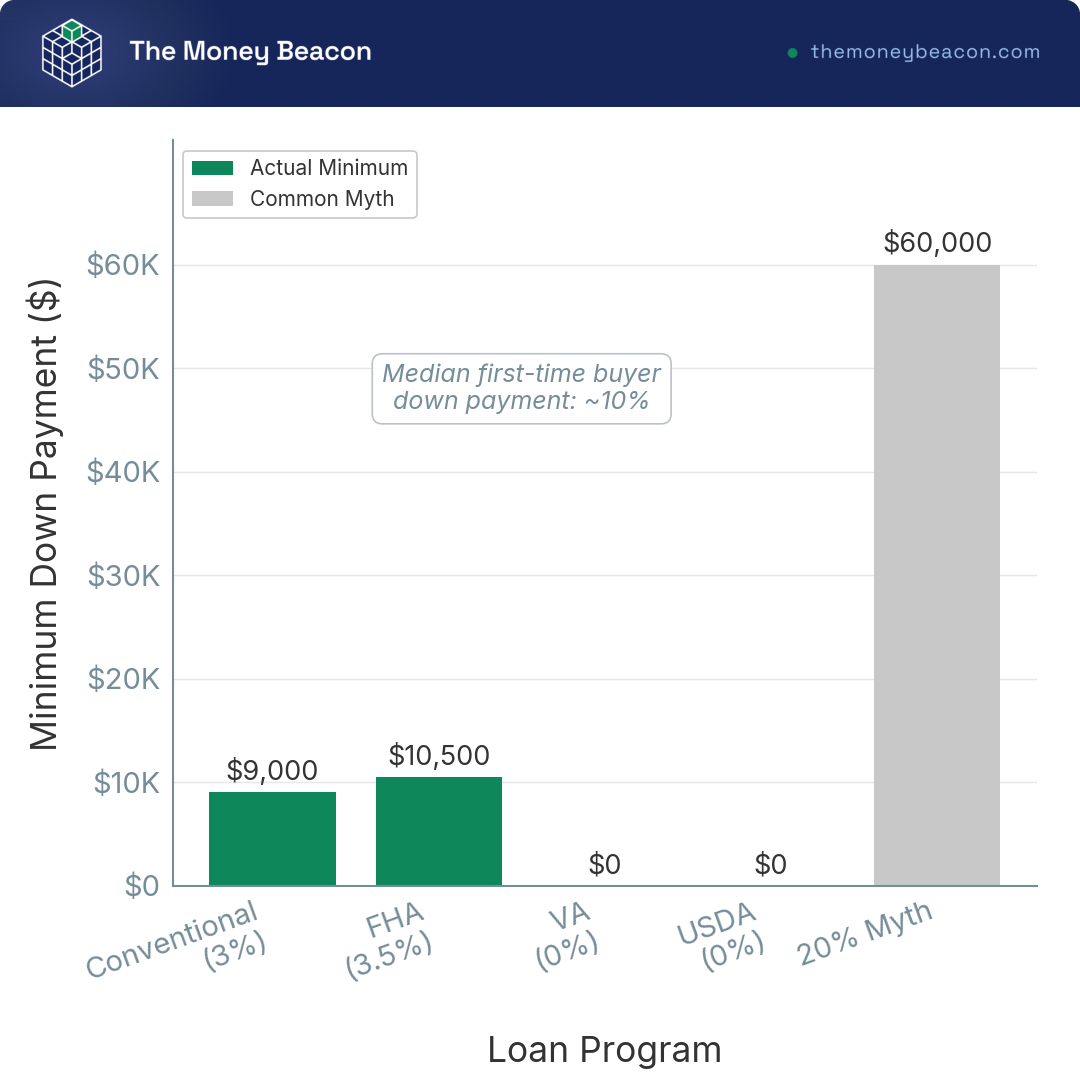
Here is the part the 20% rule never tells you. A conventional loan can go to 3% down, FHA to 3.5%, and VA or USDA loans to 0% for buyers who qualify. On that same $300,000 home, the down payment floor is $9,000, not $60,000. The 20% number is real, but all it buys you is an exit from private mortgage insurance; it was never a requirement to get the keys. The median first-time buyer in the US actually puts down around 10%, and plenty put down far less.
The 2026 market does ask more of you than it did a few years ago. In mid-June 2026 the 30-year fixed rate sat near 6.47%, so the monthly payment carries real weight, and the question “how much house can I afford” deserves an honest answer, not a hopeful one.
So before you tour a single listing, you need two things straight: what payment your budget can actually live with, and how much cash it truly takes to reach the closing table. This guide on how to buy your first home walks each step in the order a careful buyer should take it, from the affordability gut-check through pre-approval, loan choice, and down payment assistance, all the way to closing day. We start with the only question that matters first: can you actually afford this?
1. Can You Actually Afford a House? Run the Numbers First
So you want to know whether you can afford to own. The honest version of that question isn’t “what will a lender approve,” it’s “what monthly payment can my budget live with, even in a bad month?”
1.1 What homeownership really costs each month (PITI and beyond)
Most lenders quote your monthly payment as PITI: principal, interest, taxes, and insurance. That’s the right place to start, because it’s the number that hits your checking account on the first of every month. On the running $300,000 home, a $300,000 loan at 6.47% on a 30-year fixed runs about $1,890 a month in principal and interest alone, before a dollar of tax or insurance gets added.
Property taxes come next, and they vary by where you buy. The national median effective rate sits around 0.93% of the home’s value per year, which adds a few hundred dollars a month on a typical home. Homeowners insurance is the third escrow line, and it swings widely by state and risk. Two more costs belong in any honest budget: mortgage insurance (PMI on a conventional loan, MIP on an FHA loan) when you put down less than 20%, and HOA dues if you buy a condo or a home inside a planned community.
Here’s the full picture of what that monthly number actually contains.
| Component | What it is | Typical scale (one example) |
|---|---|---|
| Principal + Interest | Loan repayment | $300k loan, 6.47%, 30-yr ≈ $1,890/mo |
| Property taxes | Local ad valorem tax | ~0.93% of value/yr (national median effective rate) |
| Homeowners insurance | Hazard/dwelling coverage | varies widely by state/risk |
| Mortgage insurance | PMI (conv.) or MIP (FHA) if low down | covered later in this guide |
| HOA dues | Condo/community fees | property-specific |
So the payment is more than the loan. Past PITI, plan for maintenance (a common rule of thumb is 1% of the home’s value per year, so roughly $3,000 on a $300,000 home), for utilities a renter may never have paid, and for an emergency fund the house now leans on. A donut chart makes the split easy to see at a glance.
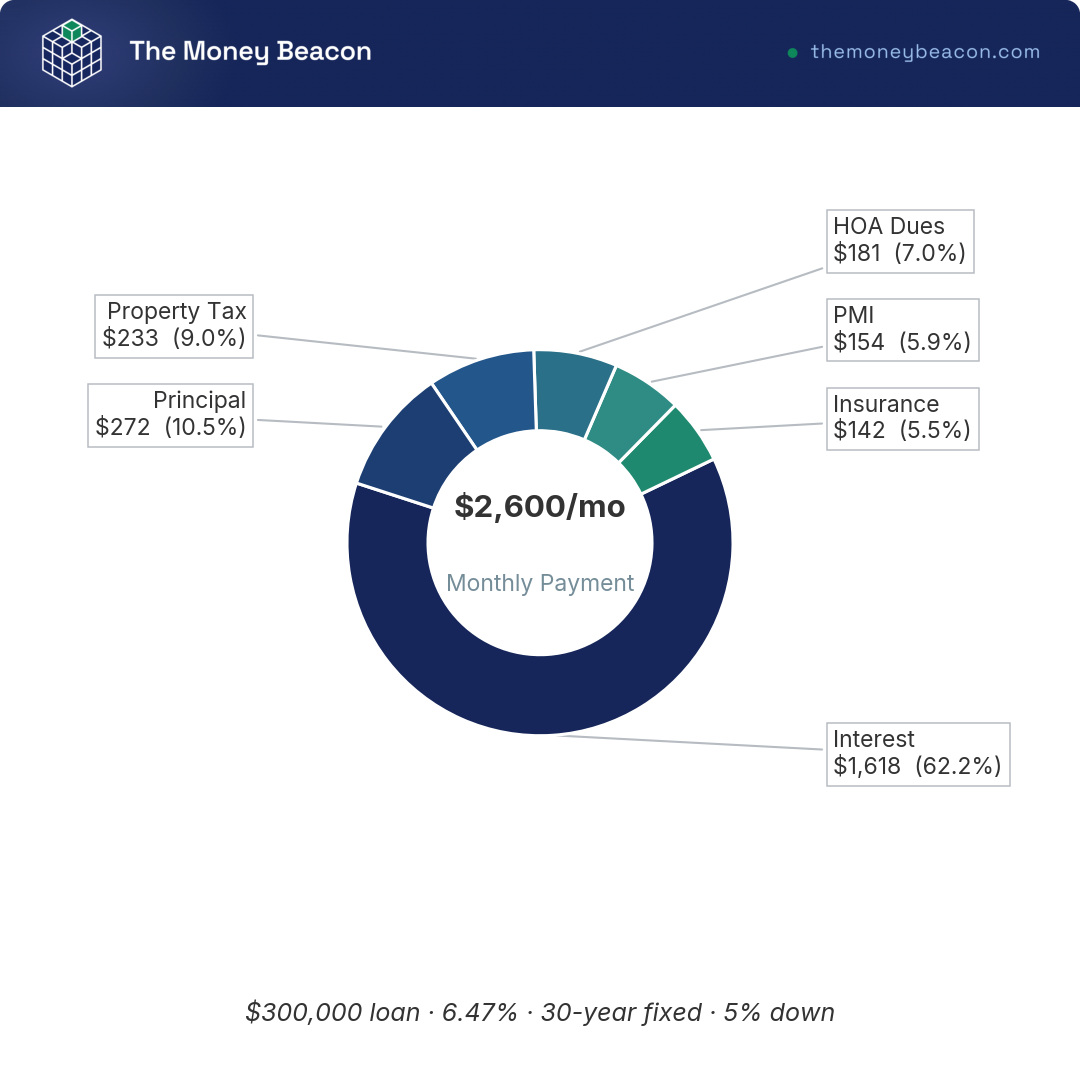
A lender sets a ceiling. The honest question is what payment survives a bad month, not what a lender will approve, so set a lower, livable target underneath that ceiling, which is exactly what the next number helps you do.
1.2 The 28/36 rule: how much house your income actually supports
Knowing what a payment contains is one thing; knowing how big a payment your paycheck can carry is the part that turns income into a price range. That’s the job of the 28/36 rule, the affordability guardrail lenders have leaned on for decades.
The rule has two halves, both measured against your gross monthly income (your income before taxes). Your housing payment, the full PITI, should stay at or below 28% of gross monthly income, the front-end ratio. All your debt payments together, housing plus everything else, should stay at or below 36%, the back-end ratio. The smaller of the two numbers is the one that binds you.
Run it on a real paycheck. If you earn $7,000 a month gross, the 28% front-end caps your target PITI at $1,960, and the 36% back-end caps your total debt at $2,520. Now add your existing debts. If the car payment, the student loans, and the minimum card payments already total $700 a month, the back-end leaves $2,520 minus $700, or $1,820, for housing. That $1,820 becomes the real ceiling, below the $1,960 the front-end alone would have allowed. Working out how much down payment for a house to aim at starts here, because the payment you can carry sets the price you can chase.
One caveat is worth knowing before you take a lender’s “approved” number at face value. Automated underwriting can clear you well above 28%, sometimes comfortably so. The number to plan around is the one your budget can absorb on a bad month, not the one the software will rubber-stamp.
1.3 Debt-to-income ratio: the number that makes or breaks approval
The 28/36 rule gives you a target. Debt-to-income is the version of that target a lender actually runs your file against, and after credit, it’s the single most decisive number in underwriting.
Debt-to-income, or DTI, is your total monthly debt payments divided by your gross monthly income. The back-end DTI is the one that matters most: it adds the new housing payment to every other monthly obligation (car, student loans, minimum card payments) and measures the total against your income. The front-end version looks at housing alone. Programs allow more headroom than the 36% guideline suggests, and the ceilings differ sharply by loan type.
| Program | “Comfortable” guideline | Common practical max (with compensating factors) |
|---|---|---|
| Conventional (Fannie/Freddie) | 36% | up to 50% via automated underwriting |
| FHA | 31%/43% | manual underwriting may exceed only with compensating factors |
| VA | residual income method | no fixed DTI cap; ~41% benchmark plus residual income test |
| USDA | 29%/41% | up to 32%/44% with 680+ credit and compensating factors (GUS) |
Data current as of June 2026.
Read across the table and the lesson is that conventional loans stretch furthest, up to 50% back-end through Fannie’s and Freddie’s automated underwriting when your credit and reserves are strong, while VA skips a fixed cap entirely in favor of a residual-income test. That flexibility is real, but stretching to a 50% DTI means half your gross income is committed to debt before you’ve bought a single grocery. The smarter play is to walk into the lender with a lower DTI, which both widens your approval and cheapens your rate. Paying down a card or two before you apply does double duty, and if balances are scattered across high-rate accounts, our guide to consolidating high-interest debt shows how to shrink that monthly number faster.
With the payment understood and the debt math run, one question is left before you commit any cash: does buying actually beat renting for you?
1.4 Renting vs. buying: when buying actually wins
You can carry the payment and clear the DTI, and buying can still be the wrong call. The deciding factor is rarely the monthly number; it’s how long you plan to stay.
Buying and later selling a home is expensive on both ends, often 8% to 10% of the price combined once you count agent commissions, closing costs, and the costs of selling. That upfront drag is why a common break-even runs 3 to 5 years: stay shorter and the transaction costs swamp any equity you build, stay longer and ownership pulls ahead. The exact crossover shifts with price appreciation, rent growth, and your rate, but the shape holds.
A few factors push the decision one way or the other, and it helps to weigh them side by side rather than in isolation.
| Factor | Favors renting | Favors buying |
|---|---|---|
| Expected stay | < 3 years | 5+ years |
| Price-to-rent ratio | high (>20) | low (<15) |
| Job/income stability | uncertain | stable |
| Maintenance tolerance | low | willing/able |
| Upfront cash | tight | sufficient for full cash-to-close |
So renting wins for short stays, expensive-to-buy markets, and unstable income, while buying wins when you’ll stay put, the local price-to-rent math is friendly, and you have the cash to close without scraping bottom. A cost curve over ten years makes the crossover concrete.
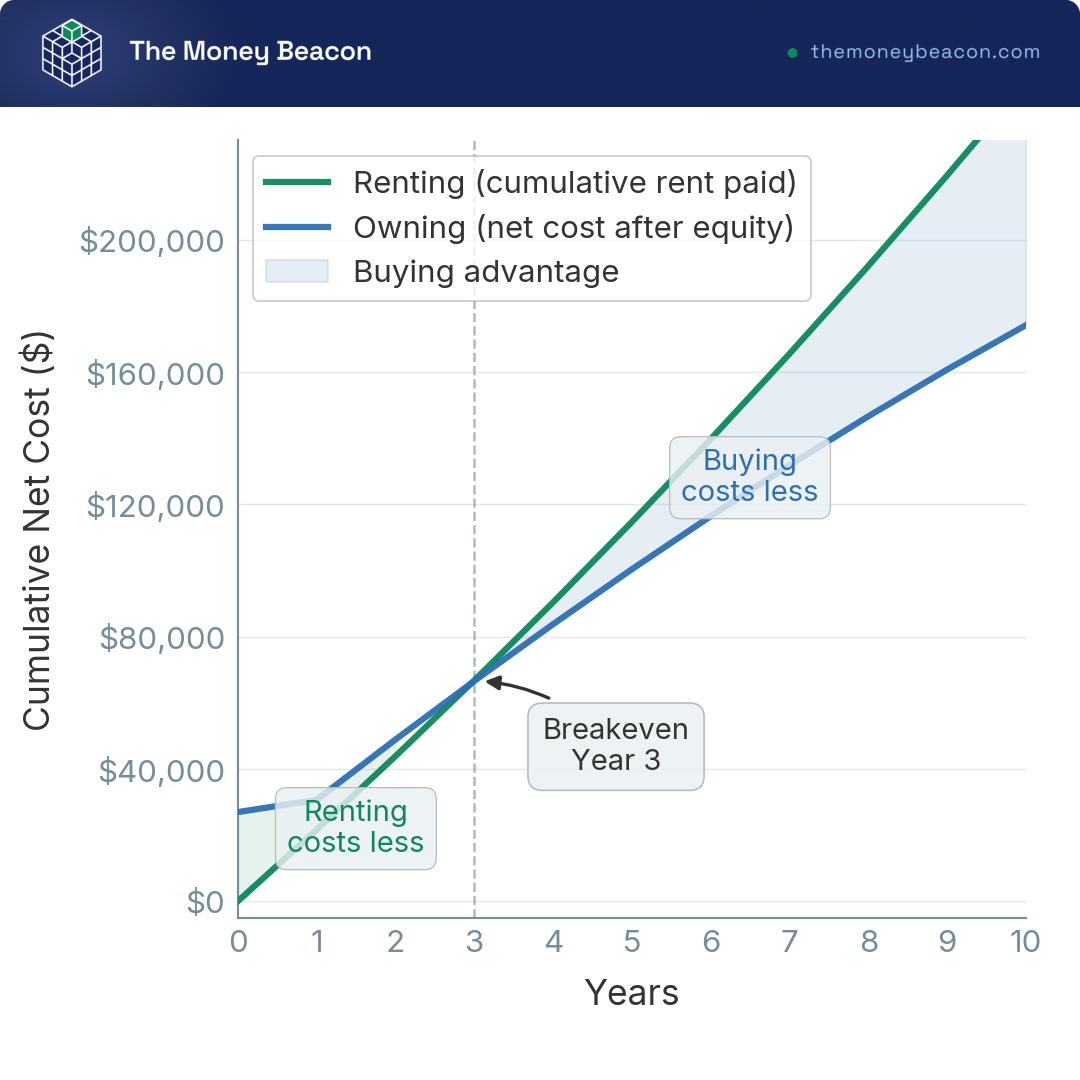
Once the monthly cost works and a few years of staying put justify the transaction drag, the next thing standing between you and a house is upfront cash. The fear that scares off the most buyers there is the 20% down payment, so that myth is the first thing to take apart.
2. How Much You Really Need for a Down Payment (Hint: Not 20%)
Now we pin down exactly how much cash you truly need, where the stubborn 20% number came from, and what changes when you put down less.
2.1 Where the 20% myth comes from and why it’s optional
If 20% down was never required, why does everyone repeat it? Because it’s a real threshold, just not the one people think.
Twenty percent is the point at which a conventional loan avoids private mortgage insurance, nothing more. It isn’t a legal rule, not a universal lender requirement, and not the price of admission to homeownership. Below 20%, conventional borrowers simply pay PMI until their loan shrinks to the cancellation point, which is a recurring cost, not a locked door. So treat “you need 20% down” as the first myth to retire, and let the real question be how little you can responsibly put down by program.
2.2 Minimum down payments by loan type, side by side
With the myth cleared, the useful number is the actual floor under each loan program, because that floor decides which doors are open to you. The minimums vary, and so do the strings attached to each.
| Program | Min. down | Min. credit (typical) | Mortgage insurance | Property/use limits |
|---|---|---|---|---|
| Conventional 97 / HomeReady / Home Possible | 3% | ~620 | PMI, cancelable | primary residence; HomeReady/Home Possible income limit ≤80% AMI |
| FHA | 3.5% (580+); 10% (500-579) | 580 / 500 | Upfront + annual MIP | primary residence; loan limits apply |
| VA | 0% | no VA minimum (lender overlays ~620) | none; funding fee instead | eligible veterans/service members; primary residence |
| USDA Guaranteed | 0% | ~640 (GUS) | upfront + annual guarantee fee | eligible rural area; income ≤115% of median household income |
Data current as of June 2026.
Translate the percentages into dollars on a $300,000 home and the spread is stark. A conventional 3% loan asks $9,000 down with credit around 620; FHA asks 3.5%, or $10,500, at a 580 score; and an eligible veteran or a buyer in a qualifying rural area can put down $0. The decision on how much down on a house, then, is less about a single magic number and more about which program you qualify for and what each one costs you once you are in it.
2.3 The trade-offs of a smaller down payment
A smaller down payment isn’t free money; it’s a trade. You keep more cash today and enter the market sooner, but you borrow more, pay interest on the larger balance, and usually carry mortgage insurance until you build enough equity.
| Down payment | Loan amount | Est. P&I/mo | PMI? | Cash needed for down |
|---|---|---|---|---|
| 3% ($9,000) | $291,000 | ~$1,834 | yes | $9,000 |
| 5% ($15,000) | $285,000 | ~$1,796 | yes | $15,000 |
| 10% ($30,000) | $270,000 | ~$1,701 | yes (lower) | $30,000 |
| 20% ($60,000) | $240,000 | ~$1,512 | no | $60,000 |
Data current as of June 2026.
The gap between the cheapest and the priciest down payment is about $322 a month in principal and interest, plus the PMI that the three smaller options carry and the 20% option drops. What drives both the loan size and the PMI is one ratio: loan-to-value, or LTV, your loan balance divided by the home’s value. Put 3% down and your LTV starts at 97%; put 20% down and it starts at 80%, the line where PMI disappears. The smaller your down payment, the higher your LTV, and the higher your LTV, the more mortgage insurance you owe until your balance falls back to that 80% mark. PMI isn’t a penalty you are stuck with forever, and exactly how it works and how to shed it comes later in this guide; for now, the takeaway is that LTV is the dial that sets it. A bar chart lines up the minimums against the 20% myth so the contrast is plain.
2.4 How long it takes to save it, and how to get there faster
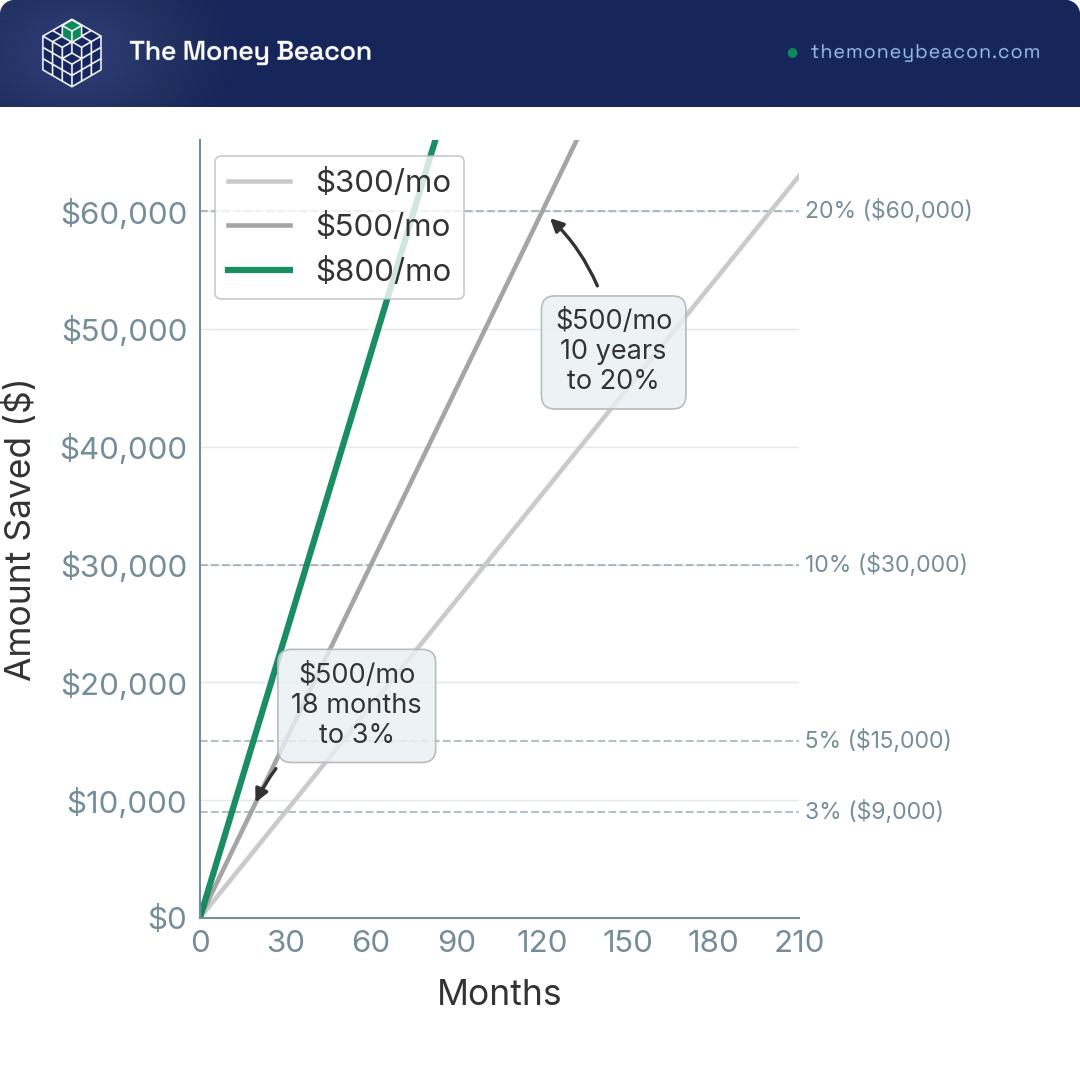
The lower your target, the sooner you’re at the closing table, and the difference is measured in years, not months. Saving the $9,000 for a 3% down payment at $500 a month takes about 18 months. Saving the full $60,000 for 20% at that same pace takes roughly 10 years. That single comparison is the strongest argument for matching your down payment to a low-down program rather than holding out for the 20% trophy.
A handful of accelerators pull that timeline in, and they matter most when buying a first time home and every dollar of cash is spoken for. Automating a fixed transfer the day your paycheck lands removes the temptation to skip a month. Down payment assistance, a first-time buyer’s $10,000 individual retirement account (IRA) exception, and documented gift funds (a donor’s gift letter confirming the amount and that no repayment is expected) can each cover a chunk of the cash, and we get into exactly how those levers work later in this guide. The simplest lever is where you park the money: a savings account that actually pays you while you wait, instead of one rounding your interest to zero. Months of patient saving deserve more than a rounding error, which is why a high-yield savings account belongs at the center of any down payment fund. A chart of the saving timeline shows how much sooner a lower target gets you there.
You now know you can put down as little as 0% to 3.5% and what that smaller down payment costs you each month. The next question is which of those loan programs you actually qualify for, and which one fits your situation best.
3. Choosing the Right Loan: Conventional, FHA, VA, and USDA
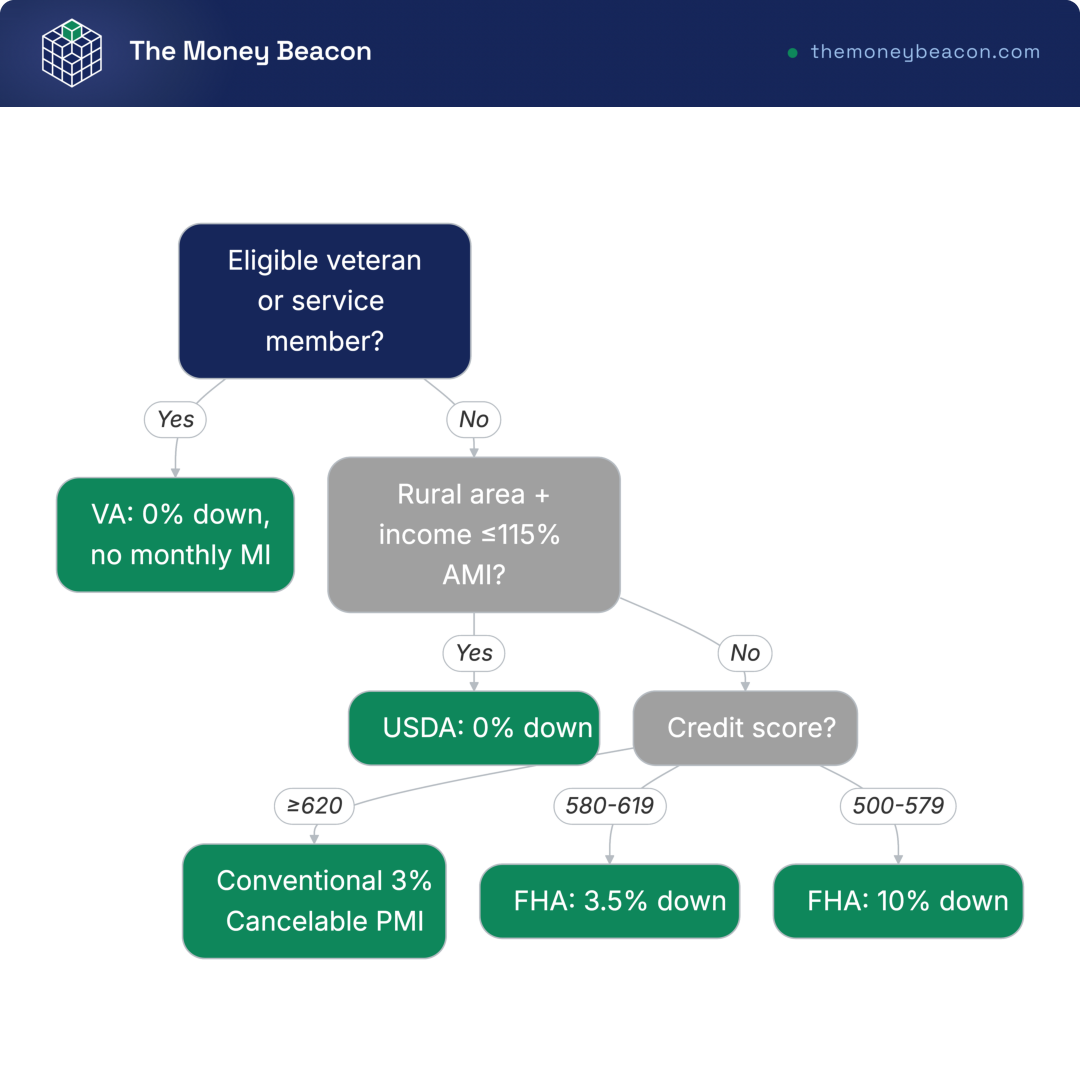
Four programs, one decision: which mortgage is yours? The fastest way to sort them is by what gates each one: eligibility first, since VA and USDA hand eligible buyers zero down, then credit.
3.1 Conventional loans: the default for solid credit
For a buyer with decent credit, the conventional mortgage is the workhorse, and for one good reason it usually beats the alternatives. Conventional loans aren’t government-insured; they follow Fannie Mae and Freddie Mac guidelines and stay at or below the conforming loan limit. They suit buyers with credit around 620 or higher and allow as little as 3% down through Conventional 97, HomeReady (Fannie), or Home Possible (Freddie), with the HomeReady and Home Possible versions reserved for incomes at or below 80% of area median income.
The decisive edge over FHA is the mortgage insurance. A conventional loan’s PMI is cancelable, and it’s cheaper at strong credit scores, where FHA’s insurance often clings to the loan for life. So if your score clears 620 and you would otherwise reach for FHA, the conventional route usually wins on cost over time, a comparison we return to later in this guide. On the approval side, conventional loans run back-end DTI up to 50% through Fannie’s Desktop Underwriter or Freddie’s Loan Product Advisor when the rest of your file is strong.
One ceiling applies to every conventional loan: the conforming loan limit. For 2026 the baseline sits at $832,750 for a one-unit home, rising to a high-cost-area ceiling of $1,249,125. Borrow above that line and you’re no longer in conforming territory; you need a jumbo loan, which we get to at the end of this section. Rates move week to week across programs and lenders, so it pays to compare current mortgage rates and lenders before you commit to one. If your credit sits below 620, though, the conventional door narrows and FHA becomes the more realistic option.
3.2 FHA loans: lower credit bar, lasting mortgage insurance
When credit is the obstacle, FHA is the program built to clear it. Insured by the Federal Housing Administration inside HUD, FHA loans accept a credit score as low as 580 with 3.5% down, or 500 to 579 with 10% down. That lower bar is the whole appeal, and it’s the reason FHA exists. For a buyer rebuilding credit, it’s often the only door open.
The trade-off is the mortgage insurance, and the FHA version is less forgiving than conventional PMI. You pay an upfront MIP of 1.75% of the loan, financed into the balance, plus an annual MIP of roughly 0.50% of the loan per year, paid monthly. The catch that costs people the most: when your down payment is under 10%, that annual MIP lasts the life of the loan. Shedding it generally means refinancing into a conventional loan once you’ve built enough equity, a route we map out later. Only if you put 10% or more down does the annual MIP end on its own, after 11 years. FHA also caps what interested parties (the seller, mainly) can contribute at 6% of the sales price, and its DTI benchmark of 31%/43% can stretch with compensating factors. Understanding the full FHA loan requirements up front saves a costly surprise after closing, because the difference between cancelable PMI and life-of-loan MIP is exactly the kind of detail we untangle further on.
Hank’s take

follow Fed policy closely and you stop treating today’s 6.47% as permanent. If rates ease over the next few years, that FHA-to-conventional refinance to kill the MIP turns from a someday idea into a concrete plan, so I would not lock into life-of-loan insurance assuming it is forever.
3.3 VA and USDA loans: zero down for eligible buyers
Before you weigh credit scores at all, check one thing first: whether you qualify for zero down. Two programs offer it, and for the buyers they fit, nothing else competes.
VA loans, guaranteed by the U.S. Department of Veterans Affairs, give eligible veterans, active-duty service members, and certain surviving spouses 0% down and no monthly mortgage insurance, a combination conventional and FHA simply cannot match. The main cost is a one-time VA funding fee: 2.15% of the loan for a first-use purchase with less than 5% down, rising to 3.3% on subsequent use. That fee is waived entirely for veterans receiving compensation for a service-connected disability, and for active-duty members who show evidence of a Purple Heart by closing. VA also skips a fixed DTI cap, judging affordability through a residual-income test against a roughly 41% benchmark.
USDA loans, run through Rural Development, also offer 0% down for moderate-income buyers in eligible rural and many suburban-fringe areas. Eligibility turns on income (commonly at or below 115% of the median household income) and a credit score around 640 through the automated GUS system. The costs are a 1.00% upfront guarantee fee, financed, and a small 0.35% annual fee. If you qualify for either program, start there, because zero down with no monthly PMI is genuinely hard to beat. A decision tree routes you to the program that fits your profile.
Whichever program you land on, one more set of choices shapes the payment and the total interest, and those choices apply across all four.
3.4 Fixed vs. adjustable, 15- vs. 30-year, and the jumbo line
Picking the program settles who insures your loan; it doesn’t settle how you structure it. Two structural calls remain, and both come down to a trade between the monthly payment and the total interest you hand the bank.
The first call is the term. A 30-year fixed keeps the monthly payment low but stretches the interest over three decades; a 15-year fixed raises the payment but slashes total interest and usually carries a lower rate. The second call is the rate type. A fixed-rate loan locks your rate for the full term, while an adjustable-rate mortgage (ARM) offers a lower intro rate that resets afterward (a 5/6 ARM, for example, adjusts every six months once the first five years are up), trading a cheaper start for rate risk later. Here’s how the three stack up on the running $300,000 loan.
| Loan | Rate (mid-2026) | Approx. P&I/mo | Total interest (rough) |
|---|---|---|---|
| 30-yr fixed | ~6.47% | ~$1,890 | high |
| 15-yr fixed | ~5.81% | ~$2,501 | much lower |
| 5/6 ARM | lower intro, then variable | varies | rate risk after reset |
Data current as of June 2026.
The 15-year costs about $611 more each month than the 30-year, and in exchange it cuts the lifetime interest dramatically and shaves the rate from 6.47% to 5.81%. The 30-year buys breathing room in the budget; the 15-year buys a far smaller interest bill, and the ARM bets that you’ll move or refinance before the reset bites. There’s also the ceiling from earlier: borrow above the $832,750 conforming limit (or the $1,249,125 high-cost ceiling) and a jumbo loan is your only option, with stricter credit and reserve rules attached. To see where today’s 30-year, 15-year, and ARM numbers actually land before you choose, it’s worth checking current 30-year, 15-year and ARM rates across a few lenders.
You now know which program fits you and how to structure it. But a chosen loan is still only a plan until a lender stands behind it, and turning that plan into a budget sellers actually respect is what pre-approval delivers next.
4. Getting Pre-Approved: What Lenders Look At
Pre-approval is the step that gets a lender to stand behind that plan and hand you a number sellers will actually respect.
4.1 Pre-qualification vs. pre-approval vs. underwritten approval
The fastest way to lose a house you can afford is to walk in with the wrong piece of paper. Three things sound alike and carry very different weight, so it pays to know which one you are holding.
A pre-qualification is an informal estimate built from numbers you state but nobody verifies. You tell a lender your income and your debts over the phone or through a form, and they tell you, roughly, what you might borrow. It is fine for a gut check, but a seller knows it means almost nothing, because no one pulled your credit or looked at a single pay stub.
A pre-approval is the real one. The lender pulls your credit, reviews your documents, and issues a letter that says, in effect, we have looked and we are prepared to lend you this much. A fully underwritten pre-approval (some lenders call it a verified approval) goes one step further: a human underwriter clears your income and assets up front, so the only things left to confirm later are the property and the appraisal. That is the strongest position you can bring to a negotiation.
| Level | What lender checks | Strength to a seller |
|---|---|---|
| Pre-qualification | stated info, soft/no pull | weak |
| Pre-approval | credit pull + docs | strong |
| Underwritten approval | underwriter clears income/assets | strongest |
Spend the extra effort and get the fully underwritten approval before you shop, because when two offers land at the same price, the seller takes the one least likely to fall apart at financing. One thing the letter does not tell you, though: it states the lender’s ceiling, not your livable target. The 28/36 math from Section 1 is still yours to enforce, since a lender approving you for $1,960 a month does not mean your budget should carry $1,960.
4.2 Your credit score: thresholds and how to raise it
After DTI, your credit score is the number that gates everything, and unlike DTI it also sets your price. There is no single score you “need,” but the bands matter, because each one opens different doors and quietly changes your rate and your PMI.
| Score band | Typical access | Pricing impact |
|---|---|---|
| 760+ | all programs, best pricing | lowest rate, lowest PMI |
| 700-759 | all programs | good pricing |
| 620-699 | conventional + FHA | higher PMI/rate |
| 580-619 | FHA (3.5% down) | FHA MIP applies |
| 500-579 | FHA (10% down) | limited |
Read it top to bottom and the lesson is that a score is not a pass/fail gate, it is a dial on cost. Clear 760 and you get the lowest rate and the cheapest PMI; slip to the 620-699 band and you still qualify conventional, but you pay more for the same loan. A 20-to-40-point bump before you apply can lower both your rate and your PMI at once, which is real money on a 30-year loan, not a rounding error.
Raising a score is less mysterious than it sounds. Pay every bill on time, keep your credit utilization at or below 30% of your total limit (under 10% is better still), hold off on new credit inquiries while you shop, and do not close old accounts, since age of credit helps you. If your balances are scattered across high-rate cards, folding them down with our guide to bringing your credit utilization down can move your score and your DTI in the same stroke before you ever talk to a lender.
4.3 The documents lenders ask for, and the self-employed difference
A clean file moves fast; a messy one stalls in underwriting. Once your credit is where you want it, the next job is assembling proof, and the order you gather it in matters.
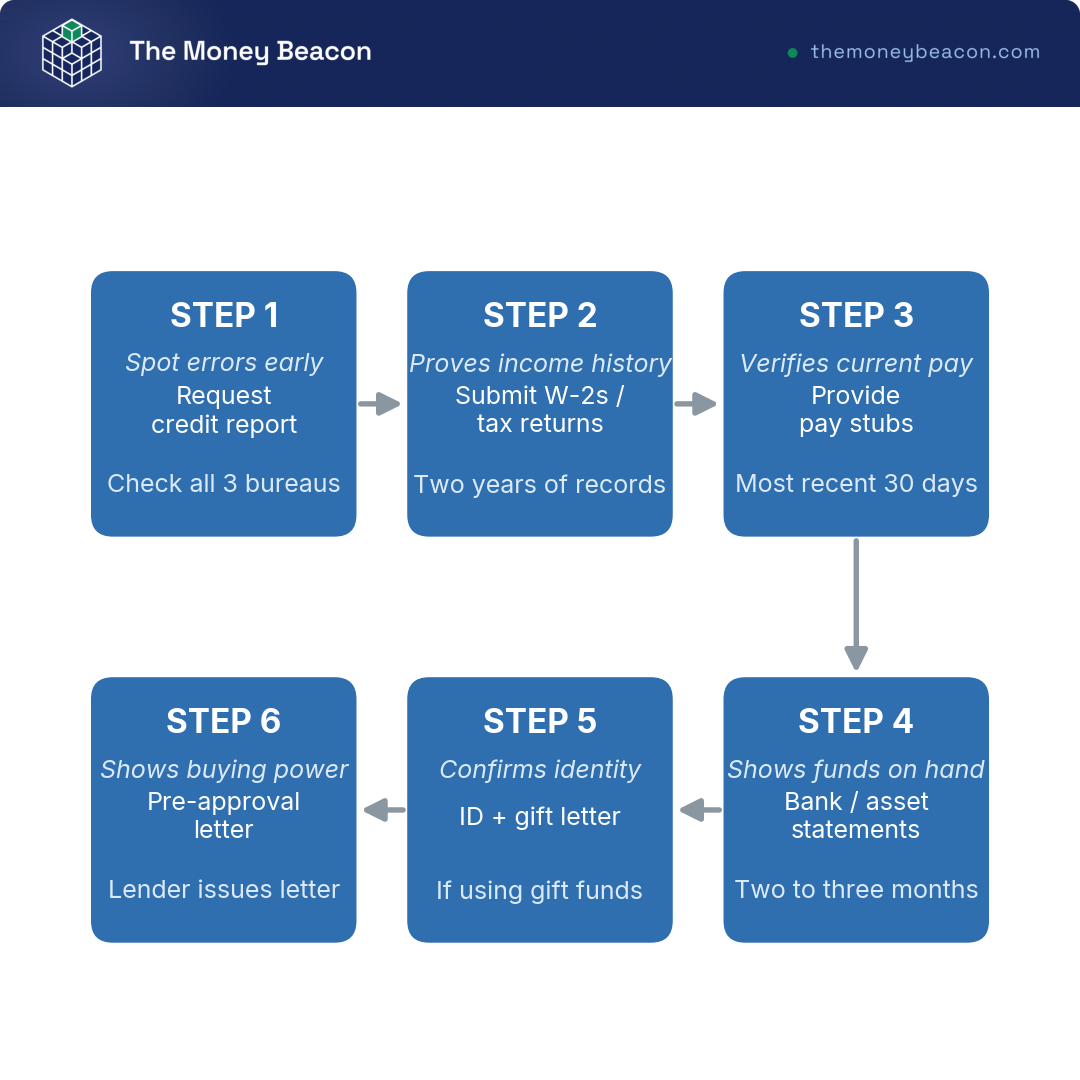
If you are a standard W-2 borrower, the lender wants your credit report, two years of W-2s and tax returns, your most recent pay stubs, two to three months of bank and asset statements, a government ID, and a gift letter if any of your down payment is a gift. That gift letter is the one people forget: it has to name the donor, state the amount, and confirm no repayment is expected.
If you are self-employed or paid on a 1099, the bar is higher, because your income is not handed to you on a W-2. Expect to add two years of tax returns, profit-and-loss statements, and your 1099s, and expect the lender to average your income across both years, so a strong recent year will not fully offset a lean prior one. Plan for that math before you apply, not after the underwriter flags it. The flowchart below lays out the order a clean file follows.
With the file built, the next question is where to take it, because the first lender you call is rarely the cheapest.
4.4 Shopping lenders without tanking your score
Here is the worry that keeps people from shopping at all: won’t five lenders pulling my credit wreck my score? It will not, as long as you keep it in a window.
The scoring models treat a burst of mortgage inquiries as rate shopping, not as five separate attempts to borrow. They fold multiple mortgage pulls into a single inquiry as long as they fall inside a focused window, which runs 14 days under VantageScore and older FICO versions, up to 45 days under current FICO. So pull them close together and the score hit is one inquiry, not five.
Inside that window, shop at least three lenders and compare them on the standardized Loan Estimate, the three-page form every lender has to issue in the same format. The lines that decide the real cost are the interest rate and the annual percentage rate (APR) together, the origination and underwriting fees (the part the lender actually controls), any discount points, the PMI or MIP, and the total cash to close at the bottom. One discipline holds the whole thing together: do not open any new debt before closing, because a new car loan or a fresh card mid-process can re-trigger underwriting and sink the approval you worked for.
Tom’s take
I’ve shopped most of the big private banks for my own borrowing, and the lesson carries straight over to a mortgage: none of them lead with their best terms, so you have to make them compete. Put three Loan Estimates side by side, tell each lender what the others quoted, and watch the fees move.
Comparing offers means little, though, until you understand what you are actually buying when a lender quotes you a rate.
4.5 Getting your rate: points, lock periods, and APR
A quoted rate is not a fixed fact of nature; it is partly something you can buy down, and partly something you have to pin in place before it drifts. Two levers and one number do most of the work here.
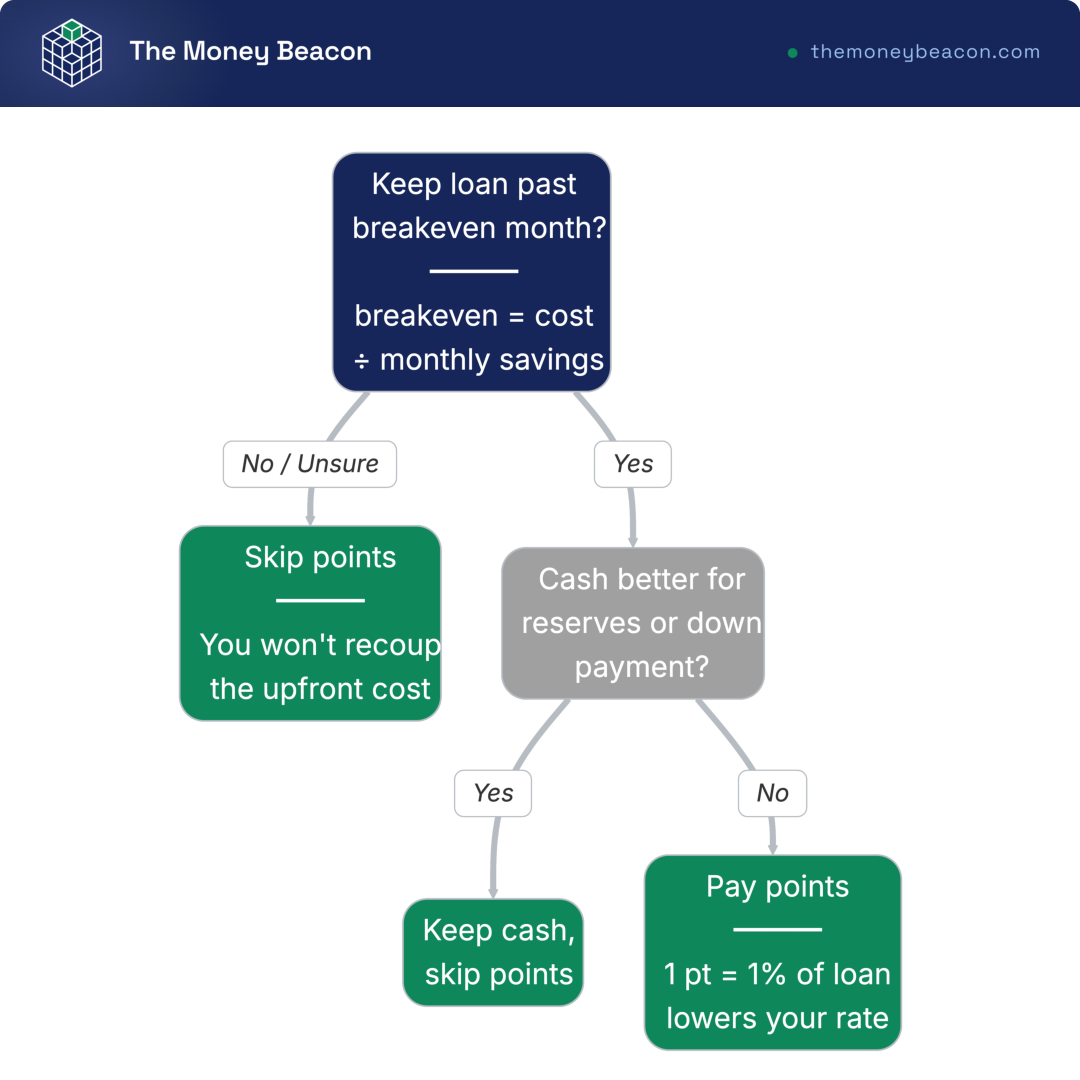
Discount points are prepaid interest. One point costs 1% of the loan and typically shaves the rate by a fraction of a percent, so on a $291,000 loan a point runs about $2,910. Whether it pays off comes down to one calculation: the cost of the points divided by your monthly savings gives the break-even month. Pay points only if you will hold the loan past that break-even, because if you may move or refinance within a few years, that upfront cash is gone before it ever earns back. FHA loan rates work the same way on points, so the same math applies whether you go conventional or FHA.
The second lever is the rate lock. A lock (commonly 30 to 60 days) freezes your quoted rate through closing, so a jump in the market between your offer and your signing does not raise your payment. The one number that ties offers together is the APR, which folds the lender’s fees into an annualized rate, and that is why it beats the headline note rate for comparing two lenders honestly. The decision tree below weighs points against how long you will actually keep the loan.
A pre-approval letter, a shopped rate, and a lock get you a credible offer. What they do not tell you is how much cash you actually need on hand to reach the closing table, and that number is bigger than the down payment alone.
5. The Cash You Need Beyond the Down Payment
The down payment is only one slice of the money you need ready before closing day, and underbudgeting the rest is one of the most expensive first-timer mistakes.
5.1 Closing costs: what they are and how much to expect
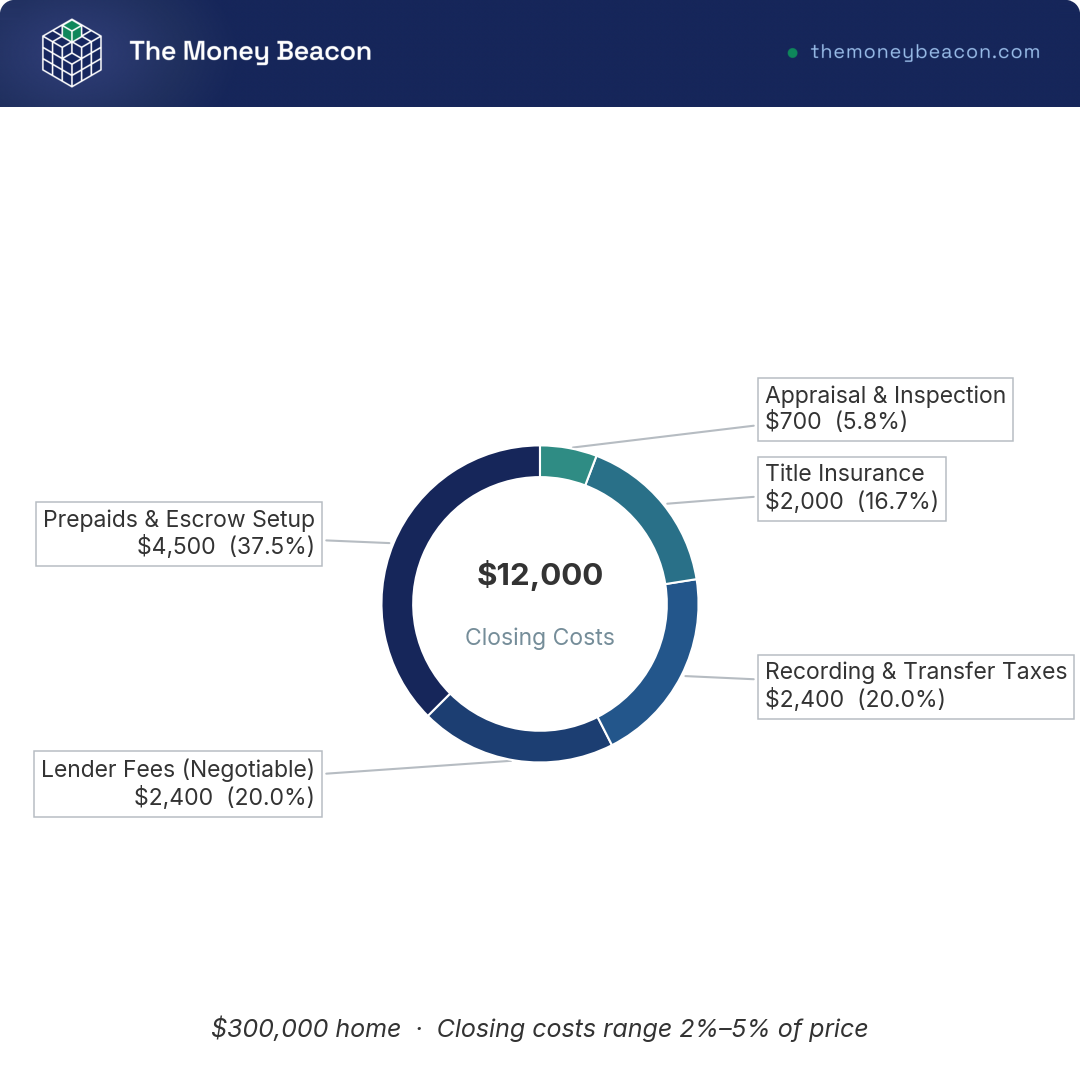
So how much is closing costs on a house, really? Plan on 2% to 5% of the purchase price, which on the running $300,000 home is $6,000 to $15,000, and it is entirely separate from your down payment. This is the line that blindsides buyers who saved a perfect down payment and forgot the rest.
The total is a stack of line items, some you can shop and some you cannot.
| Item | Typical range | Notes |
|---|---|---|
| Loan origination/underwriting | 0.5%-1% of loan | lender fee |
| Appraisal | $300-$500 (avg ~$357) | third party |
| Home inspection | ~$300-$425 (avg ~$343) | optional but advised |
| Lender’s + owner’s title insurance | varies by state | one-time |
| Escrow/settlement fees | varies | closing agent |
| Recording + transfer taxes | varies by state/locality (some states none) | government |
| Prepaid property tax + insurance + escrow setup | several months | funds escrow account |
Data current as of June 2026.
The split matters more than the total. The origination and underwriting fees at the top are lender-controlled, which means they are negotiable, and they are exactly what you compare across those three Loan Estimates from the last section. The recording and transfer taxes near the bottom are set by your state and county, so they are fixed; some states charge none, others charge thousands on the same price. The prepaids are not really fees at all, they are your own property tax and insurance paid a few months ahead to seed the escrow account, and your first year of homeowners insurance usually lands in that prepaid bucket. The donut chart below shows which slices you can push on and which are locked.
Closing costs are the bulk of the extra cash, but some of it leaves your account weeks before you ever sit at the closing table.
5.2 Earnest money, inspection, and appraisal: cash up front
Long before closing day, three payments come due, and one of them is partly at risk. Budgeting for them is part of knowing your real cash-to-close.
Earnest money is the good-faith deposit you put down when your offer is accepted, commonly 1% to 3% of the price, so $3,000 to $9,000 on the $300,000 home. It is not an extra cost in the end, since it is held in escrow and credited toward your purchase at closing. The catch is what happens if the deal dies: back out under a valid contingency and you generally get it back, but walk away without a contingency to stand on and you can forfeit the whole deposit. That is real money, so the contingencies in your offer (covered in detail later in this guide) are what protect it.
The inspection and appraisal fees are smaller but paid straight out of pocket, and they are usually non-refundable. The appraisal (typically $300 to $500) is lender-ordered to confirm the home is worth the loan; the inspection (around $300 to $425) is yours to order and your early-warning system on hidden defects. Neither gets credited back, so count both as cash spent, not cash parked.
5.3 Cash reserves: the buffer lenders and reality both want
Even after the down payment, closing costs, and the up-front fees, the lender wants to see something left in the tank. Reserves are the months of housing payment (PITI) you can still cover after closing, and the requirement swings hard by loan type.
On a one-unit primary home, a strong conventional file often carries no reserve minimum at all, and FHA on a primary residence usually asks for zero to one month. The bar climbs from there: a jumbo loan starts around 6 months of PITI and goes higher on larger balances, and a higher-DTI or multi-unit file lands somewhere in the 2-to-6-month range. Whatever the lender requires, you want more than the minimum yourself. The whole point of the livable-budget target from Section 1 was to survive a bad month, and a few months of payments kept in an accessible high-yield account is what turns a surprise furnace repair into an annoyance instead of a missed mortgage payment.
Add the slices up and the picture is sobering: down payment, plus 2% to 5% in closing costs, plus 1% to 3% in earnest money that credits back, plus whatever reserves your file and your nerves require. On the $300,000 home, a 3% down conventional buyer is looking at roughly $9,000 down and $6,000 to $15,000 in closing costs before reserves, so call it $15,000 to $24,000 of cash you need ready before closing day, not the $9,000 the down payment alone suggested. That gap is the number to plan around, and the good news is you have levers to shrink it.
5.4 How to lower or cover closing costs
That cash-to-close total is not fixed, and you do not have to drain your reserves to zero to hit it. So who covers closing costs besides you? Three levers can move a chunk of the bill off your plate.
The first is seller concessions: the seller agrees to credit part of your closing costs, usually in exchange for a slightly stronger offer on price. These are capped by program, so you cannot run them unlimited. FHA treats interested-party contributions above 6% of the sales price as an inducement to purchase, and conventional caps scale with your down payment, smaller down, smaller allowed concession. The second lever is a lender credit, where you accept a slightly higher rate and the lender covers some costs in return, which is the mirror image of paying points from Section 4. It trades a higher monthly payment for less cash today, so it fits a buyer who is cash-tight but income-comfortable. The third lever is down payment assistance, which in many programs can be applied to closing costs too, not just the down payment. The decision tree below routes you to the lever that fits your cash position and your market.
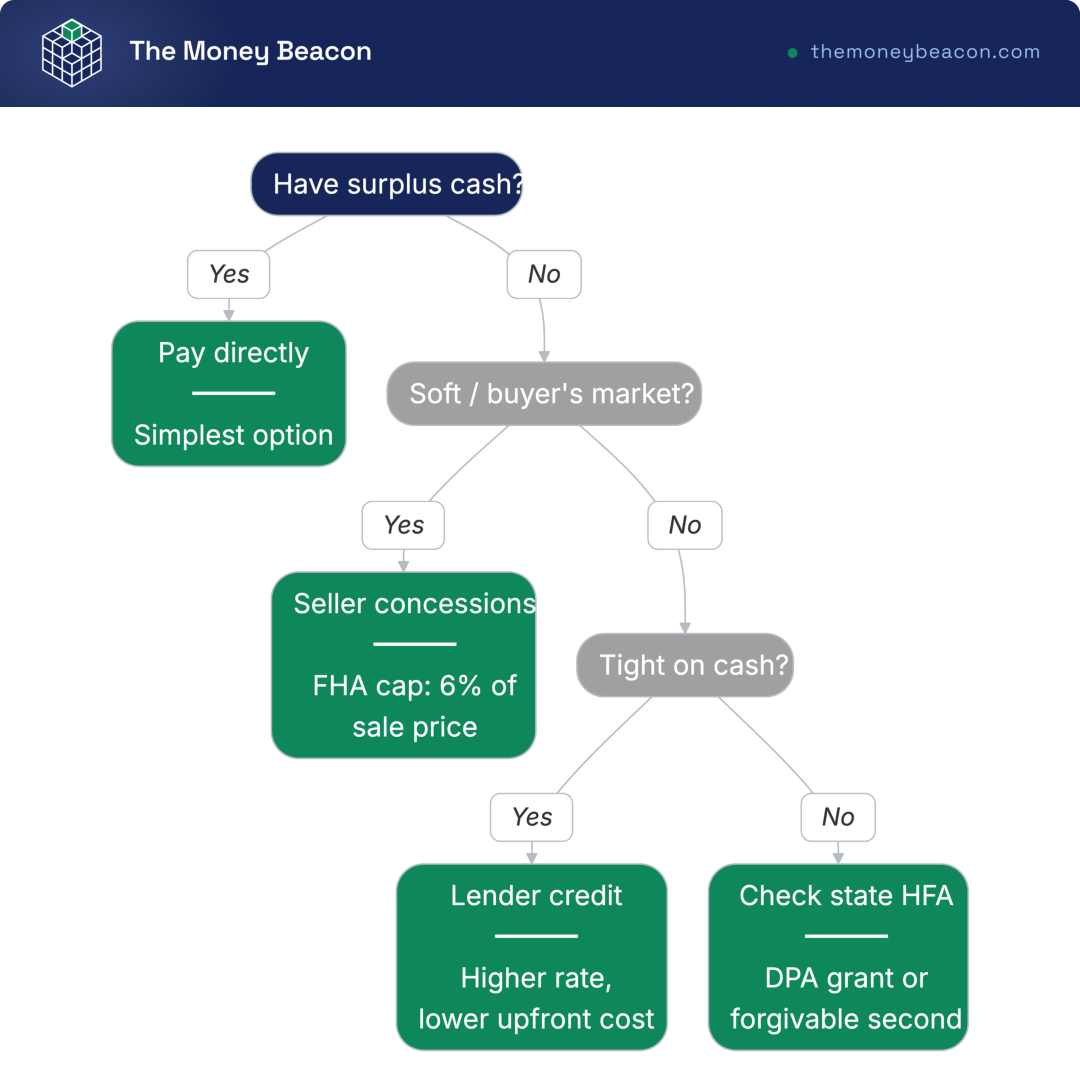
You now have the full cash-to-close picture and three ways to trim it.
6. PMI, First-Time-Buyer Programs, and Tax-Advantaged Cash
The levers that shrink the cash you bring to closing, down payment assistance and the tax-advantaged accounts you might tap, sit alongside the recurring cost you want gone fast once you are in the loan: PMI.
6.1 Private mortgage insurance: what it costs and how to drop it
The PMI riding on a low down payment is a cost you can shed, not a life sentence. Here is exactly how, starting with what that insurance actually buys.
The one thing most buyers get wrong about PMI is who it protects. It is not protecting you. PMI protects the lender if you default; you pay the premium, and the lender collects if the loan goes bad.
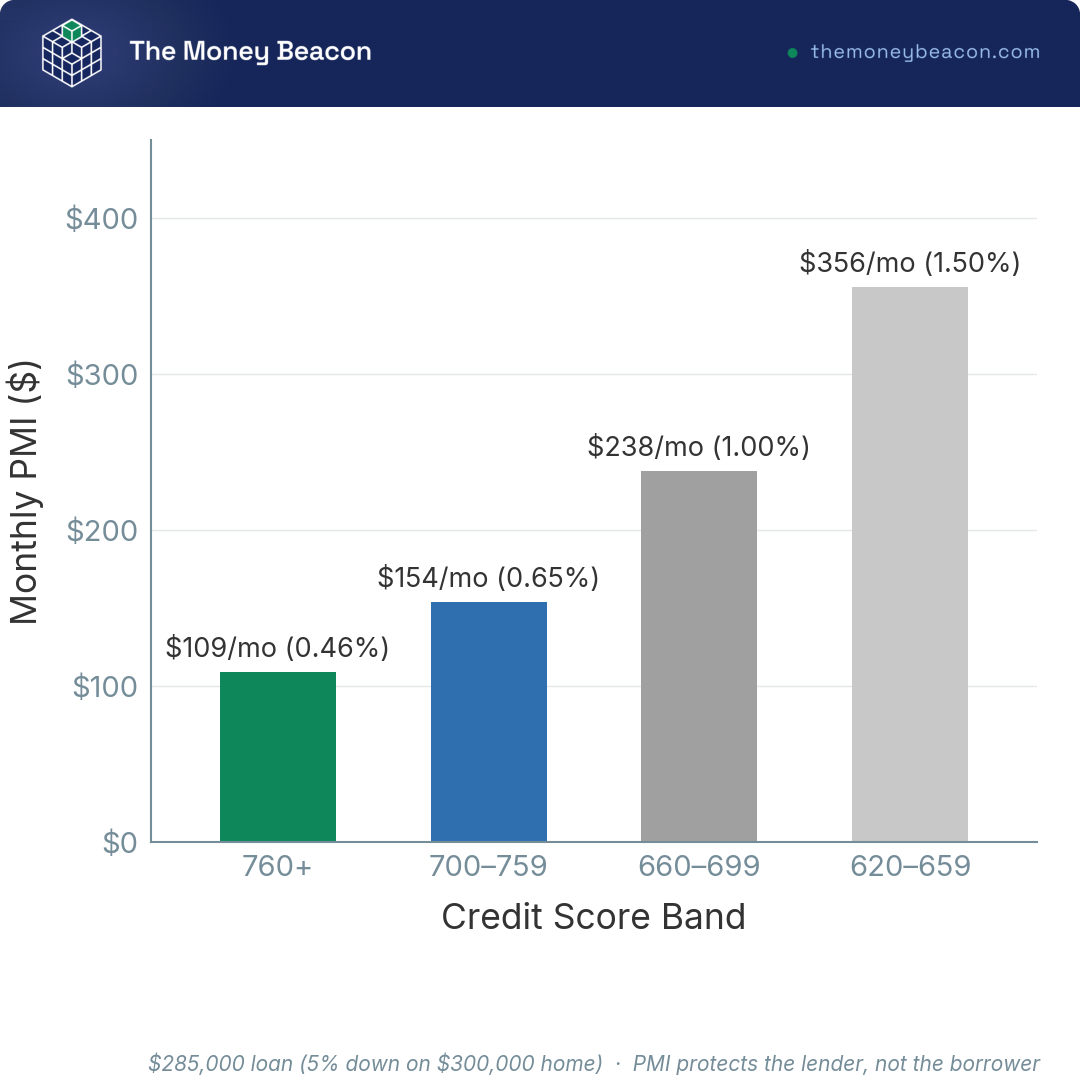
What it costs depends on your credit score, and the spread is wide. On the $285,000 loan a 5%-down buyer carries on the running $300,000 home, the monthly premium runs from one end of the credit ladder to the other like this.
| Credit score | Approx. annual PMI rate | Monthly PMI |
|---|---|---|
| 760+ | ~0.46% | ~$109 |
| 700-759 | ~0.65% | ~$154 |
| 660-699 | ~1.00% | ~$238 |
| 620-659 | ~1.50% | ~$356 |
Data current as of June 2026.
The gap between the top and bottom rows is about $247 a month for the same loan, which is the credit-score lesson from Section 4 showing up again in hard dollars. Clean up your score before you apply and you are not just buying a lower rate, you are buying cheaper insurance on top of it.
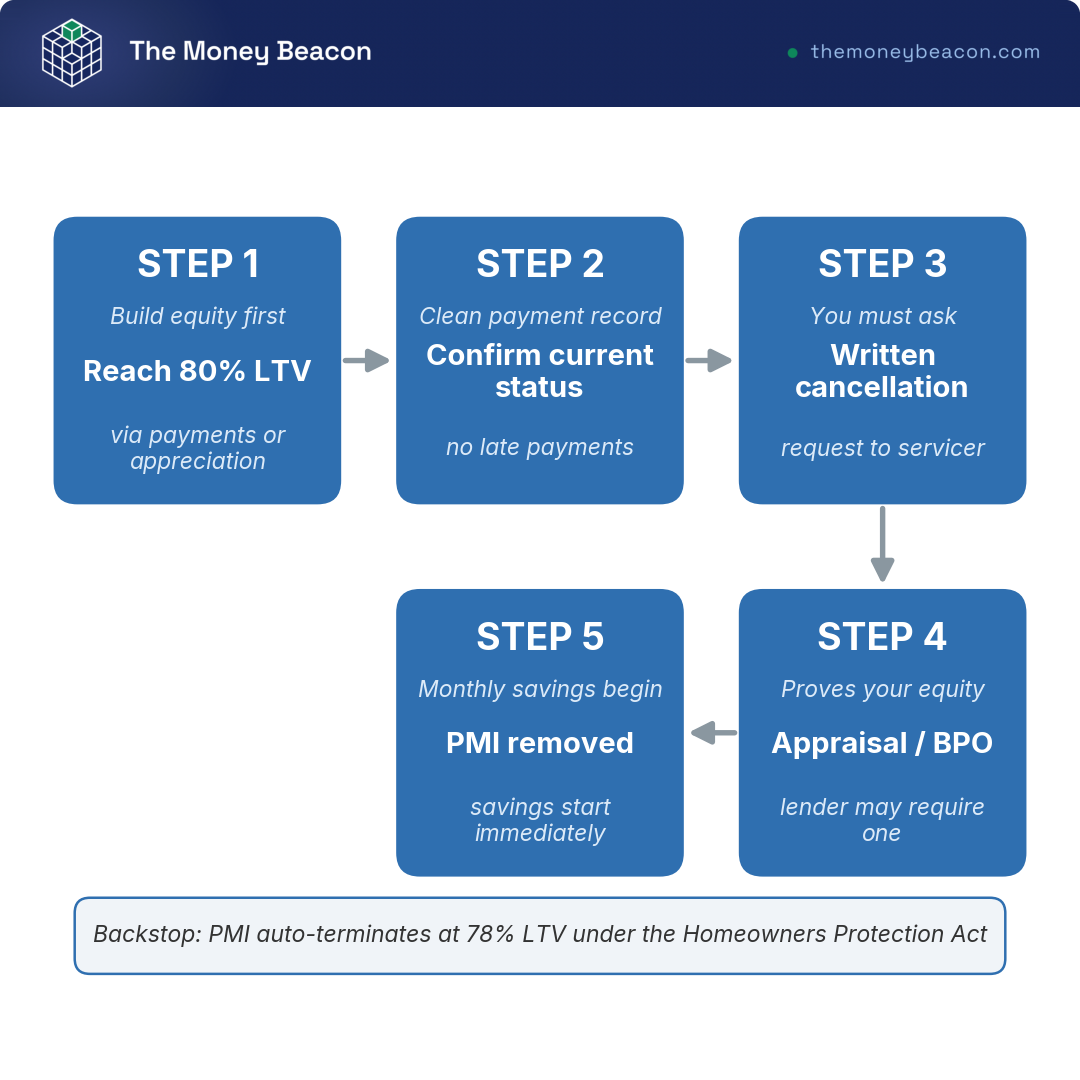
Now the part that matters most: how the PMI on your home loan ends. It runs on the federal Homeowners Protection Act of 1998, and that law gives you two exit points. The servicer must automatically terminate PMI once your loan hits 78% loan-to-value of the original value, as long as you are current. But you do not have to wait for the automatic drop. You can request cancellation the moment you reach 80% LTV, and you should, because that two-point gap can be months of premium you never had to pay. Track your balance against the original price, and the day amortization (or a little appreciation) puts you at 80%, put the request in writing to your servicer rather than waiting for the system to act on its own. The bar chart below shows how the monthly premium climbs as your credit score falls.
6.2 PMI vs. FHA MIP: why the difference matters
Conventional PMI cancels itself on a schedule. FHA’s mortgage insurance, the conventional-vs-FHA-loan comparison we kept teeing up in Section 3, plays by very different rules, and the difference can cost an FHA buyer for decades.
The two are not the same animal. Conventional PMI carries no upfront premium and ends at the 80%/78% LTV marks we just covered. FHA mortgage insurance premium (MIP) starts with a 1.75% upfront premium financed into your loan, then charges an annual premium that, when your down payment is under 10%, lasts the life of the loan. It does not cancel when you cross 80% equity. The only reliable way off it is to refinance the FHA loan into a conventional one once you have built enough equity to qualify, which is the FHA-to-conventional move Section 3 flagged. Here are the two side by side.
| Feature | Conventional PMI | FHA MIP |
|---|---|---|
| Upfront premium | none (usually) | 1.75% UFMIP |
| Cancellation by request | at 80% LTV | not for life-of-loan cases |
| Automatic termination | 78% LTV | refinance required (if <10% down) |
| Protects | lender | lender |
Data current as of June 2026.
The real question is which one you can eventually escape. Conventional PMI you cancel for free; FHA MIP you only escape by refinancing, which costs another round of closing costs and depends on where rates sit when you are ready. Whether that refinance is a plan or just a hope is what shapes the whole FHA-vs-conventional decision, so weigh how a future move into refinancing into a conventional loan would actually pencil out before you accept life-of-loan insurance as the price of a lower credit bar. The flowchart below walks the cancellation steps on the conventional side.
6.3 Down payment assistance and first-time-buyer programs
Down payment assistance is both a savings accelerator and a closing-cost lever, and for a buyer who qualifies it is the closest thing to free or near-free cash in the whole process.
Most of it flows through your state Housing Finance Agency (HFA), with many cities and counties running their own programs on top. The assistance comes in a few shapes, and the shape decides whether you ever pay it back.
| DPA type | How it works | Watch-out |
|---|---|---|
| Grant | no repayment | may have income/price caps |
| Forgivable second | forgiven over a set occupancy period, often up to 10 years | repay if you sell/move early |
| Deferred second | repaid at sale/refi | lien on the home |
| MCC (tax credit) | federal tax credit on mortgage interest | must be eligible; recapture possible |
A grant is the cleanest: money you never repay, usually capped by income and price. A forgivable second is a loan that erases itself if you stay put long enough, often up to 10 years, but sell or move early and the unforgiven balance comes due. A deferred second sits as a quiet lien you settle when you sell or refinance, and a mortgage credit certificate (MCC) is a federal tax credit on part of your mortgage interest. Here is the crucial point for your cash math: assistance can cover closing costs, not just the down payment, so on the $300,000 home it can chip into both the $9,000 down and the $6,000 to $15,000 in closing costs you budgeted.
Eligibility almost always turns on income limits, purchase-price caps, and first-time-buyer status, which for most programs means no principal residence in the prior three years, not literally never having owned. Many programs also ask you to finish a short homebuyer education course. One caution before you go hunting: the viral figures that circulate online, a “$25,000 first-time buyer grant” or a “$7,500 credit,” are proposed federal legislation or specific local programs, not a guaranteed nationwide benefit you can count on as of 2026. Start at your state HFA’s site, check the real income and price limits for your area, and treat any headline number you did not find there as unconfirmed.
6.4 Using an IRA or other accounts for the down payment
If the assistance does not fully close your gap, the next place buyers look is their own retirement accounts, and the rules reward you for knowing which dollar to pull first.
Start with a distinction that saves people from an expensive mistake: an IRA, Roth IRA, and 401(k) are accounts (tax wrappers), while the cash and investments inside them are the assets. Pulling a down payment means selling assets inside the account and withdrawing the cash, not “cashing out a Roth.” With that straight, here is how each account treats a first-home withdrawal.
| Account | Penalty on first-home use | Income tax | Repayment required? |
|---|---|---|---|
| Traditional IRA | waived up to $10,000 | yes, on pre-tax dollars | no |
| Roth IRA | contributions anytime; +$10,000 earnings exception | no on contributions | no |
| 401(k) withdrawal | no first-home exception (10% applies) | yes | no |
| 401(k) loan | n/a (a loan) | no if repaid | yes |
The tax code lets a first-time buyer pull up to $10,000 lifetime from an IRA without the usual 10% early-withdrawal penalty, and that exception covers both traditional and Roth dollars. Here is the catch on a traditional IRA: the penalty is waived, but you still owe ordinary income tax on those pre-tax dollars, so $10,000 withdrawn is not $10,000 in hand. Roth is gentler, because your contributions (the money you already paid tax on) come out anytime tax- and penalty-free, and the $10,000 exception then lets earnings come out penalty-free too.
A 401(k) has no first-home exception at all, so a straight withdrawal eats the 10% penalty plus tax; a 401(k) loan (up to $50,000 or 50% of your vested balance) sidesteps the tax if you repay it, but leaving your job can trigger fast repayment of the whole balance.
So the order of operations is clear: tap your Roth contributions first because they cost you nothing, and hold the $10,000 IRA exception in reserve for earnings, where the penalty waiver actually buys you something. One wrinkle is specific to this exception: it uses its own definition of “first-time buyer,” meaning no home ownership in the prior two years, not the three-year version the loan programs use. Before you treat any retirement account as a down payment source, it is worth understanding exactly how how a Roth IRA’s withdrawal rules work, since the contribution-versus-earnings line is what determines your tax bill.
6.5 Mortgage interest, property tax, and the homeowner tax reality
One myth deserves a quiet burial: the idea that you should buy a house for the tax break. For most first-time buyers, that break is smaller than the pitch suggests, and often it is nothing at all.
The deductions are real on paper. If you itemize, you can deduct mortgage interest on up to $750,000 of acquisition debt and your state and local taxes, including property tax, capped at $10,000 under current 2026 law. The problem is the word if. Those deductions only help when your itemized total beats the standard deduction, and the standard deduction is large enough that a buyer with a modest loan, say the $291,000 balance on a 3%-down purchase, usually clears more by taking the standard deduction and skipping the itemized math entirely. So the interest you pay does not automatically become a write-off; for many first-timers it never gets used.
Treat any tax savings as a bonus you might collect later if your numbers grow into itemizing, not a reason to buy now. If your goal is to actually move the needle on what you owe each April, the levers that lower your taxable income are usually a more reliable place to start than counting on a mortgage-interest deduction you may never itemize. With the money side fully mapped, the down payment, the loan, the cash to close, and now the tools that shrink all three, only one thing stands between you and the keys: actually going out and buying the house.
7. From Offer to Keys: House Hunting, Offers, and Closing
You have the budget, the program, the pre-approval, and the cash. Now comes the part that feels like the whole point, finding the house and getting the keys, and it runs as a sequence you can manage if you know the order.
7.1 House hunting with a budget and a buyer’s agent
The search starts with a number you already set: your livable target from Section 1, not the lender’s ceiling. The listing platforms make it easy to forget the difference.
Redfin, Zillow, and Realtor.com will happily show you everything up to your pre-approval limit and a little beyond, which is exactly how disciplined buyers drift into homes their budget cannot carry on a bad month. Set your search range to the payment you can live with, not the maximum a lender approved, and hold that line when a slightly nicer listing sits just above it.
The other thing that changed recently is how you pay the person showing you those homes. After the 2024 National Association of Realtors settlement (effective August 17, 2024), the seller is no longer assumed to cover your buyer-agent’s fee. Buyer-broker fees are now negotiated separately and may be paid by you, by the seller, or folded into the concessions we covered in Section 5. You also have to sign a written buyer representation agreement before an agent tours homes with you, so read that agreement closely, because it spells out exactly what you are agreeing to pay and under what terms. Settle the fee question with your agent up front, in writing, before you fall for a listing.
7.2 Making an offer: price, contingencies, and earnest money
You found the house. An offer is more than a price; it is a small contract, and the clauses you include are what protect the earnest money you put at risk back in Section 5.
An offer has three moving parts: the price, the earnest money deposit (the 1% to 3% good-faith deposit, $3,000 to $9,000 on the $300,000 home, credited back to you at closing), and the contingencies. Contingencies are the exits that let you walk away with your deposit intact if something goes wrong, and each one guards against a specific risk.
| Contingency | Protects against | Effect of waiving |
|---|---|---|
| Financing | loan falling through | lose earnest money if denied |
| Appraisal | overpaying above appraised value | must cover the gap in cash |
| Inspection | hidden defects | no out for major problems |
| Title | liens/ownership defects | rarely waived |
The financing contingency protects you if your loan falls through, so waiving it risks your earnest money the day the lender says no. The appraisal contingency protects you from overpaying above the home’s appraised value; waive it and you are on the hook to cover any gap in cash. The inspection contingency is your only out if the inspector finds serious defects; waive it and a cracked foundation becomes your problem. In a hot market, sellers favor offers that waive these, which tempts buyers to strip them out to win. Treat every waived contingency as a deliberate, priced bet, not a default move to look competitive, because each one you drop is real money or a real escape hatch you are handing away.
Tom’s take
I carry mortgage debt on rental property, so I have sat on both sides of these offers. The one contingency I would not casually drop is the inspection. Winning the house by waiving your only look under the hood is how a good deal turns into a five-figure repair you financed at mortgage rates.
7.3 Inspection and appraisal: protecting yourself before you commit
Two checks stand between an accepted offer and a signed loan, and they answer two different questions: is the house sound, and is it worth what you agreed to pay?
The inspection is yours to order, runs roughly $300 to $425, and is optional but worth every dollar. A good inspector finds the defects you cannot see on a showing, the aging roof, the failing water heater, the moisture in the basement, and the inspection contingency turns those findings into leverage. You can ask the seller to fix the problems, credit you to fix them yourself, drop the price, or walk away entirely if the report is bad enough. The appraisal is different: your lender orders it (typically $300 to $500) to confirm the home is worth the loan, not to protect you from defects. If the appraisal comes in below your offer price, you have three choices: renegotiate the price down to the appraised value, cover the gap out of pocket in cash, or invoke the appraisal contingency and walk.
7.4 Closing day: the Closing Disclosure, walkthrough, and keys
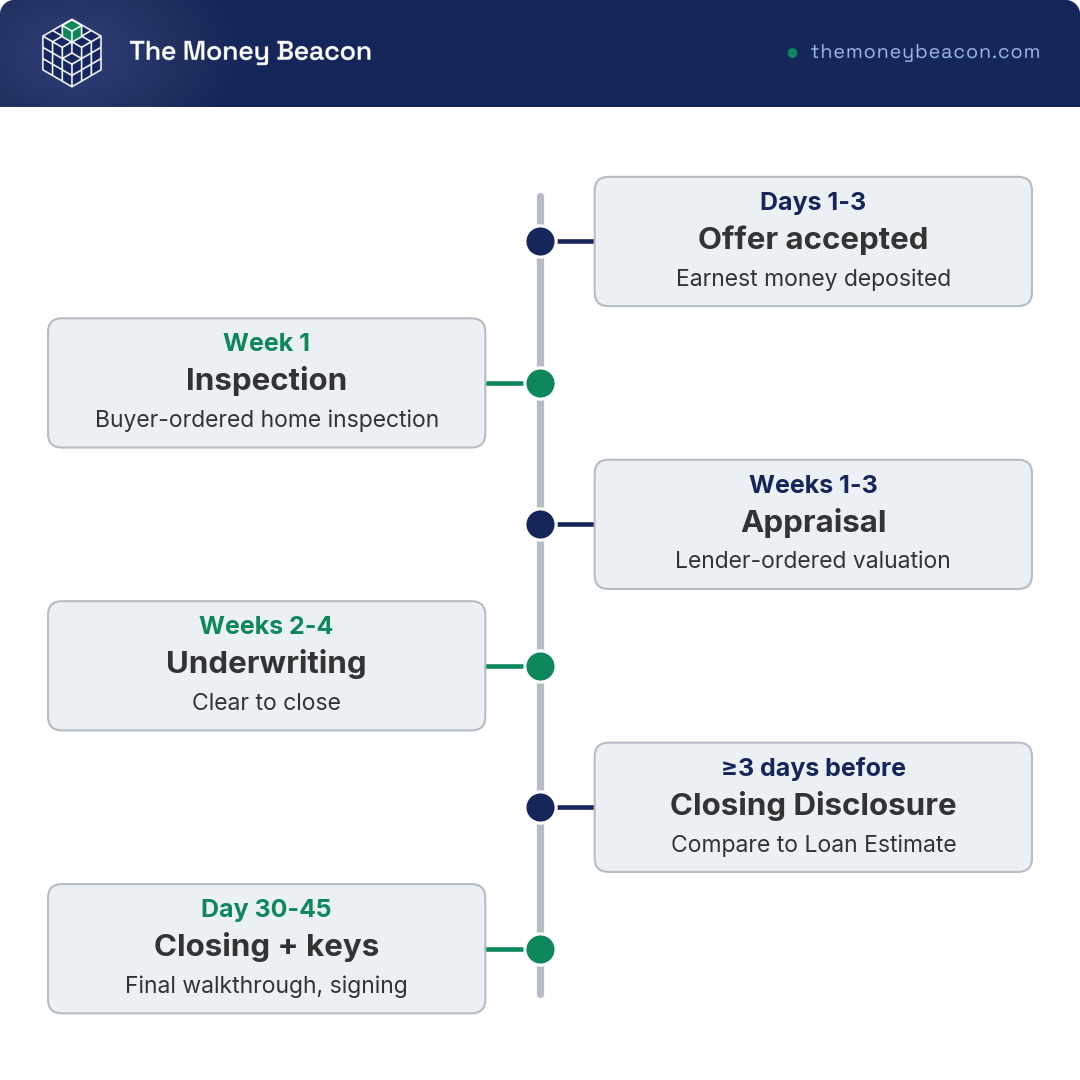
From an accepted offer to keys in hand usually takes 30 to 45 days, and the milestones fall in a predictable order. Your earnest money lands in escrow in the first one to three days, the inspection happens in week one, the appraisal lands within the first three weeks, and underwriting issues its clear to close somewhere in weeks two to four.
The most important deadline in that window is one you cannot miss. By law (the TRID/TILA-RESPA rules), your lender must deliver the Closing Disclosure at least three business days before you sign, and that three-day window exists for exactly one reason: so you can read it. Set it next to the original Loan Estimate you used to shop lenders back in Section 4 and compare them line by line, because the two forms are built to match. The rate, the fees, the cash to close, and the monthly payment should line up; if a number jumped, ask why before you sit down to sign. Missing a discrepancy on the Closing Disclosure is one of the most common and most expensive last-minute mistakes a buyer makes. The timeline below maps the whole run from offer to keys.
After the disclosure clears, two steps remain. You do a final walkthrough, usually the day before or the morning of closing, to confirm the home is in the condition you agreed to and any negotiated repairs got done. Then you sign, you fund the cash to close you spent this whole guide preparing for, and the keys are yours.
7.5 Your first-home decisions and action plan at a glance
Trace the whole path and the central question, “can I even afford this, and how do I actually do it?”, has a clear set of answers. Here is the same journey as a checklist you can carry into the process, step by step.
| Step | To do | To avoid | Common mistake |
|---|---|---|---|
| Affordability | Set a livable PITI under the 28/36 guideline | Maxing the lender’s ceiling | Ignoring maintenance/HOA |
| Down payment | Match down to program + keep reserves | Draining all cash to hit 20% | Believing 20% is mandatory |
| Loan choice | Compare PMI vs. MIP cancelation | Defaulting to FHA with good credit | Overpaying lifetime MIP |
| Pre-approval | Get underwritten approval; shop 3+ lenders | New debt before closing | Opening a car loan mid-process |
| Cash to close | Budget closing costs separately | Forgetting prepaids/reserves | Underbudgeting by thousands |
| PMI | Track LTV; request removal at 80% | Paying PMI past 80% LTV | Not asking servicer to cancel |
| Offer/closing | Keep key contingencies; review the Closing Disclosure vs. the Loan Estimate | Waiving inspection blindly | Missing Closing Disclosure discrepancies |
Conclusion
Remember the buyer from the start of this guide, the one who lands on $60,000 for a $300,000 home and quietly decides homeownership is a club that already closed its doors. That buyer was off by about $51,000: the real floor is $9,000 on a conventional loan, and as little as $0 if you qualify for VA or USDA. The 20% number was never the price of entry; all it buys you is a way out of PMI.
The bigger lesson is that the cash to close is not one number, it is several: on that same home you want closer to $15,000 to $24,000 ready, not the $9,000 the down payment alone suggests. That is the figure that ambushes first-time buyers, and now it will not ambush you.
So you have the whole sequence by now. You know what payment your budget can actually live with, which program fits your credit and your eligibility, how to walk into an offer with an underwritten pre-approval sellers respect, and how to protect your earnest money with contingencies you price like the bets they are. You know to drop conventional PMI the day you hit 80% LTV, and to read the Closing Disclosure against your Loan Estimate line by line before you sign anything.
Here is the one move to make this week: open a dedicated high-yield savings account and automate a transfer into it.
When you are ready to take the next step, it is worth shopping our comparison of current mortgage rates before you settle on a lender, lining up our comparison of homeowners insurance for the “I” in your PITI, and reading our guide to diversifying your savings so your down payment cash keeps working while you wait.
Frequently Asked Questions
How much do I really need for a down payment on a $300,000 house?
Less than most people assume. A conventional loan can go as low as 3% ($9,000), FHA needs 3.5% ($10,500), and VA or USDA loans (for eligible buyers) ask for 0% down. The famous 20% ($60,000) only matters because it lets you skip private mortgage insurance on a conventional loan. The down payment is not the whole bill, though, so plan for closing costs of 2% to 5% ($6,000 to $15,000) and earnest money of 1% to 3% on top. The practical takeaway: at $500 a month, saving the 3% ($9,000) takes about 18 months, while the 20% ($60,000) takes roughly ten years. For most first-time buyers, that gap is the difference between owning this year and owning never, and a dedicated high-yield savings account is the right place to park that money while you build it.
How much is PMI on a $300,000 mortgage, and when does it go away?
On a loan around $285,000 to $291,000 (5% to 3% down), private mortgage insurance commonly runs about $110 to $360 a month, since rates sit in the 0.5% to 1.5% band and the price is driven by your credit score. Here is the part many people get wrong: PMI protects the lender if you default, not you. The good news is it is not permanent on a conventional loan. Under the Homeowners Protection Act, you can request cancellation once you hit 80% loan-to-value, and your servicer must drop it automatically at 78% LTV, as long as your payments are current. A common and costly mistake is simply forgetting to ask, so track your balance and request cancellation the moment you cross 80%.
Is an FHA loan better than a conventional loan?
It comes down to your credit. FHA accepts scores as low as 580 with 3.5% down and is easier to qualify for, but its mortgage insurance often lasts the life of the loan when you put under 10% down, and removing it usually means refinancing into a conventional loan. Conventional loans typically want around 620, but they let you cancel PMI at 80% LTV and price that insurance lower when your score is strong. So if your credit is solid, conventional is usually cheaper over the years; if your credit is thin, FHA may be the only door open to you. Some sellers also lean toward conventional offers because they expect fewer appraisal hurdles, which can matter in a competitive bid.
How much are closing costs on a $300,000 house, and can the seller pay them?
Budget 2% to 5% of the price, roughly $6,000 to $15,000, covering lender fees, the appraisal, title insurance, escrow, recording and transfer taxes, and prepaid taxes and insurance. The seller can cover part of them through concessions, capped by your loan program (FHA treats contributions above 6% of the sales price as inducements; conventional caps scale with how much you put down). Two other levers help when cash is tight: a lender credit, where you accept a slightly higher rate in exchange for the lender covering some costs, and down payment assistance that often folds in closing costs. The point is you rarely have to drain your reserves to zero just to get to the closing table.
Can I use my IRA or 401(k) for a down payment?
Yes, with limits worth understanding before you touch the money. A first-time buyer can pull up to $10,000 lifetime from an IRA without the 10% early-withdrawal penalty, though a traditional IRA withdrawal still owes ordinary income tax on those pre-tax dollars. A Roth IRA is more flexible: you can withdraw your own contributions anytime, tax- and penalty-free, so take those first and reserve the $10,000 exception for earnings. A 401(k) has no first-home penalty exception, but you may be able to take a 401(k) loan (up to $50,000 or 50% of your vested balance) that avoids tax if repaid, with one catch: leaving your job can trigger fast repayment of the balance. If you want the full mechanics of the account itself, our Roth IRA guide walks through the contribution and withdrawal rules.
What credit score do I need, and what debt-to-income ratio will lenders allow?
There is no single magic number, but here are the practical floors: about 620 for conventional, 580 for FHA at 3.5% down (or 500 to 579 with 10% down), and no statutory minimum for VA or USDA, though lenders often overlay 620 to 640. A higher score does more than open the door; it lowers your rate and your PMI, so even a 20 to 40 point bump before you apply can save real money. On debt, the classic guideline is 28% of gross income toward housing and 36% toward total debt, but automated underwriting often approves higher: conventional back-end DTI can reach 50% with strong credit and reserves, and FHA can stretch past its 31%/43% benchmarks with compensating factors. The lender sets a ceiling, not a target, so aim for a payment that survives a bad month, not the maximum they will hand you.
Is that $25,000 first-time buyer grant real, and how long does closing take?
Be careful here. Figures like a “$25,000 first-time buyer grant” or a “$7,500 government grant” circulate widely online, but as of 2026 no such nationwide federal grant is enacted law. Those numbers point to proposed legislation (a proposed up to $25,000 down payment grant and a separate proposed up to $7,500 annual mortgage relief credit) or to specific local programs, not a guaranteed benefit you can count on everywhere. What is real and worth chasing: state Housing Finance Agency down payment assistance, which offers grants, forgivable seconds, or deferred-payment seconds, usually gated by income and purchase-price limits. As for timing, from accepted offer to keys you should expect 30 to 45 days, including inspection, appraisal, underwriting, and a mandatory 3-business-day review of your Closing Disclosure before you sign.



Comments
Questions and corrections welcome. We read everything.