


You finally decide to buy life insurance, so you go looking for a price. Banner Life advertises term coverage from $8 a month. Read the footnote and that price belongs to a 20-year-old nonsmoker in excellent health, buying $100,000 of coverage. That’s the smallest policy the company sells, on its shortest term. Change any one of those things and the $8 is gone.
Here’s what usually goes unsaid: not one of the six carriers in this comparison will quote you a price. Life insurance is individually underwritten. An underwriter sets the real number after you apply, once someone has pulled your prescription history, your medical records, and your driving record. The quote is an estimate. The offer is the price.
Banner Life is the only one of the six that publishes the arithmetic on what that underwriting verdict costs you. Its own product specs say premiums rise 25% for each table rating an underwriter assigns. So a Table 4 offer, four notches down the health ladder, costs roughly double the standard premium. That’s the same application and the same company, weeks after a quote engine gave you a friendlier number.
So what can you actually compare? Northwestern Mutual has paid a dividend every year since 1872 and publishes a 5.75% dividend interest rate for 2026, which is a strong record. It also publishes no face amounts, no issue ages, and no risk classes anywhere on its site. And one of these six isn’t an insurance company at all.
That’s why this isn’t a price table. It’s a comparison of what each carrier publishes and what it will actually sell you, from level term lengths and exam-free ceilings to conversion deadlines, dividend records, and financial strength. I’ll show you how a life insurance premium is really built and how to size the death benefit you need. I’ll cover where term life, whole life, and the no-exam paths each make sense, and which of these companies belongs on your own quote list.
1. How I compared six life insurance carriers, and why not one of them will quote you a price
Before any carrier name means anything, you need to know what can actually be compared.
1.1 The criteria I applied to all six carriers
This life insurance comparison 2026 uses nine criteria, applied identically to every company: positioning and distribution, fees, products and level periods, access conditions (issue ages, face amounts, states), published pricing, application experience, service and claims, financial strength, and tax treatment. Every fact comes from a carrier’s own site or a US regulator.
Three are participating mutuals sold through advisors: Northwestern Mutual, MassMutual and New York Life. State Farm is a stock carrier with captive agents. Banner Life is a stock term specialist, owned since February 2, 2026 by Meiji Yasuda North America Holdings. Ethos isn’t an insurer at all, just a licensed producer and third-party administrator that sells policies other companies issue.
Table: Decision speed, claim timing, distribution and state footprint
| Carrier | Decision speed published | Claim timing published | Distribution | States |
|---|---|---|---|---|
| Northwestern Mutual | “as soon as the same day” | A claim paid on average every half hour | 8,000+ advisors | Not all products in all states |
| MassMutual | MassExpress fluidless, no exam or labs | Not published | Financial professionals | All states, DC and Puerto Rico for MassExpress |
| New York Life | 24 to 48 hours on two accumulation products | Claims desk 8 am to 7 pm ET | 12,000+ agents | All states; two products exclude California |
| State Farm | Instant Answer approved “in minutes” in office | 1 to 2 days to acknowledge, 1 to 3 to process, 10 business days by check | 19,000+ agents | Not licensed MA, NY, WI; not marketing MA, RI |
| Banner Life | More than 1 in 3 get an instant decision (April 2026) | One business day once approved; 99% of claims paid | 150,000+ agents plus direct | 49 states, DC, Puerto Rico; New York via William Penn |
| Ethos | Often instant, otherwise days to weeks | Beneficiary files with the issuing carrier | Online, in-house agents, independent network | 49 states and DC; not New York |
Data current as of August 2026.
Read that last column first, because a policy you can’t buy where you live isn’t a policy.
1.2 Why none of these six will quote you a price
A life premium isn’t a posted rate, it’s an underwriting output. Age, sex, tobacco status, health and prescription history, driving record, occupation and face amount set your class, and the class sets the price.
So life insurance quotes pulled from six sites can’t be compared side by side. Every published number is an illustration at a profile the carrier picked for itself: 25-year-old female, Illinois, $250,000 at State Farm; 25-year-old, $100,000 at MassMutual; 40-year-old male, $250,000 at Banner Life; 30-year-old female, $500,000 at Ethos; 35-year-old, $500,000 to age 80 at Northwestern Mutual. New York Life publishes no premium at all.
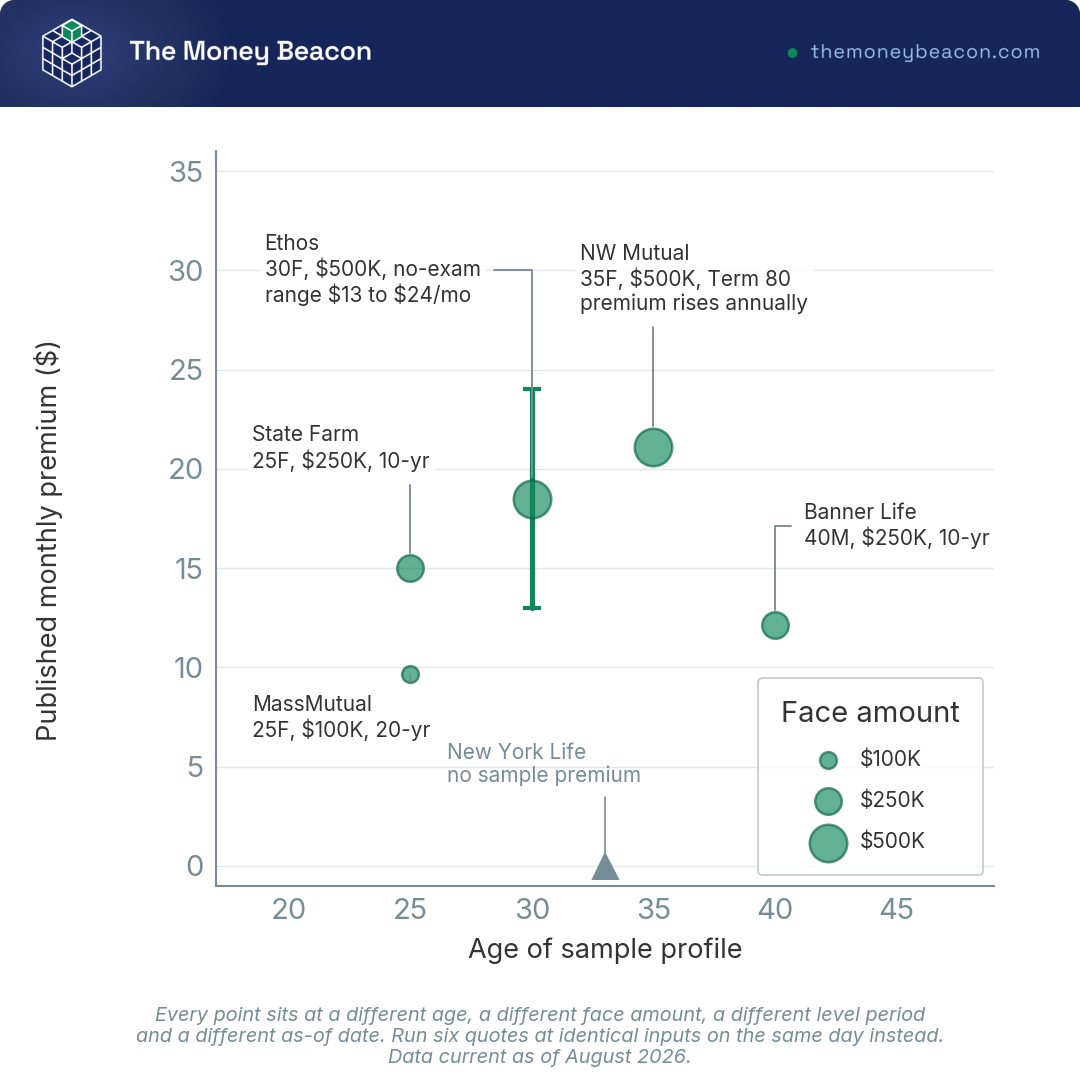
Four ages, four face amounts, five underwriting classes: stacking those is a measurement error. And a quote is only an estimate anyway, so the offer you get after underwriting is the price.
1.3 Work out your number before you shop a single carrier
Size the coverage first, because the face amount (the death benefit paid out) determines which carriers can serve you at all.
Take a $95,000 earner, age 38, two children. DIME stands for debt, income, mortgage and education. For that family: $600,000 of income replacement ($60,000 a year for ten years), a $260,000 mortgage, $125,000 of education for two, and $35,000 of debt and final expenses. That subtotals $1,020,000. Add a $125,000 buffer for childcare and lost employer benefits and you’re at $1,145,000.
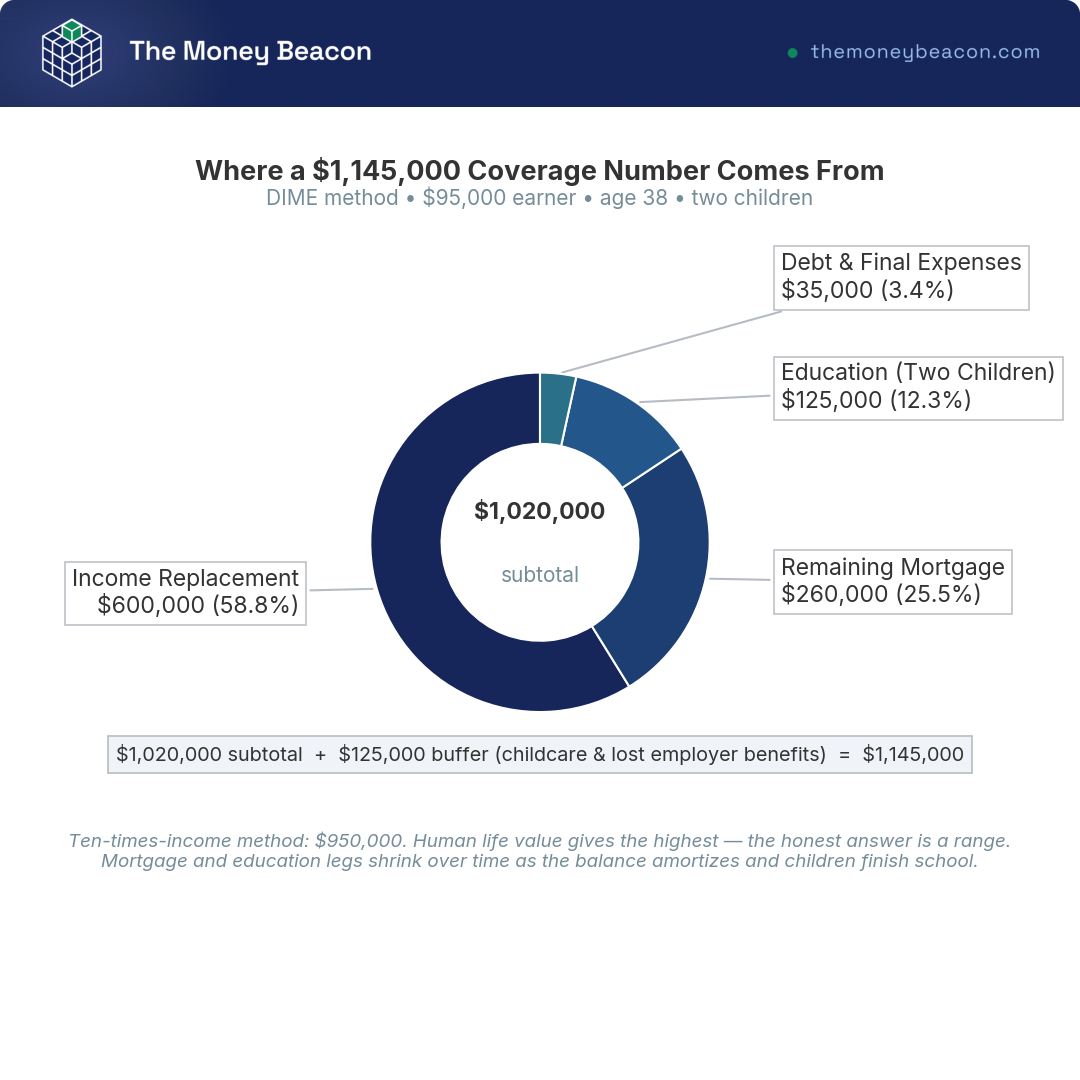
The ten-times-income rule gives $950,000. Take the higher, subtract what you already have, and don’t count group life as the plan: the balance in your 401(k) follows you, your group death benefit doesn’t.
So how much coverage to buy? Around $1.1 million.
1.4 Term, whole life, universal life: the four shapes on sale in 2026
The term vs whole life insurance question is really about how long the need lasts, not which product is better.
Cash value is the money that accumulates inside a permanent policy and that you can borrow against; level term builds none. A whole life dividend is a share of the company’s surplus, credited at a rate the board sets yearly and publishes as the dividend interest rate. Universal life insurance uses an interest-crediting rate instead, and the guaranteed kind adds a no-lapse rider. A rider is any optional add-on to the contract.
Table: The four life insurance product shapes on sale in 2026
| Shape | What it guarantees | Cash value | Who publishes it here |
|---|---|---|---|
| Level term | Death benefit for a fixed level period | None (MassMutual: “No cash value”) | All six |
| Participating whole life | Death benefit for life, fixed premium, dividends possible | Guaranteed growth | Northwestern Mutual, MassMutual, New York Life, State Farm |
| Universal life (incl. guaranteed UL) | Lifetime coverage on a crediting rate, flexible premium | Interest-crediting, no dividend | All except Ethos direct (Ethos sells indexed UL through North American) |
| Guaranteed issue whole life | Small face amount, no medical questions, graded first years | Small guaranteed cash value | State Farm, Ethos, Banner Life through Ethos |
A need that ends (a mortgage, dependent children) points to term. A need that never ends (estate liquidity, a lifelong dependent, a buy-sell agreement) points to permanent. Buying term and putting the difference into a low-cost index fund held for decades is the standard case against permanent, and it only works if you actually do it.
1.5 What happens to a term premium the day the level period ends
So what happens when term life expires? The premium starts increasing annually, and it keeps increasing.
Banner Life says premiums increase annually to age 95 after the initial level term period, with coverage expiring at 95. State Farm matches that, adding that increases will never exceed the maximum premium stated in the policy. New York Life’s wording is that premiums will increase each year thereafter. Ethos term renews to 95, with the coverage decreasing as the premium increases.
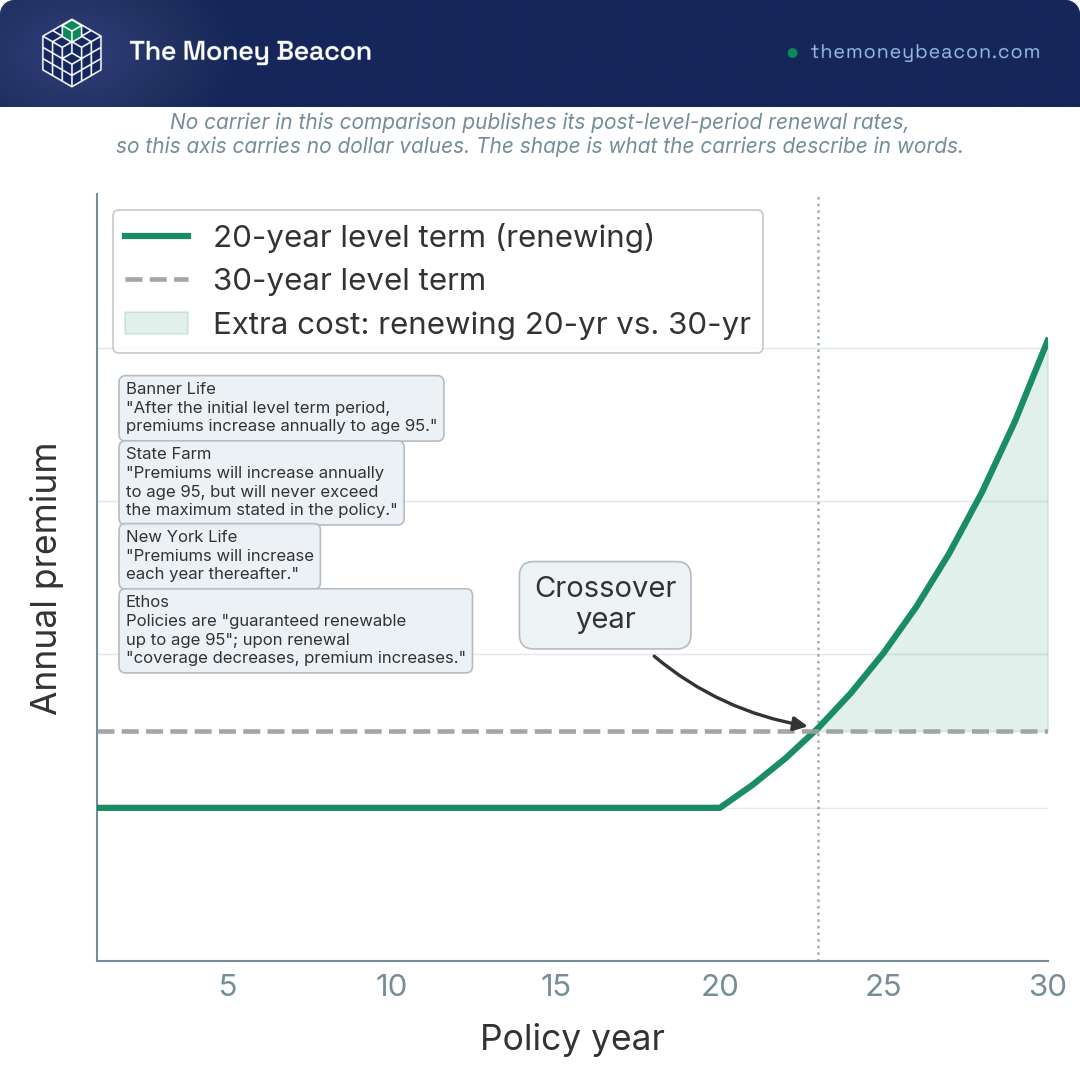
Read that chart as a shape, not a price: the axis has no dollar values because no carrier publishes its renewal scale. So choose the level period to outlast the later of your mortgage payoff and your youngest child’s independence. Buying short and renewing later is the expensive path.
1.6 The dates on a term policy you cannot afford to miss
Eight dates determine whether a policy does what you thought it would.
The free look is your window to cancel for a full refund: 30 days at Banner Life and Ethos; 20 on New York Life’s registered products; 10 on MassMutual’s Apex variable universal life in most states (30 in California, 14 in Florida, 20 in North Dakota). State Farm defers to the state contract and publishes none. Northwestern Mutual’s free look sits in a prospectus filed with the Securities and Exchange Commission (SEC) that I couldn’t open.
Contestability is the window in which the insurer can still investigate a claim and rescind for a misstatement. It’s two years at Banner Life (one year in Colorado, Missouri and North Dakota), and two years on the MassMutual and New York Life registered products. The suicide clause runs alongside it. State Farm publishes the suicide clause with a North Dakota carve-out but no incontestability period. Ethos gives a 31-day grace period after a missed premium, 60 days in California.
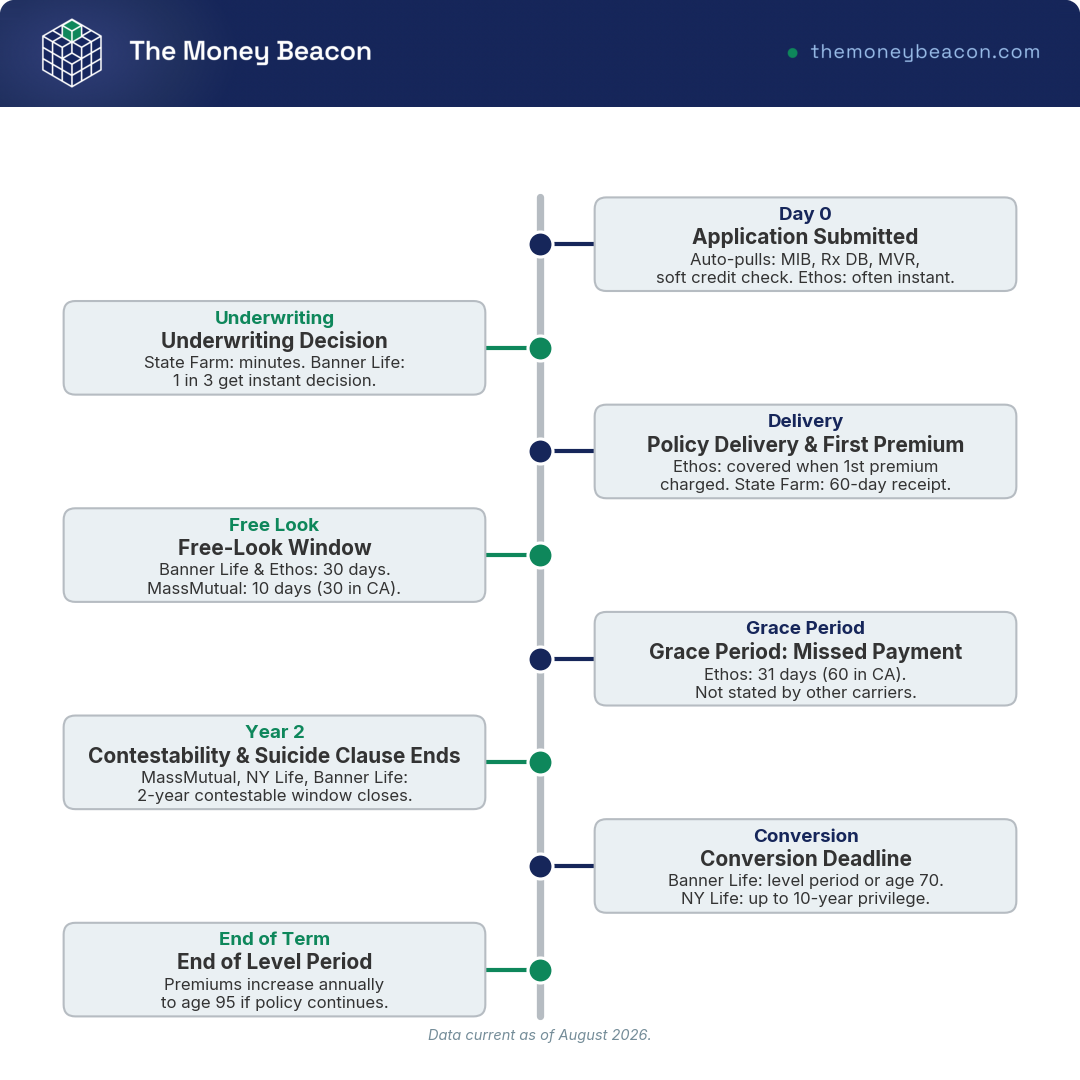
The term conversion deadline comes first, and most buyers never track it: your right to swap term for permanent without new medical evidence expires years before the term does. Put it on your calendar the week the policy is issued.
1.7 How much each carrier lets you check before an agent picks up
I rated six facts a buyer can check alone, one point each: published term issue ages, published life insurance face amount limits (a floor and a ceiling, counted separately), an exam-free ceiling, a conversion deadline, and a published sample premium.
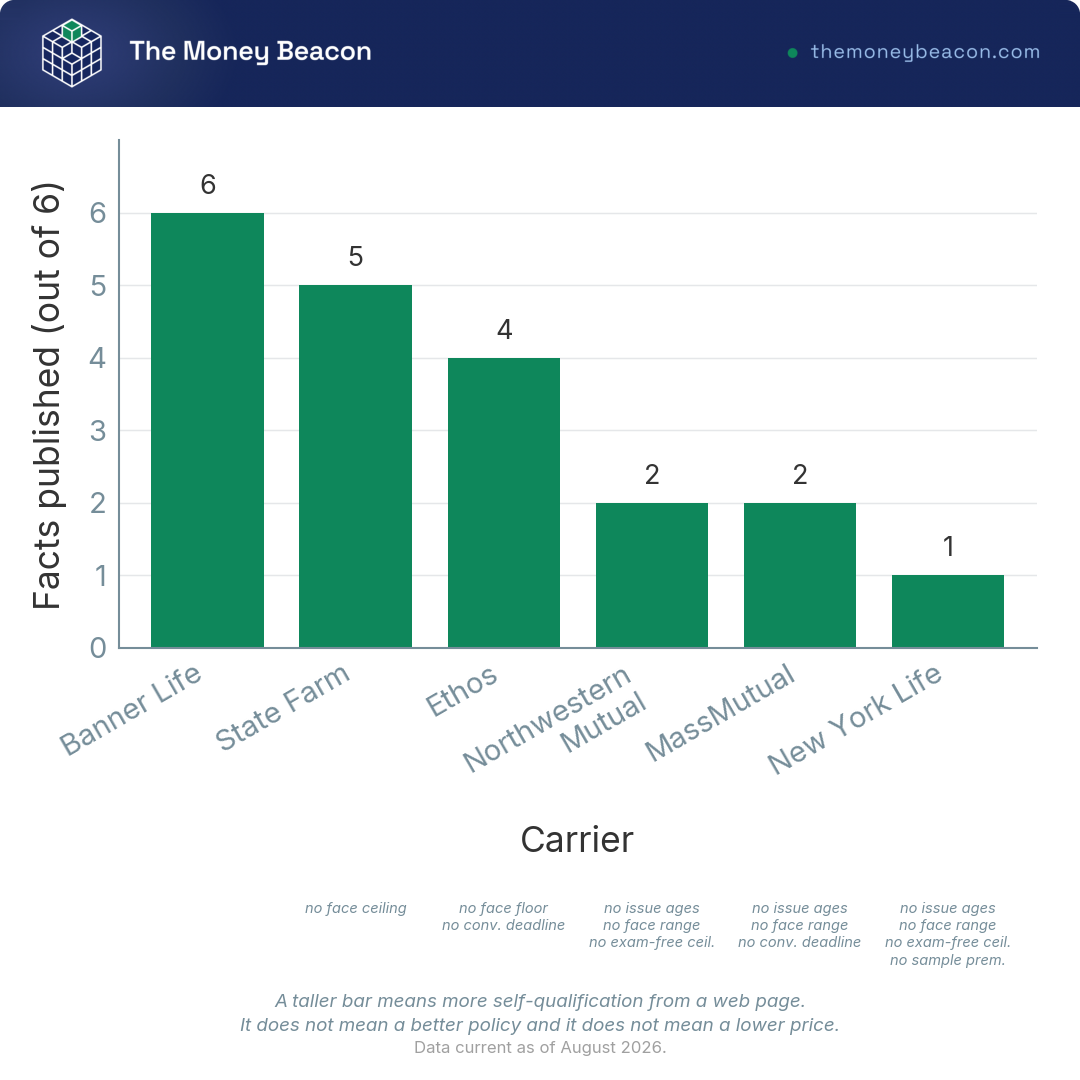
Banner Life publishes all six, State Farm five, Ethos four, Northwestern Mutual and MassMutual two each, New York Life one. But a taller bar means more self-qualification from a web page, not a better or cheaper policy.
Why are the short bars short? Northwestern Mutual routes every pricing question to one of its 8,000-plus advisors, and across all 280 URLs in its static sitemap there’s no face range, no issue age, no risk-class table. New York Life’s 1,216-URL sitemap has zero pages matching “quote.” That’s a deliberate sales model, not an oversight.
1.8 What a health rating actually costs, in dollars
Life insurance underwriting doesn’t just say yes or no. It puts you in a class, and a substandard file gets a table rating, a percentage load on the standard premium.
Only Banner Life publishes the arithmetic: 25% more per table rating, issuing through table 12. On its own sample, a 40-year-old male nonsmoker in excellent health buys $250,000 of 10-year OPTerm at $12.11 a month (rates as of January 15, 2026). From there, table 2 costs about $18.17, table 4 about $24.22, table 8 about $36.33 and table 12 about $48.44. That’s four times the sample premium for the same death benefit.
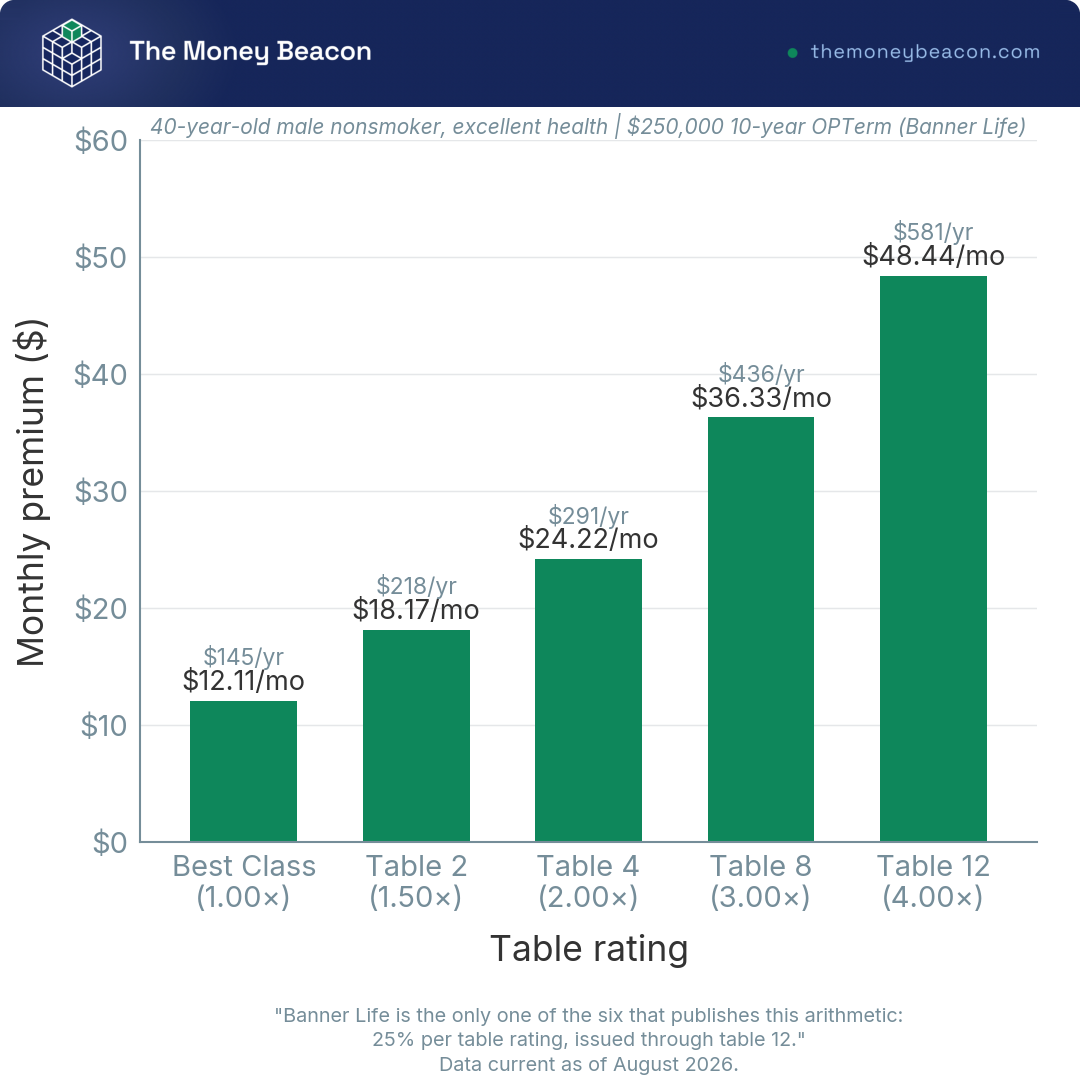
The same file gets classed differently by different underwriters, so a rated offer is a reason to shop, not to sign. And the records behind it (prescription history, motor vehicle record, Medical Information Bureau file) are consumer reports under the Fair Credit Reporting Act, so the adverse-action notice has to name the report and you can dispute it.
Hank’s take

underwriting is a pricing model, and models disagree. Insurance is priced off risk pooling and expected value, not off your personal story, so one company’s table 4 is one company’s read of a file. After years of picking apart data, that’s the part I’d hold onto: never treat a single rated offer as the number.
1.9 Exam-free, simplified issue and guaranteed issue: what each path waives
Three paths are sold as no exam life insurance, and they waive very different things.
Table: Accelerated, simplified issue and guaranteed issue: what each path waives
| Path | What is waived | What is still checked | Typical trade-off |
|---|---|---|---|
| Accelerated / algorithmic | Paramed exam and labs | MIB, prescription history, motor vehicle record, application answers | Best-class pricing preserved; face and age ceilings apply |
| Simplified issue | Exam, and most of the file | A short health questionnaire | Priced above fully underwritten; lower face amounts |
| Guaranteed issue | Everything, acceptance guaranteed | Nothing that can decline you | Graded death benefit in the first two to three years; smallest face amounts |
The exam-free path is never guaranteed. Both Banner Life and Ethos say an applicant can still be asked for follow-up questions or an exam, which resets your timeline by weeks. So don’t cancel existing coverage while an application is pending, and keep the premium money in an FDIC-insured account paying a real APY, the annual percentage yield.
Four limits are worth stating up front. Products and riders vary by state, by issuing entity and by filed form. Dividends aren’t guaranteed, and each participating carrier resets its own every year. Ratings are opinions about ability to pay claims, not about price or service. And none of this is individualized advice, which is why section 8 answers by reader profile. It’s also why paying a fee-only fiduciary for an hour costs far less than a mispriced permanent policy.
Each review below uses the same five headings in the same order.
2. Northwestern Mutual: the longest dividend record in the country, and the least you can check before you call an advisor
The largest direct provider of individual life insurance in the United States is also the one that tells you the least before you talk to a human being.
2.1 Overview
Northwestern Mutual life insurance comes from a mutual founded in Milwaukee and owned by its policyowners. On its own numbers, it reports more than 5.1 million clients, nearly $2.5 trillion of protection in force, total surplus above $42 billion and $341.8 billion of invested assets at December 31, 2025.
It sells exclusively through its own career force of more than 8,000 advisors, and that single fact explains almost everything else below. The term lineup is Term 10, Level Term 20 and Term to Age 80. The permanent lineup is whole life, three universal life variants (Custom, Survivorship and Survivorship Variable) and a single premium policy. It says it pays a death claim, on average, every half hour.
2.2 Strengths
Let’s start with the balance sheet. A++ from AM Best (reviewed November 2025), AAA from Fitch (May 2026), Aa1 from Moody’s (June 2025) and AA+ from S&P Global (May 2026). The company calls that its 35th consecutive year at the highest ratings available to a US life insurer.
Then there’s the record on whole life insurance dividends, paid every year since 1872. The 2026 dividend interest rate is 5.75% for most policies, with an expected payout above $9.2 billion, up nearly $2.4 billion over three years.
Two contract features are worth more than they look. Term conversion is guaranteed regardless of health, with no exam and no underwriting, into whole life, universal life or variable universal life. A conversion right that survives a diagnosis is the most valuable thing a healthy 30-year-old can buy on a term policy. The Additional Purchase Benefit is the other. You can add coverage at the 22nd, 25th, 28th, 31st, 34th, 37th and 40th birthdays, with a 90-day decision window each time. And the charge drops off after age 40. Retention is high too, at 97% in 2025.
2.3 Weaknesses
Nothing you’d need to qualify yourself is published. No minimum or maximum face amount, no issue ages, no policy fee and no state availability list appear anywhere on the site. The only underwriting class named is “premier class,” used in two rate footnotes. The cost to you is real: you can’t tell before an appointment whether your face amount is even in range.
The lineup has genuine holes. No indexed universal life, no final expense, no decreasing term. Every individual policy is medically underwritten, so there’s no guaranteed issue option at any age, and accidental death and dismemberment can’t be added. Term stops at 10 and 20 years plus Term to Age 80, so there’s no 30 year term life insurance in the lineup at all.
The conversion right is described only as guaranteed “up until a certain age such as 40,” an illustration rather than a deadline you can put on a calendar. And the free look and contestability periods aren’t on any consumer page.
2.4 Pricing and fees
Two illustrated term prices exist on the entire site, plus one whole life example. A healthy 35-year-old female on $500,000 of Term to Age 80 starts at $253 a year, about 69 cents a day; a male the same age starts at $306. Both footnotes assume the premier class and say the premium increases annually, so neither is a level-premium quote.
On charges there isn’t much. No policy fee or modal factor is published, and rider costs on permanent policies are deducted from cash value rather than billed. And the policy loan life insurance buyers eventually ask about works like this: borrowing adjusts the dividend interest rate credited on the loaned values to the loan rate less an administrative charge. Any loan above $100,000 requires a signed agreement.
Table: Northwestern Mutual: the published price anchors, and the charges it does not publish
| Item | What Northwestern Mutual publishes |
|---|---|
| Term to Age 80, $500,000, healthy 35-year-old female | $253 a year, about 69 cents a day; premier class; premium increases annually |
| Term to Age 80, $500,000, healthy 35-year-old male | $306 a year, about 84 cents a day; premier class; premium increases annually |
| Whole Life One, $50,000, healthy 35-year-old female | $60 a month, paid to age 100 |
| Policy fee and modal factors | Not published |
| Rider charges on permanent policies | Deducted from the policy’s cash value; no dollar amount published |
| Mortality and expense charge, illustrated policy year 10 | $601, against a $2,521 interest credit and a $2,100 annual dividend |
| Policy loans | Dividend interest rate on loaned values adjusted to the loan rate less an administrative charge; signed agreement above $100,000 |
Data current as of August 2026.
Everything else only appears inside an advisor’s illustration, so ask for the charge breakdown in writing before you sign.
2.5 Who it’s for
Northwestern Mutual is ideal for a buyer who wants participating whole life held for decades and values one named advisor over a price comparison. It’s also the right choice for a couple looking at survivorship life insurance for estate liquidity, where the strength of the balance sheet matters more than the premium.
It’s not the right choice if you want to self-qualify online, or if you need a 30-year level term. And if your whole plan is the largest death benefit per dollar, look elsewhere.
3. MassMutual: the highest published dividend interest rate of the six, and a free $50,000 policy most buyers never hear about
MassMutual pairs a 6.60% dividend interest rate and a 158-year payment record with one unusual free product. And with a consumer site that still won’t tell you what size policy it will write.
3.1 Overview
MassMutual life insurance comes from a mutual founded in Springfield in 1851 and run for the benefit of its members and participating policyowners. It ranks #102 on the FORTUNE 500, with $1.1 trillion of life protection in force at December 31, 2025 and $10.3 billion of insurance and annuity benefits paid in 2025.
Policies are issued by Massachusetts Mutual Life Insurance Company and its subsidiaries C.M. Life and MML Bay State, the last two of which aren’t admitted in New York. Sales run through financial professionals rather than a direct application. The consumer lineup is exactly four products: MassMutual Term, whole life, Guaranteed Universal Life with a no-lapse guarantee, and variable universal life.
3.2 Strengths
The dividend record comes first. MassMutual has paid a dividend every year since 1869, and 2026 marks the 158th consecutive year. The dividend interest rate is 6.60%, with an estimated $2.9 billion payout. Financial strength is A++ from AM Best, AA+ from Fitch, Aa3 from Moody’s and AA+ from S&P Global, all stable, on $34.4 billion of total adjusted capital and $298 billion of invested assets.
The exam-free path is named and specified rather than hinted at. MassExpress requires no physical exam and no labs, and it reaches a $3 million underwriting ceiling for issue ages 17 to 50. Algorithmic underwriting extends to age 59. It’s available in all states plus DC and Puerto Rico, on all individual term and whole life products. Five life insurance health classes are named in full, Ultra Preferred Non-Tobacco through Standard Tobacco, with both tobacco tracks.
And LifeBridge is the real outlier. It’s a free $50,000 ten-year policy, and MassMutual pays the premiums itself. It’s open to parents and guardians aged 19 to 42 with family income between $10,000 and $40,000, and the death benefit is earmarked for the children’s education. That’s more than 14,000 policies and $709 million of coverage since 2002. Inside that income band, this is a death benefit that costs you nothing, and it gets almost no attention.
3.3 Weaknesses
The consumer site publishes no face amount minimum or maximum for term or whole life, and no per-product life insurance issue age limits. The only age bands on the site are underwriting-program bands and the LifeBridge window. Face minimums do exist: $50,000 for permanent and $100,000 for term. But they appear only in a producer document marked for financial professional use only, so a shopper never sees them.
MassMutual also declines outright to publish a term conversion deadline. Its own footnote says conversion periods and conditions may vary by product, which is honest, and still leaves the most important date on a term policy to an advisor conversation. No policy fee, administrative charge or premium expense charge is published for term or whole life, and it publishes no time to a decision anywhere.
The lineup has gaps: no indexed universal life, no final expense or guaranteed-acceptance product, no return-of-premium rider. MassExpress has some significant exclusions too. It’s for new applications only, so no conversions, option exercises or face increases. Applicants must speak and read English and be US residents. And cardiovascular, metabolic (including diabetes), gastrointestinal, mental or nervous, autoimmune and neurological conditions all disqualify a fluidless offer.
3.4 Pricing and fees
MassMutual publishes a real rate table by age and sex rather than a single sample. The footnote matters as much as the table: it all assumes MassMutual Term, $100,000 of coverage, a 20-year term and the ultra-premium non-tobacco underwriting category.
Table: MassMutual published average monthly term premiums, $100,000 of 20-year coverage
| Age | Average monthly premium, male | Average monthly premium, female |
|---|---|---|
| 25 | $10.36 | $9.66 |
| 35 | $10.79 | $9.84 |
| 45 | $17.93 | $15.06 |
| 55 | $39.24 | $29.24 |
| 65 | $111.80 | $76.39 |
Data current as of August 2026.
Put another way, these life insurance rates climb roughly elevenfold between age 25 and age 65 for the identical $100,000 of coverage. Every year you wait gets priced into the premium for the whole level period, which is the strongest argument for buying young that any published table makes.
On charges, the consumer site shows an all-in premium and no breakdown. Charge detail exists only on the SEC-registered variable line. The Apex variable universal life prospectus discloses a $50,000 minimum face amount, surrender charges for the first ten policy years, a $250 fee to exercise the terminal-illness accelerated benefit, a $75 fee on the substitute-of-insured rider, and a chronic-illness rider at no cost for issue ages 18 to 65.
3.5 Who it’s for
MassMutual is ideal for a cash-value buyer who wants participating whole life and is shopping the dividend interest rate rather than the payout size. It’s also a strong fit for a healthy applicant aged 17 to 50 who wants a large policy placed without an exam, up to the $3 million MassExpress underwriting ceiling. And for a parent inside the LifeBridge income band, it’s the first call to make.
It’s not the right choice if you need to confirm a face amount or a conversion deadline before booking an appointment, or if you’re shopping for a guaranteed issue policy.
4. New York Life: top marks from all four rating agencies, a 172nd consecutive dividend, and no price anywhere on the site
Four rating agencies, four top grades, and not one dollar figure on a term or whole life page. That’s also the reason there’s so little you can check before an appointment.
4.1 Overview
New York Life insurance is sold by a mutual, so the company answers to policy owners rather than to Wall Street. It sells through more than 12,000 agents and advisors, and the first consultation costs you nothing.
On term you get level coverage at 10, 15 or 20 years, plus yearly renewable term. Permanent covers Custom Whole Life, which can be paid up in 10 or 20 years, and traditional universal life. Two accumulation-focused products complete the lineup: Secure Wealth Plus, permanent whole life, and Market Wealth Plus, variable universal life.
Three entities write this line. NYLIFE Insurance Company of Arizona issues the term policies, Secure Wealth Plus comes from New York Life Insurance Company, and Market Wealth Plus comes from New York Life Insurance and Annuity Corporation. Older variable universal life products are closed to new sales.
4.2 Strengths
The balance sheet is where this one really shines: A++ from AM Best, AAA from Fitch, Aa1 from Moody’s and AA+ from S&P Global. The company calls that set the highest financial strength ratings currently awarded to any life insurer. The same AM Best financial strength grade covers its named subsidiaries.
The dividend record is just as strong. In 2026 that’s the 172nd consecutive annual dividend and an estimated $2.78 billion payout, on a streak going back to 1854. Every year since 1990 has paid out more than $1 billion, over $53 billion in total. There’s no dividend interest rate, so the payout is the only dividend figure published.
Then there’s the conversion package. You convert to permanent coverage with no medical exam, into whole life or universal life. The privilege runs ten years for some products and five for others. The Conversion Credit is the unusual part: it applies money you’ve already paid on the term policy against the first year of permanent premium, during the first five policy years.
Expedited underwriting on the two accumulation products returns a decision in 24 to 48 hours, often with no exams or labs. It reads the prescription database, the MIB file and your motor vehicle record instead. Beneficiaries also get the Empathy grief-support app at no cost.
4.3 Weaknesses
Everything you’d use to qualify yourself is missing, and it’s missing on purpose. There’s no premium, no rate table and no online quote for any product. That’s a distribution choice, not a page I failed to find.
You can’t confirm a single eligibility number before the appointment. No term face amount minimum, no term issue ages and no whole life face floor appear anywhere. The only face minimum on the site is the $50,000 on Market Wealth Plus, which is SEC-registered and has to disclose it. No risk-class ladder is named. And no life insurance approval time is published for a fully underwritten application, only for the two expedited products.
State availability is spelled out only for the registered variable line, where Survivorship VUL Accumulator II isn’t sold in California.
Two limits matter to a term shopper. The level period stops at 20 years. And the conversion privilege is ten years on some products and five on others without naming which, so you only learn the most important date on your policy from an agent.
Dividends aren’t guaranteed, and not all participating policy owners are eligible for them. Policies with annual premiums above $150,000 for adults, or $100,000 for issue ages 0 to 17, drop out of expedited underwriting into the traditional kind.
4.4 Pricing and fees
Every published dollar figure at New York Life comes out of an SEC filing, and none of them is a term or whole life premium.
Table: New York Life: the only published dollar figures, and which filing each comes from
| Charge or limit | What the filing says | Product |
|---|---|---|
| Minimum face amount | $50,000 | Market Wealth Plus |
| Contract charge | $10 per month | Market Wealth Plus |
| Premium expense charge | 4% of each premium, never above 8% | Market Wealth Plus |
| Mortality and expense risk charge | 0.00% per year currently | Market Wealth Plus |
| Administrative charge | Never above $0.75 per $1,000 of face, monthly | Market Wealth Plus |
| Premium deposit account withdrawal fee | Never above 10% | Market Wealth Plus |
| Policy loan interest rate | Never above 6% in any policy year | VUL Accumulator II |
| Monthly per-thousand face amount charge | Never above $2.64257, first 20 policy years | VUL Accumulator II |
| Free look period | 20 days | Both registered policies |
| Contestable period | Two years | Both registered policies |
| Term and whole life premiums | None published | Product pages |
Data current as of August 2026.
Ten figures, and every one belongs to a registered variable product a term buyer will never own.
Most life insurance riders on whole life cost extra. The Chronic Care Rider has to be elected when the policy is written, and it isn’t sold in California. The Accidental Death Benefit rider ends at age 70.
4.5 Who it’s for
Want top-rated financial strength behind a permanent policy, and one career agent you’ll work with for years? New York Life is ideal. It’s the best choice for life insurance for estate planning too, where the rating matters more than the premium.
It’s not the right choice for a term shopper who wants a 30-year level period, or for anyone who needs a number before an appointment.
5. State Farm: one agent for the whole household, and no multi-line discount on the life premium itself
Most people buy a State Farm policy because they already have the auto policy and they like the agent. That’s a fine reason. Just not for the discount you think you’re getting on the life premium.
5.1 Overview
Check the licensing first: State Farm Life Insurance Company isn’t licensed in Massachusetts, New York or Wisconsin, and isn’t actively marketing new business in Massachusetts or Rhode Island.
Past that, State Farm life insurance is a stock carrier that has sold policies since 1929, with more than 7.8 million life and annuity policies in force. It sells through a captive network of more than 19,000 agents, so your agent quotes one company.
The lineup is unusually broad at the small end. Term means Select Term at 10, 20 and 30 years, Return of Premium Term at 20 and 30, and Instant Answer Term. On the permanent side there’s whole life, including 10, 15 and 20 Pay Life plus a single-premium version, and universal life in individual, joint and survivorship form. Guaranteed Issue Final Expense sells everywhere except New York, which has its own version. Variable universal life closed to new business on September 27, 2008.
5.2 Strengths
The eligibility grid is published in full, which is rare for a carrier sold through agents. Select Term issue ages are 18 to 75 at 10 years, 18 to 65 at 20 and 18 to 45 at 30. Coverage starts at $100,000, and the policy is renewable to age 95. Risk classes are named too, from Elite Preferred down to Preferred Tobacco, on a 36-month nicotine rule.
Every State Farm term policy is convertible term life insurance, and the right is spelled out unusually plainly. It converts to permanent coverage regardless of your health or occupation before age 75, with a first-year premium credit during the first five policy years.
Return of Premium Term is the product you don’t see often. It sells at 20 or 30 years from $100,000 and builds cash value you can borrow against. And it returns every premium at the end if the death benefit hasn’t been paid.
The two smallest policies are also the easiest to get. Guaranteed Issue Final Expense buys $10,000 to $15,000 for ages 45 to 80, with no medical questions and premiums that never increase. Instant Answer Term buys $50,000 with in-office approval in minutes.
Financial strength is A++ from AM Best (October 18, 2024), Aa1 from Moody’s (January 30, 2025) and AA from S&P Global (June 28, 2024). Claims take 1 to 2 business days to acknowledge and 2 to 3 to pay by electronic transfer.
5.3 Weaknesses
There’s one correction to make first. Buying the life policy doesn’t discount the life premium. The company’s own life FAQ says multiple line discounts apply only to auto insurance premiums. So the credit goes the other way, and the life purchase may reduce your auto premium instead. What you’re buying is one agent and one relationship. If the auto side is the real reason you’re shopping, the discount rarely beats a cheaper base rate.
After that, the gaps are contractual. Every policy is participating, yet the company publishes no dividend interest rate and no consecutive-years record. It also says term and universal life aren’t anticipated to earn dividends anyway.
No free look period and no named incontestability period appear on any life page, and both are deferred to the state contract. No maximum face amount is published anywhere. The universal life monthly expense charge is named without a figure, and the current credited rate is never stated.
A couple of smaller things are worth knowing. Instant Answer Term has no product page, no published issue ages, and sells only through an agent. And the Flexible Care Benefit rider’s state exclusions contradict each other across two pages, so trust the rider’s own page, which excludes California and New York.
5.4 Pricing and fees
Sample prices are the one thing published generously. Every one of them uses the same profile: a 25-year-old female in excellent health in Illinois.
Table: State Farm published sample monthly premiums, by product
| Product | Coverage | Sample monthly premium |
|---|---|---|
| Select Term 10 | $250,000 | $15.02 |
| Select Term 20 | $250,000 | $15.22 |
| Select Term 30 | $250,000 | $19.14 |
| Return of Premium Term 20 | $250,000 | $58.94 |
| Return of Premium Term 30 | $250,000 | $61.57 |
| 10 Pay Life | Policy minimum | $258.48 |
| 15 Pay Life | Policy minimum | $190.27 |
| 20 Pay Life | Policy minimum | $155.51 |
Data current as of August 2026.
Put the two 20-year rows side by side and you can price the refund feature. Return of Premium costs $43.72 a month more than Select Term 20. That’s $10,492.80 over twenty years, and it returns $14,145.60 at the end. So you’re getting about 2.9% a year on the extra money, and only if you pay every scheduled premium for the full term.
Single Premium Whole Life starts at a $15,000 face amount for ages 0 to 80. Its own page labels it a Modified Endowment Contract, which changes how loans and withdrawals are taxed. Universal life minimums are $25,000 for ages 0 to 17 and 55 to 85, and $50,000 for ages 18 to 54, with four withdrawals a year at $500 each minimum. Rate classes are gated by size: $100,000 buys Preferred and Super Preferred pricing, $250,000 buys Elite Preferred.
5.5 Who it’s for
State Farm is the best choice for a household that wants one named agent and a conversion right running to age 75. It’s ideal at the small end too, whether that’s a $50,000 same-day policy or final expense insurance at $10,000 to $15,000 for ages 45 to 80.
It isn’t the right choice if you live in Massachusetts, New York or Wisconsin, or if you expected the bundle to cut the life premium.
6. Banner Life: the widest term shelf of the six, under new ownership since February 2026
Here’s a carrier that tells you what it will do with your application before you file it. It also changed owners and changed names this year, so start there.
6.1 Overview
Banner Life is a stock carrier headquartered in Frederick, Maryland, with 805 employees. Meiji Yasuda North America Holdings has owned it since February 2, 2026, and the Banner Life insurance brand replaced Legal and General America that March.
Two companies do the issuing. Banner Life Insurance Company covers 49 states, DC and Puerto Rico, while William Penn Life Insurance Company of New York handles everything in New York.
It’s a term specialist by design: OPTerm, plus Life Step universal life for term conversions, plus pension risk transfer work for employers. It distributes through more than 150,000 appointed agents and directly to buyers.
Behind that are roughly $17 billion in assets, more than 1.6 million policyholders, and $1.24 billion of claims paid to over 3,700 families and businesses in 2025. Its own 2026 releases call it the third largest term life insurer in the country.
6.2 Strengths
The term shelf consists of seven level periods, 10 through 40 years. Coverage starts at $100,000 and goes up through a top premium band the spec sheet labels “$10,000,001 and over.”
Issue ages are published in full, and they narrow as the term lengthens. OPTerm 10 and 15 are 20 to 75 for every class. OPTerm 30 tightens to 20 to 55 non-tobacco and 20 to 50 tobacco.
The exam-free path is wide. Instant approval goes up to $5 million, and more than one in three applicants got an instant decision across the full month of April 2026. The purchase can take as little as 20 minutes.
Underwriting is candid about its own arithmetic. Six classes are named, from Preferred Plus Non-Tobacco to Standard Tobacco. Substandard files are issued through table 12, and the load is published rather than hidden. Preferred pricing stays open to smokers and to some applicants with a family history of cancer.
Two rider terms cost nothing extra. The Accelerated Death Benefit rider is included in every policy, and up to three term riders can be added with no additional policy fee.
Its own financial-strength page publishes A (Excellent) from AM Best, A+ (Strong) from Fitch and A (Strong) from S&P. Approved claims are paid in one business day, and the company reports paying 99% of claims.
6.3 Weaknesses
It pays no dividend, and it can’t. This is a stock company with no participating product, so dividends, a dividend interest rate and paid-up additions don’t exist in the product line. For a cash-value buyer that rules it out. For a term buyer it changes nothing.
The conversion deadline is the trap. Policies are convertible for the duration of the level premium period or to attained age 70, whichever comes first. So a 40-year-old who buys OPTerm 35 gets level coverage to age 75 and a conversion right that ends five years before the policy does. Buy at 66 or over and you’re convertible only during the first five policy years.
The permanent lineup is limited. Life Step universal life exists for term conversions only, and the consumer brand sells no whole life directly. There’s no return-of-premium rider and no guaranteed insurability rider on any of the four published rider lists.
Three practical limits are left. The online application isn’t available in New York yet. Instant approval isn’t guaranteed, so an applicant who misses the criteria can still be asked for a paramedical exam or medical records. And credit and debit cards aren’t accepted for premiums.
6.4 Pricing and fees
The fee schedule is detailed enough to plan around before you apply.
Table: Banner Life policy fee, modal factors and published sample premiums
| Item | What it costs |
|---|---|
| Annual policy fee, Banner Life products | $90, included in the quoted premium |
| Annual policy fee, William Penn products | $80, included in the quoted premium |
| Paying semi-annually, quarterly or monthly by transfer | 0.51, 0.26 or 0.085 of the annual premium |
| Substandard rating | Plus 25% per table rating, through table 12 |
| Accelerated death benefit | A lien on the policy plus an administrative fee up to $250 |
| Children’s Rider | $27.50 a year for $5,000, or $55.00 for $10,000 |
| Term riders | No additional policy fee |
| Sample: $250,000 OPTerm 10, 40-year-old male nonsmoker | $12.11 a month, $145.32 a year |
| Advertised entry price: $100,000 OPTerm 10, 20-year-old female nonsmoker | $8.58 a month |
Data current as of August 2026.
Those modal factors, the multiplier a carrier applies when you pay more often than once a year, are the cost that’s easy to miss. Twelve monthly payments come to 1.02 times the annual premium, so paying monthly costs 2% more than paying once a year. On the $145.32 sample that’s $2.91. On a $3,000 premium it’s $60 a year for the convenience.
Three conditions come with those fees. The sample rates are dated January 15, 2026. The Children’s Rider covers a child from 15 days to 18 years old, needs the policyholder to be 20 to 55, and isn’t sold in Maryland or New York. Accelerating the death benefit is capped at the lesser of $500,000 or 75% of the primary benefit.
6.5 Who it’s for
For a buyer who wants a large level term policy priced and placed fast, Banner Life is ideal. The same goes for an applicant who expects a health rating and wants the arithmetic up front. And for a young family sizing coverage above $1 million, it belongs on any best term life insurance shortlist.
For a cash-value buyer it’s not the right choice, since there’s no dividend by construction. Same if you need a permanent policy at the outset rather than a conversion later.
7. Ethos: coverage bound the same day, from a distributor that does not issue the policy
Ethos will bind coverage the same day you apply, with no medical exam and no appointment. It also isn’t an insurance company, and that one fact changes how you read everything else on its site.
7.1 Overview
Ethos Technologies Inc. is a licensed producer and third-party administrator, and it holds no insurance license of its own. Its carriers page says so in a single line, that it leaves “the actual insuring to the established insurance companies.”
Peter Colis and Lingke Wang founded it in 2016. It now reports more than 200,000 families protected and over $60 billion of coverage placed. In some states it operates as Ethos Life Insurance Services or Policy Bull. It holds California producer license 0L28949 and Arkansas 100164629, and it’s licensed in 49 states and DC but not New York.
So an Ethos life insurance policy is somebody else’s policy, sold and administered by Ethos. Five companies do the issuing, and each one comes with its own rating.
Table: Which carrier actually issues each Ethos product
| Ethos product | Issuing carrier | Rating Ethos publishes for that issuer |
|---|---|---|
| Fully underwritten and simplified issue term | Banner Life (reinsured by Munich Re) | A+ Superior AM Best, A Stable S&P, Comdex 86 |
| Direct-to-consumer term, form ICC24-PTL-1-DTC | Protective Life | A+ Superior AM Best, A1 Moody’s, AA- S&P |
| Indexed universal life | North American | A+ AM Best, as of Aug 13, 2025 |
| Term and whole life, no medical exam | TruStage, via CMFG Life and MEMBERS Life | A Excellent AM Best (Dec 2025), A2 Stable Moody’s (Jan 2026) |
| Ethos Term Life Choice, form 3034 | Ameritas | A Excellent AM Best (5/15/2024), A+ Strong S&P (2/28/2024) |
Every rating above belongs to the issuing carrier, not to Ethos. Data current as of August 2026.
The name on the website sells you the policy. The name in the form number is the one that pays.
7.2 Strengths
The clock is the product here. The application takes about five minutes, and processing is often instant. An approved applicant can activate coverage immediately, and the guaranteed acceptance route takes under ten minutes online or by phone.
No Ethos policy requires a medical exam, which is what lets you buy life insurance online and be covered the same afternoon.
Eligibility is wide at the top of the age range. US citizens and permanent residents aged 20 to 85 can apply. Term is written for ages 20 to 65, with ownership to age 80 for applicants 69 and under. Applicants aged 66 to 85 go to a guaranteed acceptance whole life policy, approved after a handful of health questions, pre-existing conditions included.
Face amounts reach $3 million of no-exam term up to age 50, and $500,000 above 50. Term policies are guaranteed renewable to age 95, and rates never increase on the simplified issue term and guaranteed whole life products.
The consumer terms are stated in plain language: 30 days to cancel for a full refund, no cancellation fee at any point afterward, a 31-day grace period on a missed payment (60 days in California), and a soft credit check that doesn’t touch your score.
Published customer ratings back that up. Trustpilot shows “Excellent” at 4.8 of 5 as of February 11, 2026, across more than 7,000 reviews. Google shows 4.6 of 5 as of July 21, 2026, and the Better Business Bureau gives an A+.
7.3 Weaknesses
Not one of the ratings on that site belongs to Ethos. It has no AM Best rating and no NAIC complaint index of its own, and it can’t have either, because it isn’t a carrier and holds no NAIC company code. So with Ethos, life insurance company financial strength is a question about the issuer, and the balance sheet standing behind your policy is somebody else’s.
It publishes no conversion terms of its own, only renewal. And on renewal your coverage decreases while the premium increases.
No underwriting classes are named anywhere. The only health classification you’ll meet is a three-way selector reading Average, Great or Excellent, plus a nicotine question, and the real class names belong to the issuer. No policy fee, administrative charge or modal factor appears on any page.
The guaranteed acceptance whole life product is the one place the issuer is never named. That’s also the product where the identity matters most, because the death benefit in the first two to three years is only the premiums you’ve paid so far.
The no-exam promise comes with a caveat in Ethos’s own FAQ, that an applicant can still be asked follow-up questions or a medical exam. That resets the timeline you came for.
Two hard limits finish the list. Ethos can’t sell in New York at all, and one policy per person is the maximum.
The site also contradicts itself on size. The coverage cap reads $3 million on the homepage and across the no-exam term pages, and $2 million in one FAQ answer. Whole life reads up to $30,000 in that same FAQ, against the $2,000 to $100,000 sold on the guaranteed acceptance page. So treat a landing-page number as an advertisement rather than a limit.
7.4 Pricing and fees
Ethos quotes ranges rather than single numbers. It labels them itself as internal data and calculator estimates as of August 2026, for non-smokers in average health. So they’re illustrations, not quotes.
Table: Ethos published sample monthly premiums, and the fees it says it doesn’t charge
| Item | What Ethos publishes |
|---|---|
| $500,000 no-exam term, 30-year-old female | $13 to $24 at 10 years, $17 to $31 at 20, $29 to $54 at 30 |
| $500,000 no-exam term, 40-year-old male | $30 to $53 at 10 years, $38 to $69 at 20, $67 to $119 at 30 |
| $1 million no-exam term, 50-year-old male | $113 to $208 at 10 years, $166 to $306 at 20, $317 to $571 at 30 |
| Guaranteed acceptance whole life, ages 66 to 85 | From $9.80 a month, for $2,000 to $100,000 of coverage |
| $10,000 of coverage at age 70 | $85 to $122 a month |
| Cancellation fee | None, at any point |
| Policy fee, administrative charge, modal factor | Not published |
Data current as of August 2026.
Look at how wide those ranges are. On $500,000 of 20-year term for a 40-year-old male, the top of the range is $69 a month against $38 at the bottom. That’s a difference of $372 a year on identical coverage for the same buyer. That width is the underwriting you haven’t been through yet.
On charges, what Ethos publishes is mostly their absence, and the one benefit it prices is free. The perks rider bundles complimentary wills and trusts. Those aren’t offered in Washington and South Dakota, and the underlying services are unavailable in Alaska and Louisiana.
7.5 Who it’s for
Two buyers should put Ethos at the top of the list. It’s ideal if you need coverage bound this week without an exam, and it’s the best choice for an applicant aged 66 to 85 who has been declined elsewhere and wants a small guaranteed acceptance policy.
It’s not the right choice for anyone in New York, where it isn’t licensed. And it’s the wrong fit if you want a conversion right written down before you sign.
8. The verdict: which life insurance carrier belongs on your quote list
Six carriers, six sets of published facts, and so far not one comparison between them. That was on purpose, because a carrier is only good or bad relative to the buyer standing in front of it. Put all six on one grid and they split on four things: the level period, the exam-free ceiling, the conversion deadline and the dividend.
8.1 The full comparison, all six carriers on every criterion
Lists of the best life insurance companies rarely tell you what any of them will do with your application, so here are the eight rows that decide it.
Table: The six carriers reduced to what decides the choice
| Criterion | Northwestern Mutual | MassMutual | New York Life | State Farm | Banner Life | Ethos |
|---|---|---|---|---|---|---|
| What it is | Mutual, advisor-sold | Mutual, advisor-sold | Mutual, career agents | Stock, captive agents | Stock, Meiji Yasuda owned | Producer and TPA, not a carrier |
| Term level periods | 10, 20, to age 80 | 10, 20, 30 | 10, 15, 20 | 10, 20, 30 plus ROP | 10 to 40, seven periods | 10 to 40, by issuer |
| Exam-free ceiling | Not published | $3 million, ages 17 to 50 | Not published | $50,000 | $5 million | $3 million |
| Conversion deadline | “up until a certain age such as 40” | Not published, by choice | 5 or 10 years by product | Age 75 | Level period or age 70, whichever first | Not published |
| 2026 dividend metric | Rate 5.75%, payout $9.2B | Rate 6.60%, payout $2.9B | Payout $2.78B, 172nd year | Participating, no rate published | Non-participating by design | Not applicable |
| Ratings (AM Best) | A++ | A++ | A++ | A++ | A (its own page) | None, and cannot have one |
| Best first quote for | Lifetime whole life with an advisor | Whole life at the highest published rate | A career agent and estate work | One agent, small policies, ROP term | Large term, fast, rated applicants | Coverage bound in days, ages to 85 |
| Main caution | Publishes no prices or issue ages | No published face range or conversion deadline | No published price at all | No multi-line discount on the life premium | No dividend; conversion ends at 70 | Banner Life issues part of what it sells |
Data current as of August 2026.
Three rows carry most of the decision. The first is what each company actually is, because these six aren’t even the same kind of business. The second is the exam-free ceiling, which ranges from $5 million down to $50,000, with two of the six publishing none. The third is the conversion deadline, the date that decides whether your term policy can still become permanent later, and two of the six publish none of that either.
8.2 How long each carrier will hold your rate level
Level term life insurance depends on one promise: the premium doesn’t move for a fixed number of years. The six disagree about how many years they’ll promise.
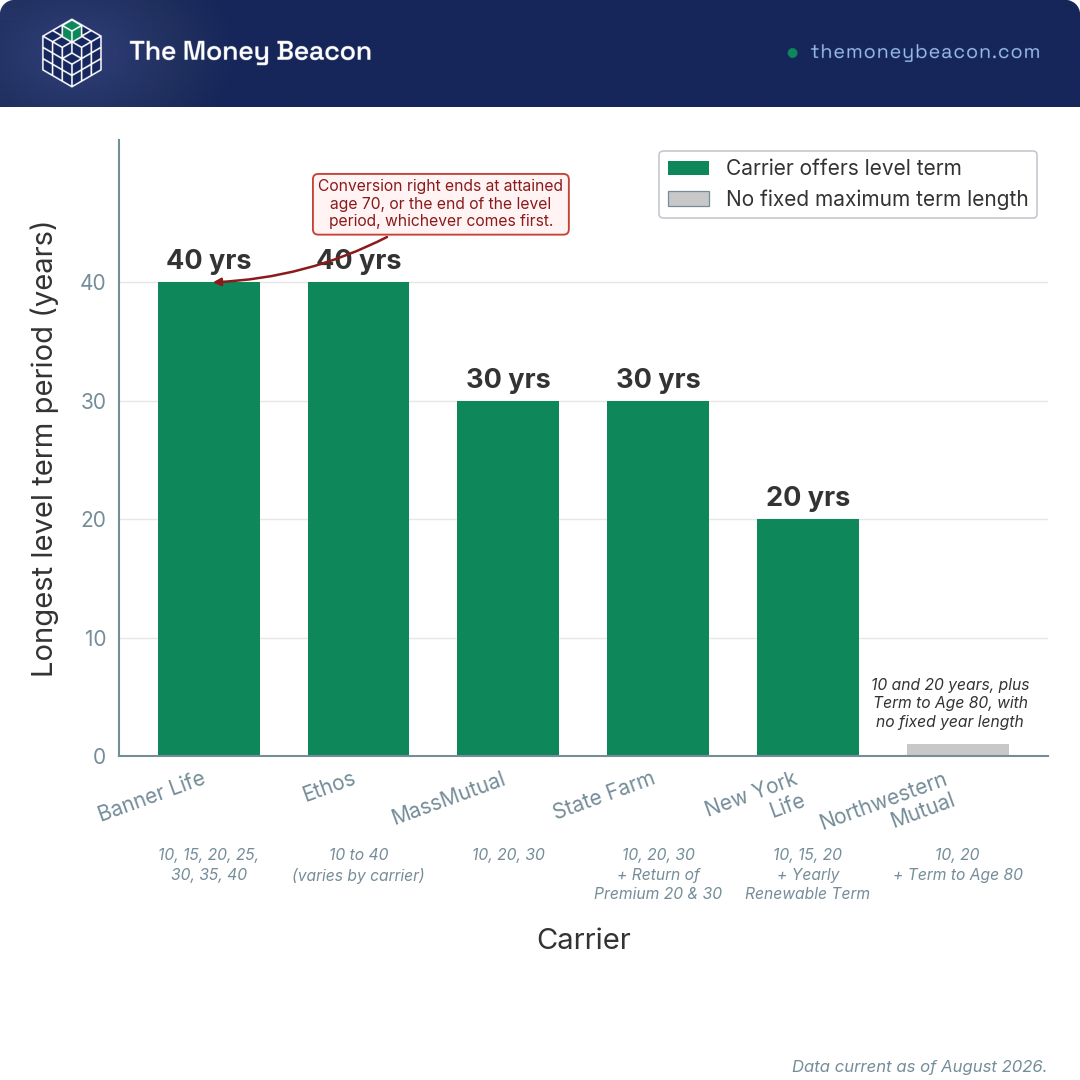
Banner Life sells seven periods out to 40 years and Ethos reaches 40 through its issuers. MassMutual and State Farm stop at 30, New York Life at 20. Northwestern Mutual has no bar at all because it publishes no number: 10 and 20 years, plus a Term to Age 80 product with no fixed length.
The tallest bar comes with a flag: the Banner Life conversion right still ends at attained age 70, years before a 35 or 40 year level period does.
8.3 Where the no-exam path runs out
A life insurance medical exam is what turns a same-week purchase into a six-week one, and four of the six publish exactly how much coverage you can buy without one.
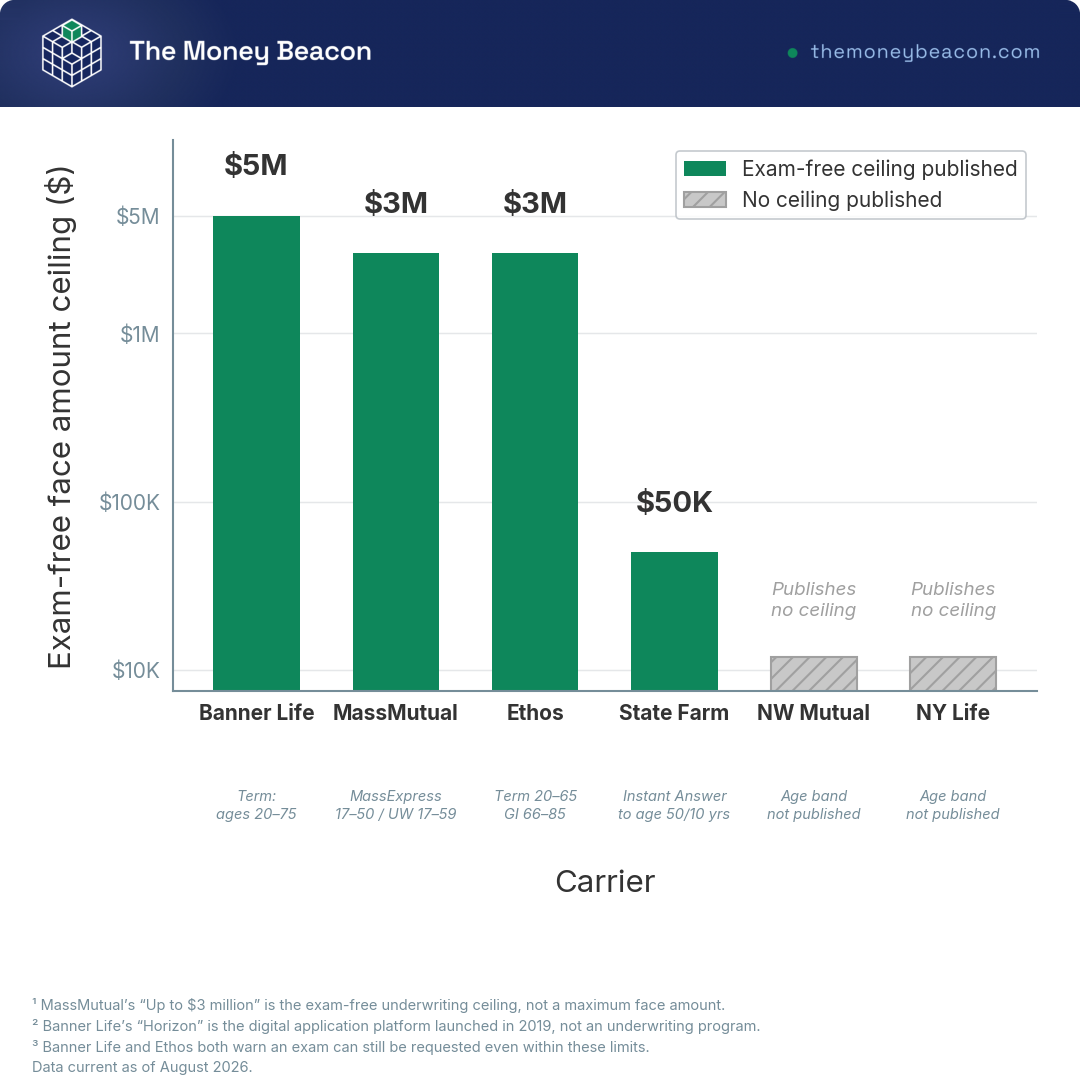
Banner Life goes to $5 million with instant approval. MassExpress reaches $3 million for issue ages 17 to 50. Ethos allows $3 million of no-exam term up to age 50 and $500,000 above it. State Farm’s Instant Answer Term stops at $50,000, and Northwestern Mutual and New York Life publish no ceiling at all.
Two footnotes belong beside that chart. MassMutual’s $3 million is an exam-free underwriting ceiling rather than a product face maximum, so reading it as the largest policy the company will write is simply wrong. And both Banner Life and Ethos warn that an exam can still be requested, so plan around the exam-free ceiling as a best case, never as the schedule.
Run the $1,145,000 need from earlier against those four numbers and three of them cover it. The one that doesn’t is State Farm’s, the one sold across the counter by an agent.
8.4 Dividends: two rates, three payouts, and one carrier that cannot pay one
A mutual life insurance company can return surplus to its policy owners. These six publish that fact in three incompatible ways, which is why a dividend ranking usually compares things that aren’t comparable.
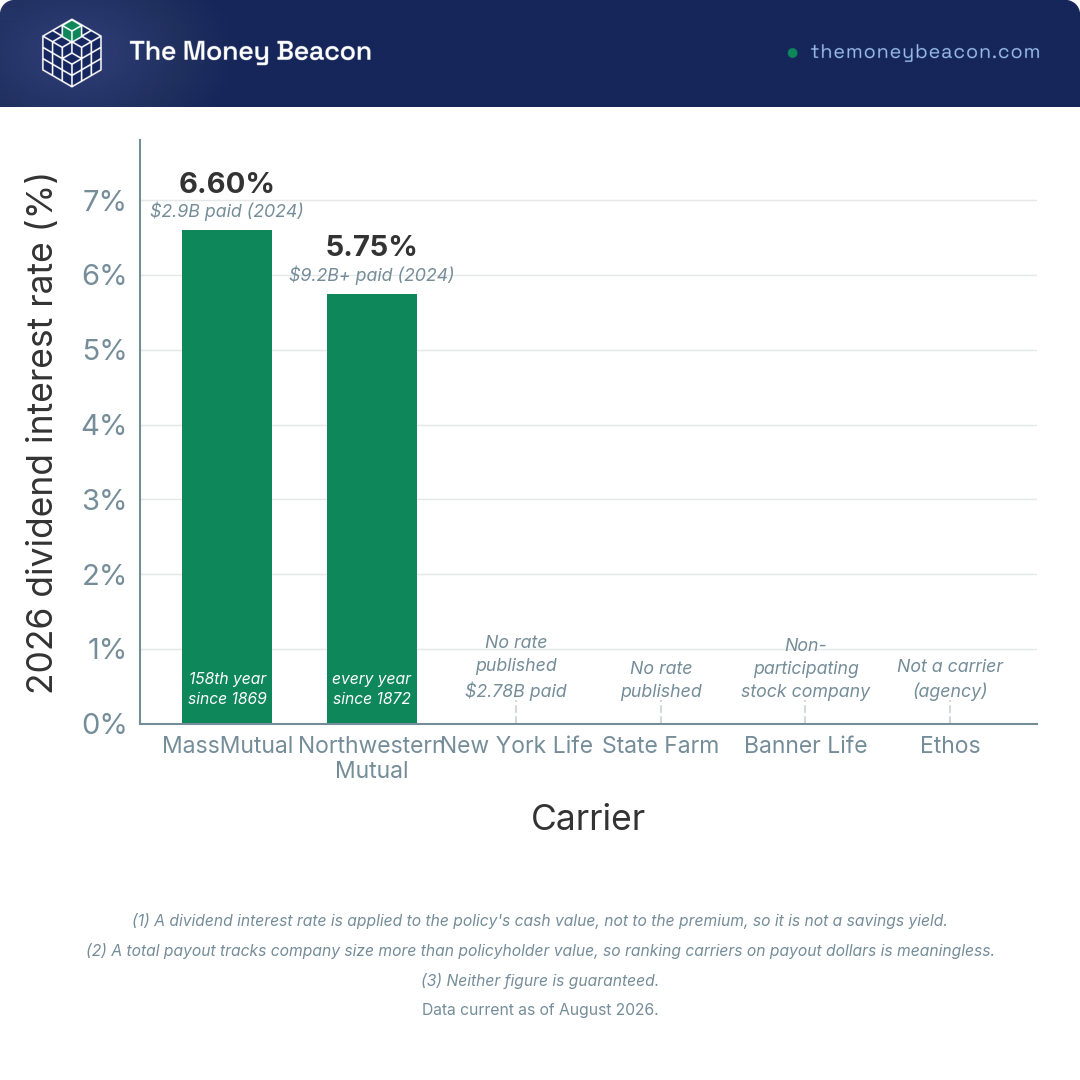
MassMutual publishes 6.60% for 2026, its 158th consecutive year, on a record running back to 1869. Northwestern Mutual publishes 5.75% for most policies, paid every year since 1872. New York Life publishes the payout and the streak and no rate at all, an estimated $2.78 billion and a 172nd consecutive annual dividend. State Farm’s policies are participating, yet it publishes neither a rate nor a record. Banner Life pays none by construction, and Ethos isn’t a carrier, so the question doesn’t apply.
A dividend interest rate and a total payout measure two different things, and the payout mostly measures how big the company is. Northwestern Mutual’s $9.2 billion against MassMutual’s $2.9 billion is roughly three times the money paid at the lower of the two rates. Dividends aren’t guaranteed at any of them, and New York Life adds that not all participating policy owners are eligible for one.
8.5 Banner Life and Ethos are not two independent picks
If you shortlisted both, you may be shortlisting the same policy twice. Banner Life issues part of what Ethos sells. Since a March 25, 2026 release, that now includes Ethos-branded Simplified Issue Whole Life and Guaranteed Issue Whole Life, available initially through select agencies.
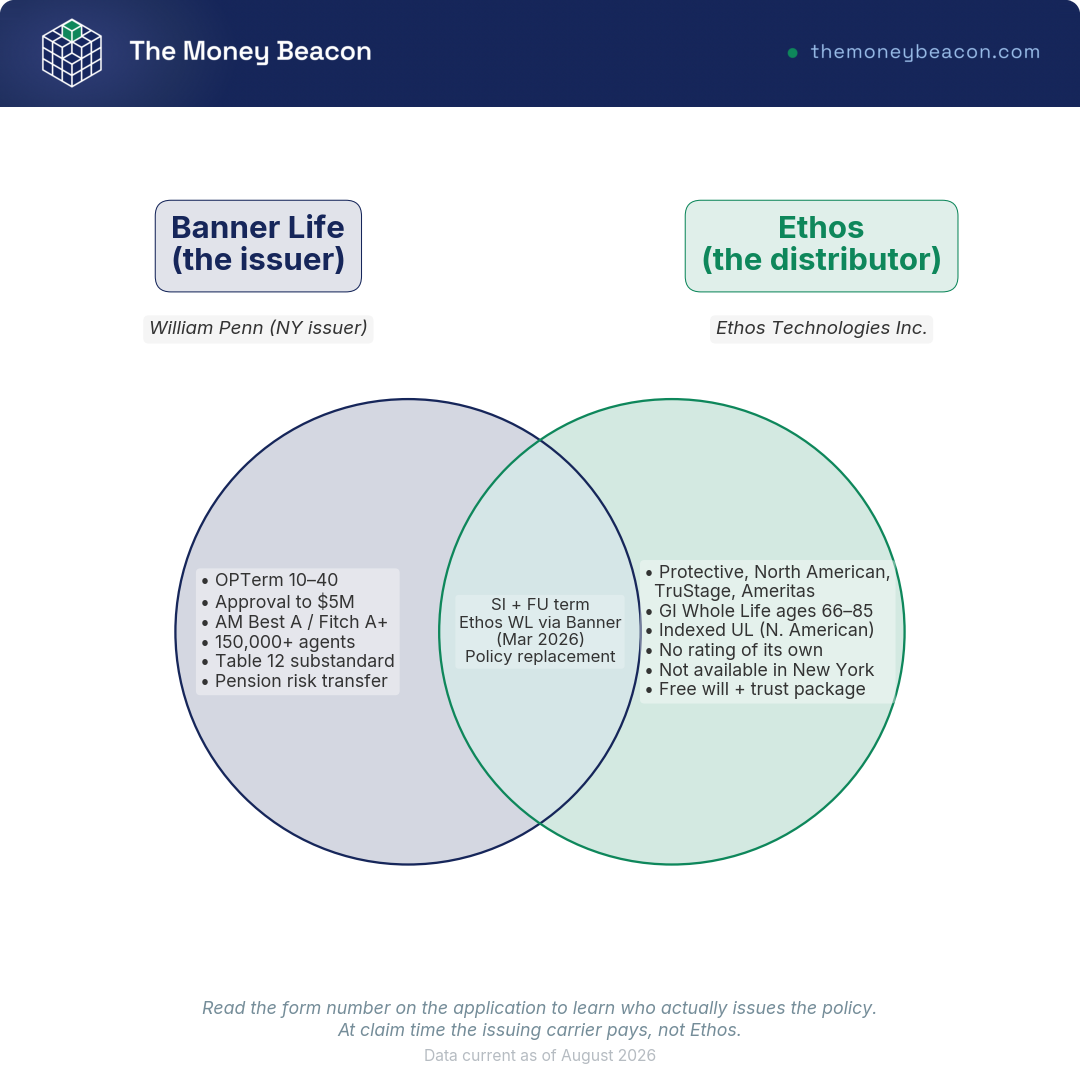
Banner Life brings the balance sheet, the ratings, the seven-period OPTerm lineup and the published fee schedule. Ethos brings the five-minute application, the exam-free underwriting and the guaranteed acceptance route for ages 66 to 85.
Not everything Ethos sells is a Banner Life policy, since Protective, North American, TruStage and Ameritas issue the rest. That’s why the check is worth a minute of your time. Read the form number on the application before you sign, write down the issuing carrier, and remember that at claim time your beneficiary files with that company, not with the website.
8.6 The verdict at a glance
A recommendation without its failure mode isn’t much use, so every row below carries both.
Table: Which carrier to quote first, by reader profile
| Reader profile | Quote first | Why | Watch out for |
|---|---|---|---|
| New parent, $1 million or more of term | Banner Life | Seven level periods, $100,000 to above $10 million, instant approval to $5 million | Conversion ends at attained age 70, before a 35 or 40 year level period does |
| Buyer who wants coverage this week | Ethos | Exam-free on every product, coverage activated the same day | Not a carrier; read the form number to learn who issues, and not available in New York |
| Cash-value and dividend buyer | MassMutual or Northwestern Mutual | Published 2026 dividend interest rates of 6.60% and 5.75%, records back to 1869 and 1872 | Dividends are not guaranteed and neither carrier publishes face-amount ranges |
| Buyer who wants one agent for everything | State Farm | 19,000+ agents, the widest small-policy menu, conversion to age 75 | The life premium gets no multi-line discount |
| Applicant expecting a health rating | Banner Life, then a second carrier | Publishes its table load (25% per table) and issues through table 12; preferred classes for smokers and some family cancer history | Shop the rated offer; the same file is classed differently by different carriers |
| Ages 66 to 85 with health issues | Ethos or State Farm | Guaranteed acceptance ages 66 to 85; State Farm Guaranteed Issue Final Expense ages 45 to 80 | Graded death benefit returns premiums only in the first two to three years |
| Estate liquidity for a couple | New York Life or Northwestern Mutual | Survivorship products, top ratings on all four scales | No published price; expect an advisor process and an illustration to read |
Data current as of August 2026.
One row is genuinely counterintuitive. The household that wants one agent for everything gets a real relationship at State Farm and no discount on the life premium itself.
8.7 Which carrier to quote first, by reader profile
The root question is the one from section 1, whether the need ends or never ends, and each branch below points to one carrier and one thing to watch.
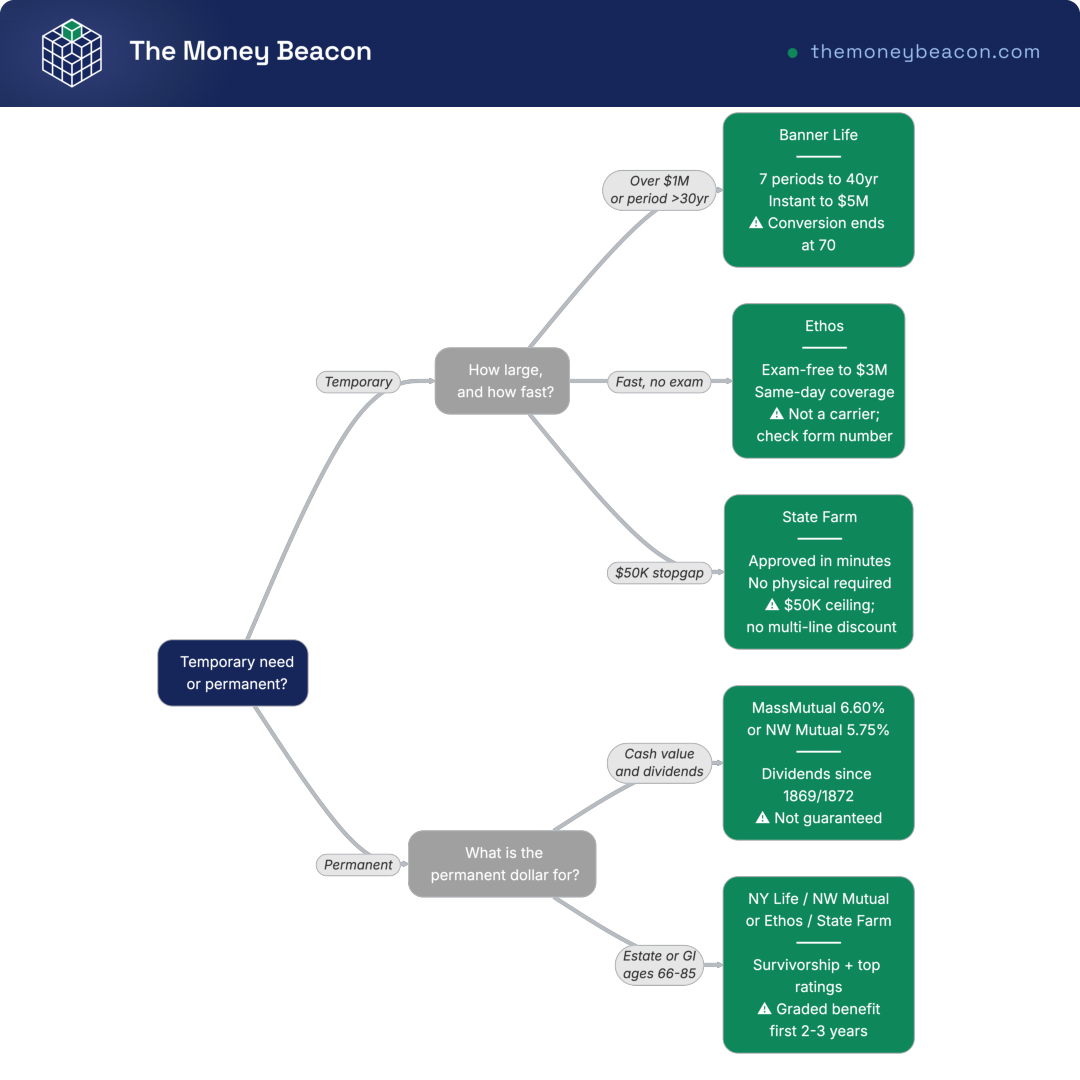
(1) The young family buying the largest death benefit per dollar. Quote Banner Life first: it will place a $1,145,000 policy with no appointment at all. In life insurance for young families the dividend Banner Life can’t pay is beside the point; the conversion right ending at attained age 70 isn’t.
(2) The cash-value buyer who wants participating whole life and a long record. Quote MassMutual and Northwestern Mutual. Neither publishes a face range or a price, so the entire comparison happens inside an advisor’s illustration. The number to test in it is the internal return after charges. Weigh that against the tax-free growth inside a Roth IRA before you commit to a premium you can’t dial back later.
Tom’s take
I insure the things that would genuinely break the plan and I self-insure the rest, which is why term keeps winning in my own accounts. Every permanent policy I’ve been shown was sold on its cash value, and the cash value is the part I already run myself, at a cost I can see and change.
(3) The buyer who wants coverage bound in days with no exam. Quote Ethos first, with Banner Life as the second look and State Farm’s Instant Answer Term for a small policy through an agent. Read the form number to learn who issues the policy, and remember Ethos can’t sell in New York.
(4) The applicant who expects a health rating, or who is aged 66 to 85. Shop the offer rather than the quote, because Banner Life is the only one of the six that publishes the arithmetic. For ages 66 to 85 the guaranteed acceptance routes are Ethos and State Farm’s Guaranteed Issue Final Expense, both with a graded death benefit that returns only your premiums for the first two to three years.
(5) The high-net-worth buyer funding estate liquidity, and the business owner funding a buy-sell agreement. Quote New York Life and Northwestern Mutual for survivorship coverage and top marks on all four rating scales, then expect an advisor process with no published price at any point.
Whichever profile fits, the next step is identical. Run two of these carriers at the same face amount, the same level period and the same date, and compare the offers that come back rather than the quotes that went out.
Conclusion
That $8 a month wasn’t a lie. It was a real price for a real person, just not for you. That’s how this entire market works: six companies, and not one of them will tell you what your coverage costs until an underwriter has read your medical file. A price ranking of these carriers isn’t something anyone can honestly publish, me included.
Everything else, though, is on the record, and there’s plenty of it. Level periods range from 20 years at New York Life to 40 at Banner Life. Exam-free ceilings range from $50,000 up to $5 million. Two of the six publish a 2026 dividend interest rate and four publish none. All of that is on the companies’ own sites, and it tells you which of them can even serve you before price matters at all.
Here’s the part most first-time buyers get backwards. They shop companies first and settle the death benefit and the term length afterward. Those two numbers do far more narrowing than any ranking does. Pick $1,145,000 and 30 years, and you’ve already ruled out the carriers that won’t write it. Then check one more thing before you sign anything: the conversion deadline. The right to turn a term policy into permanent coverage without a new medical exam is the cheapest protection you’ll ever own against being wrong about your own future. And it’s the one that expires quietly.
If you want to keep going, our walkthrough for first-time buyers works through the mortgage balance behind most of that coverage number, and the same underwriting logic shows up again in how we compare homeowners insurance. And if you’re weighing permanent coverage mostly for its cash value, our retirement planning guide covers the accounts that do that job for less.
FAQ
How much life insurance do I actually need?
Run two calculations and take the higher number. Add up your remaining mortgage, the income you want replaced, education costs and other debts (the DIME method), then subtract savings and coverage you already have. Cross check against 10 times your gross income. For a $95,000 earner with two kids and a $260,000 mortgage, DIME gives $1,145,000 against $950,000 for the income multiple, so use the higher figure. If your situation is more complex (a business, a blended family, an estate plan), a fee-only financial advisor can help you size it properly.
Should I buy term life insurance or whole life insurance?
Match the policy to how long the need lasts. A need that ends (a mortgage, kids becoming independent) calls for term long enough to outlast it. A need that doesn’t end (estate liquidity, a lifelong dependent) calls for permanent coverage. You can also buy term now and convert part of it into permanent coverage later without new medical questions, so it isn’t an all-or-nothing choice. If you’re eyeing whole life mainly as a savings vehicle, compare its growth against a low-cost index fund first; they solve different problems, and the fund usually costs less.
What happens when my term life insurance expires?
The coverage doesn’t just stop. Most level term policies renew automatically once the level period ends, and the premium jumps immediately, then keeps climbing every year after that, in some cases to age 95. Renewing a large policy at those rates gets expensive fast. The fix is buying a long enough level period the first time, one that outlasts your mortgage payoff and your youngest child’s independence, rather than the shortest term that fits today’s budget.
What’s a term conversion deadline, and why does it matter?
It’s the date your right to convert term coverage into a permanent policy without a new medical exam runs out, and it often arrives earlier than buyers expect. Banner Life’s deadline is the end of the level period or age 70, whichever comes first; State Farm’s runs to age 75. Miss it and you’re back to full underwriting, health changes included. Get the exact date from your policy illustration and put it on a calendar, not on memory.
Is no-exam life insurance too good to be true?
Not exactly, but “no exam” covers three different products. Accelerated underwriting skips the paramedical exam and labs but still pulls your prescription history, driving record and medical records, and it can still price you at standard rates. Simplified issue skips more of the file for a short questionnaire and costs more. Guaranteed issue can’t turn you down but pays only a return of your premiums, not the full death benefit, if you die of natural causes in the first two to three years. None of the three guarantees you’ll actually skip the exam either.
Is the death benefit taxable?
Generally no. Your beneficiary receives it free of federal income tax. Two exceptions are worth knowing: interest the insurer credits on a delayed payout is taxable, and if you personally own the policy, the payout can be pulled into your taxable estate, though the 2026 federal exemption of $15,000,000 per person means that only touches a small number of households. A cash-value policy classified as a modified endowment contract is taxed differently again, with loans and withdrawals counted as income first.
Is the group life insurance through my job enough on its own?
Usually not once you have dependents. It’s typically one or two times your salary, a fraction of what the DIME method or an income multiple recommends, and it ends the day you leave the job. Some employers let you convert it to an individual policy without new health questions, but usually at a higher price than the open market. Treat it the way you’d treat your 401(k) match: a floor to build on, not the whole plan.
What does an AM Best rating actually tell me?
It’s an opinion about whether the company can pay claims decades from now, not about price or service. Four of the six carriers compared here carry AM Best’s top A++ grade. For service quality, check the NAIC Complaint Index instead, which weighs complaints against a company’s market share, and look it up under the insurer’s exact legal entity name, since one brand can sell through more than one licensed company.
Which life insurance company is cheapest?
None of them, honestly, not until you apply. Every published premium uses a profile the carrier chose for its own marketing: different ages, different face amounts, different health classes, so the numbers can’t be stacked against each other. The real price is the offer that comes back after underwriting reads your actual file. Get that offer from more than one carrier on the same face amount and term length before you decide.



Comments
Questions and corrections welcome. We read everything.