


Your renewal notice shows up, the premium is up again, and you sit down to compare home insurance rates. Then you find the real problem: not one homeowners insurer publishes a price. State Farm won’t show you a home insurance rate on its site, and neither will the other five national carriers in this comparison. Every premium is rated individually. The inputs are your address, your house, your claims history and, in most states, a credit-based insurance score. The only real price is the one quoted to you, on your house, on that day.
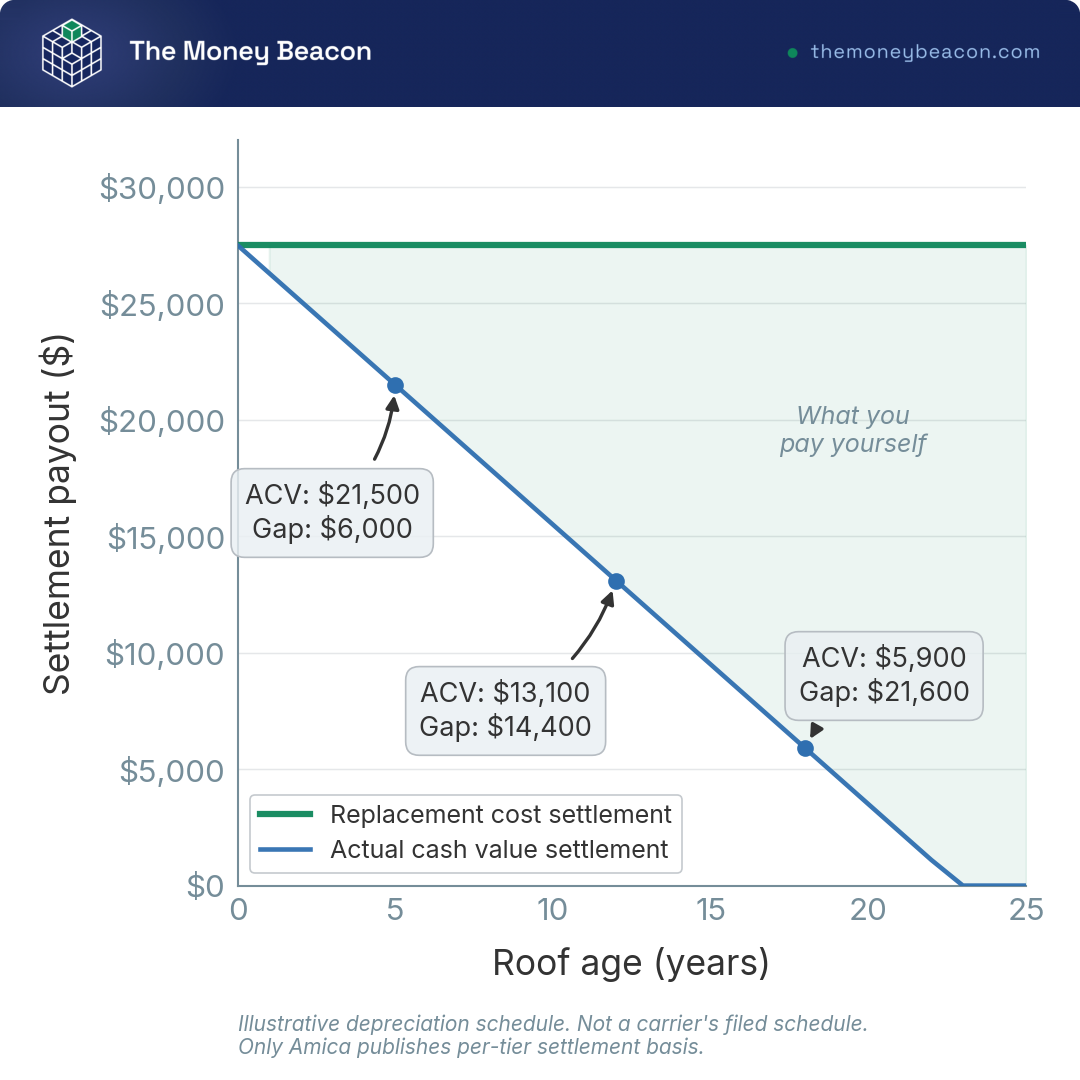
So you end up with three quotes that can’t really be compared, and the cheapest one is usually the one with the least coverage. The difference shows up after the hailstorm, not before. Say your roof costs $30,000 to replace and your deductible is $2,500. Replacement cost pays $27,500 whether that roof is five years old or eighteen. Actual cash value pays the depreciated amount instead, roughly $13,100 at twelve years. That’s more than $14,000 out of your own pocket, decided by one line on a declarations page most people never read.
You can’t shop the price in advance. But you can shop everything that determines what the price buys. How does each carrier settle contents and roofs? How much rebuild cushion does it give you above your dwelling limit? And which discounts does it actually publish a number for? So before I get to the carriers, I’ll show you the method I use to run six quotes that are genuinely comparable.
1. How we compared six homeowners insurers, and why not one of them will quote you a price
1.1 The criteria we applied to all six carriers
I applied the same nine dimensions to all six: policy form, replacement cost on dwelling, contents and roof, endorsement limits, deductible mechanics, published discounts, state availability, eligibility, claims access, and financial strength by legal writing entity.
So search for the best homeowners insurance companies 2026 and you’ll get rankings, not a price. What you can measure is what each one puts on the record. Below, “Not published” means proven absence, “Unconfirmed” means I couldn’t pin the figure down.
| Carrier | Coverage B | Coverage C | Coverage D | Coverage E | Coverage F |
|---|---|---|---|---|---|
| State Farm | 10% of Coverage A | Unconfirmed | Unconfirmed | Unconfirmed | Not published |
| Allstate | Unconfirmed | Unconfirmed | Unconfirmed | Unconfirmed | Unconfirmed |
| USAA | Unconfirmed | Unconfirmed | Unconfirmed | Unconfirmed | Unconfirmed |
| Travelers | 10% | 50% typical, 50% to 70% rule of thumb | 20%, stated range 20% to 30% | $100,000 typical minimum | Starts at $1,000 per person |
| Nationwide | Unconfirmed | Unconfirmed | Unconfirmed | Unconfirmed | Unconfirmed |
| Amica | Unconfirmed | 40% Essential, 50% Advantage, 75% Signature | Unconfirmed | $300,000/$500,000 on Platinum Choice | Up to $5,000 on Platinum Choice |
Data current as of August 2026.
Only Travelers and Amica publish numbers for most of the parts.
1.2 Why no homeowners insurer publishes a price
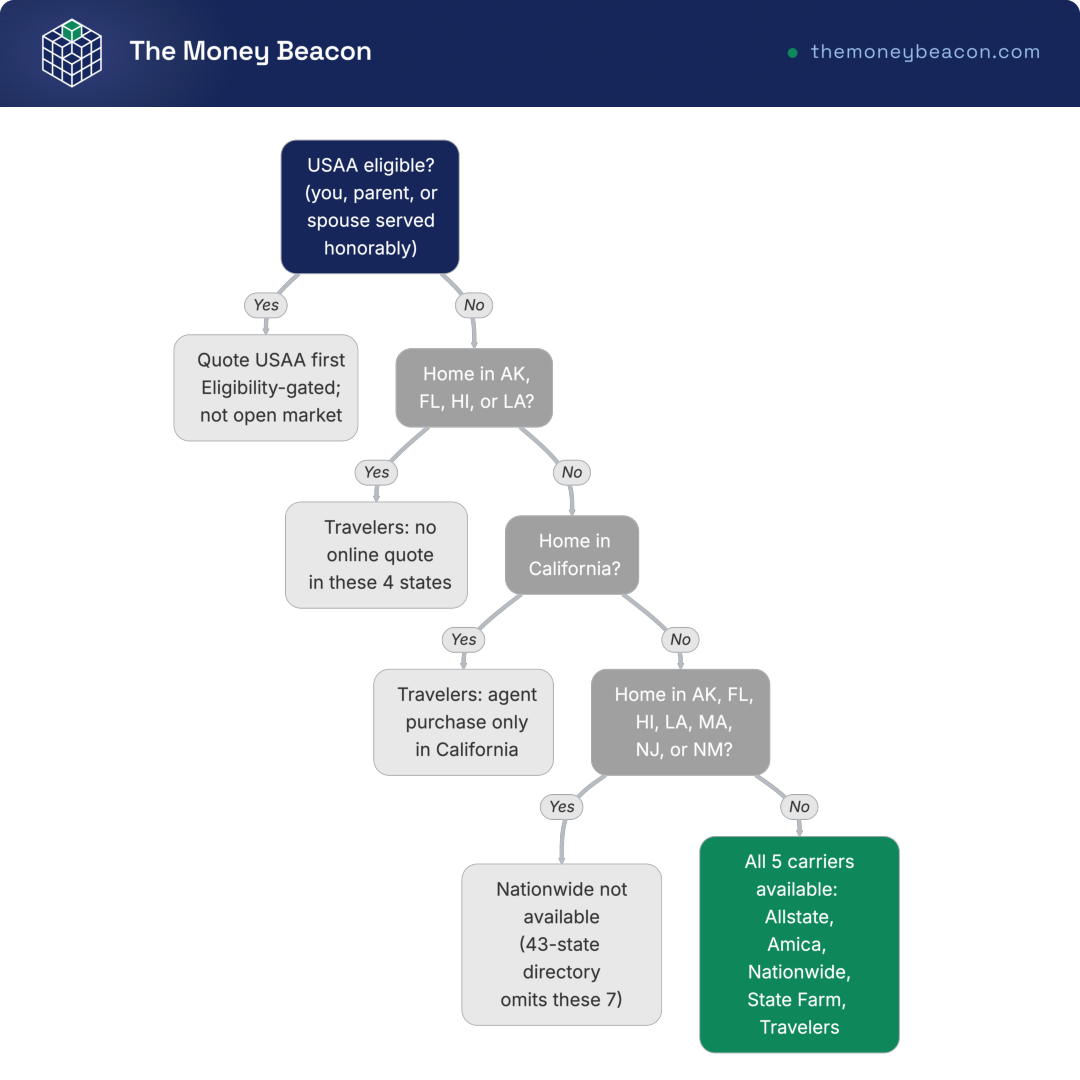
The homeowners insurance cost factors are the ones you’d guess: ZIP code, the home’s age and construction, roof age, rebuild cost, your limits and deductible, and your claims history, plus a credit-based insurance score in most states. But eligibility and geography rule carriers out before price ever does, and quoting a carrier that will never write your address is the most wasted step in home insurance shopping.
1.3 The six coverage parts, and HO-3 versus HO-5
Every policy here is built from the same six lettered parts: A the dwelling, B other structures, C personal property, D loss of use, E personal liability, F medical payments to others.
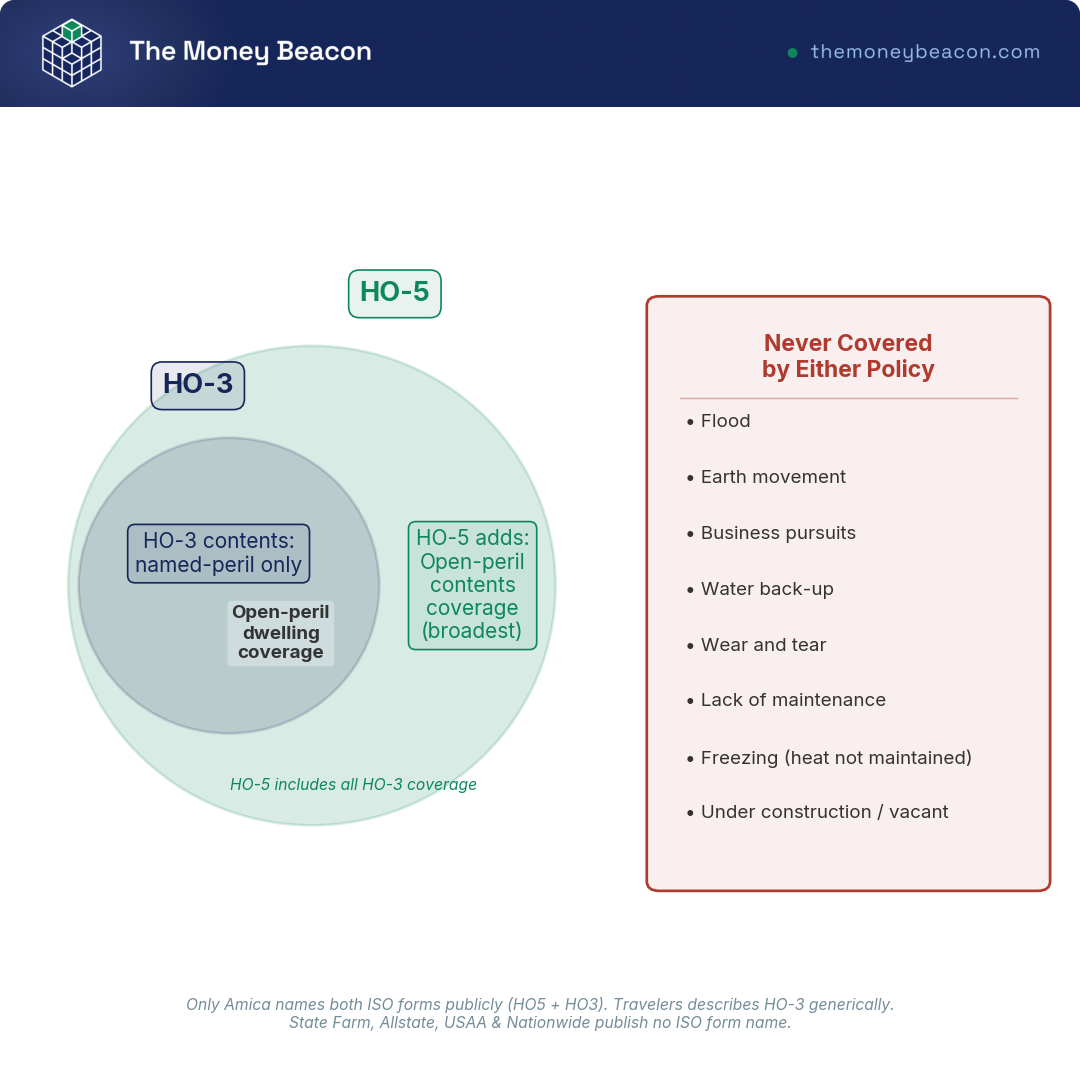
An HO-3 policy, the special form, covers the dwelling against anything not specifically excluded, and your belongings only against the causes the policy lists. An HO-5 extends that open-peril treatment to the belongings too. Only Amica and Travelers name a form, and for the other four the absence is proven.
1.4 Contents: actual cash value versus replacement cost
This is where the six really diverge, and you can read it before you ever ask for a quote. Replacement cost buys the item again today, no depreciation. Actual cash value is that same figure minus depreciation. USAA publishes replacement cost as a standard, Travelers and State Farm both default to actual cash value, and Amica splits it by tier.
Nationwide pays through a replacement cost holdback: the depreciated value first, the difference only once you’ve bought the item and sent the receipt. A household that can’t float that difference in cash never collects the second payment. So a quote at 40 percent of Coverage A on actual cash value isn’t cheaper because the carrier is generous. It’s cheaper because it’s smaller.
1.5 The roof, where most 2026 coverage erosion happens
Roof settlement is the highest-stakes line in a homeowners policy, and almost nobody publishes it. Shoppers look up roof age insurance requirements expecting a published cutoff, some age at which the basis flips. None of the six publishes one.
| Carrier | Published roof settlement basis | Roof-age threshold published |
|---|---|---|
| Amica | Essential: actual cash value; Advantage and Signature: replacement cost | Depreciation depends on roof age; the schedule itself is unconfirmed |
| Nationwide | Better Roof Replacement described only as rebuilding with stronger, safer roofing materials; the settlement method is not published | Not published |
| State Farm | Not published for the base policy; Select Service pays replacement cost with no depreciation to a vetted contractor | Unconfirmed |
| Allstate | Not published | Unconfirmed |
| USAA | Unconfirmed | Unconfirmed |
| Travelers | Unconfirmed | Unconfirmed |
Data current as of August 2026.
1.6 What a $30,000 roof actually pays out
So let’s put numbers on a $30,000 roof, with a 25-year shingle life, straight-line depreciation and a $2,500 deductible. Replacement cost settles at $27,500 whatever the roof’s age. Roof actual cash value settlement pays the depreciated figure instead: $21,500 at five years, $13,100 at twelve, and $5,900 at eighteen.
Past roughly ten years of roof age, the settlement basis is worth more than any premium difference on your quote sheet. That’s a worked model, not any carrier’s filed depreciation schedule.
1.7 Deductibles: the flat one, and the percentage one nobody warns you about
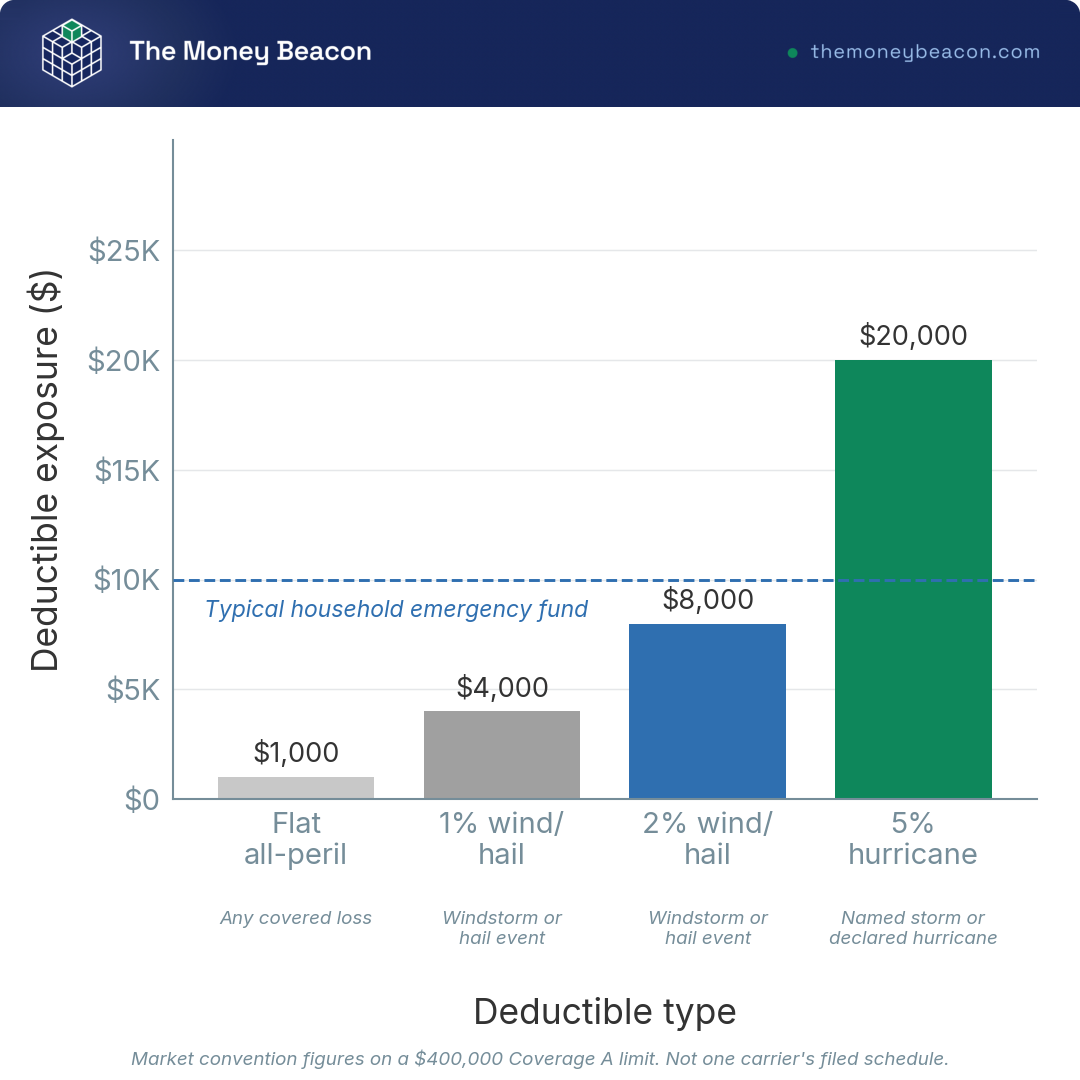
Two deductibles can apply to the same policy, and only one is the number people remember. The flat all-peril deductible is a dollar amount. The other is a percentage deductible explained nowhere on the front of your quote: a share of Coverage A, triggered by wind, hail or a named hurricane. On a $400,000 dwelling limit, a 5 percent hurricane deductible is $20,000, against the $1,000 flat deductible printed higher up the same page.
Tom’s take

I run the same test on every policy I own. Which losses would actually change my year, and which ones can I absorb myself? I take the highest deductible I could write a check for that morning without thinking, then spend the savings on the limits covering what I can’t absorb. A 5 percent hurricane deductible fails that test for most households, because $20,000 isn’t a check you write on a bad week.
So ask for both deductibles in writing, in dollars, and park the flat one where you can reach it, which is the job a high-yield savings account does.
1.8 What the base policy never covers, and the backup sublimit to ask about
Some losses are never in the base policy at any price: flood, earth movement, business pursuits, water back-up, wear and tear, and losses while the home is vacant or under construction. Flood insurance NFIP coverage is bought separately, capped at $250,000 on the building and $100,000 on contents, and it takes 30 days to take effect unless you buy it at a loan closing.
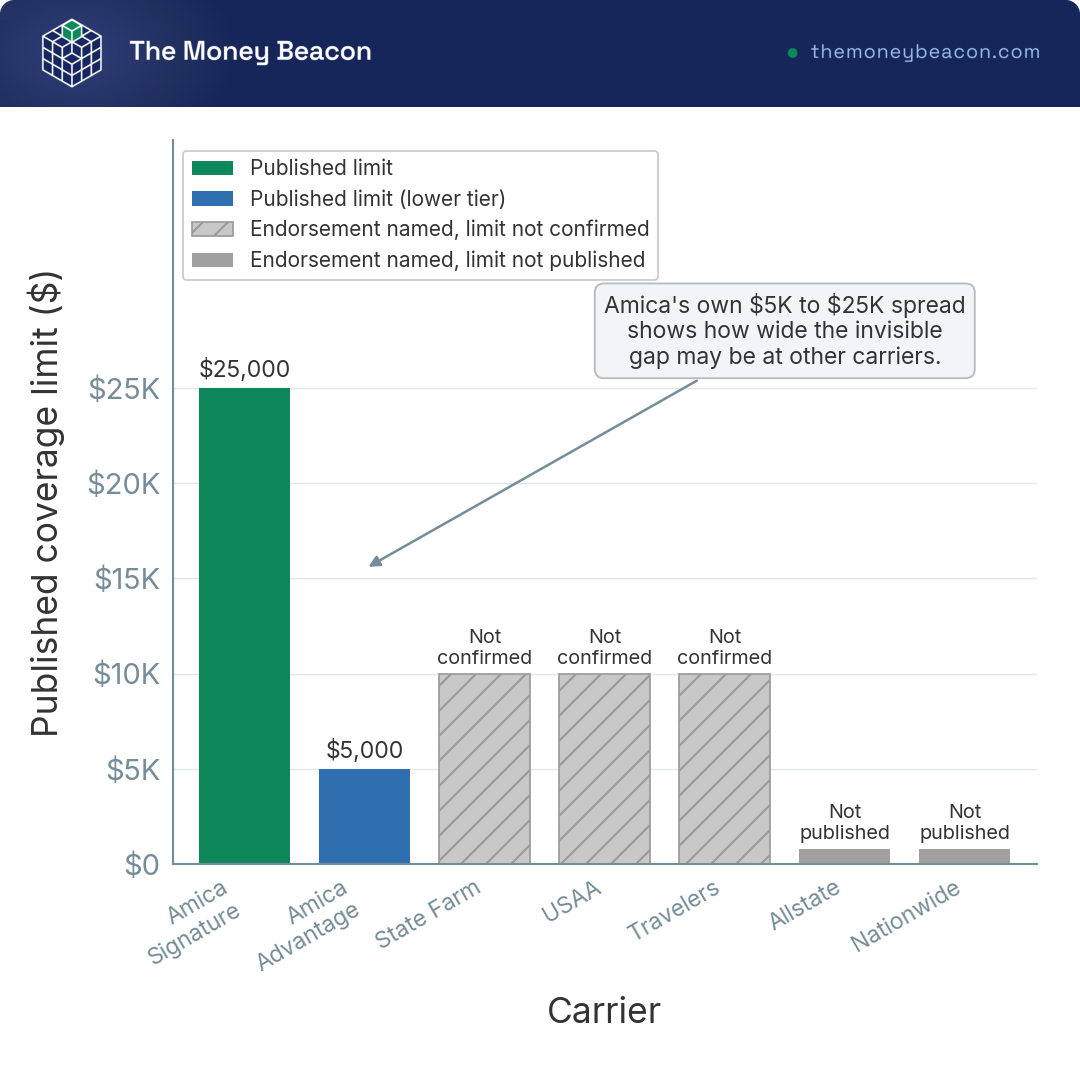
Published sewer and drain backup limits range from $5,000 to $25,000, and two of the six name the endorsement with no limit at all. A $5,000 sublimit covers very little of a flooded finished basement, so ask for your figure in dollars.
1.9 The endorsement limits worth getting in writing
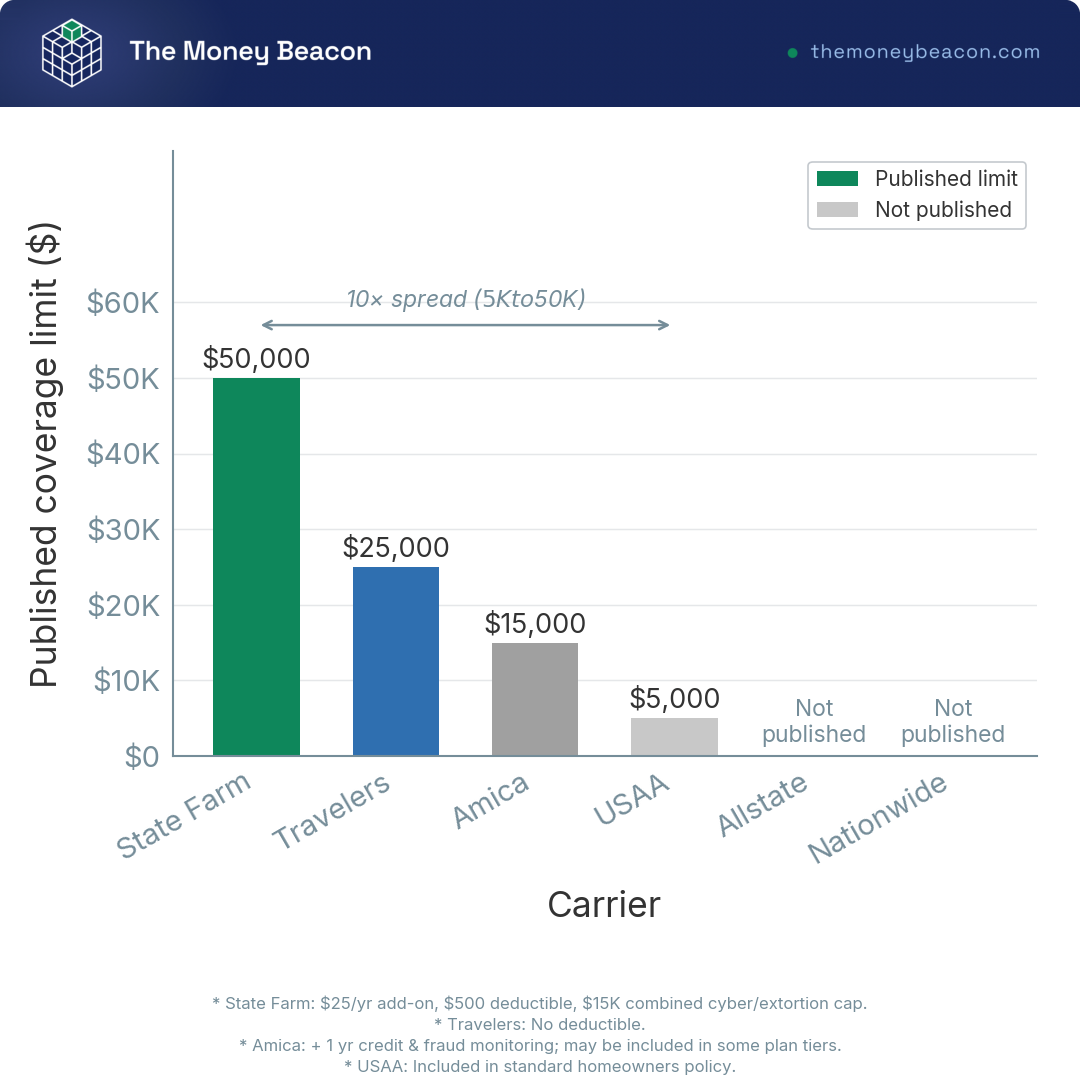
Identity theft coverage is the line most shoppers treat as a checkbox, and it varies more than ten-fold across these six, from $5,000 to $50,000, with two carriers publishing no limit at all. The same pattern repeats on ordinance or law, service lines and scheduled property, so put a dollar figure beside each endorsement line, not a tick mark.
1.10 Running six quotes that can actually be compared
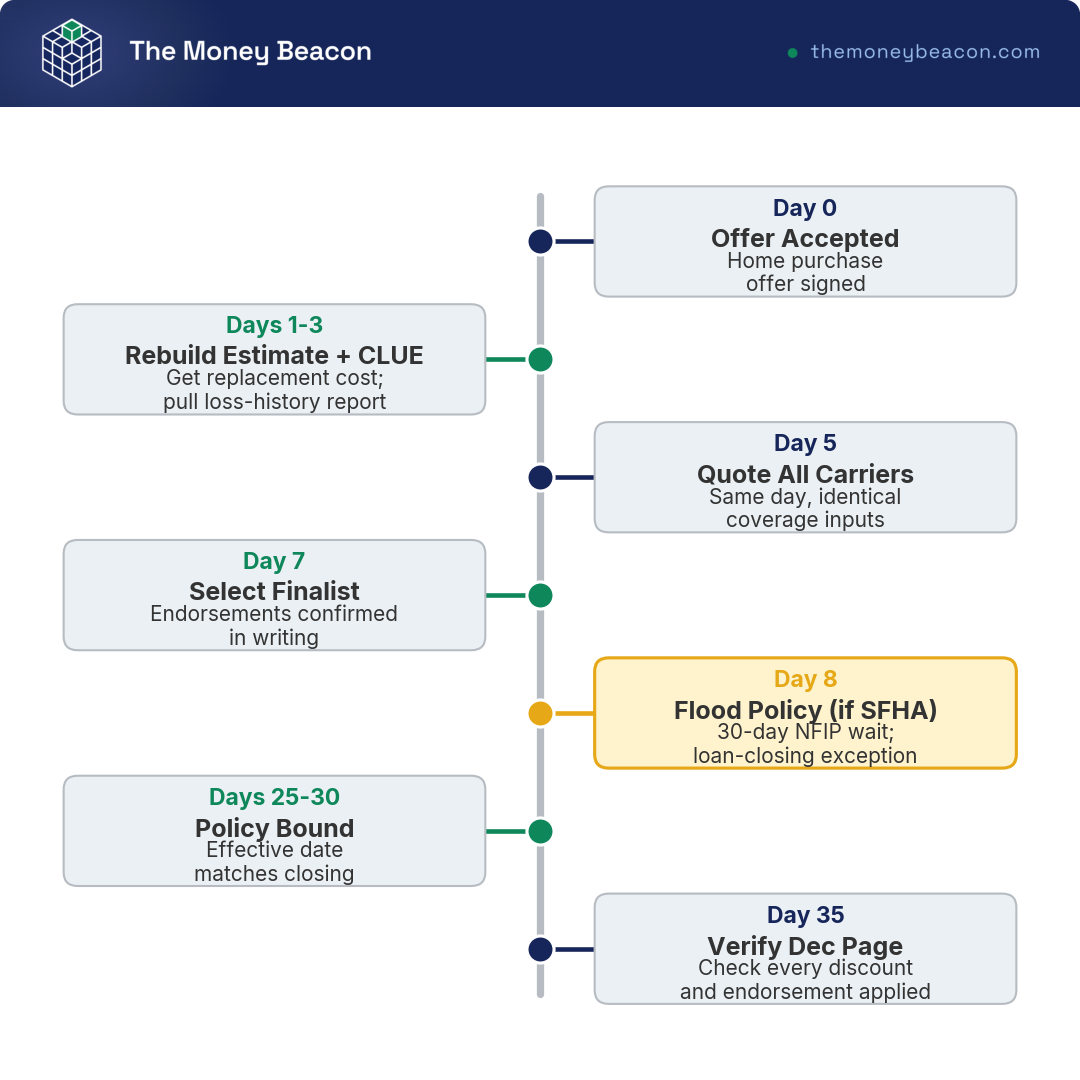
Rating is individual and rate plans refile continuously. So the only defensible way to compare home insurance quotes is a controlled experiment: freeze every input you control, vary only the carrier, and run all the eligible ones on one day.
Pull your Comprehensive Loss Underwriting Exchange (CLUE) report first, because that LexisNexis loss-history file is what every carrier reads at quote, and one miscoded loss suppresses the claims-free discount at all six at once.
So book the rebuild estimate this week, because every quote is only as honest as that number. Then take the six carriers one at a time, same five headings, same order.
2. State Farm: the captive agent network, and the coverage details it keeps off the page
2.1 Overview
Any State Farm homeowners insurance review starts in the same place, because the captive local-agent network is the product. State Farm says on its own site that it’s the largest homeowners insurer in the United States, on 2020 premium data from S&P Global Market Intelligence. A current share or rank isn’t something I could confirm. Coverage B is published at 10 percent of the dwelling limit on two separate pages, covering attached and detached garages, sheds, greenhouses, barns, shops and gazebos. That’s one of the few percentage defaults State Farm puts in public, and dwelling coverage adjusts automatically each year for local construction costs.
2.2 Strengths
Where State Farm does put numbers in public, they’re useful ones. The Personal Articles Policy is an unusually explicit scheduled-property offer: replacement cost with no depreciation deduction, generally no deductible, priced per $100 of coverage. There’s even a Wedding Presents endorsement running to 90 days after the wedding. Identity Restoration costs $25 a year and includes a $50,000 identity fraud limit, a $500 per-occurrence deductible and a $15,000 combined annual limit on cyber attack and extortion.
The California wildfire mitigation credits are published as real percentages: 4 percent to 18 percent off the wildfire portion of the premium for an IBHS Wildfire Prepared Home designation, and 2 percent to 5 percent for an NFPA Firewise USA community. The Impact Resistant Roof discount is available in 26 named states. And Select Service pays a roof claim straight to a vetted contractor, with contact within two business hours and a five-year workmanship warranty.
2.3 Weaknesses
The gaps are fundamental, and worth naming without softening. State Farm publishes no policy form, no deductible options or percentage mechanics, no extended or guaranteed replacement-cost percentage above Coverage A, no dollar range for medical payments to others, and no base-policy roof settlement basis. All five are proven absences rather than figures I failed to find. Contents default to actual cash value, with replacement cost available by option or endorsement, and state availability I couldn’t pin down.
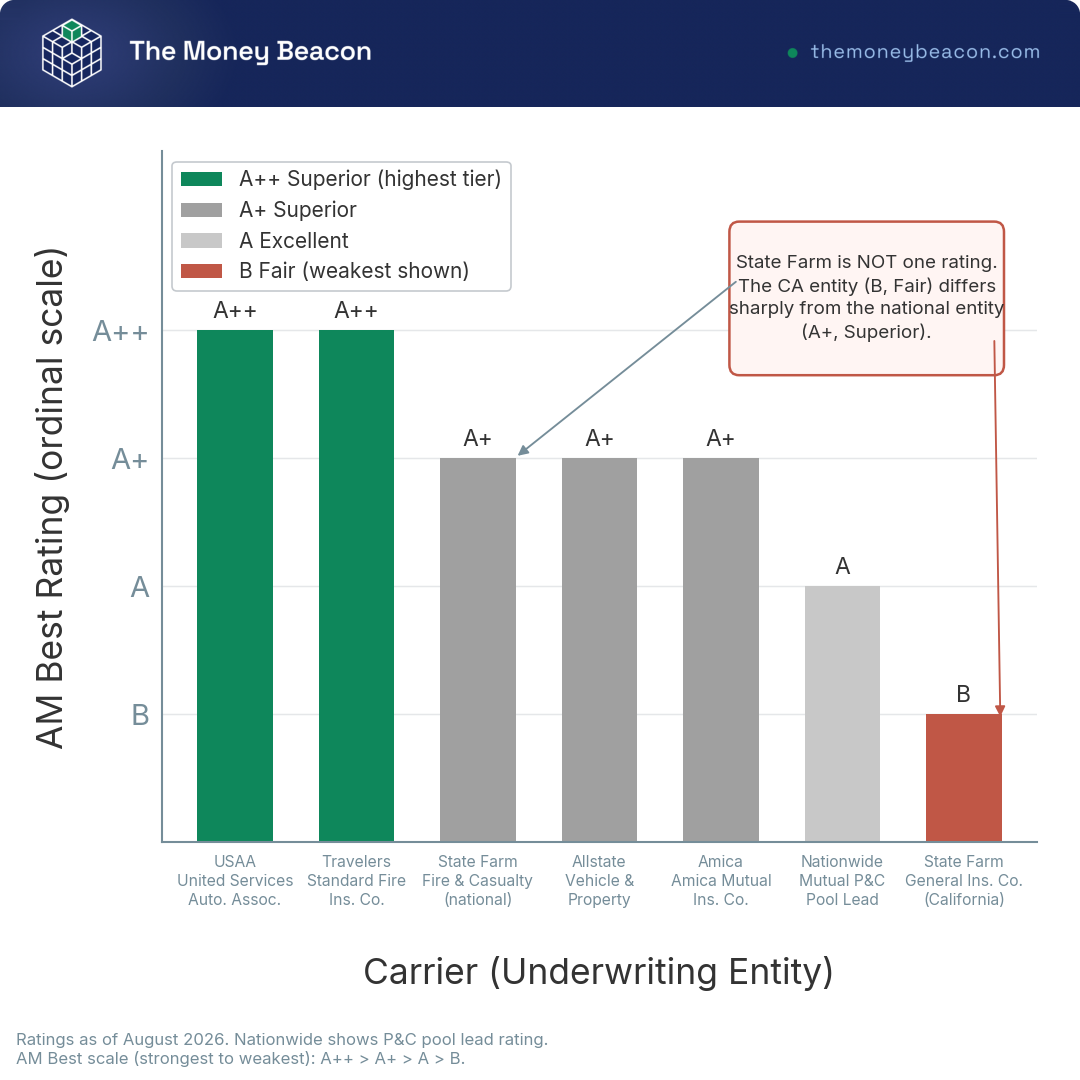
Then the entity point a California reader has to see. State Farm General Insurance Company, NAIC 25151, writes homeowners coverage in California and holds B (Fair) from AM Best. State Farm Fire and Casualty Company, NAIC 25143, writing nationally, holds A+ (Superior). Buying the brand in California isn’t buying the national balance sheet.
2.4 Pricing and fees
Only two rows below decide anything. The rest name a discount without pricing it. State Farm home insurance discounts lead with the Home Auto Discount, and its footnote matters: $1,429 is a 2025 survey of new policyholders who reported saving by switching, not a rate. It also takes two or more purchases across different lines, and State Farm says plainly that the discount doesn’t apply if you buy only one policy. Auto pairs with renters, condo or life as well as home.
| State Farm published discount | Stated value |
|---|---|
| Home Auto Discount (bundling) | Up to $1,429 average annual household savings, 2025 survey of new policyholders reporting savings by switching |
| Home Alert (fire, smoke, burglar alarms, monitoring) | Percentage not published |
| Impact Resistant Roof (class 4 or hail-resistant shingles) | Percentage not published; available in 26 named states |
| Claim Free | Typically three to five claim-free years |
| Utilities Rating Plans, Automatic Sprinkler | Percentage not published |
| Wind mitigation (IBHS FORTIFIED or Florida Building Codes) | Percentage not published |
| California wildfire mitigation, community level (NFPA Firewise USA) | 2% to 5% off the wildfire portion of premium |
| California wildfire mitigation, property level (IBHS Wildfire Prepared Home) | 4% to 18% off the wildfire portion of premium |
| Fire hydrant proximity | Threshold between 500 and 1,000 feet |
Data current as of August 2026.
Two timing rules belong beside those numbers. Remodeling or additions adding $5,000 or more of replacement cost must be reported within 90 days, and the claim-free lookback runs typically three to five years.
2.5 Who it’s for
State Farm is ideal for a bundler who wants one local agent handling home, auto and life, and for a California owner who can document wildfire mitigation and wants those credits priced. It isn’t the right choice for a buyer who wants a published replacement-cost cushion or a roof settlement basis on paper before speaking to anyone.
3. Allstate: dollar-denominated claim rewards, and how little of the contract it publishes
3.1 Overview
An Allstate homeowners insurance review has to work around a marketing name where the HO form number should be. Allstate pairs each customer with a local agent and sells the product as the House & Home policy. Published perils include theft, fire and smoke, windstorm or hail, falling objects, frozen plumbing, and water damage from plumbing, water heaters, appliances and heating or cooling systems. Standard homeowners policies are underwritten by Allstate North American Insurance Company and Allstate Vehicle and Property Insurance Company and affiliates, of Northbrook, Illinois.
3.2 Strengths
The retention features are stated in plain dollars, which is rare. Deductible Rewards takes $100 off the deductible at signup and another $100 for each claim-free year, up to $500. Claim RateGuard promises the premium won’t rise just because a claim is filed, and Claim-Free Bonus returns 5 percent at each claim-free renewal.
Allstate publishes homeowners coverage pages for all 50 states plus the District of Columbia, and its exclusion list is unusually explicit for a marketing page. Claims run through a named repair network with a tracking tool and a records app, and mobile claims centers deploy after natural disasters. It also acknowledges rating on an insurance score built from credit history, tells customers when that score cost them the lowest premium, and names the states that ban credit based insurance scores in home rating: California, Massachusetts and Maryland.
3.3 Weaknesses
The numeric disclosure is thin, and it’s worth saying so plainly. No policy form, no deductible amounts or percentage mechanics, no dwelling-side extended or guaranteed replacement-cost percentage, no roof settlement basis, and no limit figure on any of the eleven endorsements Allstate names, from identity theft restoration and water backup to scheduled personal property and service lines. Every one of those is a proven absence.
The rewards come with conditions too. Deductible Rewards isn’t available in New York or North Carolina, and earning that first-renewal $100 means adding the Enhanced Package within 60 days of policy inception. Claim RateGuard applies to one claim every five years. Bundled savings vary by state, and Allstate frames the agent relationship rather than a percentage as the bundling benefit. One piece of fine print works in your favor: where two or more deductibles apply to a single loss, only the highest applies.
3.4 Pricing and fees
Allstate prices loyalty and claims behavior in dollars while leaving the contract itself unpriced, and the table shows that split. Deductible Rewards, Claim RateGuard and Claim-Free Bonus are the numeric entries. The rest of the homeowners insurance discounts are named and left unquantified: Responsible Payer, welcome and loyalty, home buyer, Easy Pay, protective device, early signing and multi-policy.
| Allstate published discount or reward | Stated value |
|---|---|
| Deductible Rewards | $100 off the deductible at signup plus $100 each claim-free year, up to $500; requires adding the Enhanced Package within 60 days of policy inception to earn the first-renewal $100; not available in NY and NC |
| Claim RateGuard | Premium will not rise just because you file a claim; applies to one claim every five years |
| Claim-Free Rewards and Claim-Free Bonus | 5% back on renewal every claim-free year |
| Multi-policy (home and auto) | Percentage not published; bundled savings vary by state and are not available in every state |
| Responsible Payer, Welcome and loyalty, Home buyer, Easy Pay Plan, Protective device | Percentages not published |
| Early signing | Sign at least 7 days before the current policy expires |
| Florida windstorm mitigation | Verified by a licensed inspector or general contractor; underwritten by Castle Key Insurance Company and Castle Key Indemnity Company |
Data current as of August 2026.
Allstate prints its own blanket caveat under all of it: discounts aren’t available in every state, and the amounts vary.
3.5 Who it’s for
Allstate is ideal for a homeowner who wants a local agent plus loyalty mechanics they can count in dollars, meaning a deductible that shrinks each claim-free year and a first claim that doesn’t move the rate. It isn’t the right choice for a shopper who wants to compare endorsement limits or settlement percentages on paper first.
4. USAA: replacement cost as standard, if your household qualifies
4.1 Overview
The eligibility gate comes first in any USAA homeowners insurance review, because for most US households that’s also where it ends. USAA sells direct to the military community. You qualify through honorable service in the US armed forces, current enlistment or commissioning, or an active commission in NOAA or the US Public Health Service. Federal agency employment qualifies, and so does a parent or spouse who served or is already a member. If you’ve separated, you’ll need an Honorable or General Under Honorable Conditions discharge. United Services Automobile Association, NAIC 25941, holds A++ (Superior) from AM Best.
4.2 Strengths
Replacement cost coverage on contents comes standard at USAA, published as applying with no depreciation. Home Protector adds a 25 percent cushion above your dwelling limit toward rebuilding costs. You have to insure the dwelling to at least 95 percent of estimated rebuild cost. Identity theft is included up to $5,000. And two deductible waivers are written for military life: one on uniforms and equipment while you’re on active or reserve duty, the other on war losses outside the continental US, Alaska and Hawaii.
The Wildfire Response Program auto-enrolls eligible members in fifteen states at no extra premium. It sends certified firefighters to defend the property during an active wildfire. The states are Arizona, California, Colorado, Idaho, Montana, Nevada, New Mexico, North Dakota, Oklahoma, Oregon, South Dakota, Texas, Utah, Washington and Wyoming.
4.3 Weaknesses
Membership excludes most US households outright, and no price advantage changes that. USAA publishes no policy form and no deductible structure. Those are proven absences, not figures I missed. There’s also no agent network, so if you want somebody local to call after a loss, this isn’t it. The war-loss waiver doesn’t apply on North Carolina homeowners policies. Roof settlement basis and the state footprint are unconfirmed rather than absent, because I couldn’t pin either one down. And a home needing $1.5 million or more of coverage gets routed to a separate high-value product.
4.4 Pricing and fees
USAA puts a published percentage on every discount it names, which is unusual in US home insurance. Read the conditions, though: two of them are timing traps. The bundle discount wants your auto policy active within 60 days of the property policy being issued. The claims-free discount, worth up to 15 percent, asks for no claim at USAA or your previous insurer for five years or more. Loyalty needs three continuous years. And the protective devices discount wants a monitored fire or security system, not just any alarm.
| USAA published discount | Stated value |
|---|---|
| Bundle home and auto | Up to 10% off the homeowners premium; the auto policy must be active within 60 days of issuing the property policy |
| Claims-free | Up to 15% with no claim at USAA or the previous insurer in the past 5 years or more |
| Multi-product (valuable personal property, umbrella, banking, life) | Up to 9% |
| Connected Home (smart devices, data shared) | Up to 8% |
| Loyalty | Up to 5% after 3 continuous years with a property policy |
| Protective device credit (monitored fire or security system) | Up to 5% |
| Florida hurricane mitigation | Premium credits, sized from the Uniform Mitigation Verification Inspection Form |
| Oregon wildfire mitigation | Requires the home be in an active Firewise community |
Data current as of August 2026.
4.5 Who it’s for
USAA is the best choice for any household that qualifies through service or a family relationship. Even more so if you move often, store belongings between duty stations, or own military equipment. For everyone else it isn’t a choice at all, whatever the price would have been. That’s what military homeowners insurance means in the strict sense: the gate is the product.
5. Travelers: the independent-agent carrier that publishes checkable coverage math
5.1 Overview
More than 15,000 independent agents sell Travelers nationwide, and it describes itself as one of the nation’s leading and largest property casualty companies for over 170 years. A Travelers homeowners insurance review gets unusual material to work with, because it publishes coverage mechanics most carriers save for the quote call. It even names its policy form, calling a typical homeowners policy an HO3. The Standard Fire Insurance Company, NAIC 19070, writes California homeowners and holds A++ (Superior) from AM Best.
5.2 Strengths
Travelers publishes a worked limits table, genuinely rare on a consumer page. Take a $500,000 dwelling limit. Other structures are 10 percent ($50,000), personal belongings 50 percent ($250,000), additional living expenses 20 percent ($100,000), and loss of use 20 percent to 30 percent. Personal liability coverage starts at a typical $100,000 minimum, and medical payments at $1,000 per person. Liability claims generally have no deductible. That makes raising your liability limit one of the cheapest upgrades in the whole policy.
Identity fraud reimbursement is published at $25,000 with no deductible. Special personal property coverage is a genuine open-peril upgrade for contents. And MyTravelers lets you compare a repair estimate against your deductible before you file.
5.3 Weaknesses
You can’t quote online for a risk located in Alaska, Florida, Hawaii or Louisiana, and a California purchase has to go through a local independent agent. Contents default to actual cash value, and you upgrade them with the contents replacement cost endorsement. Even then, special limits on jewelry and watches remain, so a jewelry insurance rider is still a separate conversation.
Everything else missing from the public pages is unconfirmed rather than proven absent. Travelers writes that additional replacement cost protection is usually stated in percentages such as 25, 50 or even 100 percent. It never names its own figure. Its multi-policy percentage, roof settlement basis and range of deductible options are unconfirmed too, and so is whether the coinsurance formula it publishes applies to its personal homeowners form. Ask your agent for each in writing. One number is public and useful: you generally have at least six months to file a property claim.
5.4 Pricing and fees
Travelers puts a percentage on two of its discounts and names the rest without one. Early quote is worth up to 10 percent, and it scales with how far ahead of the effective date you buy. That’s the one thing you can act on today. The Travelers green home discount is worth up to 5 percent on a LEED certified house. Homebuyer needs your purchase to have closed within 12 months before the policy effective date, so it belongs on the closing checklist for a first-time buyer.
| Travelers published discount | Stated value |
|---|---|
| Early quote | Up to 10%, scaled by how far in advance the policy is purchased |
| Green home (LEED certified) | Up to 5% |
| Multi-policy (auto, umbrella, boat, personal articles floater) | Unconfirmed; the qualifying lines are named but no percentage is published |
| Homebuyer | Home purchased within 12 months prior to the policy effective date |
| Protective device | Smoke detectors and fire alarms, interior sprinklers, home security systems, automatic water shut-off systems, connected-home alerting technology |
| Loss-free | “Within a specified time period” |
Data current as of August 2026.
5.5 Who it’s for
Travelers is ideal for a homeowner who wants an independent agent shopping several carriers on their behalf, and who’d rather check published coverage mechanics than trust a marketing number. If you’ve been weighing captive agent vs independent agent, this is the independent side of that choice. It isn’t the right choice for an Alaska, Florida, Hawaii or Louisiana homeowner who wants to quote online.
6. Nationwide: a rebuild cushion of up to two times the limit, inside 43 states
6.1 Overview
Named features are how Nationwide sells, so a Nationwide homeowners insurance review means taking those names apart one at a time. You buy through an agent or by phone. Coverages A through F are all published, with ordinance or law counted as a coverage rather than an upsell, and credit card coverage inside the basic policy for unauthorized card and ATM transactions and forged checks. Nationwide also publishes its own underinsurance warning: more than half of US homes are underinsured, and a home should be insured to at least 100 percent of its estimated replacement cost. Nationwide Mutual Insurance Company, NAIC 23787, the property and casualty pool lead, holds A (Excellent) from AM Best.
6.2 Strengths
Dwelling Replacement Cost is optional, and it can pay up to two times your dwelling limit if the home has to be rebuilt after a loss. Equipment breakdown is the one endorsement Nationwide prices in public: roughly $39 to $45 a year, with a $50,000 maximum claim, a $500 deductible and a $3,000 spoilage limit. It’s addable at new business or renewal only. Brand New Belongings pays replacement cost on contents through a holdback, so you get the depreciated value first and the difference once you send the receipt. Better Roof Replacement rebuilds with stronger, safer roofing materials.
The smart home program ships you free hardware, a Ting sensor and a LeakBot leak detector, and publishes percentages by state. California gets 10 percent on water non-weather, water weather and theft, plus 5 percent on fire. Washington gets 5 percent on all perils. Plus you get the On Your Side Review, a free annual coverage consultation.
6.3 Weaknesses
The published state directory lists 43 states plus the District of Columbia. It leaves out Alaska, Florida, Hawaii, Louisiana, Massachusetts, New Jersey and New Mexico. And that advertised $1,032 average saving? Nationwide’s own footnote scopes it to condo and auto premiums, on a 2024 sample, not home.
Seven things are proven absences, and deserve to be named that way: policy form, deductible amounts and percentage mechanics, roof settlement methodology, the water backup, Valuables Plus and service line limits, any numeric claims service level, the minimum claims-free window, and any coinsurance clause. The smart home page publishes two contradictory state exclusion lists. One names Alaska, Hawaii, Louisiana, New York, Oklahoma and Washington. The other omits Washington. So a Washington reader can’t tell whether the discount exists. And loyalty rewards require six endorsement numbers most customers can’t read off their own policy.
6.4 Pricing and fees
The table below shows the difference between headline and fine print. The Texas page separately publishes a home and auto bundle of up to 20 percent. So the two biggest numbers on offer are measuring different things. Protective device, claims-free, roof rating, home purchase and prior insurance are named without any percentage at all.
Then there’s the loyalty set, which is worth money even though it isn’t a discount. It covers emergency lockout reimbursement up to $250, a waived deductible up to $5,000 on a total fire loss, and mortgage protection after a constructive total loss (not in Connecticut). And there’s a special deductible provision when an auto loss and a property loss happen together, which is the single deductible home and auto provision.
| Nationwide published discount | Stated value |
|---|---|
| Multi-policy | Average savings $1,032, but the footnote scopes the figure to condo and auto premiums, on a national sample from March through May 2024, not home |
| Home and auto bundle (Texas page) | Up to 20 percent |
| Smart home, California | 10% on water non-weather, water weather and theft; 5% on fire |
| Smart home, Washington | 5% on all perils |
| Smart home availability | Not available in AK, HI, LA, NY, OK and WA in the summary list, but the legal footnote omits WA and reads AK, HI, LA, NY and OK |
| Smart home device activation | Device must be activated within 55 days of enrollment or the discount is removed |
| Smart home free devices | A free Ting electrical-fire sensor and a free LeakBot water leak detector, both self-installed |
| Roof rating | Based on the roof’s age and surface type |
| Home renovation credit | For renovated plumbing, heating, cooling or electrical systems |
| Home purchase | Home purchased within the last 12 months |
| Prior insurance | New members, scaled by continuous years with the previous carrier |
| Protective device, claims-free, gated community | Percentages not published; claims-free minimum years not published |
Data current as of August 2026.
6.5 Who it’s for
Nationwide is ideal for the owner of an older home who wants ordinance or law and equipment breakdown named and priced up front. You’ll need to live in one of its 43 states. That’s the real argument for home insurance for older homes, where code upgrades are the expensive part. It isn’t the right choice for a homeowner in Florida, Louisiana, Massachusetts or New Jersey, or for anyone shortlisting on the advertised $1,032 figure.
7. Amica: a published coverage ladder, and the tier where the depreciation lives
7.1 Overview
An Amica homeowners insurance review is an easy one to write, because Amica publishes the contract detail most carriers hold back until the quote call. It’s a direct-writing mutual with no agent network, and it’s been issuing homeowners policies since 1956. As of December 31, 2022 it held $5.4 billion in assets and 1.4 million policies. Its consumer page goes as far as naming the ISO forms, HO5 and HO3, which is pretty rare in US homeowners insurance. Amica Mutual Insurance Company, NAIC 19976, is authorized in all states and publishes A+ (Superior) from AM Best.
7.2 Strengths
The YourPlan ladder below is the real strength: three tiers published side by side with the numbers that decide a claim. Two things around it are worth naming on their own. Buried utility lines, the service line coverage most base policies leave out, pays up to $10,000 per disruption against a $1,000 deductible, on an average claim of about $6,000. And three deductible-softening features are published. The Large Loss Deductible Waiver takes up to $2,500 off when a covered loss exceeds $75,000. The Single Loss Deductible means one event hitting your house and your car triggers only the highest single deductible. And Home Claim Forgiveness forgives up to $5,000 after five continuous years.
7.3 Weaknesses
The cheapest tier is where the depreciation lives, and a price-first shopper is exactly who gets quoted it. Essential settles both contents and the roof at actual cash value, with no Rebuild Cost Protection and no water backup at all.
An Amica dividend policy pays typically 5 percent to 20 percent of premium at the end of the term. But it isn’t guaranteed, it isn’t offered in every state, and you have to hold the policy when dividends are declared. Two proven absences go with it: no figure for the smart-device and leak-detection discounts, and no general home claims service standard. The deductible amounts are reachable only inside an address-level quote flow.
One scoped caution. On California Department of Insurance 2025 homeowners data, Amica shows a complaint index of 2.34 against a 1.00 median, on a California market share of just .344. So a handful of complaints move that index a long way. One state, one year, not a national verdict.
7.4 Pricing and fees
So this is the pricing table: what each rung of the ladder actually contains. Read it as three different contracts, and watch where the actual cash value rows stop.
| Feature | Essential | Advantage | Signature |
|---|---|---|---|
| Personal property limit | 40% of dwelling | 50% of dwelling | 75% of dwelling |
| Personal property loss settlement | Actual cash value | Replacement cost | Replacement cost |
| Roof loss settlement | Actual cash value | Replacement cost | Replacement cost |
| Rebuild Cost Protection | Not included | 130% of dwelling limit | 150% of dwelling limit |
| Water backup and sump pump | Not included | $5,000 | $25,000 |
| Buried utility lines | Not included | $10,000 | $10,000 |
| Refrigerated property | Not included | $250 | $500 |
| Tree debris removal | $1,000 | $1,000 | $1,000 |
| Matching roof and siding | Not included | Not included | Included, up to $20,000 |
| Total fire loss settlement | Not included | Not included | Included |
| Large loss deductible waiver | Not included | Not included | Up to $2,500 waived |
| Claim forgiveness | Not included | Not included | Up to $5,000 forgiven |
Data current as of August 2026.
Then the other side of the premium. The multiline discount reaches up to 30 percent when auto, home, umbrella and life are held together. Loyalty starts after two years with an insurer, and the claim-free discount asks for three claim-free years. AutoPay, e-discount, paid in full, the monitored alarm discount and the new or remodeled home credit are named without a percentage. Bundlers also get the 12-Month Auto Rate Lock. Tier availability varies by state, so confirm yours before you plan around a number.
7.5 Who it’s for
Amica is the best choice for a buyer who wants to read the coverage ladder before quoting, and who’ll pay for Advantage or Signature to get replacement cost on both contents and the roof. It isn’t the right choice for a shopper who takes the cheapest tier by default, because Essential settles at actual cash value.
8. The verdict: which homeowners insurer belongs on your quote list
8.1 Financial strength by writing entity, and the State Farm split you cannot see from the brand
Start with the entity, not the brand. Your policy is written by a specific subsidiary, and the regulator data attaches to that subsidiary. State Farm Fire and Casualty Company, NAIC 25143, writes nationally and holds A+ (Superior). State Farm General Insurance Company, NAIC 25151, writes California homeowners and holds B (Fair). So a California buyer comparing State Farm against the other five isn’t buying the balance sheet the brand implies.
The chart below has the rest, entity by entity, current as of August 2026.
Hank’s take
Years of picking apart financial stability data leave you with one habit that transfers straight to buying insurance: always ask which legal entity is on the hook. The group balance sheet is what gets advertised. The subsidiary is what pays your claim, and the two can be rated several notches apart.
And no complaint ranking appears anywhere in this comparison: the national figures couldn’t be retrieved for any of the six. If you look yours up, search the legal entity name, not the brand.
8.2 Endorsement transparency: who publishes a number at all
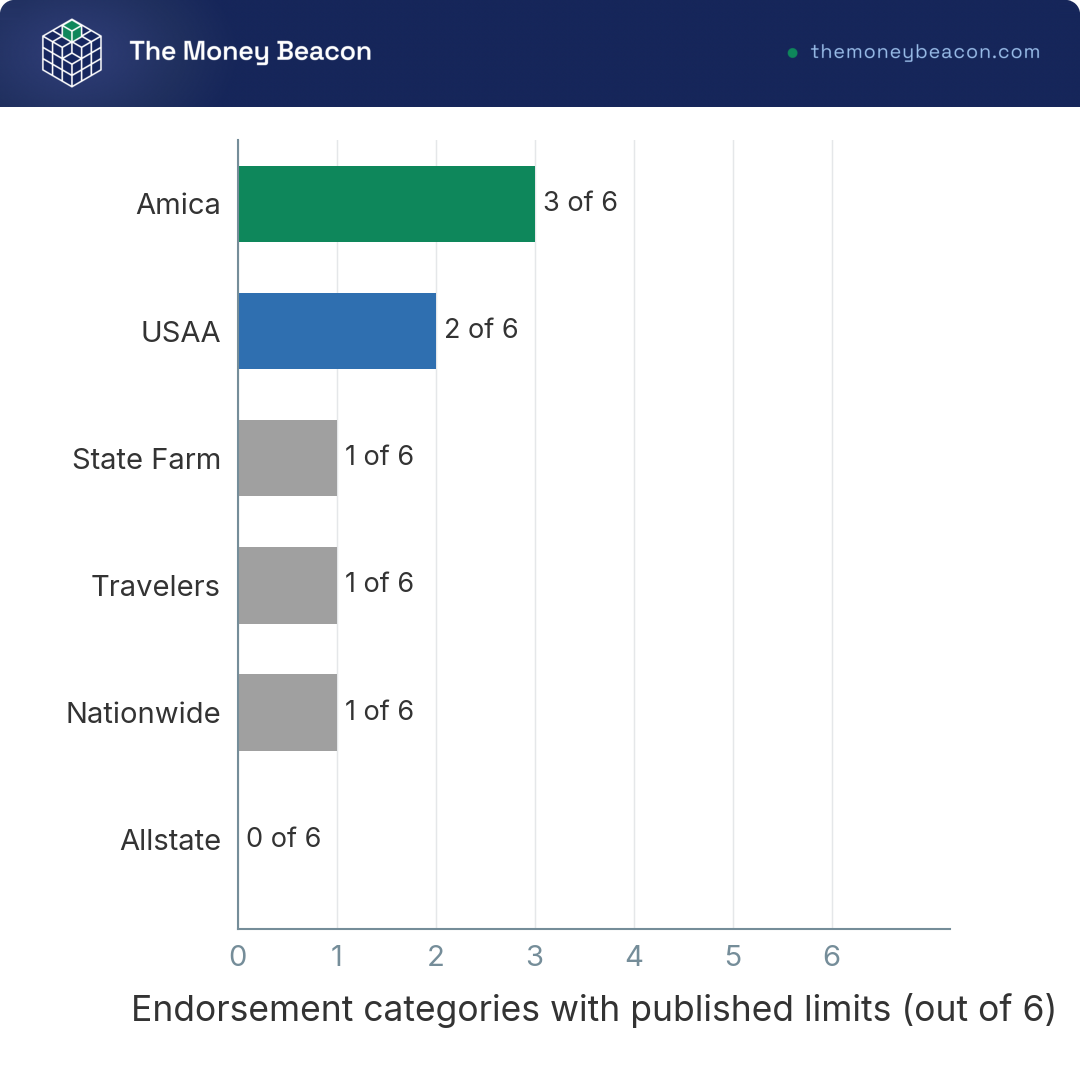
Before you get to the criteria table, look at how many of the six endorsement categories have a stated limit on each carrier’s own site. Amica publishes the most, three of six, and Allstate none at all.
The caveat matters more than the ranking: a carrier that publishes more is easier to compare on paper, and that says nothing about coverage quality, claims service or price. Use it to build a shortlist, then get the missing numbers in writing, starting with the sewer and drain backup endorsement, where $5,000 against $25,000 decides a finished basement.
8.3 The full comparison, all six carriers on every criterion
The table below carries every comparative claim in this homeowners insurance comparison, with every carrier on every row and the same three labels used in section 1.
| Criterion | State Farm | Allstate | USAA | Travelers | Nationwide | Amica |
|---|---|---|---|---|---|---|
| Policy form published | Not published | Not published | Not published | HO3 described generically | Not published | HO5 and HO3 named |
| Contents settlement, base | Actual cash value | Actual cash value or Reimbursement Provision | Replacement cost, standard | Actual cash value | Replacement cost via holdback | Actual cash value (Essential), replacement cost (Advantage, Signature) |
| Roof settlement published | Not published | Not published | Unconfirmed | Unconfirmed | Not published | Actual cash value, replacement cost, replacement cost by tier |
| Dwelling cushion above Coverage A | Not published; inflation adjustment only | Not published | Plus 25%, 95% insurance to value required | Offered; typical percentages published (25%, 50%, 100%), own figure not named | Up to 2x the limit | 130% / 150%; plus 30% Platinum Choice |
| Coverage B published | 10% | Unconfirmed | Unconfirmed | 10% | Unconfirmed | Unconfirmed |
| Coverage C published | Unconfirmed | Unconfirmed | Unconfirmed | 50%, 50% to 70% rule | Unconfirmed | 40% / 50% / 75% |
| Coverage D published | Unconfirmed | Unconfirmed | Unconfirmed | 20%, range 20% to 30% | Unconfirmed | Unconfirmed |
| Water backup sublimit | Unconfirmed | Not published | Unconfirmed | Unconfirmed | Not published | $5,000 / $25,000 |
| Identity theft limit | $50,000, $25 per year | Not published | Up to $5,000, included | $25,000, no deductible | Not published | $15,000 plus monitoring |
| Equipment breakdown | Unconfirmed | Unconfirmed | Unconfirmed | Unconfirmed | $39 to $45 per year, $50,000 cap | Offered, limit unconfirmed |
| Deductible options published | Not published | Not published | Not published | Unconfirmed | Not published | Unconfirmed, quote-flow gated |
| Wind or hail deductible published | Not published | Not published | Not published | Form published generically | Not published | Existence published, amounts unconfirmed |
| Credit-based insurance score disclosed | Not published | Yes, on its credit page | Not published | Publishes non-use in Maryland | Not published | Not published |
| Max published bundling value | $1,429 average savings | Percentage not published | 10% | Percentage not published | 20% (Texas page) | 30% |
| Claims-free discount window | 3 to 5 years | Unconfirmed | 5 years or more, up to 15% | Unconfirmed | Not published | 3 years |
| Deductible-softening feature | None published | Deductible Rewards up to $500; Claim RateGuard; only the highest deductible applies | Military uniform and war-loss waivers | None published | Fire total loss waives up to $5,000 (tenured) | $75,000 loss waives $2,500; single loss deductible; claim forgiveness up to $5,000 |
| Distribution | Captive agents | Captive agents | Direct, members only | 15,000+ independent agents | Agents plus phone | Direct writer |
| Published state footprint | Unconfirmed | 50 states plus DC | Unconfirmed | No online quote in AK, FL, HI, LA | 43 states plus DC | Authorized in all states; homeowners footprint unconfirmed |
| Eligibility restriction | None published | None published | Military service or family relationship | None published | None published | None published |
| Claims tools published | App, web, 800-SF-Claim; Select Service network | MyClaim, Good Hands network, mobile claims centers | App, web, My Claims Center; Wildfire Response Program in 15 states | MyTravelers, status tracking, upload, provider locator | Claims tracker | Contractor Connection, 2,000+ contractors |
| Published claims service standard | 2 to 3 business hours to contractor contact (Select Service) | None published | None published | At least 6 months to file a property claim | Not published | Not published |
| AM Best rating, by writing entity | A+ (Superior) national; B (Fair) in California | A+ (Superior) | A++ (Superior) | A++ (Superior) | A (Excellent), pool lead | A+ (Superior) |
Data current as of August 2026.
Don’t read the whole grid. Five rows decide most quotes: contents settlement basis, roof settlement basis, the cushion above Coverage A, deductible disclosure, and the highest published bundling value. And four of the six publish no deductible options at all.
8.4 The verdict at a glance
Treat the table below as a shortlist generator, not a ruling. And the ordering can shift in California, Massachusetts and Maryland, where credit-based insurance scores are prohibited in home rating.
| Reader profile | First choice | Second choice | Why, in one line |
|---|---|---|---|
| Military member, veteran, or eligible family | USAA | Amica | Replacement cost on contents as standard, six published discount percentages, uniform and war-loss deductible waivers |
| Home and auto bundler | Amica | State Farm | Highest published bundle ceiling at 30%, plus a single loss deductible when one event hits both |
| Older home, aging roof | Amica (Advantage or Signature) | Nationwide | The only published roof settlement schedule; Nationwide adds ordinance or law and priced equipment breakdown |
| Wants the largest rebuild cushion | Nationwide | Amica Signature | Up to two times the dwelling limit, versus 150% at Amica Signature |
| Prior CLUE claim in the last 3 years | Allstate | Amica | Claim RateGuard protects one claim every five years; Deductible Rewards keeps accruing. Amica’s Home Claim Forgiveness needs five years of continuous prior coverage |
| Coastal or hail-belt, percentage wind deductible | Travelers (outside AK, FL, HI, LA) | State Farm | Travelers publishes the percentage-deductible form; State Farm publishes wind mitigation and impact-resistant-roof discounts |
| Price-first shopper | Run all six, same day | none | No carrier publishes a rate; the only cheap carrier is the one cheapest for that address on that day |
| Wants a local agent to call after a loss | State Farm | Allstate | Captive local agent plus a named repair network with published response times |
| Wants an independent agent shopping the market | Travelers | Nationwide | 15,000-plus independent agents; California requires the agent route anyway |
| Holds significant jewelry, art, or collectibles | State Farm | Travelers | Personal Articles Policy pays replacement cost with generally no deductible |
| Owns a high-value home above $1.5 million | USAA (if eligible) | Amica Platinum Choice | USAA routes above $1.5 million to a dedicated high-value product |
| Lives in a wildfire state (AZ, CA, CO, ID, MT, NV, NM, ND, OK, OR, SD, TX, UT, WA, WY) | USAA (if eligible) | State Farm (California) | Wildfire Response Program auto-enrolls eligible homes at no extra cost; State Farm publishes wildfire mitigation percentages in California |
Data current as of August 2026.
8.5 If you qualify through military service
If you meet the USAA eligibility requirements, quote USAA first. Amica is the sensible second quote.
One thing before you call: plenty of people rule themselves out too early, so check eligibility through a parent or spouse first.
8.6 If you are bundling home and auto
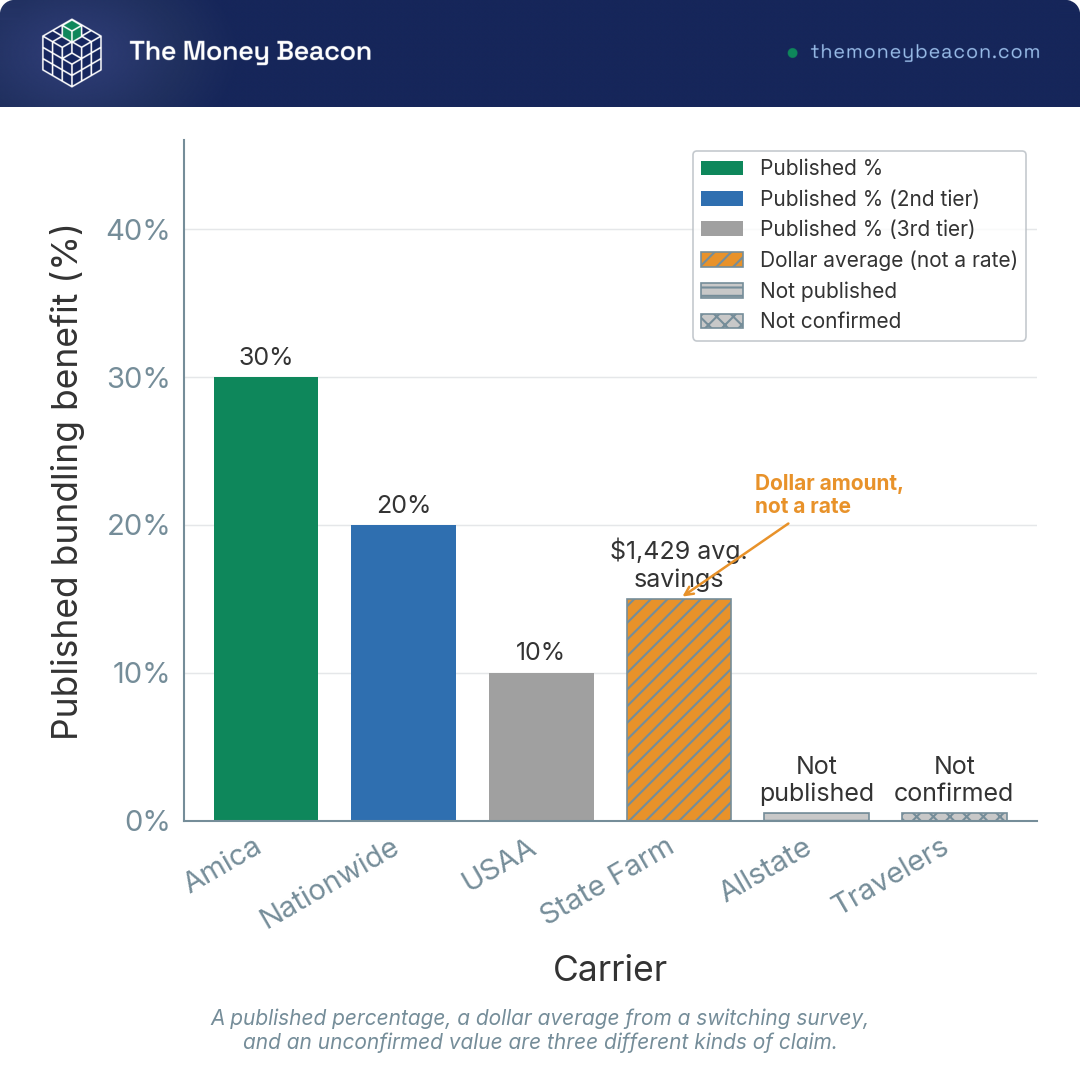
A multi policy discount on home and auto is the saving everyone quotes, and it’s where the numbers stop being comparable. So never weigh an advertised dollar average against a published percentage. Amica’s up to 30 percent is a real percentage. State Farm’s $1,429 is a self-reported switching survey.
Amica first, State Farm second, and ask Amica to confirm the Single Loss Deductible applies. Bundled savings vary by state, so ask for your own state’s number in dollars. And before you move the auto policy for a percentage, compare the policy itself, not just the discount.
8.7 If your home or roof is getting older
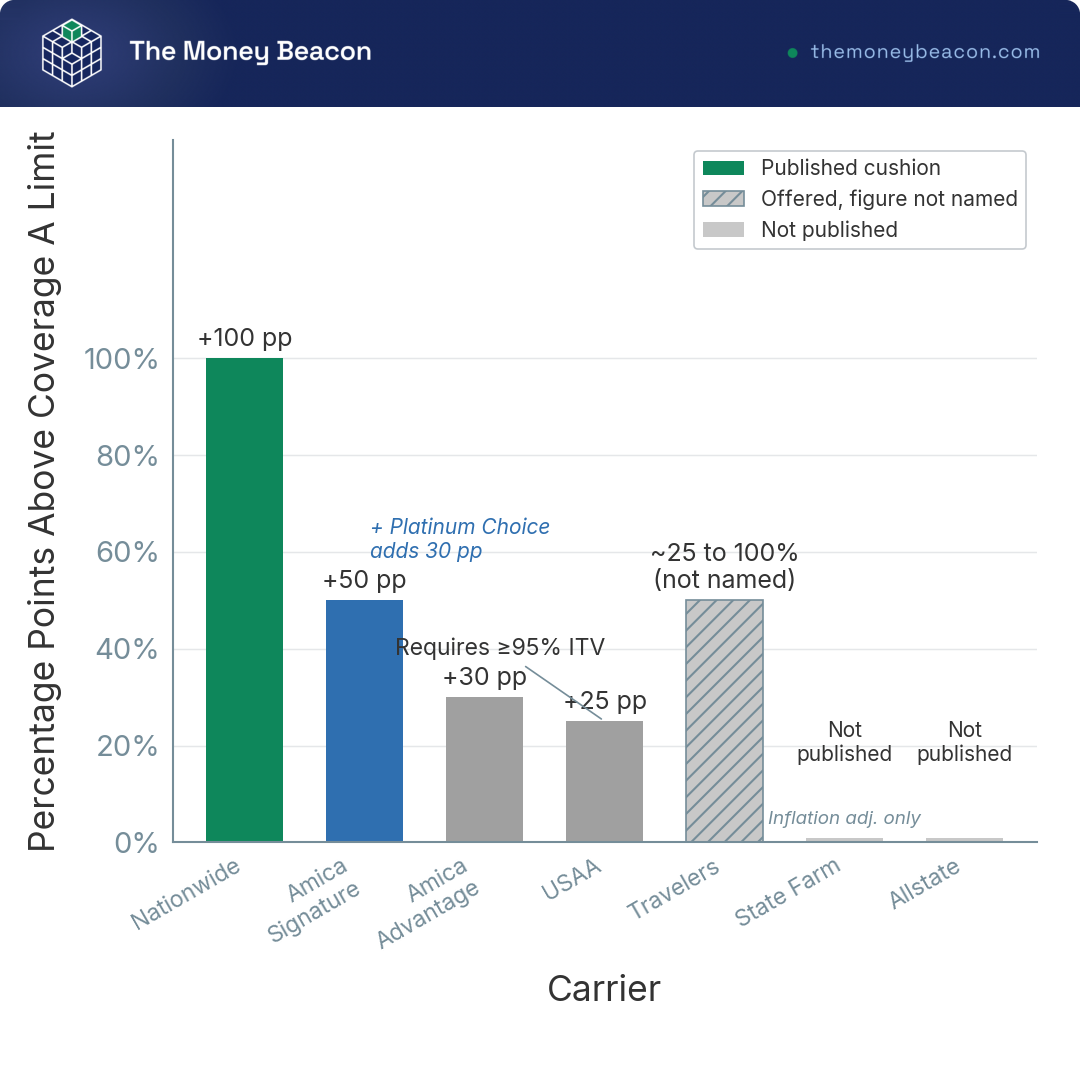
This reader is buying settlement basis and rebuild cushion, not premium. Amica on Advantage or Signature is the first quote, because it’s the only one of the six publishing a roof settlement basis. Nationwide is second.
Set Coverage A at 100 percent of your rebuild cost estimate first, then ask for the cushion on top. Automatic inflation adjustment is a floor, not a substitute.
8.8 If you live on the coast, in the hail belt, or in a wildfire state
Availability closes carriers before price does. Travelers doesn’t quote online in Alaska, Florida, Hawaii or Louisiana. Nationwide’s directory omits seven states.
If Travelers will write your coastal or hail-belt address, it’s the first quote, because it publishes that a deductible may be a dollar amount or a percentage. State Farm is second. In a wildfire state, an eligible household should quote USAA first. In California, an owner who can document mitigation should quote State Farm, at 4 percent to 18 percent for an IBHS Wildfire Prepared Home and 2 percent to 5 percent for NFPA Firewise USA.
Ask for the wind and hail deductible in dollars, not percent, on the same call as the premium. And if no voluntary carrier will write the address, ask about your state’s FAIR Plan, the insurer of last resort.
8.9 If you are shopping on price, including with a claim on your CLUE report
Pull your CLUE report before you start, because all six read the same LexisNexis file.
Then guard against the four ways a cheaper quote is just a smaller one: a 40 percent Coverage C against a 50 percent one, actual cash value contents, an actual cash value roof, and a $2,500 deductible against a $1,000 one.
For a household with a claim behind it, Allstate is the first quote, for Deductible Rewards and Claim RateGuard, and Amica the second, though its claim forgiveness needs five years of continuous prior coverage.
Conclusion
Home insurance is the rare purchase where the price stays hidden until the last step. Not one of the six carriers in this comparison publishes a rate. Every premium is built from inputs specific to your house and your record. That’s annoying, but it isn’t a dead end. Each one publishes part of its contract, and the contract decides whether a claim check covers your roof or half of it.
So compare what’s on the record first. How the policy pays out on contents and the roof. How much rebuild cushion a carrier adds above your dwelling limit. Which endorsements come with a dollar figure, and which discounts come with a real percentage, not a slogan. Read financial strength on the legal entity named on your declarations page, not the brand in the ads.
Then there’s the part many homeowners work out too late. A cheaper quote is usually a smaller one. Four levers do most of that shrinking. None of them shows up on the premium line, and all four are checkable in writing before you bind.
Here’s your step for this week. Book a rebuild cost estimate and pull your CLUE report. One is the number every quote depends on, the other is the loss history all six carriers read. Then pick a single day, freeze the inputs you control, and take the eligible carriers one at a time. Vary the carrier and nothing else, or you end up with six quotes that only look different.
Bundling comes up in almost every home quote, and the biggest published discounts ask for more than home and auto. So read how term and whole life policies actually differ before you add one just to reach a percentage. And since your lender collects the premium through escrow, look at what a refinance would change about the monthly payment too.
FAQ
What is the best way to compare homeowners insurance?
Fix everything except the carrier, then quote all six the same day. Lock in your Coverage A rebuild estimate, your contents settlement basis (replacement cost or actual cash value), and both deductibles before you request a single quote. Compare declarations pages before premiums. Travelers shows why: on a $500,000 dwelling limit, its typical figures give $50,000 of other structures and $250,000 of personal property, so a cheaper quote using smaller percentages is just a smaller policy.
How much should home insurance be on a $400,000 house?
No carrier publishes a rate, so any single premium number is a guess. What you can size up is the shape of the coverage. A $400,000 Coverage A limit typically includes about $40,000 of other structures at the 10% default State Farm and Travelers both publish, and $160,000 to $300,000 of personal property depending on the carrier’s percentage. The deductible matters more: a flat $1,000 deductible against a 2% wind deductible is $1,000 versus $8,000 on the same hailstorm.
What is the difference between actual cash value and replacement cost on a roof?
Depreciation. On a $30,000 roof replacement with a $2,500 deductible, replacement cost pays $27,500 regardless of the roof’s age. Actual cash value pays less as the roof ages: roughly $21,500 at five years, $13,100 at twelve, and $5,900 at eighteen, a shortfall of more than $21,000 by year eighteen. Amica is the only one of these six carriers publishing its roof settlement basis: Essential settles at actual cash value, Advantage and Signature pay full replacement cost.
How does a percentage wind, hail, or hurricane deductible work?
It replaces your flat dollar deductible for that one peril with a percentage of your dwelling limit. Travelers confirms the mechanic on its own site: a deductible “may be either a dollar amount or a percentage,” and some policies carry more than one. On a $400,000 dwelling limit, a 1% wind deductible is $4,000, a 2% deductible is $8,000, and a 5% hurricane deductible is $20,000. None of the six publishes its own percentage bands online, so get that number off your quote.
Who qualifies for USAA homeowners insurance?
USAA publishes its eligibility categories directly: honorable service in the US armed forces, current enlistment or commissioning, an active commission in NOAA or the US Public Health Service, federal agency employment, or a parent or spouse who served or is a USAA member. National Guard, Reserve members, cadets, midshipmen, and officer candidates qualify too. It’s a hard gate, not a pricing tier. The same rule governs USAA’s auto policies, covered in our auto insurance comparison.
Does homeowners insurance cover flood, earthquake, or sewer backup?
No, not as standard coverage on any of these six policies. Allstate publishes the plainest exclusion list: flood, earth movement, water backup, wear and tear, and losses while a home is vacant or under construction. Flood is bought separately through the NFIP, capped at $250,000 for the building and $100,000 for contents, with a 30-day wait unless bought at closing, a timeline our guide for first-time buyers covers. Earthquake is an endorsement, as at USAA. Sewer backup carries its own sublimit, ranging from $5,000 to $25,000 at Amica.
What is a CLUE report, and how does an old claim change my quote?
CLUE, the Comprehensive Loss Underwriting Exchange, is a property loss-history database every carrier pulls at quote. Claims-free discounts run against it with multi-year lookbacks: State Farm typically checks three to five years, Amica checks three years, and USAA needs five years or more for its claims-free discount of up to 15%. Pull your own report before you shop and dispute anything wrong. All six carriers read the same file, so one miscoded loss can wipe out your discount everywhere at once.
Is an HO-5 policy worth the upgrade over a standard HO-3?
It depends on how much of your belongings would need explaining after a loss. HO-3 covers your home’s structure broadly but covers personal property only against named causes of loss, so you’d have to prove what happened. HO-5 extends that broad coverage to belongings too, shifting the burden of proof to the carrier. Amica is the only one of these six naming its forms, describing HO5 as giving all the protection of a standard HO3 “plus many additional and extended coverages.” Neither form covers flood or earthquake.



Comments
Questions and corrections welcome. We read everything.